Adhyaya 29
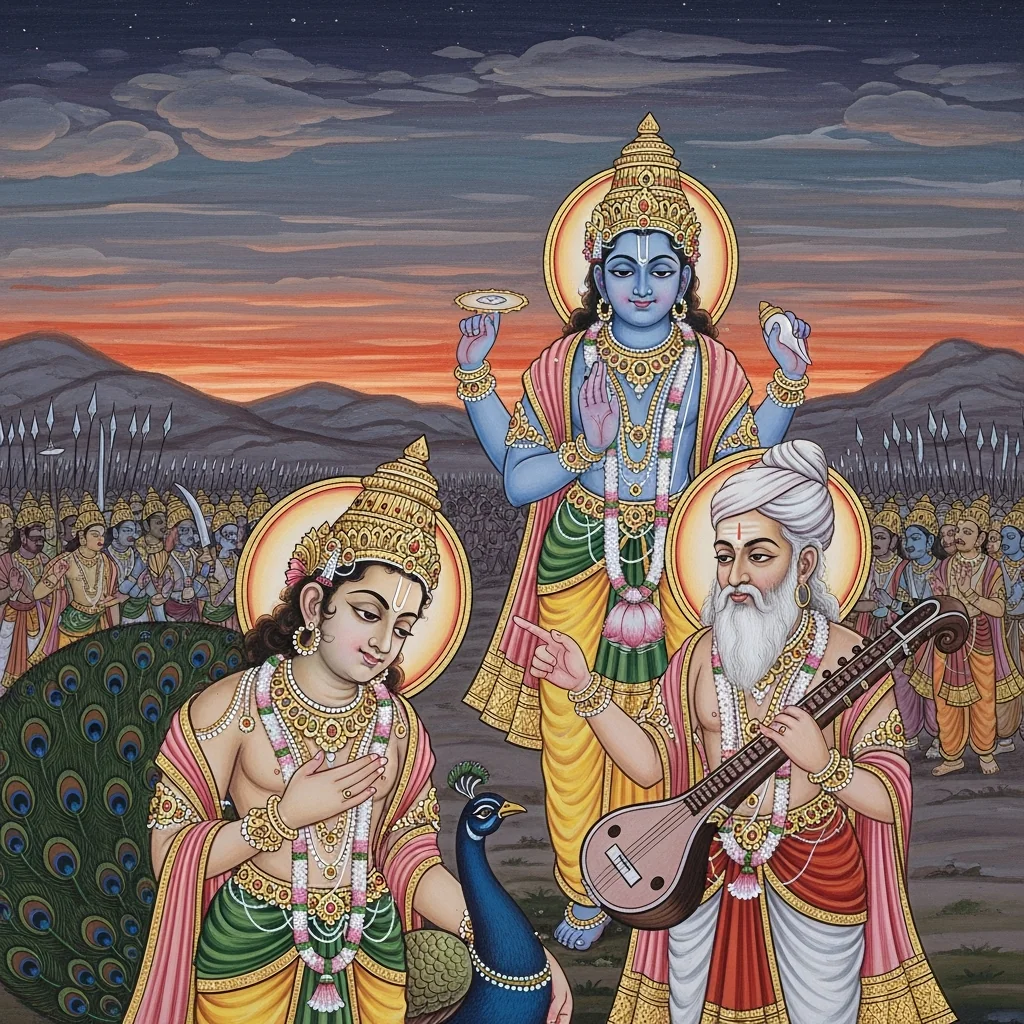
This chapter unfolds a vast caturaṅga war between devas and asuras, rendered in swift battlefield images of severed limbs and fallen heroes. Mucukunda, son of Māndhātṛ, confronts the asura chief Tāraka and presses toward a decisive, escalating violence, even nearing the use of the Brahmāstra. Nārada intervenes with a dharmic constraint: Tāraka is not to be slain by a human, and the power to end him must be redirected to the divinely appointed Kumāra, Śiva’s son. As the struggle intensifies, Vīrabhadra and Śiva’s gaṇas engage Tāraka in a fierce duel, while Nārada repeatedly urges restraint, setting martial fervor against cosmic ordinance. The narrative then turns as Viṣṇu explicitly designates Kṛttikā-suta/Kumāra as the only possible slayer. Kumāra first appears as an observer, uncertain in distinguishing friend from foe, and Nārada supplies the account of Tāraka’s austerities and conquests. The chapter closes with Tāraka’s boastful challenge and his mobilization to fight Kumāra, preparing the sanctioned resolution of adharma through the proper divine instrument.
Shlokas
Verse 1
लोमश उवाच । उभे सेने तदा तेषां सुराणां चामरद्विषाम् । अनेकाश्चर्यसंवीते चतुरंगबलान्विते । विरेजतुस्तदान्योऽन्यं गर्जतो वांबुदागमे
Lomaśa said: Then those two armies—of the gods and of their enemies—arrayed in many wondrous formations and furnished with the fourfold forces, shone against one another like thunderclouds roaring at the coming of the rains.
Verse 2
एतस्मिन्नन्तरे तत्र वल्गमानाः परस्परम् । देवासुरास्तदा सर्वे युयुधुश्च महाबलाः
In the meantime, there—charging at one another—the gods and the asuras, all of great strength, engaged in battle.
Verse 3
युद्धं सुतुमुलं ह्यासीद्देवदैत्यसमाकुलम् । रुण्डमुण्डांकितं सर्वं क्षणेन समपद्यत
The battle was utterly tumultuous, crowded with gods and daityas; in a moment, everything became marked by severed trunks and heads.
Verse 4
भूमौ निपतितास्तत्र शतशोऽथ सहस्रशः । केषांचिद्बाहविश्छिन्नाः खड्गपातैः सुदारुणैः
There, hundreds—indeed thousands—fell upon the ground; for some, their arms were severed by the most dreadful strokes of swords.
Verse 5
मुचुकुंदो हि बलवांस्त्रैलोक्येऽमितविक्रमः
For Mucukunda was mighty, of immeasurable prowess throughout the three worlds.
Verse 6
तारको हि तदा तेन मुचुकुंदेन धीमता । खड्गेन चाहतास्तत्र सर्वप्राणेन वक्षसि । प्रसह्य तत्प्रहारं च प्रहसन्वाक्यमब्रवीत्
Then Tāraka, struck there on the chest with full force by the wise Mucukunda’s sword, endured that blow—and, laughing, spoke these words.
Verse 7
किं रे मूढ त्वया चाद्य कृतमस्ति बलादिदम् । न त्वया योद्धुमिच्छामि मानुषेणैव लज्जया
“What, you fool—what have you accomplished today by this show of strength? I do not even wish to fight with you, out of shame at battling a mere human.”
Verse 8
तारकस्य वचः श्रुत्वा मुचुकुंदोऽभ्यभाषत । मया हतोऽसि दैत्येंद्र नान्यो भवितुमर्हसि
Hearing Tāraka’s words, Mucukunda replied: “You have been slain by me, O lord of daityas; it cannot be otherwise.”
Verse 9
दृष्ट्वा मे खड्गसंपातं न त्वं तिष्ठसि चाग्रतः । त्वां हन्मि पश्य मे शौर्यं दैत्यराज स्थिरो भव
“Seeing the sweep of my sword, you still do not stand before me! I will strike you down—behold my valor, O king of the Dānavas. Stand firm!”
Verse 10
एवमुक्त्वा तदा वीरो मुचुकुंदो महाबलः । यावज्जघान खड्गेन तावच्छक्त्या समाहतः । मांधातुस्तनयस्तत्र पपात रणमंडले
Thus having spoken, the mighty hero Mucukunda struck with his sword; at that very moment he was smitten by the Śakti-weapon. There, upon the field of battle, the son of Māndhātṛ fell.
Verse 11
पतितस्तत्क्षणादेव चोत्थितः परवीरहा
Though fallen, he rose again that very instant—the slayer of enemy heroes.
Verse 12
स सज्जमानोतिमहाबलो वै हंतुं तदा दैत्यपतिं च तारकम् । ब्रह्मास्त्रमुद्यम्य धनुर्गृहीत्वा मांधातृपुत्रो भुवनैकजेता
Then that exceedingly mighty one—the son of Māndhātṛ, conqueror of the worlds—prepared to slay Tāraka, lord of the Dānavas; taking up his bow, he raised the Brahmā-weapon, the Brahmāstra.
Verse 13
स तारकं योद्धकामस्तरस्वी रुषान्वितोत्फुल्लविलोचनो महान् । स नारदो ब्रह्मसुतो बभाषे तदा नृवीरं मुचुकुंदमेवम्
As he, eager to fight Tāraka, surged forward—great, his eyes wide with wrath—then Nārada, the son of Brahmā, addressed that human hero Mucukunda thus.
Verse 14
न तारको हन्यते मानुषेण तस्मादेतन्मा विमोचीर्महास्त्रम्
“Tāraka cannot be slain by a human; therefore, do not release this great weapon.”
Verse 15
निशम्य वचनं तस्य देवर्षेर्नारदस्य च । मुचुकुंद उवाचेदं भविता कोऽस्य मारकः
Hearing the words of the divine seer Nārada, Mucukunda said: “Who, then, will be his slayer?”
Verse 16
तदोवाच महातेजा नारदो दिव्यदर्शनः । एनं हंता कुमारश्च कुमारोऽयं शिवात्मजः
Then the radiant Nārada, of divine vision, said: “Kumāra will slay him—this Kumāra is the son of Śiva.”
Verse 17
तस्माद्भवद्भिः स्थातव्यमैकपद्येन युध्यताम् । तिष्ठ त्वं चायतो भूत्वा मुचुकुंद महामते
“Therefore, you all should hold your ground and fight, standing firm as one. And you, Mucukunda of great resolve—stand ready, composed.”
Verse 18
निशम्य वाक्यं च मनोहरं शुभं ह्युदीरितं तेन महाप्रभेण । सर्वे सुराः शांतिपरा बभूवुस्तेनैव साकं नृवरेणयत्नात्
Hearing those auspicious and pleasing words spoken by that greatly radiant sage, all the gods became inclined toward peace—joining with that best of men through earnest effort.
Verse 19
ततो दुंदुभयो नेदुः शंखाश्च कृतनिश्चयाः । ताडिता विविधैर्वाद्यैः सुरासुरसमन्वितैः
Then the kettle-drums resounded, and the conches—blown with firm resolve—were sounded, as many kinds of instruments were struck amid the assembled Devas and Asuras.
Verse 20
जगर्जुरसुरास्तत्र देवान्प्रति कृतोद्यमाः । शिवकोपोद्भवो वीरो वीरभद्रो रुषान्वितः
There the Asuras roared, making ready to assail the Devas; and Vīrabhadra—the hero born of Śiva’s wrath—stood forth, filled with fury.
Verse 21
गणैर्बहुभिरासाद्य तारकं च महाबलम् । मुचुकुंदं पृष्ठतः कृत्वा तथैव च सुरानपि
With many Gaṇas they closed around the mighty Tāraka; and setting Mucukunda to the rear—along with the Devas as well—they pressed in for the encounter.
Verse 22
तदा ते प्रमथाः सर्वे पुरस्कृत्य कुमारकम् । युयुधुः संयुगे तत्र वीरभद्रादयो गणाः
Then all those Pramathas, setting the divine Kumāra at the forefront, fought there in that battle—Vīrabhadra and the other Gaṇas.
Verse 23
त्रिशूलैरृष्टिभिः पाशैः खड्गैः परशुपाट्टिशैः । निजघ्नुः समरेन्योन्यं सुरासुरविमर्द्दने
With tridents, spears, nooses, swords, axes, and battle-axes, they struck one another in the fight—amid the crushing clash of Devas and Asuras.
Verse 24
तारको वीरभद्रेण त्रिशूलेन हतो भृशम् । पपात सहसा तत्र क्षण मूर्छापरिप्लुतः
Struck fiercely by Vīrabhadra with a trident, Tāraka suddenly fell there, overwhelmed for a moment by swoon and stupor.
Verse 25
उत्थाय च मुहूर्त्ताच्च तारको दैत्यपुंगवः । लब्धसंज्ञो बलाविष्टो वीरभद्रं जघान च
After a brief while, Tāraka—the foremost of the Daityas—rose again and regained consciousness; filled with strength, he struck Vīrabhadra in return.
Verse 26
स शक्तिं च महातेजा वीरभद्रो हि तारकम् । त्रिशूलेन च घोरेण शिवस्यानुचरो बली
That mighty, radiant Vīrabhadra—Śiva’s powerful attendant—assailed Tāraka with the śakti spear-weapon and also with a fearsome trident.
Verse 27
एवं संयुध्यमानौ तौ जघ्नतुश्चेतरेतरम् । द्वंद्वयुद्धं सुतुमुलं तयोर्जातं महात्मनोः
Thus, as they fought on, the two struck each other again and again; between those two mighty ones, a fiercely tumultuous duel arose.
Verse 28
सुरास्तत्रैव समरे प्रेक्षकाह्यभवंस्तदा । तयोर्भेरीमृदंगाश्च पटहानकगोमुखाः
In that very battle, the Devas then became mere onlookers; and for those two, war-drums and mṛdaṅgas resounded—along with paṭahas, ānakas, and gomukhas.
Verse 29
तथा डमरूनादेन व्याप्तमासीज्जगत्त्रयम् । तेन घोषेण महता युद्यमानौ महाबलौ
Then, with the booming sound of the ḍamaru drum, all the three worlds were filled; amid that mighty roar, the two immensely powerful warriors fought on.
Verse 30
शुशुभातेऽतिसंरब्धौ प्रहारैर्जरीकृतौ । अन्योन्यमभिसंरब्धौ तौ बुधांगारकाविव
Fiercely enraged and worn down by blows, they still shone in their combat—locked against one another like Mercury and Mars in close encounter.
Verse 31
नारदेन तदा ख्यातो वीरभद्रस्य तद्वधः । न रोचते च तद्वाक्यं वीरभद्रस्य वै तदा
At that time Nārada spoke of that outcome—of Vīrabhadra’s death; but those words did not please Vīrabhadra then.
Verse 32
नारदेन यदुक्तं हि तारकस्य वधं प्रति । यथा रुद्रस्तथा सोऽपि वीरभद्रो महाबलः
For what Nārada had said concerning the slaying of Tāraka—Vīrabhadra too is mighty, even as Rudra is.
Verse 33
एवं प्रयुध्यमानौ तौ जघ्नतुश्चेतरेतरम् । अन्योन्यं स्वर्द्धमानौ तौ गर्जंतौ सिंहयोरिव
Thus battling, those two struck each other again and again; rising against one another, they roared like two lions.
Verse 34
एवं तदा तौ भुवि युध्यमानौ महात्मना ज्ञानवतां वरेण । स वीरभद्रो हि तदा निवारितो वाक्यैरनेकैरथ नारदेन
While the two fought thus upon the earth, the great-souled Nārada—foremost among the wise—checked Vīrabhadra then, restraining him with many words of counsel.
Verse 35
तथा निशम्य तद्वाक्यं नारदस्य मुखोद्गतम् । वीरभद्रो रुषाविष्टो नारदं प्रत्युवाच ह
Having heard those words spoken from Nārada’s mouth, Vīrabhadra—seized by wrath—replied to Nārada.
Verse 36
तारकं च वधिष्यामि पश्य मेऽद्य पराक्रमम् । आनयंति च ये वीराः स्वामिनं रणसंसदि । ते पापिनो ह्यधर्मिष्ठा विमृशंतिरणं गताः
‘I shall also slay Tāraka—behold my valor today! And those warriors who bring their lord into the assembly of battle—those sinful, most unrighteous men, once they have entered war, begin to deliberate.’
Verse 37
भीरवस्ते तु विज्ञेया न वाच्यास्ते कदाचन । त्वं न जानासि देवर्षे योधानां च प्रतिक्रियाम्
‘They are to be known as cowards indeed; they should never be spoken of. O divine seer, you do not understand the warriors’ way of response and conduct.’
Verse 38
मृत्युं च पृष्ठतः कृत्वा रणभूमौ गतव्यथाः । शस्त्राशस्त्रैर्भिन्नगात्राः प्रशस्ता नात्र संशयः
‘With death set behind them, they go upon the battlefield without anguish; though their limbs be torn by weapons and missiles, they are praised—of this there is no doubt.’
Verse 39
इत्युक्त्वा चावदद्देवान्वीरभद्रो महाबलः । श्रुण्वंतु मम वाक्यानि देवा इन्द्रपुरोगमाः
Having spoken thus, the mighty Vīrabhadra addressed the gods: “Let the devas, led by Indra, now hear my words.”
Verse 40
अतारकां महीं चाद्य करिष्ये नात्र संशयः
“Today I shall make the earth free of Tāraka—of this there is no doubt.”
Verse 41
अथ त्रिशूलमादाय तारकेण युयोध सः । वृषारूढैरनेकैश्च त्रिशूलवरधारिभिः
Then, taking up the trident, he fought with Tāraka—together with many trident-bearing warriors mounted upon bulls.
Verse 42
कपर्द्दिनो वृषांकाश्च गणास्तेतिप्रहारिणः । वीरभद्रं पुरस्कृत्य वीरभद्रपराक्रमाः
Those gaṇas—wearing matted locks and bearing the bull-emblem—struck with the trident; placing Vīrabhadra at their forefront, they advanced with Vīrabhadra’s own valor.
Verse 43
त्रिशूलधारिणः सर्वे सर्वे सर्पागभूषणाः । सचंद्रशेखराः सर्वे जटाजूटविभूषिताः
All of them bore tridents; all were adorned with serpents; all were crowned with the moon, and all were ornamented with piled matted locks.
Verse 44
निलकण्ठा दशभुजाः पञ्चकत्त्रास्त्रिलोचनाः । छत्रचामरसंवीताः सर्वे तेऽत्युग्रबाहवः
Blue-throated, ten-armed, five-faced, and three-eyed—attended by parasols and fly-whisks—each of them possessed exceedingly fierce arms.
Verse 45
वीरभद्रं पुरस्कृत्य सर्वे हरपराक्रमाः । युयुधुस्ते तदा दैत्यास्ताकासुरजीविनः
With Vīrabhadra set at their head, all those of prowess like Hara fought then against the daityas who lived under the power of Tārakāsura.
Verse 46
पुनः पुनस्तैश्च तदा बभूवुर्गणैर्जितास्ते ह्यसुराः पराङ्मुखाः । बभूव तेषां च तदातिसंगरो महाभयो दैत्यवरैस्तदानीम्
Again and again the gaṇas overcame them, and those asuras turned back in retreat. Then, among the foremost daityas, a terrible and fearsome clash arose at that time.
Verse 47
अमृष्यमाणाः परमास्त्रकोविदैस्ततो गणास्ते जयिनो बभूवुः । गणैर्जितास्ते ह्यसुराः पराभवं तं तारकं ते व्यथिताः शशंसुः
Unable to endure it, those gaṇas—skilled in the highest weapons—became victorious. Defeated by the gaṇas, the asuras, distressed, reported that defeat to Tāraka.
Verse 48
विनाम्य चापं हि तथा च तारकः स योद्धुकामः प्रविवेश सेनाम् । यथा झषो वै प्रविवेश सागरं तथा ह्यसौ दैत्यवरो महात्मा
Then Tāraka, bending his bow and eager to fight, entered the army—just as a great fish enters the ocean—so indeed did that foremost daitya, the mighty one.
Verse 49
गणैः समेतो युयुधे तदानीं स वीरभद्रो हि महाबलश्च । सर्वान्सुरांश्चेंद्रमुखान्महाबलस्तथा गणान्यक्षपिशाचगुह्यकान् । स दैत्यवर्योऽतिरुषं प्रविष्टः संमर्दयामास महाबलो हि
Then Vīrabhadra, of immense strength and accompanied by the gaṇas, fought at that time. That mighty one crushed the gods led by Indra, and also the hosts of yakṣas, piśācas, and guhyakas. The foremost of the daityas, seized by fierce wrath, ground them down in battle—for he was truly of great power.
Verse 50
ततः समभवद्युद्धं देवदानवसंकुलम् । देवदानवयक्षाणां सन्निपातकरं महत्
Then a great battle arose, thronged with devas and dānavas—an immense clash that drew devas, dānavas, and yakṣas into one tumultuous encounter.
Verse 51
तथा वृषा गर्जमाना अश्वाञ्जघ्नुश्च सादिभिः । रथिभिश्च रथाञ्जघ्नुः कुंजरान्सादिभिः सह
So too, the bulls, bellowing loudly, struck down horses along with their riders; and the charioteers shattered chariots, and elephants as well—together with those mounted upon them.
Verse 52
वृषारूढौः सरथैस्ते च सर्वे निष्पाटिता ह्यसुराः पोथिताश्च
Those asuras—mounted upon bulls and borne in their chariots—were all driven back and smashed down, struck and broken in the fray.
Verse 53
क्षयं प्रणीता बहवस्तदानीं पेतुः पृथिव्यां निहताश्च केचित् । केचित्प्रविष्टा हि रसातलं च पलायमाना बहवस्तथैव
Many were brought to destruction then; some, slain, fell upon the earth. Some indeed plunged into Rasātala, and many others fled away in fear.
Verse 54
केचिच्च शरणं प्राप्ता रुद्रानुचरकिंकरान् । एवं नष्टं तदा सैन्यं विलोक्यासुरपालकः । तारको हि रुषाविष्टो हंतुं देवगणान्ययौ
Some took refuge with the servants who follow Rudra. Seeing his army thus ruined, Tāraka, the protector of the asuras, filled with rage, advanced to slay the hosts of the gods.
Verse 55
भुजानामयुतं कृत्वा दैत्यराजो हि तारकः । आरुह्य सिंहं सहसा घातयामास तान्रणे
Tāraka, king of the Daityas, having mustered a host of warriors, mounted a lion and, all at once, struck them down in the battle.
Verse 56
दंशितेन च सिंहेन वृषाः केचिद्विदारिताः । तथैव तारकेणैव घातिता बहवो गणाः
By the lion’s fierce biting, some bulls were torn apart; and likewise, by Tāraka himself, many Gaṇas were slain.
Verse 57
एवं कृतं तदा तेन तारकेण महात्मना । सर्वेषामेव देवानामशक्यस्तारको महान्
Thus, at that time, did Tāraka, the great-souled one, act. For all the gods, the mighty Tāraka was indeed impossible to overcome.
Verse 58
जातस्तदा महाबाहुस्त्रैलोक्यक्षयकारकः । तारकस्यानुगा दैत्या अजेया बलवत्तराः
Then there arose a mighty-armed one, a cause of ruin for the three worlds. The Daityas who followed Tāraka were unconquerable, even more powerful than before.
Verse 59
महारूढा दंशिताश्च करालास्ते प्रहारिणः । तै राहृता गणाः सर्वे सिंहैश्च वृषभा हताः
Mounted high and fearsome—tusked and grim—those mighty strikers attacked. By them all the Gaṇas were seized and dragged away, and the bulls were slain by lions.
Verse 60
एवं निहन्यमाना वै गणास्ते रणमण्डले । प्रहस्य विष्णुः प्रोवाच कुमारं शिववल्लभम्
As those Gaṇas were being struck down on the battlefield, Viṣṇu—smiling—addressed Kumāra, beloved of Śiva.
Verse 61
विष्णुरुवाच । नान्यो हंतास्य पापस्य त्वद्विना कृत्तिकासुत । तस्मात्त्वया हि कर्त्तव्यं वचनं च महाभुज
Viṣṇu said: “None other can slay this sinful one except you, O son of the Kṛttikās. Therefore, O mighty-armed one, act and carry out this counsel.”
Verse 62
तारकस्य वधार्थाय उत्पन्नोऽसि शिवात्मज । तस्मात्त्वयैव कर्त्तव्य निधनं तारकस्य च
“For the sake of slaying Tāraka you were born, O son of Śiva. Therefore, the destruction of Tāraka must indeed be accomplished by you alone.”
Verse 63
तच्छ्रुत्वा भगवान्क्रुद्धः पार्वतीनन्दनो महान् । उवाच प्रहसन्वाक्यं विष्णुं प्रति यथोचितम्
Hearing that, the great Lord—Pārvatī’s son—became angered; yet smiling, he spoke fitting words in reply to Viṣṇu.
Verse 64
मया निरीक्ष्यते सम्यक्चित्रयुद्धं महात्मनाम् । अनिभिज्ञोऽस्म्यहं विष्णो कार्याकार्यविचारणे
“I have been watching closely this wondrous battle of great souls. But, O Viṣṇu, I am not yet skilled in judging what should be done and what should not.”
Verse 65
केऽस्मदीयाः परे चैव न जानामि कथंचन । किमर्थं युध्यमाना वै परस्परवधे स्थिताः
“Who are ours and who are the others—I do not know at all. For what reason are they fighting, standing intent on killing one another?”
Verse 66
कुमारस्य वचः श्रुत्वा नारदो वाक्यमब्रवीत्
Hearing the Kumāra’s words, Nārada spoke in reply.
Verse 67
नारद उवाच । कुमारोऽसि महाबाहो शंकरस्यांशसंभवः । त्वं त्राता जगतां स्वामी देवानां च परा गतिः
Nārada said: “O mighty-armed one, you are Kumāra, born from a portion of Śaṅkara. You are the protector of the worlds, their lord, and the supreme refuge of the gods.”
Verse 68
तारकेण पुरा वीर तपस्तप्तं सुदारुणम् । येनैव विजिता देवा येन स्वर्गस्तथा जितः
“Formerly, O hero, Tāraka performed exceedingly fierce austerities—by which the gods were conquered, and by which even heaven was brought under his power.”
Verse 69
तपसा तेन चोग्रेण अजेयत्वमवाप्तवान् । अनेनापि जितश्चेंद्रो लोकपालास्तथैव च
By that fierce austerity he attained invincibility; and by him even Indra was conquered, and likewise the guardians of the worlds.
Verse 70
त्रैलोक्यं च जितं सर्वं ह्यनेनैव रदुरात्मना । तस्मात्त्वया निहंतव्यस्तारकः पापपूरुषः
Truly, by this wicked-souled one the whole of the three worlds has been subdued; therefore you must slay Tāraka, that sinful being.
Verse 71
सर्वेषां शं विधातव्यं त्वया नाथेन चाद्य वै । नारदस्य वचः श्रुत्वा कुमारः प्रहसन्महान् । विमाना दवतीर्याथ पदातिः परमोऽभवत्
“Today, O Lord, you must bring welfare to all.” Hearing Nārada’s words, the great Kumāra smiled; then, descending from his celestial chariot, he stood forth as the supreme foot-soldier, ready for battle.
Verse 72
पद्म्यां तदासौ परिधावमानः शिवात्मजोयं च कुमाररूपी । करे समादाय महाप्रभावां शक्तिं महोल्कामिव दीप्तियुक्ताम्
Then he sped across the lotus-strewn ground—Śiva’s own son, appearing as Kumāra—taking in his hand a mighty Śakti-spear, blazing like a great meteor.
Verse 73
दृष्ट्वा तमायांतमतीव चंडमव्यक्तरूपं बलिनां वरिष्ठम् । दैत्यो बभाषे सुरसत्तमानमसौ कुमारो द्विषतां निहंता
Seeing him approach—exceedingly fierce, of an awe-inspiring, unmanifest form, foremost among the mighty—the Daitya said to the best of the gods: “This Kumāra is the slayer of enemies.”
Verse 74
अनेन सार्द्धं ह्यहमेव वीरो योत्स्यामि सर्वानहमेव वीरान् । गणांश्च सर्वानपि घातयामि महेश्वरांल्लोकपालांश्च सद्यः
“With him I alone, the hero, will fight—yes, I alone will face all the champions. I will strike down all the Gaṇas as well, and even the great lords and the world-guardians—at once!”
Verse 75
इत्येवमुक्त्वा सततं महाबलः कुमारमुद्दिश्य ययौ च योद्धम् । जग्राह शक्तिं परमाद्भुतां च स तारको वाक्यमिदं बभाषे
Having spoken thus, the ever-mighty one advanced toward Kumāra to fight. He seized a supremely wondrous spear, and that Tāraka then uttered these words.
Verse 76
तारक उवाच । कुमारो मेग्रतश्चाद्य भवद्भिश्च कथं कृतः । यूयं गतत्रपा देवा येषां राजा पुरंदरः
Tāraka said: “How have you made this Kumāra stand before me today? You gods are shameless—your king is Purandara (Indra)!”
Verse 77
पुरा येन कृतं कर्म विदितं सर्वमेव तत् । प्रसुप्ताश्चार्द्दिता गर्भे जठरस्था निपातिताः
“All the deeds that were done by him in the past are fully known—how those who lay asleep were tormented, and how those dwelling in the womb were struck down.”
Verse 78
कश्यपस्यात्मजेनैव बहुरूपो हतोऽसुरः । नमुचिश्च हतो वीरो वृत्रश्चैव तथा हतः
“By Kaśyapa’s son alone the many-formed Asura was slain; the hero Namuci was slain, and likewise Vṛtra too was slain.”
Verse 79
कुमारं हंतुमोसौ देवेंद्रो बलघातकः । कुमारोऽयं मया देवा घातितोद्य न संशयः
“That Indra, the slayer of foes by force, has set out to kill the Kumāra. But today, O gods, this Kumāra shall be slain by me—of this there is no doubt.”
Verse 80
पुरा हतास्त्वया विप्रा दक्षयज्ञे ह्यनेकशः । तत्कर्मणः फलं चाद्य वीरभद्र महामते । दर्शयिष्यामि ते वीर रणे रणविशारद
Formerly, at Dakṣa’s sacrifice, many brāhmaṇas were slain by you. And today, O wise Vīrabhadra—O hero skilled in battle—I shall show you on the battlefield the fruit of that deed.
Verse 81
इत्येवमुक्त्वा स तदा महात्मा दैत्याधिपो वीरवरः स एकः । जग्राह शक्तिं परमाद्भुतां च स तारको युद्धविदां वरिष्ठः
Having spoken thus, that great-souled lord of the daityas—an unmatched hero—Tāraka, foremost among those skilled in warfare, then seized a most wondrous spear (śakti).
Verse 82
इति परमरुषभिभूतो दितितनयः परीवृतोऽसुरेंद्रैः । युधि मतिमकरोत्तदा निहंतुं समरविजयी स तारको बलीयान्
Thus, overwhelmed by fierce rage, that son of Diti—surrounded by the lords of the asuras—Tāraka, mighty and victorious in war, then resolved in battle to slay his foe.