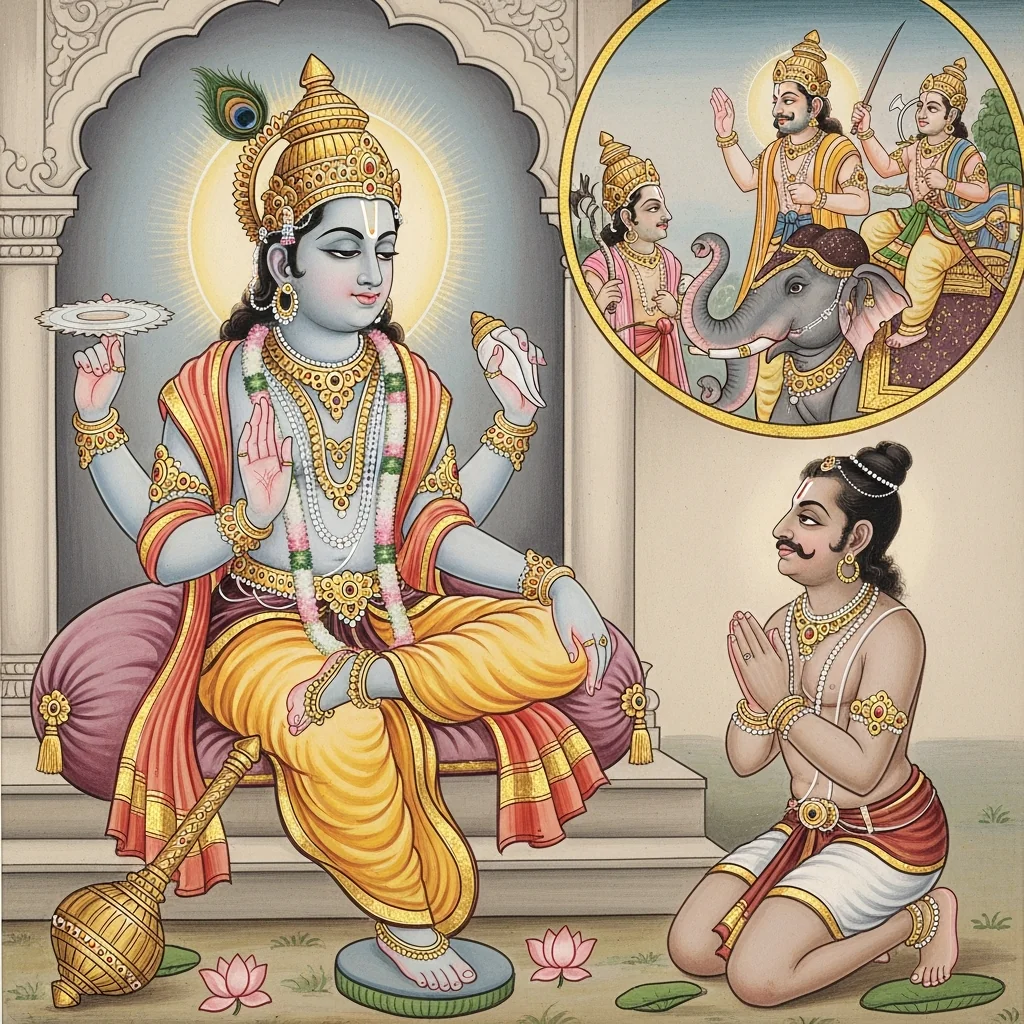
Adhyaya 14
This chapter recounts the climax of the deva–asura war: Viṣṇu routs the daityas and, after a failed trident-strike, subdues Kālanemi. When he regains consciousness, Kālanemi refuses further combat, reflecting that death in battle is but momentary and that slain asuras, by Brahmā’s ordinance, reach an imperishable realm, enjoy deva-like pleasures, and later return to saṃsāra. Thus he asks Viṣṇu not for victory, but for the supreme isolation/liberation—kaivalya. The narrative then turns to Indra, who continues violence against the defeated and terrified remnants. Nārada intervenes, declaring that harming the fearful or those who have surrendered is a grievous sin and ethically forbidden, even in thought. Indra desists and returns to heaven, where a victory festival with ritual music and celestial rejoicing is described as arising from Śaṅkara’s favor. Afterward the surviving daityas approach Śukra, son of Bhṛgu, who revives the fallen through life-restoring knowledge. He consoles Bali with the teaching that those slain by weapons attain heaven. The chapter ends with the daityas relocating to Pātāla under Śukra’s direction, stabilizing cosmic order through martial resolve, ethical restraint, and restorative counsel.
Shlokas
Verse 1
लोमश उवाच । ततो युद्धमतीवासीदसुरैर्विष्णुना सह । ततः सिंहाः सपक्षास्ते दंशिताः परमाद्भुताः
Lomaśa said: Then a most intense battle arose between the asuras and Viṣṇu. Thereupon those wondrous lions—winged and armed with fangs—appeared.
Verse 2
असुरैरुह्यमानास्ते रहुत्मंतं व्यदारयन् । सिंहास्ते दारितास्तेन खंडशश्च विदारिताः
As those lions were being borne along by the asuras, they tore open Rahutmanta. But he, in turn, ripped those lions apart—splitting them into fragments.
Verse 3
विष्णुना च तदा दैत्याश्चक्रेण शकलीकृताः । हतांस्तानसुरान्दृष्ट्वा कालनेमिः प्रतापवान्
Then Vishnu, with his discus, cut the daityas into pieces. Seeing those asuras slain, the mighty Kalanemi burned with prowess.
Verse 4
त्रिशूलेनाहनद्विष्णुं रोषपर्याकुलेक्षणः । तमायांतं च जगृहे मुकुंदोऽनाथसंश्रयः
With a trident he struck Vishnu, his eyes agitated with fury. And as he came charging in, Mukunda—refuge of the helpless—seized him.
Verse 5
करेण वामेन जघान लीलया तं कालनेमिं ह्यसुरं महाबलम् । तेनैव शूलेन समाहतोऽसौ मूर्च्छान्वितोऽसौ सहसा पपात
With his left hand, playfully, he struck that mighty asura Kalanemi. Then, struck by that very trident, he fell down at once, overcome by faintness.
Verse 6
पतितः पुनरुत्थाय शनैरुन्मील्य लोचने । पुरतः स्थितमालोक्य विष्णुं सर्वगुहाशयम्
Having fallen, he rose again and slowly opened his eyes. Seeing Vishnu standing before him—who dwells in the innermost cave of all beings—he beheld him clearly.
Verse 7
लब्धसंज्ञोऽब्रवीद्वाक्यं कालनेमिर्महाबलः । तव युद्धं न दास्यामि नास्ति लोके स्पृहा मम
Regaining consciousness, the mighty Kalanemi spoke: "I will not offer you battle. I have no craving for anything in the worlds."
Verse 8
ये येऽसुरा हता युद्धे अक्षयं लोकमाप्नुयुः । ब्रह्मणो वचनात्सद्य इंद्रेण सह संगताः
Whatever asuras were slain in battle attained an imperishable realm; by Brahmā’s word, they were at once united in companionship with Indra.
Verse 9
भुंजतो विविधान्भोगान्देववद्विचरंति ते । इंद्रेण सहिताः सर्वे संसारे च पतंत्यथ
They enjoy many kinds of pleasures and move about like gods, all together with Indra; and then, thereafter, they fall again into saṃsāra.
Verse 10
तस्माद्युद्धेन मरणं न कांक्षे क्षणभंगुरम् । अन्यजन्मनि मे वीर वैरभावान्न संशयः । दातुमर्हसि मे नाथ कैवल्यं केवलं परम्
Therefore I do not desire death in battle, which is momentary and fleeting. In another birth, O hero, enmity will surely arise in me again, without doubt. So, O Lord, grant me the supreme, pure Kaivalya—final liberation alone.
Verse 11
तथेति दैत्यप्रवरो निपातितः परेण पुंसा परमार्थदेन । दत्त्वाऽभयं देवतानां तदानीं तथा सुधां देवताभ्यः प्रदत्त्वा
Saying, “So be it,” that foremost of daityas was brought down by the Supreme Person, the giver of the highest good. At that time He granted fearlessness to the gods, and likewise bestowed nectar (amṛta) upon the deities.
Verse 12
कालनेमिर्हतो दैत्यो देवा जाता ह्यकटकाः । शल्यरूपो महान्सद्यो विष्णुना प्रभविष्णुना
When the demon Kālanemi was slain, the gods became free from affliction. Yet at once a great torment—like a lodged spear—arose, even through Viṣṇu, the all-powerful Lord.
Verse 13
तिरोधानं गतः सद्यो भगवान्कमलेक्षणः । इंद्रोऽपि कदनं कृत्वा दैत्यानां परमाद्भुतम्
The Blessed Lord, lotus-eyed, vanished at once. Then Indra too wrought a most wondrous slaughter among the demons.
Verse 14
पतितानां क्लीबरूपाणां भग्नानां भीतचेतसाम् । मुक्तकच्छशिखानां च चक्रे स कदनक्रियाम्
Against those who had fallen—broken, fearful at heart, and made cowardly in appearance, their girdles and topknots loosened—he carried out deeds of destruction.
Verse 15
अर्थशास्त्रपरो भूत्वा महेंद्रो दुरातिक्रमः । दैत्यानां कालरूपोऽसौ शचीपतिरुदारधीः
Intent on stratagem and statecraft, Mahendra became irresistible; to the Daityas he appeared as Time itself—Śacī’s lord, of lofty resolve.
Verse 16
एवं निहन्य्मानानामसुराणां शचीपतेः । निवारणार्थं भगवानागतो नारदस्तदा
As the Asuras were being thus slain by Śacī’s lord, the venerable Nārada then arrived to restrain him.
Verse 17
नारद उवाच । युद्धहताश्च ये वीरा ह्यसुरा रणमण्डले । तेषामनु कथं कर्ता भीतानां च विहिंसनम्
Nārada said: “The heroic Asuras have already been slain upon the field of battle; how, then, can one continue to commit violence against those who are afraid?”
Verse 18
ये भीतांश्च प्रपन्नांश्चघातयंति मदोद्धताः । ब्रह्मघ्नास्तेऽपि विज्ञेया महापातकसंयुताः
Those who, intoxicated with pride, slay the frightened and even those who have surrendered for refuge are to be known as “brahma-slayers” as well—men stained with great sins.
Verse 19
तस्मात्त्वया न कर्त्तव्यं मनसापि विहिंसनम् । एवमुक्तस्तदा शक्रो नारदेन महात्मना
Therefore you must not commit violence—even in thought. Thus, at that time, the great-souled Nārada admonished Śakra (Indra).
Verse 20
सुरसेनान्वितः सद्य आगतो हि त्रिविष्टपम् । तदा सर्वे सुरगणाः सुहृद्भ्यश्च परस्परम् । बभूवुर्मुदिताः सर्वे यक्षगंधर्वकिंनराः
Accompanied by the army of the gods, he swiftly returned to Triviṣṭapa (heaven). Then all the hosts of the gods rejoiced with one another as dear friends; all the Yakṣas, Gandharvas, and Kiṃnaras became glad.
Verse 21
तदा इंद्रोऽमरावत्यां हस शच्याऽभिषेचितः
Then indeed Indra, in Amarāvatī, was consecrated (anointed) by Śacī.
Verse 22
देवर्षिप्रमुखैश्चैव ब्रह्मर्षिप्रमुखैस्तथा । शक्रोऽपि विजयं प्राप्तः प्रसादाच्छंकरस्य च
Led by the divine seers and likewise by the great Brahma-seers, even Śakra (Indra) attained victory—by the grace of Śaṅkara (Śiva).
Verse 23
तदा महोत्सवो विप्रा देवलोके महानभूत् । शंखाश्च पटहाश्चैव मृदंगा मुरजा अपि । तथानकाश्च भेर्यश्च नेदुर्दुंदुभयः समम्
Then, O brāhmaṇas, a great festival arose in the world of the gods. Conches and kettle-drums, mṛdaṅgas and murajas, and also nākas and bherīs—together the dundubhis resounded in unison.
Verse 24
गायकाश्चैव गंधर्वाः किन्नराश्चाप्सपोगणाः । ननृतुर्जगुस्तुष्टुवुश्च सिद्धचारणगुह्यकाः
Singers, Gandharvas, Kinnaras, and hosts of Apsarases danced, sang, and offered hymns of praise; and so too did the Siddhas, Cāraṇas, and Guhyakas.
Verse 25
एवं विजयमापन्नः शक्रो देवेस्वरस्तदा । देवैर्हतास्तदा दैत्याः पतितास्ते महीतले
Thus Śakra, the lord of the gods, attained victory. Then the Dānavas/Daityas, slain by the gods, fell upon the surface of the earth.
Verse 26
गतासवो महात्मानो बलिप्रमुखतो ह्यमी । तपस्तप्तुं पुरा विप्रो भार्गवो मानसोत्तरम्
Those great ones—Bali foremost among them—had lost their lives. Formerly, the Brāhmaṇa Bhārgava (Śukra) had gone to Mānasottara to perform austerities.
Verse 27
गतः शिष्यैः परिवृतस्तस्माद्युद्धं न वेद तत् । अवशेषाश्च ये दैत्यास्ते गता भार्गवं प्रति
Having gone there surrounded by his disciples, he did not know of that battle. And the Daityas who remained went to Bhārgava.
Verse 28
कथितं वै महद्धृत्तमसुराणां क्षयावहम् । निशम्य मन्युमाविष्टो ह्यागतो भृगुनंदनः
When the great event—bringing ruin upon the Asuras—was reported, Bhṛgu’s son (Bhārgava/Śukra), hearing it, was seized by wrath and came forth.
Verse 29
शिष्यैः परिवृतो भूत्वा मृतांस्तानसुरानपि । विद्यया मृतजीविन्या पतितान्समजीवयत्
Surrounded by his disciples, he revived even those Asuras who had died and fallen, by the ‘life-restoring’ knowledge that raises the dead.
Verse 30
निद्रापायगता यद्वदुत्थितास्ते तदाऽसुराः । उत्थितः स बलिः प्राह भार्गवं ह्यमितद्युतिम्
As though their sleep had merely passed, those Asuras then arose. Bali too rose and spoke to Bhārgava, whose splendor was immeasurable.
Verse 31
जीवितेन किमद्यैव मम नास्ति प्रयोजनम् । पातितस्त्रिदशेंद्रेण यथा कापुरुषस्तथा
“What use is life to me now? I have no purpose in it—cast down by the lord of the Thirty (Indra), like a coward.”
Verse 32
बलिनोक्तं वचः श्रुत्वा शुक्रो वचनमब्रवीत् । मनस्विनो हि ये शूराः पतंति समरे बुधा
Hearing Bali’s words, Śukra replied: “Indeed, the high-souled heroes who fall in battle are regarded by the wise as truly noble.”
Verse 33
ये शस्त्रेण हताः सद्यो म्रियमाणा व्रजंति वै । त्रिविष्टपं न संदेह इति वेदानुशासनम्
Those who are struck down by weapons and die at once indeed go to Triviṣṭapa (heaven); of this there is no doubt—such is the ordinance of the Veda.
Verse 34
एवमाश्वासयामास बलिनं भृगुनंदनः । तपस्तताप विविधं दैत्यानां सिद्धिदायकम्
Thus did Bhṛgu’s son (Śukra) console Bali. Then he undertook diverse austerities—practices that bestow success and accomplishment upon the Daityas.
Verse 35
तथा दैत्य गताः सर्वे भृगुणा च प्रचोदिताः । पातालमवसन्सर्वे बलिमुख्याः सुखेन वै
So, urged on by Bhṛgu (i.e., by Śukra of Bhṛgu’s line), all the Daityas—led by Bali—went and dwelt in Pātāla, indeed at ease.