Adhyaya 21
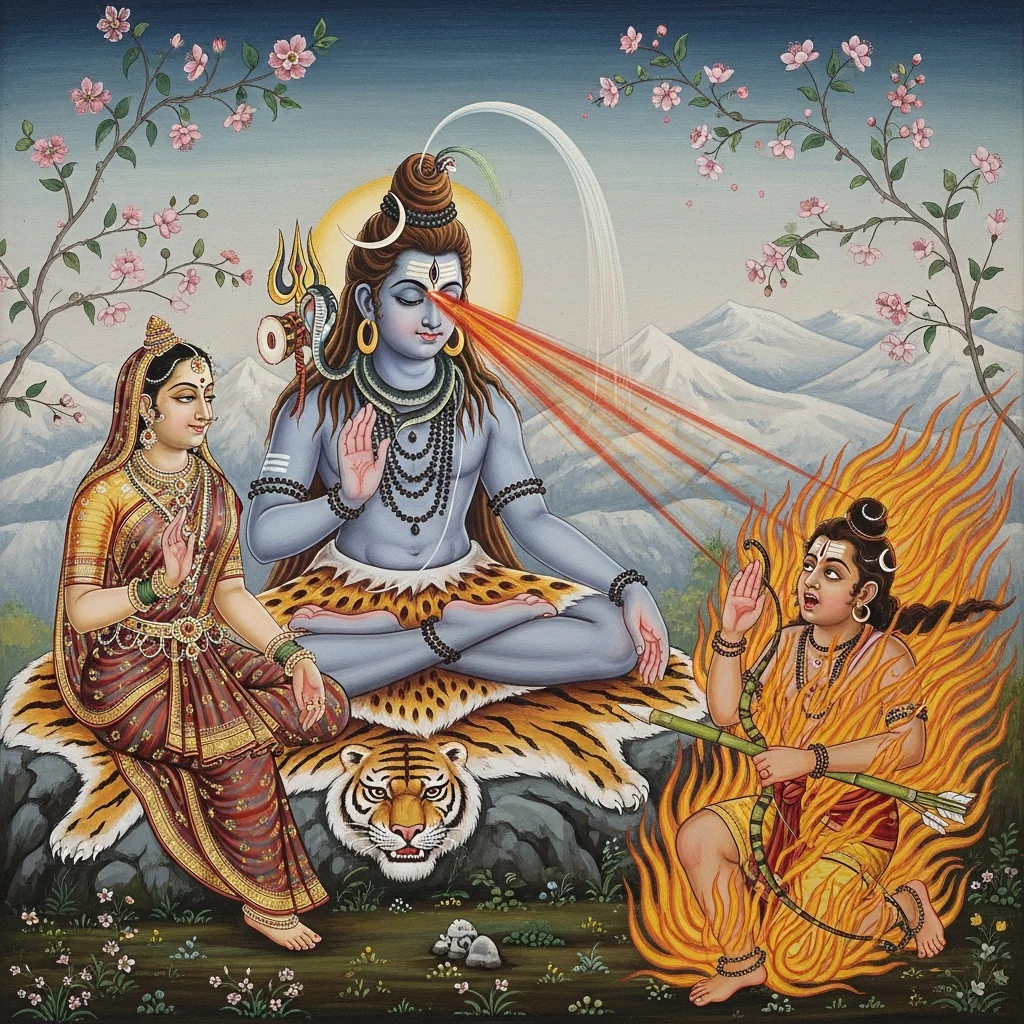
The chapter begins with Lomāśa describing Pārvatī’s growth and Śiva’s fierce tapas in a Himalayan valley, guarded by gaṇas. Himavān comes with Pārvatī to seek Śiva’s darśana, but Nandin controls access, stressing that nearness to the ascetic Lord must follow disciplined, ritual propriety. Śiva grants Himavān regular darśana yet forbids bringing the maiden close, leading to a philosophical exchange in which Pārvatī tests Śiva’s claim of transcending prakṛti and probes the logic of perception and speech. Meanwhile the devas, distressed by their cosmic danger—especially Tāraka—decide that only Madana (Kāma) can disturb Śiva’s austerity. Madana arrives with apsarases; nature turns unseasonably erotic, and even the gaṇas are affected, revealing desire’s cosmological force. Madana releases the mohana-arrow; Śiva briefly beholds Pārvatī and is stirred, then recognizes Madana and burns him to ashes with the third eye. Devas and sages debate: Śiva condemns kāma as the root of suffering, while the sages argue that kāma is woven into worldly creation and cannot be simply negated. Śiva then withdraws in concealment (tiraḥdhāna). Pārvatī vows to restore the situation through intensified tapas; renouncing even leaves, she becomes “Apārṇā” and advances to extreme bodily restraint. The chapter ends with the gods seeking Brahmā’s aid; Brahmā approaches Viṣṇu, and Viṣṇu proposes going to Śiva to secure the marriage outcome, framing the tale as a sacred and ethical necessity rather than mere romance.
Shlokas
Verse 1
लोमश उवाच । वर्द्धमाना तदा साध्वी रराज प्रतिवासरम् । अष्टवर्षा यदा जाता हिमालयगृहे सती
Lomaśa said: As that virtuous one grew, she shone more and more each day. When Satī became eight years old, she dwelt in the house of Himālaya.
Verse 2
महेशो हिमवद्द्रोण्यां तताप परमं तपः । सर्वैर्गणैः परिवृतो वीरभद्रादिभिस्तदा
Then Maheśa performed supreme austerity in a valley of the Himālaya, surrounded at that time by all his gaṇas—led by Vīrabhadra and others.
Verse 3
एतत्तपो जुषाणं तं महेशं हिमवान्ययौ । तत्पादपल्लवं द्रष्टुं पार्वत्या सह बुद्धिमान्
Seeing Maheśa (Śiva) absorbed in that holy austerity, the wise Himavān drew near with Pārvatī, longing to behold the tender “lotus-shoot” of His feet.
Verse 4
यावत्समागतो द्रष्टं नंदिनासौ निवारितः । द्वारि स्थिते च तदा क्षणमेकं स्थिरोऽभवत्
When he came to behold (Śiva), Nandin restrained him; and standing at the doorway, he remained still for a moment.
Verse 5
पुनर्विज्ञापयामास नंदिना हिमवान्गिरिः । विज्ञप्तो नंदिना शंभुरचलो द्रष्टुमागतः
Again Himavān, the Mountain, conveyed his request through Nandin. Informed by Nandin, Śambhu—though unmoving in tapas—acknowledged the one who had come to see Him.
Verse 6
तदाकर्ण्य वचस्तस्य नंदिनः परमेश्वरः । आनयस्व गिरिं चात्र नंदिनं वाक्यमब्रवीत्
Hearing Nandin’s words, Parameśvara said to Nandin: “Bring that mountain here.”
Verse 7
तथेति मत्वा नंदी तं पर्वतं च हिमाचलम् । आनयामास स तथा शंकरं लोकशंकरम्
Thinking, “So be it,” Nandin brought that mountain—Himācala—there; and thus he brought about the meeting with Śaṅkara, the benefactor of the worlds.
Verse 8
दृष्ट्वा तदानीं सकलेश्वरं प्रभुं तपो जुषाणं विनिमीलितेक्षणम्
Then, beholding the Lord—the ruler of all—absorbed in austerity, his eyes gently closed,
Verse 9
कपर्द्धिनं चंद्रकलाविभूषणं वेदांतवेद्यं परमात्मनि स्थितम् । ववंद शीर्ष्णा च तदा हिमाचलः परां मुदं प्रापदहीनसत्त्वः
Himācala then bowed his head to the Lord—matted-haired, adorned with the crescent moon, knowable through Vedānta, established in the Supreme Self—and, with steadfast heart, attained the highest joy.
Verse 10
उवाच वाक्यं जगदेकमंगलं हिमालयो वाक्यविदां वरिष्ठः
Himālaya, foremost among the eloquent, spoke words that were the singular auspiciousness of the world.
Verse 11
सभाग्योऽहं महादेव प्रसादात्तव शंकर । प्रत्यहं चागमिष्यामि दर्शनार्थं तव प्रभो
“I am blessed, O Mahādeva, by your grace, O Śaṅkara. And every day I shall come, O Lord, for the sake of your darśana.”
Verse 12
अनया सह देवेश अनुज्ञां दातुर्महसि । श्रुत्वा तु वचनं तस्य देवदेवो महेश्वरः
“O Lord of the gods, you ought to grant permission for her to accompany (me).” Having heard his words, Maheśvara—God of gods—(responded).
Verse 13
आगंतव्यं त्वया नित्यं दर्शनार्थं ममाचल । कुमारीं च गृहे स्थाप्य नान्यथा मम दर्शनम्
“O Acala, you must come each day for my darśana. And only after placing the maiden at home shall you behold me—otherwise not.”
Verse 14
अचलः प्रत्युवाचेदं गिरिशं नतकंधरः । कस्मान्मयानया सार्द्धं नागंतव्यं तदुच्यताम् । अचलं च व्रीत शंभुः प्रहसन्वाक्यमब्रवीत्
Acala, bowing his head in reverence, replied to Giriśa: “Why should I not come together with her? Please tell me.” Then Śambhu, smiling, spoke to Acala in these words.
Verse 15
इयं कुमारी सुश्रोणी तन्वी चारुप्रभाषिणी । नानेतव्या मत्समीपे वारयामि पुनः पुनः
“This maiden—fair-hipped, slender, and sweet-spoken—must not be brought near me. I forbid it again and again.”
Verse 16
एतच्छ्रुत्वा वचनं तस्य शंभोर्निरामयं निःस्पृहनिष्ठुरं वा । तपस्विनोक्तं वचनं निशम्य उवाच गौरी च विहस्य शंभुम्
Hearing Śambhu’s words—untroubled, desireless, and even stern—Gaurī, having listened to the ascetic’s statement, spoke while smiling at Śambhu.
Verse 17
गौर्युवाच । तपःशक्त्यान्वितः शंभो करोषि विपुलं तपः । तव बुद्धिरियं जाता तपस्तप्तुं महात्मनः
Gaurī said: “O Śambhu, endowed with the power of tapas, you perform immense austerity. O great-souled one, this resolve has arisen in you to undertake such tapas.”
Verse 18
कस्त्वं का प्रकृतिः सूक्ष्मा भगवंस्तद्विमृश्यताम् । पार्वत्यास्तद्वचः श्रुत्वा महेशो वाक्यमब्रवीत्
“Who are you? What is this subtle Prakṛti? O Blessed One—let this be reflected upon.” Hearing Pārvatī’s words, Maheśa replied.
Verse 19
तपसा परमेणैव प्रकृतिं नाशयाम्यहम् । प्रकृत्या रहितः सुभ्रु अहं तिष्ठमि तत्त्वतः । तस्माच्च प्रकृते सिद्धैर् कार्यः संग्रहः क्वचित्
“By supreme tapas alone I dissolve Prakṛti. Free from Prakṛti, O fair-browed one, I abide in truth. Therefore, at times, the perfected ones should also restrain and gather in their Prakṛti.”
Verse 20
पार्वत्युवाच । यदुक्तं परया वाचा वचननं शंकर त्वया । सा किं प्रकृति र्नैव स्यादतीतस्तां भवान्कथम्
Pārvatī said: “O Śaṅkara, the statement you uttered in exalted words—would that not itself be Prakṛti? And how have you gone beyond it?”
Verse 21
यच्छृणोपि यदश्रासि यच्च पश्यसि शंकर । वाग्वादेन च किं कार्यमस्माके चाधुना प्रभो
“Whatever you hear, whatever you cause to be heard, and whatever you see, O Śaṅkara—what need is there for verbal disputation for us now, O Lord?”
Verse 22
तत्सर्वं प्रकृतेः कार्यं मिथ्यावादो निर्र्थकः । प्रकृतेः परतो भूत्वा किमर्थं तप्यते तपः
“All of that is only the work of Prakṛti; talk of it otherwise is pointless. If you truly stand beyond Prakṛti, then for what purpose is this austerity being performed?”
Verse 23
त्वया शंभोऽधुना ह्यस्मिन्गिरौ हिमवति प्रभो । प्रकृत्या मिलितोऽसि त्वं न जानासि हि शंकर
“O Śambhu, O Lord—here and now, upon this Himālaya mountain, you have become joined with Prakṛti; indeed, O Śaṅkara, you do not seem to recognize it.”
Verse 24
वाग्वादेन च किं कार्यमस्माकं चाधुना प्रभो । प्रकृतेः परतस्त्वं च यदि सत्यं वचस्तव । तर्हि त्वया न भेतव्यं मम शंकर संप्रति
“And what use is mere debate for us now, O Lord? If your statement is true—that you are beyond Prakṛti—then, O Śaṅkara, you should not be afraid of me at all at this moment.”
Verse 25
प्रहस्य भगवान्देवो गिरिजां प्रत्युवाच ह
Smiling, the Blessed Lord—Śiva—then replied to Girijā.
Verse 27
महादेव उवाच । प्रत्यहं कुरु मे सेवां गिरिजे साधुभाषिणि
Mahādeva said: “O Girijā, fair-speaker—render service to me each day.”
Verse 28
तपस्तप्तुमनुज्ञा मे दातव्या पर्वताधिप । अनुज्ञया विना किंचित्तपः कर्तुं न पार्यते
“O Lord of mountains, permission must be granted to me to perform austerity (tapas). Without permission, one cannot accomplish even a little tapas.”
Verse 29
एतच्छ्रुत्वा वचस्तस्य देवदेवस्य शूलिनः । प्रहस्य हिमवाञ्छंभुमिदं वचनमब्रवीत्
Hearing the words of the God of gods, the trident-bearing Lord, Himavān smiled and spoke this reply to Śambhu.
Verse 30
त्वदीयं हि जगत्सर्वं सदेवासुरमानुषम् । किमहं तु महादेव तुच्छो भूत्वा ददामि ते
“Indeed, this entire world is yours—together with gods, asuras, and humans. So what could I, being insignificant, possibly give to you, O Mahādeva?”
Verse 31
एवमुक्तो हिमवता शंकरो लोकशंकरः । प्रहस्य गिरिराजं तं याहीति प्राह सादरम्
Thus addressed by Himavān, Śaṅkara—the benefactor of the worlds—smiled and courteously said to that king of mountains, “Go.”
Verse 32
शंकरेणाब्यनुज्ञातः स्वगृहं हिमवान्ययौ । सार्द्धं गिरिजया सोऽपि प्रत्यहं दर्शने स्थितः
Permitted by Śaṅkara, Himavān returned to his own abode. Along with Girijā, he too remained present for daily darśana (sacred audience).
Verse 33
एवं कतिपयः कालो गतश्चोपासनात्तयोः
Thus, some time passed while those two remained engaged in devoted worship.
Verse 34
सुतापित्रोश्च तत्रैव शंकरो दुरतिक्रमः । पार्वतीं प्रति तत्रैव चिंतामापेदिरे सुराः
There itself Śaṅkara—unassailable—remained, absorbed in his purpose; and the gods, thinking of Pārvatī, were seized by anxiety.
Verse 35
ते चिंत्यमानाश्च सुरास्तदानीं कथं महेशो गिरिजां समेष्यति । किं कार्यमद्यैव वयं च कुर्मो बृहस्पते तत्कथयस्व मा चिरम्
Then the gods, pondering, asked: “How will Maheśa come to unite with Girijā? What must we do at once? O Bṛhaspati, tell us—without delay.”
Verse 36
बृहस्पतिरुवाचेदं महेंद्रं प्रति सद्वचः । एवमेतत्त्वया कार्यं महेंद्र श्रूयतां तदा
Bṛhaspati spoke these good words to Mahendra: “This is what must be done by you, O Mahendra—listen now.”
Verse 37
एतत्कार्यं मदनेनैव राजन्नान्यः समर्थो भविता त्रिलोके । विप्लावितं तापसानां तपो हि तस्मात्त्वरात्प्रार्थनीयो हि मारः
“This task can be accomplished only by Madana, O king; in the three worlds none else will be capable. Since he can shake the austerities of ascetics, therefore Māra must be invoked at once.”
Verse 38
गुरोर्वचनमाकर्ण्य आह्वयन्मदनं हरिः । आह्वानादाजगामाथ मदनः कार्यसाधकः
Hearing the guru’s words, Hari summoned Madana; and upon that summons, Madana—able to accomplish the task—came there.
Verse 39
रत्या समेतः सह माधवेन स पुष्पधन्वा पुरतः सभायाम् । महेंद्रमागम्य उवाच वाक्यं सगर्वितं लोकमनोहरं च
Accompanied by Rati and together with Mādhava, the Flower-bowed one (Kāma) came before the assembly; approaching Mahendra, he spoke words proud in tone, yet captivating to the world.
Verse 40
अहमाकारितः कस्माद्ब्रूहि मेऽद्य शचीपते । किं कार्यं करवाण्यद्य कथ्यतां मा विलंबितम्
“Why have I been summoned? Tell me today, O lord of Śacī. What task shall I accomplish today? Speak—do not delay.”
Verse 41
मम स्मरणमात्रेण विभ्रष्टा हि तपस्विनः । त्वमेव जानासि हरे मम वीर्यपराक्रमौ
“By merely remembering me, ascetics fall from their austerity; you alone, O Hari, know my power and prowess.”
Verse 42
मम वीर्यं च जानाति शक्तेः पुत्रः पराशरः । एवं चानये च बहवो भृग्वाद्य ऋषयो ह्यमी
“My power is known even to Parāśara, the son of Śakti; and likewise many other sages too—beginning with Bhṛgu—know it well.”
Verse 43
गुरुरप्यभिजानाति भार्योतथ्यस्य चैव हि । तस्यां जातो भरद्वाजो गुरुणा संकरो हि सः
Even the Guru knows indeed that she is the wife of Utathya. Yet in her was born Bharadvāja—he is said to be of mixed parentage, having been begotten by the Guru.
Verse 44
भरद्वाजो महाभाग इत्युवाच गुरुस्तदा । जानाति मम वीर्यं च शौर्यं चैव प्रजापतिः
Then the Guru said, “Bharadvāja is most blessed. Prajāpati knows well my potency and my valor.”
Verse 45
क्रोधो हि मम बंधुश्च महाबलपरक्रमः । उभाभ्यां द्रावितं विश्वं जंगमाजंगमं महत् । ब्रह्मादिस्तंबपर्यंतं प्लावितं सचराचरम्
“Wrath is truly my kinsman, mighty in strength and prowess. By us two the vast universe—moving and unmoving—has been thrown into turmoil; from Brahmā down to the tiniest blade of grass, the whole world with all that moves and does not move has been overwhelmed.”
Verse 46
देवा ऊचुः । मदनद्वं समर्थोसि अस्माञ्जेतुं सदैव हि । महेशं प्रति गच्छाशु सुरकार्यार्थसिद्धये । पार्वत्या सहितं शंभुं कुरुष्वाद्य महामते
The gods said: “O Madana, you are ever able to conquer even us. Go quickly to Maheśa to accomplish the gods’ purpose. O great-minded one, bring Śambhu—together with Pārvatī—under your influence today.”
Verse 47
एवमभ्यर्थितो देवैर्मदनो विश्वमोहनः । जगाम त्वरितो भूत्वा अप्सरोभिः समन्वितः
Thus entreated by the gods, Madana—the enchanter of the worlds—set out at once, swiftly, accompanied by the Apsarases.
Verse 48
ततो जगामाशु महाधनुर्द्धरो विस्फार्य चापं कुसुमान्वितं महत् । तथैव बाणांश्च मनोरमांश्च प्रगृह्य वीरो भुवनैकजेता । तस्मिन्हिमाद्रौ परिदृश्यमानोऽवनौ स्मरो योधयतां वरिष्ठः
Then he went swiftly, bearing the great bow—drawing tight that mighty bow adorned with flowers—and taking up charming arrows as well. That hero, the sole conqueror of the worlds, was seen there on the Himalayan mountain: Smara, foremost among those who wage battle by enchantment.
Verse 49
तत्रागता तदा रंभा उर्वशी पुंजिकस्थली । सुम्लोचा मिश्रकेशी च सुभगा च तिलोत्तमा
Then, in that place, Rambhā, Urvaśī, Puñjikasthalī, Sumlocā, Miśrakeśī, Subhagā, and Tilottamā arrived.
Verse 50
अन्याश्च विविधाः जाताः साहाय्ये मदनस्य च । अप्सरसो गणैर्दृष्टा मदनेन सहैव ताः
Many other Apsarases too, of diverse kinds, came to aid Madana. The Gaṇas beheld those Apsarases together with Madana himself.
Verse 51
सर्वे गणाश्च सहसा मदनेन विमोहिताः । भृंगिणा च तदा रंभा चण्डेन सह चोर्वशी
All the Gaṇas were suddenly deluded by Madana. Then Rambhā was with Bhṛṅgin, and Urvaśī was with Caṇḍa.
Verse 52
मेनका वीरभद्रेण चण्डेन पुंजिकस्थली । तिलोत्तमादयस्तत्र संवृताश्च गणैस्तदा
Menakā was with Vīrabhadra, and Puñjikasthalī with Caṇḍa. Tilottamā and the others there were then surrounded by the Gaṇas.
Verse 53
अमत्तभूतैर्बहुभिस्त्रपां त्यक्त्वा मनीषिभिः । अकाले कोकिला भिश्च व्याप्तामासीन्महीतलम्
The face of the earth was filled with many beings, as though intoxicated, casting off all modesty—even the wise; and cuckoos too, out of season, spread their calls everywhere.
Verse 54
अशोकाश्चंपकाश्चूता यूथ्यश्चैव कदंबकाः । नीषाः प्रियालाः पनसा राजवृक्षाश्चरायणाः
In abundance stood aśoka and campaka trees, mangoes, yūthikā creepers, and kadamba; also nīṣa, priyāla, jackfruit (panasa), and the rājavṛkṣa—together with other growths of the forest.
Verse 55
द्राक्षावल्लयः प्रदृश्यंते बहुला नागकेशराः । तथा कदल्यः केतक्यो भ्रमरैरुपशोभिताः
Grape-vines were seen everywhere; nāgakeśara trees were plentiful; and banana plants and ketakī blossoms were further adorned by swarming bees.
Verse 56
मत्ता मदनसंगेन हंसीभिः कलहंसकाः । करेणुभिर्गजाह्यासञ्छिखंडीभिः शिखंडिनः
Maddened by love’s touch, the male swans clung to their mates; the bulls pressed close to the cow-elephants; and the peacocks to the peahens.
Verse 57
निष्कामा ह्यतुरा ह्यासञ्छिवसंपर्कजैर्गुणैः । अकस्माच्च तथाभूतं कथं जातं विमृश्य च
They had been desireless and free from distress, endowed with qualities born of contact with Śiva; reflecting, they wondered: “How has this sudden change come to be?”
Verse 58
शैलादो हि महातेजा नंदी ह्यमितविक्रमः । रक्षसं विबुधानां वा कृत्यमस्तीत्यचिंतयत्
Then Nandī, Śailāda’s son—radiant and of boundless valor—pondered: “Surely some business of a rākṣasa, or of the gods, is afoot.”
Verse 59
एतस्मिन्नंतरे तत्र मदनो हि धनुर्द्धरः । पंचबाणान्समारोप्य स्वकीये धनुषि द्विजाः । तरोश्छायां समाश्रित्य देवदारुगतां तदा
Just then, there, Madana the bowman—O twice-born—set his five arrows upon his own bow and took refuge in the shade of a deodāra tree.
Verse 60
निरीक्ष्य शंभुं परमासने स्तितं तपो जुषाणं परमेष्ठिनां पतिम् । गंगाधरं नीलतमालकंठं कपर्दिनं चन्द्रकलासमेतम्
He beheld Śambhu seated upon the supreme seat, absorbed in austerity—the Lord of the highest beings—bearing Gaṅgā, with a throat dark as the nīla-tamāla, matted-haired, and adorned with the crescent moon.
Verse 61
भुजंगभोगांकितसर्वगात्रं पंचाननं सिंहविशालविक्रमम् । कर्पूरगौरे परयान्वितं च स वेद्धुकामो मदनस्तपस्विनम्
His entire body was marked with coiled serpents, five-faced, with lion-like vast valor; fair as camphor and accompanied by the Supreme Goddess—Madana, wishing to pierce him, took aim at that ascetic Lord.
Verse 62
दुरासदं दीप्तिमतां वरिष्ठं महेशमुग्रं सह माधवेन । यावच्छिवं वेद्धुकामः शरेण तावद्याता गिरिजा विश्वमाता । सखीजनैः संवृता पूजनार्थं सदाशिवं मंगलं मंगलानाम्
Maheśa—fierce, unapproachable, foremost among the radiant—stood with Mādhava. And just as Madana longed to pierce Śiva with his arrow, at that very moment Girijā, Mother of the universe, arrived surrounded by her companions, to worship Sadāśiva—the Auspicious One, the source of all auspiciousness.
Verse 63
कनककुसुममालां संदधे नीलकंठे सितकिरणमनोज्ञादुर्ल्लभा सा तदानीम् । स्मितविकसितनेत्रा चारुवक्त्रं शिवस्य सकलजननित्री वीक्षमाणा बभूव
Then the Mother of all beings placed a garland of golden blossoms upon the blue-throated Lord—rare and lovely like moonbeams. With eyes opening in a gentle smile, she gazed upon Śiva’s beautiful face.
Verse 64
तावद्विद्धः शरेणैव मोहनाख्येन चत्वरात् । विध्यमानस्तदा शंभुः शनैरुन्मील्य लोचने । ददर्श गिरिजां देवोब्धिर्यथा शशिनः कलाम्
Just then Śambhu was struck at the crossroads by an arrow named “Moha.” Pierced by it, he slowly opened his eyes and beheld Girijā—like the lord of the ocean beholding the moon’s crescent.
Verse 65
चारुप्रसन्नवदनां बिंबोष्ठीं सस्मितेक्षणाम् । सुद्विजामग्निजां तन्वीं विशालवदनोत्सवाम्
He saw her with a lovely, serene face; with lips red as the bimba fruit; with smiling eyes; slender in form—radiant and auspicious, a festival to behold in her wide and splendid countenance.
Verse 66
गौरीं प्रसन्नमुद्रां च विश्वमोहनमोहनाम् । यया त्रिलोकरचना कृता ब्रह्मादिभिः सह
He beheld Gaurī with a gracious, tranquil bearing—she who enchants even the enchanter of the world; by her power, together with Brahmā and the other gods, the ordering of the three worlds is accomplished.
Verse 67
उत्पत्तिपालनविनाशकरी च या वै कृत्वाग्रतः सत्त्वरजस्तमांसि । सा चेतनेन ददृशे पुरतो हरेण संमोहनी सकलमंगलमंगलैका
She who truly brings about creation, preservation, and dissolution—having set before herself the qualities of sattva, rajas, and tamas—was then beheld face to face by Hara in full awareness. She is the Enchantress, the one supreme auspiciousness among all that is auspicious.
Verse 68
तां निरीक्ष्य भवो देवो गिरिजां लोकपावनीम् । मुमोह दर्शनात्तस्या मदनेनातुरीकृतः । विस्मयोत्फुल्लनयनो बभूव सहसा शिवः
Seeing her—Girijā, purifier of the worlds—Lord Bhava was bewildered by her very sight, afflicted by Kāma. Suddenly Śiva’s eyes widened, blossoming with astonishment.
Verse 69
एवं विलोकमानोऽसौ देवदेवो जगत्पतिः । मनसा दूयमानेन इदमाह सदाशिवः
Thus gazing, the God of gods, the Lord of the universe—his mind burning within—Sadāśiva spoke these words.
Verse 70
अनया मोहितः कस्मात्तपःस्थोऽहं निरामयः । कुतः कस्माच्च केनेदं कृतमस्ति ममाप्रियम्
“Why have I been deluded by her, though I abide in austerity and am free from affliction? From where, for what reason, and by whom has this unwelcome thing been done to me?”
Verse 71
ततो व्यलोकयच्छंभुर्द्दिक्षु सर्वासु सादरम् । तावद्दृष्टो दक्षिणस्यां दिशि ह्यात्तशरासनः
Then Śambhu looked attentively in all directions. At that moment, in the southern quarter, he saw one holding a bow and arrows, ready in hand.
Verse 72
चक्रीकृतधनुः सज्जं चक्रे बेद्धुं सदाशिवम् । यावत्पुनः संधयति मदनो मदनांतकम् । तावद्दृष्टो महेशेन सरोषेण तदा द्विजाः
With his bow bent into a circle and made ready, Madana set out to pierce Sadāśiva. But just as he was aiming again at the Destroyer of Madana, he was seen by Maheśa—then, O brāhmaṇas, with wrath arising.
Verse 73
निरीक्षितस्तृतीयेन चक्षुषा परमेण हि । मदनस्तत्क्षणादेव ज्वालामालावृतोऽभवत् । हाहाकारो महानासीद्देवानां तत्र पश्यताम्
Indeed, when he was beheld by the supreme third eye, Kāma (Madana) was instantly enveloped in a garland of flames. As the gods looked on there, a great cry of anguish arose among them.
Verse 74
देवा ऊचुः । देवदेव महादेव देवानां वरदो भव । गिरिजायाः सहायार्थं प्रेषितो मदनोऽधुना
The gods said: “O God of gods, O Mahādeva—be the bestower of boons upon the gods. Madana (Kāmadeva) has now been sent to aid Girijā (Pārvatī).”
Verse 75
वृथा त्वयाथ दग्धोऽसौ मदनो हि महाप्रभः
“O mighty Lord, that illustrious Madana has been burned by you in vain.”
Verse 76
त्वया हि कार्यं जगदेकबंधो कार्यं सुराणां परमेण वर्चसा । अस्यां समुत्पत्स्यति देव शंभो तेनैव सर्वं भवतीह कार्यम्
“O sole kinsman of the universe, it is for you—by your supreme splendor—to accomplish the work of the gods. O Lord Śambhu, from her will arise the destined one; by him alone, all that must be done here will be fulfilled.”
Verse 77
तारकेण महादेव देवाः संपीडिता भृशम् । तदर्थं जीवितं चास्य दत्त्वा च गिरिजां प्रभो
“O Mahādeva, the gods are grievously oppressed by Tāraka. For that very purpose, O Lord, (we acted) by granting him life and by offering Girijā…”
Verse 78
वरयस्व महाभाग देवाकार्ये भव क्षमः । गजासुरात्तवया त्राता वयं सर्वे दिवौकसः
“O greatly fortunate One, choose (to favor us) and be able in the gods’ work. From Gajāsura you saved all of us, the dwellers of heaven.”
Verse 79
कालकूटाच्च नूनं हि रक्षिताः स्मो न चान्यथा । भस्मासुराच्च सर्वेश त्वया त्राता न संशयः
Surely by you alone were we saved from Kālakūṭa, the deadly poison, and not otherwise. And from Bhasmāsura too, O Lord of all, you rescued us—there is no doubt.
Verse 80
मदनोयं समायातः सुराणां कार्यसिद्धये । तस्मात्त्वया रक्षणीय उपकारः परो हि नः
This Madana has come for the fulfillment of the gods’ purpose. Therefore he should be protected by you, for his help is of the highest value to us.
Verse 81
विना तेन जगत्सर्वं नाशमेष्यति शंकर । निष्कामस्त्वं कथं शंभो स्वबुद्ध्या च विमृस्यताम्
Without him, O Śaṅkara, the entire world will go to ruin. O Śambhu, though you are desireless, consider this with your own wisdom.
Verse 82
तदोवाच रुषाविष्टो देवान्प्रति महेश्वरः । विना कामेन भो देवा भवितव्यं न चान्यथा
Then Maheśvara, filled with anger, spoke to the gods: “O gods, without Kāma it cannot be so—there is no other way.”
Verse 83
यदाःकामं पुरस्कृत्य सर्वे देवाः सवासवाः । पदभ्रष्टाश्च दुःखेन व्याप्ता दैन्यं समाश्रिताः
When all the gods—together with Indra—placed Desire at the forefront, they fell from their proper station; overwhelmed by sorrow, they became afflicted and sank into misery.
Verse 84
कामो हि नरकायैव सर्वेषां प्राणिनां ध्रुवम् । दुःखरूपी ह्यनंगोऽयं जानीध्वं मम भाषितम्
Desire (Kāma), indeed, surely leads all living beings toward hell. This bodiless Kāma is truly of the nature of suffering—know this as my declared teaching.
Verse 85
तारकोऽपि दुराचारो निष्कामोऽद्य भविष्यति । विनाकामेन च कथं पापमाचरते नरः
Even Tāraka, though of wicked conduct, will today become free from desire; for without desire, how can a person commit sin?
Verse 86
तस्मात्कामो मया दग्धः सर्वेषां शांतिहेतवे । युष्माभिश्च सुरैः सर्वैरसुरैश्च महर्षिभिः
Therefore I burned Kāma for the sake of peace for all—before you gods, before all the asuras, and before the great sages as well.
Verse 87
अन्यैः प्राणिभिरेवात्र तपसे धीयतां मनः । कामक्रोधविहीनं च जगत्सर्वं मया कृतम्
Here, let other beings set their minds upon austerity (tapas); for I have fashioned the entire world to be free from desire and anger.
Verse 88
तस्मादेनं पापिनं दुःखमूलं न जीवयिष्यामि सुराः प्रतीक्ष्यताम् । निरन्तरं चात्मसुखप्रबोधमानंदलक्षणमागाधमनन्यरूपम्
Therefore I will not let this sinful one—the very root of suffering—live; O gods, wait and see. And in its place may there be an unbroken awakening of the soul’s own bliss—an unfathomable, uniquely real state marked by pure joy.
Verse 89
एवमुक्तास्तदा तेन शंभुना परमेष्ठिना । ऊचुर्महर्षयः सर्वे शकर लोकशंकरम्
Thus addressed by Śambhu, the supreme Lord, all the great sages then spoke to Śakara, the benefactor of the worlds.
Verse 90
यदुक्तं भवता शंभो परं श्रेयस्करं हि नः । किं तु वक्ष्याम देवेश श्रूयतां चावधार्यताम्
What you have said, O Śambhu, is indeed supremely beneficial for us. Yet, O Lord of the gods, something must be stated—please listen and consider it carefully.
Verse 91
यथा सृष्टमिदं विश्वं कामक्रोधसमन्वितम् । तत्सर्वं कामरूपं हि स कामो न तु हन्यते
As this universe has been created with desire and anger woven into it, all of it is indeed of the form of desire; therefore that Kāma cannot truly be slain.
Verse 92
धर्मार्थकामामोक्षाश्च चत्वारो ह्येकरूपताम् । नीतायेन महादेव स कामोऽयं न हन्यते
Dharma, Artha, Kāma, and Mokṣa—these four have been led into a single unity by you, O Mahādeva; therefore this Kāma cannot be slain.
Verse 93
कथं त्वया हि संदग्धः कामो हि दुरतिक्रमः । येन संघटितं विश्वमाब्रह्मस्थावरात्मकम्
How, indeed, could you burn Kāma, who is so hard to overcome—by whom this whole universe is held together, from Brahmā down to the immovable beings?
Verse 94
कामेन हीयते विश्वं कामेन पाल्यते । कामेनोत्पद्यते विश्वं तस्मात्कामो महाबलः
By Kāma (desire) the world wanes; by Kāma it is sustained; by Kāma the world is born—therefore Kāma is of immense power.
Verse 95
यस्मात्क्रोधो भवत्युग्रो येन त्वं च वशीकृतः । तस्मात्कामं महादेव संबोधयितुमर्हसि
Since from him fierce anger arises, and by him even you are brought under sway, therefore, O Mahādeva, you should rouse Kāma back to awareness (restore him).
Verse 96
त्वया संपादितो देव मदनो हि महाबलः । समर्थो हि समर्थत्वात्तत्सामर्थ्यं करिष्यति
O Deva, Madana has been brought into that state by you, and he is indeed mighty; being fully capable, he will accomplish that power (his function) again.
Verse 97
ऋषिभिश्चैवमुक्तोऽपि द्विगुणं रूपमास्थितः । चक्षुषा हि तृतीयेन दग्धुकामो हरस्तदा
Even though the sages spoke thus, Hara assumed a form twice as intense; then, with his third eye, he desired to burn Kāma.
Verse 98
मुनिभिश्चारणैः सिद्धैर्गणैश्चापि सदाशिवः । स्तुतश्च वंदितो रुद्रः पिनाकी वृषवाहनः
Sadāśiva—Rudra, bearer of the Pināka and rider of the bull—was praised and worshipped by sages, Cāraṇas, Siddhas, and by the Gaṇas as well.
Verse 99
मदनं च तथा दग्ध्वा त्यक्त्वा तं पर्वतं रुषा । हिमवंताभिधं सद्यस्तिरोधानगतोऽभवत्
Thus having burned Madana, and abandoning that mountain in wrath, he at once vanished, entering concealment upon the mountain called Himavant.
Verse 100
तिरोधानगतं देवी वीक्ष्य दग्धं च मन्मथम् । सकोकिलं सचूतं च सभृंगं सहचंपकम्
Seeing that he had gone into concealment and that Manmatha was burned, the Goddess (Pārvatī) beheld the spring scene as well—cuckoos, mango trees, bees, and campaka blossoms.
Verse 101
तथैव दग्धं मदनं विलोक्य रत्या विलापं च तदा मनस्विनी । सबाष्पदीर्घं विमना विमृस्य कथं स रुद्रो वशगो भवेन्मम
Seeing Madana burned and hearing Rati’s lament, the resolute one reflected—downcast, with long, tearful sighs: “How could that Rudra ever come under my sway?”
Verse 102
एवं विमृश्य सुचिरं गिरिजा तदानीं संमोहमाप च सती हि तथा बभाषे । संमुह्यमाना रुदतीं निरीश्यरतिर्महारूपवतीं मनस्विनीम्
Having reflected thus for a long time, Girijā then fell into bewilderment; in that state Satī spoke, looking upon Rati—radiant in beauty and high-minded—overcome and weeping.
Verse 103
मा विषादं कुरु सखि मदनं जीवयाम्यहम् । त्वदर्थं भो विशालाक्षि तपसाऽराधयाम्यहम्
“Do not grieve, my friend; I shall restore Madana to life. For your sake, O wide-eyed one, I will worship Śiva through austerity (tapas).”
Verse 104
हरं रुद्रं विरुपाक्षं देवदेवं जगद्गुरुम् । मा चिंतां कुरु सुश्रोमि मदनं जीवयाम्यहम्
I shall propitiate Hara—Rudra, Virūpākṣa, the God of gods, the Guru of the world. Do not grieve, O fair-hipped one; I will restore Madana to life.
Verse 105
एवम श्वास्य तां साध्वी गिरिजां रतिरंजसा । तपस्तेपे च सुमहत्पतिं प्राप्तुं सुमध्यमा
Thus, having swiftly consoled that virtuous lady—Rati—the fair-waisted one undertook mighty austerities, longing to regain her husband.
Verse 106
मदनो यत्र दग्धश्च रुद्रेण परमात्मना । तप्यमानां तपस्तत्र नारदो ददृशे तदा
There—at the very spot where Madana had been burned by Rudra, the Supreme Self—Nārada then beheld her engaged in burning austerities.
Verse 107
उवाच गत्वा सहसा भामिनीं रतिमंतिके । कस्यासि त्वं विशालाक्षि केन वा तप्यते तपः
Hastening to that impassioned lady—Rati—Nārada spoke: “O wide-eyed one, whose are you? And for whom is this austerity performed?”
Verse 108
तरुणी रूपसंपन्ना सौभाग्येन परेण हि । नारदस्य वचः श्रुत्वा रोषेण महता तदा । उवाच वाक्यं मधुरं किंचिन्निष्ठुरमेव च
She—young, radiant in beauty, and greatly blessed—on hearing Nārada’s words was seized by intense anger; and she spoke words that were sweet, yet slightly harsh.
Verse 109
रतिरुवाच । नारदोऽसि मया ज्ञातः कुमारस्त्वं न संशयः । स्वस्वरूपादर्शनं च कर्तुमर्हसि सुव्रत
Rati said: “I recognize you—you are Nārada. And you are but a boy, without doubt. O man of good vows, you ought to refrain from showing yourself here in your own familiar form.”
Verse 110
यथागतेन मार्गेण गच्छ त्वं मा विलंबितम् । बटो न किंचिज्जानासि केवलं कलिकृन्महान्
“Go back by the very path you came—do not delay. O boy, you know nothing; you are merely a great maker of quarrels.”
Verse 111
परस्त्रीकामुकाः क्षुद्रा विटा व्यसनिनश्च ये । तथा ह्यकर्मिणः स्तब्धास्तेषां मध्ये त्वमग्रणीः
“Those who lust after others’ women are petty; so too are libertines and addicts. Likewise the idle and the arrogant—among all such people, you are their foremost.”
Verse 112
एवं निर्भर्त्सितो रत्या नारदो मुनिसत्तमः । स्वयं जगाम त्वरीतं शंबरं दैत्यपुंगवम्
Thus rebuked by Rati, Nārada—the best of sages—himself hurried off to Śambara, the foremost among the Dānavas.
Verse 113
शशंस दैत्यराजाय दग्धं मदनमेव च । रुद्रेण क्रोधयुक्तेन तस्य भार्या मनस्विनी
Kāma’s resolute wife reported to the king of the Dānavas that Madana (Kāma) had been burned to ashes by Rudra, inflamed with wrath.
Verse 114
तामानय महाभाग भार्यां कुरु महाबल । अतीव रूपसंपन्ना या आनीतास्त्वयानघ । तासां मध्ये रूपवती रतिः सा मदनप्रिया
“Bring her here, O fortunate one; take her as your wife, O mighty one. Among the women of surpassing beauty whom you have brought, the most lovely is Rati—she is Madana’s beloved.”
Verse 115
एवमाकर्ण्य वचनं देवर्षेर्भावितात्मनः । जगाम सहसा तत्र यत्रास्ते सा सुशोभना
Having thus heard the words of the God-sage, whose self was refined by austerity, he quickly went to the place where that radiant lady was staying.
Verse 116
तां दृष्ट्वा सु विशालाक्षीं रतिं मदनमोहिनीम् । उवाच प्रहसन्वाक्यं शंबरो देवसंकटः
Seeing Rati—wide-eyed and enchanting even Madana—Śaṃbara, a terror to the gods, spoke with a mocking smile.
Verse 117
एहि तन्वि मया सार्द्धं राज्यं भोगान्यथेष्टतः । भुंक्ष्व देवि प्रसादान्मे तपसा किं प्रयोजनम्
“Come, slender one, with me; enjoy kingdom and pleasures as you wish. O goddess, partake of my favors—what need is there of austerities?”
Verse 118
एवमुक्ता तदा तेन शंबरेण महात्मना । उवाच तन्वी मधुरं महिषी मदनस्य सा
Thus addressed by Śaṃbara, Rati—the slender, sweet-speaking queen of Madana—replied.
Verse 119
विधवाहं महाबाहो नैवं भाषितुमर्हसि । राजा त्वं सर्वदैत्यानां लक्ष्णैः परिवारितः
“I am a widow, O mighty-armed one; you should not speak to me in this manner. You are the king of all the Dānavas, surrounded by royal marks and splendor.”
Verse 120
एतत्तद्वचनं श्रुत्वा शंबरः काममोहितः । करे ग्रहीतु कामोऽसौ तदा रत्या निवारितः
Hearing her words, Śaṃbara—deluded by desire—wished to seize her by the hand; but then Rati restrained him.
Verse 121
विमृश्य मनसा सर्वमजेयत्वं च तस्य वै । मा स्पृश त्वं च रे मूढ मम संस्पर्शजेन वै
“Reflect on everything in your mind—on his invincibility as well. Do not touch me, you fool; by the very act of touching me…”
Verse 122
संपर्केण च दग्धोऽसि नान्यथा मम भाषितम् । तदोवाच महातेजाः शंबरः प्रहसन्निव
“By contact you will be burned—my words will not be otherwise.” Then the radiant Śaṃbara replied, as though laughing.
Verse 123
विभीषिकाभिर्बह्वीभिर्मां भीषयसि मानिनि । गच्छ शीघ्रं मम गृहं बहूक्त्या किं प्रयोजनम्
“Proud lady, you try to frighten me with many threats. Come quickly to my house—what is the use of so much talk?”
Verse 124
इत्युच्यमानेन तदा नीता सा प्रसभं तथा । स्वपुरं परमं तन्वी शंबरेण मनस्विनी
Thus addressed, the slender yet resolute lady was forcibly seized by Śaṃbara and taken to his own splendid city.
Verse 125
कृता महानसेऽध्यक्षा नाम्ना मायावतीति च
She was appointed as the superintendent of the great kitchen and became known by the name Māyāvatī.
Verse 126
ऋषय ऊचुः । पार्वत्याधिकृतं सर्वं मदनानयनं प्रति । संबरेण हृतातन्वी मदनस्य प्रिया सती । अत ऊर्ध्वं तदा सूत किं जातं तत्र वर्ण्यताम्
The sages said: “All that Pārvatī undertook to bring Madana has been told. Madana’s slender, virtuous beloved was carried off by Śaṃbara. What happened next, O Sūta? Please describe it.”
Verse 127
सूत उवाच । गतं तदा शिवं दृष्ट्वा दग्ध्वा मदनमोजसा । पार्वती तपसा युक्ता स्थिता तत्रैव भामिनी
Sūta said: “Then, seeing Śiva depart—after he had burned Madana by his fiery power—Pārvatī, endowed with austerity, remained there itself, steadfast.”
Verse 128
पित्रा तेन तदा तन्वी मात्रा चैव विचारिता । बाले एहि गृहे शीघ्रं मा श्रमं कर्तुमर्हसि
Then her father and mother urged the slender maiden: “Child, come home quickly; you should not undergo such hardship.”
Verse 129
उक्ता ताभ्यां तदा साध्वी गिरिजा वाक्यमब्रवीत्
Thus addressed by them, the virtuous Girijā (Pārvatī) then spoke these sacred words.
Verse 130
पार्वत्युवाच । नागच्छामि गृहं मातस्तात मे श्रृणु तत्त्वतः । वाक्यं धर्मार्थयुक्तं च येन त्वं तोषमेष्यसि
Pārvatī said: “Mother, Father, I will not go home. Hear me in truth: I shall speak words grounded in dharma and right purpose, by which you will be satisfied.”
Verse 131
शंभुः परेषां परमो दग्धो येन महाबलः । मदनो मम सान्निध्यमानयेऽत्रैव तं शिवम्
“Śambhu is the Supreme among all; by him the mighty Madana was burned. Therefore I shall bring that Śiva here itself into my presence.”
Verse 132
दुर्लभोहि तदा शंभुः प्राणिनां गृहमिच्छताम् । नागच्छामि गृहं मातस्तस्मात्सर्वं विमृश्यताम्
“For Śambhu is difficult to attain for embodied beings who seek only household life. Therefore, Mother, I will not return home; let everything be considered carefully.”
Verse 133
तदोवाच महातेजा हिमवान्स्वसुतां प्रति । दुराराध्यः शिवः साक्षात्सर्वदेवनमस्कृतः । त्वया प्राप्तुमशक्यो हि तस्मात्त्वं स्वगृहं व्रज
Then the illustrious Himavān said to his daughter: “Śiva is indeed difficult to propitiate—He is the very Lord, revered by all the gods. He cannot be attained by you so easily; therefore, return to your own home.”
Verse 134
सा बाष्पपूरितेनैव कंठेन स्वसुतां प्रति । उवाच मेना तन्वंगियाहि शीघ्रं गृहं प्रति
Then Menā, her throat choked with tears, said to her daughter: “O slender-limbed one, go quickly—return home.”
Verse 135
तदा प्रहस्य चोवाच मातरं प्रति पार्वती । प्रतिज्ञां श्रृणु मे मातस्तपसा परमेण हि
Then Pārvatī, smiling, spoke to her mother: “Mother, hear my vow—for by supreme austerity I shall fulfill it.”
Verse 136
अत्रैव तं समानीय वरयामि विचक्षणम् । नाशयामि रुद्रस्य रुद्रत्वं वारवर्णिनि
“Right here I shall bring Him and choose that discerning One as my bridegroom. O fair-complexioned mother, I shall quell even Rudra’s ‘Rudra-ness’—His fierce, unapproachable aspect.”
Verse 137
सुखरूपं परित्यज्य गिरिजा च मनस्विनी । शंभोरारधनं चक्रे परमेण समाधिना
Abandoning comfort and ease, the resolute daughter of the mountain, Girijā, undertook the worship of Śambhu with supreme concentration (samādhi).
Verse 138
जया च विजया चैव माधवी च सुलोचना । सुश्रुता च श्रुता चैव तथैव च शुकी परा
Jayā and Vijayā, Mādhavī and Sulocanā; Suśrutā and Śrutā, and likewise the excellent Śukī—
Verse 139
प्रम्लोचा सुभगा श्यामा चित्रांगी चारुणी स्वधा । एताश्चान्याश्च बहवः सख्यस्ता गिरिजां प्रति । उपासांचक्रिरे सा च देवगर्भा च भामिनी
Pramlocā, Subhagā, Śyāmā, Citrāṅgī, Cāruṇī, Svadhā—these and many other devoted friends attended upon Girijā; and Devagarbhā too, that radiant lady, served her.
Verse 140
तपसा परमोग्रेण चरंती चारुहासिनी । मदनो यत्र दग्धश्च रुद्रेण च महात्मना । तत्रैव वेदिं कृत्वा च तस्योपरि सुसंस्थिता
Wandering in severe, supreme austerity, the fair-smiling one reached the very place where Madana (Kāma) had been burned by the great-souled Rudra. There itself she prepared a sacred altar and sat firmly upon it.
Verse 141
त्यक्त्वा जलाशनं बाला पर्णादा ह्यभवच्च सा । ततः साऽर्द्राणि पर्णानि त्यक्त्वा शुष्काणि चाददे
The young maiden gave up even water and food, and became a leaf-eater. Then, abandoning moist leaves, she took only dry leaves.
Verse 142
शुष्काणि चैव पर्णानि नाशितानि तया यदा । अपर्णेति च विख्याता बभुव तनुमध्यमा
When she gave up even the dry leaves, she became renowned as ‘Aparṇā’—“she who has no leaves.” Thus the slender-waisted one became celebrated by that name.
Verse 143
वायुपानरता जाता अंबुपानादनंतरम् । कालक्रमेण महता बभूव गिरिजा सती । एकांगुष्ठेन च तदा दधार च निजं वपुः
After subsisting on water, Satī—Girijā—became devoted to living on air alone. Over a long passage of time, she sustained her body then with only a single toe, steadfast in her resolve.
Verse 144
एवमुग्रेण तपसा शंकराराधनं सती । चकार परया तुष्ट्या शंभोः प्रीत्यर्थमेव च
Thus, through fierce austerity, Satī worshiped Śaṅkara with supreme gladness, solely to please Śambhu.
Verse 145
परं भावं समाश्रित्य जगन्मंगलमंगला । तुष्ट्यर्थं च महेशस्य तताप परमं तपः
Taking refuge in the highest spiritual intent, the Auspicious One who brings auspiciousness to the worlds undertook supreme austerity to satisfy Maheśa.
Verse 146
एवं दिव्यसहस्राणि वर्षाणि च तताप वै । हिमा लयस्तदागत्य पार्वतीं कृतनिश्चयाम्
In this manner she indeed performed austerities for thousands of divine years. Then Himālaya came to Pārvatī, whose resolve was firm.
Verse 147
सभार्यः स सुतामाप्त उवाच च महासतीम् । मा खिद्यतां महादेवि तपसानेन भामिनि
He—Himālaya—arrived there with his wife and said to the great Satī: “O Mahādevī, do not grieve because of this austerity, O radiant one.”
Verse 148
क्व रुद्रो दृश्यते बाले विरक्तो नात्र संशयः । त्वं तन्वी तरुणी बाला तपसा च विमोहिता
“Where is Rudra to be seen, O girl? He is detached—of this there is no doubt. You are slender and young, O maiden, and this austerity has bewildered you.”
Verse 149
भविष्यति न संदेहः सत्यं प्रतिवदामि ते । तस्मादुत्तिष्ठ याह्याशु स्वगृहं वरवर्णिनि
It shall surely come to pass—there is no doubt; I speak truth to you. Therefore, rise and quickly go to your own home, O fair-complexioned one.
Verse 150
किं तेन तव रुद्रेण ये दग्धः पुराऽनघे । मदनो निर्विकारित्वात्तं कथं प्रार्थयिष्यसि
What use is that Rudra to you, O blameless one—he who once burned Kāma? Since he is changeless and unaffected, how will you petition him?
Verse 151
गगनस्थो यथा चंद्रो ग्रहीतुं न हि शक्यते । तथैव दुर्गमः शर्भुर्जानीहि त्वं शुचिस्मिते
Just as the moon stationed in the sky cannot be seized, so too Śarbhu is difficult to reach—know this, O pure-smiling one.
Verse 152
तथैव मेनया चोक्ता तथा सह्याद्रिणा सती । मेरुणा मंदरेणैव मैनाकेन तथैव च
In the same way, Satī was admonished by Menā; likewise by Sahyādri, by Meru, by Mandara, and also by Maināka.
Verse 153
एभिरुक्ता तदा तन्वी पार्वती तपसि स्थिता । उवाच प्रहसन्त्तेव हिमवंतं शुचिस्मिता
Thus addressed, the slender-limbed Pārvatī—steadfast in austerity—spoke to Himavān with a pure, gentle smile, as though laughing softly.
Verse 154
पुरा प्रोक्तं त्वया तात अंब किं विस्मृतं त्वया । अधुनैव प्रतिज्ञां च श्रृणुध्वं मम बांधवाः
Father, you once spoke of this—have you forgotten it? Now hear at once my sacred vow, O my kinsfolk.
Verse 155
विरक्तोऽसौ महादेवो मदनो येन वै हतः । तं तोषयामि तपसा शंकरं लोकशंकरम्
That Mahādeva is detached—he by whom Kāma (Madana) was truly slain. By austerity (tapas) I shall please Śaṅkara, the benefactor of the worlds.
Verse 156
सर्वे यूयं च गच्छंतु नात्र कार्या विचारणा । दग्धो हि मदनो येन येन दग्धं गिरेर्वनम्
All of you should depart—there is no need for deliberation here. For he who burned Madana also burned the forest upon this mountain.
Verse 157
तमानयामि चात्रैव तपसा केवलेन हि । तपोबलेन महता सुसेव्यो हि सदाशिवः
Here itself I shall draw him to me by austerity (tapas) alone. By the great power born of tapas, Sadāśiva is truly to be served with devotion and won.
Verse 158
तं जानीध्वं महाभागाः सत्यंसत्यं वदाम्यहम्
Know this, O fortunate ones—I speak the truth, the truth alone.
Verse 159
संभाषमाणा जननीं तदानीं हिमालयं चैव तथा च मेनाम् । तथैव मेरुं मितभाषिणी तदा सा मंदरं पर्वतराजकन्या । जग्मुस्तदा तेन पथा च पर्वता यथागतेनापि विचक्षमाणाः
Then, speaking with her mother—and also with Himālaya and Menā—the gentle-spoken daughter of the Mountain-king set forth for Mandara; and the mountains went along that very path, watching her as she departed.
Verse 160
गतेषु तेषु सर्वेषु सखीभिः परिवारिता । तत्रैव च तपस्तेपे परमार्था सती तदा
When they had all departed, she—surrounded by her companions—performed austerity right there; then the virtuous Satī, intent on the highest purpose, did so.
Verse 161
तपसा तेन महता तप्तमासीच्चराचरम् । तदा सुरासुराः सर्वे ब्रह्माणं शरणं गताः
By that great austerity, all that moves and all that is still was scorched; then all the devas and asuras alike went to Brahmā for refuge.
Verse 162
देवा ऊचुः । त्वया सृष्टमिदं सर्वं जगद्देव चराचरम् । त्रातुमर्हसि देवान्नस्त्वदन्यो नोपपद्यते
The gods said: “O Lord, this entire moving and unmoving world was created by you. You ought to protect us, the gods—for none other than you is fit for this.”
Verse 163
अस्माकं रक्षणे शक्त इत्याकर्ण्य वचस्तदा । विमृश्य च तदा ब्रह्मा मनसा परमेण हि
Hearing the words, “He is capable of protecting us,” Brahmā then reflected deeply with his supreme mind.
Verse 164
गिरिजातपसोद्भूतं दावाग्निं परमं महत् । ज्ञात्वा ब्रह्मा जगा माशु क्षीराब्धिं परमाद्भुतम्
Knowing that a vast, supreme forest-fire had arisen from Girijā’s austerity, Brahmā swiftly went to the wondrous Ocean of Milk.
Verse 165
तत्र सुप्तं सुप्लयंके शेषाख्ये चातिशोभने । लक्ष्म्या पादोपयुगलं सेव्यमानं निरंतरम्
There he beheld Viṣṇu asleep upon the splendid couch named Śeṣa, while Lakṣmī continuously attended to his pair of feet.
Verse 166
दूरस्थेनापि तार्क्ष्येण नतकंधरधारिणा । सेव्यमानं श्रिया कांत्या क्षांत्या वृत्त्या दयादिभिः
He was attended even by Tārkṣya (Garuḍa), standing at a distance with bowed neck; and he was served by Śrī—by splendor, by patience, by right conduct, by compassion, and the like.
Verse 167
नवशक्तियुतं विष्णुं पार्पदैः परिवारितम् । कुमुदोथ कुमुद्वांश्च सनकश्च सनंदनः
He saw Viṣṇu endowed with nine powers, surrounded by his attendants—Kumuda, Kumudvān, and the sages Sanaka and Sanandana.
Verse 168
सनातनो महाभागः प्रसुप्तो विजयोऽरिजित् । जयंतश्च जयत्सेनो जयश्चैव महाप्रभः
Sanātana the fortunate, Prasupta, Vijaya the conqueror of foes, and also Jayanta, Jayatsena, and Jaya of great splendor were present.
Verse 169
सनत्कुमारः सुतपा नारदश्चैव तुंबुरुः । पांचजन्यो महाशंखो गदा कौमोदकी तथा
There were Sanatkumāra, Sutapā, Nārada, and Tumburu; and also Pāñcajanya, the great conch, and the mace Kaumodakī.
Verse 170
सुदर्शनं तथा चापं शार्ङ्गं च परमाद्भुतम् । एतानि वै रूपवंति दृष्टानि परमेष्ठिना
He also beheld Sudarśana and the wondrous bow Śārṅga; these splendid forms were indeed seen by Parameṣṭhin (Brahmā).
Verse 171
विष्णोः समीपे परमामनो भृशं समेत्य सर्वे सुरदानवास्तदा । विष्णुं चाहुः परमेष्ठिनां पतिं तीरे तदानीमुदधेर्महात्मनः
Then all the gods and dānavas, greatly distressed in mind, gathered near Viṣṇu on the shore of the majestic ocean and addressed him as the Lord of the Parameṣṭhins.
Verse 172
त्राहित्राहि महाविष्णो तप्तान्नः शरणागतान् । तपसोग्रेण महता पार्वत्याः परमेण हि । शेषासने चोपविष्ट उवाच परमेश्वरः
They cried: “Save us, save us, O Mahāviṣṇu—us who are scorched and have come for refuge—by the fierce, immense, supreme austerity of Pārvatī.” Thus they pleaded; and the Lord, seated upon the seat of Śeṣa, spoke.
Verse 173
युष्माभिः सहितश्चापि व्रजामि परमेश्वरम् । महादेवं प्रार्थयामो गिरिजां प्रति वै सुराः
“Accompanied by you all, I shall go to the Supreme Lord. O gods, let us beseech Mahādeva concerning Girijā (Pārvatī).”
Verse 174
पाणिग्रहार्थमधुना देवदेवः पिनाकधृक् । यथा नेष्यति तत्रैव करिष्यामोऽधुना वयम्
Now, for the rite of hand-taking in marriage, as the God of gods—Śiva, bearer of the Pināka—shall lead the matter, so indeed shall we act accordingly.
Verse 175
तस्माद्वयं गमिष्यामो यत्र रुद्रो महाप्रभुः । तपसोग्रेण संयुक्तो ह्यास्ते परममंगलः
Therefore we shall go to where Rudra, the great Lord, abides—joined to intense austerity—He who is the highest auspiciousness.
Verse 176
विष्णोस्तद्वचनं श्रुत्वा ऊचुः सर्वे सुरासुराः । न यास्यामो वयं सर्वे विरूपाक्षं महाप्रभम्
Hearing Viṣṇu’s words, all the devas and asuras said: “We will not go—all of us—to Virūpākṣa, the great Lord.”
Verse 177
यदा दग्धः पुरा तेन मदनो दुरतिक्रमः । तथैव धक्ष्यत्यस्माकं नात्र कार्या विचारणा
For formerly, by him, even invincible Madana (Kāma) was burned; in the same way he will burn us—there is no need for deliberation here.
Verse 178
प्रहस्य भगवान्विष्णुरुवाच परमेश्वरः । मा भयं क्रियतां सर्वैः शिवरूपी सदाशिवः
Smiling, the blessed Lord Viṣṇu spoke: “Let none of you give rise to fear; Sadāśiva is of the very form of auspiciousness.”
Verse 179
स न धक्ष्यति सर्वेषां देवानां भयनाशनः । तस्माद्भवद्भिर्गतव्यं मया सार्द्धं विचक्षणाः
He will not burn you—the remover of fear for all the gods. Therefore, O wise ones, you must go together with me.
Verse 180
शंभुं पुराणं पुरुषं ह्यधीशं वरेण्यरूपं च परं पराणाम् । तपो जुषाणं परमार्थरूपं परात्परं तं शरणं व्रजामि
To Śambhu—the ancient Person, the sovereign Lord, of most excellent form, the Supreme beyond the supreme—I take refuge: he who delights in austerity and whose very nature is the highest truth.