Adhyaya 22
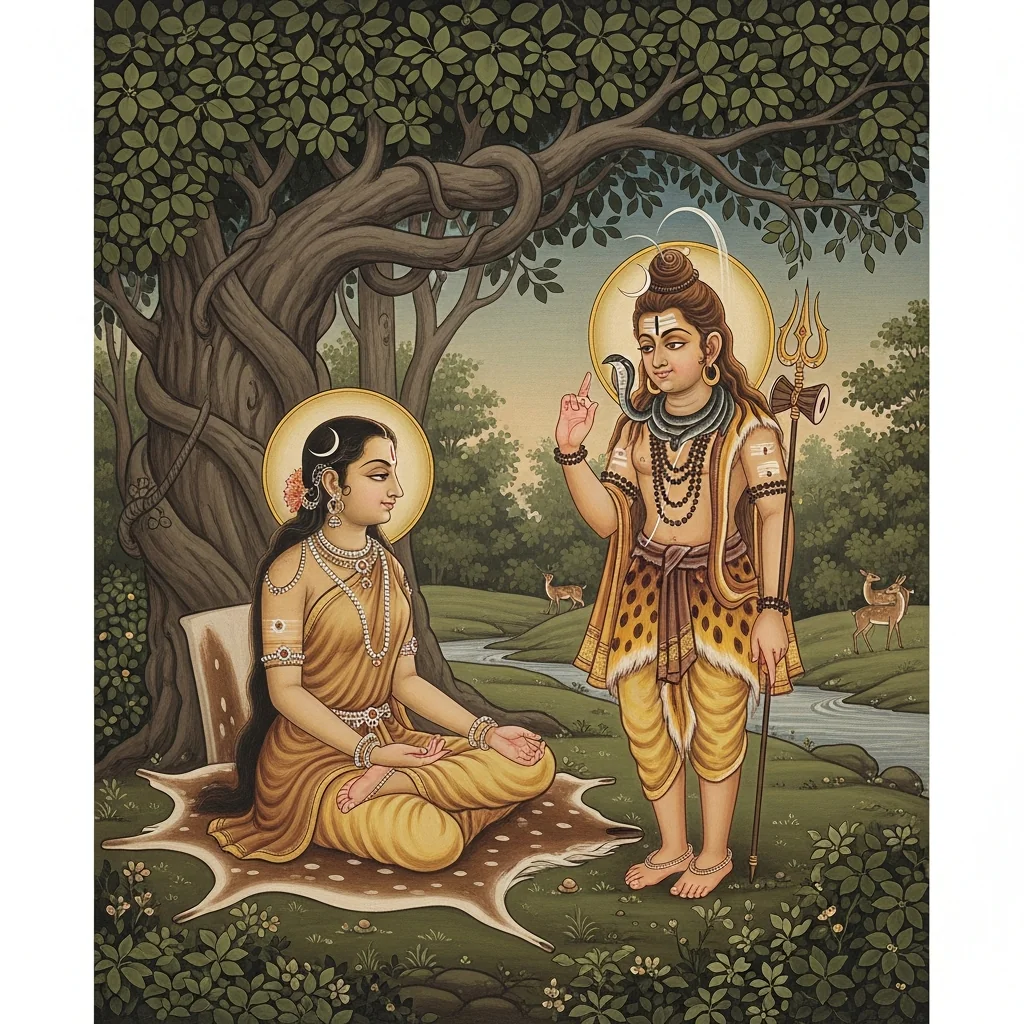
Chapter 22 begins with Sūta describing the devas—led by Brahmā and Viṣṇu—approaching Śiva, who sits in profound samādhi amid his gaṇas, adorned with serpent-ornaments and ascetic emblems. The devas praise him with Veda-toned hymns; when Nandī asks their purpose, they petition deliverance from the asura Tāraka, declaring that only Śiva’s son can defeat him. Śiva answers by turning their plea into ethical and contemplative instruction: abandon kāma (desire) and krodha (anger), beware delusion born of passion, and then he returns to meditation. The narrative shifts to Pārvatī’s tapas, which draws Śiva forth; he tests her resolve by appearing as a brahmacārin (baṭu) who disparages Śiva as inauspicious and socially marginal. Pārvatī (through her companions) rejects the slander, whereupon Śiva reveals his true form and offers a boon. Pārvatī asks for a formal marriage, to be arranged through Himālaya, so divine aims may be fulfilled—including the birth of Kumāra for Tāraka’s downfall. Śiva gives a cosmological-philosophical discourse on the guṇas, prakṛti–puruṣa, and the māyā-conditioned nature of the manifest world, yet agrees—“by worldly convention”—to proceed. The chapter ends with Himālaya’s arrival, familial rejoicing, and a movement toward domestic life as Pārvatī remains inwardly fixed on Śiva.
Shlokas
Verse 1
सूत उवाच । एवमुक्तास्तदा देवा विष्णुना परमेष्ठिना । जग्मुः सर्वे महेशं च द्रष्टुकामाः पिनाकिनम्
Sūta said: Thus addressed at that time by Viṣṇu, the exalted one, all the gods set out to see Maheśa—Pinākin (Śiva who bears the bow).
Verse 2
परे पारे परमेण समाधिना । योगपीठे स्तितं शंभुं गणैश्च परिवारितम्
There, on the farthest shore (of transcendence), in supreme samādhi, they beheld Śambhu seated upon the yogic seat, surrounded by his gaṇas.
Verse 3
यज्ञोपवितविधिना उरसा बिभ्रंत वृतम् । वासुकिं सर्पराजं च कंबलाश्वतरौ तथा
They beheld him wearing, in the proper manner, the sacred thread across his chest; and (as ornaments) Vāsuki, the king of serpents, as well as Kambala and Aśvatara.
Verse 4
कर्णद्वये धारयंतं तथा कर्कोटकेन हि । पुलहेन च बाहुभ्यां धारयंतं च कंकणे
They beheld him wearing (serpents) upon both ears—indeed Karkoṭaka—and also bearing Pulaha upon his arms as bracelets.
Verse 5
सन्नृपुरे शङ्खकपद्मकाभ्यां संधारयंतं च विराजमानम् । कर्पूरगौरं शितिकंठमद्भुतं वृपान्वितं देववरं ददर्शुः
There, in that divine city, they beheld the supreme God shining gloriously, bearing conch and lotus; wondrous, camphor-white in radiance, blue-throated, and endowed with majesty.
Verse 6
तदा ब्रह्मा च विष्णुश्च ऋषयो देवदानवाः । तुष्टुवुर्विविधैः सूक्तैर्वेदोपनिपदन्वितैः
Then Brahmā and Viṣṇu, the sages, and the hosts of gods and dānavas praised (him) with many hymns, rich with the spirit of the Veda and the Upaniṣads.
Verse 7
ब्रह्मोवाच । नमो रुद्राय देवाय मदनांतकराय च । भर्गाय भूरिभाग्याय त्रिनेत्राय त्रिविष्टषे
Brahmā said: Salutations to Rudra, the divine Lord, the destroyer of Madana; to Bharga, the greatly auspicious one; to the three-eyed, and to him who is praised in heaven.
Verse 8
शिपिविष्टाय भीमाय शेषशायिन्नमोनमः । त्र्यंबकाय जगद्धात्रे विश्वरूपाय वै नमः
Salutations again and again to Śipiviṣṭa, to the Terrible One, to the one who reclines upon Śeṣa; salutations indeed to Tryambaka, the sustainer of the world, the one whose form is the universe.
Verse 9
त्वं धाता सर्वलोकानां पिता माता त्वमीश्वरः । कृपया परया युक्तः पाह्यस्मांस्त्वं महेश्वर
You are the ordainer of all worlds; you are father and mother—you are the Lord. Endowed with supreme compassion, protect us, O Maheśvara.
Verse 10
इत्थं स्तुवत्सु देवेषु नन्दी प्रोवाच तान्प्रति । किमर्थमागता यूयं किं वा मनसि वर्तते
As the gods were praising in this way, Nandī spoke to them: “For what purpose have you come, and what is it that rests in your minds?”
Verse 11
ते प्रोचुर्देवकार्यार्थं विज्ञप्तुं शंभुमागता । विज्ञप्तो नंदिना तेन शैलादेन महात्मना । ध्यानस्थितो महादेवः सुरकार्यार्थसिद्धये
They replied, “We have come to petition Śambhu for the sake of the gods’ task.” Informed by Nandī—Śilāda’s great-souled son—Mahādeva, abiding in meditation, (turned) for the accomplishment of the gods’ purpose.
Verse 12
ब्रह्मादयः सुग्गणाः सुरसिद्धसंघास्त्वां द्रष्टुमेव सुरवर्य विसेषयंति । कार्य्यार्थिनोऽसुरवरैः परिभर्त्स्यमाना अभ्यागताः सपदि शत्रुभिरर्दिताश्च
Brahmā and the other noble hosts—companies of gods and siddhas—have come, O best of gods, longing to see you. Seeking the accomplishment of their task, harassed by the foremost asuras, they have arrived at once, afflicted by enemies.
Verse 13
तस्मात्त्वया हि देवेश त्रातव्याश्चाधुना सुराः । एवं तेन तदा शंभुर्विज्ञप्तो नंदिना द्विजाः
Therefore, O Lord of the gods, the Devas must now be protected by you. Thus, O twice-born sages, Śambhu was then petitioned in this manner by Nandin.
Verse 14
शनैःशनैरुपरमच्छंभुः परमकोपनः । समाधेः परमात्माऽसावुवाच परमेश्वरः
Gradually, Śambhu—though fiercely wrathful—grew calm. Then the Supreme Self, Parameśvara, emerged from samādhi and spoke.
Verse 15
महादेव उवाच । कस्माद्युयं महाभागा ह्यागता मत्समीपगाः । ब्रह्मादयो ह्यमी देवा ब्रूत कारणमद्य वै
Mahādeva said: “For what reason have you blessed ones come near me? You are the gods beginning with Brahmā—tell me now the cause.”
Verse 16
तदा ब्रह्मा ह्युवाचेदं सुरकार्यं महत्तरम् । तारकेण कृतं शंभो देवानां परमाद्भुतम्
Then Brahmā spoke: “O Śambhu, a very great matter concerning the Devas has occurred—something astonishing has been brought about by Tāraka.”
Verse 17
कष्टात्कष्टतरं देव तद्विज्ञप्तुमिहागताः । हे शंभो तव पुत्रेण औरसेन हतो भवेत् । तारको देवशत्रुश्च नान्यथा मम भाषितम्
“O Lord, a calamity worse than calamity has arisen; we have come here to inform you. O Śambhu, Tāraka—the enemy of the gods—can be slain only by your own true-born son; my statement cannot be otherwise.”
Verse 18
तस्मात्त्वया गिरिजा देव शंभो गृहीतव्या पाणिना दक्षिणेन । पाणिग्रहेणैव महानुभाव दत्ता गिरीन्द्रेण च तां कुरुष्व
Therefore, O divine Śambhu, you must take Girijā by the right hand in marriage. O great-souled one, accept her—she has been given by the lord of mountains—by the very act of hand-taking.
Verse 19
ब्रह्मणो हि वचः श्रुत्वा प्रहसन्नब्रवीच्छिवः । यदा मया कृता देवी गिरिजा सर्वसुन्दरी
Having heard Brahmā’s words, Śiva smiled and said: “When I fashioned the Goddess Girijā—she who is all-beautiful…”
Verse 20
तदा सर्वे सुरेन्द्राश्च ऋषयो मुनयस्तथा । सकामाश्च भविष्यंति अक्षमाश्च परे पथि
“Then all the lords of the Devas, and the Ṛṣis and Munis as well, will become filled with desire—and, on the higher path, they will be unable to endure their restraint.”
Verse 21
मदनो हि मया दग्धः सर्वेषां कार्यसिद्धये । मया ह्यधि कृता तन्वी गिरिजा च सुमध्यमा
“Indeed, I burned Madana for the accomplishment of everyone’s purpose. And I have taken charge of, and directed, the slender-waisted Girijā as well.”
Verse 22
तदानीमेव भो देवाः पार्वती मदनं च सा । जीवयिष्यति भो ब्रह्मन्नात्र कार्या विचारणा
“Even now, O Devas, that Pārvatī will restore Madana to life. O Brahman, there is no need for deliberation in this matter.”
Verse 23
एवं विमृश्य भो देंवाः कार्या कार्यविचारणा । मदनेनैव दग्धेन सुरकार्यं महत्कृतम्
“Thus, O Devas, reflect well and deliberate on what must be done. By Madana—now burnt—great service has already been rendered for the gods.”
Verse 24
यूयं सर्वे च निष्कामा मया नास्त्यत्र संशयः । यथाहं च सुराः सर्वे तथा यूयं प्रयत्नतः
All of you are free from selfish desire—of this I have no doubt. As I am, and as all the gods are, so too are you, through your earnest effort.
Verse 25
तपः परमसंयुक्ताः पारयामः सुदुष्करम् । परमानन्दसंयुक्ताः सुखिनः सर्व एव हि
Endowed with the highest austerity, we accomplish what is most difficult. United with supreme bliss, indeed all of us are happy.
Verse 26
यूयं समाधिना तेन मदनेन च विस्मृतम् । कामो हि नरकायैव तस्मात्क्रोधोऽभिजायते
Through that samādhi you have forgotten Madana. For desire leads only to hell; from it, anger is born.
Verse 27
क्रोधाद्भवति संमोहः संमोहाद्भ्रमते मनः । कामक्रोधौ परित्यज्य भवद्भिः सुरसत्तमैः । सर्वैरेव च मंतव्यं मद्वाक्यं नान्यथा क्वचित्
From anger arises delusion; from delusion the mind goes astray. Therefore, O best of the gods, abandon desire and anger. Let my words be accepted by all—never otherwise, at any time.
Verse 28
एवं विश्राव्य भगवान्स हि देवो वृषध्वजः । सुरान्प्रबोधयामास तथा ऋषिगणान्मुनीन्
Having thus spoken, the Blessed Lord—Śiva, whose banner is the bull—awakened and instructed the gods, and likewise the hosts of sages and ascetics.
Verse 29
तूष्णींभूतोऽभवच्छंभुर्ध्यानमाश्रित्य वै पुनः । आस्ते पुरा यथावच्च गणैश्च परिवारितः
Then Śambhu fell silent once more and, taking refuge again in meditation, remained as before—rightly established—surrounded by his gaṇas.
Verse 30
ध्यानास्थितं च तं दृष्ट्वा नन्दौ सर्वान्विसृज्य तान् । सब्रह्मसेन्द्रान्विबुधानुवाच प्रहसन्निव
Seeing him absorbed in meditation, Nandin dismissed them all, and then addressed the gods—along with Brahmā and Indra—as if smiling.
Verse 31
यतागतेन मार्गेण गच्छध्वं मा विलंबितम् । तथेति मत्वा ते सर्वे स्वंस्वं स्थानमथाऽव्रजन्
“Depart by the very path by which you came—do not delay.” Thinking, “So be it,” they all then went to their respective abodes.
Verse 32
गतेषु तेषु सर्वेषु समाधिस्थोऽभवद्भवः । आत्मानमात्मना कृत्वा आत्मन्येन विचंतयन्
When they all had departed, Bhava (Śiva) remained established in samādhi—making the Self the means of realizing the Self, and contemplating within the Self alone.
Verse 33
परात्परतरं स्वच्छं निर्मलं निरवग्रहम् । निरञ्जनं निराभासं यस्मिन्मुह्यंति सूरयः
Beyond even the beyond is That Reality—utterly clear, stainless, without obstruction; untainted and without any illusory appearance—upon which even the wise seers become bewildered.
Verse 34
भानुर्नभात्यग्निरथो शशी वा न ज्योतिरेवं न च मारुतो न हि । यं केवलं वस्तुविचारतोऽपि सूक्ष्मात्परं सूक्ष्मतरात्परं च
There, neither the sun shines, nor fire, nor the moon; no such ordinary light exists there—nor even the wind. That which, even when examined as “a thing” by subtle inquiry, is beyond the subtle and beyond even the subtlest.
Verse 35
अनिर्द्देश्य मचिन्त्यं च निर्विकारं निरामयम् । ज्ञप्तिमात्रस्वरूपं च न्यासिनो यांति तत्र वै
Indescribable and unthinkable, changeless and free from affliction—of the very nature of pure awareness alone: to That, indeed, the renunciants (nyāsins) attain.
Verse 36
शब्दातीनं निर्गुणं निर्विकारं सत्तामात्रं ज्ञानगम्यं त्वगम्यम् । यत्तद्वस्तु सर्वदा कथ्यते वै वेदातीतैश्चागमैर्मन्त्रभूतैः
Beyond words, without qualities, and changeless—mere Being itself—reachable only by true knowledge, yet not grasped by ordinary means: that Reality is ever spoken of by the transcendent revelations and the Āgamas that are mantra in essence.
Verse 37
तद्वस्तुभूतो भगवान्स ईश्वरः पिनाकपाणिर्भगवान्वृध्वजः । येनैव साक्षान्मकरध्वजो हतस्तपो जुषाणः परमेश्वरः सः
That very Reality is the Blessed Lord, the Sovereign—Śiva, bearing the Pināka bow, marked by the bull-banner. By him, indeed, Makaradhvaja (Kāma) was slain outright—he who delights in austerity, that Supreme Lord.
Verse 38
लोमश उवाच । गिरिजा हि तदा देवी तताप परमं तपः । तपसा तेन रुद्रोऽपि उत्तमं भयमागतः
Lomaśa said: Then, indeed, the Goddess Girijā performed the highest austerity. By that austerity, even Rudra was seized by a great concern.
Verse 39
विजित्य तपसा देवी पार्वती परमेण हि । शम्भुं सर्वार्थदं स्थाणुं केवलं स्वस्वरूपिणम्
By her supreme austerity, Goddess Pārvatī overcame all obstacles and won over Śambhu—the bestower of every good, the Immovable Lord (Sthāṇu), abiding solely in his own essential nature.
Verse 40
यदा जितस्तया देव्या तपसा वृषभध्वजः । समाधेश्चलितो भूत्वा यत्र सा पार्वती स्थिता
When Vṛṣabhadhvaja (Śiva of the bull-banner) was thus won over by the Goddess through her austerity, he was stirred from his deep samādhi and went to where Pārvatī was abiding.
Verse 41
जगाम त्वरितेनैव देवदेवः पिनाकधृक् । तत्रापश्यत्स्थितां देवीं सखीभिः परिवारिताम्
The God of gods, bearer of the Pināka, went swiftly. There he beheld the Goddess standing, surrounded by her companions.
Verse 42
वेदिकोपरि विन्यस्तां यथैव शशिनः कलाम् । स देवस्तां निरीक्ष्याथ बटुर्भूत्वाथ तत्क्षणात्
Placed upon the altar-platform like the crescent of the moon, the God looked upon her—and at that very moment he assumed the form of a young ascetic (baṭu).
Verse 43
ब्रह्मचारिस्वरूपेण महेशो भगवान्भवः । सखीनां मध्यमाश्रित्य ह्युवाच बटुरूपवान् । किमर्थमालिमध्यस्था तन्वी सर्वांगसुन्दरी
Bhagavān Maheśa—Bhava himself—assuming the form of a brahmacārin, stood among her companions and spoke in the guise of a young ascetic: “For what purpose, O slender one of flawless beauty, do you stand here in the midst of your friends?”
Verse 44
केयं कस्य कुतो याता किमर्थं तप्यते तपः । सर्वं मे कथ्यतां सख्यो याथा तथ्येन संप्रति
“Who is she? Whose is she? From where has she come? For what reason is she performing austerity? Tell me everything, O friends—truthfully, here and now.”
Verse 45
तदोवाच जया रुद्रं तपसः कारणं परम्
Then Jayā spoke to Rudra, declaring the highest reason for her austerity.
Verse 46
हिमाद्रेर्दुहितेयं वै तपसा रुद्रमीश्वरम् । प्राप्तुकामा पतित्वन सेय मत्रोपविश्य च
“She is indeed the daughter of Himādri. Desiring to attain Rudra, the Lord, as her husband, she has sat down here and is practicing austerity.”
Verse 47
तपस्तताप सुमहत्सर्वेषां दुरतिक्रमम् । बटो जानीहि मे वाक्यं नान्यथा मम भाषितम्
“She has undertaken a very great austerity, difficult for all to surpass. O young ascetic, know my words—my statement is not otherwise than the truth.”
Verse 48
तच्छत्वा वचनं तस्याः प्रहस्येदमुवाच ह । श्रृण्वतीनां सखीनां वै महेशो बटुरूपवान्
Having heard her words, Maheśa—still in the form of a young ascetic—laughed and spoke as the companions listened.
Verse 49
मूढेयं पार्वती सख्यो न जानाति हिताहितम् । किमर्थं च तपः कार्यं रुद्रपाप्त्यर्थमेव च
O friends, this Pārvatī is deluded; she does not discern what is beneficial and what is harmful. Why should austerity be undertaken—only for the sake of attaining Rudra?
Verse 50
सोऽमंगलः कपाली च श्मशानालय एव च । अशिवः शिवशब्देन भण्यते च वृथाथ वै
He is inauspicious, a skull-bearer, and a dweller in cremation grounds. Though he is ‘not-śiva’ (not auspicious), he is vainly called by the name ‘Śiva’.
Verse 51
अनया हि वृतो रुद्रो यदा सख्यः समेष्यति । तदेयमशुभा तन्वी भविष्यति न संशयः
When Rudra is chosen by her and comes to be with her, O friends, then this slender maiden will surely become unfortunate—of this there is no doubt.
Verse 52
यो दक्षशापाद्विकृतो यज्ञबाह्योऽभवद्विटा । ये ह्यंगभूताः शर्वस्य सर्पा ह्यासन्महाविषाः
O lady, he is the one who, because of Dakṣa’s curse, became deformed and was cast outside the sacrifice. And those that form the limbs/ornaments of Śarva are serpents indeed, terribly venomous.
Verse 53
शवभस्मान्वितो रुद्रः कृत्तिवासा ह्यमंगलः । पिशाचैः प्रमथैर्भूतैरावृतो हि निरंतरम्
Rudra is smeared with the ash of corpses; he wears a hide and is said to be inauspicious—ever and continually surrounded by piśācas, pramathas, and other spirits.
Verse 54
तेन रुद्रेण किं कार्यमनया सुकुमारया । निवार्यतां सखीभिश्च मर्तुकामा पिशाचवत्
What has this delicate maiden to do with that Rudra? Let her friends restrain her—she seems intent on death, like one rushing toward the piśācas.
Verse 55
इंद्रं हित्वा मनोज्ञं च यमं चैव महाप्रभम् । नैरृतं च विशालाक्षं वरुणं च अपां पतिम्
Setting aside Indra the delightful, and Yama the mighty lord, and Nairṛta the wide-eyed one, and Varuṇa, the lord of waters—
Verse 56
कुबेरं पवनं चैव तथैव च विभावसुम् । एवमादीनि वाक्यानि उवाच परमेश्वरः । सखीनां श्रृण्वतीनां च यत्र सा तपसि स्थिता
—and Kubera, and Pavana (Vāyu), and likewise Vibhāvasu (Agni). Such and similar words did Parameśvara speak, while her companions listened, at the place where she stood firm in austerity.
Verse 57
इत्याकर्ण्य वचस्तस्य रुद्रस्य बटुरूपिणः । चुकोप च शिवा साध्वी महेशं बटुरूपिणम्
Hearing those words of Rudra, who had assumed the form of a young brahmacārin, the virtuous Śivā grew angry at Maheśa in that baṭu-form.
Verse 58
जये त्वं विजये साध्वि प्रम्लोचेऽप्यथ सुन्दरि । सुलोचने महाभागे समीचीनं कृतं हि मे
“Jaya and Vijaya, O virtuous one; and you too, Pramlocā—O beautiful one; Sulocanā, O greatly fortunate—what I have done is indeed proper.”
Verse 59
किमेतस्य बटोः कार्यं भवतीनामिहाधुना । बटुस्वरूपमास्थाय आगतो देवनिंदकः
“What business has this baṭu with you ladies here and now? Assuming the guise of a baṭu, a slanderer of the gods has come.”
Verse 60
अयं विसृज्यतां सख्यः किमनेन प्रयोजनम् । बटुस्वरूपिणं रुद्रं कुपिता सा ततोऽब्रवीत्
“Let this one be dismissed, friends—what use is he?” Thus, angered, she spoke to Rudra who had taken the form of a baṭu.
Verse 61
बटो गच्छाशु त्वरितो न स्थेयं च त्वयाऽधुना । किमनेन प्रलापेन तव नास्ति प्रयोजनम्
“O baṭu, go quickly—do not remain here now. What is the point of this prattle? You have no purpose here.”
Verse 62
बटुर्निर्भर्त्सितस्तत्र तया चैवं तदा पुनः । प्रहस्य वै स्थिरो भूत्वा पुनर्वाक्यमथाब्रवीत्
Thus rebuked there by her, the baṭu then laughed, remained steady, and once again spoke these words.
Verse 63
शनैः शनैरवितथं विजयां प्रति सत्वरम् । कस्मात्कोपस्तयातन्वि कृतः केनैव हेतुना
“Steadily—yet without fail—success is attained. O slender one, why have you become angry? For what reason has this wrath arisen?”
Verse 64
सर्वेषामपि तद्वाच्यं वचनं सूक्तमेव यत् । यथोक्तेन च वाक्येन कस्मात्तन्वी प्रकोपिता
That statement is fit to be spoken before all, for it is truly well said. Why then, O slender one, have you been angered by words spoken exactly as they were?
Verse 65
यः शंभुरुच्यते लोके भिक्षुको भिक्षुकप्रियः । यदि मे ह्यनृतं प्रोक्तं तदा कोप इहोचितः
Śambhu—known in the world as the beggar, the one dear to beggars—if I have spoken falsehood, then anger here would indeed be justified.
Verse 66
इयं तावत्सुरूपा च विरूपोऽसौ सदाशिवः । विशालाक्षी त्वियं बाला विरूपाक्षो भवस्तथा
She is indeed beautiful, while that Sadāśiva is of strange form. This young maiden is wide-eyed, whereas Bhava is ‘odd-eyed’ as well.
Verse 67
एवंभूतेन रुद्रेण मोहितेयं कथं भवेत् । सभाग्यो हि पतिः स्त्रीणां सदा भाव्यो रतिप्रियः
How could she be infatuated with such a Rudra? For a husband, in truth, should be fortunate and ever desirable to women—one who delights in love.
Verse 68
इयं कथं मोहितास्ति निर्गुणेन युगात्मिका । न श्रुतो न च विज्ञातो न दृष्टः केन वा शिवः
How is she—who embodies the very ages—bewildered by the attributeless One? Śiva has not been heard of, nor truly known, nor seen by anyone at all.
Verse 69
सकामानां च भूतानां दुर्लभो हि सदाशिवः । तपसा परमेणैव गर्वितेयं सुमध्यमा
For beings driven by desire, Sadāśiva is truly hard to attain. This fair-waisted lady has grown proud only through supreme austerity.
Verse 70
निःस्तंभो हि सदा स्थाणुः कथं प्राप्स्यति तं पतिम् । मयोक्तं किं विशालाक्षि कस्मान्मे रुषिताऽधुना
Sthāṇu is ever without support—how will she obtain him as her husband? O wide-eyed one, what have I said that you are angry with me now?
Verse 71
यावद्रोषो भवेन्नॄणां नारीणां च विशेषतः । तेन रोषेण तत्सर्वं भस्मीभूतं भविष्यति
So long as anger arises in people—especially in women—by that very wrath, all of this will be reduced to ashes.
Verse 72
सुकृतं चोर्जितं तन्वि सत्यमेवोदितं सति । कामः क्रोधश्च लोभश्च दंभो मात्सर्यमेव च
O slender one, what I have spoken is truly true: hard-earned merit is amassed—yet it is assailed by desire, anger, greed, hypocrisy, and envy as well.
Verse 73
च प्रपंचश्चतेन सर्वं विनश्यति । तस्मात्तपस्विभिर्युक्तं कामक्रोधादिवर्जनम्
And with that, all worldly entanglement is destroyed. Therefore, for ascetics it is proper to abandon desire, anger, and the like.
Verse 74
यदीश्वरो हृदि मध्ये विभाव्यो मनीषिभिः सर्वदा ज्ञप्तिमात्रः । तदा सर्वैर्मुनिवृत्त्या विभाव्यस्तपस्विभिर्नान्यथा चिंतनीयः
If the Lord is ever to be contemplated by the wise in the very center of the heart as pure awareness alone, then ascetics should contemplate Him with the mind-set of sages, and should not think of Him in any other way.
Verse 75
एतच्छ्रुत्वा वचनं तस्य शंभोस्तदाब्रवीद्विजया तं च सर्वम् । गच्छात्र किंचित्तव नास्ति कार्यं न वक्तव्यं वचनं बालिशान्यत्
Having heard those words of Śambhu, Vijayā then replied to him in full: “Go from here—there is nothing for you to do. Do not speak any more childish words.”
Verse 76
एवं विवदमानं तं बटुरूपं सदाशिवम् । विसर्जयामास तदा विजया वाक्यकोविदा
Thus, as he continued to argue—Sadāśiva in the form of a young brahmacārin—Vijayā, skilled in speech, dismissed him.
Verse 77
तिरोधानं गतः सद्यो महेशो गिरिजां प्रति । अलक्ष्यमाणः सर्वासां सखीनां परमेश्वरः
At once Maheśa passed into concealment, turning toward Girijā—becoming unseen to all her companions, the Supreme Lord.
Verse 78
प्रादुर्बभूव सहसा निजरूपधरस्तदा । यदा ध्यानस्थिता देवी निजध्यानपरा सती
Then, suddenly, he manifested in his own true form—when the Goddess, the virtuous Satī, was seated in meditation, wholly devoted to her inner contemplation.
Verse 79
तदा हृदिस्थो देवेशो बहिर्हृष्टिचरोभवत् । नेत्रे उन्मील्य सा साध्वी गिरिजायतलोचना । अपश्यद्देवदेवेशं सर्वलोकमहेश्वरम्
Then the Lord of gods, who had been abiding within the heart, became manifest outwardly. Opening her eyes, that holy lady—Girijā of wide eyes—beheld the Lord of the gods, the Great Lord of all worlds.
Verse 80
द्विभुजं चैकवक्त्रं कृत्तिवाससमद्भुतम् । कपर्दं चंद्ररेखांकं निवीतं गजचर्मणा
He was wondrous: two-armed and one-faced, clad in a skin-garment; with matted locks marked by the crescent-moon line, and girded with an elephant hide.
Verse 81
कर्णस्थौ हि महानागौ कंबलाश्वतरौ तदा । वासुकिः सर्पराजश्च कृताहारो महाद्युति
At that time, two great serpents—Kambala and Aśvatara—were set at his ears; and Vāsuki, the king of serpents, radiant and well-nourished, (adorned him as well).
Verse 82
वलयानि महार्हाणि तदा सर्पमयानि च । कृतानि तेन रुद्रेण तथा शोभाकराणि च
Then there were precious bracelets as well—made of serpents—fashioned by that Rudra, and they were likewise bestowers of splendor.
Verse 83
एवंभूतस्तदा शंभुः पार्वतीं प्रति चाग्रतः । उवाच त्वरया युक्तो वरं वरय भामिनि
Then Śambhu, being in such a state, spoke to Pārvatī who stood before him; urged on with haste he said, “O fair lady, choose a boon—ask what you desire.”
Verse 84
व्रीडया परया युक्ता साध्वी प्रोवाच शंकरम् । त्वं नाथो मम देवेश त्वया किं विस्मृतं पुरा
Filled with profound modesty, the virtuous lady spoke to Śaṅkara: “You are my Lord, O God of gods—what, then, have you forgotten of what was done in former times?”
Verse 85
दक्षयज्ञविनाशं च यदर्थं कृतवान्प्रभो । स त्वं साहं समुत्पन्ना मेनायां कार्यसिद्धये
“O Lord, for the very purpose for which you once brought about the destruction of Dakṣa’s sacrifice—here you stand, and here am I, reborn from Menā, so that that divine aim may be fulfilled.”
Verse 86
देवानां देवदेवेश तारकस्य वधं प्रति । भवतो हि मया देव भविष्यति कुमारकः
“O God of gods, for the sake of the gods and for the slaying of Tāraka: from you and from me, O Lord, a son will surely be born.”
Verse 87
तस्मात्त्वया हि कर्तव्यं मम वाक्यं महेश्वर । गंतव्यं हिमवत्पार्श्व नात्र कार्या विचारणा
“Therefore, O Maheśvara, you must do as I say: you should go to Himavat’s side—there is no need for deliberation in this.”
Verse 88
याचस्व मां महादेव ऋषिभिः परिवारितः । करिष्यति न संदेहस्तव वाक्यं च मे पिता
“O Mahādeva, ask for my hand, surrounded by the ṛṣis. Without doubt my father will grant your request and honor your word.”
Verse 89
दक्षकन्या पुराहं वै पित्रा दत्ता यदा तव । यथोक्तविधिना तत्र विवाहो न कृतस्त्वया
Formerly, when I was Dakṣa’s daughter and my father gave me to you, you did not perform the marriage there according to the prescribed rite.
Verse 90
न ग्रहाः पूजितास्तेन दक्षेण च महात्मना । ग्रहाणां विषयत्वेन सच्छिद्रोऽयं महानभूत्
And the great-souled Dakṣa did not worship the grahas (planetary powers). Since the grahas were treated as a matter of neglect, this great affair became defective, full of a breach.
Verse 91
तस्माद्यथोक्तविधिना कर्तुमर्हसि सुव्रत । विवाहं स्वं महाभाग देवानां कार्यसिद्धये
Therefore, O you of noble vow, O fortunate one, you should have your own marriage performed according to the prescribed rite, for the accomplishment of the gods’ purpose.
Verse 92
तदोवाच महाबाहो गिरिजां प्रहसन्निव । स्वभावेनैव तत्सर्वं जंगमाजंगमं महत् । जातं त्वया मोहितं च त्रिगुणैः परिवेष्टितम्
Then the mighty-armed Lord replied to Girijā, as though smiling: “By your own nature, all this vast world—moving and unmoving—has come into being; and it is also deluded, wrapped about by the three guṇas.”
Verse 93
अहंकारात्समुत्पन्नं महत्तत्त्वं च पार्वति । महत्तत्त्वात्तमो जातं तमसा वेष्टितं नभः
From ahaṃkāra (egoity) arises the principle of Mahat, O Pārvatī. From Mahat, tamas—darkness—is born; and space (nabhas) becomes enveloped by that darkness.
Verse 94
भसो वायुरुत्पन्नो वायोरग्निरजायत । अग्नेरापः समुत्पन्ना अद्भ्यो जाता मही तदा
From that primal basis arose the wind; from wind, fire was born. From fire the waters issued forth; and from the waters, the earth then emerged.
Verse 95
मह्यादिकानि स्थास्नूनि चराणि च वरानने । दृश्यंयत्सर्वमेवैतन्नश्वरं विद्धि मानिनि
O fair-faced one, earth and all the rest—both the immovable and the moving—whatever is seen: know all this to be perishable, O proud lady.
Verse 96
एकोऽनेकत्वमापन्नो निर्गुणो हि गुणावृतः । स्वज्योतिर्भाति यो नित्यं परज्योत्स्नान्वितोऽभवत् । स्वतंत्रः परतंत्रश्च त्वया देवि महत्कृतम्
The One has come to appear as many; the attributeless is, as it were, veiled by attributes. He who ever shines by his own light came to be accompanied by another’s radiance. The independent became dependent—this great transformation has been wrought by you, O Goddess.
Verse 97
मायामयं कृतमिदं च जगत्समग्रं सर्वात्मना अवधृतं परया च बुद्ध्या । सर्वात्मभिः सुकृतिभिः परमार्थभावैः संसक्तिरिंद्रियगणैः परिवेष्टितं च
This entire universe has been fashioned as a work of Māyā, and is upheld by the Supreme Self and by transcendent intelligence. Even the meritorious who abide in the highest truth find themselves entangled—surrounded by the hosts of senses.
Verse 98
के ग्रहाः के उडुगणाः के बाध्यंते त्वया कृताः । विमुक्तं चाधुना देवि शर्वार्थं वरवर्णिनि
Which planets, which constellations, and which beings have been constrained—made so by you? And now, O Goddess, what has been released for Śarva’s purpose, O most beautiful one?
Verse 99
गुणकार्यप्रसंगेन आवां प्रादुर्भवः कृतः । त्वं हि वै प्रकृतिः सूक्ष्मा रजःसत्त्वतमोमयी
Through the unfolding of the guṇas and their effects, our manifestation has been brought about. For you indeed are subtle Prakṛti—constituted of rajas, sattva, and tamas.
Verse 100
व्यापारदक्षा सततमहं चैव सुमध्यमे । हिमालयं न गच्छामि न याचामि कथंचन
I, ever skilled in carrying out tasks, O slender-waisted one, do not go to the Himālaya, nor do I beg in any way at all.
Verse 101
देहीति वचनात्सद्यः पुरुषो याति लाघवम् । इत्थं ज्ञात्वा च भो देवि किमस्माकं वदस्व वै
At the mere command ‘Give!’, a man at once becomes lightened (of burden). Knowing thus, O Goddess, tell us indeed: what should we do?
Verse 102
कार्यं त्वदाज्ञया भद्रे तत्सर्वं वक्तुमर्हसि । तेनोक्तात्र तदा साध्वी उवाच कमलेक्षणा
“What is to be done by your command, O auspicious lady—please declare all of that.” Thus addressed there, the virtuous, lotus-eyed Lady then spoke.
Verse 103
त्वमात्मा प्रकृतिश्चाहं नात्र कार्या विचारणा । तथापि शंभो कर्तव्यं मम चोद्वहनं महत्
“You are the Supreme Self, and I am Prakṛti; there is no need for deliberation about this. Even so, O Śambhu, you must perform the great act of formally bearing (accepting) me in marriage.”
Verse 104
देहो ह्यविद्ययाक्षिप्तो विदेहो हि भवान्परः । तथाप्येवं महादेव शरीरावरणं कुरु
This body is truly cast into existence by ignorance, while You are the transcendent, bodiless One. Even so, O Mahādeva, assume a covering of flesh.
Verse 105
प्रपंचरचनां शंभो कुरु वाक्यान्मम प्रभो । याचस्व मां महादेव सौभाग्यं चैव देहि मे
O Śambhu, O Lord—fashion the order of the world according to my words. O Mahādeva, ask for my hand and grant me auspicious marital fortune.
Verse 106
इत्येवमुक्तः स तया महात्मा महेश्वरो लोकविडंबनाय । तथेति मत्वा प्रहसञ्जगाम स्वमालयं देववरैः सुपूजितः
Thus addressed by her, that great-souled Maheśvara—wishing to enact the divine play for the world—assented, saying, “So be it.” Smiling, and greatly honored by the foremost of the gods, he departed to his own abode.
Verse 107
एतस्मिन्नंतरे तत्र हिमवान्गिरिभिः सह । मेनया भार्यया सार्द्धमाजगाम त्वरान्वितः
Meanwhile, at that very time, Himavān arrived there in haste, accompanied by the mountains and together with his wife Menā.
Verse 108
पार्वतीदर्शनार्थं च सुतैश्च परिवारितः । तेन दृष्टा महादेवी सखीभिः परिवारिता
Seeking the sight of Pārvatī, and surrounded by his sons, he beheld the Great Goddess, who was surrounded by her companions.
Verse 109
पार्वत्या च तदा दृष्टो हिमवान्गिरिभिः सह । अभ्युत्थानपरा साध्वी प्रणम्य शिरसा तदा । पितरौ च तदा भ्रातॄन्बंधूंश्चैव च सर्वशः
Then Pārvatī beheld Himavān together with the mountains. The virtuous lady, intent on rising in reverence, bowed her head and at that time paid homage to her parents, her brothers, and all her kinsfolk in every way.
Verse 110
स्वमंकमारोप्य महायशास्तदा सुतां परिष्वज्य च बाष्पपूरितः । उवाच वाक्यं मधुरं हिमालयः किं वै कृतं साध्वि यथा तथेन
Then the illustrious Himālaya lifted his daughter onto his lap and embraced her, his eyes brimming with tears. Speaking sweetly, he said: “O good lady, what indeed has happened—why are matters thus?”
Verse 111
तत्कथ्यतां महाभागे सर्वं शुश्रूषतां हि नः । तच्छ्रुत्वा मधुरं वाक्यमुवाच पितरं प्रति
“O most fortunate one, let it all be told; we are eager to listen.” Hearing these sweet words, she spoke in reply to her father.
Verse 112
तपसा परमेणैव प्रार्थितो मदनांतकः । शांतं च मे महात्कार्यं सर्वेषामपि दुर्ल्लभम्
She said: “By supreme austerity alone I entreated Madanāntaka (the slayer of Kāma). And my great undertaking—so hard for all beings to achieve—has been brought to a peaceful fulfillment.”
Verse 113
तत्र तुष्टो महादेवो वरणार्थं समागतः । स मयोक्तस्तदा शंभुर्ममषाणिग्रहः कथम्
There, Mahādeva—well pleased—came for the purpose of accepting the bride. Then I addressed Śambhu: “How shall my hand be given in marriage?”
Verse 114
क्रियते च तदा शंभो मम पित्रा विनाधुना । यतागतेन मार्गेण गतोऽसौ त्रिपुरांतकः
“And now, O Śambhu, my father is performing the rite without you. Tripurāntaka has departed by the very path by which he came.”
Verse 115
तस्यास्तद्वचनं श्रुत्वा अवाप परमां मुदम् । बंधुभिः सह धर्मात्मा उवाच स्वसुतां पुनः
Hearing her words, the righteous one was filled with supreme joy; and, together with his kinsmen, he spoke again to his own daughter.
Verse 116
स्वगृहं चाद्य गच्छामो वयं सर्वे च भूधराः । अनया राधितो देवः पिनाकी वृषभध्वजः
“Let us all, O lords of the mountains, go today to our own abode. Through her, the God—Pinākī, whose banner is the Bull—has been duly propitiated.”
Verse 117
इत्यूचुस्ते सुराः सर्वे हिमालयपुरोगमाः । पार्वतीसहिताः सर्वे तुष्टुर्वाग्भिरादृताः
So spoke all those gods, with Himālaya at their head; and all of them, together with Pārvatī, praised the Lord with reverent words.
Verse 118
तां स्तूयमानां च तदा हिमालयो ह्यारोप्य चांसं वरवर्णिनीं च । सर्वेथ शैलाः परिवार्य चोत्सुकाः समानयामासुरथ स्वमालयम्
While she was being praised, Himālaya lifted the fair-complexioned maiden onto his shoulder; and all the mountains, eagerly surrounding them, brought her to their own abode.
Verse 119
देवदुंदुभयो नेदुः शंखतूर्याण्यनेकशः । वादित्राणि बहून्येव वाद्यमानानि सर्वशः
Divine kettledrums resounded; conches (śaṅkha) and trumpets rang out again and again. Many instruments were being played everywhere, in every direction.
Verse 120
पुष्पर्षेण महता तेनानीता गृहं प्रति
With a great shower of flowers, she was escorted toward the home.
Verse 121
सा पूज्यमाना बहुभिस्तदानीं महाविभूत्युल्लसिता तपस्विनी । तथैव देवैः सह चारणैश्च महर्षिभिः सिद्धगणैश्च सर्वशः
Then that ascetic maiden, radiant with great splendor, was worshipped by many—by the gods, by the Cāraṇas, by great Ṛṣis, and by hosts of Siddhas on every side.
Verse 122
पूज्यमाना तदा देवी उवाच कमलासनम् । देवानृषीन्पितॄन्यक्षानन्यान्सर्वान्समागतान्
While being honored, the Goddess then addressed Kamalāsana (Brahmā), and also all who had assembled—gods, sages, ancestors (Pitṛs), Yakṣas, and others.
Verse 123
गच्छध्वं सर्व एवैते येन्ये ह्यत्र समागताः । स्वंस्वं स्थानं यताजोषं सेव्यतां परमेश्वरः
“Let all of you who have assembled here now depart. Return, each to your own proper place, and there—according to your station—worship Parameśvara (the Supreme Lord Śiva).”
Verse 124
एवं तदानीं स्वपितुर्गृहं गता संशोभमाना परमेण वर्चसा । सा पार्वती देववरैः सुपूजिता संचिंतयंती मनसा सदाशिवम्
Thus, at that time, Pārvatī returned to her father’s house, radiant with supreme splendor. Reverently honored by the foremost of the gods, she kept contemplating Sadāśiva within her heart.