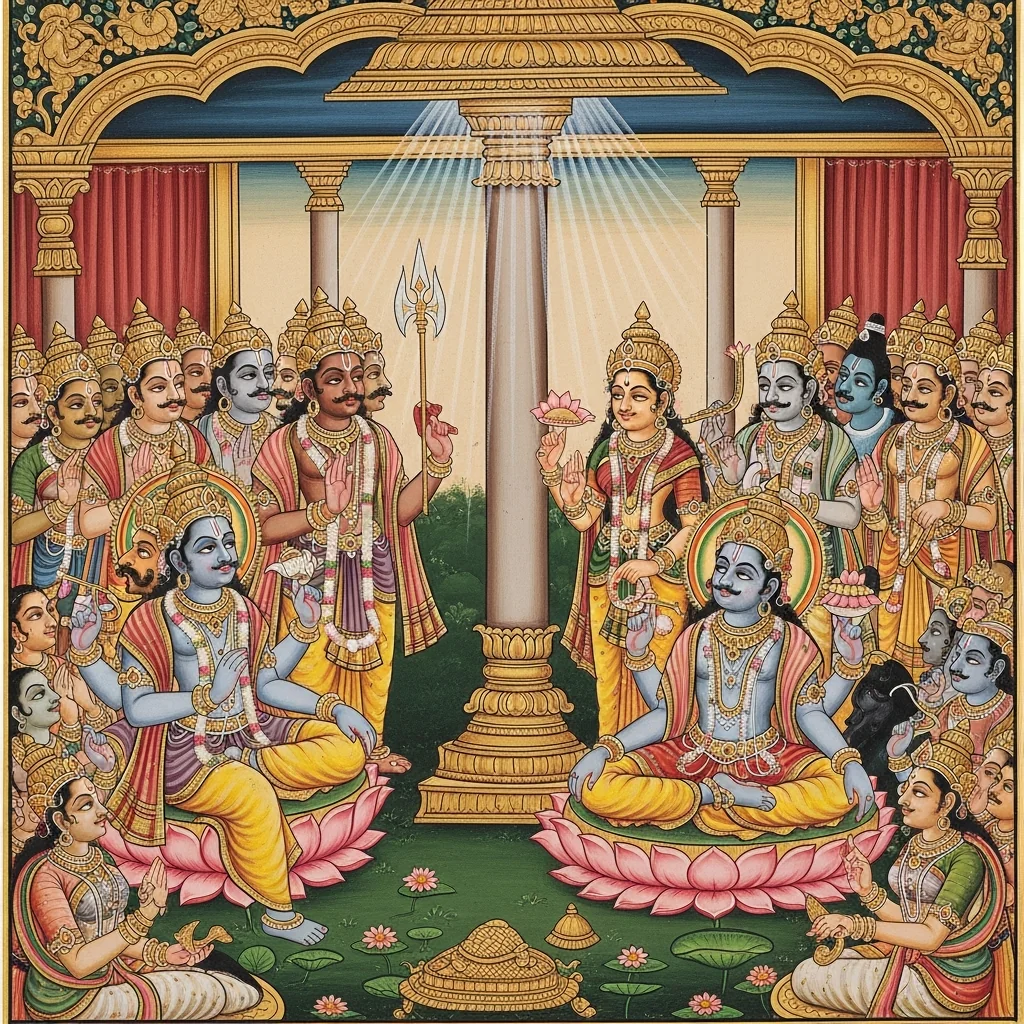
Adhyaya 6
Chapter 6 begins with the sages asking how liṅga-pratiṣṭhā—the establishing of liṅga worship—can proceed when Śiva seems set aside. Lomasha answers by recounting an instructive incident in Dāruvana: Śiva appears as a digambara mendicant, receives alms from the sages’ wives, and draws their attention; when the sages return, they deem it a breach of ascetic order and accuse Śiva of wrongdoing. In response to their curse, Śiva’s liṅga falls to the earth and expands into a cosmic, world-encompassing form, dissolving ordinary divisions of direction, element, and duality. The liṅga is revealed as a theological sign of the Absolute that upholds the cosmos. The gods seek its limits—Viṣṇu downward and Brahmā upward—yet neither finds an end. Brahmā then falsely claims to have seen the summit, with Ketakī and Surabhī offered as witnesses; a bodiless voice exposes the deceit and issues censures that serve as an ethical lesson on misrepresentation and authority. The chapter closes with afflicted gods and sages taking refuge in the liṅga, affirming it as the stabilizing center of devotion and metaphysical meaning.
Shlokas
Verse 1
ऋषय ऊचुः । लिंगे प्रतिष्ठा च कथं शिवं हित्वा प्रवर्तिता । तत्कथ्यतां महाभाग परं शुश्रुषतां हि नः
The sages said: How did the practice of installing and worshiping through the liṅga arise, as though setting aside Śiva in his direct form? O greatly fortunate one, tell us—for we long to hear it in full.
Verse 2
लोमश उवाच । यदा दारुवने शंभुर्भिक्षार्थं प्राचरत्प्रभुः
Lomaśa said: When, in the Dāru forest, the Lord Śambhu wandered forth seeking alms—
Verse 3
दिगंबरो मुक्तजटाकलापो वेदांतवेद्यो भुवनैकभर्ता । स ईश्वरो ब्रह्मकलापधारो योगीश्वराणां परमः परश्च
Sky-clad, with his matted locks unbound; known through Vedānta, the sole sustainer of the worlds—he, the Lord, bearer of the whole treasury of sacred knowledge, is supreme among the lords of yogins, and higher still beyond the highest.
Verse 4
अणोरणीयान्महतो मही यान्महानुभावो भुवनाधिपो महान् । स ईश्वरो भिक्षुरूपी महात्मा भिक्षाटनं दारुवने चकार
Smaller than the smallest, greater than the greatest; of boundless majesty, the great Lord of the worlds—he, the Lord, that great-souled one, assumed the form of a mendicant and undertook the alms-wandering in the Dāru forest.
Verse 5
मध्याह्न ऋषयो विप्रास्तीर्थं जग्मुः स्वकाश्रमात् । तदानीमेव सर्वास्ता ऋषीभार्याः समागताः
At midday the sage-brāhmaṇas went from their own hermitages to the tīrtha, the sacred bathing place; at that very time all the sages’ wives assembled there.
Verse 6
विलोकयंत्यः शंभुं तमाचख्युश्च परस्परम् । कोऽसौ भिक्षुकरूपोयमागतोऽपूर्वदर्शनः
Gazing upon Śambhu, they said to one another: “Who is this one, come here in the form of a beggar—of a sight never seen before?”
Verse 7
अस्मै भिक्षां प्रयच्छामो वयं च सखिभिः सह । तथेति गत्वा सर्वास्ता गृहेभ्य आनयन्मुदा
“Let us give him alms, we together with our companions.” Saying, “So be it,” all those women went to their homes and, with joy, brought back offerings of alms.
Verse 8
भिक्षान्नं विविधं श्लक्ष्णं सोपचारं च शक्तितः । प्रदत्तं भिक्षितं तेन देवदेवेन शूलिना
According to their ability, they offered various fine, delicate foods as alms, together with due courtesies; and that alms-food was accepted and eaten by the Trident-bearing Lord, the God of gods.
Verse 9
काचित्प्रियतमं शंभुं बभाषे विस्मयान्विता । कोसि त्वं भिक्षुको भूत्वा आगतोत्र महामते
Then one woman, astonished, spoke to her beloved Śambhu: “Who are you, O great-minded one, that you have come here in the guise of a beggar?”
Verse 10
ऋषीणामाश्रमं शुद्धं किमर्थं नो निषीदसि । तयोक्तोऽपि तदा शंभुर्बभाषे प्रहसन्निव
“This is the pure hermitage of the sages—why do you not sit and rest?” Though addressed thus by her, Śambhu then replied, as if smiling.
Verse 11
ईश्वरोहं सुकेशांते पावनं प्राप्तवानिमम् । ईश्वरस्य वचः श्रुत्वा ऋषिभार्या उवाच तम्
He said: “I am Īśvara, O fair-haired one; I have come to this purifying place.” Hearing the words of Īśvara, the sage’s wife spoke to him.
Verse 12
ईश्वरोऽसि महाभाग कैलासपतिरेव च । एकाकिनः कथं देव भिक्षार्थमटनं तव
She said: “You are indeed Īśvara, O fortunate one—Kailāsa’s Lord as well. How is it, O Deva, that you wander alone for the sake of alms?”
Verse 13
एवमुक्तस्तया शंभुः पुनस्तामब्रवीद्वचः । दाक्षायण्या विरहितो विचरामि दिगंबरः
Thus addressed by her, Śambhu spoke again: “Separated from Dākṣāyaṇī, I wander as a digambara ascetic, clad in the sky.”
Verse 14
भिक्षाटनार्थं सुश्रोणि संकल्परहितः सदा । तया सत्या विना किंचित्स्त्रीमात्रं मम भामिनि । न रोचते विशालाक्षि सत्यं प्रतिवदामि ते
“For the sake of alms-wandering, O fair-hipped one, I remain ever free of worldly intent. Without that Satī, O passionate lady, no mere woman pleases me. O wide-eyed one, I speak this truth to you.”
Verse 15
तस्योक्तं वचनं श्रुत्वा उवाच कमलेक्षणा । स्त्रियो हि सुखसंस्पर्शाः पुरुषस्य न संशयः
Hearing his words, the lotus-eyed woman replied: “Women are indeed pleasant to touch for a man—of this there is no doubt.”
Verse 16
तास्स्त्रियो वर्जिताः शंभो त्वादृशेन विपश्चिता
“Therefore, O Śambhu, women are to be avoided by a discerning man such as you.”
Verse 17
इति च प्रमदाः सर्वा मिलिता यत्र शंकरः । भिक्षापात्रं च तच्छंभोः पूरितं च महागुणैः
Thus all the noble women gathered where Śaṅkara was, and Śambhu’s alms-bowl was filled—abundantly endowed with excellent offerings and virtues.
Verse 18
अन्नैश्चतुर्विधैः षड्भी रसैश्च परिपूरितम् । यदा संभुर्गंतुकामः कैलासं पर्वतं प्रति । तदा सर्वा विप्रपत्न्यो ह्यन्गच्छन्मुदान्विताः
It was filled with the four kinds of foods and made complete with the six tastes. When Śambhu (Śiva) wished to depart toward Mount Kailāsa, then all the wives of the brāhmaṇas went along, their hearts brimming with joy.
Verse 19
गृहकार्यं परित्यज्य चेरुस्तद्गतमानसाः । गतासु तासु सर्वासु पत्नीषु ऋषिसत्तमाः
Abandoning their household duties, they moved on with minds fixed upon him. And when all those wives had gone, the foremost of sages (returned) and found them gone.
Verse 20
यावदाश्रममभ्येत्य तावच्छून्यं व्यलोकयन् । परस्परमथोचुस्ते पत्न्यः सर्वाः कुतो गताः
When they came back to the hermitage, they saw it empty. Then they said to one another, “Where have all our wives gone?”
Verse 21
न विदामोऽथ वै सर्वाः केन नष्टेन चाहृताः । एवं विमृश्यमानास्ते विचिन्वंतस्ततस्ततः
They said, “We do not know at all—by whom have they been taken away and made to vanish?” Thus reflecting, they searched here and there.
Verse 22
समपश्यंस्ततः सर्वे शिवस्यानुगताश्च ताः । शिवं दृष्ट्वा तु संप्राप्ता ऋषयस्ते रुषान्विताः
Then they all saw those women following after Śiva. And on seeing Śiva, those sages approached—filled with anger.
Verse 23
शिवस्याथाग्रतो भूत्वा ऊचुः सर्वे त्वरान्विताः । किं कृतं हि त्वया शंभो विरक्तेन महात्मना । परदारापहर्त्तासि त्वमृषीणां न संशयः
Standing before Śiva, they all spoke in haste: “O Śambhu, great-souled and detached—what is this you have done? You are a stealer of other men’s wives, even of the sages; there is no doubt!”
Verse 24
एवं क्षिप्तः शिवो मौनी गच्छमानोऽपि पर्वतम् । तदा स ऋषिभिः प्राप्तो महादेवोऽव्ययस्तथा । यस्मात्कलत्रहर्ता त्वं तस्मात्षंढो भव त्वरम्
Thus rebuked, the silent Śiva continued on toward the mountain. Then that imperishable Mahādeva was confronted by the sages, who said: “Since you are a stealer of spouses, therefore become impotent at once!”
Verse 25
एवं शप्तः स मुनिभिर्लिंगं तस्यापतद्भुवि । भूमिप्राप्तं च तल्लिंगं ववृधे तरसा महत्
Thus cursed by the sages, his liṅga fell upon the earth. And once it touched the ground, that liṅga rapidly grew immense.
Verse 26
आवृत्य सप्त पातालान्क्षणाल्लिंगमदोर्ध्वतः । व्याप्य पृथ्वीं समग्रां च अंतरिक्षं समावृणोत्
In an instant the liṅga rose upward, covering the seven netherworlds; and, pervading the entire earth, it enveloped even the mid-space (atmosphere).
Verse 27
स्वर्गाः समावृताः सर्वे स्वर्गातीतमथाभवत् । न मही न च दिक्चक्रं न तोयं न च पावकः
All the heavens were veiled over, and it became something beyond even heaven. There was no earth, no compass of directions, no water, and no fire.
Verse 28
न च वायुर्न वाकाशं नाहंकारो न वा महत् । न चाव्यक्तं न कालश्च न महाप्रकृतिस्तथा
There was no wind, no ether; neither the ego-principle (ahaṃkāra) nor the great cosmic principle (mahat). There was no unmanifest (avyakta), no time, and likewise no Mahāprakṛti.
Verse 29
नासीद्द्ववैतविभागं च सर्वं लीनं च तत्क्षणात् । यस्माल्लीनं जगत्सर्वं तस्मिंल्लिगे महात्मनः
No division of duality remained; in that very instant everything dissolved. Since the entire universe dissolved into it—into that liṅga of the Great-Souled One—
Verse 30
लयनाल्लिंगमित्येवं प्रवदंति मनीषिणः । तथाभूतं वर्द्धमानं दृष्ट्वा तेऽपि सुरर्षयः
“Because it is the place of dissolution (laya), it is called liṅga”—so declare the wise. Seeing it in that state, ever increasing, even the divine sages—
Verse 31
ब्रह्मेंद्रविष्णुवाय्यग्निलोकपालाः सपन्नगाः । विस्मयाविष्टमनसः परस्परमथाब्रुवन्
Brahmā, Indra, Viṣṇu, Vāyu, Agni, the guardians of the worlds (lokapālas)—together with the nāga serpent beings—astonished in mind, then spoke among themselves.
Verse 32
किमायामं च विस्तारं क्व चांतः क्व च पीठिका । इति चिंतान्विता विष्णुमूचुः सर्वे सुरास्तदा
“What is its length and breadth? Where is its end, and where its base?”—thus, filled with concern, all the gods then spoke to Viṣṇu.
Verse 33
देवा ऊचुः । अस्य मूलं त्वया विष्णो पद्मोद्भव च मस्तकम् । युवाभ्यां च विलोक्यं स्यात्स्थाने स्यात्परिपालकौ
The gods said: “O Viṣṇu, seek its root; and you, O Lotus-born (Brahmā), its summit. Let it be examined by you two; remain in your own stations as guardians.”
Verse 34
श्रुत्वा तु तौ महाभागौ वैकुंठकमलोद्भवौ । विष्णुर्गतो हि पातालं ब्रह्मा सर्वर्गं जगाम ह
Hearing this, those two fortunate ones—Viṣṇu, Lord of Vaikuṇṭha, and the Lotus-born (Brahmā)—set forth: Viṣṇu went down to Pātāla, while Brahmā went to heaven.
Verse 35
स्वर्गं गतस्तदा ब्रह्मा अवलोकनतत्परः । नापस्यत्तत्र लिंगस्य मस्तकं च विचक्षमः
Then Brahmā went to heaven, intent on searching; yet, though discerning, he did not see there the summit of that liṅga.
Verse 36
तथा गतेन मार्गेण प्रत्यावृत्त्याब्जसंभवः । मेरुपृष्ठमनुप्राप्तः सुरभ्या लक्षितस्ततः
Returning by the very path he had gone, the Lotus-born (Brahmā) came upon the ridge of Meru; there he was noticed by Surabhī.
Verse 37
स्थिता या केतकीच्छायामुवाच मधुरं वचः । तस्या वचनमाकर्ण्य सर्वलोकपितामहः । उवाच प्रहसन्वाक्यं छलोक्त्या सुरभिं प्रति
Standing in the shade of the ketakī plant, she spoke sweet words. Hearing her speech, the Grandfather of all the worlds (Brahmā) laughed and, with deceitful intent, addressed Surabhī.
Verse 38
लिंगं महाद्भुतं दृष्टं येनव्याप्तं जगत्त्रयम् । दर्शनार्थं च तस्यांतं देवैः संप्रेषितोस्मयहम्
I have beheld a greatly wondrous Liṅga, pervading the three worlds; and to behold its farthest end, the gods sent me forth.
Verse 39
न दृष्टं मस्तकं तस्य व्यापकस्य महात्मनः । किं वक्ष्येऽहं च देवाग्रे चिंता मे चाति वर्तते
I did not behold the head of that all-pervading Great One. What shall I say before the gods? A mighty anxiety overwhelms me.
Verse 40
लिंगस्य मस्तकं दृष्टं देवानां च मृषा वदेः । ते सर्वे यदि वक्ष्यंति इंद्राद्या देवतागणाः
“I shall falsely tell the gods that I have seen the head of the Liṅga—if all the hosts of deities, beginning with Indra, will say the same in support.”
Verse 41
ते संति साक्षिमो देवा अस्मिन्नर्थे वदत्वरम् । अर्थेऽस्मिन्भव साक्षी त्वं केतक्या सह सुव्रते
“Those gods are witnesses in this matter—speak quickly in support. In this affair, you too must be a witness, O virtuous one, together with the ketakī.”
Verse 42
तद्वचः शिरसा गृह्य ब्रह्मणः परमेष्ठिनः । केतकीसहिता तत्र सुरभी तदमानयत्
Bowing her head and accepting those words of Brahmā, the Supreme Lord (Parameṣṭhin), Surabhī there brought the ketakī along, as instructed.
Verse 43
एवं समागतो ब्रह्म देवाग्रे समुवाच ह
Thus, having arrived, Brahmā spoke in the presence of the gods.
Verse 44
ब्रह्मोवाच । लिंगस्य मस्तकं देवा दृष्टवानहमद्भुतम् । समीचीनं चार्तितं च केतकीदल संयुतम्
Brahmā said: “O gods, I have seen the wondrous head of the Liṅga—well-formed and adorned, furnished with ketakī petals.”
Verse 45
विशालं विमलं श्लक्ष्णं प्रसन्नतरमद्भुतम् । रम्यं च रमणीयं च दर्शनीयं महाप्रभम्
“Vast, spotless, smooth, and exceedingly radiant—wondrous; charming and most delightful, worthy of beholding, and of great splendor.”
Verse 46
एतादृशं मया दृष्टं न दृष्टं तद्विनाक्वचित् । ब्रह्मणो हि वचः श्रुत्वा सुरा विस्मयमाययुः
“Such a sight I have seen—never have I seen anything like it anywhere else.” Hearing Brahmā’s words, the gods were struck with astonishment.
Verse 47
एवं विस्मयपूर्णास्ते इंद्राद्या देवतागणाः । तिष्ठंति तावत्सर्वेशो विष्णुरध्यात्मदीपकः
Thus, filled with wonder, Indra and the hosts of gods stood there. And for that time, Viṣṇu—the Lord of all, a lamp of inner spiritual discernment—remained present.
Verse 48
पातालादागतः सद्यः सर्वेषामवदत्त्वरम् । तस्याप्यंतो न दृष्टो मे ह्यवलोकनतत्परः
Returning at once from Pātāla, he urgently declared to all: “Though I was intent on searching and beholding, I did not see its end.”
Verse 49
विस्मयो मे महाञ्जातः पातालात्परतश्चरन् । अतलं सुतलं चापि नितलं च रसातलम्
Great astonishment arose in me as I traveled beyond Pātāla—past Atala, Sutala, Nitala, and Rasātala.
Verse 50
तथा गतस्तलं चैव पातालं च तथातलम् । तलातलानि तान्येनं शून्यवद्यद्विभाव्यते
So too he went through the regions—Stala, Pātāla, and Atala; and those nether realms appeared, in comparison to Him, as though empty and insignificant.
Verse 51
शून्यादपि च शून्यं च तत्सर्वं सुनिरीक्षितम् । न मूलं च न मध्यं च न चांतो ह्यस्य विद्यते
All that was examined was emptiness beyond emptiness itself; yet of this there is neither root nor middle, nor indeed any end to be found.
Verse 52
लिंगरूपी महादेवो येनेदं धार्यते जगत् । यस्य प्रसादादुत्पन्ना यूयं च ऋषयस्तथा
Mahādeva, in the form of the Liṅga, is He by whom this entire world is upheld. By whose grace you too—O sages—have come into being.
Verse 53
श्रुत्वा सुराश्च ऋषयस्तस्य वाक्यमपूजयन् । तदा विष्णुरुवाचेदं ब्रह्माणं प्रहसन्निव
Hearing those words, the gods and the sages honored them with reverence. Then Viṣṇu spoke to Brahmā, as if with a gentle, knowing smile.
Verse 54
दृष्टं हि चेत्त्वया ब्रह्मन्मस्तकं परमार्थतः । साक्षिणः के त्वया तत्र अस्मिन्नर्थे प्रकल्पिताः
“If indeed you truly saw the summit in the highest truth, O Brahmā, then who were the witnesses you appointed there for this claim?”
Verse 55
आकर्ण्य वचनं विष्णोर्ब्रह्मा लोकपितामहः । उवाच त्वरितेनैव केतकी सुरभीति च
Hearing Viṣṇu’s words, Brahmā—the grandsire of the worlds—quickly replied: “Ketakī and Surabhī.”
Verse 56
ते देवा मम साक्षित्वे जानीहि परमार्थतः । ब्रह्मणो हि वचः श्रुत्वा सर्वे देवास्त्वरान्विताः
“Know in truth that those gods stand as witnesses on my behalf.” Hearing Brahmā’s words, all the gods were filled with urgency and moved to act.
Verse 57
आह्वानं चक्रिरे तस्याः सुरभ्याश्च तया सह । आगते तत्क्षमादेव कार्यार्थं ब्रह्मणस्तदा
They then summoned her, and Surabhī along with her. As soon as they arrived, for the sake of Brahmā’s purpose, the matter was taken up at once.
Verse 58
इंद्राद्यैश्च तदा देवैरुक्ता च सुरभी ततः । उवाच केतकीसार्द्धं दृष्टो वै ब्रह्मणा सुराः
Then Surabhī, addressed by Indra and the other gods, spoke together with Ketakī: “Truly, O gods, the summit was seen by Brahmā.”
Verse 59
लिंगस्य मस्तको देवाः केतकीदलपूजितः । तदा नभोगता वाणी सर्वेषां श्रृण्वतामभूत्
“O gods, the summit of the Liṅga was worshipped with Ketakī petals.” At that moment, a voice moving through the sky arose as all listened.
Verse 60
सुरभ्या चैव यत्प्रोक्तं केतक्या च तथा सुराः । तन्मृषोक्तं च जानीध्वं न दृष्टो ह्यस्य मस्तकः
“O gods, know that what was spoken by Surabhī and likewise by Ketakī is false; for the summit of this Liṅga has not been seen.”
Verse 61
तदा सर्वेऽथ विबुधाः सेंद्रा वै विष्णुना सह । शेपुश्च सुरभीं रोषान्मृषावादनतत्पराम्
Then all the gods—Indra along with Viṣṇu—became enraged and cursed Surabhī, who was intent on speaking falsehood.
Verse 62
मुखेनोक्तं त्वयाद्यैवमनृतं च तथा शुभे । अपवित्रं मुखं तेऽस्तु सर्वधर्मबहिष्कृतम्
“O fair one, since you have spoken such untruth with your mouth, let your mouth be impure and excluded from all dharma.”
Verse 63
सुगंधकेतकी चापि अयोग्या त्वं शिवार्चने । भविष्यसि न संदेहो अनृता चैव भामिनि
And you too, fragrant Ketakī—without doubt—you shall become unfit for the worship of Śiva, for you have spoken untruth, O lady.
Verse 64
तदा नभो गता वाणी ब्रह्मणं च शशाप वै । मृषोक्तं च त्वया मंद किमर्थं बालिशेन हि
Then the sky-borne voice indeed cursed Brahmā: “O foolish one, why did you, in childishness, speak falsehood?”
Verse 65
भृगुणा ऋषिभिः साकं तथैव च पुरोधसा । तस्माद्युयं न पूज्याश्च भवेयुः क्लेशभागिनः
“Along with Bhṛgu, with the sages, and likewise with your priest—therefore you shall not be worthy of worship, and you shall become sharers in affliction.”
Verse 66
ऋषयोऽपि च धर्मिष्ठास्तत्त्ववाक्यबहिष्कृताः । विवादनिरता मूढा अतत्त्वज्ञाः समत्सराः
“Even those sages—though reputed as righteous—are cast out from words of truth: devoted to dispute, deluded, ignorant of reality, and filled with envy.”
Verse 67
याचकाश्चावदान्याश्च नित्यं स्वज्ञानघातकाः । आत्मसंभाविताः स्तब्धाः परस्परविनिंदकाः
“(They became) beggars and (even those famed as) donors—ever destroying their own discernment; self-conceited, stiff with pride, and mutually censuring one another.”
Verse 68
एवं शप्ताश्च मुनयो ब्रह्माद्या देवतास्तथा । शिवेन शप्तास्ते सर्वे लिंगं शरणमाययुः
Thus the sages and the deities beginning with Brahmā, cursed by Śiva, all went to the Liṅga for refuge.