Adhyaya 25
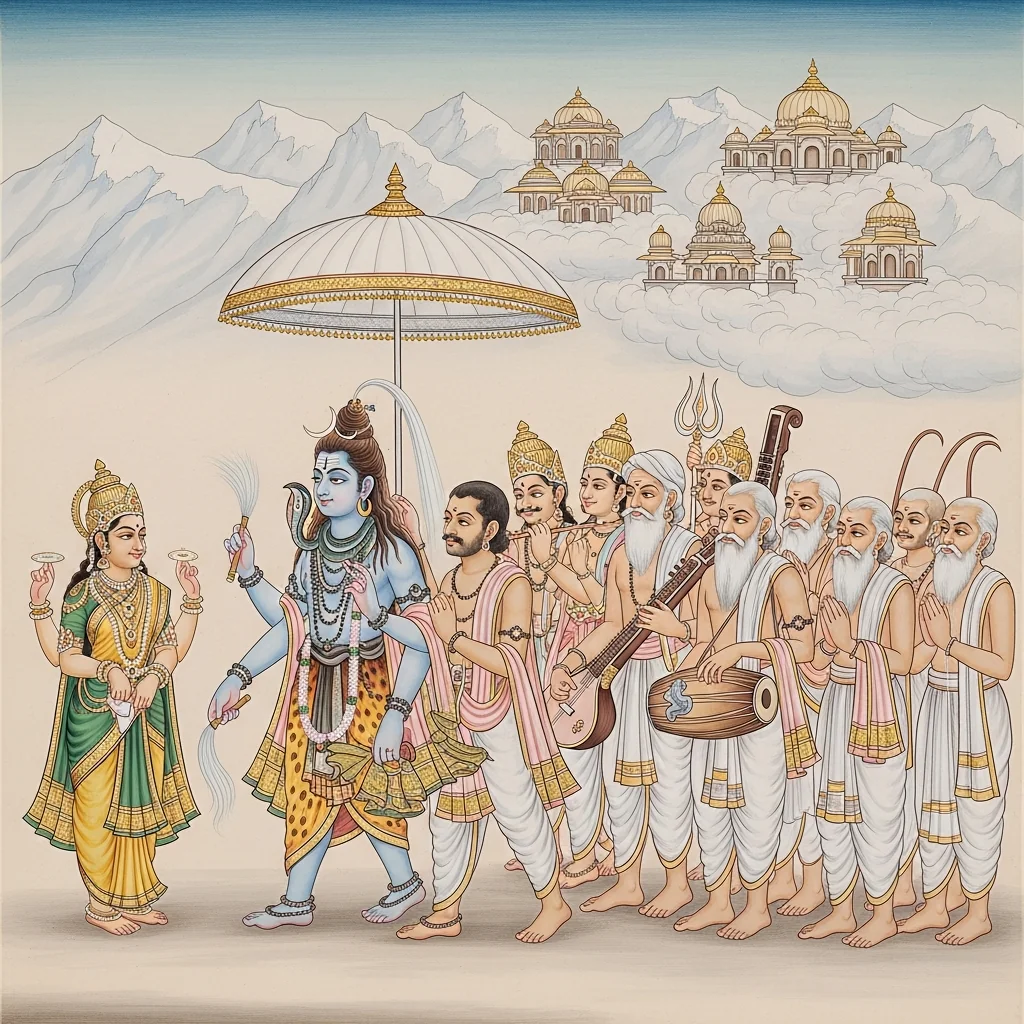
Lomaśa depicts a Himalayan ceremonial splendor: Viśvakarman, Tvaṣṭṛ, and other divine artisans fashion celestial residences, and Śiva is installed in radiant majesty. Menā arrives with her companions and performs nīrājana (auspicious waving of light) to Mahādeva, marveling that his beauty surpasses all that Pārvatī had described. Garga commands that Śiva be brought for the marriage rites; mountains, ministers, and gathered hosts prepare gifts as music and Vedic recitation swell. Śiva advances surrounded by gaṇas, yoginī-cakra forces, and fierce protective retinues—Caṇḍī, Bhairavas, and pretas/bhūtas. Viṣṇu requests that Caṇḍī remain nearby for the world’s protection, and Śiva, with a conciliatory word, temporarily restrains the martial entourage. A grand procession follows with Brahmā, Viṣṇu, the luminaries, lokapālas, sages, and revered women such as Arundhatī, Anasūyā, Sāvitrī, and Lakṣmī; Śiva is bathed, praised, and led into the ritual pavilion. Within the inner altar-space Pārvatī sits adorned and prepared; the auspicious moment is observed as Garga recites praṇava (oṃ) formulae. Pārvatī and Śiva worship one another with arghya, akṣata, and ritual offerings. The narrative then opens the formal kanyādāna: Himavat seeks guidance on procedure, and tension arises when Śiva’s gotra and kula are questioned. Nārada intervenes, declaring Śiva transcendent beyond lineage, grounded in nāda (sacred sound), and the assembly responds in astonishment, affirming Śiva’s incomprehensibility and cosmic sovereignty.
Shlokas
Verse 1
लोमश उवाच । तत्रोपविविशुः सर्वे सत्कृताश्च हिमाद्रिणा । ते देवाः सपरिवाराः सहर्षाश्च सवाहनाः
Lomaśa said: Thereupon, all of them sat down there, duly honoured by Himādri. Those gods—along with their attendants—were joyful, and they came with their respective vehicles.
Verse 2
तत्रैव च महामात्रं निर्मितं विश्वकर्मणा । दीप्त्या परमया युक्तं निवासार्थं स्वयम्भुवः
There itself, Viśvakarman constructed a magnificent grand residence, endowed with supreme radiance, intended as a dwelling for Svayambhū (Brahmā).
Verse 3
तथैव विष्णोस्त्वपरं भवनं स्वयमेव हि । भास्वरं सुविचित्र च कृतं त्वष्ट्रा मनोरमम् । वण्डीगृहं मनोज्ञं च तथैव कृतवान्स्वयम्
Likewise, for Viṣṇu too, another residence was made—indeed by his own agency—brilliant and richly wondrous, fashioned beautifully by Tvaṣṭṛ. And he himself likewise made a delightful Vaṇḍī-house (a splendid pavilion, a house of praise).
Verse 4
तथैव श्वेतं परमं मनोज्ञं महाप्रभं देववरैः सुपूजितम् । कैलासलक्ष्मीप्रभया महत्या सुशोभितं तद्भवनं चकार
Likewise, he made a supremely charming, radiant white mansion—greatly revered by the foremost of the gods—beautifully adorned with mighty splendour, the very ‘fortune of Kailāsa’.
Verse 5
तत्रैव शंभुः परया विभूत्या स स्थापितस्तेन हिमाद्रिणा वै
There itself, Śambhu (Śiva) was enthroned and firmly established by Himādri, with supreme majesty and divine glory.
Verse 6
एतस्मिन्नंतरे मेना समायाता सखीगणैः । नीराजनार्थं शंभुं च ऋषिभिः परिवारिता
Meanwhile, Menā arrived with groups of her companions, surrounded also by sages, to perform nīrājana—the auspicious waving of lights—for Śambhu (Śiva).
Verse 7
तदा वादित्रदिर्घोपैर्नादितं भुवनत्रयम् । नीराजनं कृतं तस्य मेनया च तपस्विनः
Then, with the prolonged, resonant sounds of instruments, the three worlds seemed to resound. And Menā performed nīrājana for that great ascetic Lord.
Verse 8
अवलोक्य परा साध्वी मेनाऽजानाद्धरं तदा । गिरिजोक्तमनुस्मृत्य मेना विस्मयमागता
Upon looking, the supremely virtuous Menā did not recognize Hara (Śiva) at that moment. Then, remembering what Girijā (Pārvatī) had spoken, Menā was filled with wonder.
Verse 9
यद्वै पुरोक्तं च तया पार्वत्या मम सन्निधौ । ततोऽधिकं प्रपश्यामि सौंदर्यं परमेष्ठिनः । महेशस्य मया दृष्टमनिर्वाच्यं च संप्रति
“What Pārvatī had spoken before in my very presence—now I behold even beyond that: the supreme beauty of the Most High. Truly, the majesty of Maheśa that I am seeing at this moment is beyond all description.”
Verse 10
एवं विस्मयमापन्ना विप्रपत्नीभिरावृता । अहतां बरयुग्मेन शोभिता वरवर्णिनी
Thus, filled with wonder and surrounded by the wives of brāhmaṇas, the fair-complexioned noble lady shone—adorned with an unworn pair of garments.
Verse 11
कंचुकी परमा दिव्या नानारत्नैश्च शोभिता । अंगीकृता तदा देव्या रराज परया श्रिया
A supremely divine bodice, resplendent with many kinds of jewels, was then accepted by the Goddess—and she blazed forth with incomparable splendor.
Verse 12
बिभ्रती च तदा हारं दिव्यरत्नविभूषितम् । वलयानि महार्हाणि शुद्धचामीकराणि च
Then she wore a necklace adorned with celestial gems, and also precious bracelets of pure gold.
Verse 13
तत्रोपविष्टा सुभगा ध्यायंती परमेश्वरम् । सखीभिः सेव्यमाना सा विप्रपत्नीभिरेव च
Seated there, that fortunate lady meditated upon the Supreme Lord; she was attended by her companions and also by the wives of brāhmaṇas.
Verse 14
एतस्मिन्नंतरे तत्र गर्गो वाक्यमभाषत । पाणिग्रहार्थं शंभुं च आनयध्वं स्वमंदिरम् । त्वरितेनैव वेलायामस्यामेव विचक्षणाः
Meanwhile, Garga spoke these words there: “Bring Śambhu to your own residence for the rite of taking the hand (marriage). Quickly—at this very auspicious time, O discerning ones!”
Verse 15
तच्छ्रुत्वा वचनं तस्य गर्गस्य च महात्मनः । अभ्युत्थानपराः सर्वे पर्वताः सकलत्रकाः
Hearing the words of that great-souled Garga, all the lords of the mountains—together with their entire retinues—set their minds on rising and setting forth in reverent honor.
Verse 16
महाविभूत्या संयुक्ताः सर्वे मंगलपाणयः । सालंकृतास्तदा तेषां पत्न्योलंकारमंडिताः
All of them, endowed with great majesty and bearing auspicious gifts in their hands, were then finely adorned; and their wives were resplendent with splendid ornaments.
Verse 17
उपायनान्यनेकानि जगृहुः स्निग्धलोचनाः । तदा वादित्रघोषेण ब्रह्मघोषेण भूयसा
Those tender-eyed ones took up many gifts; then, amid the booming of instruments and the even louder resonance of Vedic chants,
Verse 18
आजग्मुः सकलात्रास्ते यत्र देवो महेश्वरः । प्रमथैरावृतस्तत्र चंड्या चैवाभिसेवितः
All those groups arrived at the place where the Lord Maheśvara was; there he was surrounded by the Pramathas and attended also by Caṇḍī.
Verse 19
तथा महर्षिभिस्तत्र तथा देवगणैः सह । एभिः परिवृतः श्रीमाञ्छंकरो लोकशंकरः
There too, surrounded by great seers and accompanied by the hosts of gods, the glorious Śaṅkara—benefactor of the worlds—was seen encircled by them all.
Verse 20
श्रुत्वा वादित्रनिर्घोषं सर्वे शंकरसेवकाः । उत्थिता ऐकापद्येन देवैरृषिभिरावृताः
Hearing the resounding clamor of the musical instruments, all the attendants devoted to Śaṅkara rose at once, surrounded by gods and sages.
Verse 21
तथोद्यतो योगिनाचक्रयुक्ता गणा गणानां गणानां पतिरेकवर्चसाम् । शिवंपुरस्कृत्य तदानुभावास्तथैव सर्वे गणनायकाश्च
Then the Gaṇas advanced, joined with the Yoginī-cakra; and the lord of the Gaṇas—radiant with singular splendor—went forth. With Śiva placed at the forefront, all those mighty ones, the leaders of the Gaṇas as well, moved on.
Verse 22
तद्योगिनी चक्रमतिप्रचंडं टंकारभेरीरवनिस्वनेन । चंडीं पुरस्कृत्य भयानकां तदा महाविभूत्या समलंकृतां तदा
Then that fiercely formidable circle of Yoginīs surged forth amid the thunder of drums and the blare of war-instruments. Placing the fearsome Caṇḍī in the lead, they appeared adorned with great supernatural majesty.
Verse 23
कंठे कर्कोटकं नागं हारभूतं च कार सा । पदकं वृश्चिकानां च दंदशूकांश्च बिभ्रती
Around her neck she wore the serpent Karkoṭaka as a garland; she also bore an ornament made of scorpions, and carried venomous snakes as her adornments.
Verse 24
कर्णावतंसान्सा दध्रे पाणिपादमयांस्तथा । रणे हतानां वीराणां शिरांस्युरसिचापरान्
She wore ear-ornaments fashioned of hands and feet; and upon her chest she bore other trophies—the heads of heroes slain in battle.
Verse 25
द्वीपिचर्मपरीधाना योगिनीचक्रसंयुता । क्षेत्रपालावृता तद्वद्भैरवैः परिवारिता
Clad in a leopard-skin and united with the circle of Yoginīs, she was encircled by the Kṣetrapālas, guardians of the sacred field, and likewise attended by Bhairavas as her retinue.
Verse 26
तथा प्रेतैश्च भूतैश्च कपटैः परिवारिता । वीरभद्रादयश्चैव गणाः परमदारुणाः । ये दक्षयज्ञनाशार्थे शिवेनाज्ञापितास्तदा
She too was surrounded by Pretas and Bhūtas and by deceitful, terrifying beings. Vīrabhadra and the other Gaṇas—exceedingly dreadful—were those whom Śiva had commanded at that time for the destruction of Dakṣa’s sacrifice.
Verse 27
तथा काली भैरवी च माया चैव भयावहा । त्रिपुरा च जया चैव तथा क्षेमकरी शुभा
There were also Kālī and Bhairavī, and Māyā who brings dread; Tripurā and Jayā as well, and auspicious Kṣemakarī, bestower of well-being.
Verse 28
अन्याश्चैव तथा सर्वाः पुरस्कृत्य सदाशिवम् । गंतुकामाश्चोग्रतरा भूतैः प्रेतैः समावृताः
And many other goddesses as well—all of them—setting Sadāśiva at the forefront, desired to proceed; exceedingly fierce, they were surrounded by Bhūtas and Pretas.
Verse 29
एताः सर्वा विलोक्याथ शिवभक्तो जनार्द्दनः । महर्षीश्च पुरस्कृत्य ह्यमरांश्च तथैव च । अनसूयां पुरस्कृत्य तथैव च ह्यरुंधतीम्
Having beheld all of them, Janārdana—devoted to Śiva—went forward, placing in the forefront the great sages and likewise the gods; and he also honored Anasūyā, and in the same way Arundhatī.
Verse 30
विष्णुरुवाच । चण्डीं कुरु समीपस्थां लोकपालनतां प्रभो
Viṣṇu said: “O Lord, appoint Caṇḍī to remain nearby, entrusted with the protection and governance of the worlds.”
Verse 31
तदुक्तं विष्णुना वाक्यं निशम्य जगदीश्वरः । उवाच प्रहसन्नेव चंडीं प्रति सदाशिवः
Hearing the words spoken by Viṣṇu, the Lord of the universe—Sadāśiva—smiled and replied to Caṇḍī.
Verse 32
अत्रैव स्थीयतां चंडीं यावदुद्वहनं भवेत् । मम भावान्विजानासि कार्याकार्ये सुशोभने
“Let Caṇḍī remain right here until the carrying-away (of the bride) is to take place. O fair one, you understand my intention in what is to be done and what is not to be done.”
Verse 33
एवमाकर्ण्य वचनं शंभोरमिततेजसः । उवाच कुपिता चंडी विष्णुमुद्दिश्य सादरम्
Having thus heard the words of Śaṃbhu of immeasurable splendor, Caṇḍī—angered—spoke, addressing Viṣṇu, yet with due regard.
Verse 34
तथान्ये प्रमथाः सर्वे विष्णुमूचुः प्रकोपिताः । यत्रयत्र शिवो भाति तत्रतत्र वयं प्रभो
Then all the other Pramathas too, enraged, spoke to Viṣṇu: “Wherever Śiva is manifest, there we also are, O Lord.”
Verse 35
त्वया निवारिताः कस्माद्वयमाभ्युदये परे । तेषां तद्वचनं श्रुत्वा केशवोवाक्यमब्रवीत्
“Why have you restrained us at the very moment of this great undertaking?” Hearing their words, Keśava spoke in reply.
Verse 36
चण्डीमुद्दिश्य प्रमथानन्यांश्चैव तथाविधान् । यूयं चैव मया प्रोक्ता मा कोपं कर्त्तुमर्हथ
Addressing Caṇḍī, the Pramathas, and others of that kind, Keśava said: “You have indeed been instructed by me; you should not give way to anger.”
Verse 37
एवमुक्तास्तदा तेन चंडीमुख्या गणास्तदा । एकांतमाश्रिताः सर्वे विष्णुवाक्याज्ज्वलद्धृदः
Thus addressed by him, the gaṇas headed by Caṇḍī withdrew to a secluded place; all of them still had hearts aflame, because of Viṣṇu’s restraining words.
Verse 38
तावत्सर्वे समायाताः पर्वतेंद्रस्य मंत्रिणः । सकलत्राः संभ्रमेण महेशं प्रति सत्वरम्
Meanwhile, all the ministers of the Lord of Mountains arrived—together with their households—hastening in excitement toward Maheśa.
Verse 39
पंचवाद्यप्रघोषेण ब्रह्मघोषेण भूयसा । योषिद्भिः संवृतास्तत्र गीतशब्देन भूयसा
There the air resounded with the loud clamour of the five kinds of instruments and, even more, with Vedic recitations; surrounded by women, the place rang again and again with auspicious singing.
Verse 40
एवं प्राप्ता यत्र शंभुः सकलैः परिवारितः । आगत्य कलशैः साकं स्नापितो हि सदाशिवः । स्त्रीभिर्मंगलगीतेन सर्वाभरणभूषितः
Thus they reached the place where Śambhu stood, surrounded by all his attendants. Then Sadāśiva was bathed with sacred water brought in kalaśa pots, while women sang auspicious songs; he shone adorned with every ornament.
Verse 41
ऋषयो देवगंधर्वास्तथान्ये पर्वतोत्तमाः । शंभ्यग्रगास्तदा जग्मुः स्त्रियश्चैव सुपूजिताः । बभौ छत्रेण महता ध्रिमाणेन मूर्द्धनि
Then sages, divine Gandharvas, and other exalted mountain-born beings proceeded in the forefront for Śambhu; and well-honoured women too went along. He shone with a great parasol held above his head.
Verse 42
चामरै वीर्ज्यमानोऽसौ मुकुटेन विराजितः । ब्रह्मा विष्णुस्तथा चंद्रो लोकपालस्तथैव च
He was fanned with cāmara whisks and shone with a crown; Brahmā, Viṣṇu, the Moon, and the guardians of the worlds were there as well.
Verse 43
अग्रगा ह्यपि शोभंतः श्रिया परमया युताः । तथा शंखाश्च भेर्यश्च पटहानकगोमुखाः
Those who went in front were splendid, endowed with supreme glory; and conches, kettle-drums, tabors, ānaka drums, and gomukha horns sounded forth.
Verse 44
तथैव गायकाः सर्वे परममंगलम् । पुनः पुनरवाद्यंत वादित्राणि महोत्सवे
Likewise all the singers performed supremely auspicious songs; again and again the musical instruments were played during the great festival.
Verse 45
अरुंधती महाभागा अनसूया तथैव च । सावित्री च तथा लक्ष्मीर्मातृभिः परिवारिताः
The greatly fortunate Arundhatī, Anasūyā, Sāvitrī, and Lakṣmī too—surrounded by the Divine Mothers (Mātrikās)—were present there.
Verse 46
एभिः समेतो जगदेकबंधुर्बभौ तदानीं परमेण वर्चसा । सचंद्रसूर्यानिलवायुना वृतः सलोकपालप्रवरैर्महर्षिभिः
United with them, the one true kinsman of the world shone then with supreme radiance—surrounded by the Moon, the Sun, the Wind (Anila/Vāyu), the foremost guardians of the worlds, and great sages.
Verse 47
स वीज्यमानः पवनेनः साक्षाच्छत्रं च तस्मै शशिना ह्यधिष्ठितम् । सूर्यः पुरस्तादभवत्प्रकाशकः श्रियान्वितो विष्णुरभूच्च सन्निधौ
He was fanned by the Wind itself, and for him the Moon served as the very parasol. The Sun stood in front as the illuminator, and Viṣṇu, endowed with splendour, was present nearby.
Verse 48
पुष्पैर्ववर्षुर्ह्यवकीर्यमाणा देवास्तदानीं मुनिभिः समेताः । ययौ गृहं कांचनकुट्टिमं महन्महावि भूत्यापरिशोभितं तदा । विवेश शंभुः परया सपर्यया संपूज्यमानो नरदेवदानवैः
Then the gods, gathered with sages, showered flowers as they were scattered all around. Śambhu proceeded to a great residence with golden paving, splendid with immense majesty; and he entered it, being worshipped with highest reverence by kings, gods, and dānavas.
Verse 49
एवं समागतः शंभुः प्रविष्टो यज्ञमण्डपम् । संस्तूयमानो विबुधैः स्तुतिभिः परमेश्वरः
Thus Śambhu arrived and entered the sacrificial pavilion (yajña-maṇḍapa); the Supreme Lord, Parameśvara, was being hymned by the gods with exalted praises.
Verse 50
गजादुत्तारयामास महेशं पर्वतोत्तमः । उपविश्य ततः पीठे कृत्वा नीराजनं महत्
The foremost of mountains helped Maheśa dismount from the elephant. Then, seating Him upon a throne, they performed a grand nīrājana (ārati) rite.
Verse 51
मेनया सखिभिः साकं तथैव च पुरोधसा । मधुपर्कादिकं सर्वं यत्कृतं चैव तत्र वै
There, Menā—together with her companions and likewise with the family priest—arranged all the offerings beginning with the madhuparka and the rest.
Verse 52
ब्रह्मणा नोदितः सद्यः पुरोधाः कृतवान्प्रभुः । मंगलं शुभकल्याणं प्रस्तावसदृशं बहु
Prompted by Brahmā, the priest immediately performed many auspicious rites—benedictions and blessings—befitting the occasion.
Verse 53
अंतर्वेद्यां संप्रवेश्य यत्र सा पार्वती स्थिता । वेदिकोपरि तन्वंगी सर्वाभरणभूषिता
He was led into the inner sanctified area where Pārvatī stood—slender-limbed, upon the altar-platform, adorned with every ornament.
Verse 54
तत्रानीतो हरः साक्षाद्विष्णुना ब्रह्मणा सह । लग्नं निरीक्षमाणास्ते वाचस्पतिपुरोगमाः
There Hara Himself was brought in by Viṣṇu together with Brahmā; and they—led by Vācaspati—began observing the auspicious moment (lagna).
Verse 55
गर्गो मुनिश्चोपविष्टस्तत्रैव घटिकालये । यावत्पूर्णा घटी जाता तावत्प्रणवभाषणम्
The sage Garga sat there in the place of timekeeping; until a ghaṭī was fulfilled, the recitation of the Praṇava—sacred “Oṃ”—continued.
Verse 56
ओंपुण्येति प्रणिगदन्गर्गो वध्वंजलिं दधे । पार्वत्यक्षतपूर्णं च शिवोपरि ववर्ष वै
Uttering “Oṃ, puṇya!”, Garga placed the bride’s hands in añjali; and Pārvatī, her palms filled with akṣata—unbroken rice-grains—showered them upon Śiva.
Verse 57
तया संपूजितो रुद्रो दध्यक्षतकुशादिभिः । मुदा परमया युक्ता पार्वती रुचिरानना
By her, Rudra was duly worshipped with curd, akṣata, kuśa-grass, and the like; and lovely-faced Pārvatī, filled with supreme joy, performed the worship.
Verse 58
विलोकयंती शंभुं तं यदर्थे परमं तपः । कृतं पुरा महादेव्या परेषां परमं महत्
She gazed upon that Śambhu—for whose sake the Great Goddess had formerly undertaken the supreme austerity, exceedingly great beyond all others.
Verse 59
तपसा तेन संप्राप्तो जगज्जीवनजीवनः । नारदेन ततः प्रोक्तो महादेवो वृषध्वजः
By that austerity she attained the Lord who is the very life of all living beings in the universe. Then Nārada revealed Mahādeva—the bull-bannered Lord (Vṛṣadhvaja).
Verse 60
तथा गंगादिभिश्चन्यैर्मुनिभिः सनकादिभिः । प्रति पूजां कुरु क्षिप्रं पार्वत्याश्च त्रिलोचन । तदा शिवेन सा तन्वी पूजितार्घ्याक्षतादिभिः
Likewise, together with Gaṅgā and the other holy ones, and with sages such as Sanaka and the rest, swiftly perform reciprocal worship, O Three-eyed Lord, for Pārvatī as well. Then that slender Lady was worshipped by Śiva with offerings such as arghya and akṣata (unbroken rice) and the like.
Verse 61
एवं परस्परं तौ च पार्वतीपरमेश्वरौ । अर्च्यमानौ तदानीं च शुशुभाते जगन्मयौ
Thus Pārvatī and Parameśvara worshipped one another; and at that time, both—pervading the whole universe—shone in splendor as they were adored.
Verse 62
त्रैलोक्यलक्ष्म्या संवीतौ निरीक्षंतौ परस्परम् । तदा नीराजितौ लक्ष्म्या सावित्र्या च विशेषतः । अरुंधत्या तदा तौ च दंपती परमेश्वरौ
Clad in the splendor of the fortune of the three worlds, they gazed upon one another. Then Lakṣmī and, especially, Sāvitrī performed nīrājana—the auspicious waving of lights—for them; and at that time Arundhatī too honored that divine couple, the Supreme Lords.
Verse 63
अनसूया तथा शंभुं पार्वतीं च यशस्विनीम् । दृष्ट्वा नीराजयामास प्रीत्युत्कलितलोचना
So too Anasūyā, seeing Śambhu and the illustrious Pārvatī, performed nīrājana for them—her eyes brimming and widened with joy.
Verse 64
तथैव सर्वा द्विजयोषितश्च नीराजयामासुरहो पुनः पुनः । सतीं च शंभुं च विलोकयंत्यस्तथैव सर्वा मुदिता हसंत्यः
In the same way, all the wives of the brāhmaṇas there performed nīrājana again and again. Gazing upon Satī (Pārvatī) and Śambhu, they all rejoiced, smiling and laughing in delight.
Verse 65
लोमश उवाच । एतस्मिन्नंतरे तत्र गर्गाचार्यप्रणोदितः । हिमवान्मेनया सार्द्धं कन्यां दातुं प्रचक्रमे
Lomaśa said: Meanwhile there, urged on by the teacher Garga, Himavān together with Menā began the preparations to give the maiden in marriage.
Verse 66
हैमं कलशमादाय मेना चार्द्धां गामाश्रिता । हिमाद्रेश्च महाभागा सर्वाभरणभूषिता
Taking a golden water-pot, Menā approached the rite, supporting herself upon a cow. That fortunate lady of Himādri was adorned with every ornament.
Verse 67
तदा हिमाद्रिणा प्रोक्तो विश्वनाथो वरप्रदः । ब्रह्मणा सह संगत्य विष्णुना च तथैव च
Then Himādri addressed Viśvanātha, the bestower of boons. Brahmā had come together with him, and likewise Viṣṇu as well.
Verse 68
सार्द्धं पुरोधसा चैव गर्गेण सुमहात्मना । कन्यादानं करोम्यद्य देवदेवस्य शूलिनः
Together with the family priest and with the great-souled Garga, I shall today perform the kanyādāna for the God of gods—the trident-bearing Lord.
Verse 69
प्रयोगो भण्यतां ब्रह्मन्नस्मिन्समय आगते । तथेति मत्वा ते सर्वे कालज्ञा द्विजसत्तमाः
“O Brahmin, now that the proper time has arrived, declare the procedure.” Thinking, “So be it,” all those excellent Brahmins—knowers of the right time—assented.
Verse 70
कथ्यतां तात गोत्रं स्वं कुलं चैव विशेषतः । कथयस्व महाभाग इत्याकर्ण्य वचस्तथा । सुमुखेन विमुखः सद्यो ह्यशोच्यः शोच्यतां गतः
“Dear one, tell us your gotra and, in particular, your lineage—declare it, O fortunate one.” Hearing such words, the fair-faced one turned away at once; though beyond grief, he was made an object of lament in their eyes.
Verse 71
एवंविधः सुरवरैरृषिभिस्तदानीं गंधर्वयक्षमुनिसिद्धगणैस्तथैव । दृष्टो निरुत्तरमुखो भगवान्महेशो हास्यं चकार सुभृशं त्वथ नारदश्च
At that time Bhagavān Maheśa was seen by the foremost of the gods, by the ṛṣis, and likewise by hosts of Gandharvas, Yakṣas, Munis, and Siddhas—standing with a silent, unanswering face. Maheśa laughed heartily; and then Nārada too laughed.
Verse 72
वीणां प्रकटयामास ब्रह्मपुत्रोऽथ नारदः । तदानीं वारितो धीमान्वीणां मा वादय प्रभो
Then Nārada, the son of Brahmā, brought forth his vīṇā. At that moment the wise one was restrained: “O lord, do not play the vīṇā.”
Verse 73
इत्युक्तः पर्वतेनैव नारदो वाक्यमब्रवीत् । त्वया पृष्टो भवः साक्षात्स्वगोत्रकथनं प्रति
Thus addressed by Parvata, Nārada spoke: “You have directly questioned Bhava (Śiva) regarding the telling of his own gotra.”
Verse 74
अस्य गोत्रं कुलं चैव नाद एव परं गिरे । नादे प्रतिष्ठितः शंभुर्नादो ह्यस्मिन्प्रतिष्ठितः
“For him, both gotra and lineage are nothing but Nāda—the sacred Sound, O best of mountains. Śambhu is established in Nāda, and Nāda indeed is established in him.”
Verse 75
तस्मान्नादमयः शंभुर्नादाच्च प्रतिलभ्यते । तस्माद्वीणा मया चाद्य वादिता हि परंतप
Therefore Śambhu is constituted of Nāda, and through Nāda He is attained. Hence I have indeed played the vīṇā today, O subduer of foes.
Verse 76
अस्य गोत्रं कुलं नाम न जानंति हि पर्वत । ब्रह्मादयो हि विवुधा अन्येषां चैव का कथा
His gotra, lineage, and even “name” are not known, O Parvata. Even Brahmā and the other gods do not know—what then could be said of others?
Verse 77
त्वं हि मूढत्वमापन्नो न जानासि हि किंचन । वाच्यावाच्यं महेशस्य विषया हि बहिर्मुखाः
You have fallen into delusion and know nothing. For the matters of what may—or may not—be spoken about Maheśa are indeed beyond the reach of outward-turned sense-objects.
Verse 78
येये आगमिकाश्चाद्रे नष्टास्ते नात्र संशयः । अरूपोयं विरूपाक्षो ह्यकुलीनोऽयमुच्यते
Whatever “Āgamic” authorities you imagine here on the mountain are lost—of this there is no doubt. This One is formless; though called Virūpākṣa, he is said to be without lineage.
Verse 79
अगोत्रोऽयं गिरिश्रेष्ठ जामाता ते न संशयः । न कर्त्तव्यो विमर्शोऽत्र भवता विबुधेन हि
O best of mountains, this One is beyond all lineage; He is indeed your son-in-law—there is no doubt. Therefore, O wise one, you should not deliberate or question further in this matter.
Verse 80
न जानंति हरं सर्वे किं बहूक्त्या मम प्रभो । यस्याज्ञानान्महाभाग मोहिता ऋषयो ह्यमी
Not all know Hara (Śiva)—so what need is there for many words, my Lord? O blessed one, even these sages have been bewildered through ignorance of Him.
Verse 81
ब्रह्मापि तं न जानाति मस्तकं परमेष्ठिनः । विष्णुर्गतो हि पातालं न दृष्टो हि तथैव च
Even Brahmā does not know His summit—the very crown of the Supreme Creator. And Viṣṇu, having gone down to Pātāla, did not behold His end there either.
Verse 82
तेन लिंगेन महता ह्यगाधेन जगत्त्रयम् । व्याप्तमस्तीति तद्विद्धि किमनेन प्रयोजनम्
Know this: by that vast and unfathomable Liṅga, the three worlds are pervaded. What purpose would be served by probing further?
Verse 83
अनयाराधितं नूनं तव पुत्र्या हिमालय । तत्त्वतो हि न जानासि कथं चैव महागिरे
O Himālaya, surely He has been worshipped by your daughter. Yet you do not know Him in His true reality—how could you, O great mountain?
Verse 84
आभ्यामुत्पाद्यते विश्वमाभ्यां चैव प्रतिष्ठितम् । एतच्छ्रुत्वा वचस्तस्य नारदस्य महात्मनः
From those two, the universe is brought forth, and by those two it is also established and sustained. Hearing these words of that great-souled Nārada...
Verse 85
हिमाद्रिप्रमुखाः सर्वे तथा चेंद्रपुरोगमाः । साधुसाध्विति ते सर्वे ऊचुर्विस्मितमानसाः
All of them—led by Himādri (the Himalaya), and also those headed by Indra—spoke with minds filled with wonder, saying, “Well said, well said!”
Verse 86
ईश्वरस्य तु गांभीर्यं ज्ञात्वा सर्वे विचक्षणाः । विस्मयेन समाश्लिष्टा ऊचुः सर्वे परस्परम्
Realizing the Lord’s profundity, all the discerning ones—embraced by wonder—spoke among themselves.
Verse 87
ऋषय ऊचुः । यस्याज्ञया जगदिदं च विशालमेव जातं परात्परमिदं निजबोधरूपम् । सर्वं स्वतंत्रपरमेश्वरभागम्यं सोऽसौ त्रिलोकनिजरूपयुतो महात्मा
The sages said: “By whose command this vast universe has arisen—He who is beyond the beyond, whose very nature is pure self-awareness. All belongs to that independent Supreme Lord; that great soul bears the three worlds as His own form.”