Adhyaya 34
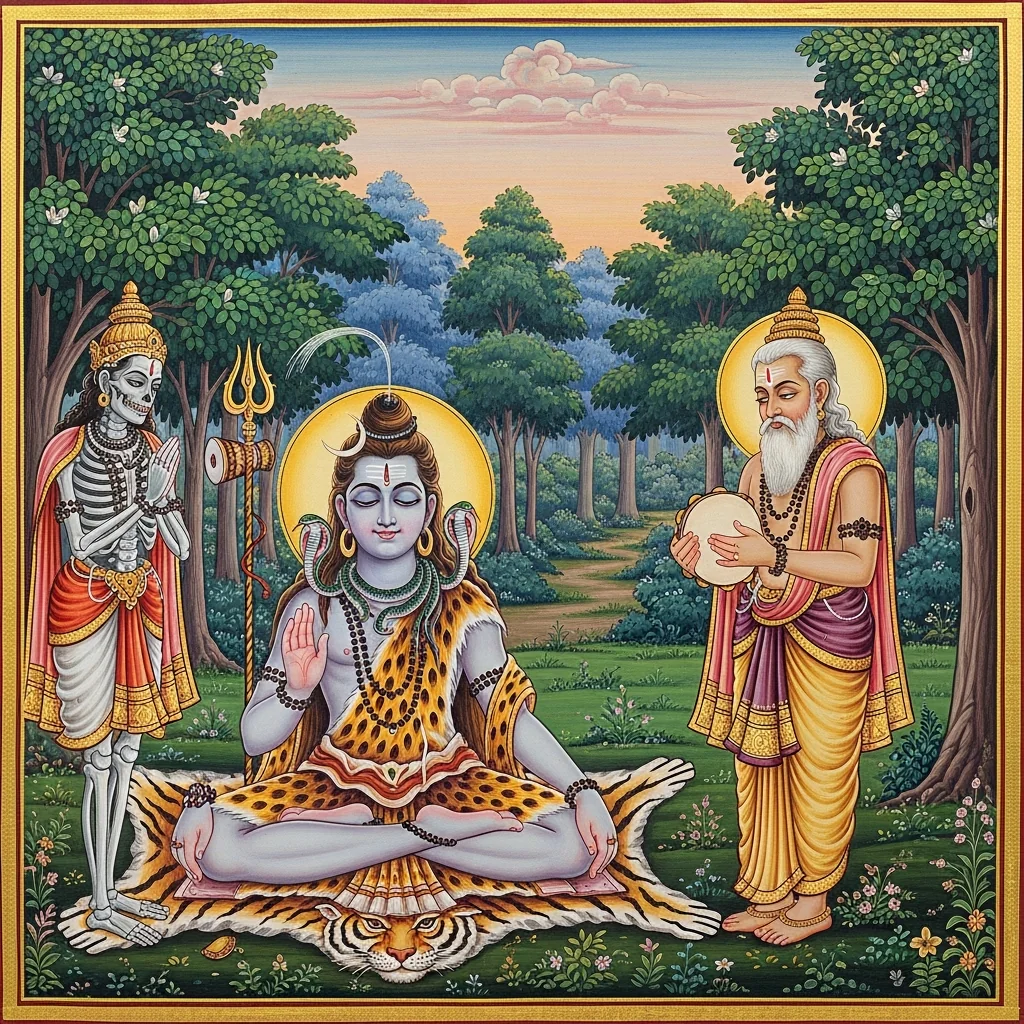
Lomāśa portrays Śiva’s royal splendor on Kailāsa: devas and ṛṣis attend Him, celestial musicians perform, and His victories over mighty adversaries are recalled. Nārada journeys to moon-bright Kailāsa and beholds its marvels—wish-fulfilling trees, birds and animals, and the wondrous descent of the Gaṅgā—along with crafted gatekeepers and wonders within the sacred precinct. He then sees Śiva with Pārvatī, with iconographic detail highlighting Śiva’s serpent-ornaments and His multiform majesty. A playful episode follows: Nārada proposes dice-play as “sport,” Pārvatī challenges, and Śiva and Pārvatī contest amid teasing, claims of victory, and escalating speech. Bhṛṅgī intervenes with doctrinal admonition about Śiva’s invincibility and supremacy; Pārvatī replies sharply, even cursing Bhṛṅgī, and in anger removes Śiva’s ornaments as though claiming the stakes. Śiva, offended and reflecting on detachment, withdraws alone to a forest-like hermitage, assumes yogic posture, and enters contemplative absorption—recasting the incident as an ethical-theological lesson on ego, speech, and renunciation.
Shlokas
Verse 1
लोमश उवाच । राज्यं चकार कैलास दवदवा जगत्पतिः । गणैः समेतो बहुभिर्वीरभद्रान्वितो महान्
Lomaśa said: The Lord of the universe held sovereign rule upon Kailāsa, accompanied by many hosts of gaṇas, and attended by the great Vīrabhadra.
Verse 2
ऋषिभिः सहितो रुद्रो देवैरिन्द्रादिभिः सह । ब्रह्मा यस्य स्तुतिपरो विष्णुः प्रेष्यवदास्थितः
Rudra was accompanied by the sages and by the gods led by Indra; for him Brahmā was devoted to praise, and Viṣṇu stood near as though in humble service.
Verse 3
इंद्रो देवगणैः सार्द्धं सेवाधर्मपरोऽभवत् । यस्य च्छत्रधरश्चंद्रो वायुश्चामरधृक्तथा
Indra, together with the hosts of gods, became devoted to the dharma of service; for him the Moon bore the royal parasol, and Vāyu likewise held the cāmara fan.
Verse 4
सूपान्नकर्ता सततं जातवदा निरन्तरम् । गंधर्वा गायका यस्य स्तावकाश्च पिनाकिनः
Jātavedā (Agni) continually prepared rich and abundant foods; the Gandharvas served as singers for him, and bards too praised the Pinākin, the Lord who bears the Pināka bow.
Verse 5
विद्याधराश्च बहवस्तथा चाप्सरसां गणाः । ननृतुश्चाग्रगा यस्य सोऽसौ कैलासपर्वते
Many Vidyādharas and hosts of Apsarases danced in the forefront for him—thus he dwelt upon Mount Kailāsa.
Verse 6
पुत्रैर्गणेशस्कंदाद्यैस्तथा गिरिजया सह । राज्यं प्रतापिभिश्चक्रेऽशंकश्चंक्रमणेन च
Together with his sons—Gaṇeśa, Skanda, and others—and with Girijā (Pārvatī), he exercised his radiant sovereignty, moving about fearlessly.
Verse 7
येनांधको महा दैत्यः स देवानामरिर्महान् । दुष्टो विद्धस्त्रिशूलेन गगने स्थापितश्चिरम्
By him the great demon Andhaka—mighty enemy of the gods—was pierced with the trident, and that wicked one was set aloft in the sky for a long time.
Verse 8
हत्वा गजासुरं येन उत्कृत्त्य चर्म वै कृतम् । चिरं प्रावरणं दिव्यं तथा त्रिपुरदीपनम् । विष्णुना पाल्यभूतेन रेजे सर्वांगसुन्दरः
By him Gajāsura was slain, and his hide was flayed and made into a divine covering worn for long; likewise he accomplished the burning of Tripura. With Viṣṇu become as it were his protector and attendant, the all-limbed Beautiful One shone forth.
Verse 9
तं द्रष्टुकामो भगवान्नारदो दिव्य र्शनः । ययौ च पर्वतश्रेष्ठं कैलासं चन्द्रपांडुरम्
Desiring to behold him, the blessed Nārada of celestial vision went to the best of mountains—Kailāsa, pale and radiant like the moon.
Verse 10
सुधया परया चापि सेवितं परमाद्भुतम् । कर्पूरगौरं च तदा दृष्ट्वा तं सुमहाबलम् । नारदो विस्मयाविष्टः प्रविष्टो गन्धमादनम्
He beheld that supremely wondrous realm, attended even with the highest nectar; and seeing him—camphor-white and of immense might—Nārada, filled with astonishment, entered Gandhamādana.
Verse 11
अनेकाश्चर्यसंयुक्तं तपनैश्च सुशोभितम् । गायद्विद्याधरीभिश्च पूरितं च महाप्रभम्
It was filled with countless wonders, beautifully adorned with radiant lights, and resounding with the songs of Vidyādharī maidens—altogether a place of great splendor and divine majesty.
Verse 12
कल्पद्रुमाश्च बहवो लताभिः परिवेष्टिताः । घनच्छायासू तास्वेव विशिष्टा कामधेनवः
There stood many Kalpadrumas, wish-fulfilling trees, entwined with creepers; and within those very groves of dense shade were exceptional Kāmadhenus—the boon-bestowing sacred cows.
Verse 13
पारिजातवनामोदलंपटा बहवोऽलयः । कलहंसाश्च बहवः क्रीडमानाः सरस्तु च
There were many dwellings fragrant with the scent wafting from Pārijāta groves; and in the lakes as well, many swans sported in joy.
Verse 14
शिखंडिनो महच्चक्रुस्तत्र केकारवं मुदा । पंचमालापिनः सर्वे विहंगाः संमदान्विताः
There peacocks raised loud cries in gladness; and all the birds, singing sweetly in measured notes, were filled with joyous exhilaration.
Verse 15
करिणः करिणीभिश्च मोदमानाः सुवर्चसः । सिंहास्तथा गर्जमानाः शार्दूलैः सह संगताः
Elephants, together with their mates, rejoiced there, radiant and splendid; likewise lions, roaring, mingled in harmony even with tigers.
Verse 16
वृषभा नंदिमुख्याश्च रेभमाना निरन्तरम् । देवद्रुमाश्च बहवस्तथा चंदनवाटिकाः
Bulls—chief among them Nandin—bellowed without ceasing; and there were many divine trees, as well as groves of sandalwood.
Verse 17
नागपुंनागबकुलाश्चंपका नागकेसराः । तथा च वनजंब्वश्च तथा कनककेतकाः
There were nāga and bakula trees, campaka blossoms and nāgakesara; also wild jambū trees, and ketaka plants shining like gold.
Verse 18
कह्लाराः करवीरिश्च कुमुदानि ह्यनेकशः । मंदाराश्च बदर्यश्च क्रमुकाः पाटलास्तथा
There were kahlāra lotuses, karavīra oleanders, and many kumuda water-lilies; also mandāra trees, badarī jujubes, kramuka areca palms, and pāṭalā trees.
Verse 19
तथान्ये बहवो वृक्षाः शम्भोस्तोषकराह्यमी । ऐकपद्येन दृष्टास्ते नानाद्रुमलतान्विताः । आरामा बहवस्तत्र द्विगुणाश्च बभूविरे
So too there were many other trees, truly pleasing to Śambhu. Even at a single glance they seemed adorned with many kinds of trees and creepers; and many delightful groves were there, as though doubled in number.
Verse 20
गगनान्निस्सृतः सद्यो गंगौघः परमाद्भुतः । पतितो मस्तके तस्य पर्वतस्य सुशोभिते
A most marvelous torrent of the Gaṅgā, issuing forth from the sky, at once descended upon the splendid summit of that mountain.
Verse 21
कूपो हि पयसां ये न पवित्रं वर्तते जगत् । सोपि द्विधा तदा दृष्टो नारदेन महात्मना
Even a well of water—by which the world is sustained and purified—was then seen by the great-souled Nārada as split into two.
Verse 22
सर्वं तदा द्विधाभूतं दृष्टं तेन महात्मना । नारदेन तदा विप्राः परमेण निरीक्षितः
Then, to that great soul Nārada, everything appeared as though divided into two; O brāhmaṇas, he beheld it with a most extraordinary, supreme vision.
Verse 23
एवं विलोकमानोऽसौ नारदो भगवानृषिः । त्वरितेन तथा यातः शिवालोकनतत्परः
Thus observing, the divine sage Nārada hurried onward, intent solely upon the darśana—the blessed sight—of Śiva.
Verse 24
यावद्द्वारि स्थितोपश्यन्महदाश्चर्यमेव च । द्वारपालौ तदा दृष्टौ कृतकौ विश्वक्मणा
While standing at the doorway and gazing, he beheld a great marvel indeed: two gatekeepers were seen there, fashioned by Viśvakarman.
Verse 25
नारदो मोहितो ह्यासीत्पप्रच्छ च स तौ तदा । अहं प्रवेष्टुमिच्छामि शिवदर्शनलालसः
Nārada was truly astonished, and he asked the two: “I wish to enter, yearning for Śiva’s darśana—His blessed sight.”
Verse 26
तस्मादनुज्ञा दातव्या दर्शनार्थं शिवस्य च । अश्रृण्वन्तौ तदा दृष्ट्वा नारदो विस्मितोऽभवत्
“Therefore, permission should be granted for the sake of Śiva’s darśana.” Yet, seeing that the two did not listen, Nārada grew astonished.
Verse 27
ज्ञानदृष्ट्या विलोक्याथ दूष्णींभूतोऽभवत्तदा । कृत्रिमौ हि च तौ ज्ञात्वा प्रविष्टो हि महामनाः
Then, gazing with the eye of insight, he became silent; knowing the two to be but artificial, the great-minded one entered.
Verse 28
तथान्ये तत्सरूपाश्च दृष्टास्तेन महात्मना । ऋषिः प्रणमितस्तैश्च नारदो भगवान्मु
Likewise, that great soul saw others too of the same form; and they bowed in reverence to the divine sage Nārada. (The text appears truncated at the end.)
Verse 29
एवमादीन्यनेकानि आश्चर्याणि ददर्श सः । ददर्शाथ च सुव्यक्तं त्र्यंबकं गिरिजान्वितम्
In this manner he beheld many marvels; then he clearly saw Tryambaka (Śiva), accompanied by Girijā (Pārvatī).
Verse 30
अर्धासनगता साध्वी शंकरस्य महात्मनः । तनया गिरिराज्य यया व्याप्तं जगत्त्रयम्
The virtuous Lady sat upon half the seat of the great-souled Śaṅkara; she, the daughter of the Mountain-King, by whose Śakti the three worlds are pervaded.
Verse 31
गौरी सितेक्षणा बाला तन्वंगी चारुलोचना । यया रूपी कृतः शम्भुरुपादेयः कृतो महान्
Gaurī—fair, bright-eyed, youthful, slender-limbed, and lovely-eyed—by her presence made Śambhu appear in a manifest form, and made the Great Lord supremely worthy of reverent contemplation and devotion.
Verse 32
निर्विकानि विकारैश्च बहुभिर्विकलीकृतः । अर्द्धागलग्ना सा देवी दृष्टा तेन शिवस्य च
Though in truth unchanging, he appeared as if transformed by many modes; and that Goddess, joined to Śiva as his inseparable half, was beheld by him as well.
Verse 33
नारदेन तथा शम्भुर्दृष्टस्त्रिभुवनेश्वरः । शुद्धचामी करप्रख्यः सेव्यमानः सुरासुरैः
Thus Nārada beheld Śambhu, the Lord of the three worlds—radiant like pure gold—being honored and attended by both gods and asuras.
Verse 34
शंखेन भोगिवर्येण सेवितं चांघ्रिपंकजम् । धृतराष्ट्रेण च तथा तक्षकेण विशेषतः । तथा पद्मेन महा शेषेणापि विशेषतः
His lotus-feet were reverently attended by the chief serpent Śaṅkha, and likewise by Dhṛtarāṣṭra—especially by Takṣaka—and also by Padma and the great Śeṣa in particular.
Verse 35
अन्यैश्च नागवर्यैश्च सेवितो हि निरंतरंम् । वासुकिः कंठलग्नो हि हारभूतो महाप्रभः
He was continually attended by other foremost Nāgas as well; and Vāsuki, the great and radiant one, clung about his neck, becoming his garland.
Verse 36
कंबलाश्वतरौ नित्यं कर्णभूषणभूषितौ । जटामूलगताश्चान्ये महाफणिवरा ह्यमी
Kambala and Aśvatara ever adorned him as ornaments for his ears; and other great hooded serpent-lords dwelt at the roots of his matted locks.
Verse 37
अनेकजातिसंवीता नानावर्णाश्च पद्मिनः । तक्षकः कुलिकः शंखो धृतराष्ट्रो महाप्रभः
Surrounded by many kinds and adorned in many hues stood those serpent-lords—Padma, Takṣaka, Kulika, Śaṅkha, and the mighty Dhṛtarāṣṭra.
Verse 38
पद्मो दंभः सुदंभश्च करालो भीषणस्तथा । एते चान्ये च बहवो नागाश्चाशीविषा ह्यमी
Padma, Dambha, Sudambha, Karāla, and Bhīṣaṇa—these, and many other Nāgas besides, fierce bearers of venom, were there.
Verse 39
अंगभूता हरस्या सन्पूज्यस्यास्य जगत्त्रये । फणैकया शोभमानाः केचिद्धि पन्नगोत्तमाः
As though becoming limbs of Hara—worship-worthy throughout the three worlds—some excellent serpents shone forth, adorned with but a single hood.
Verse 40
फणानां द्वितयं केषां त्रितयं च महाप्रभम् । चतुष्क पंचकषट्कं सप्तकं चाष्टकं तथा
For some there were two hoods, for others three, in splendid majesty; and in radiant array there were those with four, five, six, seven, and likewise eight hoods.
Verse 41
नवकं दशकं चैव तथैकादशकं त्वथ । द्वादशकं चाष्टादशकमेकोनविंशकं तथा
Some had nine hoods, some ten; likewise some had eleven; and then some had twelve, some eighteen, and some nineteen as well.
Verse 42
चत्वारिंशत्फणाः केऽपि पंचाशत्कं च षष्टिकम् । सप्ततिश्चाप्यशीतिश्च नवतिश्च तथैव च
Some bore forty hoods; some bore fifty and sixty; some bore seventy, some eighty, and some ninety as well.
Verse 43
तथा शतसहस्राणि ह्ययुतप्रयुतानि च । अर्बुदानि च रत्नानि तथा शङ्खमितानि च
Likewise there were hundreds of thousands—tens of thousands and millions—myriads upon myriads; and jewels beyond count, measured in ‘śaṅkha’ units as well.
Verse 44
अनंताश्च फणा येषां ते सर्पाः शिवभूषणाः । दृष्टास्तदानीं ते सर्वे नारदेन महात्मना
Those serpents whose hoods were endless were the very ornaments of Śiva; all of them were then seen by the great-souled Nārada.
Verse 45
विद्यावंतोऽपि ते सर्वे भोगिनोऽपि सुशोभिताः । हारभूषणभूतास्ते मणिमंतोऽमितप्रभाः
All of them were learned; all were splendid nāgas as well—becoming garlands and ornaments, gem-bedecked and of immeasurable radiance.
Verse 46
अर्द्धचंद्रांकितो यस्य कपर्द्दस्त्वतिसुंदरः । चक्षुषा च तृतीयेन भालस्थेन विराजितः
He whose matted hair-bun was exquisitely beautiful, marked with the half-moon; and who shone with the third eye set upon His forehead.
Verse 47
पंचवक्त्रो महादेवो बाहुभिर्द्दशभिर्वृतः । तथा मरकतश्यामकंधरोऽतीवसुंदरम्
Mahādeva was five-faced, encircled by ten arms; His neck and shoulders were emerald-dark—exceedingly beautiful.
Verse 48
उरो यस्य विशालं च तथोरुजघनं परम् । चरणद्वयं च रुद्रस्य शोभितं परमं महत्
His chest was broad, His thighs and hips supremely mighty; and Rudra’s pair of feet shone—lofty and magnificent beyond measure.
Verse 49
तद्दृष्टं चरणारविंदमतुलं तेजोमयं सुंदरं संध्यारागसुमंगलं च परमं तापापनुत्तिंकरम् । तेजोराशिकरं परात्परमिदं लावण्यलीलस्पदं सर्वेषां सुखवृद्धिकारणपरं शंभोः पदं पावनम्
Then was beheld that incomparable lotus of feet—radiant, beautiful, supremely auspicious like the crimson glow of twilight, and the highest remover of suffering. Pouring forth torrents of light, beyond the beyond, the playground of grace and beauty—Śambhu’s holy feet, the supreme cause of the increase of happiness for all, purify.
Verse 50
तथैव दृष्ट्वा परमं पराणां परा सती रूपवती च सुंदरी । सौभाग्यलावण्यमहाविभूत्या विराजमाना ह्यतिसुंदरी शुभा
And then, seeing the Supreme of the supreme, Satī—transcendent, radiant in form, and beautiful—shone forth, exceedingly lovely and auspicious, with vast majesty of good fortune and grace.
Verse 51
दृष्ट्वा तौ दपती शुद्धौ राजमानौ जगत्त्रये । अभिन्नौ भेदमापन्नौ निर्गुणौ गुणिनौ च तौ
Beholding that pure divine couple, resplendent through the three worlds, Nārada saw that though they are truly non-different, they appear as two; and though beyond all qualities, they also manifest with qualities.
Verse 52
साकारौ च निराकारौ निरातंकौ सुखप्रदौ । ववंदे च मुदा तौ स नारदो भगवत्प्रियः । उत्थायोत्थाय च तदा तुष्टाव जगदीश्वरौ
With form and beyond form, free from all affliction and bestowers of bliss—Nārada, beloved of the Lord, joyfully bowed to Them. Rising again and again, he then praised the two Lords of the world.
Verse 53
नारद उवाच । नतोस्म्यहं देववरौ युवाभ्यां परात्पराभ्यां कलया तथापि । दृष्टौ मया दंपती राजमानौ यौ वीजभूतौ सचराचरस्य
Nārada said: I bow to you both, O best of gods—supreme beyond the supreme—though you appear only as a portion of your fullness. I have beheld the radiant divine couple, the seed-source of all that moves and all that does not.
Verse 54
पितरौ सर्वललोकस्य ज्ञातौ चाद्यैव तत्त्वतः । मया नास्त्यत्र संदेहो भवतोः कृपया तथा
You are the parents of all the worlds—today I have known this in truth. By your grace, I have no doubt whatsoever about it.
Verse 55
एवं स्तुतौ तदा तेन नारदेन महात्मना । तुतोष भगवाञ्छंभुः पार्वत्या सहितस्तदा
Thus praised then by the great-souled Nārada, the Blessed Śaṃbhu—together with Pārvatī—was pleased.
Verse 56
महादेव उवाच । सुखेन स्थीयते ब्रह्मन्किं कार्यं करवाणि ते । तच्छ्रुत्वा वचनं शंभोर्नारदो वाक्यमब्रवीत्
Mahādeva said: “Abide happily, O Brahmin. What shall I do for you?” Hearing Śaṃbhu’s words, Nārada replied.
Verse 57
दर्शनं जातमद्यैव तेन तुष्टोऽस्म्यहं विभो । दर्शनात्सर्वमेवाद्य शंभो मम न संशयः
(Nārada said:) “This very day I have received your darśana; by that I am content, O Lord. Through this darśana, everything has become clear today, O Śaṃbhu—there is no doubt in me.”
Verse 58
क्रीडनार्थमिहायातः कैलासं पर्वतोत्तमम् । हृदिस्थो हि सदा नॄणामास्थितो भगवन्प्रभो
(Nārada said:) “You have come here to Kailāsa, the best of mountains, for līlā—divine sport. Yet, O Blessed Lord, you ever abide established in the hearts of human beings.”
Verse 59
तथापि दर्शनं भाव्यं सततं प्राणिनामिह
Yet even so, in this world, living beings should continually have (your) darśana.
Verse 60
गिरिजोवाच । का क्रीडा हि त्वया भाव्या वद शीघ्रं ममाग्रतः । तस्यास्तद्वचनं श्रुत्वा उवाच प्रहसन्निव
Girijā said: “What divine sport (līlā) is to be undertaken by you? Tell me quickly, here before me.” Hearing her words, he replied as if smiling.
Verse 61
द्यूतक्रीडा महादेव दृश्यते विविधात्र च । भवेद्द्वाभ्यां च द्यूते हि रमणाच् महत्सुखम्
O Mahādeva, here dice-play (dyūta) is seen in many delightful forms; and in a game played by two, indeed, from mutual sport arises great happiness.
Verse 62
इत्येवमुक्त्वो परतं सती भृशमुवाच वाक्यं कुपिता ऋषिं प्रति । कथं विजानासि परं प्रसिद्धं द्यूतं च दुष्टोदरकं मनस्विनाम्
Having spoken thus and then pausing, Satī—greatly angered—addressed the sage: “How do you know so well that widely notorious dice-play, that ‘wicked-bellied’ vice, unworthy of the noble-minded?”
Verse 63
त्वं ब्रह्मपुत्रोऽसि मुनिर्मनीषिणां शास्ता हि वाक्यं विविधैः प्रसिद्धैः । चरिष्यमाणो भुवनत्रये न हि त्वदन्यो ह्यपरो मनस्वी
You are Brahmā’s son, a sage—the instructor of the wise—renowned for manifold authoritative sayings; roaming through the three worlds, there is truly no other noble-minded one like you.
Verse 64
एवमुक्तस्तदा देव्या नारदो देवदर्शनः । उवाच वाक्यं प्रहसन्गिरिजां शिवसन्निधौ
Thus addressed by the Goddess, Nārada—he who beholds the gods—smilingly spoke to Girijā in Śiva’s very presence.
Verse 65
नारद उवाच । द्यूतं न जानामि न चाश्रयामि ह्यहं तपस्वी शिवकिंकरश्च कथं च मां पृच्छसि राजकन्यके योगीश्वराणां परमं पवित्रे
Nārada said: “I do not know dice-play, nor do I resort to it; I am an ascetic and a servant of Śiva. How is it that you ask me, O princess—O supremely pure one among the lords of yogins?”
Verse 66
निशम्य वाक्यं गिरिजा सती तदा ह्युवाच वाक्यं च विहस्य तं प्रति । जानासि सर्वं च बटोऽद्य पश्य मे द्यूतं महेशेन करोमि तेऽग्रतः
Hearing his words, Girijā Satī then spoke—laughing toward him: “You know everything, child! Today, watch: I shall play dice with Maheśa, right before you.”
Verse 67
इत्येवमुक्त्वा गिरिराजकन्यका जग्राह चाक्षान्भुवनैकसुंदरी । क्रीडां चकाराथ महर्षिसाक्ष्यके तत्रास्थिता सा हि भवेन संयुता
Thus speaking, the daughter of the Mountain-king—the sole beauty of the worlds—took up the dice and began the game, with the great sage as witness; there she stood, united with Bhava (Śiva).
Verse 68
तौ दंपती क्रीडया सज्जमानौ दृष्टौ तदा ऋषिणा नारदेन । सविस्मयोत्फुल्लमना मनस्वी विलोकमानोऽतितरां तुतोष
Then the sage Nārada beheld the two spouses absorbed in their play; filled with wonder and a blossoming heart, that noble one, as he watched, rejoiced exceedingly.
Verse 69
सखीजनेन संवीता तदा द्यूतपरा सती । शिवेन सह संगत्य च्छलाद्द्यूतमकारयत्
Then Satī, surrounded by her companions and intent on the game, joined with Śiva and—by a playful ruse—caused the dice-play to proceed.
Verse 70
स पणं च तदा चक्रे छलेन महता वृतः । जिता भवानी च तदा शिवेन प्रहसन्निव
Then he made a wager, covered by a great ruse; and at that time Bhavānī was defeated by Śiva, as though he were laughing.
Verse 71
नारदोऽस्याः शिवेनाथ उपहासकरोऽभवत् । निशम्य हारितं द्यूतमुपहासं निशम्य च
O Lord, Nārada became for her (Pārvatī) a cause of jest. Hearing of the dice-game and of what had been lost, he also heard the mocking laughter.
Verse 72
नारदस्य दुरुक्तैश्च कुपिता पार्वती भृशम् । उवाच त्वरिता चैव दत्त्वा चैवार्द्धचंद्रकम्
Stung by Nārada’s harsh words, Pārvatī grew exceedingly wrathful. Swiftly she spoke and offered, as the stake, the half-moon ornament.
Verse 73
तथा शिरोमणी चैव तरले च मनोहरे । मुखं सुखोभनं चैव तथा कुपितसुंदरम् । दृष्टं हरेण च पुनः पुनर्द्यूतमकारयत्
She then offered the crest-jewel as well, and the shimmering, enchanting ornaments; even her face—gently radiant, yet lovely in anger. Seeing this, Hara again and again made the dice-game go on.
Verse 74
तथा गिरिजया प्रोक्तः शंकरो लोकशंकरः । हारितं च मया दत्तः पण एव च नान्यथा
Thus addressed by Girijā, Śaṅkara, the benefactor of the worlds, heard her say: “What I have lost has indeed been given; it is the wager, and nothing else.”
Verse 75
क्रियते च त्वया शंभो कः पणो हि तदुच्यताम् । ततः प्रहस्य चोवाच पार्वतीं च त्रिलोचनः
“O Śambhu, what wager are you making? Let it be declared.” Then Trilocana, the Three-eyed Lord, smiling, spoke to Pārvatī.
Verse 76
मया पणोऽयं क्रियते भवानि त्वदर्थमेतच्च विभूषणं महत् । सा चंद्रलेखा हि महान्हि हारस्तथैव कर्णोत्पलभूषणद्वयम्
“Bhavānī, I make this wager for your sake—these are splendid adornments: that crescent-moon ornament, a great necklace, and likewise the pair of lotus ear-ornaments.”
Verse 77
इदमेव त्वया तन्वि मां जित्वा गृह्यतां सुखम् । ततः प्रवर्तितं द्यूतं शंकरेण सहैव च
“O slender one, having conquered me, take these very things with ease.” Then the dice-game was set in motion, with Śaṅkara himself as the player.
Verse 78
एवं विक्रीडमानौ तावक्षविद्याविशारदौ । तदा जितो भवान्याथ शंकरो बहुभूषणः
Thus the two, skilled in the lore of dice, played on. Then Śaṅkara—adorned with many ornaments—was defeated by Bhavānī.
Verse 79
प्रहस्य गौरी प्रोवाच शंकरं त्वतिसुंदरी । हारितं च पणं देहि मम चाद्यैव शंकर
Smiling, Gaurī—the exceedingly beautiful—said to Śaṅkara: “Give me the wager you have lost—today itself, O Śaṅkara.”
Verse 80
तदा महेशः प्रहसन्सत्यं वाक्यमुवाच ह । न जितोऽहं त्वया तन्वि तत्त्वतो हि विमश्यताम्
Then Maheśa, smiling, spoke a truthful word: “I have not truly been conquered by you, slender one—reflect upon the reality in its essence.”
Verse 81
अजेयोऽहं प्राणिनां सर्वथैव तस्मान्न वाच्यं तु वोच हि साध्वि । द्यूतं कुरुष्वाद्य यथेष्टमेव जेष्यामि चाहंच पुनः प्रपश्या
“I am indeed unconquerable by living beings in every way; therefore, O virtuous lady, do not say such a thing. Play the game of dice today as you please—then you will see again that I too shall win.”
Verse 82
तदाम्बिकाह स्वपतिं महेशं मया जितोऽस्यद्य न विस्मयोऽत्र । एवमुक्त्वा तदा शंभुं करे गृह्य वरानना । जितोऽसि त्वं न संदेहस्त्वं न जानासि शंकर
Then Ambikā said to her lord Maheśa: “Today I have defeated you—there is no wonder in that.” Saying so, the fair-faced Goddess took Śambhu by the hand and declared: “You are defeated—without doubt. O Śaṅkara, you do not understand.”
Verse 83
एवं प्रहस्य रुचिरं गिरिजा तु शंभुं सा प्रेक्ष्या नर्मवचसा स तयाभिभूतः । देहीति म सकलमंगलमंगलेश यद्धारितं स्मररिपो वचसानुमोदितम्
Thus, smiling charmingly, Girijā looked upon Śambhu and, with playful words, overcame him. She said: “Give it to me, O Lord of all auspiciousness—O foe of Smara—what you had staked and what your own words had approved.”
Verse 84
शिव उवाच । अजेयोऽहं विशालाक्षि तव नास्त्यत्र संशयः । अहंकारेण यत्प्रोक्तं तत्त्वतस्तद्विमृश्यताम्
Śiva said: “O wide-eyed one, there is no doubt that I am unconquerable for you. Yet whatever was spoken in pride—let that be reflected upon in truth.”
Verse 85
तस्य तद्वचनं श्रुत्वा प्रोवाच च विहस्य सा । अजेयो हि महादेवः सर्वेषामपि वै प्रभो
Hearing those words, she spoke again with a smile: “Indeed Mahādeva is unconquerable—O Lord—by all beings.”
Verse 86
मयैकया जितोऽसि त्वं द्यूतेन विमलेन हि । न जानासि च किंचिच्च कार्याकार्यं विवक्षितम्
“Yet by me alone you have been defeated—indeed, by a faultless game of dice. And you do not at all discern what should be done and what should not be done, as intended.”
Verse 87
एवं विवदमानौ तौ दंपती परमेश्वरौ । नारदः प्रहसन्वाक्यमुवाच ऋषिसत्तमः
As the two divine spouses thus argued, Nārada—the best of sages—smilingly spoke these words.
Verse 88
नारद उवाच । आकर्णयाऽकर्णविशालनेत्रे वाक्यं तदेकं जगदेकमंगलम् । असौ महाभाग्यवतां वरेण्यस्त्वया जितः किं च मृषा ब्रवीषि
Nārada said: “Listen, O wide-eyed goddess whose eyes reach to the ears, to this single statement—the one auspicious truth for the whole world: He, the most worthy among the greatly fortunate, has been conquered by you—so why do you speak falsely?”
Verse 89
अजितो हि महादेवो देवानां परमो गुरुः । अरूपोऽयं सुरूपोयं रूपातीतोऽयमुच्यते
“Mahādeva is indeed unconquered, the supreme teacher of the gods. He is said to be formless, yet also beautifully formed; He is spoken of as transcending all form.”
Verse 90
एक एव परं ज्योतिस्तेषामपि च यन्महः । त्रैलोक्यनाथो विश्वात्मा शंकरो लोकशंकरः
“He alone is the supreme Light; His splendor is the very glory even of them (the gods). Śaṅkara is the Lord of the three worlds, the Soul of the universe—the benefactor who brings welfare to the worlds.”
Verse 91
कथं त्वया जितो देवि ह्यजेयो भुवनत्रये । शिवमेनं न जानासि स्त्रीभावाच्च वरानने
O Goddess, how could you have ‘conquered’ him—Śiva—who is truly unconquerable in the three worlds? O fair-faced one, because of womanly pride you do not recognize him as he really is.
Verse 92
नारदेनैवमुक्ता सा कुपिता पार्वती भृशम् । बभाषे मत्सरग्रस्ता साक्षेपं वचनं सती
Thus addressed by Nārada, Pārvatī became greatly angered. Overcome by jealousy, that virtuous Satī spoke words filled with reproach.
Verse 93
पार्वत्युवाच । चापल्याच्च न वक्त्व्यं ब्रह्मपुत्र नमोस्तु ते तव भीतास्मि भद्रं ते देवर्षे मौनमावह
Pārvatī said: “Speak not so rashly, O son of Brahmā; salutations to you. I am wary of your words, O divine seer—keep silence; may good be yours.”
Verse 94
कथं शिवो हि देवर्ष उक्तोऽतो हि त्वया बहु । मत्प्रसादा स्छवो जात ईश्वरो यो हि पठ्यते
“How is it, O divine seer, that you have spoken so much about Śiva? By my favor he became ‘Īśvara’—he who is celebrated as the Lord.”
Verse 95
मया लब्धप्रतिष्ठोऽयं जातो नास्त्यत्र संशयः
“Through me he attained his standing—of this there is no doubt.”
Verse 96
एवं बहुविधं श्रुत्वा नारदो मौनमाश्रयत् । पस्थितं च तद्दृष्ट्वा भृंगी वाक्यमथाब्रवीत्
Hearing her speak in many ways like this, Nārada resorted to silence. Seeing him about to depart, Bhṛṅgī then spoke these words.
Verse 97
भृंग्युवाच । त्वया बहु न वक्तव्यं पुनरेव च भामिनि । अजेयो निर्विकारो हि स्वामी मम सुमध्यमे
Bhṛṅgī said: “Do not speak so much again, O passionate lady. My Lord is truly unconquerable and changeless, O slender-waisted one.”
Verse 98
स्त्रीभावयुक्तासि वरानने त्वं देवं न जानासि परं पराणाम् । कामं पुरस्कृत्य पुरा भवानि समागतास्येव महेशमुग्रम
O lovely-faced Bhavānī, bound by womanly self-conceit you do not recognize the God who is higher than the highest. Formerly, placing desire in the forefront, you approached the fierce Mahādeva.
Verse 99
यथा कृतं तेन पिनाकिना पुरा एतत्स्मृतं किं सुभगे वदस्व नः । कृतो ह्यनंगो हि तदा ह्यनेन दग्धं वनं तस्य गिरेः पितुस्ते
Tell us, O fortunate one, if you remember what was done long ago by that Pināka-bearing Lord. For then, by him, Kāma was made bodiless, and the forest of your father—the Mountain—was burned.
Verse 100
वात्त्वयाराधित एव एष शिवः पराणां परमः परात्मा
Indeed, it is this Śiva—supreme among the supreme, the highest Self—who was worshiped by you.
Verse 101
भृंगिणेत्येवमुक्ता सा ह्युवाच किपिता भृशम् । श्रृण्वतो हि महेशस्य वाक्यं पृष्टा च भृंगिणम्
Thus addressed as “Bhṛṅgiṇī,” she—greatly angered—spoke while Mahēśa listened; and she questioned Bhṛṅgi (to answer for his words).
Verse 102
पार्वत्युवाच । हं भृंगिन्पक्षपातित्वाद्यदुक्तं वचनं मम । शिवप्रियोऽसि रे मन्द भेदबुद्धिरतो ह्यसि
Pārvatī said: “Ha! O Bhṛṅgi—through your partisanship you have spoken those words to me. Though you are dear to Śiva, O dull one, you cling to a mind of division.”
Verse 103
अहं शिवात्मिका मूढ शिवो नित्यं मयि स्थितः । कथं शिवाभ्यां भिन्नत्वं त्वयोक्तं वाग्बलेन हि
“I am of Śiva’s very nature, O deluded one; Śiva ever abides in me. How then have you, by mere force of words, asserted a difference between Śiva and me?”
Verse 104
श्रुतं च वाक्यं शुभदं पार्वत्या भृंगिणा तदा । उवाच पार्वतीं भृंगी रुषितः शिवसन्निधौ
Having heard Pārvatī’s auspicious words then, Bhṛṅgi—angered—spoke to Pārvatī in Śiva’s very presence.
Verse 105
पुतुर्यज्ञे च दक्षस्य शिवनिंदा त्वया श्रुता । अप्रियक्षवणात्सद्यस्त्वया त्यक्तं कलेवरम्
“At Dakṣa’s sacrifice you heard the reviling of Śiva; and, from hearing what was unbearable, you at once abandoned your body.”
Verse 106
तत्क्षणादेव नन्वंगि ह्यधुना किं कृतं त्वया । संभ्रमात्किं न जानासि शिवनिंदकमेव च
“And yet, O fair-limbed one—right now—what have you done? In your agitation, do you not recognize that this too is nothing but reviling of Śiva?”
Verse 107
कथं वा पर्वतश्रेष्ठाज्जाता से वरवर्णिनि । कथं वा तपसोग्रेण संतप्तासि सुमध्यमे
O exquisitely beautiful one, how were you born from the noblest of mountains? O slender-waisted one, how were you purified by fierce austerities?
Verse 108
सप्रेमा च शिवे भक्तिस्तव नास्तीह संप्रातम् । शिवप्रियासि तन्वंगि तस्नादेवं ब्रवीमि ते
At present, here, loving devotion to Śiva is not seen in you. Yet, O fair-bodied one, you are dear to Śiva; therefore I speak to you in this way.
Verse 109
शिवात्परतरं नान्यत्त्रिषु लोकेषु विद्यते । शिवे भक्तिस्त्वया कार्या सप्रेमा वरवर्णिनि
In the three worlds nothing higher than Śiva exists. Therefore, O most beautiful one, cultivate loving devotion to Śiva.
Verse 110
भक्तासि त्वं महादेवि महाभाग्यवतां वरे । संसेव्यतां प्रयत्नेन तपसोपार्जितस्त्वया
O Mahādevī, you are a devotee, the best among the greatly fortunate. Let that devotion be diligently practiced and honored, for you have earned it through austerity.
Verse 111
शिवो वरेण्यः सर्वेशो नान्यथा कर्तुमर्हसि । भृंगिणो वचनं श्रुत्वा गिरिजा तमुवाचह
Śiva is the most excellent, the Lord of all; you should not act otherwise. Hearing Bhṛṅgi’s words, Girijā (Pārvatī) spoke to him.
Verse 112
गिरिजोवाच । रे भृंगिन्मौनमालंब्य स्थिरो भवाथ वा व्रज । वाच्यावाच्यं न जानासि किं ब्रवीषि पिशाचवत्
Girijā said: “O Bhṛṅgi! Take refuge in silence—be steady, or else depart. You do not know what should and should not be said; why do you speak like a piśāca (a ghoul)?”
Verse 113
तपसा केन चानीतः कया चापि शिवो ह्ययम् । काहं कोऽसौ त्वया ज्ञातो भेदबुद्ध्या ब्रवीषि मे
“By what austerity was he brought here—and by whom indeed could this Śiva be spoken of as ‘brought’? Who am I, and who is he, that you speak to me with a mind fixed on difference?”
Verse 114
कोऽसि त्वं केन युक्तोऽसि कस्माच्च बहु भाषसे । शापं तव प्रदास्यामि शिवः किं कुरुतेऽधुना
“Who are you? With what power are you endowed, that you speak so much? I shall give you a curse—what will Śiva do now?”
Verse 115
भृंगिणोक्ता तिरस्कृत्य तदा शापं ददौ सती । निमामो भव रे मन्द रे भृंगिञ्छिंकरप्रिय
Then Satī, slighting Bhṛṅgi’s words, pronounced a curse: “Become without flesh, O fool—O Bhṛṅgi, fond of Śaṅkara!”
Verse 116
एवमुक्त्वा तदा देवी पार्वती शंकरप्रिया । अथ कोपेन संयुक्ता पार्वती शंकरं तदा
Having spoken thus, the Goddess Pārvatī, beloved of Śaṅkara, then—filled with anger—turned to Śaṅkara.
Verse 117
कर गृह्य च तन्वंगी भुजंगं वासुकिं तथा । उदतारयत्कंठात्सा तथान्यानि बहूनि च
The slender-limbed Goddess seized the serpent Vāsuki with her hand and drew it forth from (Śiva’s) neck, along with many other things besides.
Verse 118
शंभोर्जग्राह कुपिता भूषणानि त्वरान्विता । हृत चंद्रकला तस्य गजाजिनमनुत्तमम्
Angry and in haste, she seized Śambhu’s ornaments; she removed from him the crescent-moon emblem and the unsurpassed elephant-hide.
Verse 119
कंबलाश्वतरौ नागौ महेशकृतभूषणौ । हृतौ तया महादेव्या छलोक्त्यां च प्रहस्य वै
Kambala and Aśvatara—the two serpents Maheśa had made into ornaments—were taken away by Mahādevī as she spoke in jest and laughed.
Verse 120
कौपीनाच्छा दनं तस्या च्छलोक्त्या च प्रहस्य वै । तदा गणाश्च सख्यश्च त्रपया पीडिता भवन्
Even his loincloth, his covering, she took away—mocking him with playful words and laughter. Then the gaṇas and her companions were afflicted with embarrassment.
Verse 121
पराङ्गमुखाश्च संजाता भृङ्गी चैव महातपाः । तथा चण्डो हि मुण्डश्च महालोमा महोदरः
They turned their faces away in shame and became downcast—Bhṛṅgī and other great ascetics; likewise Caṇḍa and Muṇḍa, Mahāloman, and Mahodara as well.
Verse 122
एते चान्ये च बहवो गणास्ते दुःखिनोऽभवन् । तांश्च दृष्ट्वा तथाभूतन्महेशो लज्जितोऽभवत्
These and many other gaṇas became distressed. Seeing them in that condition, Maheśa too felt ashamed.
Verse 123
उवाच वाक्यं रुषितः पार्वतीं प्रति शंकरः
Angered, Śaṅkara spoke these words to Pārvatī.
Verse 124
रुद्र उवाच । उपहासं प्रकुर्वंति सर्वे हि ऋषयो भृशम् । तथा ब्रह्मा च विष्णुश्च तथा चेन्द्रादयो ह्यमी
Rudra said: “All the sages are making intense mockery; and so too Brahmā and Viṣṇu, and likewise these Indra and the other gods.”
Verse 125
उपहासपराः सर्वे किं त्वयाद्य कृतं शुभे । कुले जातासि तन्वंगि कथमेवं करिष्यसि
“All are intent on mockery. O auspicious one, what have you done today? O slender-limbed lady, born into a noble lineage—how will you act like this?”
Verse 126
त्वया जितो ह्यहं सुभ्रु यदि जानासि तत्त्वतः । तर्ह्येवं कुरु मे देहि कौपीनाच्छादनं परम् । देहि कौपी नामात्रं मे नान्यथा कर्तुमर्हसि
“You have indeed conquered me, O fair-browed one—if you truly understand the reality. Therefore do this: give me a supreme covering, a kaupīna. Give me at least the name of a kaupīna; you should not do otherwise.”
Verse 127
एवमुक्ता सती तेन शंभुना योगिना तदा । प्रहस्य वाक्यं प्रोवाच पार्वती रुचिरानना
Thus addressed by Śambhu the yogin, Satī—Pārvatī of lovely face—smiled and replied in words.
Verse 128
किं कौपीनेन ते कार्यं मुनिना भावितात्मना । दिगम्बरेणैव तदा कृतं दारुवनं तथा
“O sage of disciplined soul, what need have you of a kaupīna? Indeed, as a digambara—sky-clad ascetic—you once acted thus in Dāruvana as well.”
Verse 129
भिक्षाटनमिषेणैव ऋषिपत्न्यो विरोहिताः । गच्छ तस्ते तदा शंभो पूजनं तैर्महत्कृतम्
“Using the pretext of begging, the sages’ wives were stirred and drawn away. Go then, O Śambhu—for at that time they performed great worship of you.”
Verse 130
कौपीनं पतितं तत्र मुनिभिर्नान्यथोदितम् । तस्मात्त्वया प्रहातव्यं द्यूतोहारितमेव तत्
“The sages declared that the kaupīna fell there and not otherwise. Therefore you should abandon it—it is indeed like something lost away in gambling.”
Verse 131
तच्छ्रुत्वा कुपितो रुद्रः पार्वतीं परमेश्वरः । निरीक्षमाणोऽतिरुषा तृतीयेनैव चक्षुषा
Hearing those words, Rudra—Parameśvara—became enraged with Pārvatī and, burning with fierce wrath, looked at her with his very third eye.
Verse 132
कुपितं शंकरं दृष्ट्वा सर्व देवगणास्तदा । भयेन महताविष्टास्तथा गणकुमारकाः
Seeing Śaṅkara enraged, all the hosts of gods at that time—together with the youthful attendants of the Gaṇas—were seized by great fear.
Verse 133
ऊचुः सर्वे शनैस्तत्र शंकितेन परस्परम् । अद्यायं कुपितो रुद्रो गिरिजां प्रति संप्रति
There they all spoke softly to one another, anxious and apprehensive: “Today, indeed, Rudra has become angry with Girijā (Pārvatī).”
Verse 134
यथा हि मदनो दग्धस्तथेयं नान्यथा वचः । एवं मीमांसमानास्ते गणा देवर्षयस्तदा
“Just as Kāma (Madana) was burned, so too will this be; it cannot be otherwise,” they said. Thus, at that time, the Gaṇas and the divine seers deliberated among themselves.
Verse 135
विलोकितास्तया देव्या सर्वे सौभाग्यमुद्रया । उवाच प्रहसन्नेव सती सत्पुरुषं तदा
Then the Goddess looked upon them all with an auspicious, gracious sign; and Satī, smiling, spoke to the noble Lord at that moment.
Verse 136
किमालोकपरो भूत्वा चक्षुषा परमेण हि । नाहं कालो न कामोऽहं नाहं दभस्य वै मखः
“Why do you fix your gaze with that supreme eye? I am not Time, I am not Kāma, nor am I the sacrifice of Dabha (Dākṣa).”
Verse 137
त्रिपुरो नैव वै शंभो नांधको वृषभध्वज । वीक्षितेनैव किं तेन तव चाद्य भविष्यति । वृथैव त्वं विरूपाक्षो जातोऽसि मम चाग्रतः
“O Śambhu, O Lord whose banner bears the Bull—this is neither Tripura nor Andhaka. What is gained by merely looking with that eye, and what will befall you today? In vain have you become ‘Virūpākṣa,’ the Three-Eyed, before me.”
Verse 138
एवमादीन्यनेकानि हयुवाच परमेश्वरी । निशम्य देवो वाक्यानि गमनाय मनो दधे
Thus Parameśvarī spoke many words of this kind. Hearing her utterances, the God resolved in his mind to depart.
Verse 139
वनमेव वरं चाद्य विजनं परमार्थतः । एकाकी यतचित्तात्मा त्यक्तसर्वपरिग्रहः
“Truly, today the forest—solitary and secluded—is best for me: alone, with mind and self restrained, having abandoned every possession and attachment.”
Verse 140
स सुखी परमार्थज्ञः स विद्वान्स च पंडितः । येन मुक्तौ कामरागौ स मुक्तः स सुखी भवेत्
He alone is happy: he is the knower of the highest truth, truly learned and wise—by whom desire and passion have been released and abandoned. Such a one is liberated; such a one becomes happy.
Verse 141
एवं विमृश्य च तदा गिरिजां विहाय श्रीशंकरः परमकारुणिकस्तदानीम् । यातः प्रियाविरहितो वनमद्भुतं च सिद्धाटवीं परमहंसयुतां तथैव
Having thus reflected, Śrī Śaṅkara—supremely compassionate—then left Girijā. Separated from his beloved, he proceeded to a wondrous forest, and also to Siddhāṭavī, the hermitage-grove frequented by paramahaṃsa sages.
Verse 142
निर्गतं शंकरं दृष्ट्वा सर्वे कैलासवासिनः । निर्ययुश्च गणाः सर्वे वीरभद्रादयोऽनु तम्
Seeing Śaṅkara set forth, all the dwellers of Kailāsa came out; and all the gaṇas too—beginning with Vīrabhadra—followed after Him.
Verse 143
छत्रं भृंगी समादाय जगाम तस्य पृष्ठतः । चामरे वीज्यमाने च गंगायमुनसन्निभे
Bhṛṅgī, taking up the royal parasol, went behind Him; and as chowries were being waved, they shone like Gaṅgā and Yamunā.
Verse 144
ताभ्यां युक्तस्तदा नंदी पृष्ठतोऽन्वगमत्सुधीः । वृषभों ह्यग्रतो भूत्वा पुष्पकेण विराजितः
Then wise Nandī, accompanied by them, followed behind; and the Bull went in front, splendidly adorned with a flower-ornament (puṣpaka).
Verse 145
शोभमानो महादेव एभिः सर्वैः सुशोभनैः । अंतःपुरगता देवी पार्वती सा हि दुर्मनाः
Mahādeva shone, attended by all these splendid ones; but the Goddess Pārvatī, staying within the inner apartments, was indeed downcast at heart.
Verse 146
सखीभिर्बहुभिस्तत्र तथान्याभिः सुसंवृता । गिरिजा चिंतयामास मनसा परमेश्वरम्
There, surrounded by many friends and other attendants, Girijā contemplated Parameśvara within her mind.
Verse 147
ततो दूरं गतः शंभुर्विसृज्य च गणांस्तदा । गणेशं च कुमारं च वीरभद्रं तथाऽपरान्
Then Śambhu went far away, and at that time he dismissed the gaṇas—Gaṇeśa, Kumāra (Skanda), Vīrabhadra, and others as well.
Verse 148
भृंगिणं नंदिनं चंडं सोमनंदिनमेव च । एतानन्यांश्च सर्वांश्च कैलासपुरवासिनः
Bhṛṅgin, Nandin, Caṇḍa, and Somanandin as well—these and all the others, the residents of the city of Kailāsa—were also dismissed and left behind.
Verse 149
विसृज्य च महादेव एक एव महातपाः । गतो दूरं वनस्यांते तथा सिद्धवटं शिवः
Having dismissed them, Mahādeva—great in austerity—went alone, far away, to the edge of the forest; thus Śiva reached Siddhavaṭa, the “Banyan of the Siddhas.”
Verse 150
काश्मीररत्नोपलसिद्धरत्नवैदूर्यचित्रं सुधया परिष्कृतम् । दिव्यासनं तस्य च कल्पितं भुवा तत्रास्थितो योगपतिर्महेशः
There, upon the ground, a divine seat was fashioned for him—variegated with Kashmir gemstones, jewel-slabs, perfected gems, and vaidūrya, and polished with lime-plaster. Upon that seat Maheśa, the Lord of Yoga, took his place.
Verse 151
पद्मासने चोपविष्टो महेशो योगवित्तमः । केवलं चात्मनात्मानं दध्यौ मीलितलोचनः
Seated in the lotus posture, Maheśa—the supreme knower of yoga—closed his eyes and meditated solely upon the Self by the Self, absorbed in inward contemplation.
Verse 152
शुशुभे स महादेवः समाधौ चंद्रशेखरः । योगपट्टः कृतस्तेन शेषस्य च महात्मनः । वासुकिः सर्पराजश्च कटिबद्धः कृतो महान्
In samādhi, Mahādeva—Candrasekhara—shone in radiant splendor. The great-souled Śeṣa became his yogic band, and Vāsuki, king of serpents, was bound as his mighty waist-belt.
Verse 153
आत्मानमात्मात्मतया च संस्तुतो वेदांतवेद्यो न हि विश्वचेष्टितः । एको ह्यनेको हि दुरंतपारस्तथा ह्यर्क्यो निजबोधरूपः । स्थितस्तदानीं परमं पराणां निरीक्षमाणो भुवनैकभर्ता
Praised as the very Self in the mode of Selfhood, knowable through Vedānta and not impelled by worldly activity—he is one, and yet appears as many; unfathomable and beyond measure, radiant like the sun as the very form of innate awareness. Thus, then, the sole Lord of the worlds stood, beholding the supreme state beyond all.