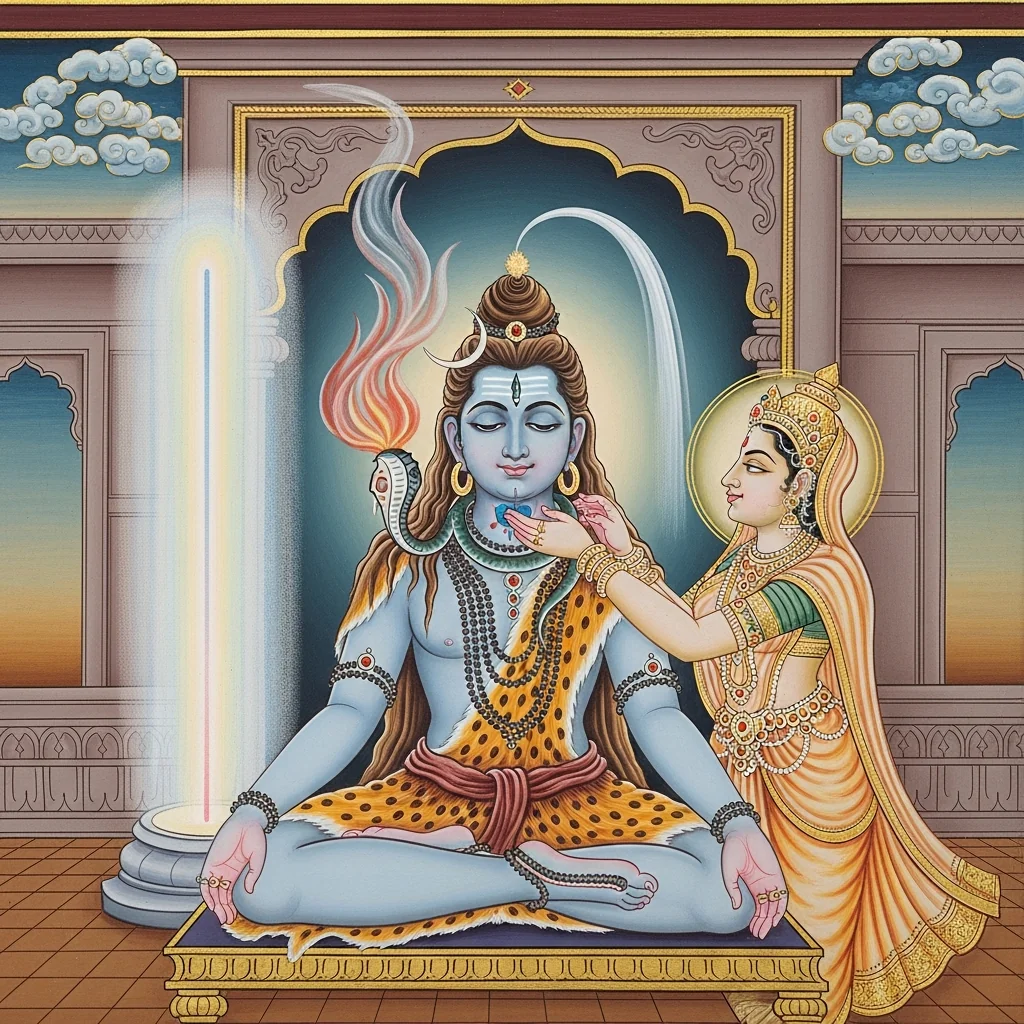
Adhyaya 10
This chapter presents a layered theological dialogue. The sages ask how creation could resume after a cosmic conflagration in which the brahmāṇḍa and its beings seem reduced to ash by Rudra’s wrath and the fire-like poison of kālakūṭa. Through Lomāśa, the narrator depicts the devas—Brahmā and Viṣṇu among them—overwhelmed by fear and delusion; Heramba (Gaṇeśa) petitions Śiva, explaining that such confusion disrupts proper worship and thereby multiplies obstacles. Śiva replies in Liṅga-form, teaching liṅga-tattva: the manifest world is tied to ahaṃkāra and the play of the guṇas under kāla-śakti, while the supreme principle is calm, māyā-free, beyond both duality and non-duality—pure awareness and bliss. Pressed by Gaṇeśa on plurality, conflicting doctrines, and the origin of beings, the narrative introduces Śakti as the world-womb and recounts Gaṇeśa’s emergence through prakṛti, conflict, transformation into Gajānana, and appointment as lord of the gaṇas and remover of obstacles. In the culmination, Gaṇeśa hymns the Liṅga united with Śakti; Śiva, as Liṅga, absorbs/neutralizes the kālakūṭa threat, revives the worlds, and admonishes the devas for neglecting Gaṇeśa and Durgā. An explicit ritual-ethical rule is established: worship of Vighneśa at the beginning of undertakings is necessary for siddhi (successful attainment).
Shlokas
Verse 1
मुनय ऊचुः । यत्त्वया कथितं ब्रह्मन्ब्रह्मांडं सचराचरम् । भस्मीभूतं रुद्रकोपात्कालकूटाग्निनाऽथ़खिलम्
The sages said: “O Brāhman, as you have told it, the entire universe—moving and unmoving—was reduced to ash by Rudra’s anger, by the fire of Kālakūṭa.”
Verse 2
ब्रह्मांडांतरतः किं तु रुद्रं मन्यामहे वयम् । तदा चराचरं नष्टं ब्रह्मविष्णुपुरोगमम्
But within the brahmāṇḍa, where are we to understand Rudra to be? For at that time all that moved and all that stood unmoving—led by Brahmā and Viṣṇu—was destroyed.
Verse 3
भस्मीभूतं रुद्रकोपात्कथं सृष्टिः प्रवर्तिता । कुतो ब्रह्मा च विष्णुश्च कुतश्चंद्रपुरोगमाः
When everything was reduced to ash by Rudra’s wrath, how did creation begin again? From where did Brahmā and Viṣṇu arise, and from where the Moon and the other luminaries?
Verse 4
अन्ये सुरा सुराः कुत्र भस्मीभूता लयं गताः । अत ऊर्ध्वं किमभवत्तत्सर्वं वक्तुमर्हसि
Where did the other gods and the asuras go, once reduced to ash and dissolved into dissolution? What happened after that—please tell us all of it.
Verse 5
व्यासप्रसादात्सकलं वेत्थ त्वं नापरो हि तत् । तस्माज्ज्ञानमयं शास्त्रं तज्जानासि न चापरः
By Vyāsa’s grace you know everything—there is none other who knows it so. Therefore that scripture, made of knowledge itself, is known by you, and by no one else.
Verse 6
इति पृष्टस्तदा सर्वैर्मुनिभिर्भावितात्मभिः । सूतो व्यासं नमस्कृत्य वाक्यं चेदमथाब्रवीत्
Thus questioned by all the sages—self-controlled and contemplative—Sūta first bowed to Vyāsa and then spoke these words.
Verse 7
लोमश उवाच । यदा ब्रह्मांडमध्यस्था व्याप्ता देवा विषाग्निना । हरिब्रह्मादयो ह्येते लोकपालाः सवासवाः । तदा विज्ञापितः शंभुर्हेरंबेन महात्मना
Lomaśa said: When the gods dwelling within the cosmic sphere were pervaded by the fire of poison—Viṣṇu, Brahmā, and the world-guardians along with Indra—then Śambhu was informed by the great-souled Heraṃba (Gaṇeśa).
Verse 8
हेरंब उवाच । हे रुद्र हे महादेव हे स्थाणो ह जगत्पते । मया विघ्नं विनोदेन कृतं तेषां सुदुर्जयम्
Heraṃba said: O Rudra, O Mahādeva, O Sthāṇu, O Lord of the world—by playful intent I have created for them an obstacle that is very hard to overcome.
Verse 9
भयेन मति मोहात्त्वां नार्च्चयंति च मामपि । उद्योगं ये प्रकुर्वन्ति तेषां क्लेशोऽधिको भवेत्
Through fear and delusion of mind they worship neither You nor me. Those who press on with mere exertion, without propitiation, meet with greater hardship.
Verse 10
एवमभ्यर्थितस्तेन पिनाकी वृषभध्वजः । विघ्नांधकारसूर्येण गणाधिपतिना तदा
Thus entreated by him, Pinākin—the Bull-bannered Lord—was then approached by the Gaṇādhipati, the ‘sun’ that dispels the darkness of obstacles.
Verse 11
लिंगरूपोऽब्रवीच्छंभुर्निराकारो निरामयः । निरंजनो व्योमकेशः कपर्द्दी नीललोहितः
Śambhu—formless, free from affliction, stainless—spoke while abiding in the form of the Liṅga: the sky-haired Lord, the matted-haired One, the blue-and-reddish-hued Mahādeva.
Verse 12
महेश्वर उवाच । हेरंब श्रृणु मे वाक्यं श्रद्धया परया युतः । अहंकारात्मकं चैव जगदेतच्चराचरम्
Maheśvara said: O Heraṃba, listen to my words with supreme faith. This entire universe, moving and unmoving, is indeed of the nature of ahaṃkāra—the “I”-principle.
Verse 13
स्थितिं करोत्यहंकारः प्रलयोत्पत्तिमेव च । जगदादौगणपते तदा विज्ञप्तिमात्रतः
Ahaṃkāra brings about the world’s continuance, and also its dissolution and its arising. O Gaṇapati, at the beginning of the cosmos this occurs through mere cognition—through a simple impulse of knowing.
Verse 14
मायाविरहितं शांतं द्वैताद्वैतपरं सदा । ज्ञप्तिमात्रस्वरूपं तत्सदानंदैकलक्षणम्
That Reality is free of māyā, tranquil, and ever beyond both duality and non-duality. Its nature is pure consciousness alone, bearing the single mark of eternal bliss.
Verse 15
गणपतिरुवाच । यदि त्वं केवलो ह्यात्मा परमानन्दलक्षणः । तस्मात्त्वदपरं किंचिन्नान्यदस्ति परंतप
Gaṇapati said: If You alone are the Self (Ātman), marked by supreme bliss, then apart from You there exists nothing whatsoever, O subduer of foes.
Verse 16
नानारूपं कथं जातं सुरासुरविलक्षणम् । विचित्रं मोहजननं त्रिभिर्द्देवैश्च लक्षितम्
How did this manifold universe arise—so distinct in form among gods and asuras—so wondrous, yet a cause of delusion, and marked as threefold by the three deities?
Verse 17
भूतग्रामैश्चतुर्भिश्च नानाभेदैः समन्वितैः । जातं संसारचक्रं च नित्यानित्यविलक्षणम्
From the four hosts of elements, diversified into many distinctions, the wheel of saṃsāra has arisen—bearing the marks of both the eternal and the non-eternal.
Verse 18
परस्परविरोधेन ज्ञानवादेन मोहिताः । कर्मवादरताः केचित्केचित्स्वगुणमाश्रिताः
Bewildered by mutually conflicting doctrines of ‘knowledge’, some delight in doctrines of ‘action (karma)’; while others cling to their own inborn disposition (guṇa).
Verse 19
ज्ञाननिष्ठाश्च ये केचित्परस्परविरोधिनः । एवं संशयमापन्नं त्राहि मां वृषभध्वज
Even those established in ‘knowledge’ are seen to contradict one another. Thus fallen into doubt, save me, O Bull-bannered Lord (Śiva).
Verse 20
अहं गणश्च कुत्रत्याः क्व चायं वृषभः प्रभो । एते चान्ये च बहवः कुतो जाताश्च कुत्र वै
From where have I and these gaṇas come—and from where is this bull, O Lord? And these many others as well: from what source were they born, and to what end do they go?
Verse 21
कृताः सर्वे महाभागाः सात्त्विका राजसाश्च वै । प्रहस्य भगवाञ्छंभुर्गणेशं वक्तुमुद्यतः
All these fortunate ones are fashioned with sāttvika and rājasika dispositions. Smiling, the Blessed Lord Śambhu prepared to reply to Gaṇeśa.
Verse 22
महेश्वर उवाच । कालशक्त्या च जातानि रजःसत्त्वतमांसि च । तैरावृतं जगत्सर्वं सदेवासुमानुषम्
Maheśvara said: By the power of Time, rajas, sattva, and tamas come into being. By them the whole world is veiled—together with gods, asuras, and humans.
Verse 23
परिदृश्यमानमेतच्चानश्वरं परमार्थतः । विद्ध्येतत्सर्वसिद्ध्यैव कृतकत्वाच्च नश्वरम्
This world that is seen is not, in the ultimate sense, truly imperishable. Know it as perishable, precisely because it is made—this understanding itself leads toward complete attainment.
Verse 24
लोमश उवाच । यावद्गणेशसंयुक्तो भाषमाणः सदाशिवः । लिंगरूपी विश्वरूपः प्रादुर्भूता सदाशिवात्
Lomaśa said: While Sadāśiva, accompanied by Gaṇeśa, was speaking, the cosmic universal form—manifesting as the Liṅga—appeared forth from Sadāśiva.
Verse 25
शिवरूपा जगद्योनिः कार्यकारणरूपिणी । लिंगरूपी स भगवान्निमग्नस्तत्क्षणादभूत्
Śiva-formed, the womb of the universe, the very shape of cause and effect—He, the Blessed Lord, becoming the Liṅga, was at that very moment established in its place.
Verse 26
एका स्थिता परा शक्तिर्ब्रह्मविद्यात्मलक्षणा । गणेशो विस्मयाविष्टो ह्यवलोकनतत्परः
There stood the one Supreme Power, whose very nature is Brahma-vidyā (the knowledge of the Absolute). Gaṇeśa, filled with wonder, remained intent only on gazing upon Her.
Verse 27
ऋषय ऊचुः । प्रकृत्यन्तर्गतं सर्वं जगदेतच्चराचरम् । गणेशस्य पृथक्त्वं च कथं जातं तदुच्यताम्
The sages said: “This entire world—moving and unmoving—abides within Prakṛti. How, then, did Gaṇeśa come to possess a distinct and separate status? Pray, explain that.”
Verse 28
लोमश उवाच । साक्षात्प्रकृत्याः संभूतो गणेशो भगवानभूत् । यथारूपः शिवः साक्षात्तद्रूपो हि गणेश्वरः
Lomaśa said: “Gaṇeśa arose directly from Prakṛti and became a Bhagavān. Indeed, whatever is Śiva’s very form, that very form is Gaṇeśvara’s.”
Verse 29
शिवेन सह संग्रामो ह्यभूत्तस्य महात्मनः । अज्ञानात्प्रकृतो भूत्वा बहुकालं निरन्तरम्
Indeed, that great-souled one came to wage war with Śiva; for, through ignorance, becoming bound to Prakṛti, he continued so unceasingly for a long time.
Verse 30
तस्य दृष्ट्वा ह्यजेयत्वं गजारूढस्य तत्तदा । त्रिशूलेनाहनच्छंभुः सगजं तमपातयत्
Seeing then the invincibility of him who was mounted on an elephant, Śambhu struck with the trident and cast him down together with the elephant.
Verse 31
तदा स्तुतो महादेवः परशक्त्या परंतपः । परशक्तिमुवाचेदं वरं वरय शोभने
Then Mahādeva, the mighty subduer of foes, was praised by the Supreme Śakti. And he said to that Parāśakti: “O auspicious one, choose a boon.”
Verse 32
तदा वृतो महादेवो वरेण परमेण हि । योऽयं त्वया हतो देव मम पुत्रो न संशयः
Then Mahādeva was entreated with the highest boon: “O God, this one whom you have slain is my son—of that there is no doubt.”
Verse 33
त्वां न जानात्ययं मूढः प्रकृत्यंशसमुद्भवः । तस्मात्पुत्रं जीवयेमं मम तृष्ट्यर्थमेव च
“This deluded one does not recognize you, for he has arisen from a portion of Prakṛti. Therefore, revive this son, for my satisfaction as well.”
Verse 34
प्रहस्य भगवान्रुद्रो मायापुत्रमजीवयत् । सिंधुरवदनेनैव मुखे स समयोजयत्
Smiling, Bhagavān Rudra restored the māyā-born son to life, and he fitted upon him, as his face, the visage of an elephant.
Verse 35
तदा गजाननो जातः प्रसादाच्छंकरस्य च । मायापुत्रोपि निर्मायो ज्ञानवान्संबभूव ह
Then, by Śaṅkara’s gracious favor, he became Gajānana (the elephant-faced one). Though born of māyā, he became free from māyā and truly endowed with wisdom.
Verse 36
आत्मज्ञानामृतेनैव नित्यतृप्तो निरामयः । समाधिसंस्थितो रौद्रः कालकालांतकोऽभवत्
Sated forever by the nectar of Self-knowledge and free from all affliction, he became established in samādhi; assuming a fierce (Raudra) state, he became the very “slayer of Time—and of Time’s end”.
Verse 37
योगदंडार्थमुत्पाट्य स्वकीयं दशनं महत् । करे गृह्य गणाध्यक्षः शब्धब्रह्मातिवर्त्तते । ऋद्धिसिद्धिद्वयेनैव एकत्वेन विराजितः
Uprooting his own great tusk to serve as a yogic staff and taking it in his hand, the Lord of the Gaṇas transcended the “Brahman of sound,” mere verbal revelation. Endowed with both prosperity and spiritual accomplishment, he shone in oneness.
Verse 38
ये ते गणाश्च विघ्नाश्च ये चान्येऽभ्यधिका भुवि । तेषामपि पतिर्जातः कृतोऽसौ शंभुना तदा
Over those gaṇas and those obstacles—and over all others more powerful upon the earth—he too became their lord; thus, at that time, Śambhu appointed him as their master.
Verse 39
तस्माद्वि लोकयामास प्रकृतिं विश्वरूपिणीम् । पृथक्स्थित्वाग्रतो जानाल्लिंगं प्रकृतिमेव च । ददर्श विमलं लिंगं प्रकृतिस्थं स्वभावतः
Then he beheld Prakṛti, whose form is the universe. Standing apart, he discerned before him both the Liṅga and Prakṛti themselves; and he saw the stainless Liṅga, by its very nature abiding within Prakṛti.
Verse 40
आत्मानं च गणैः साद्धं तथैव च जगत्त्रयम् । लीनं लिंगे समस्तं तद्धेरम्बो ज्ञानवानपि
And Heramba—though possessed of knowledge—saw his own self together with the gaṇas, and likewise the three worlds, all entirely dissolved into the Liṅga.
Verse 41
मुमोह च पुनः संज्ञां प्रतिलभ्य प्रयत्नतः । ननाम शिरसा ताभ्यामीशाभ्यां स गणेश्वरः
He swooned again; then, regaining consciousness with effort, that Lord of the Gaṇas bowed his head to the two Divine Sovereigns.
Verse 42
तदा ददर्श तत्रैव लोकसंहारकारकम् । ब्रह्माणं चैव रुद्रं च विष्णुं चैव सदाशिवम्
Then, right there, he beheld the agent of the world’s dissolution—Brahmā, Rudra, Viṣṇu, and Sadāśiva.
Verse 43
ददर्श प्रेततुल्यानि लिंगशक्त्यात्मकानि च । ब्रह्माण्डगोलकान्येव कोटिशः परमाणुवत्
He saw countless cosmic globes—like atoms, by the millions—ghostlike in appearance, and constituted of the Liṅga’s power (Śakti).
Verse 44
लीयंते च विलीयंते महेशे लिंगरूपिणि । प्रकृत्यंतर्गतं लिंगं लिंगस्यांतर्गता च सा
They merge and are dissolved into Maheśa in the form of the Liṅga. The Liṅga is contained within Prakṛti, and she (Prakṛti) is contained within the Liṅga.
Verse 45
शक्त्या लिंगं च संछन्नं तदा सर्वमदृश्यत । लिंगेन शक्तिः संछन्ना परस्परमवर्तत
Then the Liṅga was veiled by Śakti, and everything became unseen. Śakti, in turn, was veiled by the Liṅga; thus they mutually enveloped one another.
Verse 46
शिवाभ्यां संश्रितं लोकं जगदेतच्चराचरम् । गणेशो वापि तज्ज्ञानं न परेऽपि तथाविदन्
This entire world—moving and unmoving—rests upon the two Śivas (Śiva together with Śakti). That truth was known in its fullness by Gaṇeśa; even the others did not understand it in the same way.
Verse 47
तदोवाच महातेजा गणाध्यक्षो गणैः सह । सशक्तिकं स्तूयमानः शक्त्या च परया तदा
Then the radiant Lord of the Gaṇas, Gaṇeśa, together with his attendants, spoke—while the Deity united with Śakti was being praised, and while the supreme Power itself stood present.
Verse 48
गणेश उवाच । नमामि देवं शक्त्यान्वितं ज्ञानरूपं प्रसन्नं ज्ञानात्परं परमंज्योतिरूपम् । रूपात्परं परमं तत्त्वरूपं तत्त्वात्परं परमं मंगलं च आनंदाख्यं निष्कलं निर्विषादम्
Gaṇeśa said: I bow to the God united with Śakti—serene, whose very nature is knowledge; beyond knowledge, the supreme form of Light; beyond all form, the highest Reality-principle; beyond even that principle, the supreme Auspiciousness, called Bliss itself—partless and free from sorrow.
Verse 49
धूमात्परमयोवह्निर्धूमवत्प्रतिभासते । प्रकृत्यंतर्गस्त्वं हि लक्ष्यसे ज्ञानिसंभवः । प्रकृत्यंतर्गतस्त्वं हि मायाव्यक्तिरितीयसे
As fire, though beyond smoke, may appear as if smoky, so You—though transcending Prakṛti—are perceived as if within it when knowledge arises in the wise. Yet when seen within Prakṛti, You are spoken of as Māyā’s manifesting power.
Verse 50
एवंविधस्त्वं भगवन्स्वमायया सृजस्यथोलुंपसि पासि विश्वम् । अस्माद्गरात्सर्वमिदं प्रनष्टं सब्रह्मविप्रेंद्रयुतं चराचरम्
O Blessed Lord, such as You are, by Your own Māyā You create the universe, withdraw it, and protect it. Yet by this poison the whole world—moving and unmoving, together with Brahmā and the foremost among sages—has been brought to ruin.
Verse 51
यथा पुरासीर्भगवान्महेशस्त्रैलोक्यनाथोऽसि चराचरात्मा । कुरुष्य शीघ्रं सहजीवकोशं चराचरं तत्सकलं प्रदग्धम्
As You were of old, O Lord Maheśa—ruler of the three worlds, the very Self of all that moves and stands still—so now act swiftly: restore the whole creation, utterly burned, together with the living beings’ sheath of life.
Verse 52
लोमश उवाच । एवं स्तुतो गणेशेन भगवान्भूतभावनः । यदुत्थितं कालकूटं लोकसंहारकारकम्
Lomaśa said: Thus praised by Gaṇeśa, the Blessed Lord, the sustainer of all beings, turned his attention to the Kālakūṭa poison that had arisen, able to bring about the destruction of the worlds.
Verse 53
लिंगरूपेण तद्ग्रस्तं विमलं चाकरोत्तदा । सदेवासुरमर्त्याश्च सर्वाणि त्रिजगन्ति च । तत्क्षणाद्रक्षितान्येव कृपया परया युतः
Taking the form of the Liṅga, he swallowed that poison and made it pure. In that very instant the three worlds—together with gods, demons, and mortals—were protected, for he was endowed with supreme compassion.
Verse 54
ब्रह्मा विष्णुः सुरेंद्रश्च लोकपालाः सहर्षयः । यक्षा विद्याधराः सिद्धा गंधर्वाप्सरसां गणाः । उत्थिताश्चैव ते सर्वे निद्रापरिगता इव
Brahmā, Viṣṇu, Indra, the guardians of the directions with the sages; Yakṣas, Vidyādharas, Siddhas, and hosts of Gandharvas and Apsarases—all of them arose, as though waking from sleep.
Verse 55
विस्मयेन समाविष्टा बभूवुर्जातसाध्वसाः । सर्वे देवासुराश्चैव ऊचुराश्चर्यवत्ततः
Filled with amazement and struck with sudden awe, all the gods and demons then spoke in wonder.
Verse 56
क्व कालकूटं सुमहद्येन विद्राविता वयम् । मृतप्रायाः कृताः सद्यः सलोकपालका ह्यमी
“Where is that dreadful, mighty Kālakūṭa poison—by which we, along with the guardians of the worlds, were driven away and made as good as dead in an instant?”
Verse 57
इत्यब्रुवंस्तदा दैत्यास्तूष्णींभूतास्तदा स्थिताः । शक्रादयो लोकपाला विष्णुं सर्वेश्वरेश्वरम् । ब्रह्माणं च पुरस्कृत्य इदमूचुः समेधिता
When the Daityas had spoken thus, they fell silent and stood still. Then Indra and the other guardians of the worlds—placing Brahmā in the forefront and addressing Viṣṇu, the Lord of the lords of all—spoke these words with minds composed and intent.
Verse 58
केनेदं कारितं विष्णो न विदामोऽल्पमेधसः । तदा प्रहस्य भगवान्ब्रह्मणा सह तैः सुरैः
“O Viṣṇu, by whom has this been brought about? We, of little understanding, do not know.” Then the Blessed One, together with Brahmā and those gods, smiled.
Verse 59
समाधिमगमन्सर्वेऽप्येकाग्रमनसस्तदा । तत्त्वज्ञानेन निर्हृत्य कामक्रोदादिकान्द्विजाः
Then all of them entered samādhi with one-pointed minds; and by true knowledge they cast out desire, anger, and the rest—O twice-born.
Verse 60
तदात्मनि स्थितं लिंगमपश्यन्वि बुधादयः । विष्णुं पुरस्कृत्य तदा तुष्टुवुः परमार्थतः
Then the sages and the wise beheld the Liṅga abiding in their very Self. With Viṣṇu placed at the fore, they praised (Śiva) in the highest truth.
Verse 61
आत्मना परमात्मानं योगिनः पर्युपासते
By the Self, the yogins worship and realize the Supreme Self (Paramātman).
Verse 62
लिंगमेव परं ज्ञानं लिंगमेव परं तपः । लिंगमेव परो धर्मो लिंगमेव परा गतिः । तस्माल्लिंगात्परतरं यच्च किंचिन्न विद्यते
The Liṅga alone is the highest knowledge; the Liṅga alone is the highest austerity. The Liṅga alone is the supreme dharma; the Liṅga alone is the highest goal. Beyond the Liṅga there is nothing whatsoever.
Verse 63
एवं ब्रुवंतो हि तदा सुरासुराः सलोकपाला ऋषिभिश्च साकम् । विष्णुं पुरस्कृत्य तमालवर्णं शंभुं शरण्यं शरणं प्रपन्नाः
Thus speaking, the Devas and Asuras—together with the Lokapālas and the Ṛṣis—placing Viṣṇu at the fore, surrendered and took refuge in Śambhu, the dark-hued Lord, the true Refuge of all.
Verse 64
त्राहित्राहि महादेव कृपालो परमेश्वर । पुरा त्राता यथा सर्वे तथात्वं त्रातुमर्हसि
“Save us, save us, O Mahādeva—compassionate Supreme Lord! As you once protected all, so now you ought to protect us again.”
Verse 65
तद्देवदेव भवतश्चरणारविंदं सेवानुबंधमहिमानमनंतरूपम् । त्वदाश्रितं यत्परमानुकंपया नमोऽस्तु ते देववर प्रसीद
“Therefore, O God of gods, we bow to your lotus feet—whose glory is realized through devoted service, and whose forms are endless. By your supreme compassion you become the refuge of those who seek you. Salutations to you, O best of gods; be gracious.”
Verse 66
लिंगस्वरूपमध्यस्थो भगवान्भूतभावनः । सर्वैः सुरगणैः साकं बभाषेदं रमापतिः
Abiding within the very form of the Liṅga, the Blessed Lord—nurturer of all beings—together with all the hosts of gods, spoke these words; thus spoke Viṣṇu, the Lord of Lakṣmī.
Verse 67
त्वं लिंगरूपी भगवाञ्जगतामभयप्रदः । विष्णुना संस्तुतो देवो लिंगरूपी महेश्वरः
You are the Blessed Lord in the form of the Liṅga, bestower of fearlessness upon the worlds. Thus praised by Viṣṇu, Maheśvara—the god in Liṅga-form—is proclaimed.
Verse 68
मृतास्त्राता गरात्सर्वे तस्मान्मृत्युंजय प्रभो । रक्षरक्ष महाकाल त्रिपुरांत नमोस्तु ते
All were saved from death and from poison; therefore, O Lord Mṛtyuñjaya, protect—protect! O Mahākāla, destroyer of Tripura, homage be to You.
Verse 69
विष्णुना संस्तुतो देवो लिंगरूपी महेश्वरः । प्रादुर्बभूव सांबोऽथ बोधयन्निव तान्सुरान्
Praised by Viṣṇu, Maheśvara—the god in the form of the Liṅga—then manifested as Sāmbā (Śiva with Umā), as though instructing those gods.
Verse 70
हे विष्णो हे सुराः सर्व ऋषयः श्रूयतामिदम् । मन्यतेऽपि हि संसारे अनित्ये नित्यताकुलम्
O Viṣṇu! O all you gods and sages—listen to this: in this impermanent saṃsāra, the bewildered still imagine permanence.
Verse 71
अविलोकयताऽत्मात्मना विबुधादयः । किं यज्ञैः किं तपोभिश्च किमुद्योगेन कर्मणाम्
O gods and the rest—without beholding the Self by the Self, what is achieved by sacrifices, what by austerities, and what by strenuous engagement in actions?
Verse 72
एकत्वेन पृथक्त्वेन किंचिन्नैव प्रयोजनम् । यस्माद्भवद्भिर्मिलितैः कृतं यत्कर्म दुष्करम्
Whether in unity or in separation, without right understanding there is no true purpose; for you, when united, accomplished that difficult deed.
Verse 73
क्षीराब्धेर्मथनं तत्तु अमृतार्थं कथं कृतम् । मृत्युं जयं निराकृत्य अवज्ञाय च मां सदा
How was that churning of the Ocean of Milk done for the sake of nectar—having rejected the Conqueror of Death and continually slighted Me?
Verse 74
तस्मात्सर्वे मृत्युमुखं पतिता वै न संशयः । अस्माभिर्निर्मितो देवो गणेशः कार्यसिद्धये
Therefore, all of you have surely fallen into the very mouth of death—there is no doubt. Yet by Us, the god Gaṇeśa was created for the accomplishment of undertakings.
Verse 75
न नमंति गणेशं च दुर्गां चैव तथाविधाम् । क्लेशभाजो भविष्यति नात्र कार्या विचारणा
Those who do not bow to Gaṇeśa, and likewise to Durgā of such power, will become heirs to affliction—of this there is no need for doubt or debate.
Verse 76
यूयं सर्वे त्वधर्मिष्ठाः स्तब्धाः पंडितमानिनः । कार्याकार्यमविज्ञाय केवलं मानमोहिताः
All of you are indeed steeped in adharma—stiff with pride, imagining yourselves to be learned. Not knowing what should be done and what should not, you are deluded only by self-importance.
Verse 77
तस्मात्कालमुखे सर्वे पतिता नात्र संशयः । सर्वे श्रुतिपरा यूयमिंद्राद्या देवतागणाः
Therefore, all of you have fallen into the “mouth of Time”—of this there is no doubt. Yet you, the hosts of gods beginning with Indra, all claim to be devoted to the Śruti.
Verse 78
प्ररोचनपराः सर्वे क्षुद्राश्चेंद्रादयो वृथा । नात्मानं च प्रपंचेन वेत्सि त्वं हि शचीपते
All of you are intent only on flattery and persuasion; petty indeed are you gods beginning with Indra, and all your boasting is vain. O lord of Śacī, you do not truly know the Self—only the play of worldly appearances.
Verse 79
कृतः प्रयत्नो हि महानमृतार्थं त्वया शठ । अश्वमेधशतेनैव यद्राज्यं प्राप्तवानसि । अपि तच्च पराधीन तन्न जानासि दुर्मते
O deceiver, you have made a great effort for the sake of “immortality”. By a hundred Aśvamedha sacrifices you obtained sovereignty—yet even that is dependent on another’s power; this, in your bad judgment, you do not understand.
Verse 80
यैर्वदवाक्यैस्त्वं मूढ संस्तुतोऽसि तपस्विभिः । ते मूढास्तो षयंति त्वां तत्तद्रागपरायणाः
By whatever empty words you, O deluded one, are praised by ascetics—those deluded men merely try to please you, being devoted to this or that attachment.
Verse 81
विष्णो त्वं च पक्षपातान्न जानासि हिताहितम् । केचिदधतास्त्वया विष्णो रक्षिताश्चैव केचन
O Viṣṇu, because of partiality you do not discern what is beneficial and what is harmful. Some are oppressed by you, O Viṣṇu, while others are indeed protected.
Verse 82
इच्छायुक्तस्त्वमत्रैव सदा बालकचेष्टितः । येऽन्ये च लोकपाः सर्वे तेषां वार्ता कुतस्त्विह
Here you act only by whim, ever behaving like a child. And as for all the other guardians of the worlds—what place is there here for their word in this matter?
Verse 83
अन्यथा हि कृते ह्यर्थे अन्यथात्वं भविष्यति । कार्यसिद्धिर्भवेद्येन भवद्भिर्विस्मृतं च तत्
If an undertaking is carried out in the wrong way, its result will surely turn out otherwise. And the very principle by which success in the task is attained—you have forgotten that.
Verse 84
येनाद्य रक्षिताः सर्वे कालकूटमहाभयात् । येन नीलीकृतो विष्णुर्येन सर्वे पराजिताः
By whom all were today protected from the great terror of Kālakūṭa poison; by whom even Viṣṇu was turned dark-blue; by whom all were subdued—
Verse 85
लोका भस्मीकृता येन तस्माद्येनापि रक्षिताः । तस्यार्च्चनाविधिः कार्यो गणेशस्य महात्मनः
He by whom the worlds were reduced to ashes—and by whom, for that very reason, they were also protected: therefore the proper rite of worship of that great-souled Gaṇeśa should be performed.
Verse 86
कर्मारंभे तु विघ्नेशं ये नार्चंति गणाधिपम् । कार्यसिद्धिर्न तेषां वै भवेत्तु भवतां यथा
Those who, at the very commencement of an undertaking, do not worship Vighneśa, the Lord of the Gaṇas—true success in their work does not arise for them, as it does for those who do worship.
Verse 87
एतन्महेशस्य वचो निशम्य सुरासुराः किंनरचारणाश्च । पूजाविधानं परमार्थतोऽपि पप्रच्छुरेनं च तदा गिरीशम्
Hearing these words of Maheśa, the devas and asuras, together with the kiṃnaras and cāraṇas, then questioned Girīśa in detail about the true procedure of worship.