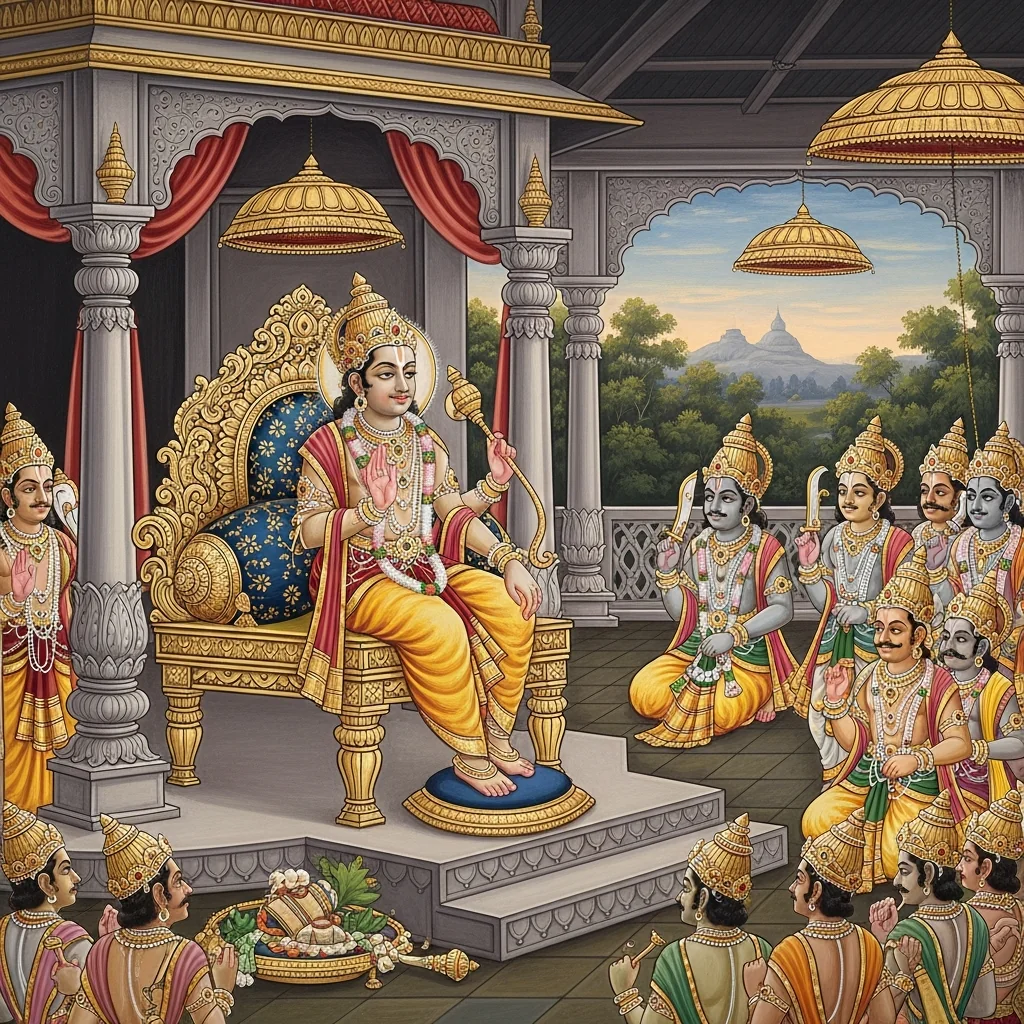
Adhyaya 28
Lomāśa recounts a moment of crisis: the Devas, distressed by Tāraka’s threat, petition Rudra/Śiva for protection. Śiva declares that Kumāra (Kārttikeya) will be the means of deliverance, and the Devas set out with him at their head. A celestial voice reassures them that victory is assured when they uphold Śaiva (Śāṅkarī) leadership. As war draws near, at Brahmā’s prompting Death’s daughter Senā—of singular beauty—arrives and is accepted in relation to Kumāra; thereafter Kumāra is installed as senāpati (commander). Conches, drums, and battle instruments resound through the sky. A brief maternal dispute among Gaurī, Gaṅgā, and the Kṛttikās is settled by Nārada, reaffirming Kumāra’s Śaiva origin and his purpose “for the gods’ work.” Kumāra instructs Indra to return to heaven and rule without interruption, consoling the displaced Devas. Tāraka arrives with a vast host; Nārada confronts him, declaring the inevitability of the Devas’ effort and Kumāra’s destined role. Tāraka answers with derision, challenging Indra and scorning supports tied to the human realm. Nārada reports back; the Devas rally, invest Kumāra with royal insignia (elephant, then a jewel-like aerial conveyance), and assemble the lokapālas with their retinues. Both sides form battle arrays in Antarvedī—between the Gaṅgā and Yamunā—amid detailed musters of troops, vehicles, weapons, and a ceremonial display of power before engagement.
Shlokas
Verse 1
लोमश उवाच । कुमारं स्वांकमारोप्य उवाच जगदीश्वरः । देवान्प्रति तदा रुद्रः सेंद्रान्भर्गः प्रतापवान्
Lomaśa said: Then the Lord of the world, placing the Kumāra upon his own lap, spoke to the gods—along with Indra. That mighty Rudra, the radiant Bharga, addressed them.
Verse 2
किं कार्यं कथ्यतां देवाः कुमारेणाधुना मम । तदोचुः सहिताः सर्वे देवं पशुपतिं प्रति
“O gods, tell me: what task is now to be accomplished by my Kumāra?” Then all of them together spoke to the Lord Paśupati.
Verse 3
तारकाद्भयमुत्पन्नं सर्वेषां जगतां विभो । त्राता त्वं जगतां स्वामी तस्मात्त्राणं विधीयताम्
“O Lord, fear has arisen for all the worlds because of Tāraka. You are the protector, the master of the worlds—therefore let deliverance be ordained.”
Verse 4
कुमारेण हतोऽद्यैव तारको भविता प्रभो । तस्मादद्यैव यास्यामस्तारकं हंतुमुद्यताः
“O Lord, today itself Tāraka will be slain by the Kumāra. Therefore today itself we shall go forth, ready to kill Tāraka.”
Verse 5
तथेति मत्वा सहसा निर्जग्मुस्ते तदा सुराः । कार्त्तिकेयं पुरस्कृत्य शंकरातमजमेव हि
Thinking, “So be it,” the gods swiftly set out, placing Kārttikeya—truly the son of Śaṅkara—at their head.
Verse 6
सर्वे मिलित्वा सहसा ब्रह्मविष्णुपुरोगमाः । देवानामुद्यमं श्रुत्वा तारकोऽपि महाबलः
All of them quickly assembled, with Brahmā and Viṣṇu at their head; and Tāraka too, mighty in strength, hearing of the gods’ mobilization…
Verse 7
सैन्येन महता चैव ययौ योद्धुं सुरान्प्रति । देवैर्दृष्टं समायातं तारकस्य महद्बलम्
He marched forth with a vast army to wage war against the gods. The gods beheld Tāraka’s great force drawing near.
Verse 8
तदा नभोगता वाणी ह्युवाच परिसांत्व्य तान् । शांकरिं च पुरस्कृत्य सर्वे यूय प्रतिष्ठिताः
Then a heavenly voice spoke, consoling them: “With Śaṅkarī (Pārvatī) at the forefront, all of you stand firmly established and protected.”
Verse 9
दैत्यान्विजित्य संग्रामे जयिनो हि भविष्यथ
“Having conquered the Daityas in battle, you shall indeed be victorious.”
Verse 10
वाचं तु खेचरीं श्रुत्वा देवाः सर्वे समुत्सुकाः । कुमारं च पुरस्कृत्य सर्वे ते गतसाध्वसाः
Hearing the celestial voice, all the Devas grew eager; setting Kumāra at their head, they all became free from fear.
Verse 11
युद्धकामाः सुरा यावत्तावत्सर्वे समागताः । वरणार्थं कुमारस्य सुता मृत्योर्दुरत्यया
As soon as the war-eager gods assembled, there arrived—hard to overcome—the daughter of Death, intent on choosing Kumāra.
Verse 12
ब्रह्मणा नोदिता पूर्वं तपः परममाश्रिता । तपसा तेन महता कुमारं प्रति वै तदा । आगता दुहिता मृत्योः सेना नामैकसुंदरी
Formerly, urged by Brahmā, she had undertaken the highest austerity. By that great tapas she then came to Kumāra—the daughter of Death, named Senā, peerlessly beautiful.
Verse 13
तां दृष्ट्वा तेऽब्रुवन्सर्वे देवं पशुपतिं प्रति । एनं कुमारमुद्दिश्य आगता ह्यतिसुंदरी
Seeing her, they all spoke to the Lord Paśupati: “This exceedingly beautiful one has come, intending this very Kumāra.”
Verse 14
ब्रह्मणो वचनाच्चैव कुमारेण तदा वृता । अथ सेनापतिर्जातः कुमारः शांकरिस्तदा
In accordance with Brahmā’s word, she was then chosen by Kumāra; and at that time Kumāra, the son of Śaṅkara, became the Commander of the hosts (Senāpati).
Verse 15
तदा शंखाश्च भेर्यश्च पटहानकगोमुखाः । तथा दुंदुभयो नेदुर्मृदंगाश्च महास्वनाः
Then the sacred conches and kettledrums—paṭahas, ānakas, and gomukhas—resounded; likewise the duṃdubhis thundered, and the mṛdaṅgas poured forth a mighty sound.
Verse 16
तेन नादेन महता पूरितं च नभस्तलम् । तदा गौरी च गंगा च कृत्तिका मातरस्तथा । परस्परमथोचुस्ताः सुतो मम ममेति च
By that great roar the vault of the sky was filled. Then Gaurī, Gaṅgā, and the Kṛttikās—the Mothers—said to one another, “He is my son, indeed mine.”
Verse 17
एवं विवादमापन्नाः सर्वास्ता मातृकादयः । निवारिता नारदेन मौढ्यं मा कुरुतेति च
Thus all those mothers and mother-goddesses fell into dispute; they were restrained by Nārada, who said, “Do not act foolishly.”
Verse 18
पार्वत्यां शंकराज्जातो देवकार्यार्थसिद्धये । तूष्णींभूतास्तदा सर्वाः कृत्तिका मातृभिः सह
Born of Pārvatī and Śaṅkara for the fulfillment of the gods’ purpose, they all then became silent—the Kṛttikās along with the Mothers.
Verse 19
गुहेनोक्तास्तदा सर्वा ऋषिपत्न्यश्च कृत्तिकाः । नक्षत्राणि समाश्रित्य भवद्भिः स्थीयतां चिरम्
Then Guha (Kārttikeya) addressed them all—both the sages’ wives and the Kṛttikās—saying: “Taking refuge among the constellations, remain there for a long time.”
Verse 20
तथा मातृगणस्तेन स्वामिना स्थापितो दिवि । मृत्योः कन्यां च संगृह्य कार्त्तिकेयस्त्वरान्वितः
Likewise, that Lord established the host of the Mothers in heaven; and taking with him the daughter of Death, Kārttikeya, filled with urgency, moved onward.
Verse 21
इंद्रं प्रोवाच भगवान्कुमारः शंकरात्मजः । दिवं याहि सुरैः सार्द्धं राज्यं कुरु निरन्तरम्
The Blessed Kumāra, Śaṅkara’s son, spoke to Indra: “Go to heaven together with the gods, and rule your kingdom without interruption.”
Verse 22
इंद्रेणोक्तः कुमारो हि तारकेण प्रपीडिताः । स्वर्गाद्विद्राविताः सर्वे वयं याता दिशो दश
Indra said to the Kumāra: “Indeed, we have been grievously oppressed by Tāraka. Driven out of heaven, all of us have fled to the ten directions.”
Verse 23
किं पृच्छसि महाभाग अस्मान्पदपरिच्युतान् । एवमुक्तस्तदा तेन वज्रिणाशंकरात्मजः । प्रहस्येंद्रं प्रति तदा मा भैषीत्यभयं ददौ
“Why do you question us, O fortunate one, when we have fallen from our station?” Thus addressed by Vajrin (Indra), Śaṅkara’s son then smiled and said to Indra, “Do not fear,” granting him assurance.
Verse 24
यावत्कथयतस्तस्य शांकरेश्च महात्नः । कैलासं तु गते रुद्रे पार्वत्या प्रमथैः सह
While that great-souled son of Śaṅkara was speaking, Rudra had gone to Kailāsa, together with Pārvatī and the Pramathas.
Verse 25
आजगाम महादैत्यो दैत्यसेनाभिरावृतः । रणदुंदुभयो नेदुस्तता प्रलयभीषणाः
A mighty demon arrived, encompassed by the armies of the Dānavas; war-drums thundered, dreadful as the terrors of pralaya, the cosmic dissolution.
Verse 26
रणकर्कशतूर्याणि डिंडिमान्यद्भुतानि च । गोमुखाः खरश्रृंगाणि काहलान्येव भूरिशः
Harsh war-instruments blared—marvelous ḍiṇḍimas, gomukha horns, donkey-horns, and many kāhalas besides.
Verse 27
वाद्यभेदा आवाद्यंत तस्मिन्दैत्यसमागमे । गर्जमानास्तदा वीरस्तारकेण सहैव तु
At that gathering of demons, many kinds of instruments were played; then the hero, together with Tāraka, roared aloud.
Verse 28
उवाच नारदो वाक्यं तारकं देवकण्टकम्
Nārada spoke words to Tāraka, the thorn in the side of the gods.
Verse 29
नारद उवाच । पुरा देवैः कृतो यत्नो वधार्थं नात्र संशयः । तवैव चासुरश्रेष्ठ मयोक्तं नान्यथा भवेत्
Nārada said: “Formerly the gods indeed strove to bring about your death—of this there is no doubt. And, O best of Asuras, what I have spoken to you is truly about you; it shall not be otherwise.”
Verse 30
कुमारोऽयं च शर्वस्य तवार्थं चोपपादितः । एवं ज्ञात्वा महाबाहो कुरु यत्नं समाहितः
This Kumāra is the son of Śarva (Śiva), brought forth expressly for your sake. Knowing this, O mighty-armed one, strive with a mind fully gathered and intent.
Verse 31
नारदोक्तं निशम्याथ तारकः प्रहसन्निव । उवाच वाक्यं मेधावी गच्छ त्वं च पुरंदरम्
Hearing Nārada’s words, Tāraka—almost laughing—spoke with shrewdness: “Go you, and (tell) Purandara (Indra).”
Verse 32
मम वाक्यं महर्षे त्वं वद शीघ्रं यथातथम् । कुमारं च पुरस्कृत्य मया योद्धुं त्वमिच्छसि
O great sage, quickly convey my message exactly as it is. Setting Kumāra at the fore, you (the gods) wish to fight with me.
Verse 33
मूढभावं समाश्रित्य कर्तुमिच्छसि नान्यथा । मनुष्यमेकमाश्रित्य मुचुकुन्दाख्यमेव च
Clinging to folly, you wish to act in this way alone and in no other—relying upon a single mere human, the one called Mucukunda.
Verse 34
तत्प्रभावेऽमरावत्यां स्थितोऽसि त्वं न चान्यथा । कौमारं बलमाश्रित्य तिष्ठसे त्वं ममाग्रतः
By his very influence you stand established in Amarāvatī—there is no other cause. And relying on the strength of Kumāra, you now stand before me.
Verse 35
त्वां हनिष्याम्यहं मन्दलोकपालैः सहैव हि । एवं कथय देवेन्द्रं देवर्षे नान्यथा वद
I shall kill you—along with those feeble guardians of the worlds. Tell this to Devendra (Indra), O divine sage; speak it exactly so, and not otherwise.
Verse 36
तथेति मत्वा भगवान्स नारदो ययौ सुराञ्छक्रपुरोगमांश्च । आचष्ट सर्वं ह्यसुरेन्द्रभाषितं सहोपहासं मतिमांस्तथैव
Thinking, “So be it,” the venerable Nārada went to the gods led by Śakra (Indra), and the wise sage reported everything spoken by the lord of Asuras—along with its mockery—just as it was.
Verse 37
नारद उवाच । भवद्भिः श्रूयतां देवा वचनं मम नान्यथा । तारकेण यदुक्तं च सानुगे नावधार्यताम्
Nārada said: “O gods, hear my words—exactly as they are. Let what was spoken by Tāraka, together with his followers, be duly taken to heart.”
Verse 38
तारक उवाच । त्वां हनिष्यामि रे मूढ नान्यथा मम भाषितम्
Tāraka said: “I will kill you, you fool—my declaration shall not be otherwise.”
Verse 39
मुचुकुन्दं समासाद्य लोकपालैश्च पूजितः । न त्वया भीरुणा योत्स्ये देवो भूत्वा नराश्रितः
“Having approached King Mucukunda—honoured even by the guardians of the worlds—I will not fight with you, a coward, while I, though a god, have taken refuge in a human state.”
Verse 40
तस्य वाक्यं निशम्योचुः सर्वे देवाः सवासवाः । कुमारं च पुरस्कृत्य नारदं चर्षिसत्तमम्
Hearing his words, all the gods—together with Indra—replied, placing Kumāra in the forefront, and also Nārada, the best of sages.
Verse 41
जानासि त्वं हि देवर्षे कुमारस्य बलाबलम् । अज्ञो भूत्वा कथं वाक्यमुक्तं तस्य ममाग्रतः
“O divine sage, you surely know the strength and the limits of Kumāra. How then, feigning ignorance, did you speak such words about him in my presence?”
Verse 42
प्रहस्य नारदो वाक्यमुवाच तस्य सन्निधौ । अहमप्युपहासं च वाक्यं तारकमुक्तवान्
Smiling, Nārada spoke in his presence: “I too spoke mocking words to Tāraka.”
Verse 43
जानीध्वममराः सर्वे कुमारं जयिनं सुराः । भविष्यत्यत्र मे वाक्यं नात्र कार्याविचारणा
“Know this, O immortals, O gods: Kumāra is the conqueror. My statement will surely come to pass here—there is no need for hesitation or over-deliberation.”
Verse 44
नारदस्य वचः श्रुत्वा सर्वे देवा मुदान्विताः । ऐकपद्येन चोत्तस्थुर्योद्धुकामाश्च तारकम्
Hearing Nārada’s words, all the gods, filled with joy, rose at once—eager to fight Tāraka.
Verse 45
कुमारं गजमारोप्य देवेन्द्रो ह्यग्रगोऽभवत् । सुरसैन्येन महता लोकपालैः समावृतः
Mounting Kumāra upon an elephant, Indra went in the vanguard, surrounded by the mighty army of the gods and by the guardians of the worlds.
Verse 46
तदा दुन्दुभयो नेदुर्भेरीतूर्याण्यनेकशः । वीणावेणुमृदंगानि तथा गन्धर्वनि स्वनाः
Then the kettle-drums resounded, and many war-drums and trumpets blared; vīṇās, flutes, and mṛdaṅgas sounded, along with the melodious strains of the Gandharvas.
Verse 47
गजं दत्त्वा महेंद्राय कुमारो यानमारुहत् । अनेकरत्नसंवीतं नानाश्चर्यसमन्वितम् । विचित्रचित्रं सुमहत्तथाश्चर्यसमन्वितम्
After giving the elephant to great Indra, Kumāra mounted a splendid conveyance—adorned with many jewels, filled with manifold marvels, vast and wondrous, with richly variegated designs.
Verse 48
विमानमारुह्य तदा महायशाः स शांकरिः सर्वगणैरुपेतः । श्रिया समेतः परया बभौ महान्स वीज्यमानश्चमरैर्महाप्रभैः
Then that illustrious son of Śaṅkara (Kumāra), mounting the aerial chariot and accompanied by all his gaṇas, shone forth in great splendour—endowed with supreme glory, and fanned with radiant cāmara-whisks.
Verse 49
प्राचे तसं छत्र महामणिप्रभं रत्नैरुपेतं बहुभिर्विराजितम् । धृतं तदा तेन कुमारमूर्द्धनि चन्द्रैः किरणैः सुशोभितम्
Then, in the eastern direction, a royal parasol blazing with the radiance of great gems—adorned with many jewels—was held above the head of the divine Commander (Kumāra), made splendid as though beautified by moonlike rays.
Verse 50
संमीलितास्तदा सव देवा इन्द्रपुरोगमाः । बलैः स्वैः स्वैः परिक्रांता योद्धुकामा महाबलाः
Then all the gods, led by Indra, assembled together—each surrounded by his own forces—mighty in strength and eager for battle.
Verse 51
यमेऽपि स्वगणैः सार्द्धं मरुद्भिश्च सदागतिः । पाथोभिर्वरुणस्तत्र कुबेरो गुह्यकैः सह । ईशोऽपि प्रमथैः सार्द्धं नैरृतो व्याधिभिः सह
Yama too arrived with his own attendants; and the ever-moving Maruts were there as well. Varuṇa came with the waters, Kubera with the Guhyakas, and Īśa with the Pramathas; Nairṛta also came accompanied by hosts of afflictions.
Verse 52
एवं तेऽष्टौ लोकपा योद्धुकामाः सर्वे मिलित्वा तारकं हंतुमेव । पुरस्कृत्वा शांकरिं विश्ववंद्यं सेनापतिं चात्मविदां वरिष्ठम्
Thus the eight guardians of the worlds, all desiring battle, united with one aim—to slay Tāraka. Placing in the forefront the Śaiva Power revered by the whole world, and the Commander-in-chief, the foremost among knowers of the Self, they advanced.
Verse 53
एवं ते योद्धुकामा हि अवतेरुश्च भूतलम् । अंतर्वेद्यां स्थिताः सर्वे गंगा यमुनमध्यगाः
Thus, eager for battle, they descended to the earth and all took their positions in Antarvedī—the holy tract lying between the Gaṅgā and the Yamunā.
Verse 54
पातालाच्च समायातास्तारकस्योपजीविनः । चेरुरंगबलोपेता हन्तुकामाः सुरान्रणे
And from Pātāla came those who lived under Tāraka’s patronage. Endowed with bodily strength, they moved about, intent on killing the gods in battle.
Verse 55
तारको हि समायातो विमानेन विराजितः । छत्रेण च महातेजा ध्रियमाणेन मूर्द्धनि
Tāraka indeed arrived, resplendent in his vimāna, the aerial chariot; and that mighty, radiant one had a royal parasol held above his head.
Verse 56
चामरैर्विज्यमानो हि शुशुभे दैत्यराट् स्वयम्
Fanned with chāmaras, yak-tail whisks, the king of the Daityas himself appeared splendid.
Verse 57
एवं देवाश्च दैत्याश्च अंतर्वेद्यां स्थितास्तदा । सैन्येन महता तत्र व्यूहान्कृत्वा पृथक्पृथक्
Thus, the gods and the Daityas, stationed in Antarvedī at that time, arranged their great armies there into separate battle-formations.
Verse 58
गजान्कृत्वा ह्येकतश्च हयांश्च विविधांस्तथा । स्यंदनानिविचित्राणि नानारत्नयुतानि च
Placing elephants on one side, and likewise various horses, they also set out wondrous chariots, adorned with many kinds of jewels.
Verse 59
पदाता बहवस्तत्र शक्तिशूलपरश्वधैः । खड्गतोमरनाराचैः पाशमुद्गरशोभिताः
There, numerous foot-soldiers stood resplendent—armed with spears (śakti), tridents (triśūla), and axes, and adorned with swords, javelins, iron arrows, nooses, and maces.
Verse 60
ते सेने सुरदैत्यानां शुशुभाते परस्परम् । हंतुकामास्तदा ते वै स्तूयमानाश्च बन्धुभिः
Those two armies of the gods and the daityas shone facing one another—each intent on striking down the other, while being praised and cheered on by their kinsmen.