Adhyaya 11
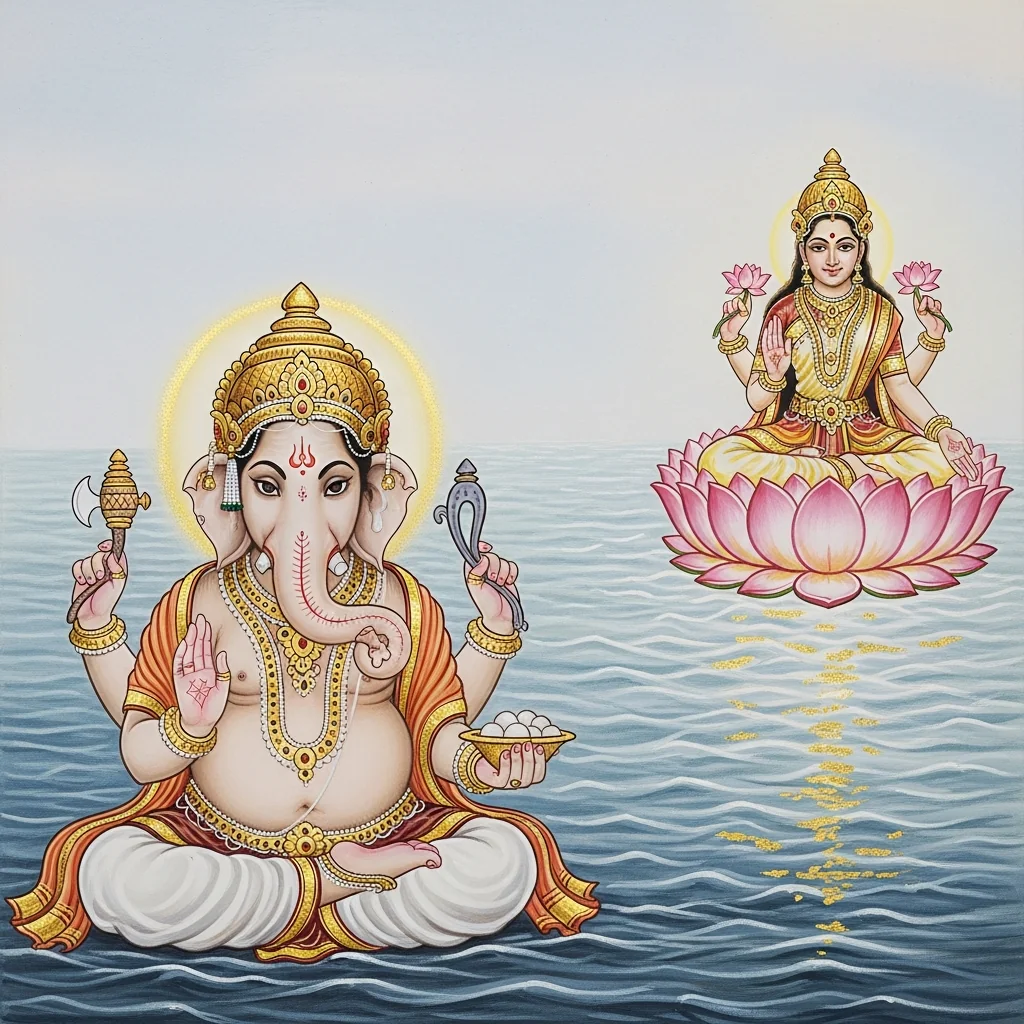
Chapter 11 begins with Maheśvara laying down a disciplined rite of worship for Gaṇādhipa (Gaṇeśa), especially for caturthī observance: preliminary purification by snāna (bathing), offerings of gandha (fragrance), mālya (garlands), and akṣata (consecrated grains), and a mandated sequence of dhyāna. It then presents an iconographic-meditational form: a five-faced, ten-armed, three-eyed Gaṇeśa with specified facial colors and held attributes, followed by a threefold typology of meditation—sāttvika, rājasa, and tāmasa—each with distinct visual features. The chapter further fixes offering counts, notably twenty-one dūrvā and twenty-one modakas, and supplies praise-names to be used in worship. The narrative then turns to the cosmic episode of samudra-manthana: after the gods’ worship, they go to the Kṣīrārṇava (Milk Ocean) and churn it, from which arise Candra, Surabhī (Kāmadhenū), wish-fulfilling trees, the Kaustubha jewel, Uccaiḥśravā, Airāvata, and other treasures. At last Mahālakṣmī appears; her universal gaze bestows prosperity, and amid celestial rejoicing she chooses Viṣṇu. Thus the chapter interweaves vidhi (ritual order), dhyāna-lakṣaṇa (contemplative form), and cosmological myth to show how devotional order upholds cosmic order.
Shlokas
Verse 1
महेश्वर उवाच । प्रतिपक्षे चतुर्थ्यां तु पूजनीयो गणाधिपः । स्नात्वा शुक्लतिलैः शुद्धैः शुक्लपक्षे सदा नृभिः
Maheśvara said: On the Caturthī of the dark fortnight, Gaṇādhipa should be worshipped. Having bathed, people should also always worship in the bright fortnight with pure white sesame.
Verse 2
कृत्वा चावस्यकं सर्वं गणेशस्यार्चनक्रियाम् । प्रयत्नेनैव कुर्वीत गंधमाल्याक्षतादिभिः
Having performed all the required acts of Gaṇeśa’s worship, one should carry out the arcana with sincere effort—using fragrance, garlands, unbroken rice (akṣata), and other offerings.
Verse 3
ध्यानमादौ प्रकर्तव्यं गणेशस्य यथाविधि । आगमा बहवो जाता गणेशस्य यथा मम
First, proper meditation on Gaṇeśa should be performed according to rule. Many Āgamas have arisen concerning Gaṇeśa, just as many have arisen concerning me.
Verse 4
बहुधोपासका यस्मात्तमः सत्त्वरजोन्विताः । गणभेदेन तान्येव नामानि बहुधाऽभवत्
Because worshippers are of many kinds—endowed with tamas, sattva, and rajas—the very same (divine forms) came to have many names, according to the divisions of their groups.
Verse 5
पंचवक्त्रो गणाध्यक्षो दशबाहुस्त्रिलोचनः । कांतस्फटिकसंकाशो नीलकंठो गजाननः
He is five-faced, the Lord of the Gaṇas; ten-armed and three-eyed; radiant like pure crystal, blue-throated, and elephant-faced.
Verse 6
मुखानि तस्य पंचैव कथयामि यतातथम्
I shall describe his five faces, exactly as they are.
Verse 7
मध्यमं तु मुखं गौरं चतुर्दन्तं त्रिलोचनम् । शुंडादंडमनोज्ञं च पुष्करे मोदकान्वितम्
The central face is fair in hue, four-tusked, and three-eyed; with a pleasing, staff-like trunk, and holding sweet modakas in a lotus-hand.
Verse 8
तथान्यत्पीतवर्णं च नीलं च शुभलक्षणम् । पिंगलं च तथा शुभ्रं गणेशस्य शुभाननम्
Likewise, one face is yellow in color; another is blue, bearing auspicious marks; another is tawny (piṅgala), and another is white—thus are the auspicious faces of Gaṇeśa.
Verse 9
तथा दशभुजेष्वेव ह्यायुधानि ब्रवीमि वः । पाशं पस्शुपद्मे च अंकुशं दंतमेव च
Likewise, I shall tell you the weapons to be contemplated in (Gaṇeśa’s) ten hands: the noose, the lotus, the goad (aṅkuśa), and also the tusk.
Verse 10
अक्षमालां लांगलं च मुसलं वरदं तथा । पूर्णं च मोदकैः पात्रं पाणिना च विचिंतयेत्
(One should contemplate Him) holding a rosary, a plough, a pestle, and the boon-bestowing hand; and in another hand, a bowl filled with modakas.
Verse 11
लंबोदर विरूपाक्षं निवीतं मेखलान्वितम् । योगासने चोपविष्टं चंद्रलेखां कशेखरम्
(Contemplate Gaṇeśa as) pot-bellied, with distinctive eyes, wearing the sacred thread and a girdle, seated in a yogic posture, and adorned upon the head with the mark of the crescent moon.
Verse 12
ध्यानं च सात्त्विकं ज्ञेयं राजसं हि नृणामिव । शुद्धचामीकराभासं गजाननमलौकिकम्
Meditation is to be understood as sāttvika, and also as rājasa—the latter as found among men. In the sāttvika contemplation, envision the elephant-faced Lord as otherworldly, shining like pure gold.
Verse 13
चतुर्भुजं त्रिनयनमेकदंतं महोदरम् । पाशांकुशधरं देवं दंतमोदकपात्रकम्
(Meditate upon) the divine one as four-armed, three-eyed, single-tusked, and great-bellied—bearing the noose and goad, and also the tusk and a bowl of modakas.
Verse 14
नीलं च तामसं ध्यानमेवं त्रिविधमुच्यते । ततः पूजा प्रकर्तव्या भवद्भिः शीघ्रमेव च
And the blue form is the tāmasa meditation—thus meditation is said to be threefold. After that, you should perform worship, and do so promptly indeed.
Verse 15
एकविंशतिदूर्वाभिर्द्वाभ्यां नाम्ना पृथक्पृथक् । सर्वनामभिरेकैव दीयते गणनायके
With twenty-one blades of dūrvā grass, each is to be offered separately, reciting two names for each. Then, with all the names recited together, one additional offering is given to Gaṇanāyaka (Gaṇeśa).
Verse 16
तथैव नामभिर्देया एकविंशतिमोदकाः । दशनामान्यहं वक्ष्ये पूजनार्थं पृथक्पृथक्
In the same manner, twenty-one modakas are to be offered while the names are recited. I shall declare ten names for worship, each to be uttered separately.
Verse 17
गणाधिप नमस्तेस्तु उमापुत्राघनाशन । विनायकेशपुत्रोति सर्वसिद्धिप्रदायक
O Gaṇādhipa, salutations to you—O son of Umā, destroyer of sin; O Vināyaka, “son of Īśa”; bestower of every siddhi and accomplishment.
Verse 18
एकदंतेभवक्त्रेति तथा मूषकवाहन । कुमारगुरवे तुभ्यं पूजनीयः प्रयत्नतः
(Salutations to you as) “Ekadanta, the Single-tusked”, “O Lord of the awe-inspiring face”, and “He whose mount/banner is the mouse”. O preceptor of Kumāra, you are to be worshipped with earnest effort.
Verse 19
एवमुक्त्वा सुरान्सद्यः परिष्वज्य च सादरम् । विष्णुं गुहाशयं सद्यो ब्रह्माणं च सदाशिवः
Having spoken thus, Sadāśiva at once embraced the gods with reverence, and immediately embraced Viṣṇu—who abides in the cave—and Brahmā as well.
Verse 20
तिरोधान गतः सद्यः शंभुः परमशोभनः । प्रणम्य शंभुं ते सर्वे गणाध्यक्षार्च्चने रताः
At once the supremely resplendent Śambhu vanished from sight. Having bowed to Śambhu, they all became intent on worship of the Lord of the Gaṇas (Gaṇeśa).
Verse 21
ततः संपूज्य विधिवद्गणाध्यक्षार्च्चने रताः । उपचारैरनेकैश्च दूर्वाभिश्च पृथक्पृथक्
Then, devoted to the worship of the Lord of the Gaṇas, they duly honored him according to rule—using many offerings and, separately, blades of dūrvā grass.
Verse 22
संतुष्टो हि गणाध्यक्षो देवानां वरदोऽभवत् । प्रदक्षिणं नमस्कृत्य तैः सर्वैरभितोषितः
Pleased, the Lord of the Gaṇas became a boon-giver to the gods. Satisfied by them all, he received their circumambulation (pradakṣiṇā) and obeisance.
Verse 23
तमोगुणान्विताः सर्वे ह्यसुरा नाभ्यपूजयन् । उपहासपरास्ते वै देवान्प्रत्यसुरोत्तमाः
But all the Asuras, dominated by the quality of darkness (tamas), did not offer worship. Those foremost among Asuras instead mocked the gods.
Verse 24
पूजयित्वा शांकरिं ते पुनः क्षीरार्णवं ययुः । ब्रह्मा विष्णुश्च ऋषयो देवदैत्याः सुरोत्तमाः
Having worshipped Śāṃkarī, they returned again to the Ocean of Milk—Brahmā, Viṣṇu, the sages, and the best among Devas and Daityas.
Verse 25
मंथानं मंदरं कृत्वा रज्जुं कृत्वाथ वासुकिम् । ममंथुश्च तदा देवा विष्णुं कृत्वाथ सन्निधौ
Making Mandara the churning-rod and Vāsuki the rope, the gods then churned the ocean, with Viṣṇu stationed nearby in attendance to aid the work.
Verse 26
मथ्यमाने तदाब्धौ च निर्गतश्चंद्र अग्रतः । पीयूषपूर्णः सर्वेषां देवानां कार्यसिद्धये
As that ocean was being churned, the Moon emerged first, filled with nectar, bringing about the fulfillment of the gods’ purpose.
Verse 27
शौनक उवाच । अर्णवे किं पुरा चंद्रो निक्षिप्तः केन सुव्रत । गजादिकानि रत्नानि कथितानि त्वया पुरा
Śaunaka said: “O you of noble vows, why was the Moon formerly placed into the ocean, and by whom? Earlier you have described the jewels, such as the elephants and others.”
Verse 28
एतत्सर्वं समासेन आदौ कथय मे प्रभो । ज्ञात्वा सर्वे वयं सूत पश्चादावर्णयामहे
“Tell me all this briefly from the very beginning, O lord. Once we have understood it, we all, O Sūta, shall then recount it further.”
Verse 29
तेषां तद्वचनं श्रुत्वा सूतो वाक्यमुपाददे
Having heard their words, Sūta then began to speak in reply.
Verse 30
चंद्र आपोमयो विप्रा अत्रिपुत्रो गुणान्वितः । उत्पन्नो ह्यनसूयायां ब्रह्मणोंऽशात्समुद्भवः । रुद्रस्यांशाद्धि दुर्वासा विष्णोरंशात्तु दत्तकः
O brāhmaṇas, Candra—formed of the Waters—was the virtuous son of Atri, born of Anasūyā as an emanation from a portion of Brahmā. From a portion of Rudra was born Durvāsā, and from a portion of Viṣṇu, Dattaka (Dattātreya).
Verse 31
क्षीराब्धिं मथ्यमानं तु दृष्ट्वा चंद्रो मुदान्वितः । क्षीराब्धिरपि चंद्रं च दृष्ट्वा सोऽप्युत्सुकोऽभवत्
Seeing the Ocean of Milk being churned, Candra became filled with joy; and the Ocean of Milk too, seeing Candra, became eager as well.
Verse 32
प्रविष्टश्चोभयप्रीत्या श्रृण्वतां भो द्विजोत्तमाः । चंद्रो ह्यमृत पूर्णोभूदग्रतो देवसन्निधौ
O best of the twice-born, listen: entering forth with mutual affection, Candra became filled with nectar, standing in front in the presence of the gods.
Verse 33
दृष्ट्वा च कांतिं त्वरितोऽथ चंद्रो नीराजितो देवगणैस्तदानीम् । वादित्रगोषैस्तुमुलैरनेकैर्मृदंगशंखैः पटहैरनेकैः
Beholding his splendor, Candra then hastened forth; at that moment the hosts of gods welcomed him with ceremonial honor, amid many thunderous sounds of instruments—drums, conches, and numerous kettle-drums.
Verse 34
नमश्चक्रुश्च ते सर्वे ससुरासुरदानवाः । तदा गर्गं पृच्छमाना बलं चंद्रस्य तत्त्वतः
All of them—gods, asuras, and dānavas alike—paid obeisance; then they questioned Garga about the true measure of Candra’s strength.
Verse 35
गर्गेणोक्तास्तदा सर्वेषां बलमद्य वै । केंद्रस्थानगताः सर्वे भवतामुत्तमा ग्रहाः
Then Garga declared: “Truly, today strength belongs to you all; all your excellent planets are established in the kendras (cardinal stations).”
Verse 36
चंद्रं मुरुः समायातो बुधश्चैव समागतः । आदित्यश्च तथा शुक्रः शनिरंगारको महान्
To Candra came Muru; Budha also arrived; likewise Āditya, Śukra, and Śani, and the mighty Aṅgāraka (Maṅgala).
Verse 37
तस्माच्चंद्रबलं श्रेष्ठं भवतां कार्यसिद्धये । गोमंतसंज्ञकोनाम मुहूर्तोऽयं जयप्रदः
Therefore, for the accomplishment of your undertaking, the strength of Candra is supreme. This muhūrta, known as Gomanta, bestows victory.
Verse 38
एवमाश्वासिता देवा गर्गेणैव महात्मना । ममंथुरब्धिं त्वरिता गर्जमाना महाबलाः
Thus reassured by the great-souled Garga, the mighty gods swiftly churned the ocean, roaring with power.
Verse 39
द्विगुणं बलमापन्ना महात्मानो दृढव्रताः । महेशं स्मरमाणास्ते गणेशं च पुनः पुनः
Those great-souled ones, firm in their vows, gained strength twofold—unceasingly remembering Maheśa (Śiva) and again and again invoking Gaṇeśa.
Verse 40
निर्मथ्यमानादुदधेर्गर्जमानाच्च सर्वशः । निर्गता सुरभिः साक्षाद्देवानां कार्यसिद्धये
From the ocean, as it was churned and roared on every side, Surabhī herself emerged—manifest—for the fulfillment of the gods’ purpose.
Verse 41
तुष्टा कपिलवर्णां सा ऊधोभारेण भूयसा । तरंगोपरि गच्छंती शनकैः शनकैस्ततः
Joyful and tawny-hued, she moved upon the tops of the waves—slowly, slowly—burdened by the great weight of her udder.
Verse 42
कामधेनुं समायांतीं दृष्ट्वा सर्वे सुरासुराः । पुष्पवर्षेण महता ववर्षुरमितप्रभाम्
Seeing Kāmadhenu approach, all the devas and asuras rained down a great shower of flowers upon her of immeasurable splendor.
Verse 43
तदा तूर्याण्यनेकानि नेदुर्वाद्यान्यनेकशः । आनीता जलमध्याच्च संवृता गोशतैरपि
Then many trumpets sounded, and many kinds of instruments resounded. Brought forth from the midst of the waters, she appeared surrounded by hundreds of cows as well.
Verse 44
तासु नीलाश्च कृष्णश्च कपिलाश्च कपिंजलाः । बभ्रवः श्यामका रक्ता जंबूवर्णाश्च पिंगलाः । आभिर्युक्ता तदा गोभिः सुरभिः प्रत्यदृश्यत
Among them were blue, black, tawny, and kapiñjala-hued cows; brown, dark, red, jambu-colored, and golden-brown as well. Then Surabhī was seen attended by these cows.
Verse 45
असुरासुरसंवीतां कामधेनुं ययाचिरे । ऋषयो हर्षसंयुक्ता देवान्दैत्यांश्च तत्क्षणात्
The sages, filled with joy, at once requested Kāmadhenu—the wish-fulfilling cow—surrounded by the hosts of devas and asuras, from the gods and the daityas.
Verse 46
सर्वेभ्यश्चैव विप्रेभ्यो नानागोत्रेभ्य एव च । सुरभीसहिता गावो दातव्या नात्र संशयः
To all the brāhmaṇas—indeed, from many different lineages—cows together with Surabhī should be given; of this there is no doubt.
Verse 47
तैर्याचितास्तेऽत्र सुरासुराश्च ददुश्च ता गाः शिवतोषणाय । तैः स्वीकृतास्ता ऋषिभिः सुमंगलैर्महात्मभिः पुण्यतमैः सुरभ्यः
Requested by them there, the devas and asuras granted those cows for the sake of pleasing Śiva. Those Surabhī-cows were accepted by the sages—most auspicious, great-souled, and supremely meritorious.
Verse 48
पुण्याहं मुनिभिः सर्वैः कारितास्ते तदा सुराः । देवानां कार्यसिद्ध्यर्थमसुराणां क्षयाय च
Then all the sages caused the gods to perform the auspicious ‘Puṇyāha’ rite, so that the gods’ purpose might be accomplished and the asuras brought to ruin.
Verse 49
पुनः सर्वे सुसंरब्धा ममंथुः क्षीरसागरम् । मथ्यमानात्तदा तस्मादुदधेश्च तथाऽभवत्
Then all of them, fully resolved, again churned the Ocean of Milk. And as that ocean was being churned, further wondrous manifestations arose from its depths.
Verse 50
कल्पवृक्षः पारिजातश्चूतः संतानकस्तथा । तान्द्रुमानेकतः कृत्वा गन्धर्वनगरोपमान् । ममंथुरुग्रं त्वरिताः पुनः क्षीरार्णवं बुधा
The wish-fulfilling Kalpavṛkṣa, the Pārijāta, the mango, and the Santānaka as well—gathering those trees together like a city of Gandharvas, the wise swiftly and fiercely churned the Ocean of Milk once again.
Verse 51
निर्मथ्यमानादुदधेरभवत्सूर्यवर्चसम् । रत्नानामुत्तमं रत्नं कौस्तुभाख्यं महाप्रभम्
From the ocean as it was being churned there arose a brilliance like the sun—the greatest of jewels, the mighty-splendored gem named Kaustubha.
Verse 52
स्वकीयेन प्रकाशेन भासयंतं जगत्त्रयम् । चिंतामणिं पुरस्कृत्य कौस्तुभं ददृशुर्हि ते
With its own radiance it illumined the three worlds; placing the Cintāmaṇi in the forefront, they beheld the Kaustubha indeed.
Verse 53
सर्वे सुरा ददुस्तं वै कौस्तुभं विष्णवे तदा । चिंतामणि ततः कृत्वा मध्ये चैव सुरासुराः । ममंथुः पुनरेवाब्धिं गर्जंतस्ते बलोत्कटाः
Then all the gods presented that Kaustubha to Viṣṇu. Making the Cintāmaṇi the central prize, the gods and demons—roaring in their overpowering might—churned the ocean once again.
Verse 54
मथ्यमानात्ततस्तस्मादुच्चैःश्रवाः समद्भुतम् । बभूव अश्वो रत्नानां पुनश्चैरावतो गजः
As the churning continued, from that ocean arose the wondrous Uccaiḥśravā—foremost among horses—and then also the elephant Airāvata.
Verse 55
तथैव गजरत्नं च चतुःषष्ट्या समन्वितम् । गजानां पांडुराणां च चतुर्द्दन्तं मदान्वितम्
Likewise there appeared the Elephant-Treasure, attended by sixty-four (others)—a pale-white lord among elephants, four-tusked and filled with rut and vigor.
Verse 56
तान्सर्वान्मध्यतः कृत्वा पुनश्चैव ममंथिरे । निर्मथ्यमानादुदधेर्निर्गतानि बहून्यथ
Placing all those treasures in the midst, they churned again. And as the ocean was thoroughly churned, many more things then emerged from it.
Verse 57
मदिरा विजया भृंगी तथा लशुनगृंजनाः । अतीव उन्मादकरो धत्तूरः पुष्करस्तथा
There emerged Madirā (intoxicating liquor), Vijayā, Bhṛṅgī, and also garlic and onions; likewise Dhattūra, which causes extreme delirium, and Puṣkara as well.
Verse 58
स्थापिता नैकपद्येन तीरे नदनदीपतेः । पुनश्च ते तत्र महासुरेन्द्रा ममंथुरब्धिं सुरसत्तमैः सह
These were set down by Naikapadya on the bank of the lord of rivers. Then, there again, the great lords among the Asuras churned the ocean together with the best of the gods.
Verse 59
निर्मथ्यमानादुदधेस्तदासीत्सा दिव्य लक्ष्मीर्भुवनैकनाथा । आन्वीक्षिकीं ब्रह्मविदो वदंति तथआ चान्ये मूलविद्यां गृणंति
When the ocean was being churned, then appeared that radiant Lakṣmī—the divine sovereign lady of the worlds. Knowers of Brahman call her Ānvīkṣikī (the power of true inquiry), while others praise her as the root-knowledge itself.
Verse 60
ब्रह्मविद्यां केचिदाहुः समर्थाः केचित्सिद्धिमृद्धिमाज्ञा मथाशाम् । यां वैष्णवीं योगिनः केचिदाहुस्तथा च मायां मायिनो नित्ययुक्ताः
Some, endowed with competence, declare her to be Brahmavidyā, the knowledge of Brahman; some call her siddhi and prosperity, granting command over the aims one desires. Some yogins speak of her as the Vaiṣṇavī power, and those ever-versed in occult mastery describe her as Māyā itself.
Verse 61
वदंति सर्वे केनसिद्धांतयुक्तां यां योगमायां ज्ञानशक्त्यान्विता ये
All proclaim her as established by decisive reasoning and true conclusions—her whom they call Yogamāyā, endowed with the power of knowledge.
Verse 62
ददृशुस्तां महालक्ष्मीमायांती शनकैस्तदा । गौरां च युवतीं स्निग्धां पद्मकिंजल्कभूषणाम्
Then they saw Mahālakṣmī approaching slowly—fair-complexioned, youthful, radiant and tender in beauty, adorned with the golden filaments of lotus blossoms.
Verse 63
सुस्मितां सुद्विजां श्यामां नवयौवनभूषणाम् । विचित्रवस्त्राभरणरत्नानेकोद्यतप्रभाम्
She was gently smiling, splendidly radiant, dark-hued in charm, adorned with fresh youth; her brilliance rose from many jewels and ornaments and from garments of wondrous variety.
Verse 64
बिंबोष्ठीं सुनसां तन्वीं सुग्रीवां चारुलोचनाम् । सुमध्यां चारुजघनां बृहत्कटितटां तथा
Her lips were like ripe bimba-fruit; her nose was graceful; her form slender; her neck beautiful; her eyes charming. She had a delicate waist, lovely hips, and a broad, majestic slope of the haunches.
Verse 65
नानारत्नप्रदीपैश्च नीराजितमुखांबुजाम् । चारुप्रसन्नवदनां हारनूपूरशोभिताम्
Her lotus-like face was honoured with āratī, the waving of lights from many jewel-lamps; her countenance was serene and delightful, and she shone with necklaces and anklets.
Verse 66
मूर्द्धनि ध्रियमाणेन च्छत्रेणापि विराजिताम् । चामरैर्वीज्यमानां तां गंगाकल्लोललोहितैः
She was further glorified by a royal parasol held above her head, and she was fanned with cāmaras—reddened like the rippling waves of the Gaṅgā.
Verse 67
पांडुरं गजमारूढां स्तूयमानां महर्षिभिः । सुरद्रुमपुष्पमालां बिभ्रतीं मल्लिकायुताम्
She, radiant, mounted upon a pale elephant, was praised by great sages; she wore a garland of celestial tree-flowers, mingled with jasmine.
Verse 68
कराग्रे ध्रियमाणां तां दृष्ट्वा देवाः समुत्सुकाः । आलोकनपरा यावत्तावत्तान्ददृशे ह्यसौ
Seeing her led forth at the very front, the gods grew eager and intent on beholding her; and for as long as they kept gazing, she too indeed looked upon them.
Verse 69
देवांश्च दानवांश्चैव सिद्धचारणपन्नगान् । यथा माता स्वपुत्रांश्च महालक्ष्मीस्तथा सती
That auspicious Mahālakṣmī, Satī, looked upon the Devas and the Dānavas, the Siddhas, the Cāraṇas, and the serpent-beings—just as a mother regards her own children.
Verse 70
आलोकितास्तथा देवास्तया लक्ष्म्या श्रियान्विताः । सञ्जातास्तत्क्षणादेव राज्य लक्षणलक्षिताः । दैत्यास्ते निःश्रिका जाता ये श्रियाऽनवलोकिताः
Those Devas upon whom Lakṣmī (Śrī) cast her gaze at once became filled with prosperity and marked with the signs of sovereignty. But those Daityas whom Śrī did not glance upon were stripped of splendor and fortune.
Verse 71
निरीक्ष्यमाणा च तदा मुकुन्दं तमालनीलं सुकपोलनासम् । विभ्राजमानं वपुषा परेण श्रीवत्सलक्ष्मं सदयावलोकम्
Then, gazing upon Mukunda—dark as the tamāla tree, with lovely cheeks and nose—she beheld him shining with transcendental radiance, bearing the mark of Śrīvatsa, and looking with compassion.
Verse 72
दृष्ट्वा तदैव सहसा वनमालयान्विता लक्ष्मीर्गजादवततार सुविस्मयंती । कंठे ससर्ज पुरुषस्य परस्य विष्णोर्मालां श्रिया विरचितां भ्रमरैरुपेताम्
Seeing him, Lakṣmī—adorned with a forest-garland—at once descended swiftly from the elephant in wondrous amazement, and placed upon the neck of the Supreme Person, Viṣṇu, a garland fashioned with splendor and attended by bees.
Verse 73
वामांगमाश्रित्य तदा महात्मनः सोपाविशत्तत्र समीक्ष्य ता उभौ । सुराः सदैत्या मुदमापुरद्भुतां सिद्धाप्सरः किंनरचारणाश्च
Then, taking the left side of that great-souled Lord, she sat there. Beholding the two together, the Devas along with the Daityas, and also the Siddhas, Apsarases, Kinnaras, and Cāraṇas, attained wondrous joy.
Verse 74
सर्वेषामेव लोकानामैकपद्येन सर्वशः । हर्षो महानभूत्तत्र लक्ष्मीनारायणागमे
For all the worlds, in every way and at once, a great joy arose there at the coming together of Lakṣmī and Nārāyaṇa.
Verse 75
लक्ष्म्या वृतो महाविष्णुर्लक्ष्मीस्तेनैव संवृता । एवं परस्परं प्रीत्या ह्यवलोकनतत्परौ
Mahāviṣṇu was encircled by Lakṣmī, and Lakṣmī likewise was embraced by him. Thus, in mutual affection, the two remained intent on gazing upon one another.
Verse 76
शंखाश्च पटहाश्चैव मृदंगानकगोमुखाः । भेर्यश्च झर्झरीणां च स शब्दस्तुमुलोऽभवत्
Conches and kettle-drums, mṛdaṅgas, ānakas, and gomukhas, along with bherīs and jharjharīs—there arose a thunderous tumult of sound.
Verse 77
बभूव गायकानां च गायनं सुमहत्तदा । ततानि विततान्येन घानानि सुषिराणि च
Then the singing of the vocalists became very grand; and there were also instruments of every kind—stringed, stretched-skin, percussion, and wind instruments.
Verse 78
एवं वाद्यप्रभेदैश्च विष्णुं सर्वात्मना हरिम् । अतोषयन्सुगीतज्ञा गंधर्वाप्सरसां गणाः
Thus, with many varieties of instruments, the hosts of Gandharvas and Apsarases—skilled in excellent song—fully delighted Viṣṇu, Hari, with all their hearts.
Verse 79
तथा जगुर्नारदतुंबुरादयो गंधर्वयक्षाः सुरसिद्ध संघाः । संसेवमानाः परमात्मरूपं नारायणं देवमगाधबोधम्
So too Nārada, Tumburu, and other hosts of Gandharvas and Yakṣas, along with companies of gods and Siddhas, sang in praise—reverently attending upon Nārāyaṇa, the Lord whose very form is the Supreme Self, whose wisdom is unfathomable.