Adhyaya 9
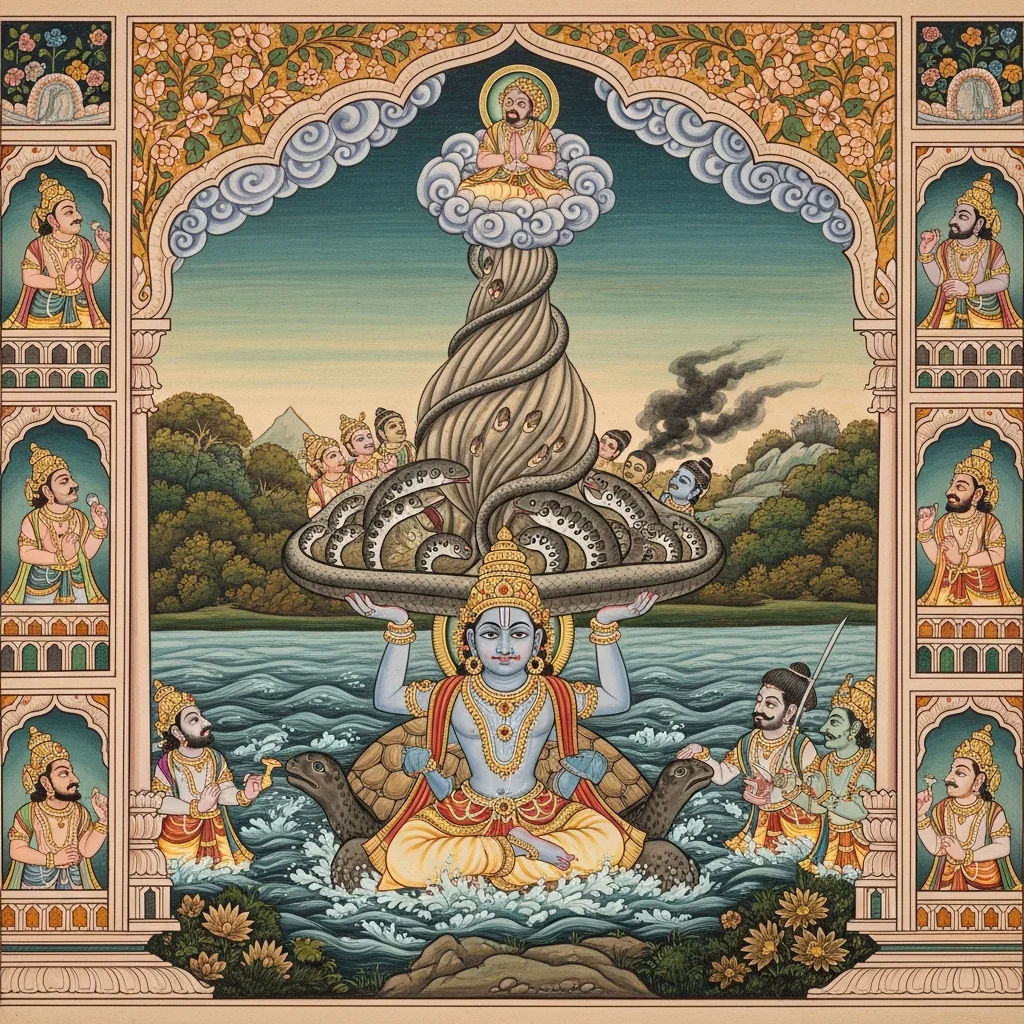
This adhyāya opens with Lomasha portraying Indra in a celestial assembly, surrounded by the lokapālas, devas, ṛṣis, apsarases, and gandharvas. When Bṛhaspati, the deva-guru, arrives, Indra—clouded by pride and royal intoxication—fails to render proper honor by invitation, seat, and respectful dismissal. Taking this as avajñā (disrespect), Bṛhaspati withdraws in concealment (tirodhāna), and the devas fall into dejection. Nārada identifies the moral breach: by slighting the guru, Indra’s sovereignty collapses and he must seek forgiveness. Indra searches for Bṛhaspati and consults Tārā, who cannot disclose his whereabouts. He returns amid ominous portents as Bali advances from Pātāla with the daityas; the devas are defeated, and many key treasures are lost, falling into the ocean. Bali consults Śukra, who teaches that sura-sovereignty requires extensive yajña discipline, especially the aśvamedha. Indra, now vulnerable, appeals to Brahmā; the devas then approach Viṣṇu on the shore of the Kṣīrārṇava (Milk Ocean). Viṣṇu declares the crisis to be the immediate karmic fruit of Indra’s misconduct and instructs a strategic reconciliation with the daityas. Indra approaches Bali in Sutala as a supplicant; Nārada extols śaraṇāgata-pālana (protecting one who seeks refuge) as a supreme dharma, and Bali honors Indra, establishing a pact. Together they plan to recover the ocean-fallen treasures by churning the Milk Ocean, choosing Mandara as the churning-rod and Vāsuki as the rope. The first attempt fails; the mountain collapses, causing injury and despair. Viṣṇu intervenes—lifting and setting Mandara, then becoming Kūrma (the tortoise) as the stabilizing base, and sustaining the work. As the churning intensifies, the destructive poison Hālāhala/Kālakūṭa arises, threatening the three worlds. Nārada urges immediate recourse to Śiva as the highest refuge, yet the sura–asura host persists in misguided effort. The poison spreads catastrophically, described in hyperbolic crisis-register as reaching even Brahmā’s realm and Vaikuṇṭha, evoking dissolution-like conditions attributed to Śiva’s dread power—thereby preparing the theological necessity for Śiva’s salvific intervention in what follows.
Shlokas
Verse 1
लोमश उवाच । एकदा तु सभामध्य आस्थितो देवराट् स्वयम् । लोकपालैः परिवृतो देवैश्च ऋषिभिस्तथा
Lomāśa said: Once, the Lord of the gods himself sat in the midst of the royal assembly, surrounded by the guardians of the directions, by the gods, and by sages as well.
Verse 2
अप्सरोगणसंवीतो गंधर्वैश्च पुरस्कृतः । उपगीयमानविजयः सिद्धविद्याधरैरपि
He was attended by hosts of apsarases, honored in front by gandharvas, and his victories were being sung—by siddhas and vidyādharas as well.
Verse 3
तदा शिष्यैः परिवृतो देवराजगुरुः सुधीः । आगतोऽसौ महाभागो बृहस्पति रुदारधीः
Then, surrounded by his disciples, the wise preceptor of the king of gods arrived—auspicious Bṛhaspati, steadfast in Rudra’s devotion.
Verse 4
तं दृष्ट्वा सहसा देवाः प्रणेमुः समुपस्थिताः । इंद्रोपि ददृशे तत्र प्राप्तं वाचस्पतिं तदा
Seeing him, the gods who were present at once bowed down. Indra too then saw that Vācaspati (Bṛhaspati) had arrived there.
Verse 5
नोवाच किंचिद्दुर्मेधावचो मानुपुरःसरम् । नाह्वानं नासनं तस्य न विसर्जनमेव च
But the foolish-minded one said nothing—no courteous words of welcome. He neither invited him, nor offered him a seat, nor even gave him a proper leave-taking.
Verse 6
शक्रं प्रमत्तं ज्ञात्वाथ मदाद्राज्यस्य दुर्मतिम् । तिरोधानमनुप्राप्तो बृहस्पती रुषान्वितः
Knowing Śakra to be careless and, through the intoxication of kingship, of corrupted judgment, Bṛhaspati—filled with indignation—departed into concealment.
Verse 7
गते देवगुरौ तस्मिन्विमनस्काऽभवन्सुराः । यक्षा नागाः सगंधर्वा ऋषयोऽपि तथा द्विजाः
When the divine guru had gone, the gods became downcast. Yakṣas, nāgas, gandharvas, and even sages and brāhmaṇas likewise were distressed.
Verse 8
गांधर्वस्या वसाने तु लब्धसंज्ञो हरिः सुरान् । पप्रच्छ त्वरितेनवै क्व गतो हि महातपाः
When the gandharva-music concluded, Hari (Indra) came to his senses and quickly asked the gods, “Where indeed has that great ascetic gone?”
Verse 9
तदैव नारदेनोक्तः शक्रो देवाधिपस्तथा । त्वया कृता ह्यवज्ञा च गुरोर्नस्त्यत्र संशयः
Just then Nārada spoke to Śakra, lord of the gods: “You have indeed shown contempt toward your Guru—of this there is no doubt.”
Verse 10
गुरोरवज्ञया राज्यं गतं ते बलसूदन । तस्मात्क्षमापनीयोऽसौ सर्वभावेन हि त्वया
O slayer of Bala, by slighting the Guru your kingship has slipped away. Therefore you must seek his forgiveness with your whole being.
Verse 11
एतच्छ्रुत्वा वचस्तस्य नारदस्य महात्मनः । आसनात्सहसोत्थाय तैः सर्वैः परिवारितः । आगच्छत्त्वरया शक्रो गुरोर्गेहमतंद्रितः
Hearing those words of the great-souled Nārada, Śakra sprang up at once from his seat and, surrounded by all his attendants, hurried without delay to his Guru’s dwelling.
Verse 12
पृष्ट्वा तारां प्रणम्यादौ क्व गतो हि महातपाः । न जानामीत्युवाचेदं तारा शक्रं निरीक्षती
After asking Tārā and first bowing to her, he inquired, “Where has the great ascetic gone?” Tārā, looking at Śakra, replied, “I do not know.”
Verse 13
तदा चिंतान्वितो भूत्वा शक्रः स्वगृहमाव्रजत् । एतस्मिन्नंतरे स्वर्गे ह्यनिष्टान्द्भुतानि च
Then Śakra, filled with anxiety, returned to his own abode. Meanwhile, in heaven, ominous and unwelcome portents began to appear.
Verse 14
अभवन्सर्वदुःखार्थे शक्रस्य च महात्मनः । पातालस्थेन बलिना ज्ञातं शक्रस्य चेष्टितम्
Those portents arose to bring Śakra, the great one, into complete distress. And Bali, dwelling in Pātāla, came to know of Śakra’s actions and condition.
Verse 15
ययौ दैत्यैः परिवृतः पातालादमरावतीम् । तदा युद्धमतीवासीद्देवानां दानवैः सह
Surrounded by the Daityas, he marched from Pātāla to Amarāvatī. Then a most fierce battle arose between the gods and the Dānavas.
Verse 16
देवाः पराजिता दैत्यै राज्यं शक्रस्य तत्क्षणात् । संप्राप्तं सकलं तस्य मूढस्य च दुरात्मनः
The gods were defeated by the Daityas, and in that very moment Śakra’s (Indra’s) kingdom was wholly seized by that deluded, wicked one.
Verse 17
नीतं सर्वप्रयत्नेन पातालं त्वरितं गताः । शुक्रप्रसादात्ते सर्वे तथा विजयिनोऽभवन्
With every effort they carried it off and swiftly returned to Pātāla; by Śukra’s favor, all of them indeed became victorious.
Verse 18
शक्रोऽपि निःश्रिको जातो देवैस्त्यक्तस्ततो भृशम् । देवी तिरोधानगता बभूव कमलेक्षणा
Śakra (Indra) too became utterly bereft, forsaken by the gods. And the Goddess—lotus-eyed Śrī—vanished from him, withdrawing into concealment.
Verse 19
ऐरावतो महानागस्तथैवोच्चैःश्रवा हयः । एवमादीनि रत्नानि अनेकानि बहून्यपि । नीतानि सहसा दैत्यैर्लोभादसाधुवृत्तिभिः
Airāvata, the great elephant, and Uccaiḥśravā, the celestial horse—together with many other precious treasures—were suddenly carried off by the Dānavas, whose conduct was unrighteous, driven by greed.
Verse 20
पुण्यभांजि च तान्येव पतितानि च सागरे । तदा स विस्मयाविष्टो बलिराह गुरुं प्रति
Those very treasures—bestowers of merit—fell into the ocean. Then Bali, struck with astonishment, spoke to his guru.
Verse 21
देवान्निर्जित्य चास्माभिरानीतानि बहूनि च । रत्नानि तु समुद्रेऽथ पतितानि तदद्भुतम्
‘After conquering the gods, we brought back many treasures; yet those jewels have now fallen into the ocean—how astonishing!’
Verse 22
बलेस्तद्वचनं श्रुत्वा उशना प्रत्युवाच तम् । अश्वमेधशतेनैव सुरराज्यं भविष्यति । दीक्षितस्य न संदेहस्तस्माद्भोक्त स एव च
Hearing Bali’s words, Uśanā (Śukra) replied: ‘By performing a hundred Aśvamedha sacrifices, kingship over the gods will surely arise. For one who has been duly consecrated, there is no doubt—therefore he alone shall enjoy it.’
Verse 23
अश्वमेधं विना किंचित्स्वर्गं भोक्तं न पार्यते
Without the Aśvamedha, one cannot in any measure attain and enjoy heaven.
Verse 24
गुरोर्वचनमाज्ञाय तूष्णींभूतो बलिस्ततः । बभूव देवैः सार्द्धं च यथोचितमकारयत्
Understanding his guru’s instruction, Bali became silent; and then, together with the gods, he had what was proper duly carried out.
Verse 25
इन्द्रोपि शोच्यतां प्राप्तो जगाम परमेष्ठिनम् । विज्ञापयामास तथा सर्वं राज्यभयादिकम्
Indra too, fallen into a pitiable state, went to Parameṣṭhin (Brahmā) and reported everything—his fear for the kingdom and all else.
Verse 26
शक्रस्य वचनं श्रुत्वा परमेष्ठी उवाच ह
Hearing Śakra’s words, Parameṣṭhin spoke.
Verse 27
संमिलित्वा सुरान्सर्वांस्त्वया साकं त्वरान्विताः । आराधनार्थं गच्छामो विष्णुं सर्वेश्वरेश्वरम्
‘Gathering all the gods together, and with you—swiftly—let us go to worship Viṣṇu, the Lord of the lords of all.’
Verse 28
तथेति गत्वा ते सर्वे शक्राद्या लोकपालकाः । ब्रह्माणं च पुरस्कृत्य तटं क्षीरार्णवस्य च । प्राप्योपविश्य ते सर्वे हरिं स्तोतुं प्रचक्रमुः
Saying, ‘So be it,’ all of them—the world-guardians led by Śakra—set forth. With Brahmā placed in the forefront, they reached the shore of the Ocean of Milk; and seated there, they all began to hymn Hari.
Verse 29
ब्रह्मोवाच । देवदेव जगान्नाथ सुरासुरनमस्कृत । पुण्यश्लोकाव्ययानंत परमात्मन्नमोऽस्तु ते
Brahmā said: O God of gods, Lord of the universe, revered by devas and asuras alike—O imperishable, endless Supreme Self, praised by holy hymns—salutations be to You.
Verse 30
यज्ञोऽसि यज्ञरूपोऽसि यज्ञांगोऽसि रमापते । ततोऽद्य कृपया विष्णो देवानां वरदो भव
You are the sacrifice itself; You are the very form of sacrifice; You are the limbs of sacrifice, O Lord of Ramā. Therefore today, O Viṣṇu, out of compassion become the granter of boons to the gods.
Verse 31
गुरोरवज्ञया चाद्य भ्रष्टराज्यः शतक्रतुः । जातः सुरर्षिभिः साकं तस्मादेनं समुद्धर
By slighting his guru, Śatakratu (Indra) has now fallen from his sovereignty, along with the divine seers. Therefore, lift him up from this downfall.
Verse 32
श्रीभगवानुवाच । दुकोकलज्ञया सर्वं नस्यतीति किमद्भुतम् । ये पापिनो ह्यधर्मिष्ठाः केवलं विषयात्मकाः । पितरौ निंदितौ यैश्च निर्दैवात्वेन संशयः
The Blessed Lord said: What is so surprising that, through the ripening of evil deeds, everything comes to ruin? Those who are sinful and most unrighteous—absorbed only in sense-objects—who even revile their parents, come to doubt and deny the very presence of divine providence.
Verse 33
अनेन यत्कृतं ब्रह्मन्सद्यस्तत्फलमागतम् । कर्मणा चास्य शक्रस्य सर्वेषां संकटागमः
O Brahmā, the result of what he has done has arrived immediately. By this deed of Śakra (Indra), distress has come upon them all.
Verse 34
विपरीतो यदा कालः पुरुषस्य भवेत्तदा । भूतमैत्रीं प्रकुर्वंति सर्वकार्यार्थसिद्धये
When time turns adverse for a person, then, for the accomplishment of every objective, people even cultivate friendship with former enemies.
Verse 35
तेन वै कारणेनेंद्र मदीयं वचनं कुरु । कार्यहेतोस्त्वया कार्यो दैत्यैः सह समागमः
For that very reason, O Indra, do as I have spoken. For the sake of the work at hand, you must meet and enter into alliance with the Daityas.
Verse 36
एवं भगवतादिष्टः शक्रः परमबुद्धिमान् । अमरावतीं ययौ हित्वा सुतलं दैवतैः सह
Thus instructed by the Lord, Śakra (Indra), keen in understanding, departed with the gods—leaving Sutala behind—and went to Amarāvatī.
Verse 37
इन्द्रं समागतं श्रुत्वा इंद्रसेनो रुषान्वितः । बभूव सह सैन्येन हंतुकामः पुरंदरम्
Hearing that Indra had arrived, Indrasena was filled with wrath; together with his army he sought to slay Purandara (Indra).
Verse 38
नारदेन तदा दैत्या बलिश्च बलिनां वरः । निवारितस्तद्वधाच्च वाक्यैरुच्चावचैस्तथा
Then Nārada restrained the Daityas—and Bali, best among the mighty—from killing him, using many kinds of words, lofty and plain, suited to the moment.
Verse 39
ऋषेस्तस्यैव वचनात्त्यक्तमन्युर्बलिस्तदा । बभूव सह सैन्येन आगतो हि शतक्रतुः
At that sage’s very instruction, Bali then set aside his anger. And indeed Śatakratu (Indra) arrived there together with his army.
Verse 40
इन्द्रसेनेन दृष्टोऽसौ लोकपालैः समावृतः । उवाच त्वरया युक्तः प्रहसन्निव दैत्यराट्
Seen by Indra’s host and encircled by the guardians of the worlds, the Daitya-king (Bali) spoke in haste, as though with a gentle smile.
Verse 41
कस्मादिहागतः शक्र सुतलं प्रति कथ्यताम् । तस्यैतद्वचनं श्रुत्वा स्मयमान उवाचतम्
“Why have you come here, O Śakra? Speak—what brings you toward Sutala?” Hearing this, Indra replied with a faint smile.
Verse 42
वयं कश्यपदायादा यूयं सर्वे तथैव च । यथा वयं तथा यूयं विग्रहो हि निरर्थकः
“We are descendants of Kaśyapa—and so are all of you. As we are, so are you; therefore hostility between us is truly meaningless.”
Verse 43
मम राज्यं क्षणेनैव नीतं दैववशात्तवया । तथा ह्येतानि तान्येन रत्नानि सुबहून्यपि । गतानि तत्क्षणादेव यत्नानीतानि वै त्वया
“In a single moment my kingdom was taken by you, compelled by fate. So too were many precious jewels—though gathered by you with great effort—carried off in that very instant.”
Verse 44
तस्माद्विमर्शः कर्तव्यः पुरुषेण विपश्चिता । विमर्शज्जायते ज्ञानं ज्ञानान्मोक्षो भविष्यति
“Therefore a discerning person should practice reflection. From reflection arises knowledge, and from knowledge liberation (mokṣa) will come.”
Verse 45
किं तु मे बत उक्तेन जाने न च तवाग्रतः । शरणार्थी ह्यहं प्राप्तः सुरैः सह तवांतिकम्
But alas—what use is my speaking? Before You I do not know what should be done. Seeking refuge, I have come into Your presence, together with the gods.
Verse 46
एतच्छ्रुत्वा तु शक्रस्य वाक्यं वाक्यविदां वरः । प्रहस्योवाच मतिमाञ्छक्रं प्रति विदां वरः
Hearing Śakra’s words, the best among the eloquent—wise and discerning—smiled gently and spoke in reply to Śakra.
Verse 47
त्वमागतोसि देवेंद्र किमर्थं तन्न वेद्मयहम्
You have come, O Lord of the gods; but for what purpose—I do not know that.
Verse 48
शक्रस्तद्वचनं श्रुत्वा ह्यश्रुपूर्णाकुलेक्षणः । किंचिन्नोवाच तत्रैनं नारदो वाक्यमब्रवीत्
Hearing those words, Śakra’s eyes grew troubled and filled with tears. He said nothing at all; then Nārada addressed him with words.
Verse 49
बले त्वं किं न जानासि कार्याकार्यविचारणाम् । धर्मो हि महतामेष शरणागतपालनम्
O Bali, do you not know how to discern what ought to be done and what ought not to be done? This indeed is the dharma of the great: to protect one who has come seeking refuge.
Verse 50
शरणागतं च विप्रं च रोगिणं वृद्धमेव च । यएतान्न च रक्षंति ते वै ब्रह्महणो नराः
A refuge-seeker, a brāhmaṇa, the sick, and the aged—men who do not protect these are indeed counted as slayers of Brahman (brahma-han).
Verse 51
शरणागतशब्देन आगतस्तव सन्निधौ । संरक्षणाय योग्यश्च त्वया नास्त्यत्र संशयः । एवमुक्तो नारदेन तदा दैत्यपतिः स्वयम्
By the very term “refuge-seeker,” he has come into your presence. He is fit to be protected by you—of this there is no doubt.” Thus addressed by Nārada, then the lord of the Daityas (Bali) himself…
Verse 52
विमृश्य परया बुद्ध्या कार्याकार्यविचारणाम् । शक्रं प्रपूजयामास बहुमानपुरःसरम् । लोकपालैः समेतं च तथा सुरगणैः सह
After reflecting with keen intelligence on what should and should not be done, he honored Śakra (Indra) with great respect—Śakra being accompanied by the Lokapālas and the hosts of gods.
Verse 53
प्रत्ययार्थं च सत्त्वानि ह्यनेकानि व्रतानि वै । बलिप्रत्ययभूतानि स चकारः पुरंदरः
And for the sake of assurance and proof, Puraṃdara (Indra) undertook many vows and acts of good faith—serving as guarantees to Bali.
Verse 54
एवं स समयं कृत्वा शक्रः स्वार्थपरायणः । बलिना सह चावासीदर्थशास्त्रपरो महान्
Thus, having made this agreement, Śakra (Indra)—intent on his own purpose—dwelt together with Bali, the great one devoted to Arthaśāstra, the science of polity and governance.
Verse 55
एवं निवसतस्तस्य सुतलेऽपि शतक्रतोः । वत्सरा बहवो ह्यासंस्तदा बुद्धिमकल्पयत् । संस्मृत्य वचनं विष्णोर्विमृश्य च पुनःपुनः
Thus, as he dwelt—even in Sutala—many years passed for Śatakratu (Indra). Then he devised a plan, remembering Viṣṇu’s words and reflecting on them again and again.
Verse 56
एकदा तु सभामध्य आसीनो देवराट्स्वयम् । उवाच प्रहसन्वाक्यं बलिमुद्दिश्य नीतिमान्
Once, seated in the midst of the assembly, the king of the gods himself—skilled in policy—spoke with a smile, directing his words toward Bali.
Verse 57
प्राप्तव्यानि त्वया वीर अस्माकं च त्वया बले । गजादीनि बहून्येव रत्नानि विविधानि च
O hero, by you (Bali) and by us, many things are to be obtained—elephants and the like in great number, and jewels of many kinds.
Verse 58
गतानि तत्क्षणादेव सागरे पतितानि वै । प्रयत्नो हि प्रकर्तव्यो ह्यस्माभिस्त्वयान्वितैः
They have gone at once and fallen into the ocean. Therefore effort must surely be made—by us, together with you.
Verse 59
तेषां चोद्धरणे दैत्य रत्नानामिह सागरात् । तर्हि निर्मथनं कार्यं भवता कार्यसिद्धये
“O Daitya, if those jewels are to be recovered from this ocean, then you must indeed undertake the churning, so that the intended aim may be accomplished.”
Verse 60
बलिः प्रवर्तितस्तेन शक्रेण सुरसूदनः । उवाच शक्रं त्वरितः केनेदं मथनं भवेत्
Urged by Śakra (Indra), Bali—the slayer of the gods—swiftly said to Śakra: “By what means may this churning be accomplished?”
Verse 61
तदा नभोगता वाणी मेघगंभीरनिःस्वना । उवाच देवा दैत्याश्च मंथध्वं क्षीरसागरम्
Then a voice resounded in the sky, deep as thunderclouds, proclaiming: “O Devas and Daityas, churn the Ocean of Milk!”
Verse 62
भवतां बलवृद्धिश्च भविष्यति न संशयः
“And your strength shall increase—of this there is no doubt.”
Verse 63
मंदरं चैव मंथानं रज्जुं कुरुत वासुकिम् । पश्चाद्देवाश्च दैत्याश्च मेलयित्वा विमथ्यताम्
“Make Mandara the churning-rod, and make Vāsuki the rope. Then, when Devas and Daityas have joined together, let the churning be performed.”
Verse 64
नभोगतां च तां वाणीं निशम्याथ तदाःसुराः । दैत्यैः सार्द्धं ततः सर्व उद्यमं चक्रुरुद्यताः
Hearing that celestial voice, the Asuras then—together with the Daityas—set themselves in motion; all, ready and resolute, began the undertaking.
Verse 65
पातालान्निर्गताः सर्वे तदा तेऽथ सुरासुराः । आजग्मुरतुलं सर्वे मंदरं पर्वतोत्तमम्
Then all those Devas and Asuras emerged from Pātāla and went together to the incomparable Mandara, the foremost of mountains.
Verse 66
दैत्याश्च कोटिसंख्याकास्तथा देवा न संशयः । उद्युक्ताः सहसा प्राऽयुर्मंदरं कनकप्रभम्
Daityas numbering in crores—and likewise the Devas, without doubt—swiftly advanced, fully prepared, toward Mandara, radiant like gold.
Verse 67
सरत्नं वर्तुलाकारं स्थूलं चैव महाप्रभम् । अनेकरत्नसंवीतं नानाद्रुमनिषेवितम्
It was studded with jewels, round in form, massive, and greatly resplendent—adorned with many kinds of gems and frequented by diverse trees.
Verse 68
चंदनैः पारिजातैश्च नागपुन्नागचंपकैः । नानामृगगणाकीर्णं सिंहशार्दूलसेवितम्
It was filled with hosts of varied animals, graced with sandalwood and pārijāta trees, with nāga, punnāga, and campaka blossoms—and it was frequented by lions and tigers.
Verse 69
महाशैलं दृष्ट्वा ते सुरसत्तमाः । ऊचुः प्रांजलयः सर्वे तदा ते सुरसत्तमाः
Beholding the great mountain, those foremost of the gods—all with hands joined in reverence—then addressed it.
Verse 70
देवा ऊचुः । अद्रे सुरा वयं सर्वे विज्ञप्तुमिह चागताः । तच्छृणुष्व महाशैल परेषामुपकारकः
The gods said: “O Mountain, we all have come here to make a supplication. Hear us, O great peak—benefactor of others.”
Verse 71
एवमुक्तस्तदा शैलो दवैर्दैत्यैः स मंदरः । उवाच निःसृतो भूत्वा परं विग्रहवान्वचः
Thus addressed by the gods and the daityas, that mountain—Mandara—then emerged forth and spoke lofty words, as though embodied in form.
Verse 72
तेन रूपेण रूपी स पर्वतो मंदराचलः । किमर्थमागताः सर्वे मत्समीपं तदुच्यताम्
Assuming that form, the embodied mountain Mandarācala said: “For what purpose have you all come near me? Let it be told.”
Verse 73
तदा बलिरुवाचेदं प्रस्तावसदृशं वचः । इंद्रोपि त्वरया युक्तो बभाषे सूनृतं वचः
Then Bali spoke words fitting to the occasion; and Indra too, urged by haste, spoke truthful and courteous words.
Verse 74
अस्माभिः सह कार्यार्थे भव त्वं मंदराचल । अमृतोत्पादनार्थे त्वं मंथानं भव सुव्रत
“Be with us for the accomplishment of this task, O Mandarācala. For the sake of producing amṛta, become the churning rod (manthana), O noble one.”
Verse 75
तथेति मत्वा तद्वाक्यं देवानां कार्यसिद्धये । ऊचे देवासुरांश्चेदमिन्द्रं प्रति विशेषतः
Thinking, “So be it,” for the fulfillment of the gods’ undertaking, he spoke these words to the gods and the asuras, addressing Indra in particular.
Verse 76
छेदितौ च त्वया पक्षौ वज्रेण शतपर्वणा । गंतुं कथं समर्थोऽहं भवतां कार्यसिद्धये
“And my wings were cut off by you with the thunderbolt of a hundred joints. How, then, am I able to go, for the accomplishment of your task?”
Verse 77
तदा देवासुराः सर्वे स्तूयमाना महाचलम् । उत्पाटयेयुरतुलं मंदरं च ततोद्भुतम्
Then all the gods and asuras, praising the great mountain, uprooted the incomparable and wondrous Mandara.
Verse 78
क्षीरार्णवं नेतुकामा ह्यशक्तास्ते ततोऽभवन् । पर्वतः पतितः सद्यो देवदैत्योपरि ध्रुवम्
Wishing to carry it to the Ocean of Milk, they became unable to do so. The mountain at once fell—surely—upon the gods and daityas.
Verse 79
केचिद्भग्ना मृताः केचित्केचिन्मूर्छापरा भवन् । परीवादरताः केचित्केचित्क्लेशत्वमागताः
Some were crushed and broken; some even died. Some fell into deep swoons. Some turned to bitter reproach and blame, while others sank into sheer misery and affliction.
Verse 80
ेवं भग्नोद्यमा जाता असुराःसुरदानवाः । चेतनां परमां प्राप्तास्तुष्टुवुर्जगदीश्वरम्
Thus, their efforts shattered, the hosts of Asuras and the Devas/Dānavas came to their senses; attaining supreme clarity of awareness, they praised the Lord of the universe.
Verse 81
रक्षरक्ष महाविष्णो शरणागतवत्सल । त्वया ततमिदं सर्वं जंगमाजंगमं च यत्
Protect us, protect us, O Great Viṣṇu—O lover of those who seek refuge. By You is all this pervaded: whatever moves and whatever does not move.
Verse 82
देवानां कार्यसिद्ध्यर्थं प्रादुर्भूतो हरिस्तदा । तान्दृष्ट्वा सहसा विष्णुर्गरुडोपरि संस्थितः
Then Hari manifested for the fulfillment of the gods’ purpose. Seeing them, Viṣṇu at once appeared, seated upon Garuḍa.
Verse 83
लीलया पर्वतश्रेष्ठमुत्तभ्यारोपयत्क्षणात् । गरुत्मति तदा देवः सर्वेषामभयं ददौ
Playfully, in an instant, the God lifted up the best of mountains and set it upon Garuḍa; then He granted fearlessness to all.
Verse 84
तत उत्थाय तान्देवान्क्षीरोस्योत्तरं तटम् । नीत्वा तं पर्वतं वृद्धं निक्षिप्याप्सु ततो ययौ
Then, rising up, He carried those gods to the northern shore of the Ocean of Milk; bringing that great mountain, He set it into the waters and then departed.
Verse 85
तदा सर्वे सुरगणाः स्वागत्य असुरैः सह । वासुकिं च समादाय चक्रिरे समयंच तम्
Then all the hosts of the gods, assembling together with the Asuras, took Vāsuki and made that solemn compact between them.
Verse 86
मंथानं मंदरं चैव वासुकिं रज्जुमेव च । कृत्वा सुराऽसुराः सर्वे ममंथुः श्रीरसागरम्
Making Mandara the churning-rod and Vāsuki the rope, all the Devas and Asuras together churned the glorious Ocean of Milk.
Verse 87
क्षीराब्धेर्मथ्यमानस्य पर्वतो हि रसातलम् । गतः स तत्क्षणादेव कूर्मो भूत्वा रमापतिः । उद्धृतस्तत्क्षणादेव तदद्भुतमिवाभवत्
As the Ocean of Milk was being churned, the mountain at once sank down to Rasātala. In that very moment, the Lord of Ramā became Kūrma, the Tortoise, and instantly lifted it up—an event wondrous indeed.
Verse 88
भ्राम्यमाणस्ततः शैलो नोदितः सुरदानवैः । भ्रममाणो निराधारो बोधश्चेव गुरुं विना
Then the mountain, driven on by the Devas and Dānavas, began to whirl about; whirling without a support, it was like knowledge that turns in confusion when there is no teacher.
Verse 89
परमात्मा तदा विष्णुराधारो मंदरस्य च । दोर्भिश्चतुर्भिः संगृह्य ममंथाब्धिं सुखावहम्
Then Viṣṇu, the Supreme Self, became the support of Mount Mandara; grasping it with his four arms, he churned the ocean, bringing welfare and delight.
Verse 90
तदा सुरासुराः सर्वे ममंथुः क्षीरसागरम् । एकीभूत्वा बलेनैवमतिमात्रं बलोत्कटाः
Then all the gods and the asuras churned the Ocean of Milk together; united by sheer force, they became exceedingly mighty in their exertion.
Verse 91
पृष्ठकंठोरुजान्वंतः कमठस्य महात्मनः । तथासौ पर्वतश्रेष्ठो वज्रसारमयो दृढः । उभयोर्घर्षणादेव वडवाग्निः समुत्थितः
Upon the back, neck, thighs, and knees of the great-souled Tortoise, that foremost mountain—adamantine in essence and firm—rubbed and ground; from the friction of the two, the submarine fire (Vaḍavāgni) arose.
Verse 92
हलाहलं च संजातं तदॄष्ट्वा नारदेन हि । ततो देवानुवाचेदं देवर्षिरमितद्युतिः
When the Hālāhala poison had arisen, Nārada beheld it; then that divine seer of immeasurable splendor addressed the gods as follows.
Verse 93
न कार्यं मथनं चाब्धेर्भवद्भिरधुनाऽखिलैः । प्रार्थयध्वं शिवं देवाः सर्वे दक्षस्य याजनम् । तद्विस्मृतिं च वोयातं वीरभद्रेण यत्कृतम्
‘You all must not continue the churning of the ocean now. O gods, pray to Śiva—remembering the sacrifice of Dakṣa—and let the forgetfulness that came upon you because of Vīrabhadra’s deed be dispelled.’
Verse 94
तस्माच्छिवः स्मर्यतां चाशु देवाः परः पराणामपि वा परश्च । परात्परः परमानंदरूपो योगिध्येयो निष्प्रपंचो ह्यरूपः
‘Therefore, O gods, remember Śiva at once—higher than the high, beyond even the beyond; transcending the transcendent, whose very nature is supreme bliss; to be contemplated by yogins, free from all worldly projection, and formless.’
Verse 95
ते मथ्यमानास्त्वरिता देवाः स्वात्मार्थसाधकाः । अभिलाषपराः सर्वे न श्रृण्वंति यतो जडाः
But those gods, hurrying on with the churning and seeking only their own gain, all driven by desire, did not listen, for they were dulled.
Verse 96
उपदेशैश्च बहुभिर्नोपदेश्याः कदाचन । ते रागद्वेषसंघाताः सर्वे शिवपराङ्मुखाः
Even with many instructions, they could not be taught at all; for they were a mass of attachment and aversion, all turned away from Śiva.
Verse 97
केवलोद्यमसंवीता ममंथुः क्षीरसागरम् । अतिनिर्मथनाज्जातं क्षीराब्धेश्चहलाहलम्
Wrapped only in strenuous effort, they churned the Ocean of Milk; and from that excessive churning, the Hālāhala poison was produced from the milky sea.
Verse 98
त्रैलोक्यदहने प्रौढं प्राप्तं हंतुं दिवौकसः । अत ऊर्ध्वं दिशः सर्वा व्याप्तं कृत्स्नं नभस्तलम् । ग्रसितुं सर्वभूतानां कालकूटं समभ्ययात्
The Kālākūṭa poison, grown fierce enough to burn the three worlds, advanced to destroy the dwellers of heaven. Rising upward, it pervaded all directions and filled the whole expanse of the sky, as though coming forth to swallow every being.
Verse 99
दृष्ट्वा बृहंतं स्वकरस्थमोजसा तं सर्पराजं सह पर्वतेन । तत्रैव हित्वापययुस्तदानीं पलायमाना ह्यसुरैः समेताः
Seeing that mighty serpent-king—held in the hand by sheer strength—together with the mountain, they abandoned that place at once and fled, the Asuras joining them in their flight.
Verse 100
तथैव सर्व ऋषयो भृग्वाद्याः शतशाम्यति । दक्षस्य यजनं तेन यथा जातं तथाभवत्
So too, all the Ṛṣis—beginning with Bhṛgu—were pacified in their hundreds; and thus Dakṣa’s sacrifice became exactly as it had come to be, its outcome fixed accordingly.
Verse 101
सत्यलोकं गताः सर्वे भुगुणा नोदिता भृशम् । वेदवाक्यैश्च विविधैः कालकूटं शतशस्ततः । देवा नास्त्यत्र संदेहः सत्यं सत्यं वदामि वः
Urged strongly by Bhṛgu, they all went to Satyaloka. There, by many kinds of Vedic utterances, they countered the Kālakūṭa poison again and again. O Devas, there is no doubt in this—truthfully, truthfully I tell you.
Verse 102
भृगुणोक्तं वचः श्रुत्वा कालकूटविषार्द्दिताः । सत्यलोकं समासाद्य ब्रह्माणं शरणं ययुः
Hearing Bhṛgu’s words, and afflicted by the poison of Kālakūṭa, they reached Satyaloka and went to Brahmā for refuge.
Verse 103
तदा जाज्वल्यमानं वै कालकूटं प्रभोज्जवलम् । दृष्ट्वा ब्रह्माथ तान्दृष्ट्वा ह्यकर्मज्ञानसुरासुरान् । तेषां शपितुमारेभे नारदेन निवारितः
Then Brahmā, seeing the blazing Kālakūṭa—dazzling in its fierce potency—and seeing those Devas and Asuras lacking right discernment in action, began to curse them; but Nārada restrained him.
Verse 104
ब्रह्मोवाच । अकार्यं किं कृतं देवाः कस्मात्क्षोभोयमुद्यतः । ईश्वरस्य च जातोऽद्य नान्यथा मम भाषितम्
Brahmā said: “O Devas, what improper act has been done, that this agitation has arisen? This disturbance has occurred today by the Lord’s ordinance—my statement is not otherwise.”
Verse 105
ततो देवैः परिवृतो वेदोपनिषदैस्तथा । नानागमैः परिवृतः कालकूटभयाद्ययौ
Then, surrounded by the Devas, and likewise encompassed by the Vedas and Upaniṣads—encircled by many Āgamas—he proceeded, driven by fear of Kālakūṭa.
Verse 106
ततश्चिंतान्विता देवा इदमूचुः परस्परम् । अविद्याकामसंवीताः कुर्यामः शंकरं च कम्
Then the Devas, filled with anxiety, said to one another: “Enveloped by ignorance and desire, what are we to do—and whom shall we make our Śaṅkara (protector)?”
Verse 107
ब्रह्माणं च पुरस्कृत्य तदा देवास्त्वरान्विताः । वैकुण्ठमाव्रजन्सर्वे कालकूट भयार्द्दिताः
Then, placing Brahmā at their head, the Devas hastened—all tormented by fear of Kālakūṭa—and went to Vaikuṇṭha.
Verse 108
ब्रह्मादयश्चर्षिगणाश्च तदा परेशं विष्णुं पुराणपुरुषं प्रभविष्णुमीशम् । वैकुण्ठमाश्रितमधोक्षजमाधवं ते सर्वे सुरासुरगणाः शरणं प्रयाताः
Then Brahmā and the hosts of Ṛṣis approached that Supreme Lord—Viṣṇu, the Primeval Person, the sovereign source of power—Mādhava, the transcendent Adhokṣaja abiding in Vaikuṇṭha. All those multitudes of Devas and Asuras went to him for refuge.
Verse 109
तावत्प्रवृद्धं सुमहत्कालकूटं समभ्ययात् । दग्ध्वादो ब्रह्मणो लोकं वैकुण्ठं च ददाह वै
Then that immensely swollen Kālakūṭa surged forth, first burning Brahmā’s world, and indeed it also set Vaikuṇṭha ablaze.
Verse 110
कालकूटाग्निना दग्धो विष्णुः सर्वगुहाशयः । पार्षदैः सहितः सद्यस्तमालसदृशच्छविः
Burned by the fire of Kālakūṭa, Viṣṇu—who dwells within every secret cave (the heart)—together with his attendants, at once assumed a dark hue like the tamāla tree.
Verse 111
वैकुण्ठं च सुनीलं च सर्वलोकैः समावृतम् । जलकल्मषसंवीताः सर्वे लोकास्तदाभवन्
Vaikuṇṭha too turned deep blue and was encompassed by all the worlds; then all the worlds were veiled by an astonishing “watery defilement,” like turbulent, polluted waters.
Verse 112
अष्टावरणसंवीतं ब्रह्मांडं ब्रह्मणा सह । भस्मीभूतं चकाराशु जलकल्मषमद्भुतम्
The cosmic egg, enclosed by the eight coverings, together with Brahmā, was swiftly turned to ash by that astonishing watery defilement.
Verse 113
नोभूमिर्न जलं चाग्निर्न वायुर्न नभस्तदा । नाहंकारो न च महान्मूलाविद्या तथैव च । शिवस्य कोपात्संजातं तदा भस्माकुलं जगत्
Then there was neither earth nor water nor fire nor wind, not even the sky; neither ego (ahaṃkāra) nor the Great Principle (mahat), nor even root-ignorance remained. From Śiva’s wrath, the universe at that time became a turmoil of ash.