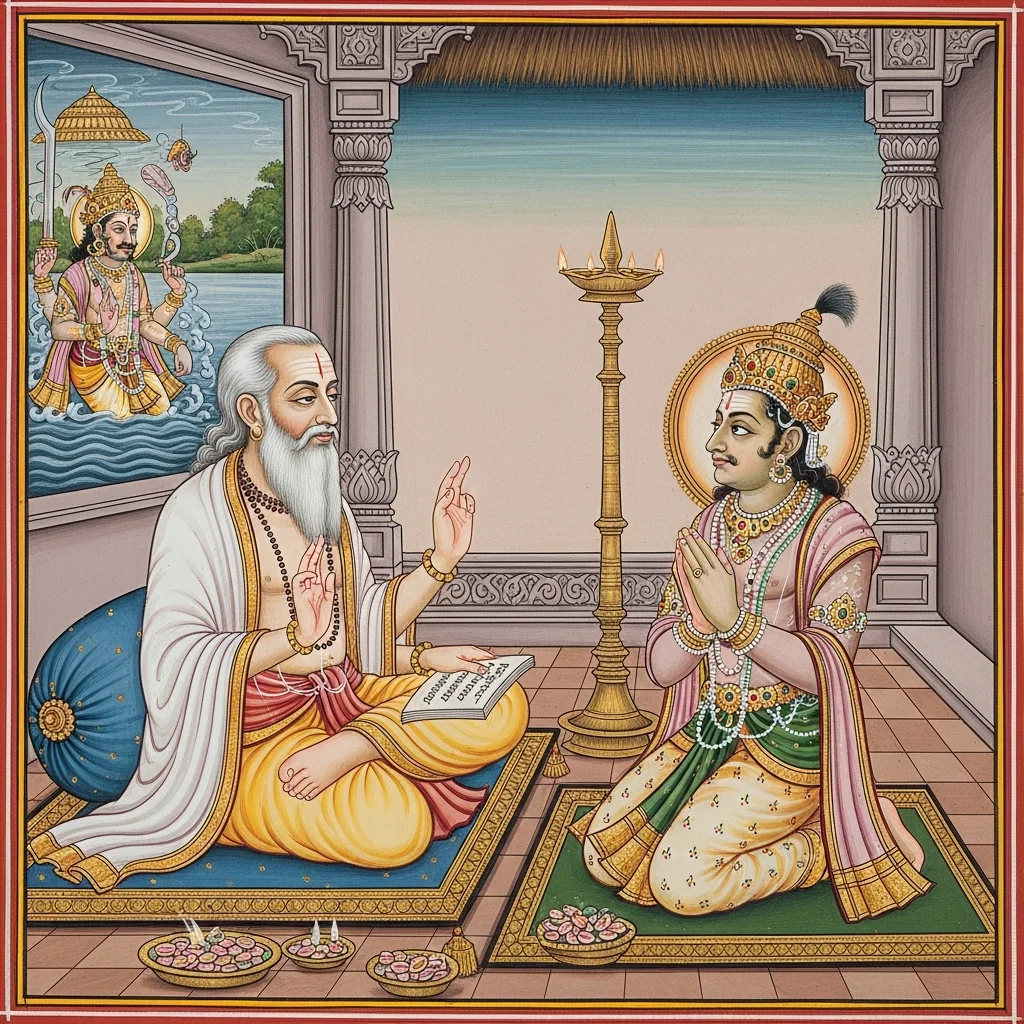
Adhyaya 17
The chapter begins with the devas’ response to Dadhīci’s passing. At Indra’s command, Surabhi, the divine cow, removes the flesh from Dadhīci’s body so that the gods may fashion weapons from his bones, including the vajra. Dadhīci’s wife Suvarcā, discovering this, flares with ascetic wrath and curses the devas to be without progeny; she then brings forth Pippalāda—known as a Rudra-avatāra—beneath an aśvattha tree, and departs into samādhi with her husband. The narrative turns to the vast deva–asura war. Namuci, protected by a boon, cannot be slain by ordinary weapons until a heavenly voice instructs Indra to kill him with foam (phena) near water, thus fulfilling and overcoming the boon’s condition. As the struggle escalates, Vṛtra’s might is repeatedly linked to tapas and prior karmic causality, including an origin connected with a curse narrative involving Citraratha. Bṛhaspati then prescribes a detailed Pradoṣa-vrata and liṅga-worship discipline: the proper time (Kārtika, śukla pakṣa, trayodaśī—especially a Monday), ritual bathing, offerings, lamp rites, circumambulation and prostrations, and the recitation of a hundred names of Rudra, presenting ritual correctness as the strategic means to victory. Later Indra is swallowed by Vṛtra; Brahmā and the gods appeal to Śiva. A heavenly instruction condemns improper circumambulation (including stepping over the pīṭhikā) and reiterates correct liṅga-arcana, even specifying flowers by time of day. Through Rudra-sūkta and Ekādaśa Rudra worship, Indra is released and Vṛtra falls; the text notes the appearance or settling of the imagery of grave sin (brahmahatyā), and the shifting of power as Bali prepares a counter-campaign through a great sacrifice.
Shlokas
Verse 1
। लोमश उवाच । ततः सर्वे सुरगणा दृष्ट्वा तं विलयं गतम् । चिंतयंतः सुरगणाः कथं च विदधामहे
Lomaśa said: Thereupon, all the hosts of gods, seeing him pass into dissolution (death), began to deliberate—‘How indeed shall we proceed now?’
Verse 2
सुरभिं चाह्वयित्वाथ तदोवाच शचीपतिः । कलेवरं दधीचस्य लिह्यास्त्वं वचनान्मम
Then Śacī’s lord (Indra) summoned Surabhī and said: “At my word, lick clean the body of Dadhīci.”
Verse 3
तथेति च वचोमत्वा तत्क्षणादेव लिह्य तत् । निर्मांसं च कृतं सद्यस्तया धेन्वा कलेवरम्
Saying “So be it,” and accepting the command, she licked it at once; and that cow immediately made the body fleshless.
Verse 4
जगृहुस्तानि चास्थीनि चक्रुः शस्त्राणि वै सुराः । तस्य वंशोद्भवं वज्रं शिरो ब्रह्मशिरस्तथा
The gods took those bones and indeed fashioned weapons: from his spine they made the Vajra, and from his head they made the Brahmaśiras weapon as well.
Verse 5
अन्यानि चास्थीनि बहूनि तस्य ऋषेस्तदानीं जगृहुः सुराश्च । तथा शिराजालमयांश्च पाशांश्चक्रुः सुरा वैरयुताश्च दैत्यान्
The gods then gathered many other bones of that sage; and they also made nooses formed of networks of sinews and veins, to bind the hostile Dāityas.
Verse 6
शस्त्राणि कृत्वा ते सर्वे महाबलपराक्रमाः । ययुर्देवातस्त्वरायुक्ता वृत्रघातनतत्पराः
Having fashioned the weapons, all those gods—mighty in strength and valor—set forth in haste, intent on slaying Vṛtra.
Verse 7
ततः सुवर्च्चाश्च दधीचिपत्नी या प्रेषिता सा सुरकार्यसिद्धये । व्यलोकयत्तत्र समेत्य सर्वं मृतं पतिं देहमथो ददर्शतम्
Then Suvarcā, the wife of Dadhīci—sent for the fulfillment of the gods’ purpose—arrived there, surveyed all, and beheld her husband’s body lying dead.
Verse 8
ज्ञात्वा च तत्सर्वमिदं सुराणां कृत्यं तदानीं च चुकोप साध्वी । ददौ सती शापमतीव रुष्टा तदा सुवर्चा ऋषिवर्यपत्नी
Knowing then the whole deed wrought by the gods, the virtuous lady was inflamed with wrath. Suvarcā, wife of that foremost sage, in fierce anger uttered a curse.
Verse 9
अहो सुरा दुष्टतराश्च सर्वे सर्वे ह्यशक्ताश्च तथैव लुब्धाः । तस्माच्च सर्वेऽप्रजसो भवंतु दिवौकसोऽद्यप्रभृतित्युवाच सा
She declared: “Alas! All you gods are most wicked—indeed, all of you are powerless and greedy. Therefore, from this day forth, let all the dwellers of heaven be without offspring.”
Verse 10
एव शापं ददौ तेषां सुराणां सा तपस्विनी । प्रवीश्याश्वत्थमूले सा स्वोदरं दारयत्तदा
Thus that ascetic woman pronounced a curse upon those gods. Then, entering beneath the root of the sacred aśvattha (pipal) tree, she tore open her own womb at that very moment.
Verse 11
निर्गतो जठराद्गर्भो दधीचस्य महात्मनः । साक्षाद्रुद्रावतारोऽसौ पिप्लादो महाप्रभः
From the womb emerged the child of the great-souled Dadhīci—Pippalāda of mighty splendor, a direct incarnation of Rudra himself.
Verse 12
प्रहस्य जननी गर्भमुवाच रुषितेक्षणा । सुवर्चा तं पिप्पलादं चिरं तिष्ठास्य सन्निधौ
Smiling, the mother Suvarcā—her eyes still fierce with indignation—addressed the child: “O Pippalāda, you shall remain for a long time in this presence (nearby).”
Verse 13
अश्वत्थस्य महाभाग सर्वेषां सफलो भवेः । तथैव भाषमाणा सा सुवर्चा तनयं प्रति । पतिमन्वगमत्साध्वी परमेण समाधिना
“O noble one, through the aśvattha you shall become the fulfiller of all aims.” Saying so to her son, the virtuous Suvarcā then followed her husband, entering the highest samādhi.
Verse 14
एवं दधीचपत्नी सा पतिना स्वर्गमाव्रजत्
Thus Dadhīci’s wife went to heaven together with her husband.
Verse 15
ते देवाः कृतशस्त्रास्त्रा दैत्यान्प्रति समुत्सुकाः । आजग्मुश्चेंद्रमुख्यास्ते महाबलपराक्रमाः
Those gods—having armed themselves with weapons and missiles—eagerly advanced against the Dānavas, led by Indra, mighty in strength and valor.
Verse 16
गुरुं पुरस्कृत्य तदाज्ञया ते गणाः सुराणां बहवस्तदानीम् । भुवं समागत्य च मध्यदेशमूचुश्च सर्वे परमास्त्रयुक्ताः
Setting their preceptor in the forefront and acting by his command, many hosts of the gods then descended to the earth, to Madhyadeśa; and all of them spoke, bearing the supreme divine missiles.
Verse 17
समागतानुपसृत्य देवांश्चेंद्रपुरोगमान् । ययौ वृत्रो महादैत्यो दैत्यवृन्दसमावृतः
Drawing near to the assembled gods led by Indra, Vṛtra—the great Daitya—advanced, surrounded by a multitude of Daityas.
Verse 18
यथा मेरोश्च शिखरं परिपूर्णं प्रदृश्यते । तथा सोऽपि महातेजा विश्वकर्म्मसुतो महान्
As the summit of Meru appears full and towering, so too appeared that great, radiant one—the mighty son of Viśvakarman.
Verse 19
तेन दृष्टो महेन्द्रश्च महेंद्रेण महासुरः । देवानां दानवानां च दर्शनं च महाद्भुतम्
He beheld Mahendra (Indra), and Mahendra beheld that great Asura. The sight of the Devas and the Dānavas facing one another was truly wondrous.
Verse 20
तदा ते बद्धवैराश्च देवदैत्याः परस्परम् । अन्योन्यमभिसंरब्धा जगर्जुः परमाद्भुतम्
Then the Devas and the Daityas, their enmity now firmly bound, rushed upon one another; inflamed against each other, they roared in a most astonishing way.
Verse 21
वादित्राणि च भीमानि वाद्यमानानि सर्वशः । श्रूयंतेऽत्र गभीराणि सुरा सुरसमागमे
And everywhere terrifying instruments were played; deep, resounding sounds were heard there, at the gathering of Devas and Asuras.
Verse 22
वाद्यमानेषु तूर्येषु ते सर्वे त्वरयान्विताः । अनेकैः शस्त्रसंघातैर्जघ्नुरन्योन्यमोजसा
As the war-trumpets sounded, all of them, driven by haste, struck one another with force, through countless blows of weapons.
Verse 23
तदा देवासुरे युद्धे त्रैलोक्यं सचराचरम् । भयेन महता युक्तं बभूव गतचेतनम्
Then, in that war between Devas and Asuras, the three worlds—along with all that moves and does not move—were seized by great fear and became as though senseless.
Verse 24
छेदिताः स्फोटिताश्चैव केचिच्छस्त्रैर्द्विधा कृताः । नाराचैश्च तथा केचिच्छस्त्रास्त्रैः शकलीकृताः
Some were cut down, some were shattered, and some were split in two by weapons; likewise, some were torn to pieces by iron arrows and by weapons and missiles.
Verse 25
भल्लैश्चेरुर्हताः केचिद्व्यंगभूता दिवौकसः । रश्मयो मेघसंभूताः प्रकाशंते नभस्स्विव
Some of the heavenly beings, struck down by barbed arrows, moved about maimed; and rays—born of clouds—seemed to shine in the sky, as it were.
Verse 26
शिरांसि पतितान्येव बहूनिच नभस्तलात् । नक्षत्राणीव च यथा महाप्रलयसंकुलम्
Many severed heads fell from the expanse of the sky—like stars, as though the great dissolution itself had become tumultuous.
Verse 27
प्रवर्तितं मध्यदेशे सर्वबूतक्षयावहम् । शक्रेण सह संग्रामं चकार नमुचिस्तदा
Then, in the central region, Namuci began a battle with Śakra—one that brought destruction upon all beings.
Verse 28
वज्रेण जघ्ने तरसा नमुचिं देवराट् स्वयम् । न रोमैकं च त्रुचितं तमुचेरसुरस्य च
The lord of the Devas himself struck Namuci swiftly with the thunderbolt; yet not even a single hair of that Asura Namuci was broken.
Verse 29
वज्रेणापि तदा सर्वे विस्मयं परमं गताः । असुराश्च सुराश्चैव महेंद्रो व्रीडितस्तदा
Then all were seized by the greatest astonishment—even at the thunderbolt’s strike—both Asuras and Devas alike; and Mahendra (Indra) felt ashamed at that time.
Verse 30
गदया नमुचिं जघ्ने गदा सापि विचूर्णिता । नमुचेरंगलग्नापि पपात वसुधातले
He struck Namuci with his mace; yet that very mace was shattered. Even while clinging to Namuci’s body, it fell down upon the earth.
Verse 31
तथा शूलेन महता तं जघान पुरंदरः । तच्छूलं शतधा चूर्णं नमुचेरंगमाश्रितम्
Likewise, Purandara (Indra) struck him with a mighty trident; yet that trident, upon reaching Namuci’s body, was shattered into a hundred pieces.
Verse 32
एवं तं वविधैः शस्त्रैराजघान सुरारिहा । प्रहस्य मानो नमुचिर्न जघान पुरंदरम्
Thus the foe of the gods assailed him with many kinds of weapons. Laughing in pride, Namuci did not strike down Purandara.
Verse 33
तूष्णींभूतस्तदा चेंद्रश्चिंतया परया युतः । किं कार्यं किमकार्यं वा इतींद्रो नाविदत्तदा
Then Indra fell silent, absorbed in deep thought. “What should be done, and what should not be done?”—thus Indra could not decide at that time.
Verse 34
एतस्मिन्नंतरे तत्र महायुद्धे महाभये । जाता नभोगता वाणी इंद्रसुद्दिश्य सत्वरम्
Just then, in that great battle filled with great terror, a voice arose from the sky, urgently addressing Indra.
Verse 35
जह्येनमद्याशु महेंद्र दैत्यं दिवौकसां घोरतरं भयावहम् । फेनेन चैवाशु महासुरेन्द्रमपां समीपेन दुरासदेन
“Slay him now, swiftly, O Mahendra—this Daitya who brings the gods the most dreadful fear. Strike down that great lord of the Asuras at once with foam, near the waters—by that hard-to-resist means.”
Verse 36
अन्येन शस्त्रेण च आहतोऽसौ वध्यः कदाचिन्न भवत्ययं तु । तस्माच्च देवेश वधार्थमस्य कुरु प्रयत्नं नमुचेर्दुरात्मनः
If struck by any other weapon, he will never be slain. Therefore, O Lord of the gods, strive specifically for the killing of that wicked-souled Namuci.
Verse 37
निशम्य वाचं परमार्थयुक्तां दैवीं सदानंदकरीं शुभावहाम् । चक्रे परं यत्नवतां वरिष्ठो गत्वोदधेः पारमनंतवीर्यः
Hearing that divine utterance—true in essence, ever joy-giving and auspicious—Indra, the foremost among the diligent and of boundless valor, exerted himself greatly and went to the farther shore of the ocean.
Verse 38
तत्रागतं समीक्ष्याथ नमुचिः क्रोधमूर्छितः । हत्वा शूलेन देवेंद्रं प्रहसन्निदमब्रवीत्
Seeing him arrive there, Namuci—faint with wrath—struck down Devendra with a trident; then, laughing, he spoke these words.
Verse 39
समुद्रस्य तटः कस्मात्सेवितः सुरसत्तम । विहाय रणभूमिं च त्यक्तशस्त्रोऽभवद्भवान्
“Why have you resorted to the seashore, O best of the gods? Abandoning the battlefield, you have become weaponless.”
Verse 40
त्वदीयेनैव वज्रेण किं कृतं मम दुर्मते
“With your own very thunderbolt, what have you done to me, you foolish one?”
Verse 41
तथान्यानि च शस्त्राणि अस्त्राणि सुबहूनि च । गृहीतानि पुरा मंद हंतुं मामेव चाधुना
So too, many other weapons and missiles were taken up earlier, O dullard—(all) to slay me; and you seek (to do so) even now.
Verse 42
किं करिष्यसि मां हंतुं युद्धाय समुपस्थितः । केन शस्त्रेण रे मंद योद्धुमिच्छसि संयुगे
How will you kill me, now that you have come forth for battle? With what weapon, O dullard, do you wish to fight in this combat?
Verse 43
त्वां गातयामि चाद्यैव यदि तिष्ठसि संयुगे । नो चेद्गच्छ मया मुक्तश्चिरं जीव सुखी भव
I shall finish you this very day if you remain in this battle. Otherwise, go—released by me; live long and be happy.
Verse 44
एवं स गर्वितं तस्य वाक्यमाहवशोभिनः । श्रुत्वा महेंद्रोऽपि रुषा जगृहे फेनमद्भुतम्
Hearing those proud words of him who shone in battle, Mahendra (Indra) too, in anger, took up wondrous foam.
Verse 45
फेनं करस्थं दृष्ट्वा तु असुरा जहसुस्तदा
But seeing foam in his hand, the Asuras laughed at that time.
Verse 46
क्षयं गतानि चास्त्राणि पेनेनैव पुरंदरः । हंतुमिच्छति मामद्य शतक्रतुरुदारधीः
His weapons are spent; and now Purandara—Śatakratu, of lofty resolve—seeks to slay me today with foam alone!
Verse 47
एवं प्रहस्य नमुचिरज्ञाय पुरंदरम् । सावज्ञं पुरतस्तस्थौ नमुचिर्दैत्यपुंगवः
Thus, laughing, Namuci—failing to comprehend Purandara—stood before him in contempt, Namuci, the bull among the Daityas.
Verse 48
तदैव तं स फेनेन शीघ्रमिंद्रो जघान ह
At that very moment, Indra swiftly struck him down with foam.
Verse 49
हते तु नमुचौ देवाः सर्वे चैव मुदान्विताः । साधुसाध्विति शब्देन ऋषयश्चाभ्यपूजयन्
When Namuci was slain, all the Devas were filled with joy; and the Ṛṣis praised that deed with the cry, “Well done! Well done!”
Verse 50
तदा सर्वे जयं प्राप्ता हत्वा नमुचिमाहवे । दैत्यास्ते कोपसंरब्धा योद्धुकामा मुदान्विताः
Then all of them won victory in the battle after slaying Namuci. Those Dāityas, inflamed with wrath, longed to fight again, stirred by a fierce and exultant ardor.
Verse 51
पुनः प्रववृते युद्धं देवानां दानवैः सह । शस्त्रास्त्रैर्बहुधा मुक्तैः परस्परवधैषिबिः
Once again war flared up between the Devas and the Dānavas; weapons and missiles of many kinds were hurled, each side bent on the other’s destruction.
Verse 52
यदा ते ह्यसुरा देवैः पातिताश्च पुनःपुनः । तदा वृत्रो महातेजाः शतक्रतुमुपाव्रजत्
When those Asuras were struck down again and again by the Devas, then Vṛtra, of immense splendor, advanced toward Śatakratu (Indra).
Verse 53
वृत्रं दृष्ट्वा तदा सर्वे ससुरासुरमानवाः । भयेन महताविष्टाः पतिता भुवि शेरते
On seeing Vṛtra, all—gods, demons, and humans alike—were seized by overwhelming fear, fell down, and lay upon the earth.
Verse 54
एवं भीतेषु सर्वेषु सुरसिद्धेषु वै तदा । इंद्रश्चैरावणारूढो वज्रपाणिः प्रतापवान्
Thus, when all the divine Siddhas were terrified, Indra—mounted upon Airāvata, the wielder of the thunderbolt—stood forth, radiant with valor.
Verse 55
छत्रेण ध्रियमाणेन चामरेण विराजितः । तदा सर्वैः समेतो हि लोकपालैः प्रतापितः
Adorned with a held parasol and shining with the royal fly-whisk, he was then accompanied by all the Lokapālas, resplendent in majesty.
Verse 56
वृत्रं विलोक्य ते सर्वे लोकपाला महेश्वराः । भयभीताश्च ते सर्वे शिवं शरणमन्वयुः
Seeing Vṛtra, all the Lokapālas—mighty lords—were struck with fear, and all of them sought Śiva as their refuge.
Verse 57
मनसाचिंतयन्सर्वे शंकरं लोकशंकरम् । लिंगं संपूज्य विधिवन्महेंद्रो जयकामुकः
All of them, in their minds, meditated on Śaṅkara, the benefactor of the worlds; and Mahendra, longing for victory, duly worshipped the Liṅga according to the rite.
Verse 58
गुरुणा विदितः सद्यो विश्वासेन परेण हि । उवाच च तदा शक्रं बृहस्पतिरुदारधीः
At once it became known to the Guru, indeed through deep trust; then Bṛhaspati, of noble intelligence, spoke to Śakra (Indra).
Verse 59
बृहस्पतिरुवाच । कार्तिके शुक्लपक्षे तु मंदवारे त्रयोदशी । समग्रा यदि लभ्येत सर्वप्राप्तयै न संशयः
Bṛhaspati said: In the month of Kārtika, in the bright fortnight, if the Trayodaśī falling on Maṃdavāra (Saturday) is obtained in full (with all its proper conditions), then it surely grants the attainment of all desired results—of this there is no doubt.
Verse 60
तस्यां प्रदोषसमये लिंगरूपी सदाशिवः । पूजनीयो हि देवेंद्र सर्वकामार्थसिद्धये
At the sacred twilight of Pradoṣa, Sadāśiva—present in the form of the Liṅga—should indeed be worshipped, O Lord of the gods, for the accomplishment of every desired aim and attainment.
Verse 61
स्नात्वा मध्याह्नसमये तिलामलकसंयुतम् । शिवस्य कुर्याद्गंधपुष्पफलादिभिः
Having bathed at midday, and with offerings accompanied by sesame and āmalaka, one should worship Śiva with fragrance, flowers, fruits, and the like.
Verse 62
पश्चात्प्रदोषवेलायां स्थावरं लिंगमर्च्चयेत् । स्वयंभु स्थापितं चापि पौरुषेयमपौरुषम्
Afterwards, at the time of Pradoṣa, one should worship a fixed, immovable liṅga—whether self-manifest, installed, of human origin, or not of human origin.
Verse 63
जने वा विजने वापि अरण्ये वा तपोवने । तल्लिंगमर्च्चयेद्भक्त्या प्रदोषे तु विशेषतः
Whether among people or in solitude, whether in a forest or in a grove of austerities, one should worship that liṅga with devotion—especially at the time of Pradoṣa.
Verse 64
ग्रामद्बहिः स्थितं लिंगं ग्रामाच्छतगुणं फलम् । ब्राह्मच्छतगुणं पुण्यमरण्ये लिंगमद्भुतम्
A liṅga situated outside a village yields fruit a hundredfold compared to one in the village; and a forest liṅga grants merit a hundredfold beyond that—marvelous indeed is the liṅga in the wilderness.
Verse 65
आरण्याच्छतगुणं पुण्यमर्चितं पार्वतं यथा । पार्वताच्चैव लिंगाच्च फलं चायुतसंज्ञितम् । तपोवनाश्रितं लिंगं पूजितं वा महाफलम्
As for a mountain liṅga duly worshipped, its merit is said to be a hundredfold beyond a forest liṅga; and beyond a mountain liṅga, the fruit is declared to be ‘ten-thousandfold’. A liṅga abiding in a tapovana, when worshipped, yields exceedingly great reward.
Verse 66
तस्मादेतद्विभागेन शिवपूजनार्चनं बुधैः । कर्त्वयं निपुणत्वेन तीर्थस्नानादिकं तथा
Therefore, the wise should perform Śiva’s worship and sacred adoration in accordance with these distinctions; and likewise, with careful skill, they should undertake bathing at the tīrthas and the rites connected with it.
Verse 67
पंचपिंडान्समुद्धृत्य स्नानमात्रेण शोभनम् । कूपे स्नानं प्रकुर्वीत उद्धृतेन विसेषतः
Having drawn up five measures (pañca-piṇḍa), bathing—by that act alone—is commendable. When bathing in a well, one should bathe especially with water that has been drawn up.
Verse 68
तडागे दश पिंडांश्च उद्धृत्य स्नानमाचरेत् । नदीस्नानं विश्ष्टं च महानद्यां विशेषतः
In a pond, having drawn up ten measures (daśa-piṇḍa), one should perform bathing. Bathing in a river is superior—and especially so in a great river.
Verse 69
सर्वेषामपि तीर्थानां गंगास्नानं विशिष्यते । देवखाते च तत्तुल्यं प्रशस्तं स्नानमाचरेत्
Among all tīrthas, bathing in the Gaṅgā is pre-eminent. Bathing in a devakhāta (a divine reservoir) is equal to that; one should perform such praised bathing.
Verse 70
प्रदीपानां सहस्रेण दीपनीयः सदाशिवः । तथा दीपशतेनापि द्वात्रिंशद्दीपमालया
Sadāśiva should be reverently illumined with a thousand lamps; likewise, even with a hundred lamps—or with a garland of thirty-two lamps—He is to be honored with light.
Verse 71
घृतेन दीपयेद्दीपाञ्छिवस्य परितुष्टये । तथा फलैश्च दीपैश्च नैवेद्यैर्गंधधूपकैः
One should light the lamps with ghee for Śiva’s complete satisfaction; and likewise offer fruits, lamps, naivedya (food-offerings), fragrances, and incense.
Verse 72
उपचारैः षोडशभिर्लिंगरूपी सदा शिवः । पूज्यः प्रदोषवेलायां नृभिः सर्वार्थसिद्धये
Sadāśiva, who abides in the form of the Liṅga, should be worshipped by people at the time of Pradoṣa with the sixteen upacāras, for the accomplishment of all aims.
Verse 73
प्रदक्षिणं प्रकुर्वीत शतमष्टोत्तरं तथा । नमस्कारान्प्रकुर्वीत तावत्संख्यान्प्रयत्नतः
One should perform circumambulation one hundred and eight times; and with equal earnestness one should also make that many prostrations (namaskāras).
Verse 74
प्रदक्षिणनमस्कारैः पूजनीयः सदाशिवः । नाम्नां शतेन रुद्रोऽसौ स्तवनीयो यताविधि
Sadāśiva should be worshipped through circumambulations and prostrations; and that Rudra is to be praised, according to rule, with a hundred names.
Verse 75
नमो रुद्राय भीमाय नीलकण्ठाय वेधसे । कपर्द्धिने सुरेशाय व्योमकेशाय वै नमः
Salutations to Rudra, the Terrible One; to Nīlakaṇṭha, the Blue-throated; to Vedhas, the Ordainer; to Kapardin, the One with matted locks; to the Lord of the gods; and salutations indeed to Vyomakeśa, whose hair is the sky.
Verse 76
वृषध्वजाय सोमाय नीलकण्ठाय वै नमः । दिगंबराय भर्गाय उमाकांतकपर्द्दिने
Salutations to Him whose banner is the Bull; to Soma; to Nīlakaṇṭha. Salutations to Digambara, to Bharga, and to Kapardin, the beloved Lord of Umā.
Verse 77
तपोमयाय व्याप्ताय शिपिविष्टाय वै नमः । व्यालप्रियाय व्यालाय व्यालानां पतये नमः
Salutations to the One made of tapas, to the All-pervading, to Śipiviṣṭa. Salutations to the serpent-beloved, to the Serpentine One, and to the Lord of serpents.
Verse 78
महीधराय व्याघ्राय पशूनां पतये नमः । त्रिपुरांतकसिंहाय शार्दूलोग्ररवाय च
Salutations to the Mountain-bearer, to the Tiger-like One, to Paśupati, Lord of beings. Salutations to the Lion who destroyed Tripura, and to Him whose fierce roar is like that of a tiger.
Verse 79
मीनाय मीननाथाय सिद्धाय परमेष्ठिने । कामांतकाय बुद्धाय बुद्धीनां पतये नमः
Salutations to Mīna, to Mīnanātha, Lord of fishes; to the Siddha, the Perfected One; to Parameṣṭhin, the Supreme Ruler; to Kāmāntaka, destroyer of Kāma; to the Wise One; and to the Lord of all intellects.
Verse 80
कपोताय विशिष्टाय शिष्टाय परमात्मने । वेदाय वेदबीजाय देवगुह्याय वै नमः
Truly, salutations to Him called “Kapotāya”, the supremely distinguished; the refuge of the cultured and righteous; the Supreme Self. Salutations to Him who is the Veda itself, the seed of the Vedas, and the divine mystery hidden even from the gods.
Verse 81
दीर्घाय दीर्घदीर्घाय दीर्घार्घाय महाय च । नमो जगत्प्रतिष्ठाय व्योमरूपाय वै नमः
Salutations to the Long and the endlessly Long; to the One of vast reach and great majesty. Salutations to the foundation of the universe, to Him whose form is the boundless sky.
Verse 82
गजासुरविनाशाय ह्यंधकासुरभेदिने । नीललोहितशुक्लाय चण्डमुण्डप्रियाय च
Salutations to the destroyer of Gajāsura, to the splitter of the demon Andhaka; to Him who is blue, red, and white— and to Him who is dear to Caṇḍa and Muṇḍa.
Verse 83
भक्तिप्रियाय देवाय ज्ञानज्ञानाव्ययाय च । महेशाय नमस्तुभ्यं महादेवहराय च
Salutations to the Divine Lord who loves devotion; to the imperishable One who is both knowledge and the knower. O Maheśa, salutations to You— to Mahādeva, to Hara as well.
Verse 84
त्रिनेत्राय त्रिवेदाय वेदांगाय नमोनमः । अर्थाय अर्थरूपाय परमार्थाय वै नमः
Again and again, salutations to the Three-eyed Lord; to Him who is the three Vedas and the limbs of the Vedas. Salutations to Him who is meaning itself, whose very form is meaning, and who is the Supreme Meaning (the highest truth).
Verse 85
विश्वरूपाय विश्वाय विश्वनाताय वै नमः । शंकराय च कालाय कालावयवरूपिणे
Salutations indeed to Him whose form is the universe; to Him who is the universe; to the Lord of the universe. Salutations to Śaṅkara, and to Time itself— to Him whose form is constituted of the very parts of Time.
Verse 86
अरूपाय च सूक्ष्माय सूक्ष्मसूक्ष्माय वै नमः । श्मशानवासिने तुभ्यं नमस्ते कृत्तिवाससे
Salutations indeed to the Formless One, to the Subtle One, to the subtlest of the subtle. Salutations to You who dwell in the cremation-ground; salutations to You, O wearer of the hide (Kṛttivāsa).
Verse 87
शशांकशेखरायैव रुद्रविश्वाश्रयाय च । दुर्गाय दुर्गसाराय दुर्गावयवसाक्षिणे
Salutations to Śaśāṅkaśekhara, the moon-crested Lord; and to Rudra, the refuge of the universe. Salutations to Durgā, to the very essence of Durgā, and to the Witness of Durgā’s limbs and powers.
Verse 88
लिंगरूपाय लिंगाय लिंगानां पतये नमः । प्रणवरूपाय प्रणवार्थाय वै नमः
Salutations to Him whose form is the Liṅga; to the Liṅga itself; to the Lord of all liṅgas. Salutations to Him whose form is Praṇava (Oṁ), and to Him who is the meaning of Praṇava.
Verse 89
नमोनमः कारणकारणाय ते मृत्युंजयायात्मभवस्वरूपिणे । त्रियंबकायासितकंठ भर्ग गौरिपते सकलमंगलहेतवे नमः
Again and again, salutations to You—the cause of all causes; Mṛtyuñjaya, the conqueror of death; the One whose very nature is the source of the self and of existence. Salutations to the Three-eyed One, to the dark-throated Radiance (Bharga), to the Lord of Gaurī, the very cause of all auspiciousness.
Verse 90
बृहस्पतिरुवाच । नाम्नां शतं महेशस्य उच्चार्यं व्रतिना तदा । प्रदक्षिणनमस्कारैरेतत्संख्यैः प्रयत्नतः । कार्यं प्रदोषसमये तुष्ट्यर्थं संकरस्य च
Bṛhaspati said: “At that time, the observer of the vow should recite one hundred names of Maheśa; and with equal count—circumambulations and prostrations—he should perform them with effort at the pradoṣa hour, in order to please Śaṅkara.”
Verse 91
एवं व्रतं समुद्दिष्टं तव शक्र महामते । शीघ्रं कुरु महाभाग पश्चाद्युद्धं कुरु प्रभो
Thus, O Śakra of great understanding, this vow has been enjoined upon you. Perform it swiftly, O blessed lord; thereafter enter into battle, O sovereign.
Verse 92
शंभोः प्रसादात्सर्वं ते भविष्यति जयादिकम्
By Śambhu’s grace, everything shall come to you—victory and all besides.
Verse 93
वृत्रो ह्ययं महातेजा दैतेयस्तपसा पुरा । शिवं प्रसादयामास पर्वते गंधमादने
For this Vṛtra is a Daiteya of great splendor; formerly, by austerities (tapas), he propitiated Śiva upon Mount Gandhamādana.
Verse 94
नाम्ना चित्ररथो राजा वनं चित्ररथस्य तत् । एतज्जानीहि भो इन्द्र शिवपुर्याः समीपतः
There was a king named Citraratha, and that forest is called “Citraratha’s.” Know this, O Indra: it lies near Śivapurī.
Verse 95
यस्मिन्वने महाभाग न संति च षडूर्मयः । तस्माच्चैत्ररथं नाम वनं परममंगलम् । तस्य राज्ञः शिवेनैव दत्तं यानं महाद्भुतम्
O greatly fortunate one, in that forest the six waves of worldly affliction (ṣaḍ-ūrmi) are not found. Therefore it is called the supremely auspicious Caitraratha Forest. To that king, Śiva himself granted a wondrous aerial chariot.
Verse 96
कामगं किंकिणीयुक्तं सिद्धचारणसेवितम् । गंधर्वैरप्सरोयक्षैः किंनरैरुपशोभितम्
It moved at will, adorned with tinkling bells, attended by Siddhas and Cāraṇas, and beautified by Gandharvas, Apsarases, Yakṣas, and Kinnaras.
Verse 97
ततस्तेनैव यानेन पृथिवीं पर्यटन्पुरा । तथा गिरीशमुख्यांश्च द्वीपांश्च विविधांस्तथा
Then, formerly, with that very vehicle he traveled over the earth, and likewise visited the foremost mountains and the many kinds of islands as well.
Verse 98
एकदा पर्यटन्राजा नाम्ना चित्ररथो महान् । कैलासमागतस्तत्र स ददर्श पराद्भुतम्
Once, while traveling, the great king named Citraratha came to Kailāsa; there he beheld something supremely wondrous.
Verse 99
सभातलं महेशस्य गणैश्चैव विराजितम् । अर्द्धागलग्नया देव्या शोभितं च महेश्वरम्
He saw the assembly-hall of Maheśa, resplendent with his Gaṇas; and Maheśvara himself, adorned by the Goddess who clung to him as his other half.
Verse 100
निरीक्ष्य देव्या सहितं सदाशिवं देव्यान्वितं वाक्यमिदं बभाषे
Seeing Sadāśiva seated together with the Goddess, he addressed these words—spoken in the very presence of Devī—towards them.
Verse 101
वयं च शंभो विषयान्विताश्च मंत्र्यादयः स्त्रीजिताश्चापि चान्ये । न लोकमध्ये वयमेव चाज्ञाः स्त्रीसेवनं लज्जया नैव कुर्मः
O Śambhu, we too are entangled in worldly objects; ministers and others as well are conquered by women. In this world we are not the only ignorant ones—yet out of shame we do not openly indulge in the service of women.
Verse 102
एतद्वाक्यं निशम्याथ महेशः प्रहसन्निव । उवाच न्यायसंयुक्तं सर्वेषामपि श्रृण्वताम्
Hearing these words, Maheśa—smiling as though in gentle amusement—spoke a reply grounded in propriety, while all listened.
Verse 103
भयं लोकापवादाच्च सर्वेषामपि नान्यथा । ग्रासितं कालकूटं च सर्वेषामपि दुर्जरम्
Fear of public reproach arises for all—there is no exception. And the swallowing of Kālakūṭa, the deadly poison, too is a feat unbearable for all.
Verse 104
तथापि उपहासो मे कृतो राज्ञा हि दुर्जरः । तं चित्ररथमाहूय गिरिजा वाक्यमब्रवीत्
Even so, the king’s mockery of me was hard to bear. Then Girijā summoned Citraratha and spoke these words.
Verse 105
गीरिजोवाच । रे दुरात्मन्कथं त्वज्ञ शंकरश्चोपहासितः । मया सहैव मंदात्मन्द्रक्ष्यसे कर्मणः फलम्
Girijā said: “O wicked one! How, in your ignorance, have you mocked Śaṅkara? O foolish soul—together with me you shall behold the fruit of your action.”
Verse 106
साधूनां समचित्तानामुपहासं करोति यः । देवो वाप्यथ वा मर्त्यः स विज्ञेयोऽधमाधमः
Whoever ridicules sādhus of even-mindedness—whether a god or a human—should be known as the lowest of the low.
Verse 107
एते मुनींद्राश्च महानुभावास्तथा ह्यमी ऋषयो वेदगर्भाः । तथैव सर्वे सनकादयो ह्यमी अज्ञाश्च सर्वे शिवमर्चयंते
These lordly sages are of great spiritual power; likewise those ṛṣis, filled with Vedic wisdom; and so too all the Sanakas and others—though (to the proud) they may seem ‘simple’—all of them worship Śiva.
Verse 108
रे मूढ सर्वेषु जनेष्वभिज्ञस्त्वमेव एवाद्य न चापरे जनाः । तस्मादभिज्ञं हि करोमि दैत्यं देवैर्द्विजैश्चापि बहिष्कृतं त्वाम्
‘O fool! Among all people, you alone today claim to be the “knower,” and no one else. Therefore I make you a “knower” indeed—as a daitya, cast out by the gods and by the twice-born as well.’
Verse 109
एवं शप्तस्तया देव्या भवान्या राजसत्तमः । राजा चित्ररथः सद्यः पपात सहसा दिवः
Thus cursed by that Goddess Bhavānī, the eminent king—Citraratha—at once suddenly fell down from heaven.
Verse 110
आसुरीं योनिमासाद्य वृत्रोनाम्नाऽभवत्तदा । तपसा परमेणैव त्वष्ट्रा संयोजितः क्रमात्
Entering an asuric womb, he then came to be known as Vṛtra. By the power of supreme austerity, Tvaṣṭṛ, in due course, brought about his formation.
Verse 111
तपसा तेन महता अजेयो वृत्र उच्यत । तस्माच्छंभुं समभ्यर्च्य प्रदोषे विधिनाऽधुना
By that great austerity, Vṛtra was proclaimed “unconquerable.” Therefore, even now, worship Śambhu at Pradoṣa according to the proper rite.
Verse 112
जहि वृत्रं महादैत्यं देवानां कार्यसिद्धये । गुरोस्तद्वचनं श्रुत्वा उवाचाथ शतक्रतुः । सोद्यापनविधिं ब्रूहि प्रदोषस्य च मेऽधुना
“Slay Vṛtra, the great demon, for the fulfillment of the gods’ purpose.” Hearing his guru’s words, Śatakratu (Indra) said: “Teach me now the concluding rite (udyāpana) of the Pradoṣa observance.”
Verse 113
बृहस्पतिरुवाच । कार्तिके मासि संप्राप्ते मंदवारे त्रयोदशी । संपूर्तिस्तु भवेत्तत्र संपूर्णव्रतसिद्धये
Bṛhaspati said: “When the month of Kārtika arrives, and Trayodaśī falls on a Saturday, then there is full completion, so that the vow may attain perfect fulfillment.”
Verse 114
वृषभो राजतः कार्यः पृष्ठे तस्य सुपीठकम् । तस्योपरिन्यसेद्देवमुमाकांतं त्रिलोचनम्
A bull (Vṛṣabha) should be fashioned of silver, and upon its back a fine pedestal. Upon that, one should place the Lord—Umākānta, the three-eyed One (Trilocana).
Verse 115
पंचवक्त्रं दशभुजमर्द्धांगे गिरिजां सतीम् । एवं चोमामहेशं च सौवर्णं कारयेद्बुधः
Let the wise have Oṃāmaheśa fashioned in gold—five-faced, ten-armed, with the virtuous Girijā (Satī) upon half His body.
Verse 116
सवृषं ताम्रपत्रे च वस्त्रेण परिगुंठिते । स्थापयित्वोमया सार्द्धं नानाबोगसमन्वितम्
Together with the bull (Nandin), place the sacred image upon a copper plate, wrapped in cloth; having installed Śiva along with Umā, adorn it with diverse offerings and sacred enjoyments.
Verse 117
विधिना जागरं कुर्याद्रात्रौ श्रद्धासमन्वितः । पंचामृतेन स्नपनं कार्यमादौ प्रयत्नतः
With faith, one should keep the night vigil according to the prescribed rite; and at the outset, with due effort, perform the ceremonial bathing with pañcāmṛta (the five nectars).
Verse 118
गोक्षीरस्नानं देवेश गोक्षीरेण मया कृतम् । स्नपनं देवदेवेश गृहाण परमेश्वर
“O Lord of the gods, I have performed the bathing with cow’s milk. O God of gods, accept this ablution (abhiṣeka), O Supreme Lord.”
Verse 119
दध्ना चैव मया देव स्नपनं क्रियतेऽधुना । गृहाम च मया दत्तं सुप्रसन्नो भवाद्य वै
“And now, O Deva, I perform the bathing with curd (dadhi) as well. Accept what has been offered by me, and today indeed be fully gracious.”
Verse 120
सर्पिषा च मया देव स्नपनं क्रियतेऽधुना । गृहाण श्रद्धया दत्तं तव प्रीत्यर्थमेव च
O Deva, I now perform Your ritual bathing with ghee (sarpis). Please accept what is offered in faith, solely for Your satisfaction.
Verse 121
इदं मधु मया दत्तं तव प्रीत्यर्थमेव च । गृहाम त्वं हि देवेश मम शांतिप्रदो भव
This honey I offer solely for Your delight. Accept it, O Lord of the gods, and grant me peace.
Verse 122
सितया देवदेवेश स्नपनं क्रियतेऽधुना । गृहाण श्रद्धया दत्तां सुप्रसन्नो भव प्रभो
O Lord of lords, I now bathe You with sugar. Accept this offering given with faith, and be exceedingly gracious, O Master.
Verse 123
एवं पंचामृतेनैव स्नपनीयो वृषध्वजः । पश्चादर्घ्यं प्रदातव्यं ताम्रपात्रेण धीमता । अनेनैव च मंत्रेण उमाकांतस्य तृष्टये
Thus Vṛṣadhvaja (Śiva) should indeed be bathed with the pañcāmṛta. Thereafter, the wise should offer arghya in a copper vessel, using this very mantra, for the satisfaction of Umākānta.
Verse 124
अर्घ्योऽसि त्वमुमाकांत अर्घेणानेन वै प्रभो । गृहाण त्वं मया दत्तं प्रसन्नो भव शंकर
O Umākānta, You are worthy of arghya; therefore, O Lord, accept this arghya offered by me. Be pleased, O Śaṅkara.
Verse 125
मया दत्तं च ते पाद्यं पुष्पगंधसमन्वितम् । गृहाण देवदेवेश प्रसन्नो वरदो भव
I offer You pādya—water for the feet—fragrant with the scent of flowers. Accept it, O Lord of lords, and, being pleased, grant boons.
Verse 126
विष्टरं विष्टरेणैव मया दत्तं च वै प्रभो । शांत्यरथं तव देवेश वरदो भव मे सदा
O Lord, I have duly offered You the seat (viṣṭara). O Lord of the gods, for the sake of peace, be ever a bestower of boons to me.
Verse 127
आचमनीयं मया दत्तं तव विश्वेश्वर प्रभो । गृहाण परमेशान तुष्टो भव ममाद्य वै
O Lord of the universe, I offer You ācamanīya, the water for ritual sipping. Accept it, O Parameśāna, and be pleased with me today indeed.
Verse 128
ब्रह्मग्रन्थिसमायुक्तं ब्रह्मकर्मप्रवर्तकम् । यज्ञोपवीतं सौवर्णं मया दत्तं तव प्रभो
O Lord, I offer You a golden sacred thread (yajñopavīta), furnished with the Brahma-knot and conducive to the rites upheld by Brahmanical tradition.
Verse 129
सुगंधं चंदनं देव मया दत्तं च वै प्रभो । भक्त्या पर मया शंभो सुगंधं कुरु मां भव
O Deva, I have offered You fragrant sandalwood, O Lord. O Śambhu, through my supreme devotion, make me fragrant—make my life pure and pleasing.
Verse 130
दीपं हि परमं शंभो घृतप्रज्वलितं मया । दत्तं गृहाण देवेश मम ज्ञानप्रदो भव
O Śambhu, I offer this supreme lamp, kindled by me with ghee. Accept it, O Lord of the gods, and bestow upon me true knowledge.
Verse 131
दीपं विशिष्टं परमं सर्वौषधिविजृंभितम् । गृहाण परमेशान मम शांत्यर्थमेव च
O Parameśāna, accept this excellent and supreme lamp, prepared with the potency of all healing herbs; grant it solely for my peace and pacification.
Verse 132
दीपावलिं मया दत्तां कृहाण परमेश्वर । आरार्तिकप्रदानेन मम तेजः प्रदो भव
O Parameśvara, accept this row of lamps that I have offered; by this gift of ārati, become for me the giver of radiance, vitality, and spiritual brilliance.
Verse 133
फलदीपादिनैवेद्यतांबूलादिक्रमेण च । पूजनीयो विधानज्ञैस्तस्यां रात्रौ प्रयत्नतः
On that night, those who know the proper rites should worship with care, following the sequence of offerings—fruits, lamps, naivedya (food offering), tāmbūla, and the rest.
Verse 134
पश्चाज्जागरणं कार्यं गृहे वा देवतालये । वितानमंडपं कृत्वा नानाश्चर्यसमन्वितम् । गीतवादित्रनृत्येन अर्चनीयः सदाशिवः
Afterwards, a night vigil should be observed—either at home or in a temple. Having prepared a canopied pavilion adorned with various wonders, one should worship Sadāśiva with singing, musical instruments, and dance.
Verse 135
अनेनैव विधानेन प्रदोषोद्यापने विधिः । कार्ये विधिमता शक्र सर्वकार्यार्थसिद्धये
By this very procedure is also taught the method for concluding (udyāpana) the Pradoṣa observance. O Śakra, let it be performed according to rule, for the accomplishment of every intended purpose.
Verse 136
गुरुणा कथितं सर्वं तच्चकार शतक्रतुः । तेनैव च सहायेन इंद्रो युद्धपरायणः
All that the guru had taught, Śatakratu carried out. With that very support, Indra set his mind upon battle.
Verse 137
वृत्रं प्रति सुरैः सार्द्धं युयुधे च शतक्रतुः । तुमुलं युद्धमभवद्देवानां दानावैः सह
Then Śatakratu fought against Vṛtra together with the gods; and a fierce battle arose between the devas and the dānavas.
Verse 138
तस्मिन्सुतुमुले गाढे देवदैत्यक्षयावहे । द्वंद्वयुद्धं सुतुमुलमतिवेलं भयावहम्
In that extremely fierce and close-fought conflict—bringing destruction to both devas and daityas—dreadful duels arose, intensely tumultuous and long-enduring, inspiring fear.
Verse 139
व्योमो यमेन युयुधे ह्यग्निना तीक्ष्णकोपनः । वरुणेन महादंष्ट्रो वायुना च महाबलः
Vyoma fought with Yama; the one of fierce wrath fought with Agni; the great-fanged one with Varuṇa; and the mighty one with Vāyu.
Verse 140
द्वन्द्वयुद्ध रताः सर्वे अन्योन्यबलकांक्षिणः
All of them, delighting in single combat, longed to test one another’s strength.
Verse 141
तथैव ते देववरा महाभुजाः संग्रामशूरा जयिनस्तदाऽभवन् । पराजयं दैत्यवाराश्च सर्वे प्राप्तास्तदानीं परमं समंतात्
Thus indeed, those best of the gods—mighty-armed and heroic in battle—became victorious then; and on every side the foremost of the Dāityas met with utter defeat at that time.
Verse 142
दृष्ट्वा सुरैर्दैत्यवरान्पराजितान्पलायमानानथ कान्दिशीकान् । तदैव वृत्रः परमेण मन्युना महाबलो वाक्य मिदं बभाषे
Seeing the foremost Dāityas defeated by the gods and fleeing in confusion, Vṛtra, of great might, at once spoke these words in blazing wrath.
Verse 143
वृत्र उवाच । हे दैत्याः परमार्ताश्च कस्माद्यूयं भयातुराः । पलायनपराः सर्वे विसृज्य रणमद्भुतम्
Vṛtra said: “O Dāityas, why are you so distressed and shaken with fear? Why do you all turn to flight, abandoning this wondrous battle?”
Verse 144
स्वंस्वं पराक्रमं वीरा युद्धाय कृतनिश्चयाः । दर्शयध्वं सुरगणास्सूदयध्वं महाबलाः
“O heroes, resolved for battle—display each your own valor. O mighty ones, strike down the hosts of the gods!”
Verse 145
गदाभिः पट्टिशैः खड्गैः शक्तितोमरमुद्गरैः । असिभिर्भि दिपालैश्च पाशतोमरमुष्टिभिः
With maces, battle-axes, swords, spears, javelins, and hammers; with blades, bhindipāla missiles, nooses, tomara darts, and iron fists—thus they armed themselves.
Verse 146
तदा देवाश्च युयुधुर्दधीचास्थिसमुद्भवैः । शस्त्रैरस्त्रैश्च परमैरसुरान्समदारयन्
Then the gods fought, wielding the supreme weapons and astras fashioned from the bones of Dadhīci, and they tore through the Asuras.
Verse 147
पुनर्दैत्या हता देवैः प्राप्तास्तेपि पराजयम् । पुनश्च तेन वृत्रेण नोद्यमानाः सुरान्प्रति
Again the Dāityas, struck down by the gods, met defeat; yet again, urged on by Vṛtra, they advanced against the gods.
Verse 148
यदा हि ते दैत्यवराः सुरेशैर्निहन्यमानाश्च विदुद्रुवुर्दिशः । केचिद्दृष्ट्वा दानवास्ते तदानीं भीतित्रस्ताः क्लीबरूपाः क्रमेणा
For when those foremost Dāityas, being slain by the lords of the gods, fled in every direction, some Dānavas—seeing this—became terrified, taking on a cowardly mien little by little.
Verse 149
वृत्रेण कोपिना चैवं धिक्कृता दैत्यपुंगवाः । हे पुलोमन्महाभाग वृषपर्वन्नमोस्तु ते
Thus, rebuked by wrathful Vṛtra, the chiefs among the Dāityas said: “O Puloman, noble and greatly blessed; O Vṛṣaparvan—salutations to you!”
Verse 150
हे धूम्राक्ष महाकाल महादैत्य वृकासुर । स्थूलाक्ष हे महादैत्य स्थूलदंष्ट्र नमोस्तु ते
O Dhūmrākṣa, O Mahākāla, O great Dāitya Vṛkāsura! O Sthūlākṣa, O great Dāitya Sthūladaṃṣṭra of massive fangs—salutations to you.
Verse 151
स्वर्गद्वारं विहायैव क्षत्रियाणां मनस्विनाम् । पलायध्वे किमर्थं वा संग्रामाङ्गणमुत्तमम्
Forsaking the very “gate to heaven” meant for high-spirited Kṣatriyas, why do you flee from this excellent field of battle?
Verse 152
संगरे मरणं येषां ते यांति परमं पदम् । यत्र तत्र च लिप्सेत संग्रामे मरणं बुधः
Those who meet their death in battle attain the supreme state. Therefore, the wise—wherever they may be—should, when duty calls, aspire to die in battle.
Verse 153
त्यजन्ति संगरं ये वै ते यांति निरयं ध्रुवम्
Indeed, those who abandon the battle go surely to hell.
Verse 154
ये ब्राह्मणार्थे भृत्यार्थे स्वार्थे वै शस्त्रपाणयः । संग्रामं ये प्रकुर्वंति महापातकिनो नराः
Men who, weapon in hand, wage war for the sake of Brahmins, for the sake of dependents or servants, or for their own rightful interest are not blameworthy; but those who incite war unrighteously are great sinners.
Verse 155
शस्त्रघातहता ये वै मृता वा संगरे तथा । ते यांति परमं स्थानं नात्र कार्या विचारणा
Those who are slain by weapon-blows, or who likewise die in battle, truly reach the supreme abode; in this there is no need for doubt or debate.
Verse 156
शस्त्रैर्विच्छिन्नदेहा ये गवार्थे स्वामिकारणात् । रणे मृताः क्षता ये वै ते यांति परमां गतिम्
Those whose bodies are hewn by weapons, who die wounded in battle for the sake of the cows or for the cause of their lord—indeed they attain the highest destiny.
Verse 157
तस्माद्रणेऽपि ये शूराः पापिनो निहताः पुरः । प्राप्नुवंति परं स्थानं दुर्लभं ज्ञानिनामपि
Therefore, even sinful men—if they are heroes and are slain at the front in battle—attain the supreme abode, difficult to reach even for the wise.
Verse 158
अथवा तीर्थगमनं वेदाध्ययनमेव च । देवतार्चनयज्ञादिश्रेयांसि विविधानि च
Or else: pilgrimage to the sacred tīrthas, the study of the Vedas, and also worship of the deities, sacrifices (yajña), and other diverse meritorious acts.
Verse 159
ऐकपद्येन तान्येव कलां नार्हंति षोडशीम् । संग्रामे पतितानां च सर्वशास्त्रेष्वयं विधिः
Even by the smallest measure—like a single “quarter-step”—those merits do not equal even one sixteenth of the merit of those who fall in battle. This rule concerning the slain in war is affirmed in all the śāstras.
Verse 160
तस्माद्युद्धावदानं च कर्तव्यमविशंकितैः । भवद्भिर्नान्यथा कार्यं देववाक्यप्रमाणतः
Therefore, without hesitation, you must undertake this martial enterprise. Do not act otherwise, for the word of the gods stands as the authority and proof.
Verse 161
यूयं सर्वे शौरवृत्त्या समेताः कुलेन शीलेन महानुभावाः । पदानि तान्येव पलायमाना गच्छंत्यशूरा रणमंडलाच्च
All of you are endowed with heroic conduct—noble by lineage and great by character. Yet those very feet, when you flee, carry you away as cowards from the circle of battle.
Verse 162
त एव सर्वे खलु पापलोकान्गच्छंति नूनं वचनात्स्मृतेश्च
Indeed, all such men surely go to sinful realms—so declares both sacred instruction and the ordinances of Smṛti.
Verse 163
ये पापिष्ठास्त्वधर्म्मस्था ब्रह्मघ्ना गुरुतल्पगाः । नरकं यांति ते पापं तथैव रणविच्युताः
Those most sinful—who stand in adharma, who slay a brāhmaṇa, who violate the teacher’s bed—go to hell; and likewise, those who fall away from the battlefield go to that same sin-bound end.
Verse 164
तस्माद्भवद्भिर्योद्धव्यं स्वामिकार्यभरक्षमैः । एवमुक्तास्तदा तेन वृत्रेणापि महात्मना
Therefore you must fight, you who are capable of bearing the burden of your lord’s cause. Thus were they addressed at that time by that great-souled Vṛtra.
Verse 165
चक्रुस्ते वचंनं तस्य असुराश्च सुरान्प्रति । चक्रुः सुतुमुलं युद्धं सर्वलोकभयंकरम्
The Asuras carried out his command against the Devas, and they waged a most tumultuous war—terrifying to all the worlds.
Verse 166
तस्मिन्प्रवृत्ते तुमुले विगाढे वृत्रो महादैत्यपतिः स एकः । उवाच रोषेण महाद्भुतेन शतक्रतुं देववरैः समेतम्
When that fierce and engulfing battle had begun, Vṛtra—the great lord of the Daityas—stood alone and, with wondrous wrath, addressed Śatakratu (Indra), who was accompanied by the foremost of the gods.
Verse 167
वृत्र उवाच । श्रृणु वाक्यं मया चोक्तं धर्म्मार्थसहितं हितम् । त्वं देवानां पतिर्भूत्वा न जानासि हिताहितम्
Vṛtra said: “Hear the words I speak—beneficial words, grounded in dharma and right purpose. Though you are lord of the gods, you do not discern what is truly wholesome and what is harmful.”
Verse 168
किंबलार्थपरो भूत्वा विश्वरूपो हतस्त्वया । प्राप्तमद्यैव भो इंद्र तस्येदं कर्म्मणः फलम्
Why, driven by desire for power, did you slay Viśvarūpa? O Indra, this very day you have received the fruit of that deed.
Verse 169
ये दीर्घदर्शिनो मंदा मूढा धर्मबहिष्कृताः । अकल्पाः कार्यसिद्ध्यर्थं यत्कुर्वंति च निष्फलम् । तत्सर्वं विद्धि देवेंद्र मनसा संप्रधार्यताम्
Those who fancy themselves far-sighted, yet are dull and deluded, cast out from dharma—unfit though striving for success—whatever they do becomes fruitless. Know all this, O lord of the gods, and weigh it well within your mind.
Verse 170
तस्माद्धर्म्मपरो भूत्वा युध्यस्व गतकल्मषः । भ्रातृहा त्वं ममैवेंद्र तस्मात्त्वा घातयाम्यहम्
Therefore, be steadfast in dharma and fight, casting off your sin. You are the slayer of my brother, O Indra; therefore I shall strike you down.
Verse 171
मा प्रयाहि स्थिरो भूत्वा देवैश्च परिवारितः । एव मुक्तस्तु वृत्रेण शक्रोऽतीव रुषान्वितः । ऐरावतं समारुह्य ययौ वृत्रजिघांसया
“Do not depart; stand firm,” said they, with the gods gathered all around. Thus released by Vṛtra, Śakra—burning with fierce wrath—mounted Airāvata and set forth, intent on slaying Vṛtra.
Verse 172
इंद्रमायांतमालोक्य वृत्रो बलवतां वरः । उवाच प्रहसन्वाक्यं सर्वेषां श्रृण्वतामपि
Seeing Indra draw near, Vṛtra—foremost among the mighty—spoke with a laugh, in words heard by all who stood there.
Verse 173
आदौ मां प्रहरस्वेति तस्मात्त्वां घातयाम्यहम्
“Strike me first,” he said; “therefore I shall strike you down.”
Verse 174
इत्येवमुक्तो देवेंद्रो जघान गदया भृशम् । वृत्रं बलवतां श्रेष्ठं जानुदेशे महाबलम्
Thus addressed, the Lord of the gods struck fiercely with his mace at Vṛtra—the strongest of the strong—smashing him at the knee, though he was of immense power.
Verse 175
तामापतंतिं जग्राह करेणैकेन लीलया । तयैवैनं जघानाशु गदया त्रिदिवेश्वरम्
As that mace came flying, he caught it playfully with a single hand; and with that very mace he swiftly struck down the lord of heaven.
Verse 176
सा गदा पातयामास सवज्रं च पुरंदरम् । पतितं शक्रमालोक्य वृत्र ऊचे सुरान्प्रति
That mace struck down Purandara, even as he held the thunderbolt in his hand. Seeing Śakra fallen, Vṛtra spoke to the gods.
Verse 177
नयध्वं स्वामिनं देवाः स्वपुरीममरावतीम्
“Lead your lord, O gods, back to your own city—Amarāvatī.”
Verse 178
एतच्छ्रुत्वा वचः सत्यं वृत्रस्य च महात्नः । तथा चक्रुः सुराः सर्वे रणाच्चेंद्रं समुत्सुकाः
Hearing these truthful words of great-souled Vṛtra, all the gods did as he said, eager to carry Indra away from the battlefield.
Verse 179
अपोवाह्य गजस्थं हि परिवार्य भयातुराः । सुराः सर्वे रणं हित्वा जग्मुस्ते त्रिदिवं प्रति
Bearing away Indra who sat upon the elephant, and surrounding him—distressed with fear—all the gods abandoned the battle and went toward heaven.
Verse 180
ततो गतेषु देवेषु ननर्त च महासुरः । वृत्रो जहास च परं तेना पूर्यत दिक्तटम्
When the gods had departed, the great Asura Vṛtra danced in exultation and laughed loudly; by that roar the whole expanse of the quarters was filled.
Verse 181
चचाल च मही सर्वा सशैलवनकानना । चुक्षुभे च तदा सर्वं जंगमं स्थावरं तथा
Then the whole earth shook—together with its mountains, forests, and groves—and at that time everything, moving and unmoving alike, was stirred into turmoil.
Verse 182
श्रुत्वा प्रयातं देवेंद्रं ब्रह्मा लोकपितामहः । उपयातोऽथ देवेंद्र स्वकमण्डलुवारिणा । अस्पृशल्लब्धसंज्ञोऽभूत्तत्क्षणाच्च पुरंदरः
Hearing that Indra had fled, Brahmā, the grandsire of the worlds, came to him; then, O Indra, he touched him with water from his own kamaṇḍalu, and in that very instant Purandara regained consciousness.
Verse 183
दृष्ट्वा पितामहं चाग्रे व्रीडायुक्तोऽभवत्तदा । महेंद्रं त्रपया युक्तं ब्रह्मोवाच पितामहः
Seeing the Grandsire before him, Indra was then filled with shame; and Brahmā, the Grandsire, spoke to Mahendra as he stood abashed.
Verse 184
ब्रह्मोवाच । वृत्रो हि तपसा युक्तो ब्रह्मचर्यव्रते स्थितः । त्वष्टुश्च तपसा युक्तो वृत्रश्चायं महायशाः । अजेयस्तपसोग्रेण तस्मात्त्वं तपसा जय
Brahmā said: “Vṛtra is indeed endowed with tapas and established in the vow of brahmacarya. Tvaṣṭṛ too is endowed with tapas, and this Vṛtra is of great renown. By the power of intense tapas he is unconquerable; therefore, you must conquer by tapas.”
Verse 185
वृत्रासुरो दैत्यपतिश्च शक्र ते समाधिना परमेणैव जय्यः । निशम्य वाक्यं परमेष्ठिनो हरिः सस्मार देवं वृषभध्वजं तदा
“O Śakra, Vṛtrāsura—the lord of the Daityas—can be conquered by you only through the highest samādhi.” Hearing the words of Parameṣṭhin (Brahmā), Hari (Indra) then remembered the god whose banner bears the bull (Śiva).
Verse 186
स्तुत्या तदातं स्तवमानो महात्मा पुरंदरो गुरुणा नोदितो हि
Then the great-souled Purandara began praising Him with hymns, for he had indeed been urged on by his teacher.
Verse 187
इंद्र उवाच । नमो भर्गाय देवाय देवानामतिदुर्गम । वरदो भव देवेश देवानां कार्यसिद्धये
Indra said: “Salutations to Bharga, the divine Lord—hard to approach even for the gods. O Lord of gods, become the giver of boons, for the accomplishment of the gods’ purpose.”
Verse 188
एवं स्तितिपरो भूत्वा शचीपतिरुदारधीः । स्वकार्यदक्षो मंदात्मा प्रपंचाभिरतः खलु
Thus, though intent on maintaining order, Śacī’s lord (Indra)—of capable intellect—yet, being self-absorbed, was skilled in his own affairs and indeed attached to worldly contrivances.
Verse 189
प्रपंचाभिरता मूढाः शिवभक्तिपरा ह्यपि । न प्राप्नुवंति ते स्थानं परमीशस्यरागिणः
Deluded people, attached to worldly entanglements—even if they profess devotion to Śiva—do not attain the abode of the Supreme Lord, for they remain bound by craving.
Verse 190
निर्मला निरहंकारा ये जनाः पर्युपासते । मृडं ज्ञानप्रदं चेशं परेशं शंभुमेव च
Those people who are pure and free from ego, who worship with devotion Mṛḍa—Śiva, the giver of spiritual knowledge—who is the Lord, the Supreme Lord, Śambhu Himself.
Verse 191
तेषां परेषां वरद इहामुत्र च शंकरः । महेंद्रेण स्तुतः शर्वो रागिणा परमेण हि
For those supreme devotees, Śaṅkara is the bestower of boons—both in this world and in the world beyond. Truly, Śarva was praised by great Indra (Mahendra), who, though exalted, was filled with intense attachment.
Verse 192
रागिणां हि सदा शंभुर्दुर्लभो नात्र संशयः । तस्माद्विरागिणां नित्यं सन्मुखो हि सदाशिवः
For those bound by attachment (rāga), Śambhu is ever difficult to attain—of this there is no doubt. Therefore, to the dispassionate, Sadāśiva is always present, near at hand, and gracious.
Verse 193
राजा सुराणां हि महानुरागी स्वकर्मसंसिद्धिमहाप्रवीणः । तस्मात्सदा क्लेशपरः शचीपतिः स्वकामभावात्मपरो हि नित्यम्
The king of the gods is deeply attached, though highly skilled in fulfilling his own works and duties. Therefore Indra, lord of Śacī, is ever beset by distress, for he is continually intent on his own desires and self-driven states of mind.
Verse 194
स्तवमानं तदा चेंद्रमब्रवीत्कार्यगौरवात् । विज्ञायाखिलदृग्द्रष्टा महेशो लिंगरूपवान्
Then, as Indra was offering praise, Maheśa—who sees all and knows every intention—spoke to him, mindful of the gravity of the task, appearing in the form of the Liṅga.
Verse 195
इंद्र गच्छ सुरैः सार्द्धं वृत्रं वै दानवं प्रति । तपसैव च साध्योऽयं रणे जेतुं शतक्रतो
“Indra, go forth together with the gods against Vṛtra, that Dānava. Yet this foe can be overcome only by tapas—by the power of austerity; thus you will be able to conquer in battle, O Śatakratu.”
Verse 196
इंद्र उवाच । केनोपायेन साध्योऽयं वृत्रो दैत्यवरो महान् । त्चछीघ्रं कथ्यतां शंभो येन मे विजयो भवेत्
Indra said: “By what means may this mighty Vṛtra—the foremost among the Daityas—be overcome? Tell me swiftly, O Śambhu, that victory may be mine.”
Verse 197
रुद्र उवाच । रणे न शक्यते हंतुमपि देववरैरपि । तस्मात्त्वया हि कर्तव्यं कुत्सितं कर्म चाद्य वै
Rudra said: “In battle he cannot be slain—even by the best of the gods. Therefore, today you must perform a certain blameworthy act, as the necessary means.”
Verse 198
अस्य शापः पुरा दत्तः पार्वत्या मम सन्निधौ । असौ चित्ररथो नाम्ना विख्यातो भुवनत्रये
“Formerly, in my very presence, Pārvatī pronounced a curse upon him. He was known as Citraratha, famed throughout the three worlds.”
Verse 199
पर्यटन्सु विमानेन मया दत्तेन भास्वता । उपहासादिमां योनिं संप्राप्तो दत्यपुंगवः
“While roaming in a radiant aerial car granted by me, that bull among the Dānavas, through mockery, came to attain this present birth—this embodiment.”
Verse 200
तस्मादजेयं जानीहि रणे रणविदां वर । एवमुक्तो महेंद्रोऽयं शंभुना योगिना भृशम्
“Therefore, O best of those skilled in battle, know him to be unconquerable in war.” Thus Mahendra (Indra) was firmly instructed by Śambhu, the great yogin.