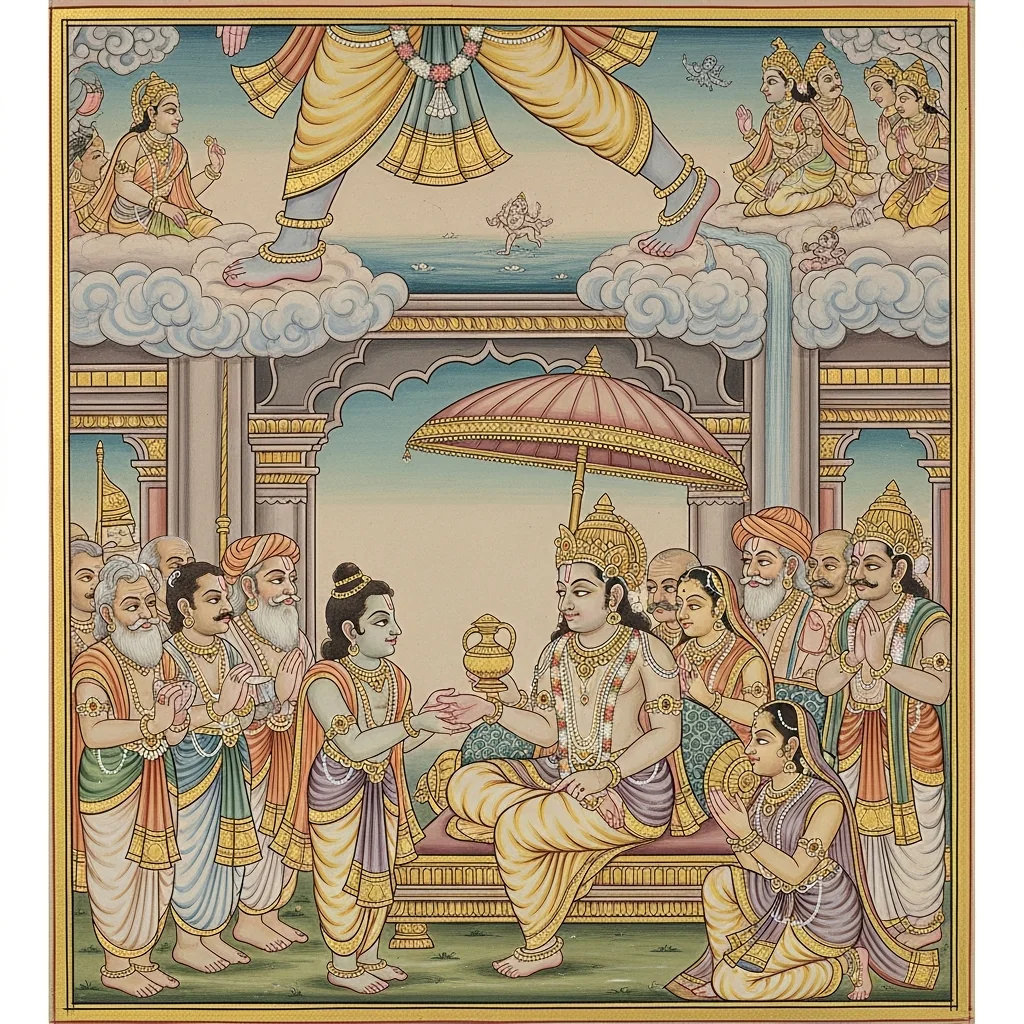
Adhyaya 19
This chapter segment (told by Lomāśa) weaves a daitya king’s moral trial together with cosmological and theological teaching. Bali, though warned by his guru Śukra (Bhārgava), upholds the dharma of dāna and resolves to give alms to the brahmacārin Vāmana (Viṣṇu in disguise). Śukra, angered by Bali’s firmness, utters a curse of inauspicious consequence; yet Bali proceeds with the gift, with Vindhyāvalī’s reverent ritual participation. Viṣṇu then expands as Trivikrama and with two strides covers earth and heaven. The third step becomes a crisis of vow and obligation; Garuḍa binds Bali for withholding what was promised. Vindhyāvalī intervenes, offering her own head and her child’s head as the locus for the remaining steps, turning the pledge into self-surrender and household devotion. Pleased, Viṣṇu releases Bali, grants him Sutala, and promises perpetual nearness as guardian at Bali’s gate, making the daitya an exemplar of generosity and bhakti. The discourse then turns to a Śaiva conclusion: Gaṅgā arises from the water that touched Viṣṇu’s foot, yet Śiva is proclaimed unsurpassed. Worship of Sadāśiva is open to all, even the marginalized; Śiva is the indwelling reality. Mahādeva is guṇātīta, beyond the three guṇas, while Brahmā, Viṣṇu, and Rudra function through rajas, sattva, and tamas respectively, pointing toward liberation.
Shlokas
Verse 1
लोमश उवाच । एवं संबोधितो दैत्यो गुरुणा भार्गवेण हि । उवाच प्रहसन्वाक्यं मेघगंभीरया गिरा
Lomaśa said: Thus addressed by his teacher Bhārgava, the Daitya spoke—smiling—words in a voice deep as thunderclouds.
Verse 2
त्वयोक्तोहं हितार्थाय यैर्वाक्यैश्चालितोऽस्म्यहम् । तव वाक्यं मम प्रीत्यै हितमप्यहितं भवेत्
You have spoken to me for my welfare, and by your words I have been stirred to act. Yet to please me, your counsel—though well-meant—could even become harmful.
Verse 3
दास्यामि भिक्षितं चास्मै विष्मवे बटुरूपिणे । पात्रीभूतो ह्ययं विष्णुः सर्वकर्मफलेश्वरः
I shall give alms to this Viṣṇu who has come in the form of a young brahmacārin. For this very Viṣṇu is the worthy recipient—He is the Lord who dispenses the fruits of all actions.
Verse 4
येषां हृदि स्थितो विष्णुस्ते वै पात्रतमा ध्रुवम् । यस्य नाम्ना सर्वमिदं पवित्रमिव चोच्यते
Those in whose hearts Viṣṇu abides are indeed, without doubt, the most worthy recipients. By His very Name, all this is spoken of as though purified.
Verse 5
येन वेदाश्च यज्ञाश्च मंत्रतंत्रादयो ह्यमी । सर्वे संपूर्णतां यांति सोऽयं विश्वेश्वरो हरिः
By Him the Vedas and sacrifices, and the rites such as mantras and tantras, all attain completeness—He indeed is Hari, the Lord of the universe.
Verse 6
आगतः कृपया मेद्य सर्वात्मा हरिरीश्वरः । उद्धर्तुं मां न संदेह एतज्जानीहि तत्त्वतः
Today, out of compassion, Hari—the Lord who is the Self of all—has come to me. Have no doubt: he has come to uplift me; know this in truth.
Verse 7
तस्य तद्वचनं श्रुत्वा चुकोप च रुषान्वितः । भार्गवः शप्तुमारेभे दैत्येंद्रं धर्म्मवत्सलम्
Hearing his words, Bhārgava became enraged, filled with wrath, and began to curse the lord of the Daityas—though he was devoted to dharma.
Verse 8
मम वाक्यमतिक्रम्य दातुमिच्छस्यरिंदम । विगुणो भव रे मंद तस्मात्त्वं निःश्रिको भव
“O subduer of foes! Since you desire to give the gift by transgressing my word, you shall become bereft of merit. O dull-witted one, therefore become ‘niḥśrīka’—deprived of prosperity and fortune.”
Verse 9
एवं शशाप च तदा परमार्थविज्ञं शिष्यं महात्मानमगाधबोधम् । स वै जगामाथ महाकविस्त्वरात्स्वमाश्रमं धर्म्मविदां वरिष्ठः
Thus, at that time, the great sage cursed his disciple—one who knew the highest truth, great-souled and of unfathomable understanding. Then Bhārgava, the great poet and foremost among the knowers of Dharma, swiftly departed to his own hermitage.
Verse 10
गते तु भार्गवे तस्मिन्बलिर्विरोचनात्मजः । वामनं चार्चयित्वा स महीं दातुं प्रचक्रमे
When Bhārgava had departed, Bali—the son of Virocana—having worshipped Vāmana, began the sacred act of gifting the earth in charity.
Verse 11
विंध्यावलिः समागत्य बलेरर्द्धांगशोभिता । अवनिज्य बटोः पादौ प्रददौ विष्णवे महीम्
Vindhyāvalī, adorning Bali as his noble other half, came forward; washing the feet of the youthful ascetic (Vāmana), she bestowed the earth upon Viṣṇu.
Verse 12
संकल्पपूर्वेण तदा विधिना विधिकोविदः । संकल्पेनैव महता ववृधे भगवानजः
Then, the one skilled in sacred procedure performed the rite in proper order, preceded by a solemn saṅkalpa (vow). And by that mighty saṅkalpa alone, the unborn Lord (Aja) began to expand.
Verse 13
यदैकेन मही व्याप्ता विष्णुना प्रभविष्णुना । सर्वे स्वर्गा द्वितीयेन व्याप्तास्तेन महात्मना
When, with one stride, the mighty Viṣṇu pervaded the earth, then with the second stride that great-souled One pervaded all the heavens.
Verse 14
सत्यलोकगतो विष्णोश्चरणः परमेष्ठिना । कमण्डलुगतेनैव अंभसा चावनेनिजे
Viṣṇu’s foot reached Satyaloka; and Parameṣṭhin (Brahmā) washed it with the water held in his kamaṇḍalu.
Verse 15
तत्पादसंपर्कजलाच्च जाता भागीरथी सर्वसुमंगला च । यया त्रिलोकी च कृता पवित्रा यया च सर्वे सगराः समुद्धृताः । यया कपर्दः परिपूरितो वै शंभोस्तदानीं च भगीरथेन
From the water that touched His foot arose Bhāgīrathī—Gaṅgā, the all-auspicious. By her the three worlds were purified; by her all the sons of Sagara were delivered. And by her, in that age, Śambhu’s matted locks were filled, when Bhagiratha brought her down.
Verse 16
तीर्थानां तीर्थमाद्यं च गंगाख्यमवतारितम् । तद्विष्णोश्चरणेनैव समेतं ब्रह्मणा कृतम्
The prime tīrtha among all tīrthas, known as Gaṅgā, was brought forth; and it was established through Viṣṇu’s very foot, being effected by Brahmā.
Verse 17
त्रिविक्रमात्परो ह्यात्मा नाम्ना त्रिविक्रमोऽभवत् । त्रिविक्रमक्रमाक्रांतं त्रैलोक्यं च तदाऽभवत्
Because of the three strides, the Supreme Self became renowned by the name Trivikrama; and then the three worlds were encompassed by Trivikrama’s steps.
Verse 18
पदद्वयेन वा पूर्णं जगदेतच्चराचरम् । विहाय तत्स्वरूपं च देवदेवो जनार्द्दनः । पुनश्च बटुरूपोऽसावुपविश्य निजासने
With just two strides, this entire moving-and-unmoving universe was filled. Then Janārdana, the God of gods, set aside that all-pervading form; and again, assuming the form of a young brahmacārin, he sat down upon his own seat.
Verse 19
तदा देवाः सगंधर्वा मुनयः सिद्धचारणाः । आगताश्च बलेर्यज्ञं द्रष्टुं यज्ञपतिं प्रभुम्
Then the gods, together with the Gandharvas, and with sages, Siddhas, and Cāraṇas, arrived to witness Bali’s sacrifice and to behold the Lord, the Master of sacrifice.
Verse 20
तत्र ब्रह्मा समागत्य स्तुतिं चक्रे परात्मनः । बलेस्तत्रैव चान्येन च दैत्येंद्राश्चागतास्त्वरम्
There Brahmā arrived and offered a hymn of praise to the Supreme Self. And there as well, swiftly, other lords of the Dānavas came to Bali’s side.
Verse 21
एभिः सर्वैः परिवृतो वामनो बलिसद्मनि । उपविश्यासने सोऽथ उवाच गरुडं प्रति
Surrounded by all of them, Vāmana sat upon a seat in Bali’s hall. Then he spoke to Garuḍa.
Verse 22
दैत्योऽसौ बालिशो भूत्वा दत्तानेन मही मम । त्रिपदक्रमणेनैव गृहीतं च पदद्वयम्
‘That Daitya, becoming foolish, has given me the earth. By the very act of striding in three steps, two strides have already been taken and claimed.’
Verse 23
पदमेकं प्रतिश्रुत्य न ददाति हि दुर्मतिः । तस्मात्त्वया गृहीतव्यं तृतीयं पदमेव च
‘Having promised one step, that ill-minded one does not give it. Therefore you must seize the third step as well.’
Verse 24
इत्युक्तो गरुडस्तेन वामनेन महात्मना । वैरोचनिं विनिर्भर्त्स्य वाक्यं चेदमुवाच ह
Thus addressed by the great-souled Vāmana, Garuḍa rebuked Bali, the son of Vairocana, and spoke these words:
Verse 25
रे बले किं त्वया मूढ कृतमस्ति जुगुप्सितम् । अविद्यमाने ह्यर्थे हि किं ददासि परमात्मने । औदार्येण हि किं कार्यमल्पकेन त्वयाधुना
“Hey, Bali! Fool—what disgraceful and loathsome deed have you done? When nothing remains, what will you give to the Supreme Self, the Paramātman? And what use is generosity now, when you are reduced to so little?”
Verse 26
इत्युक्तो बलिराविष्टः स्यमानः खगेश्वरम् । वक्ष्यमाणमिदं वाक्यं गरुत्मन्तं तदाऽब्रवीत्
Thus spoken to, Bali—overcome and growing agitated—then replied to Garuḍa, the lord of birds, as he was uttering these words.
Verse 27
समर्थोस्मि महापक्ष गृपणो न भवाम्यहम् । येनेदं कारितं सर्वं तस्मै किं प्रददाम्यहम्
Bali said: “O great-winged one, I am able; I shall not become miserly. To Him by whom all this has been brought about—what indeed should I not give?”
Verse 28
असमर्थो ह्यहं तात कृतोऽनेन महात्मना । तदोवाच बलिं सोऽपि तार्क्ष्यपुत्रो महामनाः
“Revered sir, by this great-souled One I have been rendered powerless.” Then Tārkṣya’s son, Garuḍa, noble-minded, spoke to Bali.
Verse 29
जानन्नपि च दैत्येंद्र गुरुणापि निवारितः । विष्णवेऽपि महीं प्रादास्त्वया किं विस्मृतं महत्
O lord of the Daityas! Though you knew the consequence, and though your guru sought to restrain you, you still bestowed the earth upon Viṣṇu—have you forgotten your great vow?
Verse 30
दातव्यं तत्पदं विष्णोस्तृतीयं यत्प्रतिश्रुतम् । न ददासि कथं वीर निरयेच पतिष्यसि
You must grant Viṣṇu that third step which you promised. If you do not give it, how can you be called a hero? You will fall into hell as well.
Verse 31
न ददासि तृतीयं च पदं मे स्वामिनः कथम् । बलाद्गृह्णामि रे मूढ इत्युक्त्वा तं महासुरम् । बबंध वारुणैः पाशैर्विरोचन सुतं तदा
“How can you refuse the third step to my Lord? If you will not give it, fool, I shall seize it by force!” Saying this, he then bound that great Asura—Bali, son of Virocana—with Varuṇa’s nooses.
Verse 32
नितरां निष्ठुरो भूत्वा गरुडो जयतां वरः । बद्धं स्वपतिमालोक्य विंध्यावलिः समभ्ययात्
Becoming exceedingly stern, Garuḍa—foremost among the victorious—stood firm. Seeing her husband bound, Vindhyāvalī came forward.
Verse 33
बाणमेकं समारोप्य वामनस्याग्रतः स्थिता । वामनेन तदा पृष्टा केयं चात्राग्रतः स्थिता
Nocking a single arrow, she stood before Vāmana. Then Vāmana asked, “Who is this standing here in front of me?”
Verse 34
तदोवाच महातेजाः प्रह्लादो ह्यसुराधिपः । बलेः पत्नीति त्वां प्राप्ता इयं विंध्यावली सती
Then the radiant Prahlāda, lord among the Asuras, said: “This virtuous Vindhyāvalī has come to you as Bali’s wife.”
Verse 35
प्रह्लादस्य वचः श्रुत्वा वामनो वाक्यमब्रवीत् । ब्रूहि विंध्यावले वाक्यं किं कार्यं ते करोम्यहम् । एवमुक्ता भगवता विंध्यावलिरभाषत
Hearing Prahlāda’s words, Vāmana said: “Speak, Vindhyāvalī—what do you wish me to do for you?” Thus addressed by the Lord, Vindhyāvalī replied.
Verse 36
विन्ध्यावलिरुवाच । कस्माद्बद्धो मम पतिर्गरुडेन महात्मना । तत्कथ्यतां महाभाग त्वरन्नेव जनार्द्दन । तदोवाच महातेजा बटुवेषधरो हिः
Vindhyāvalī said: “Why has my husband been bound by the great-souled Garuḍa? Tell me that quickly, O fortunate Janārdana.” Then the radiant One, wearing the guise of a brahmacārin boy, replied.
Verse 37
श्रीभगवानुवाच । अनेनैव प्रदत्ता मे मही त्रिपदलक्षणा । पदद्वयेन च मयाक्रांतं त्रैलोक्यमद्य वै
The Blessed Lord said: “By him, this earth—measured by the three steps—has indeed been granted to Me. And with two steps I have today truly encompassed the three worlds.”
Verse 38
अनेन मम दातव्यं तृतीयं पदमेव च । तस्माद्बद्धो मया साध्वि गरुडेनैव ते पतिः
“By this promise, the third step also must be given to Me. Therefore, O virtuous lady, your husband has been bound by Me—indeed by Garuḍa.”
Verse 39
श्रुत्वा भगवतो वाक्यमुवाच परमं वचः । प्रतिश्रुतमनेनैव न दत्तं हि तव प्रभो
Hearing the Lord’s words, she spoke a supreme reply: “O Lord, what was promised by him has not yet been given to You.”
Verse 40
क्रांतं त्रिभुवनं चाद्य त्वया विक्रमरूपिणा । तदस्माकं विजघ्नीथाः स्वर्गे वाप्यथवा भुवि
“Today, as the very embodiment of cosmic stride, You have traversed the three worlds. Therefore, strike us down (take the remaining step) either in heaven or upon the earth.”
Verse 41
किंचिन्न दत्ता हि विभो देवदेव जगत्पते । प्रहस्य भगवानाह तदा विंध्यावलिं प्रभुः
“Nothing at all has been given, O all-pervading Lord, O God of gods, O Master of the world.” Then the Blessed Lord, smiling, spoke to Vindhyāvalī.
Verse 42
पदानि त्रीणि मे चाद्य दातव्यानि कुतोऽधुना । शीघ्रं वद विशालाक्षि यत्ते मनसि वर्त्तते । तदोवाच च सा साध्वी ह्युरुक्रममवस्थिता
The Lord said: “Even now, three steps are to be given to Me—how can that be accomplished at present? Speak quickly, O large-eyed one, what is in your mind.” Then that virtuous lady, standing before Urukrama (Viṣṇu), spoke.
Verse 43
त्वया कुतो वेयमुरुक्रमेण क्रांता त्रिलोकी भुवनैकनाथ । तथैव सर्वं जगदेकबंधो देयं किस्माभिरतुल्यरूपिणे
“How could we possibly give anything to You, O Urukrama, by whom the three worlds have been traversed—O sole Lord of the universe? Indeed, O only kinsman of the world, what could we give to One of incomparable form?”
Verse 44
तस्माद्विहाय तद्विष्णो त्वमेवं कुरु संप्रति । प्रति श्रुतानि मे भर्त्रा पदानि त्रीणि चाधुना । ददाति मे पतिस्तेद्य नात्र कार्या विचारणा
Therefore, O Viṣṇu, set that aside and do this now: the three steps promised by my husband—today my husband gives them to You. There is no need for deliberation here.
Verse 45
निधेहि मे पदं त्वं हि शीर्ष्णि देववर प्रभो । द्वितीयं मे शिशोस्त्वं हि कुरु मूर्ध्नि जगत्पते
Place one step upon my head, O best of gods, O Lord. And place my second step upon the head of my child, O Master of the world.
Verse 46
तृतीयं च जगन्नाथ कुरु शीर्ष्णि पतेर्मम । एवं त्रीणि पदानीश तव दास्यामि केशव
And the third, O Lord of the world, place upon the head of my husband. Thus, O Lord, I shall give You the three steps, O Keśava.
Verse 47
तस्यास्तद्वचनं श्रुत्वा परितुष्टो जनार्दनः । उवाच श्लक्ष्णया वाचा विरोचनसुतं प्रति
Hearing her words, Janārdana (Viṣṇu) was greatly pleased, and with gentle speech He addressed the son of Virocana (Bali).
Verse 48
भगवानुवाच । सुतलंगच्छ दैत्येन्द्र मा विलंबितुमर्हसि । सर्वैश्चासुरसंघैश्च चिरं जीव सुखी भव
The Blessed Lord said: “O lord of the Daityas, go to Sutala; you should not delay. Live long, and be happy, together with all the hosts of Asuras.”
Verse 49
परितुष्टोऽस्म्यहं तात किं कार्यं करवाणि ते । सर्वेषामपि दातॄणां वरिष्ठोऽसि महामते
Dear child, I am wholly pleased. What shall I do for you? O great-minded one, among all givers you are the foremost.
Verse 50
वरं वरय भद्रं ते सर्वान्कामान्ददामि ते । त्रिविक्रमेणैवमुक्तो विरोचनसुतस्तदा
Choose a boon—blessings to you; I grant you all desired aims.” Thus addressed by Trivikrama, then Virocana’s son (Bali)…
Verse 51
विमुक्तो हि परिष्वक्तो देवदेवेन चक्रिणा । तदा बलिरुवाचेदं वाक्यं वाक्यविशारदः
Released—and embraced—by the Lord of gods, the Discus-bearer, Bali then spoke these words, being skilled in speech.
Verse 52
त्वया कृतमिदं सर्वं जगदेतच्चराचरम् । तस्मान्न कामये किंचित्त्वत्पदाब्जं विना प्रभो
By You all this has been made—this entire moving and unmoving world. Therefore, O Lord, I desire nothing at all apart from Your lotus-feet.
Verse 53
भक्तिरस्तु पदांभोजे तव देव जनार्दन । भूयोभूयश्च देवेश भक्तिर्भवतु शाश्वती
Let there be devotion to Your lotus-feet, O God, Janārdana. Again and again, O Lord of gods, may my devotion become everlasting.
Verse 54
एवमभ्यर्थितस्तेन भगवान्भूतभावनः । उवाच परमप्रीतो विरोचनसुतं तदा
Thus entreated by him, the Blessed Lord, the Sustainer of beings, then spoke—greatly pleased—to Virocana’s son, Bali.
Verse 55
भगवानुवाच । बले त्वं सुतलं याहि ज्ञातिसंबंधिभिर्वृतः । एवमुक्तस्तदा तेन असुरो वाक्यब्रवीत्
The Blessed Lord said: “O Bali, go to Sutala, surrounded by your kinsmen and relations.” Thus addressed by Him, the Asura then spoke in reply.
Verse 56
सुतले किं नु मे कार्यं देवदेव वदस्व मे । तिष्ठामि तव सांनिध्ये नान्यथा वक्तुमर्हसि
“What, then, is my purpose in Sutala, O God of gods? Tell me. I remain in Your presence; You should not speak otherwise.”
Verse 57
तदोवाच हृषीकेशो बलिं तं कृपयाऽन्विततः । अहं तव समीपस्थो भवामि सततं नृप
Then Hṛṣīkeśa spoke to that Bali, moved with compassion: “O king, I shall remain continually near you.”
Verse 58
द्वारि स्थितस्तव विभो निवासामि नित्यं मा खिद्यतामसुरवर्य बले श्रृणुष्व । वाक्यं तु मे वर महो वरदस्तवाद्य वैकुंठवासिभिपलं च भजामि गेहम्
“Standing at your very gate, O Mighty One, I shall dwell there always. O Bali, best of the Asuras, do not grieve—listen to My words. Today you are truly a great giver of boons; therefore, along with the residents of Vaikuṇṭha, I shall guard your house.”
Verse 59
तच्छ्रुत्वा वचनं तस्य विष्मोरतुलतेजसः । जगाम सुतलं दैत्यौ ह्यसुरैः परिवारितः
Hearing those words of Viṣṇu, whose splendor is beyond compare, the Daitya Bali, surrounded by Asuras, went to Sutala.
Verse 60
तदा पुत्रशतेनैव बाणमुख्येन सत्वरम् । वसमानो महाबाहुर्दातॄणां च परा गतिः
Then, swiftly, that mighty-armed one dwelt there with a hundred sons, led by Bāṇa, and became the highest refuge of those who give in charity.
Verse 61
त्रैलोक्ये याचका ये च सर्वे यांति बलिं प्रति । द्वारि स्थितस्तस्य विष्णुः प्रयच्छति यथेप्सितम्
All supplicants in the three worlds go to Bali; and Viṣṇu, standing at his gate, grants them whatever they desire.
Verse 62
भुक्तिकामाश्च ये केचिन्मुक्तिकामास्तथा परे । येषां यज्ञे च ते विप्रास्तत्तेभ्यः संप्रयच्छति
Some desire worldly enjoyment, others seek liberation; and the Brahmins engaged in sacrifice as well—unto all of them he bestows their aims.
Verse 63
एवंविधो बलिर्जातः प्रसादाच्छंकरस्य च । पुरा हि कितवत्वेन यद्दत्तं परमात्मने
Thus did Bali become such a one through the grace of Śaṅkara; for in former times, even if given lightly or in play, what he offered to the Supreme Self surely bore its fruit.
Verse 64
अशुचिं भूमिमासाद्य गंधपुष्पादिकं महत् । पतितं चार्प्पितं तेन शिवाय परमात्मने
Having reached an impure patch of ground, even a great offering—fragrance, flowers, and the like—that had fallen, he still offered to Śiva, the Supreme Self.
Verse 65
किं पुनः परया भक्त्या चार्चयंति महेश्वरम् । पुष्पं फलं तोयं ते यांति शिवसन्निधिम्
How much more, then, those who worship Maheśvara with supreme devotion—offering flower, fruit, and water—surely attain the presence of Śiva.
Verse 66
शिवात्परतरो नास्ति पूजनीयो हि भो द्विजाः । ये हि मूकास्तथांधाश्च पंगवो ये जडास्तथा
None is higher than Śiva; indeed, O twice-born ones, He alone is truly worthy of worship. Even those who are mute, blind, lame, or dull-witted—
Verse 67
जातिहीनाश्च चंडालाः श्वपचा ह्यंत्यजा ह्यमी । शिवभक्तिपरा नित्यं ते यांति परमां गतिम्
Even those outside caste-status—Caṇḍālas, dog-cookers, and others deemed ‘lowest’—if ever devoted to Śiva-bhakti, they attain the supreme goal.
Verse 68
तस्मात्सदाशिवः पूज्यः सर्वैरेवमनीषिभिः । पूजनीयो हि संपूज्यो ह्यर्चनीयः सदाशिवः
Therefore, Sadāśiva is to be worshipped by all wise and discerning people. Indeed, Sadāśiva alone is truly worthy of worship—fully venerable and fit to be adored with offerings.
Verse 69
महेशं परमारथज्ञाश्चिंतयंति हृदि स्थितम् । यत्र जीवो भवत्येव शिवस्तत्रैव तिष्ठति
Those who know the supreme truth contemplate Maheśa abiding in the heart. Wherever the living being is present, there indeed Śiva also resides.
Verse 70
विना शिवेन यत्किंचिदशिवं भवति क्षणात् । ब्रह्मा विष्णुश्च रुद्रश्च गुणकार्यकरा ह्यमी
Without Śiva, anything whatsoever becomes inauspicious in an instant. Even Brahmā, Viṣṇu, and Rudra function as agents of the guṇas and their effects.
Verse 71
रजोगुणान्वितो ब्रह्मा विष्णुः सत्त्वगुणान्वितः । तमोगुणाश्रितो रुद्रो गुणातीतो महेश्वरः
Brahmā is associated with rajas; Viṣṇu is associated with sattva. Rudra is grounded in tamas—while Maheśvara transcends the guṇas altogether.
Verse 72
लिंगरूपो महादेवो ह्यर्चनीयो मुमुक्षुभिः । शिवात्परतरो नास्ति भुक्तिमुक्तिप्रदायकः
Mahādeva, present in the form of the Liṅga, should be worshipped by those who seek liberation. There is none higher than Śiva, the bestower of both worldly enjoyment and final release.