Setu Khanda
Setubandha Mahatmya
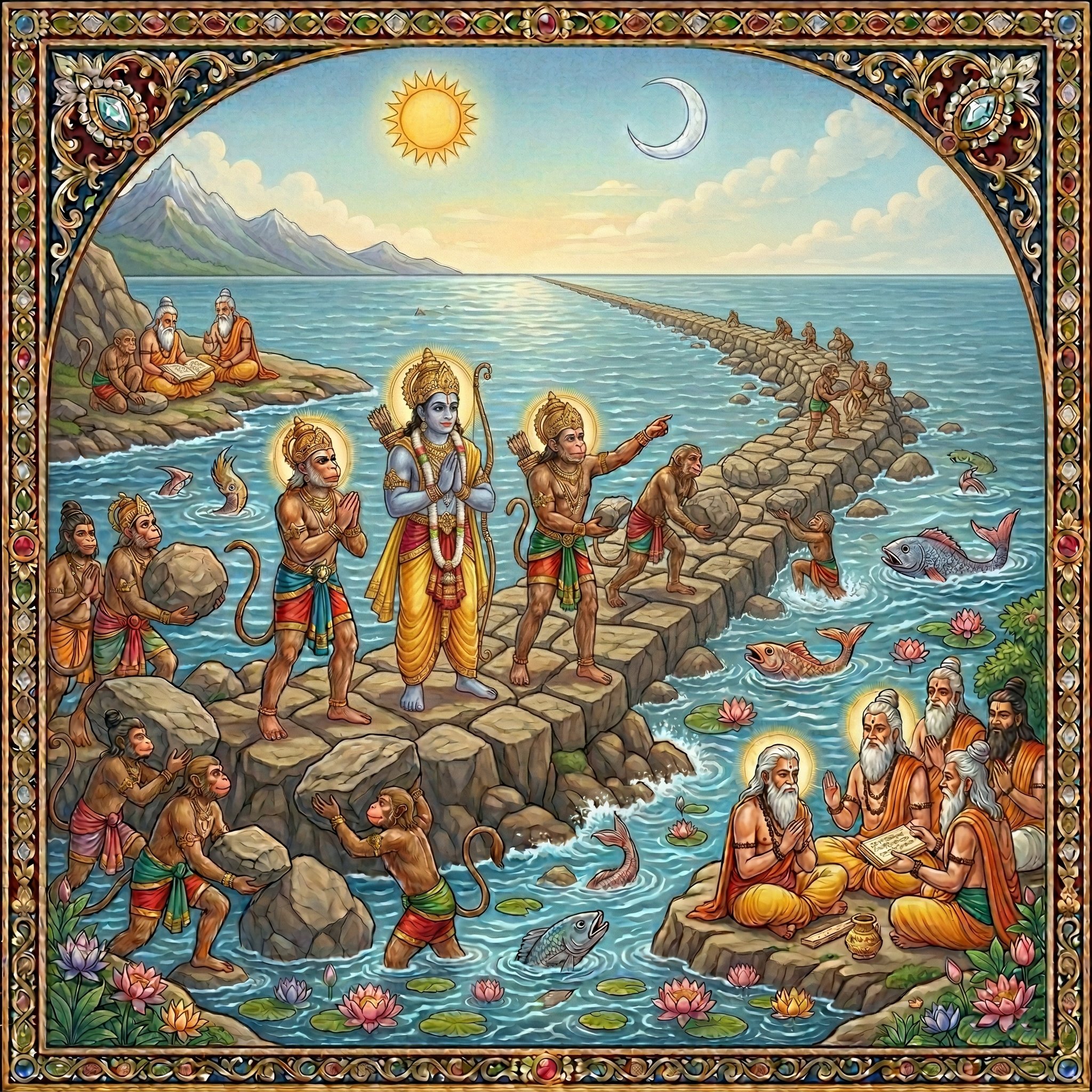
Setukhaṇḍa is anchored in the sacred geography of Setu (Rāma-setu / Setubandha) and adjacent coastal-pilgrimage zones associated with the crossing to Laṅkā. The section treats the seashore as a ritual boundary-space where vows, propitiation of the ocean (Varuṇālaya), and tīrtha networks converge. It maps merit through named bathing-sites (tīrthas) and narratively legitimizes them via the Rāma-cycle, presenting the region as both an epic memorial landscape and a functional pilgrimage itinerary.
Adhyayas in Setubandha Mahatmya
52 chapters to explore.
Adhyaya 1
सेतुमाहात्म्य-प्रस्तावना — Prologue to the Glory of Setu (Rāmasetu/Rāmeśvara)
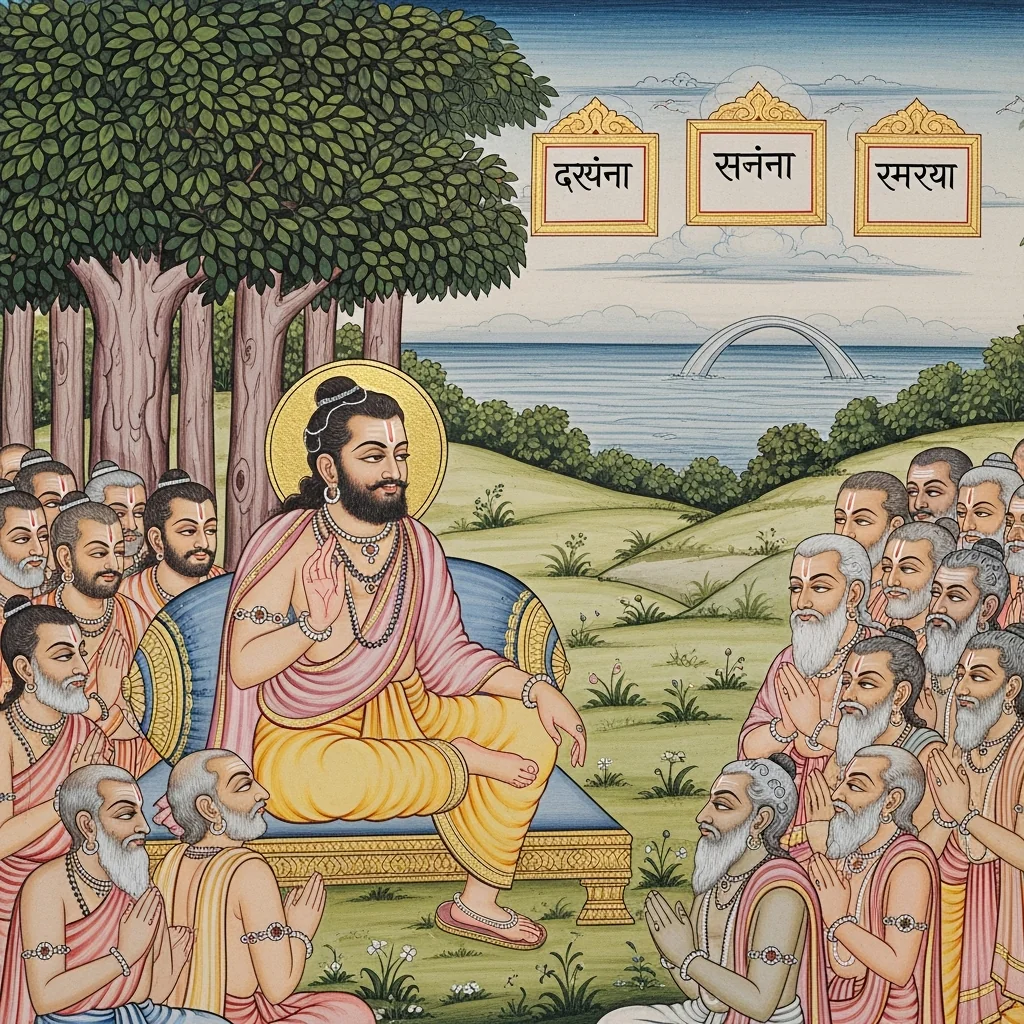
The chapter begins with invocatory verses and a depiction of liberation-seeking sages at Naimiṣāraṇya—disciplined, non-possessive, truth-oriented, and devoted to Viṣṇu. A great assembly of ṛṣis gathers to hear sin-destroying sacred narratives and to ask about worldly welfare and the path to liberation. Sūta, the renowned Purāṇic narrator and disciple of Vyāsa, arrives and is ritually honored by Śaunaka and the others. The sages question him about holy fields and tīrthas, attaining mokṣa from saṃsāra, the arising of devotion to Hari and Hara, and the efficacy of threefold karma. Sūta replies by proclaiming Rāmeśvara at Rāmasetu as the foremost of all tīrthas: the mere sight of Setu is said to loosen bondage to saṃsāra, while bathing and remembrance are taught as means of purification. A lengthy phalaśruti promises the destruction of grave faults, avoidance of punitive afterlife states, and merit comparable to sacrifices, vows, gifts, and austerities. The discourse also lays down pilgrimage ethics—sincerity of intention, the propriety of seeking support for the journey, limits on accepting gifts, and condemnation of deceit involving funds for the Setu pilgrimage. It concludes by presenting Setu as a remedy across the yugas: knowledge in Kṛta, sacrifice in Tretā, gifting in later ages, yet Setu-practice is praised as broadly beneficial in every time.
Adhyaya 2
सेतुबंधनवर्णनम् (Setubandha—Account of the Bridge and the Setu Tīrthas)
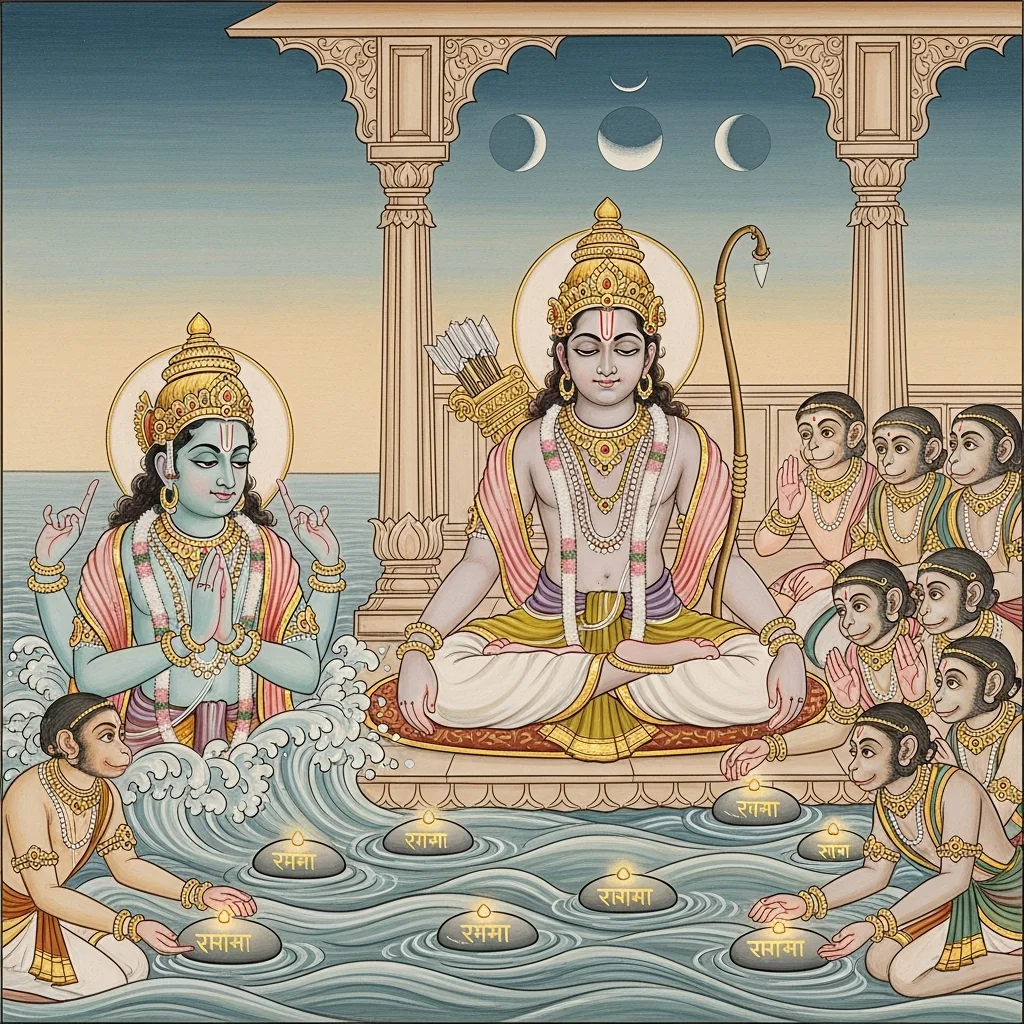
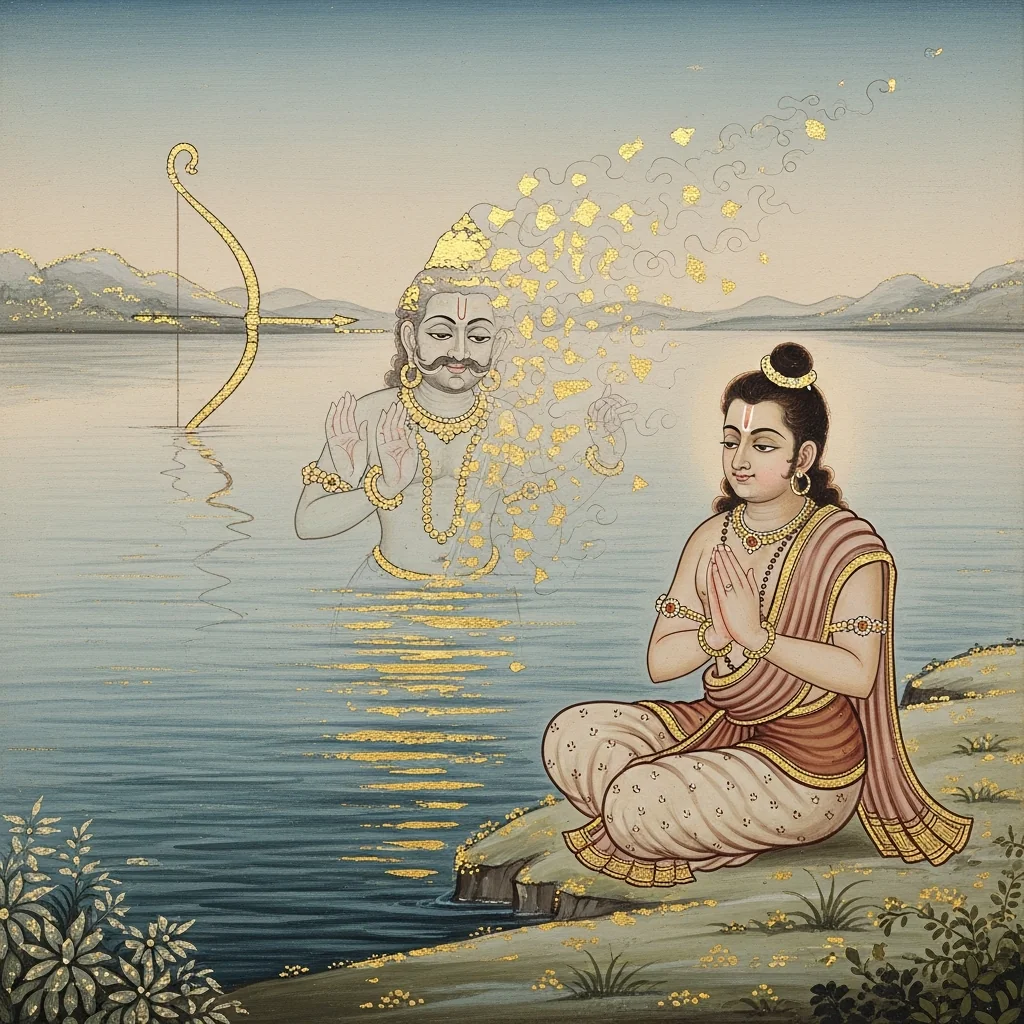
This adhyāya begins with sages asking Sūta how Rāma—renowned for acting without inner disturbance—bound a bridge across the deep ocean (Varuṇālaya), and how many tīrthas are found at Setu and in the Gandhamādana setting. Sūta then recounts, in brief, the Rāma-cycle: exile to Daṇḍaka and Pañcavaṭī; Sītā’s abduction by Rāvaṇa through Mārīca’s disguise; Rāma’s search and meeting with Hanumān; the fire-witnessed alliance with Sugrīva; Vāli’s defeat; the vānaras’ mobilization to recover Sītā; Hanumān’s successful reconnaissance and his return with the token cūḍāmaṇi; the march to Mahendra and stay at Cakra-tīrtha; and Vibhīṣaṇa’s arrival, testing, and consecration. When the ocean-crossing problem arises, counsel is offered—boats, floats, or propitiating the sea. Rāma performs disciplined upāsanā on a kuśa-grass bed for three nights; when the ocean does not appear, he prepares to dry the sea with his weapons. The ocean deity then manifests, praises Rāma with a devotional stotra, explains natural law (svabhāva) and its limits, and gives a practical remedy: Nāla, the vānaras’ artisan, will make the thrown materials float and form a bridge. Commissioned by Rāma, Nāla leads the vānaras as they gather mountains, rocks, trees, and vines, and the bridge is built in idealized measures. The chapter next proclaims the purificatory merit of bathing at Setu (Setu-snānā) and introduces a catalog of the principal Setu tīrthas, said to be twenty-four, naming many—Cakra-tīrtha, Vetāla-varada, Sītā-saras, Maṅgala-tīrtha, Amṛta-vāpikā, Brahma-kuṇḍa, Hanūmat-kuṇḍa, Agastya-tīrtha, Rāma-tīrtha, Lakṣmaṇa-tīrtha, Jaṭā-tīrtha, Lakṣmī-tīrtha, Agni-tīrtha, Śiva-tīrtha, Śaṅkha-tīrtha, Yāmuna-tīrtha, Gaṅgā-tīrtha, Gayā-tīrtha, Koṭi-tīrtha, Mānasa-tīrtha, Dhanuskoṭi. It ends with a phalaśruti: hearing or reciting this adhyāya is said to grant victory beyond and ease the affliction bound up with rebirth.
Adhyaya 3
चक्रतीर्थ-धर्मपुष्करिणी-माहात्म्य (Cakratīrtha and Dharma Puṣkariṇī: Etiology and Merit)
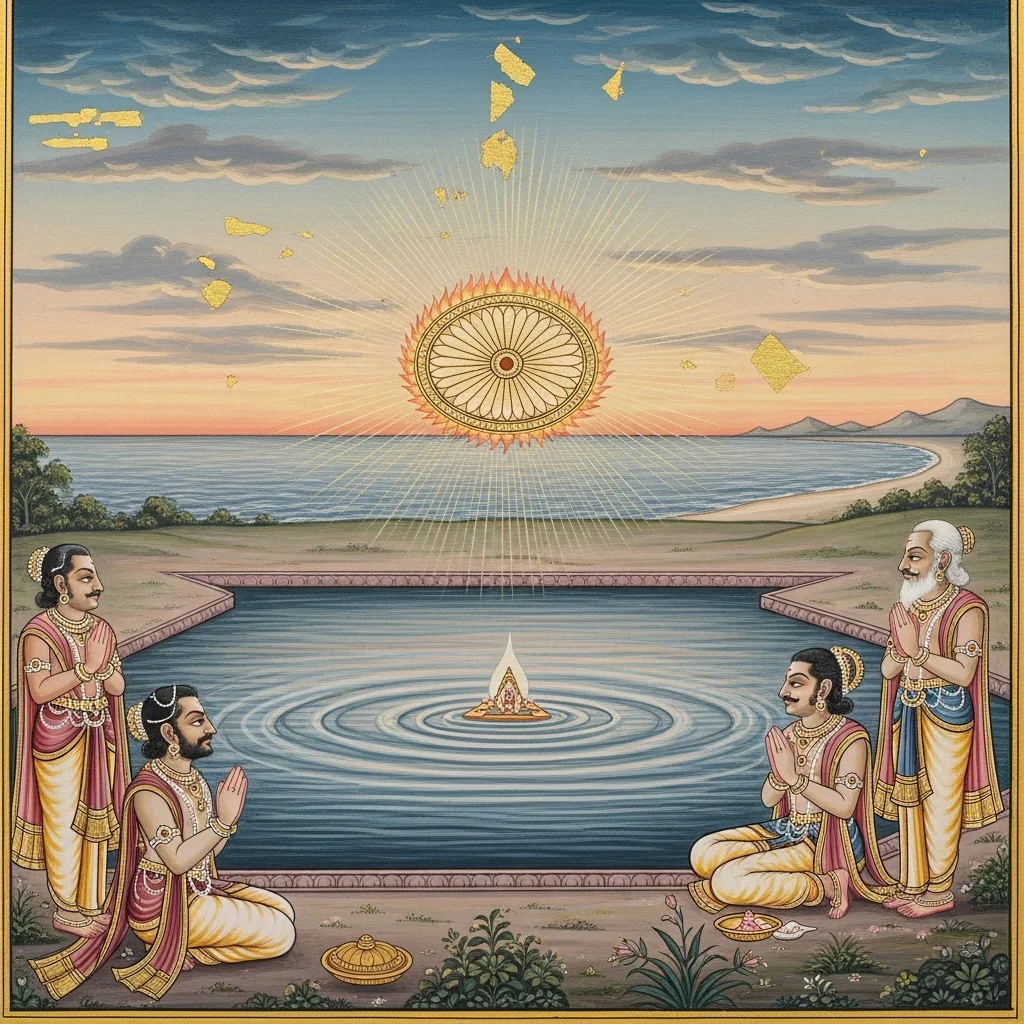
The chapter begins with the ṛṣis asking Sūta about the foremost among the twenty-four Setu tīrthas, especially the tradition’s first-ranked site called Cakratīrtha. Sūta declares its unequaled power to purify: mere remembrance, praise, or a single bath is said to dissolve even accumulated sins and remove the fear of repeated womb-dwelling (a liberation-tinged promise). He then recounts the origin. The sage Gālava, devoted to Viṣṇu, performs severe austerities on the southern seashore near Dharma Puṣkariṇī. Viṣṇu appears in a radiant theophany and grants boons—steadfast bhakti, continued residence in the āśrama, and assured protection by his discus, the Sudarśana cakra. An embedded account tells of Dharma personified doing tapas to Śiva, receiving the boon of becoming Śiva’s vehicle (vṛṣa), and establishing the bathing place Dharma Puṣkariṇī, praised as inexhaustibly fruitful. Returning to Gālava, a rākṣasa attacks him; he appeals to Nārāyaṇa, whereupon Sudarśana arrives, slays the rākṣasa, and proclaims a permanent protective presence at the pond. Because the cakra remains ever near, the place becomes famed as Cakratīrtha; bathing and ancestral offerings there are said to benefit descendants and forebears. The chapter closes with a phalaśruti: hearing or reciting this adhyāya yields the merit of Cakratīrtha’s consecratory bath, granting well-being here and auspicious results beyond.
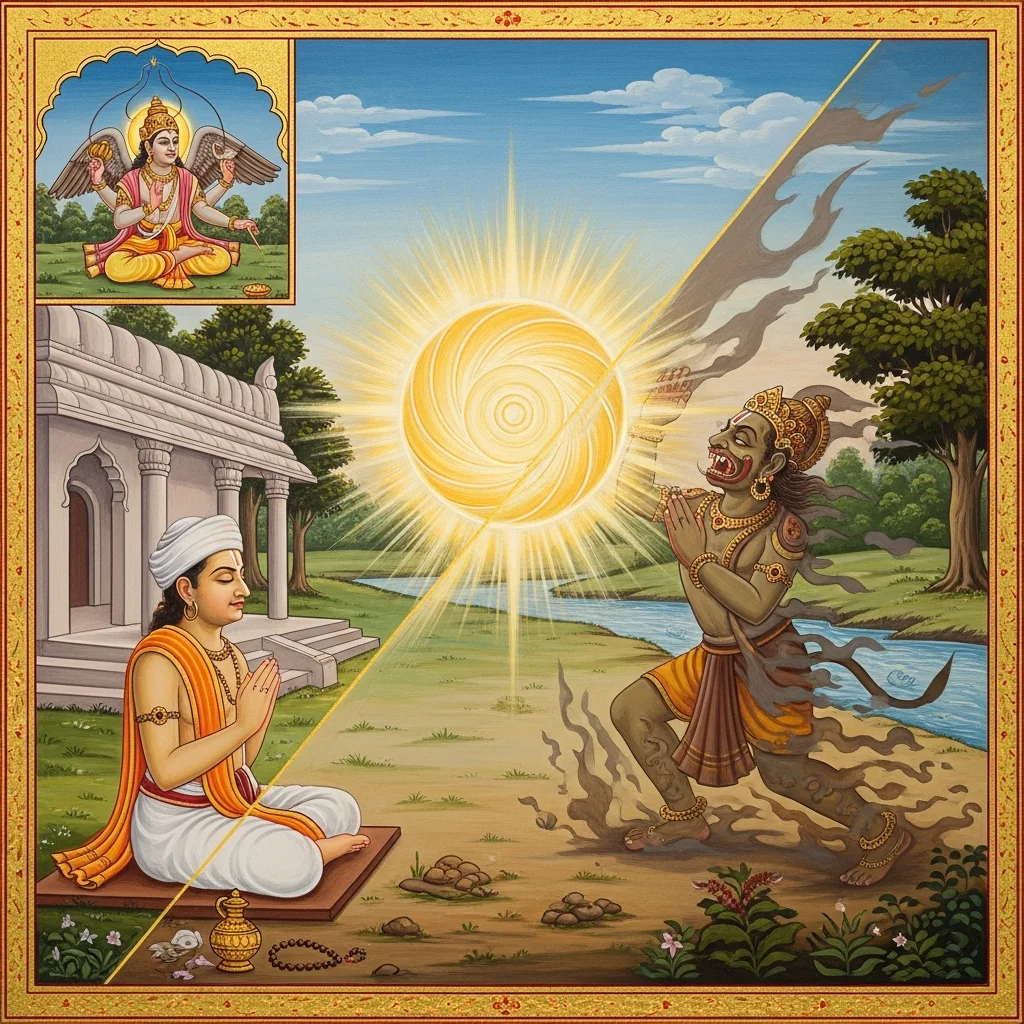
Adhyaya 4
Cakra-tīrtha Māhātmya and the Curse of Durdama (चक्रतीर्थमाहात्म्यं तथा दुर्दमशापवृत्तान्तः)
The chapter proceeds in a question-and-answer frame: the ṛṣis ask Sūta to name the rākṣasa who tormented the Viṣṇu-devoted sage Gālava. Sūta recounts the origin at Hālāsyakṣetra, where many Śiva-devoted sages led by Vasiṣṭha are engaged in worship. A gandharva named Durdama, absorbed in frivolous dalliance with many women, fails to cover himself on seeing the sages, and Vasiṣṭha curses him to become a rākṣasa; at the women’s plea, the curse is limited to sixteen years and his restoration is foretold. After wandering and harming beings, Durdama reaches Dharma-tīrtha and attacks Gālava. Gālava praises Viṣṇu, whereupon the Sudarśana-cakra is dispatched and severs the rākṣasa’s head; Durdama regains his gandharva form, hymns the cakra, and returns to heaven. Gālava then petitions Sudarśana to abide at that spot, establishing Cakra-tīrtha as a place that destroys sin, removes fear (even of bhūtas and piśācas), and grants liberation. The chapter ends by explaining the tīrtha’s seemingly “split” terrain: in primordial times Indra cut winged mountains, and fallen fragments reshaped the land and partly filled the tīrtha’s center.
Adhyaya 5
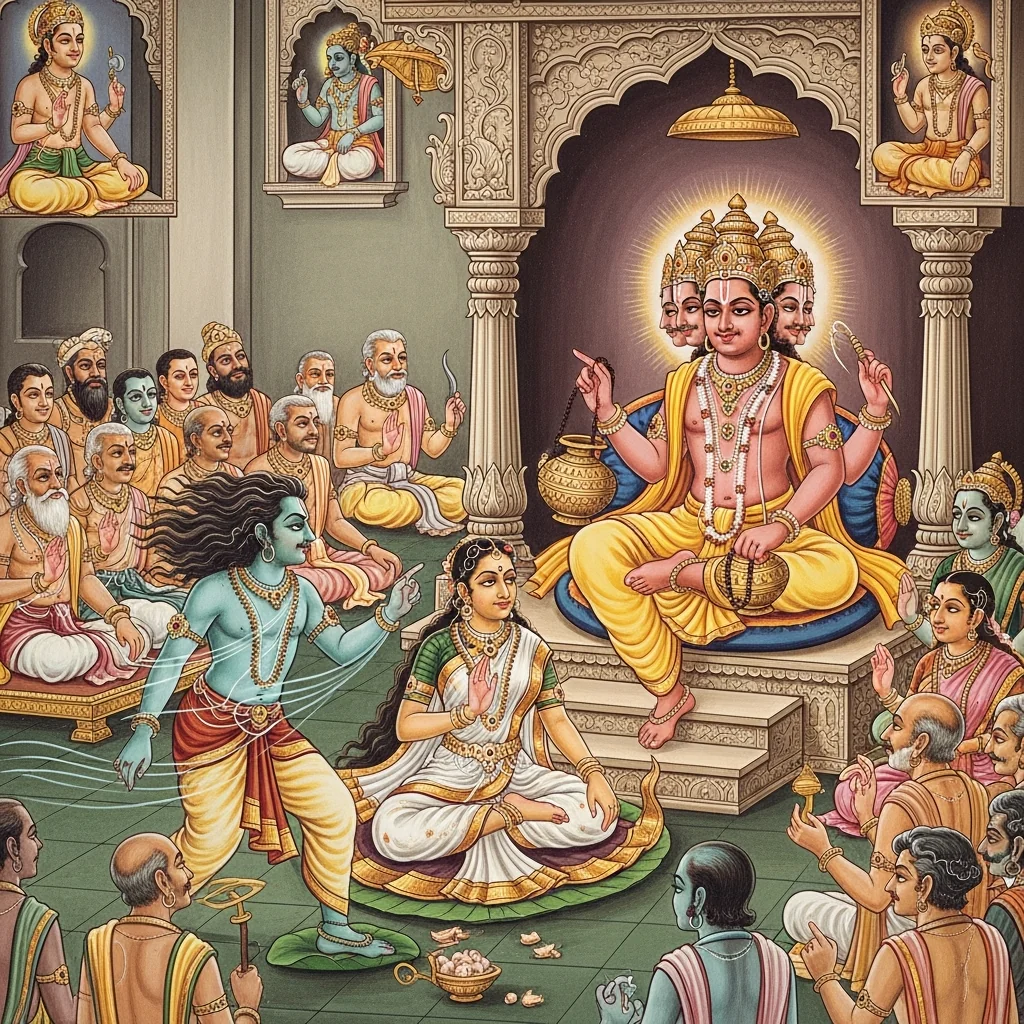
Vidhūma–Alambusā Brahmaśāpa-nivṛttiḥ (Cakratīrtha Māhātmya) | Release from Brahmā’s Curse through Cakratīrtha
Sūta tells the sages of the wondrous power of Cakratīrtha, praised as a pāpa-vināśana tīrtha that destroys sin. The tale begins with the Vasu Vidhūma and the celestial dancer Alambusā, both struck by a severe curse from Brahmā. In Brahmā’s assembly, the wind lifts Alambusā’s garment; seeing desire arise in Vidhūma, Brahmā condemns him to human birth and appoints Alambusā as his future wife. When Vidhūma pleads, Brahmā sets a limit: after ruling as a king, begetting an heir, and installing that heir on the throne, Vidhūma must bathe with his wife at Cakratīrtha near Phullagrāma on the southern ocean shore—only then will the curse end. The narrative traces the curse’s unfolding through the Somavaṃśa-linked king Śatānīka and queen Viṣṇumatī; by the sage Śāṇḍilya’s grace, Sahasrānīka is born (Vidhūma himself), and his attendants are reborn as royal companions. Alambusā is born as Mṛgāvatī, daughter of king Kṛtavarman. A separation follows: a bird carries Mṛgāvatī away; she finds refuge at Jamadagni’s āśrama, gives birth to Udayana, and later reunion is achieved through recognition tokens and the sage’s intervention. After Udayana is enthroned, Sahasrānīka fulfills the ordained pilgrimage to Cakratīrtha with Mṛgāvatī and their companions; upon bathing, the human state vanishes instantly, divine forms return, and their ascent to heaven is described. The chapter ends with a phalaśruti: reciting or hearing it grants desired fruits and affirms the tīrtha’s ritual authority.
Adhyaya 6
देवीपत्तन-चक्रतीर्थ-प्रश्नः तथा दुर्गोत्पत्तिः (Devīpattana & Cakratīrtha Inquiry; Manifestation of Durgā)
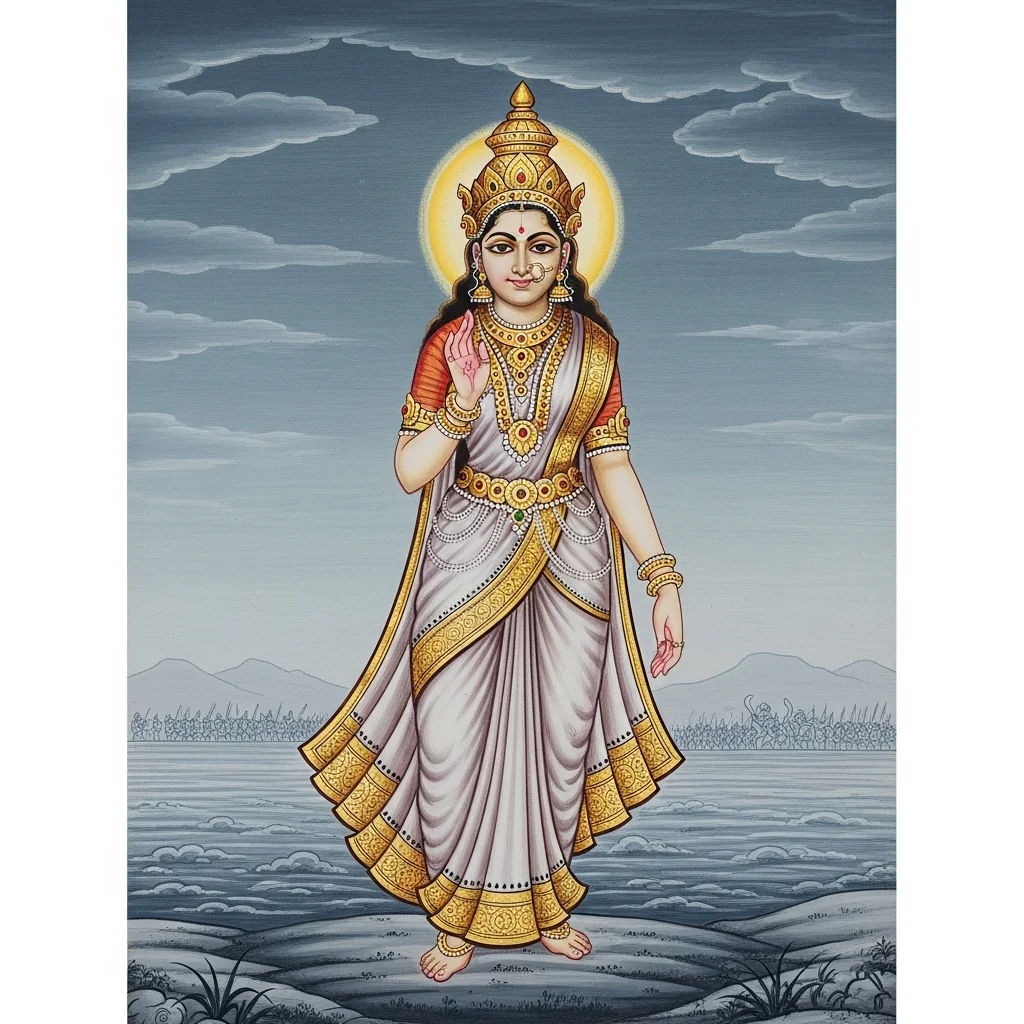
Chapter 6 begins with the ṛṣis questioning Sūta about the exact location and origin of the name Devīpura/Devīpattana, and about the boundary and extent of the revered Cakratīrtha, especially as it relates to the “Setu-root” where pilgrims bathe. Sūta presents the account as a purificatory Purāṇic narrative for readers and listeners, and anchors the sacred geography by recalling Rāma’s first act of laying stones to establish the Setu, placing Devīpura in that same holy vicinity. The narration then turns to a Devī-centered mythic past. Diti, grieving after the deva–asura conflict, commissions her daughter to perform severe tapas to obtain a son who will challenge the devas. The sage Supārśva grants a boon foretelling Mahīṣa—buffalo-faced yet human-bodied—destined to torment Indra and disrupt the celestial order. Mahīṣa grows in might, gathers asura leaders, and wages a prolonged war that drives the devas from their offices, compelling them to seek Brahmā’s intercession. Brahmā approaches Viṣṇu and Śiva; from their wrath and the gathered tejas of many deities a radiant feminine form arises—Durgā—whose limbs are explicitly identified with divine energies. The devas arm and adorn her, and her roar shakes the cosmos. Battle follows: Durgā and her gaṇas confront Mahīṣa’s vast armies and ministers, destroying hosts of asuras with arrows and weapons, while the devas regain courage through her empowering presence. Thus the chapter links a named tīrtha landscape with teaching on the Goddess’s power, cosmic order, and the ritual merit of hearing Purāṇic narration.
Adhyaya 7
Chapter 7: Durgā’s Victory over Mahiṣāsura and the Setu-Tīrtha Itinerary (Dharmapuṣkariṇī–Cakratīrtha–Setumūla)
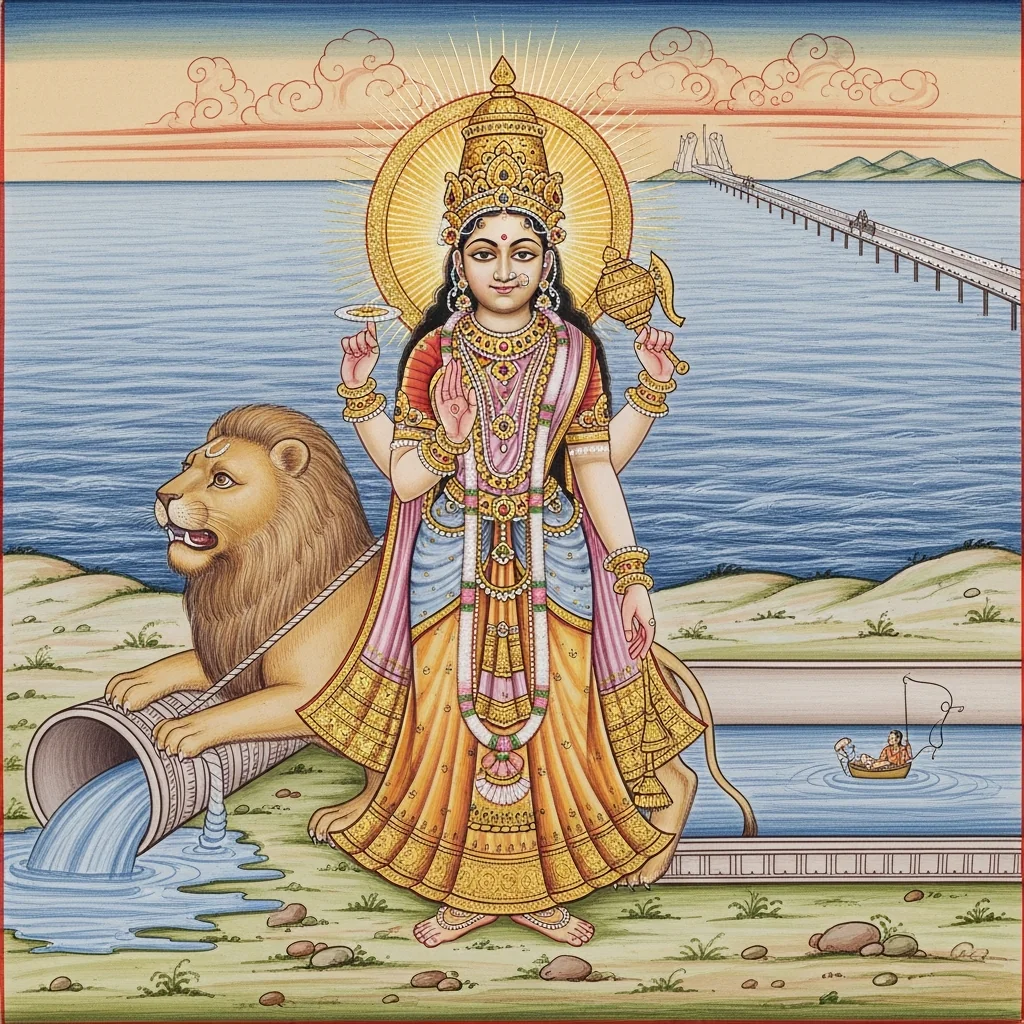
This chapter weaves a twofold sacred account, joining the myth of battle with the guidance of pilgrimage. Sūta recounts how Devī—revered as Ambikā, Caṇḍikā, Durgā, and Bhadrakālī—defeats Mahiṣāsura’s ministers and champions such as Caṇḍakopa, Citrabhānu, and Karāla through divine weapons, martial skill, and irresistible śakti. Mahiṣāsura repeatedly assumes deceptive forms (buffalo, lion-like guise, sword-bearing man, elephant, and again buffalo), while Devī’s lion-mount fights alongside her. A disembodied voice (aśarīrā vāc) reveals that the asura hides within the waters of Dharmapuṣkariṇī; the lion drinks the waters dry, exposing him, and Devī subdues him—foot upon his head, spear at his throat—then beheads him, restoring cosmic order amid hymns of praise. The narrative then turns to tīrtha-māhātmya and route-instruction. Devī establishes a city on the southern seashore; the tīrthas receive their names and boons, including an association with amṛta. A ritual itinerary is prescribed: bathe at the navapāṣāṇa area, visit Cakratīrtha, and proceed with saṅkalpa toward Setubandha. The chapter also recalls Rāma’s building of the Setu through Nala and the vānaras, affirms its dimensions and sanctity, and concludes with a phalaśruti promising spiritual attainments to those who read or hear this chapter with devotion.
Adhyaya 8
Vetalavaradā-Tīrtha Māhātmya (वेतालवरदातीर्थ-माहात्म्य) — The Origin of the Vetalavarada Sacred Ford
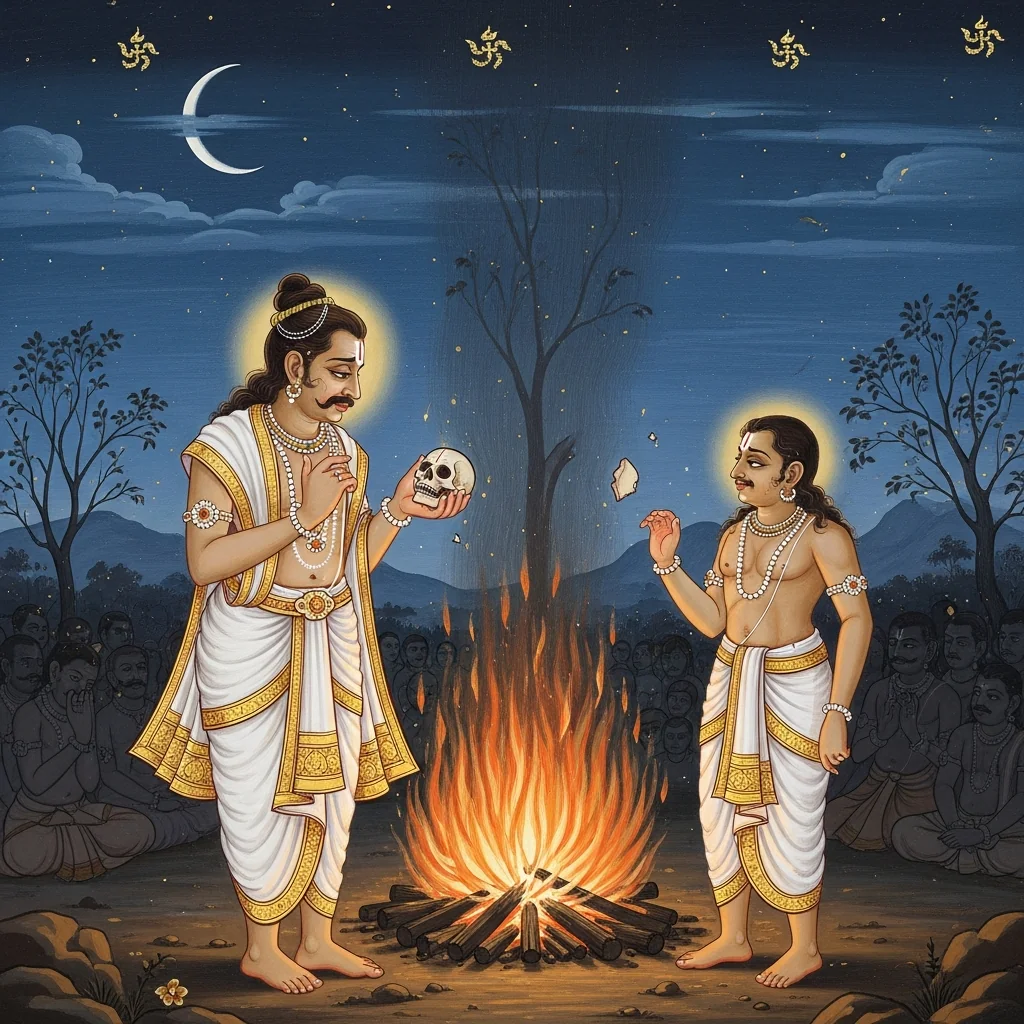
Chapter 8 begins with the ṛṣis asking Sūta for further auspicious accounts, especially about the renowned Vetalavaradā tīrtha south of Cakratīrtha. Sūta relates an esoteric yet publicly beneficial legend, traced to a discourse once spoken by Śambhu on Kailāsa. The story turns on the sage Gālava and his daughter Kāntimatī, whose disciplined service to her father exemplifies filial duty and self-restraint in dharma. Two Vidyādhara princes, Sudarśana and his younger companion Sukarṇa, behold Kāntimatī; Sudarśana’s desire becomes transgression when he seizes her by force. Her cry draws the sages, and Gālava pronounces a curse: Sudarśana must fall into human birth, endure social condemnation, and become a vetāla, while Sukarṇa also becomes human but is spared vetāla-status for lesser guilt, with release tied to later recognition of a Vidyādhara lord. The curse unfolds through rebirth: they are born as sons of the learned brāhmaṇa Govindasvāmin on the Yamunā’s bank during a long famine. An ominous blessing from a renunciant foretells separation from the elder son Vijayadatta (Sudarśana). One night in an empty shrine, the elder is struck by cold-fever and demands fire; the father seeks it at a cremation ground. The son follows, meets the funeral fire, splits a skull, tastes blood and fat, and swiftly transforms into a dreadful vetāla. A divine voice restrains him from harming his father; he departs to join other vetālas, gains the epithet Kapālasphoṭa (“Skull-Splitter”), and rises amid conflict to become a vetāla-lord. Thus the tīrtha’s identity is grounded in moral causality: unlawful desire leads to degradation, and the land remembers it in the name of the sacred ford.
Adhyaya 9
Aśokadatta’s Exploits and the Revelation of Vetalavaradā Tīrtha (अशोकदत्त-वीरचरितम् • वेतालवरदातीर्थ-माहात्म्यम्)
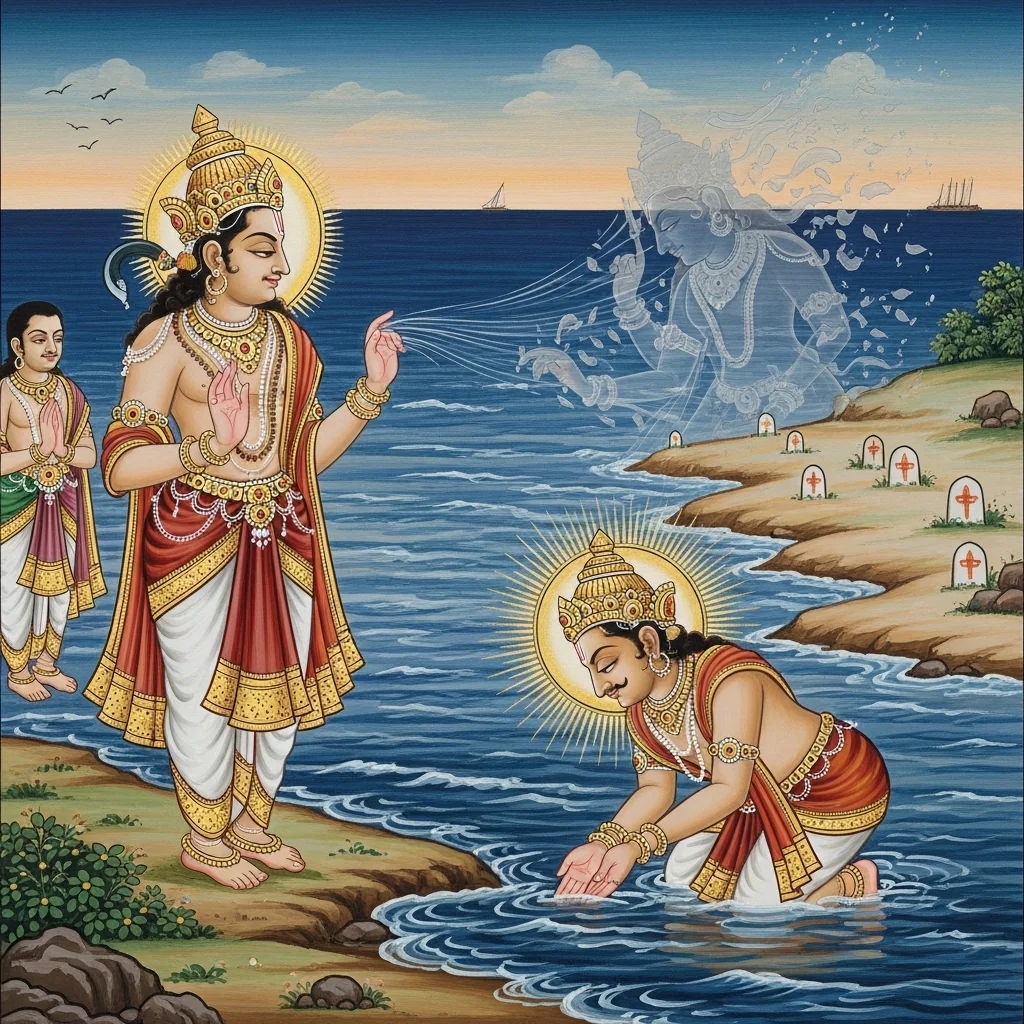
This adhyāya weaves moral exempla with the revelation of a sacred tīrtha. The grieving brāhmaṇa Govindasvāmin is sheltered by the compassionate merchant Samudradatta, while his son Aśokadatta matures into an extraordinary figure trained in both śāstra and martial skill. The Kāśī king Pratāpamukuṭa then recruits Aśokadatta to defeat a formidable southern wrestler‑king, establishing the hero’s public renown and royal favor. Later, the king and Aśokadatta hear the plea of an impaled man tormented by thirst; the king commands that water be given, presenting compassion as a royal ethical duty. At the cremation ground (śmaśāna), thronged with bhūtas, vetālas, and piśācas, Aśokadatta meets a striking woman who claims to be the victim’s beloved and asks him to offer his shoulder so she may reach him. Sensing predatory intent, Aśokadatta seizes her jeweled anklet (nūpura) and reports the eerie encounter; he is honored and granted a marriage alliance with Madanalekhā. When the king desires a matching anklet, Aśokadatta returns to the śmaśāna, uses bait (offering “great meat”) to draw out the rākṣasī, and obtains a second anklet and a second bride, Vidyutprabhā, along with a golden lotus (hemāmbuja) linked to a divine lake. Guided to the lake associated with the vetāla‑king Kapālavisphoṭa, he battles hostile beings until the Vidyādhara lord Vijñaptikautuka intervenes, revealing the curse‑chain: Aśokadatta’s brother Sukarṇa became a vetāla through a transgressive contact, and Aśokadatta’s own condition is bound up with that cursed participation. The remedy is disclosed as a supreme tīrtha near Chakratīrtha on the southern ocean shore. On arrival, mere wind‑borne droplets free Sukarṇa from the vetāla state; Aśokadatta then bathes with saṅkalpa and attains a divine form. The chapter ends by naming the site Vetalavaradā, proclaiming its extraordinary efficacy, prescribing regulated rites such as piṇḍadāna for ancestors, and concluding with a phalaśruti that promises release to readers and listeners.
Adhyaya 10
गन्धमादन-सेतुरूप-वर्णनम् तथा पापविनाशन-तीर्थमाहात्म्यम् (Gandhamādana as Setu-form and the Glory of Pāpavināśana Tīrtha)
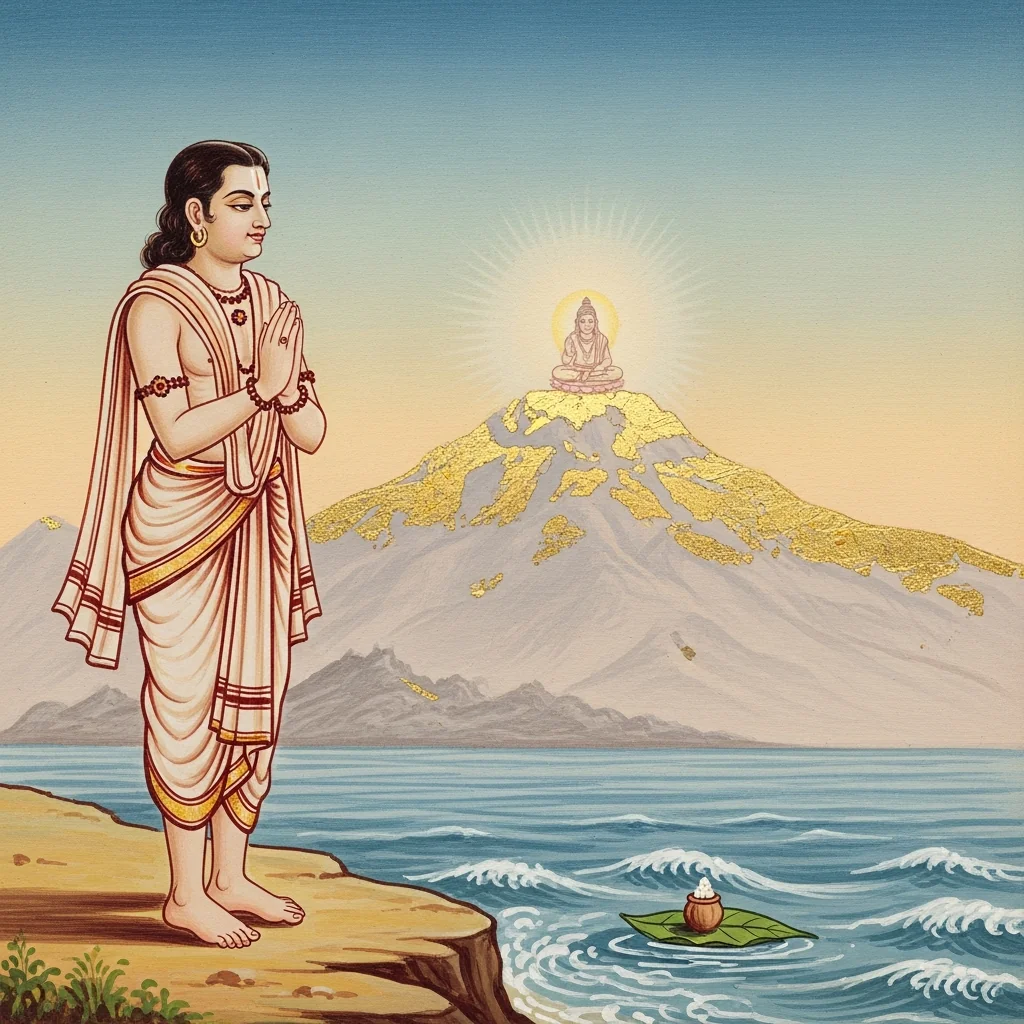
The chapter begins with Sūta’s itinerary for pilgrims: after bathing at Vetālavaradā-tīrtha, one proceeds gradually toward Gandhamādana, portrayed as standing amid the ocean in a “setu-form,” a divinely fashioned passage linked with Brahmaloka. The region is described as thick with sanctity—lakes, rivers, seas, forests, āśramas, and Vedic shrines—inhabited by sages such as Vasiṣṭha, along with siddhas, cāraṇas, and kinnaras, while major deities are said to dwell there day and night. Gandhamādana’s winds are praised for erasing vast stores of sin, and its mere sight for granting mental well-being. Ritual decorum is then prescribed: the pilgrim should beg the mountain—revered bearer of the setu—for forgiveness for stepping upon it, pray for the darśana of Śaṅkara on its summit, and continue with gentle steps. Ocean-bathing at Gandhamādana is enjoined, as is piṇḍadāna for the ancestors, even as small as a mustard seed, said to bring them lasting satisfaction. A second discourse begins when the ṛṣis ask about the tīrtha called Pāpavināśana. Sūta tells of an āśrama near Himavat, filled with disciplined Vedic practitioners. A śūdra named Dṛḍhamati seeks initiation and instruction, but the kulapati refuses, stressing social and ritual restrictions on teaching. Dṛḍhamati nonetheless builds a separate hermitage and serves with devotional hospitality. The brāhmaṇa Sumati grows attached and eventually teaches him confidential Vedic rites (havyakavya, śrāddha, mahālaya, and others), bringing Sumati severe karmic ruin—hells and many rebirths—and later, in another life, a brahmarakṣasa affliction. The afflicted son is taken to Agastya, who explains the karmic cause and prescribes the sole remedy: three days of bathing at Pāpavināśana-tīrtha, located above Gandhamādana in the Setu-region. The rite succeeds—affliction ends, health and prosperity return, and liberation is promised at death. The chapter closes by reaffirming Pāpavināśana as a widely efficacious expiatory tīrtha, granting heaven and mokṣa and revered by Brahmā, Viṣṇu, and Maheśa, while offering the narrative as an ethical caution about transmitting ritual knowledge only with proper authorization and as a map of purification through rightly performed pilgrimage.
Adhyaya 11
सीतासरः-माहात्म्यं (Sītāsaras / Sītākuṇḍa Māhātmya: Indra’s Purification Narrative)
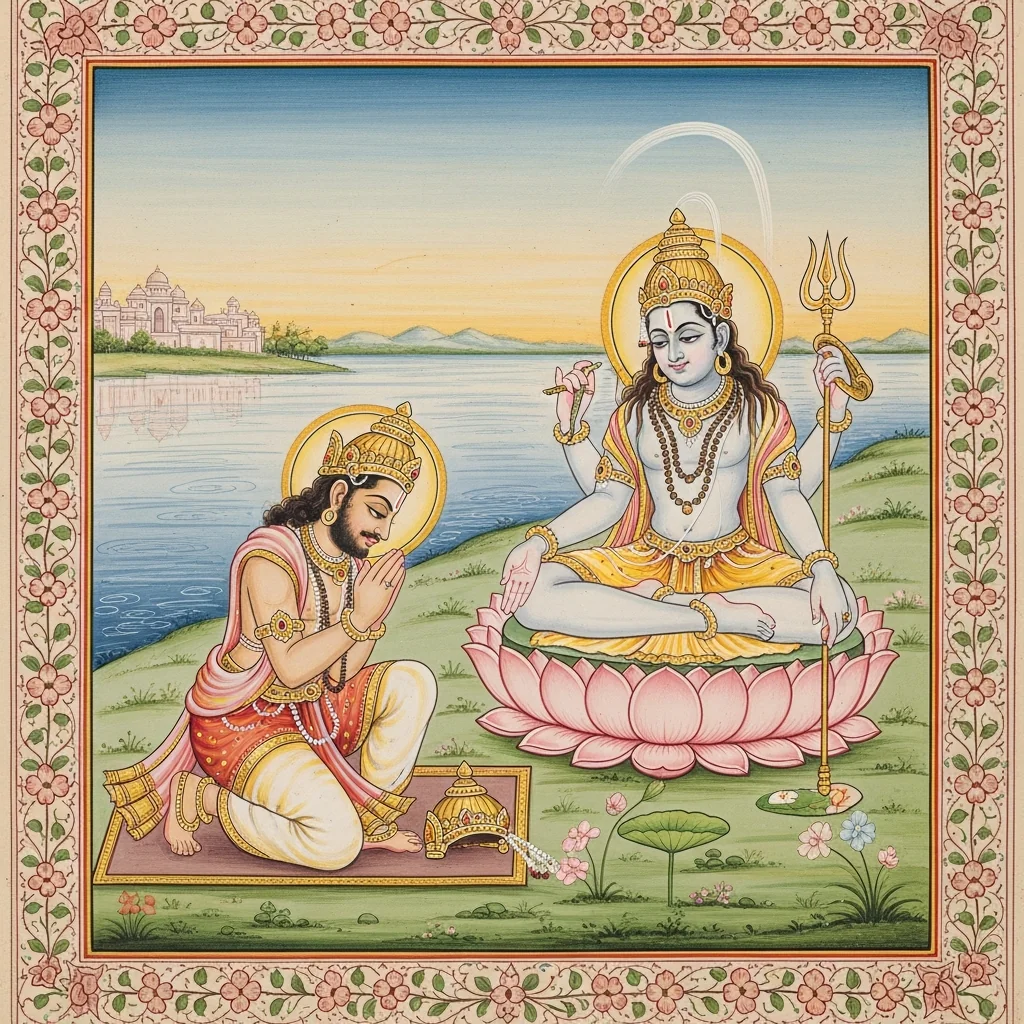
This adhyāya is a tīrtha-māhātmya discourse spoken by Sūta to the questioning ṛṣis. It begins with a ritual itinerary: after bathing at Pāpanāśa, the pilgrim should observe niyama and proceed to Sītāsaras/Sītākuṇḍa for snāna aimed at complete purification. The text further declares that the merits of the great tīrthas abide there, establishing Sītāsaras as a concentrated seat of sanctity. The narrative then addresses a theological puzzle: how Indra (Purandara) incurred brahmahatyā and how he was freed. In a war episode, the mighty rākṣasa Kapālābharaṇa, protected by boons, attacks Amarāvatī; after a prolonged battle Indra slays him with the vajra. When asked why brahmahatyā should follow from killing a rākṣasa, Sūta reveals Kapālābharaṇa’s brahmin-linked origin: he is born from the sage Śuci’s transgression with Suśīlā, wife of the rākṣasa Trivakra. Thus, because the slain one is tied to brāhmaṇa seed, the sin pursues Indra. Seeking refuge with Brahmā, Indra is instructed to pilgrimage to Sītākuṇḍa on Gandhamādana, worship Sadāśiva, and bathe in the lake; the affliction is removed and Indra is restored to his realm. The chapter concludes by grounding the tīrtha’s name and authority in Sītā’s presence and by a phalaśruti: bathing, gifting, and rites performed there grant desired aims and auspicious post-mortem states, while hearing or reciting this account bestows well-being in this world and the next.
Adhyaya 12
मंगलतीर्थमाहात्म्यम् (Mangalatīrtha Māhātmya: The Glory of the Auspicious Tīrtha)
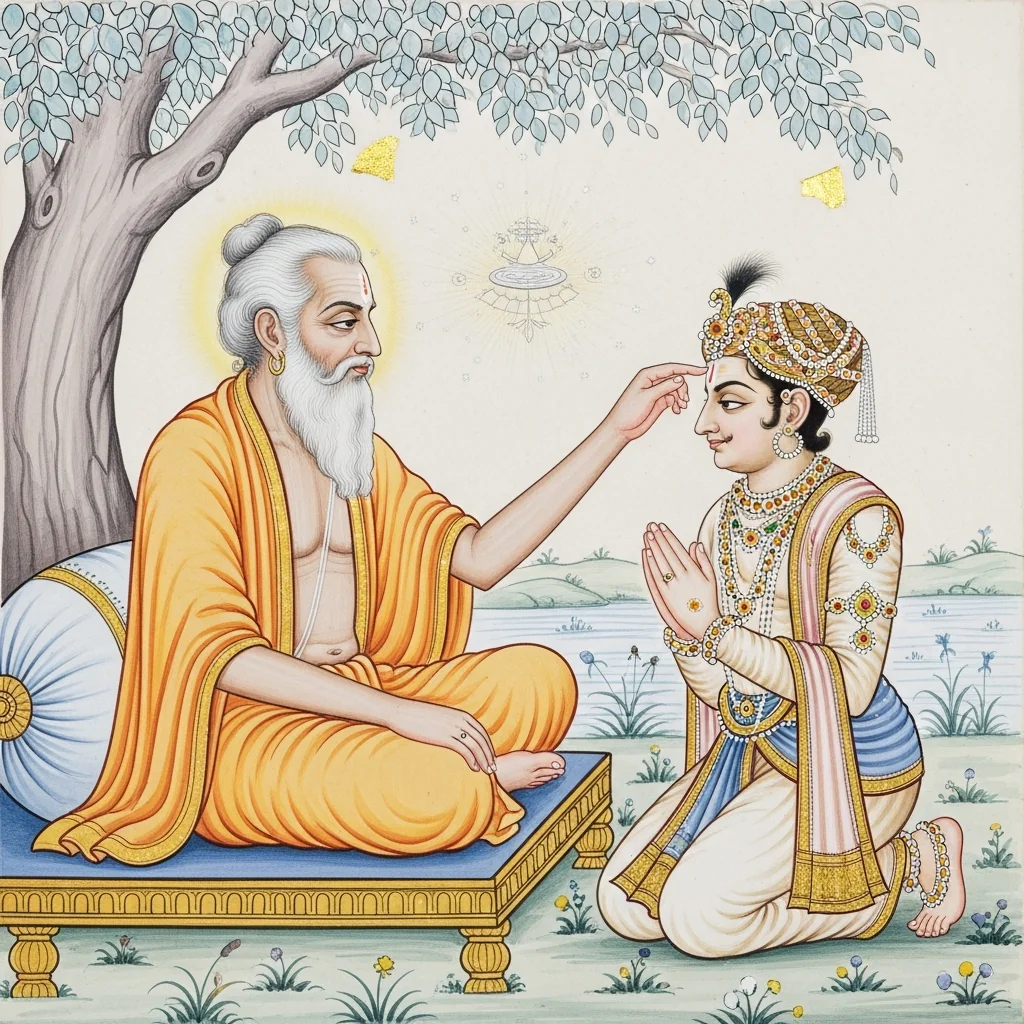
This chapter is a tīrtha-māhātmya praising “Maṅgala Tīrtha,” narrated by Sūta. After bathing at Sītākuṇḍa, the devotee is told to approach Maṅgala Tīrtha with a composed mind; it is portrayed as ever blessed by Lakṣmī (Kamala), frequented by the gods, and renowned for removing alakṣmī—misfortune and ill-luck. An exemplary itihāsa then recounts King Manojava of the Soma lineage. At first a dharmic ruler—performing sacrifices, honoring ancestors, and studying śāstra—he is undone by pride (ahaṃkāra), which breeds greed, lust, anger, violence, and envy. He wrongs brahmins and seizes deva-dravya (temple wealth), confiscating lands; consequently he is defeated by Golabha and exiled to a dreadful forest with his wife Sumitrā and son Candrakānta. In the forest, the child’s hunger awakens the king’s remorse. Manojava lists neglected duties—charity, worship of Śiva and Viṣṇu, śrāddha rites, offerings, fasting, nāma-kīrtana, wearing devotional marks, japa, and public-benefit works like planting trees and building water resources—framing suffering as the karmic result of ethical and ritual omission. Sage Parāśara arrives, consoles Sumitrā, revives Manojava from fainting through mantra and devotion to Tryambaka (Śiva), and prescribes the remedy: pilgrimage with family to Maṅgala Tīrtha on Gandhamādana near Rāmasetu, with bathing, śrāddha, and sustained discipline. Manojava undertakes prolonged practice, including forty days of one-syllable mantra japa. By the tīrtha’s power and the sage’s guidance, divine weapons and royal insignia manifest; Parāśara consecrates him by abhiṣeka and imparts higher weapon-lore (astra-upadeśa). Returning, he defeats Golabha with the Brahmāstra and rules thereafter without pride or harm. In old age he renounces, returns to Maṅgala Tīrtha for tapas and Śiva-centered meditation, attains Śivaloka at death, and Sumitrā follows; the phalaśruti declares the tīrtha grants worldly welfare and liberation-oriented fruits, burning sins like fire consumes dry grass.
Adhyaya 13
Amṛtavāpikā-Māhātmya and the Origin of Ekāntarāmanātha-kṣetra (अमृतवापिकामाहात्म्यं तथा एकांतरामनाथक्षेत्रोत्पत्तिः)
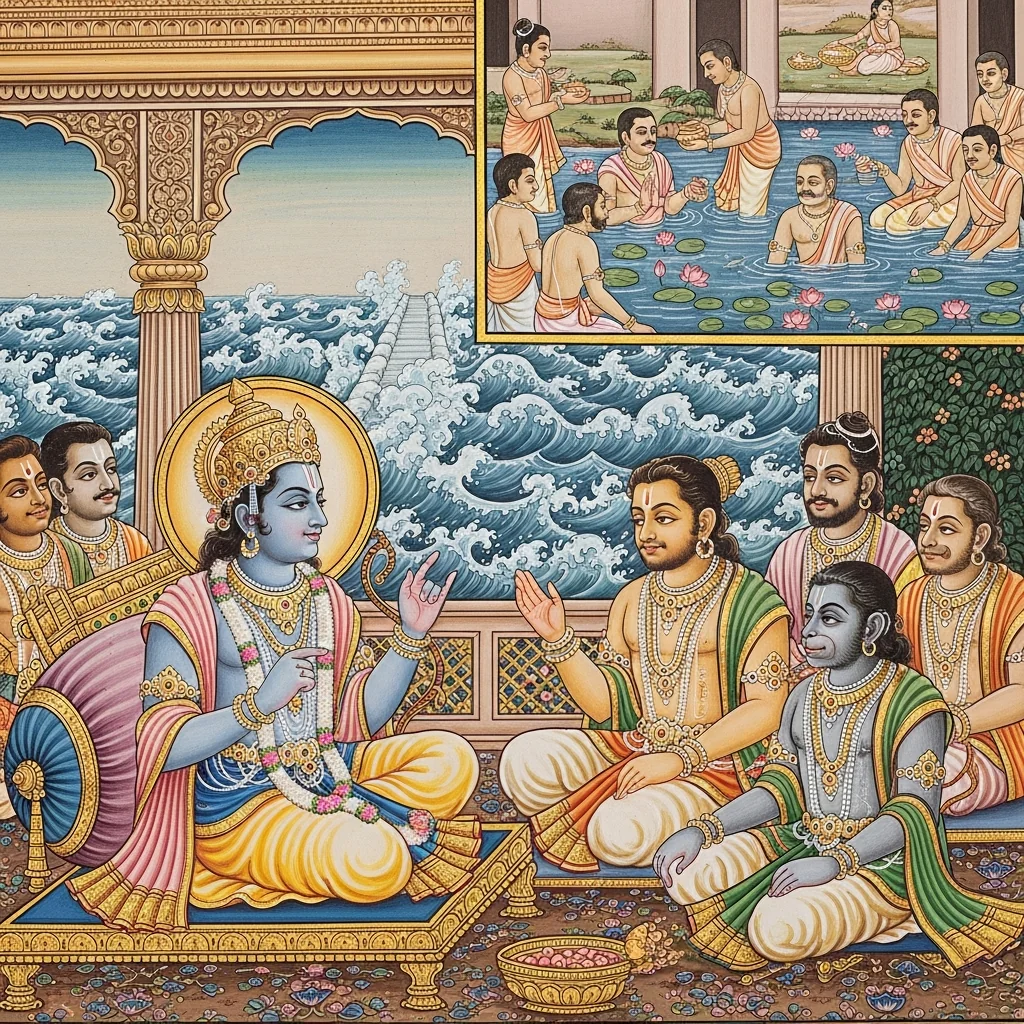
Chapter 13 is a tīrtha-māhātmya discourse narrated by Śrī Sūta. After bathing at the Maṅgalākhya Mahātīrtha, the pilgrim proceeds to the Ekāntarāmanātha-kṣetra, where Rāma (Jagannātha) is praised as ever-present with Sītā, Lakṣmaṇa, and Hanumān, together with the vānaras—signifying unbroken sanctity and protective divine nearness. The chapter then introduces Amṛtavāpikā, a meritorious pond said to remove the fear associated with aging and death. Snāna performed with śraddhā is extolled as purifying and as a means to attain “amṛtatva” through Śaṅkara’s grace. Asked why it is called Amṛtavāpikā, Sūta relates an origin tale: near Himavat, Agastya’s younger brother (Kumbhaja’s anuja) undertakes long, severe tapas while strictly observing daily duties (sandhyā, japa, atithi-pūjā, pañcayajña, śrāddha). Śiva appears and directs him to bathe at the Maṅgalākhya tīrtha near Setu/Gandhamādana as the swift path to mokṣa. The ascetic follows this, bathes with niyama for three years, and in the fourth year departs yogically through the brahma-randhra, freed from suffering; thus the pond becomes renowned as Amṛtavāpikā, and a three-year bathing observance is declared to lead to amṛtatva. The origin of the name Ekāntarāmanātha is also explained: during the building of Setu, amid the ocean’s roaring waves, Rāma consults privately (ekānte) with his allies about defeating Rāvaṇa; the site of that secret counsel becomes this kṣetra. The closing emphasis is on accessibility—even those lacking refined philosophical discernment or ritual expertise may reach “amṛta” through bathing here, highlighting salvation grounded in sacred place.
Adhyaya 14
Brahmakūṇḍa-māhātmya and the Liṅga-Origin Discourse (ब्रह्मकुण्ड-माहात्म्य तथा लिङ्गोद्भव-प्रसङ्ग)
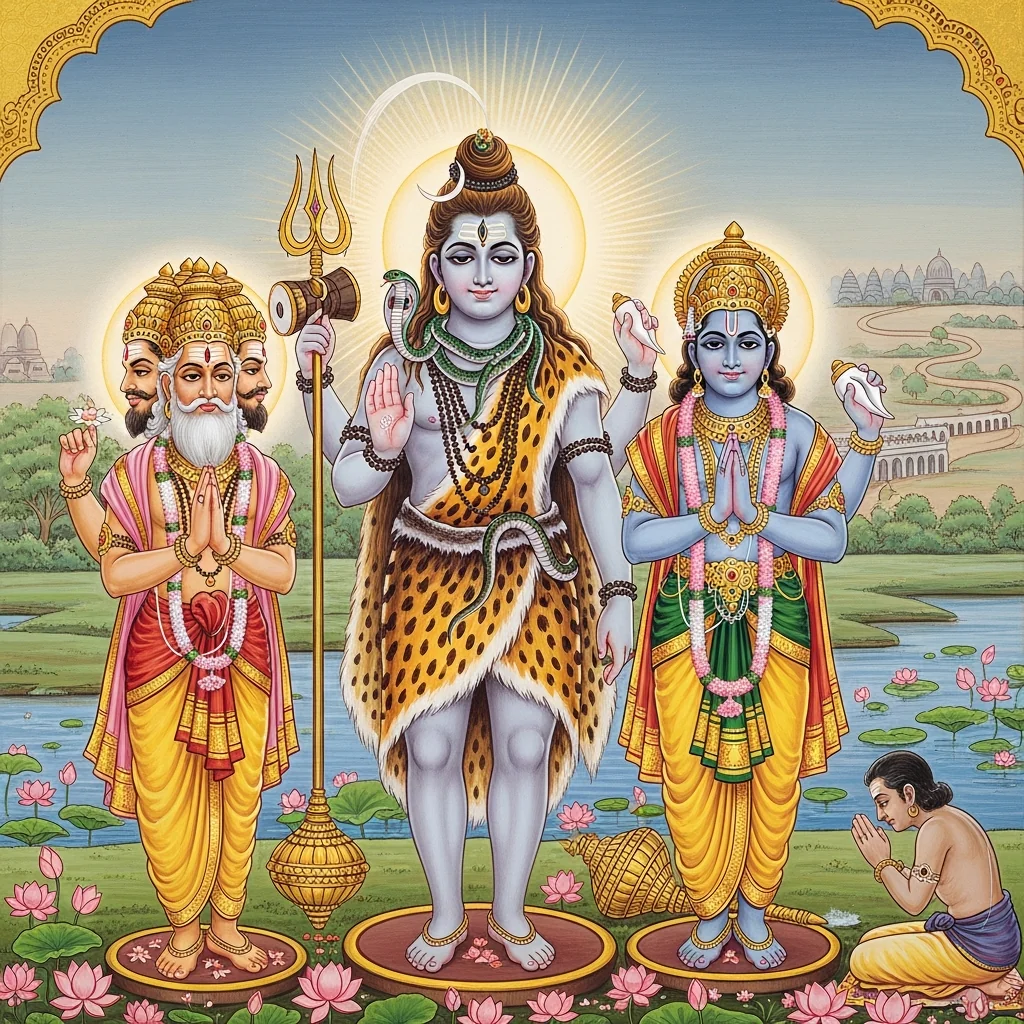
This chapter presents a twofold teaching of ritual and theology. First, Sūta describes a pilgrimage sequence that culminates at Brahmakūṇḍa on Gandhamādana, within the Setu-centered sacred landscape. He proclaims that darśana and snāna there destroy sins in their entirety and can even become the cause of attaining Vaikuṇṭha. A distinctive stress is placed on the bhasma said to arise from Brahmakūṇḍa: to apply it as tripuṇḍra, or even to place a single particle upon the forehead, is portrayed as an act immediately oriented toward liberation (mokṣa). To disparage or refuse this bhasma is treated as a grave ritual-ethical fault, bringing adverse post-mortem results. Next, in answer to the sages, Sūta recounts the pride-dispute of Brahmā and Viṣṇu and the manifestation of the self-luminous liṅga, without beginning or end (anādi–ananta). Viṣṇu speaks truthfully, while Brahmā makes a false claim; Śiva issues a normative judgment—image-worship of Brahmā is curtailed though Vedic/Smārta worship remains, and Brahmā is directed to perform extensive sacrifices at Gandhamādana to expiate his offense. That sacrificial ground becomes known as Brahmakūṇḍa, bearing the symbolism of access to mokṣa, as though the “door-bolt” of liberation were broken. Bhasma from this place is further credited with neutralizing major sins and malevolent beings. The chapter closes by noting the continued attendance of gods and ṛṣis there and by recommending ongoing sacrificial rites at the site.
Adhyaya 15
हनूमत्कुण्डमाहात्म्यं तथा धर्मसखराजचरितम् (Glory of Hanumat-Kuṇḍa and the Account of King Dharmasakha)
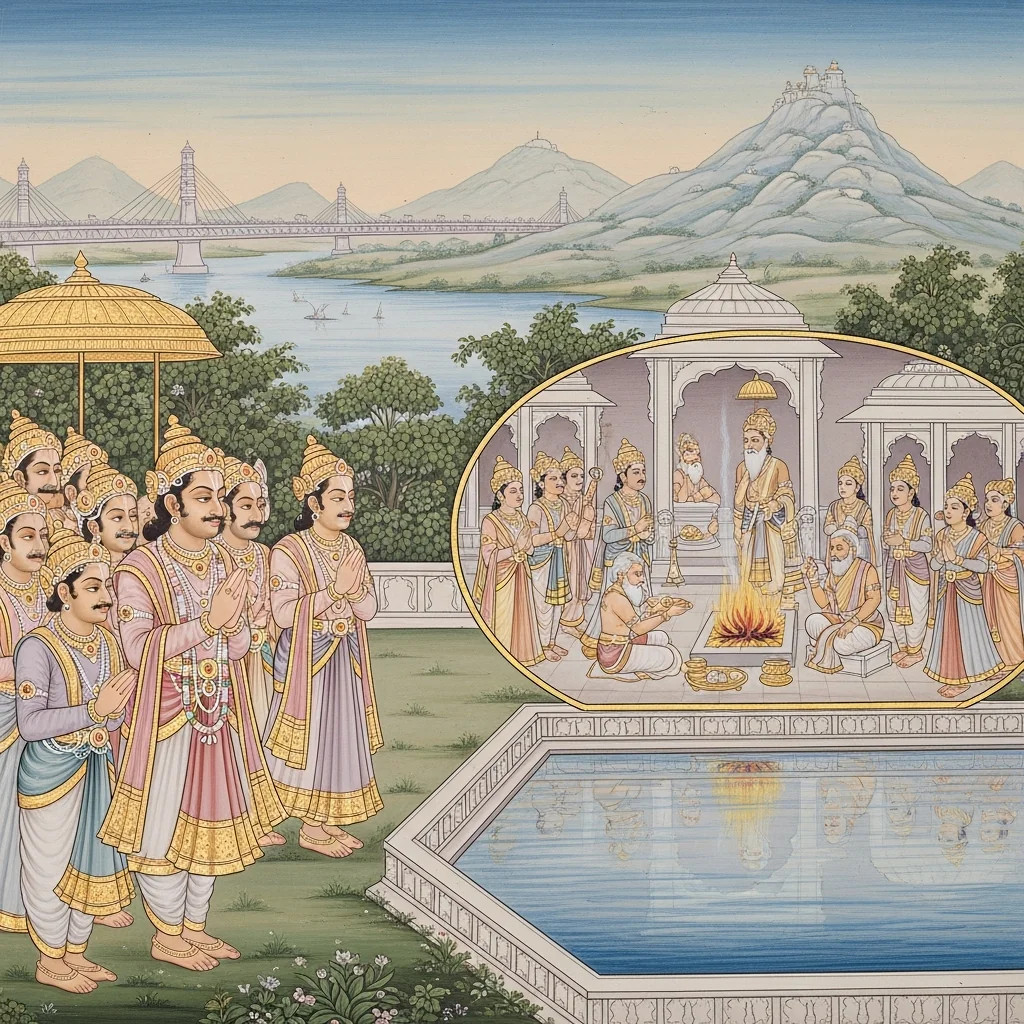
Sūta sets forth a prescribed pilgrimage order: after bathing in the highly meritorious Brahmakuṇḍa, the disciplined pilgrim proceeds to Hanumat-Kuṇḍa. Hanumat-Kuṇḍa is praised as a supreme tīrtha established by Hanumān (Mārutātmaja) for the welfare of all beings, uniquely powerful and even attended by Rudra. Bathing there is said to destroy grave sins, lessen hellish consequences over time, and lead to enduring auspicious realms such as Śiva-loka. The teaching then turns to an illustrative royal account. King Dharmasakha of the Kekaya line—righteous and politically successful—grieves for lack of an heir despite many queens and extensive dharmic works: dāna, yajñas such as the Aśvamedha, feeding others, śrāddha rites, and mantra-japa. After long years he gains a single son, Sucandra, yet a scorpion sting heightens his fear for the fragility of succession; he consults ṛtviks and his purohita for a dharma-consistent means to obtain many sons, ideally one for each wife. The priests prescribe pilgrimage to the Gandhamādana/Setu region’s Hanumat-Kuṇḍa, repeated bathing, and a putrīyeṣṭi performed on its bank. The king journeys with his household and ritual materials, completes the observances, gives abundant dakṣiṇā and gifts, and returns; in due time each queen bears a son, totaling over a hundred. He later apportions kingdoms among them, returns to the Setu region for austerities at Hanumat-Kuṇḍa, dies peacefully, and is said to attain Vaikuṇṭha, while the sons rule without rivalry. The phalaśruti concludes that reading or hearing this with focused devotion grants happiness in both worlds and divine companionship.
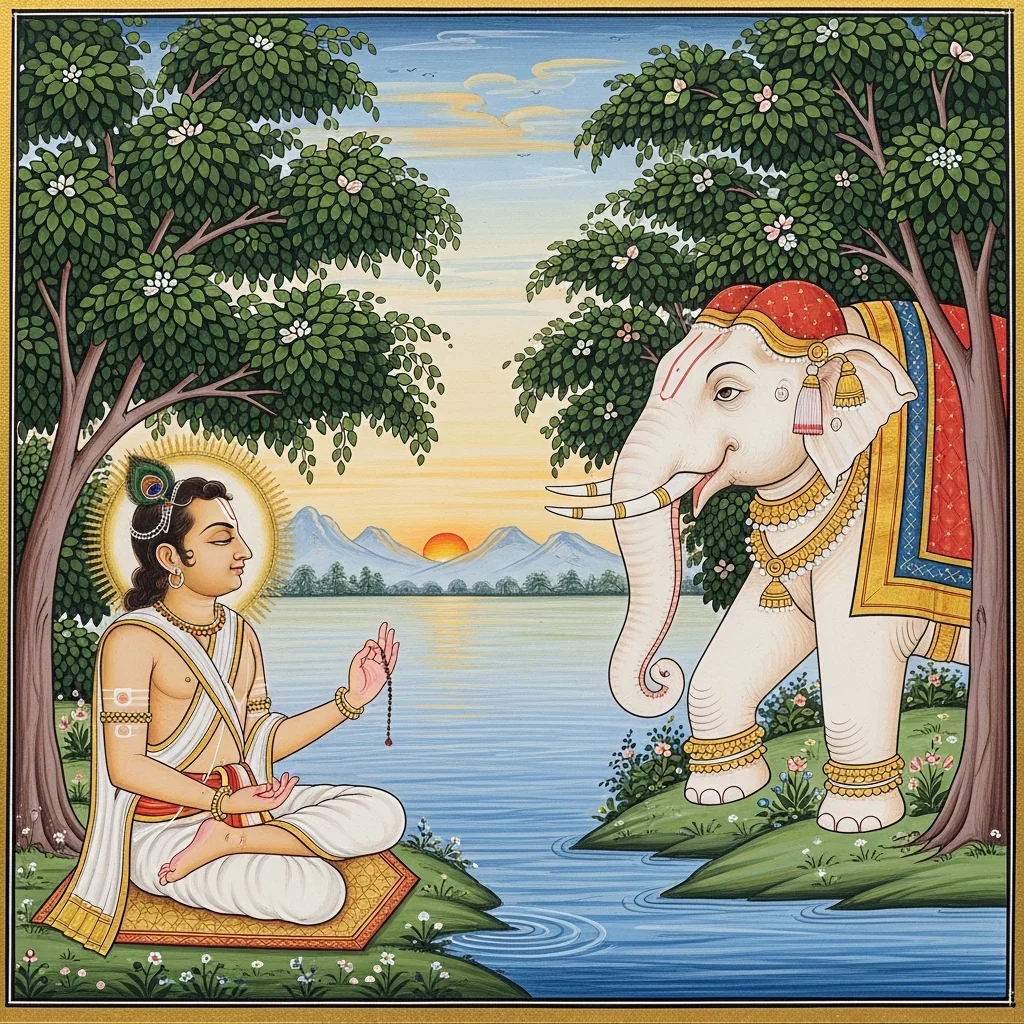
Adhyaya 16
अगस्त्यतीर्थमहिमा तथा कक्षीवान्-स्वनय-कथा (Glory of Agastya Tīrtha and the Kakṣīvān–Svanaya Narrative)
Sūta narrates a pilgrimage sequence that begins with bathing at Hanumān’s kuṇḍa and then proceeds to Agastya Tīrtha. This tīrtha is said to have been established by Kumbhayoni, the sage Agastya, in an ancient crisis involving Meru and Vindhya, when Vindhya’s unchecked growth threatened the balance of the cosmos. Following Śiva’s instruction, Agastya restrains Vindhya, and the narrative then places the sage in the Gandhamādana region, where he founds a supremely meritorious tīrtha bearing his name. A strong phala is proclaimed: bathing and drinking its water are said to end repeated birth, and the site is praised as unequalled in the three times for granting both worldly success and liberation-oriented fruits. The chapter then offers an illustrative legend: Kakṣīvān, son of Dīrghatamas, completes extensive Vedic study under Udanka and is directed to reside in disciplined observance at Agastya Tīrtha for three years, with the promise that a four-tusked elephant will appear as a providential vehicle. Since King Svanaya’s daughter has vowed to marry only one who arrives on such an elephant, Kakṣīvān’s observance fulfills the condition and enables a dharmic marriage. Formal consent is also depicted through the emissary Sudaśana to Dīrghatamas, who approves and journeys to the tīrtha, reinforcing norms of marriage authorization, vow-keeping, and tīrtha-based discipline.
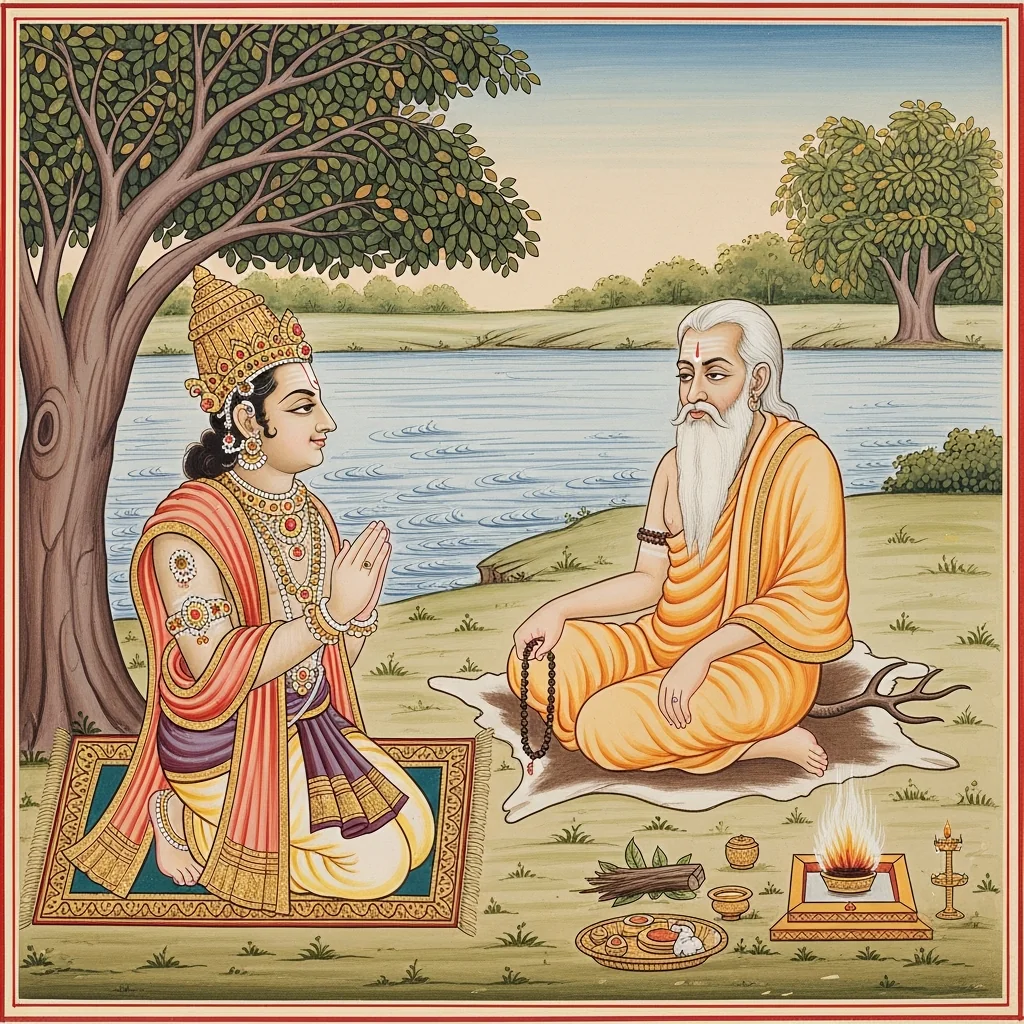
Adhyaya 17
कक्षीवद्विवाहः — Kakṣīvān’s Marriage at Agastya-tīrtha (Rituals, Gifts, and Phalaśruti)
This chapter recounts a wedding episode at Agastya-tīrtha in the Setukhaṇḍa region. Sūta tells how Kakṣīvān, acting on his teacher’s instruction and seeking a proper means to marry, arrives at the tīrtha. King Svanaya learns that the sage Dīrghatamas (with his son) is on the riverbank and pays reverence; Udanka too arrives with disciples to bathe at Rāmasetu/Dhanuṣkoṭi and serves as the ritual authority. Hospitality is observed through greetings, blessings, and the offering of arghya, after which an auspicious time is fixed and arrangements are made to bring the bride from the palace. The wedding is described with public auspicious rites: a procession, nīrājana welcome, exchange of garlands, kindling of the sacred fire, lājā-homa and related procedures, and the formal hand-taking (pāṇigrahaṇa) performed under Udanka’s supervision. When the rites conclude, the king feeds and gifts Brahmins on a grand scale and bestows ample strīdhana and dowry-like gifts upon his daughter. The sages return to their hermitage in Veda-araṇya and the king to his city; the chapter ends with a phalaśruti declaring that hearing or reciting this ancient, Veda-grounded account brings well-being and lessens hardship and poverty.
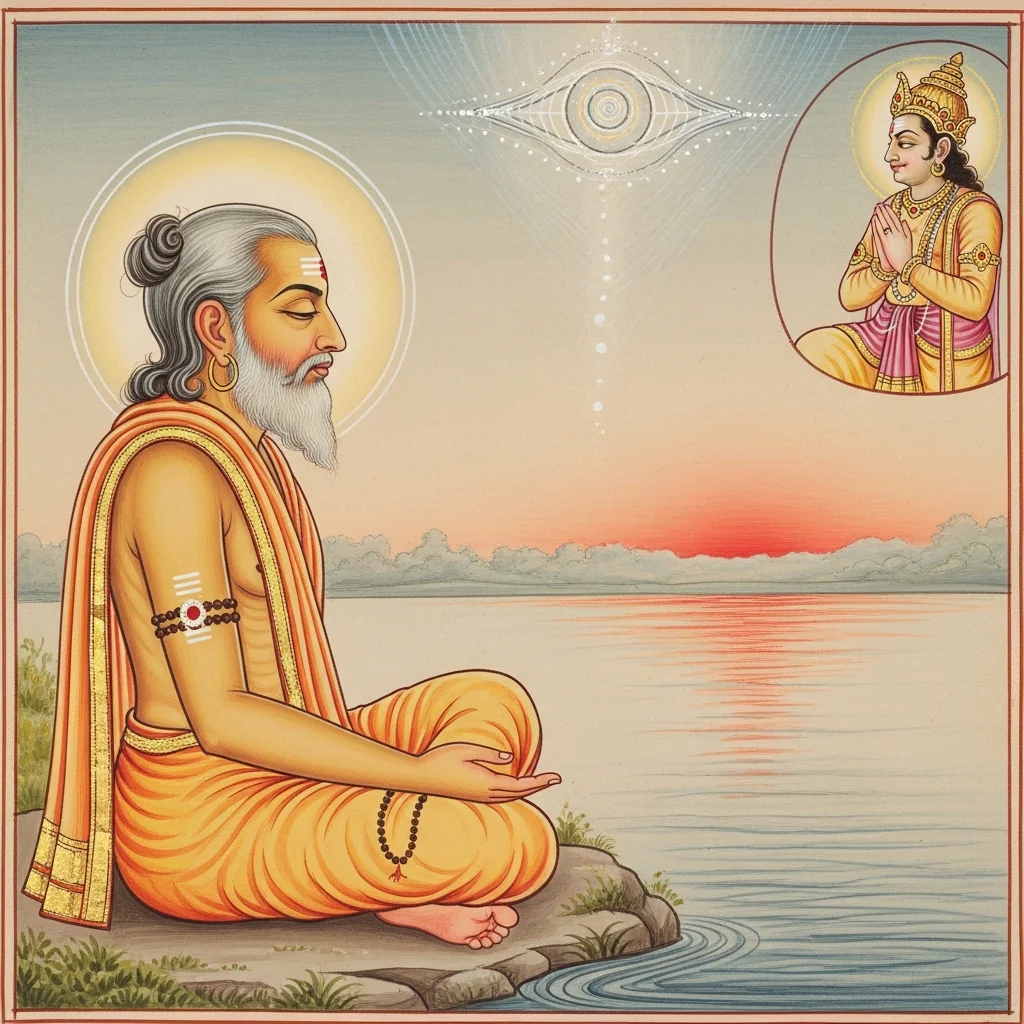
Adhyaya 18
रामतीर्थ-रघुनाथसरः-माहात्म्य तथा धर्मपुत्रप्रायश्चित्तवर्णनम् (Rāma-tīrtha and Raghunātha-saras Māhātmya; Yudhiṣṭhira’s Expiation Narrative)
The chapter begins with a tīrtha itinerary: one should bathe at Kumbhasaṃbhava-tīrtha and then go to Rāma-kuṇḍa to be released from sin. It next extols Raghunātha-saras as a pāpa-haraṇa holy place, where even small offerings to Veda-knowers multiply in merit, and where study and japa become especially fruitful. Sūta then relates a sacred history of the sage Sutīkṣṇa, Agastya’s disciple and a devotee of Rāma’s feet. On the shore of Rāmacandra-saras he performs severe tapas, continually recites the six-syllable Rāma-mantra, and offers a long hymn of salutations to Rāma’s deeds and epithets. Through sustained practice and tīrtha-sevā his devotion becomes steady and pure, accompanied by non-dual insight; various yogic attainments are listed as secondary results. The discourse broadens the tīrtha’s saving power: Rāma establishes a great liṅga on the shore for the welfare of beings, and bathing and beholding it are said to culminate in liberation. An exemplum follows: Dharmaputra (Yudhiṣṭhira) is described as instantly freed from a fault born of an untruth; when sages ask why, Sūta recounts the Mahābhārata episode of Droṇa’s death, the strategic statement about “Aśvatthāmā,” and the moral burden that followed. Later an incorporeal voice warns against kingship without expiation; Vyāsa arrives and prescribes a remedy oriented toward Rāma-setu in the southern ocean. The chapter ends with a phalaśruti: reciting or hearing it leads toward Kailāsa and freedom from repeated birth.
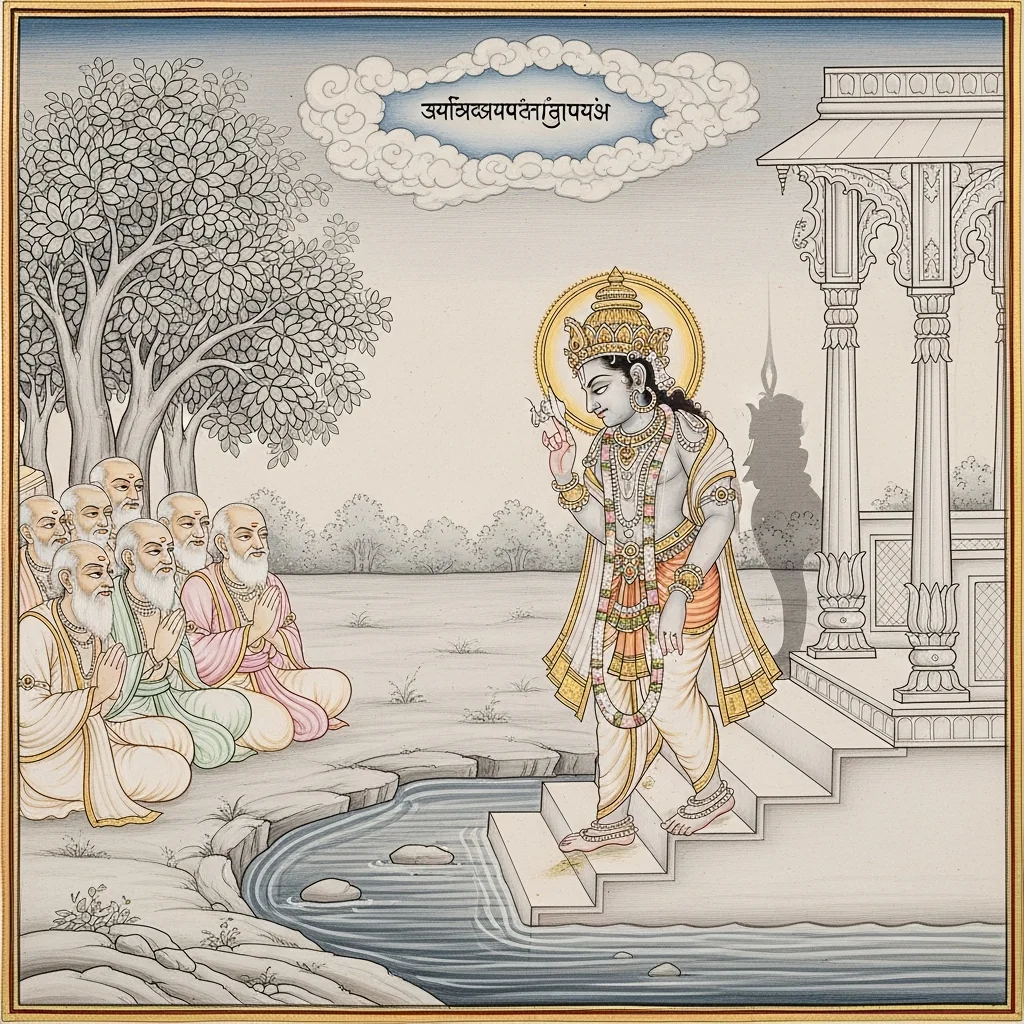
Adhyaya 19
श्रीलक्ष्मणतीर्थ-माहात्म्य एवं बलभद्र-ब्रह्महत्या-शोधन (Lakṣmaṇa-tīrtha Māhātmya and Balabhadra’s Expiation Narrative)
The chapter opens with Sūta praising the ritual power of bathing at Lakṣmaṇa-tīrtha. Its waters are taught as a purifying sacred node that removes pāpa, counters poverty, and supports auspicious aims such as longevity, learning, and progeny. The shore is further sanctified by mantra-japa, said to grant śāstra-competence, and by Lakṣmaṇa’s installation of the great liṅga Lakṣmaṇeśvara, establishing a unified water-and-liṅga holy complex. The sages then ask how Balabhadra incurred brahmahatyā and how it was resolved. Sūta recounts that Balabhadra remained neutral in the Kurukṣetra war under the pretext of pilgrimage, visited many tīrthas, and reached Naimiṣāraṇya. There he grew angry at a Sūta seated on a high seat who neither rose nor offered salutations, and he slew him with a blade of kuśa; the sages declare this a grave brahma-vadha and enjoin prāyaścitta for the sake of lokasaṅgraha. At the sages’ request Balabhadra kills the disruptive demon Balvala who defiles their sacrifice, and then undertakes a year-long tīrtha observance. Yet a dark shadow—personified impurity—continues to follow him, and a voice says the sin is not fully removed. Returning to the sages, he is directed to Gandhamādana at Rāma-setu: by bathing in Lakṣmaṇa-tīrtha and bowing to the liṅga, he hears an embodied voice confirming complete purification. The chapter ends with a phalaśruti: reading or hearing this adhyāya with focused attention leads toward liberation, described as freedom from return (apunarbha-va).
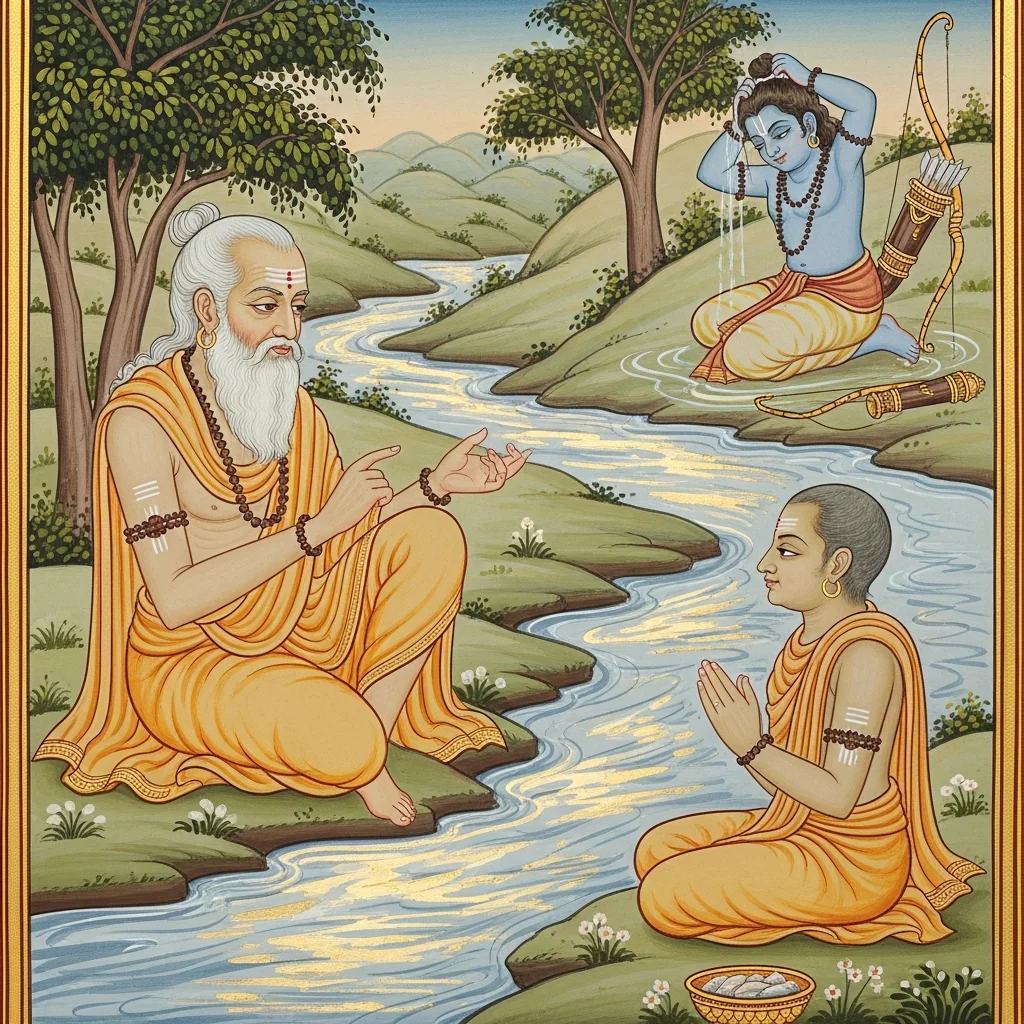
Adhyaya 20
जटातीर्थमाहात्म्य (Jatātīrtha Māhātmya: The Glory of Jatātīrtha)
This chapter is a tīrtha-māhātmya cast as instruction on inner purification and the removal of ignorance. Sūta addresses the brāhmaṇas, directing seekers from Lakṣmaṇa’s great tīrtha—praised as destroying the sin of brahmahatyā—onward to Jatātīrtha for citta-śuddhi. It censures merely verbal Vedānta—argument, disputation, and scholastic entanglement—saying that when ruled by controversy it may fail to cleanse the mind; instead, as a “light method” (laghūpāya), Jatātīrtha is extolled as a direct means to antaḥkaraṇa-śuddhi, ajñāna-nāśa, the rise of jñāna, and finally mokṣa with realization of Akhaṇḍa-saccidānanda (undivided being-consciousness-bliss). The site’s authority is grounded in origin tales: Śambhu is said to have established it for the welfare of all, and Rāma, after defeating Rāvaṇa, washed his jaṭā in its waters, giving the place its name. Statements of comparative merit claim that even a single bath here equals or surpasses famed bathing cycles. A didactic exemplum follows: Śuka asks Vyāsa for a secret method that yields mind-purification, knowledge, and final liberation; Vyāsa prescribes Jatātīrtha. Further precedents (Bhṛgu taught by Varuṇa, Durvāsā, Dattātreya) reinforce that bathing alone—without yajña, japa, fasting, or complex observances—brings buddhi-śuddhi. The chapter ends with an expansive phalaśruti: reading or hearing this adhyāya cleanses sins and grants a Vaiṣṇava destination or state.
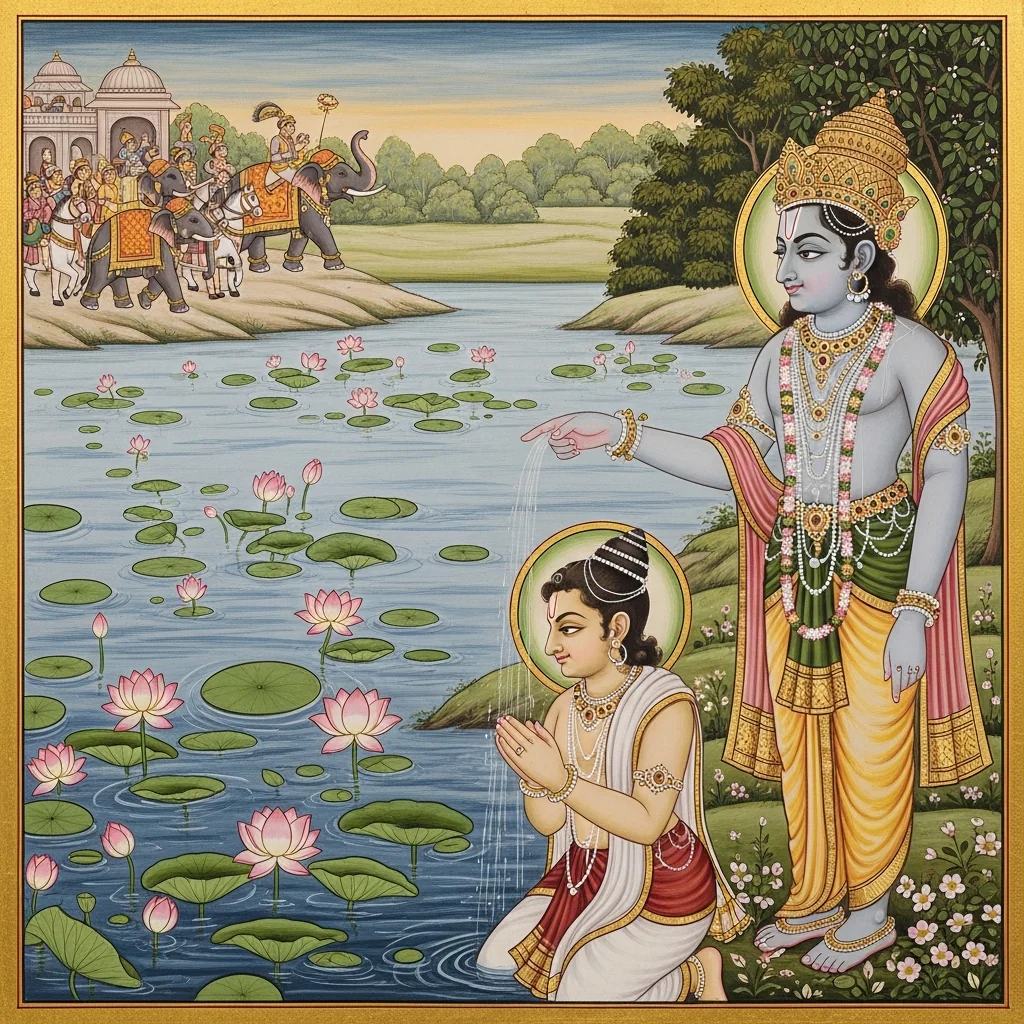
Adhyaya 21
लक्ष्मीतीर्थमाहात्म्य (Laxmī-tīrtha Māhātmya) — The Glory of Lakṣmī Tīrtha
This chapter, narrated by Sūta to the sages, maps a sequence of tīrthas and especially glorifies Lakṣmī-tīrtha as a model place of purification and prosperity. It opens with the rule of ritual approach: after bathing at Jaṭā-tīrtha, praised as sin-destroying, the cleansed pilgrim proceeds to Lakṣmī-tīrtha, where bathing with a rightly formed intention is said to accomplish one’s desired aims. An epic exemplum is then given. Yudhiṣṭhira (Dharmaputra) at Indraprastha asks Śrī Kṛṣṇa what dharma enables humans to gain great sovereignty and prosperity. Kṛṣṇa directs him to the Gandhamādana mountain region, naming Lakṣmī-tīrtha as a singular cause of aiśvarya: bathing there increases wealth and grain, diminishes foes, strengthens kṣātra power, removes sins, and lessens disease. Yudhiṣṭhira observes strict niyamas, bathes repeatedly for a month, and then gives substantial gifts to brāhmaṇas, becoming fit to undertake the Rājasūya. Kṛṣṇa further teaches that the Rājasūya requires prior digvijaya (conquest of the quarters) and the collection of tribute; the Pāṇḍavas accomplish this, return with vast riches, and Yudhiṣṭhira performs the sacrifice with extensive donations. The chapter concludes by attributing these results to the māhātmya of Lakṣmī-tīrtha and states the phalaśruti: reciting or hearing it destroys bad dreams, grants desired ends, brings prosperity in this life, and promises liberation at life’s end after the rightful enjoyment of worldly goods.
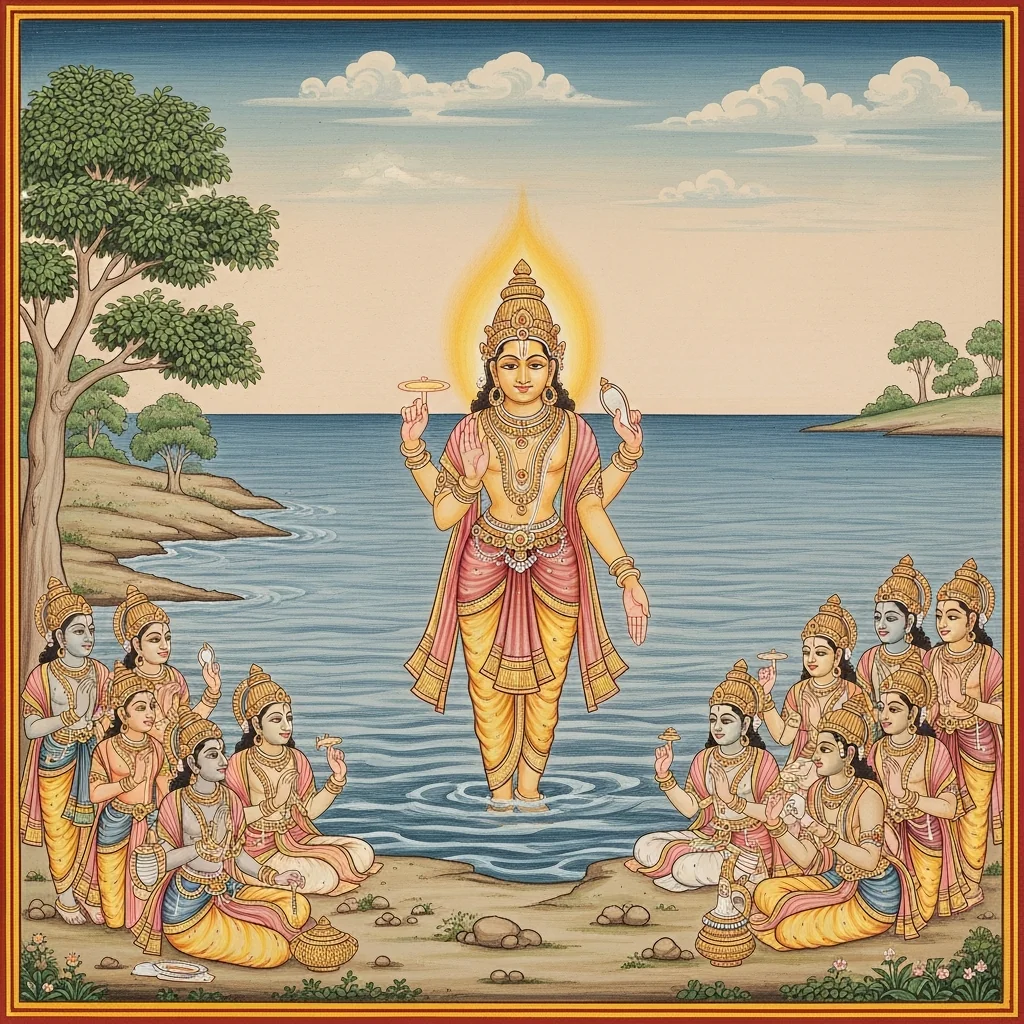
Adhyaya 22
अग्नितीर्थमहात्म्य (Agnitīrtha Māhātmya: The Glory and Origin of Agni Tīrtha)
The chapter begins with Śrī Sūta guiding pilgrims from Lakṣmītīrtha to Agnitīrtha, praising Agnitīrtha as supremely meritorious and able to destroy even grave demerit when approached with devotion. The ṛṣis ask about its origin, location, and distinctive power. Sūta recounts a Rāma episode: after defeating Rāvaṇa and installing Vibhīṣaṇa as king of Laṅkā, Rāma travels the Setu route with Sītā, Lakṣmaṇa, devas, sages, ancestors, and vānaras. At Lakṣmītīrtha, before many witnesses, Rāma invokes Agni to vindicate Sītā; Agni appears, extols her fidelity, and declares that Sītā is Viṣṇu’s perennial divine consort across all avatāras. The spot where Agni rose from the waters becomes known as Agnitīrtha. The chapter then lays down pilgrimage ethics: bathe with bhakti, fast, honor learned brāhmaṇas, and give gifts—cloth, wealth, land, and a suitably adorned maiden—promising sin-removal and attainment of Viṣṇu-sāyujya. A long exemplum follows: Duṣpaṇya, a merchant’s son, repeatedly kills children, is exiled, cursed by a sage, dies by drowning, and endures a prolonged piśāca state. Turning toward compassion and remedial sacred practice (with references to Agastya/Sutīkṣṇa seeking relief through Agnitīrtha), the narrative affirms that place-based rites purify and restore only when grounded in right conduct.
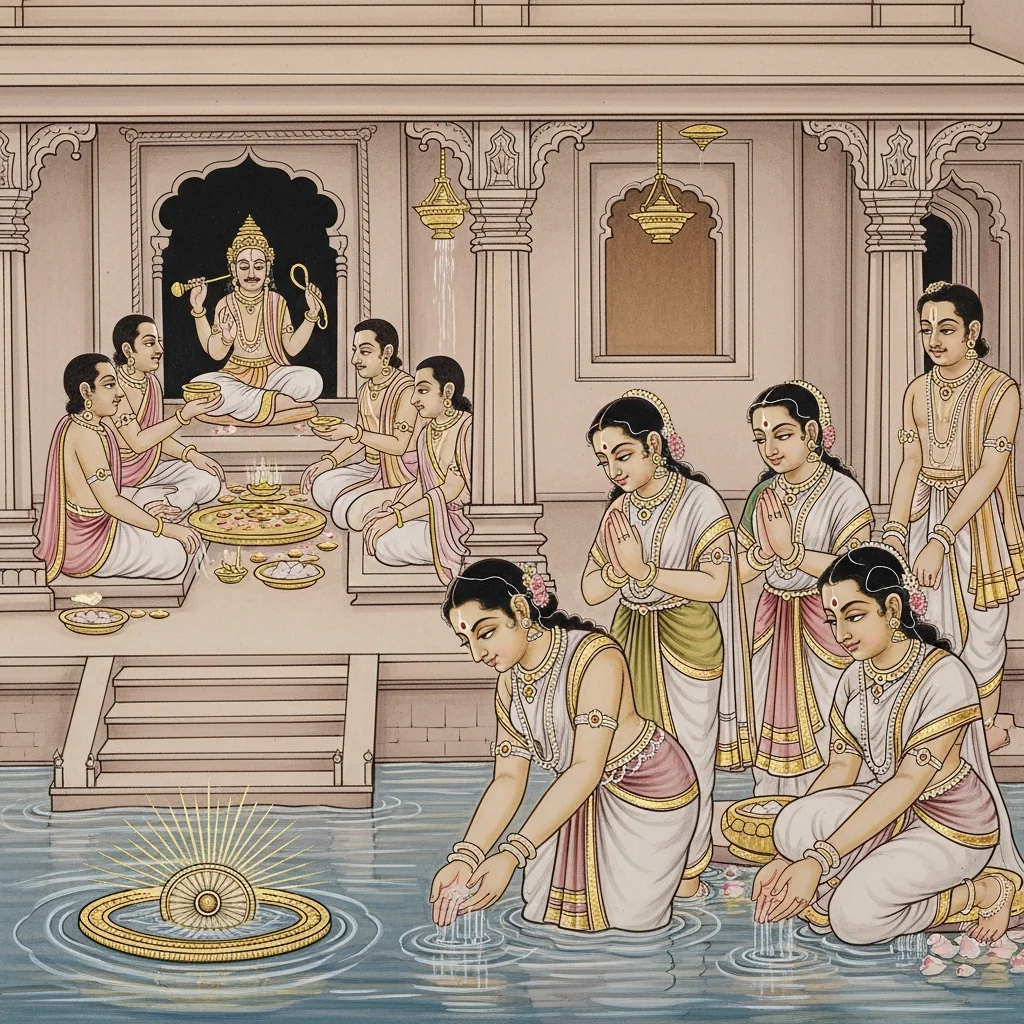
Adhyaya 23
चक्रतीर्थमाहात्म्य (Glory of Chakratīrtha): Sudarśana’s Protection and Savitṛ’s Restoration
This chapter is framed as Sūta’s guidance on a pilgrimage sequence: after bathing at Agnitīrtha, praised as the destroyer of all sins, the purified pilgrim is directed to Chakratīrtha. Bathing there with a specific intention is said to yield the corresponding desired result, establishing Chakratīrtha as a sacred place where rightful wishes are fulfilled. The tīrtha’s authority is grounded in an earlier episode: the sage Ahirbudhnya performs tapas on Gandhamādana but is harassed by fearsome rākṣasas seeking to obstruct his austerity. Sudarśana intervenes, destroys the obstructors, and is thereafter declared to abide at the tīrtha, responding to devotees’ prayers; hence the name Chakratīrtha and the assurance that harmful afflictions from such beings do not arise there. A second, more ritual-focused myth explains Savitṛ/Āditya’s epithet “chinna-pāṇi” (“severed hands”). Pressed by daityas, the devas consult Bṛhaspati and approach Brahmā, who ordains a Māheśvara Mahāyajña at Gandhamādana under Sudarśana’s protection, detailing the ṛtvij offices (hotṛ, adhvaryu, etc.). When the potent prāśitra portion is distributed, Savitṛ’s hands are severed upon contact; on Aṣṭāvakra’s advice he bathes at the local tīrtha (formerly Munitīrtha, now Chakratīrtha) and emerges with restored golden hands. The phalaśruti concludes that reading or hearing this chapter supports restoration of bodily wholeness, grants desired aims, and promises liberation to the seeker of mokṣa.
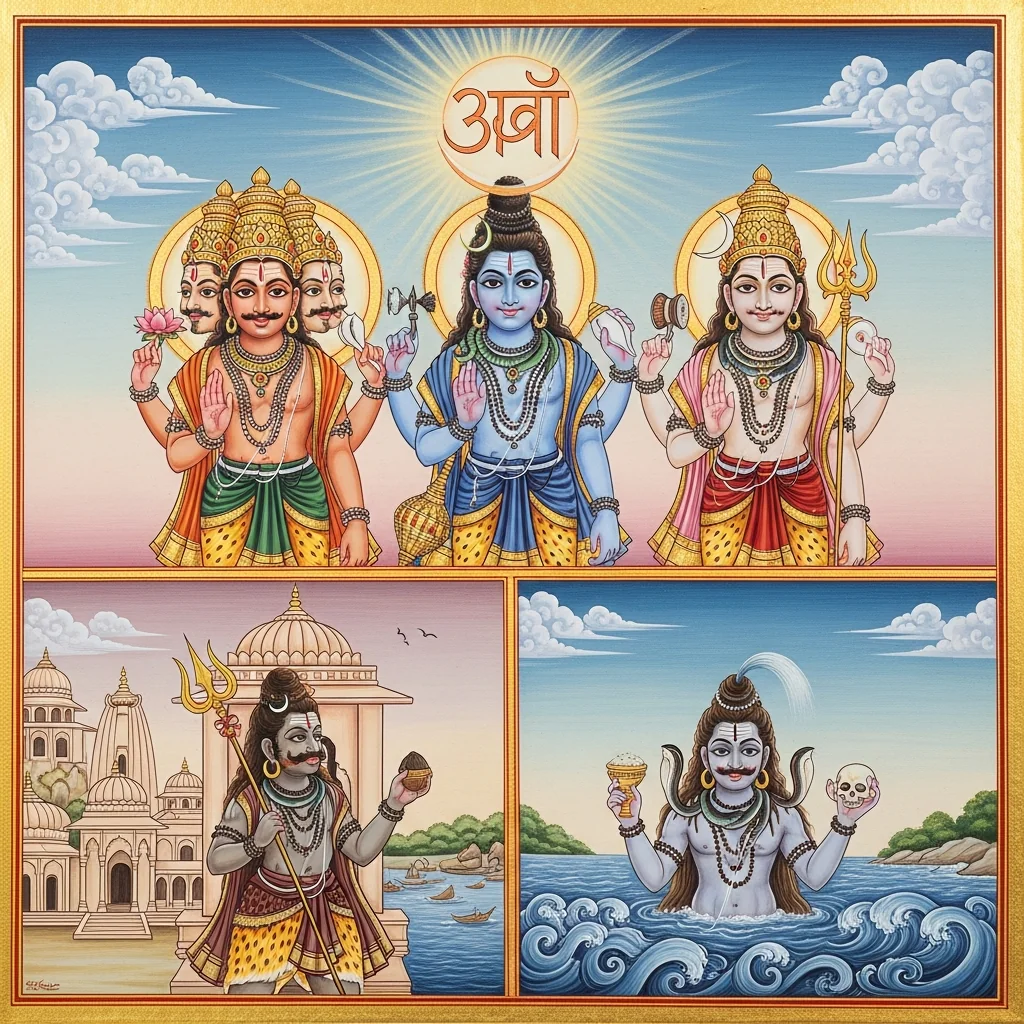
Adhyaya 24
शिवतीर्थमाहात्म्ये कालभैरवब्रह्महत्याशमनवृत्तान्तः (Śivatīrtha Māhātmya: The Kālabhairava Narrative of Brahmahatyā Pacification)
The chapter begins with a pilgrimage injunction: after bathing at Cakratīrtha, one should go to Śivatīrtha, whose immersion is praised as dissolving vast stores of grievous sin. When asked why Kālabhairava incurred the taint of brahmahatyā, Sūta recounts an earlier dispute between Brahmā and Viṣṇu over cosmic supremacy. The Vedas intervene, declaring a Lord beyond them both, and Praṇava (Oṃ) proclaims Śiva’s transcendence and his ordering of the guṇas: Brahmā for creation (rajas), Viṣṇu for protection (sattva), and Rudra for dissolution (tamas). Still deluded, Brahmā manifests a blazing fifth head; at Śiva’s command Kālabhairava severs it, and the impurity of brahmahatyā arises as a personified force that follows Bhairava. Śiva then prescribes a purificatory course: wandering as a mendicant with the skull-bowl (kapāla), entering Vārāṇasī to lessen the stain, and finally bathing at Śivatīrtha near Gandhamādana by the southern ocean to destroy what remains. After immersion Śiva confirms complete purification and instructs Bhairava to establish the skull in Kāśī, giving rise to Kapālatīrtha. The chapter ends with a phalāśruti, teaching that hearing and reciting this māhātmya brings relief from suffering and removes severe faults.
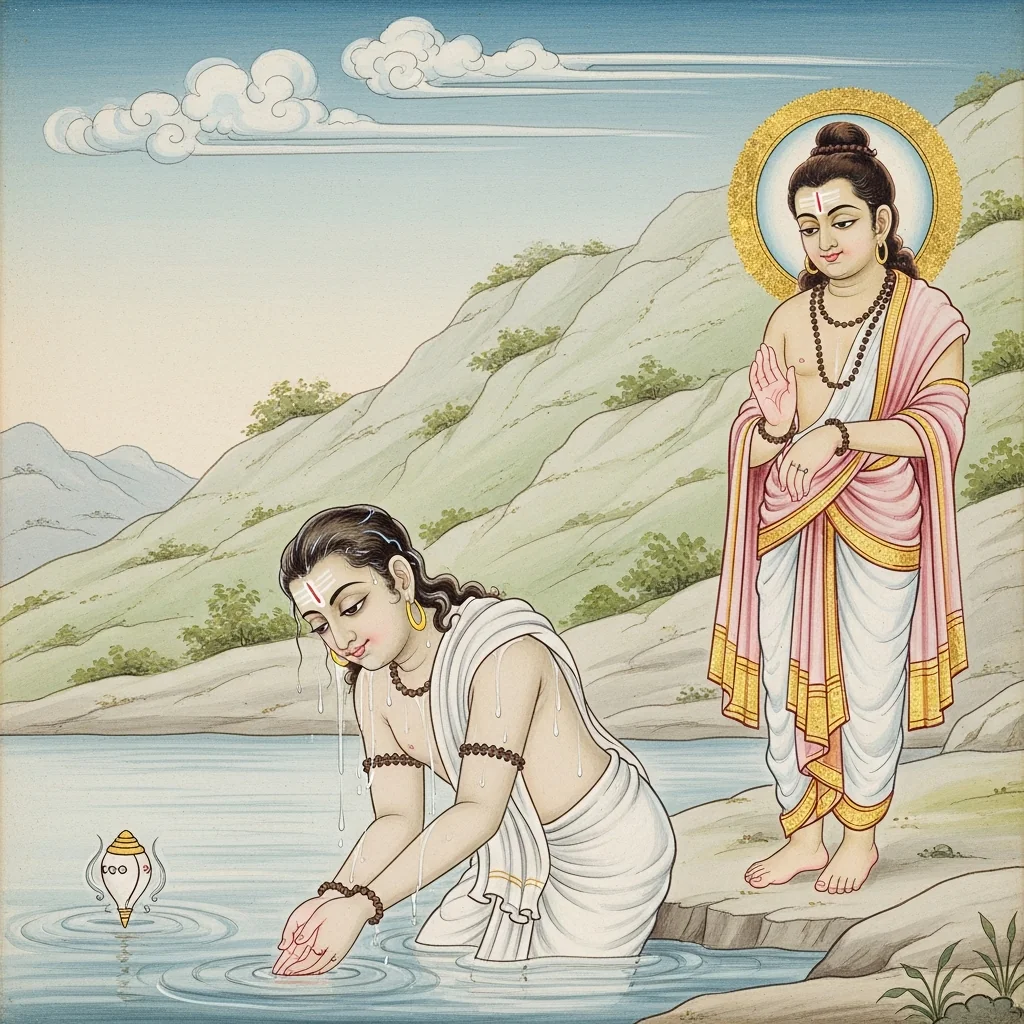
Adhyaya 25
Śaṅkhatīrtha Māhātmya (शंखतीर्थमाहात्म्य) — Purification from Kṛtaghnatā (Ingratitude)
Sūta proclaims the merit of Śaṅkhatīrtha as a place of purification: bathing (snāna) there is said to dissolve even grave moral faults, especially kṛtaghnatā (ingratitude), including offenses toward mother, father, and guru. The chapter then introduces an itihāsa: the sage Vatsanābha performs prolonged tapas with unwavering bodily stillness, until he becomes covered by an anthill (valmīka). A fierce, unceasing storm strikes the region. Personified Dharma, moved by compassion and admiration for the sage’s steadfastness, assumes the form of a great buffalo (mahiṣa) and shields Vatsanābha from the rain for seven days. When the storm ends, Vatsanābha sees the buffalo and reflects on its dharma-like conduct, yet returns to tapas; soon his mind grows unsettled. On self-inquiry he realizes the cause: he failed to honor the buffalo-savior, which he understands as kṛtaghnatā, and he even contemplates self-destruction as expiation. Dharma reveals himself, stops the act, and prescribes a non-lethal remedy: bathing at Śaṅkhatīrtha on Gandhamādana. Vatsanābha bathes, attains purity of mind, and is said to reach brahma-bhāva. The discourse closes by reaffirming the tīrtha’s efficacy and a phalaśruti: devotional recitation or hearing of this chapter supports liberation-oriented results.
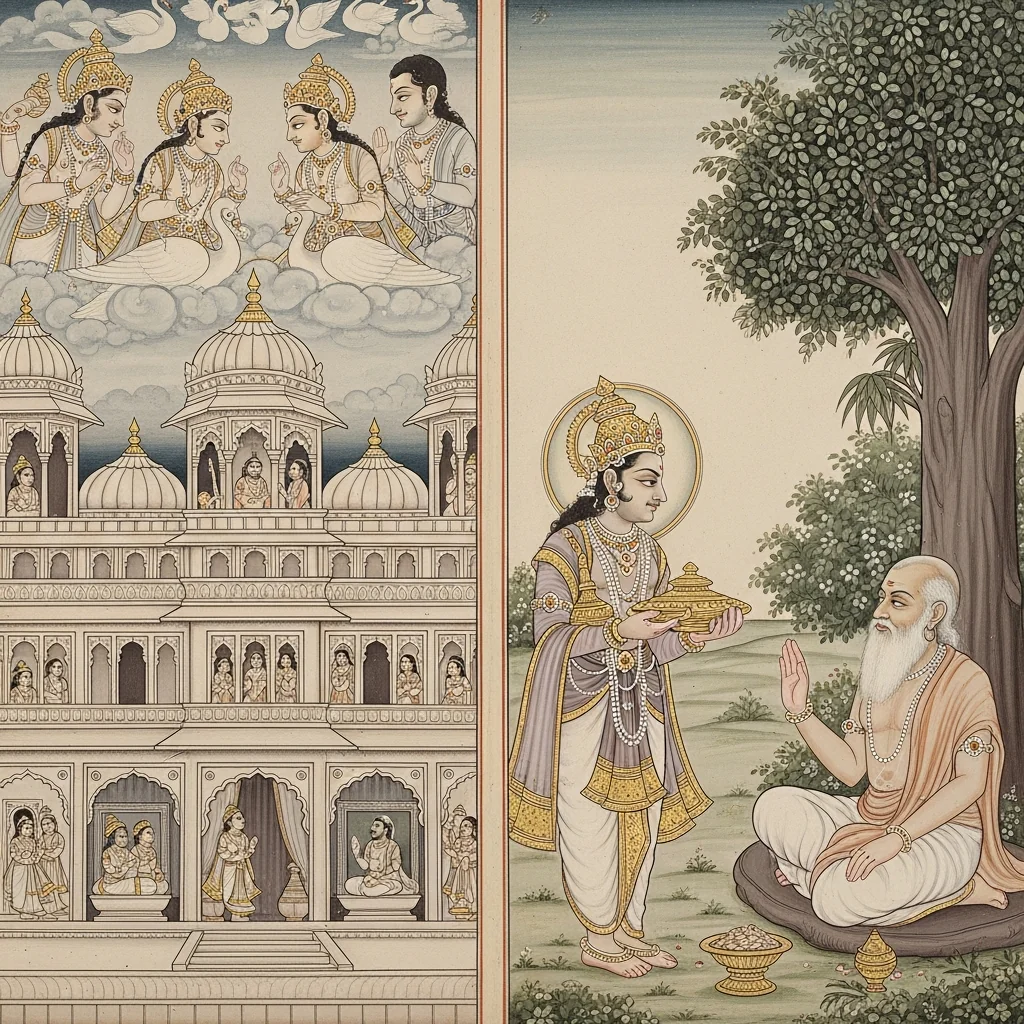
Adhyaya 26
Tīrthatraya-Āvāhana and Jñāna-Upadeśa (यमुनागङ्गागयातीर्थत्रयप्रादुर्भावः)
This adhyāya begins with Sūta outlining a sequential pilgrimage: after performing rites at Śaṅkhatīrtha, one proceeds to Yamunā, Gaṅgā, and Gayā—three celebrated tīrthas famed for removing obstacles and easing afflictions, and especially for destroying ignorance and bestowing knowledge. The ṛṣis ask how these three tīrthas came to be present at Gandhamādana, and how King Jānaśruti gained knowledge through bathing. Sūta then describes the sage Raikva (also called Sayugvāṅ), physically impaired from birth yet possessed of immense tapas. Unable to travel, he resolves to invoke the tīrthas through mantra and meditation (āvāhana). Yamunā, Gaṅgā (Jāhnavī), and Gayā rise from the subterranean realm, take human form, and are requested to remain where they emerged. Those emergence-points become Yamunātīrtha, Gaṅgātīrtha, and Gayātīrtha, where bathing is said to remove avidyā and awaken knowledge. The narrative shifts to King Jānaśruti, renowned for hospitality and generosity. Through a dialogue of celestial sages in the form of geese, his merit is contrasted with Raikva’s superior brahmajñāna. Troubled, the king seeks Raikva, offers wealth, and asks for instruction; Raikva rejects material valuation. The chapter culminates in the teaching that dispassion toward saṃsāra and toward merit/demerit is prerequisite for non-dual knowledge, the decisive dispeller of ignorance leading toward brahmabhāva.
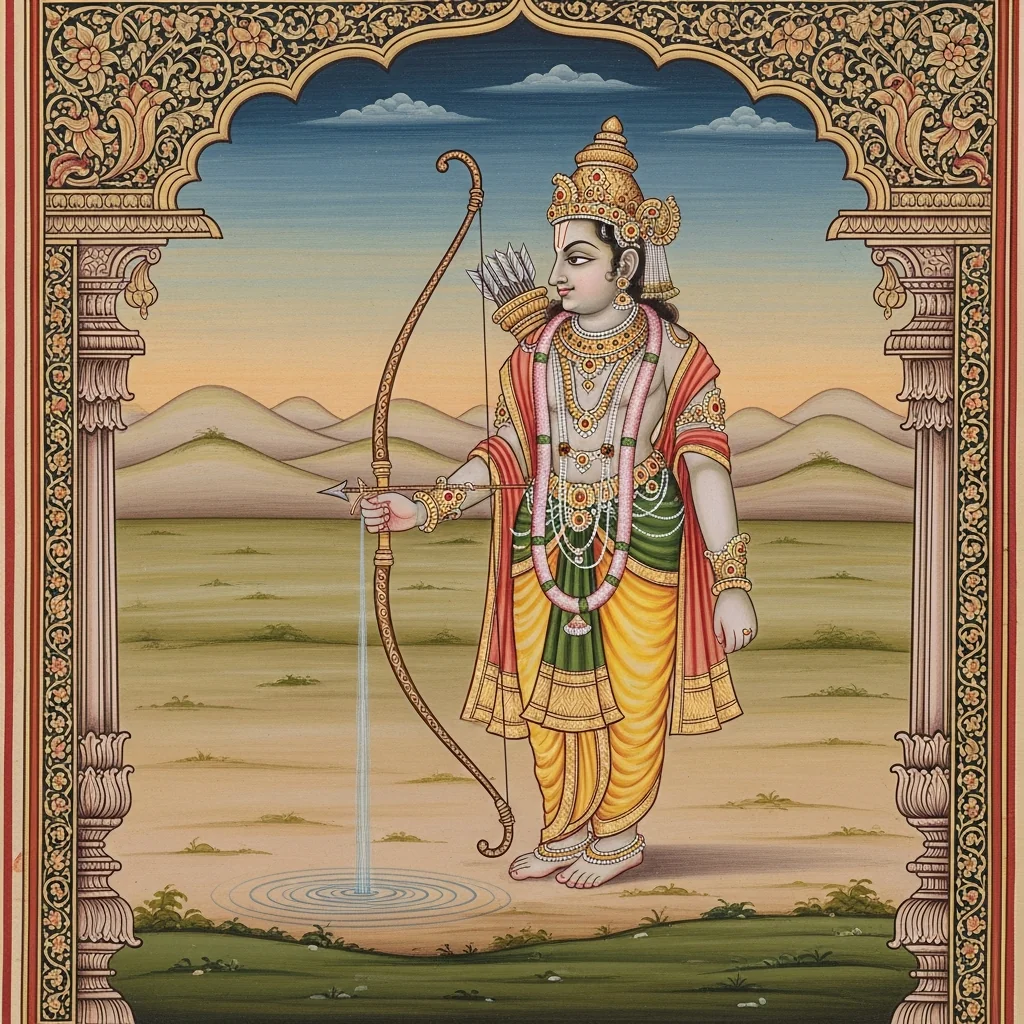
Adhyaya 27
Kotitīrtha-māhātmya and Pilgrimage Ethics (कोटितीर्थमाहात्म्य तथा तीर्थयात्रानैतिकता)
Chapter 27, narrated by Sūta to the ṛṣis, lays out a ranked itinerary of tīrthas and explains the doctrinal logic of bathing according to one’s route. It begins by advising that a pilgrim who has properly bathed at Yamunā, Gaṅgā, and Gayā should proceed to the supremely meritorious Kotitīrtha—celebrated as world-renowned, prosperity-giving, purity-producing, sin-destroying, and capable of relieving bad dreams and major obstacles. The chapter then gives the site’s origin: after Rāvaṇa’s death, Rāma seeks release from brahmahatyā and installs the liṅga called Rāmanātha on Gandhamādana. Lacking suitable water for abhiṣeka, he remembers Jāhnavī (Gaṅgā) and pierces the earth with the “koṭi” (tip) of his bow, whereupon Gaṅgā springs forth; hence the name Kotitīrtha. Bathing here is praised as the culminating purifier, dissolving even demerit accumulated across many births. When the ṛṣis ask why other tīrthas are needed if Kotitīrtha suffices, Sūta teaches pilgrimage ethics: to bypass tīrthas and temples encountered en route incurs tīrthātikrama-doṣa (the fault of passing over a sacred place), so intermediate baths are obligatory, while Kotitīrtha removes the final residue. Examples conclude the teaching: Rāma is freed from brahmahatyā and returns to Ayodhyā; Kṛṣṇa, advised by Nārada for loka-śikṣā, bathes at Kotitīrtha to neutralize the socially framed doṣa of killing his maternal uncle Kaṃsa, then returns to Mathurā. The phala-śruti declares that hearing or reciting this chapter frees one from brahmahatyā and related sins.
Adhyaya 28
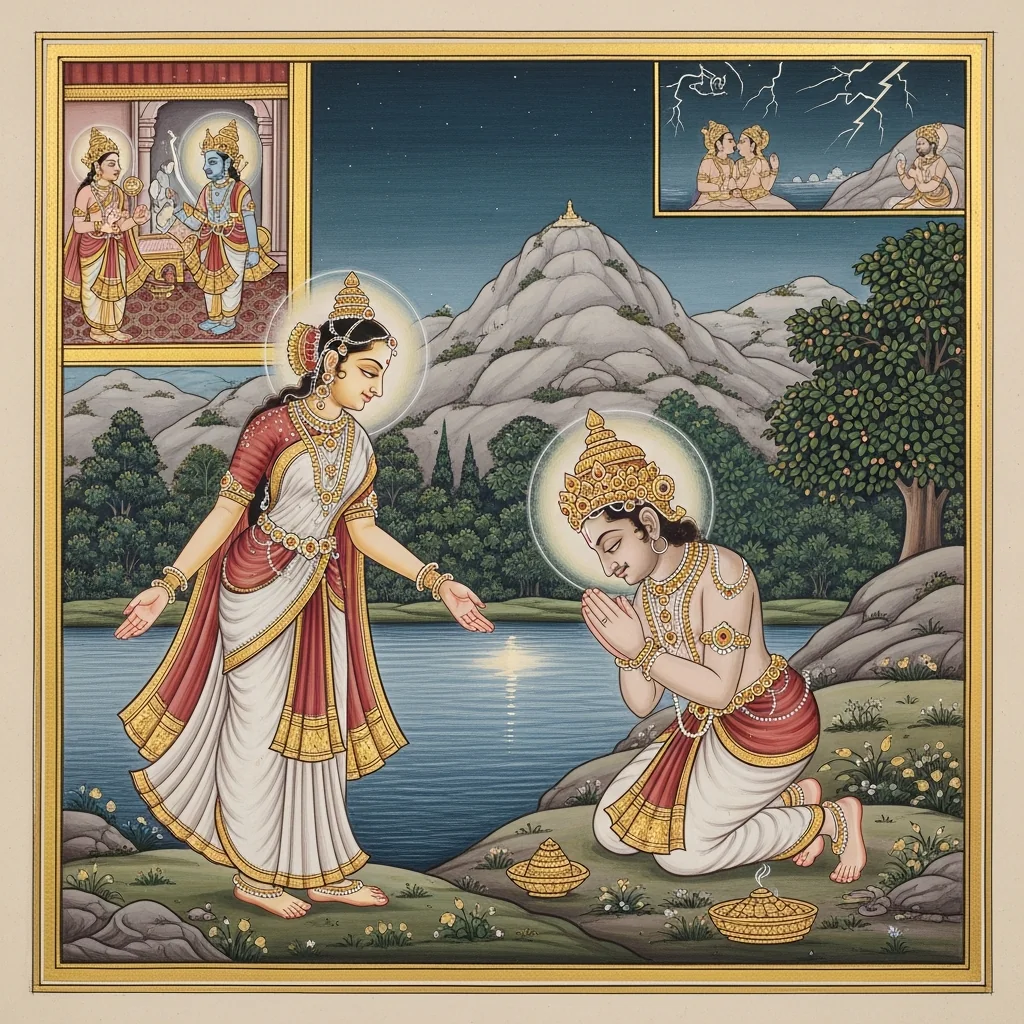
साध्यामृततीर्थमाहात्म्यं तथा पुरूरवोर्वशी-वियोगशापमोक्षणम् (The Glory of Sādhyāmṛta Tīrtha and the Curse-Release of Purūravas and Urvaśī)
The chapter begins with Sūta describing Koṭitīrtha and then turning to Sādhyāmṛta, a great tīrtha on Gandhamādana, praised as uniquely powerful for ritual bathing. A series of phala statements declares that bathing at Sādhyāmṛta surpasses austerities, celibacy, sacrifice, and charity in purifying and granting higher destinies: mere contact with its waters destroys embodied sin at once. Penitential bathers are honored in Viṣṇuloka, and even those burdened by heavy karma are said to avoid dreadful hell-realms. The discourse then offers an exemplum: King Purūravas and the apsaras Urvaśī live together under conditions (no seeing of nudity, no eating of food remnants, and protection of two lambs). The Gandharvas contrive a breach; a flash of lightning reveals the king unclothed, and Urvaśī departs. Later, in Indra’s court, both laugh during Urvaśī’s dance, and Tumburu curses them with immediate separation. Purūravas appeals to Indra, who prescribes pilgrimage to Sādhyāmṛta—served by gods, siddhas, and yogic sages—and explicitly extols it as granting both bhukti and mukti and removing curses. Purūravas bathes there, is freed from the curse, reunites with Urvaśī, and returns to Amarāvatī. The chapter closes with a phalaśruti: bathing there yields desired aims and heaven; bathing without desire yields mokṣa; and reciting or hearing this chapter grants a destiny oriented toward Vaikuṇṭha.
Adhyaya 29
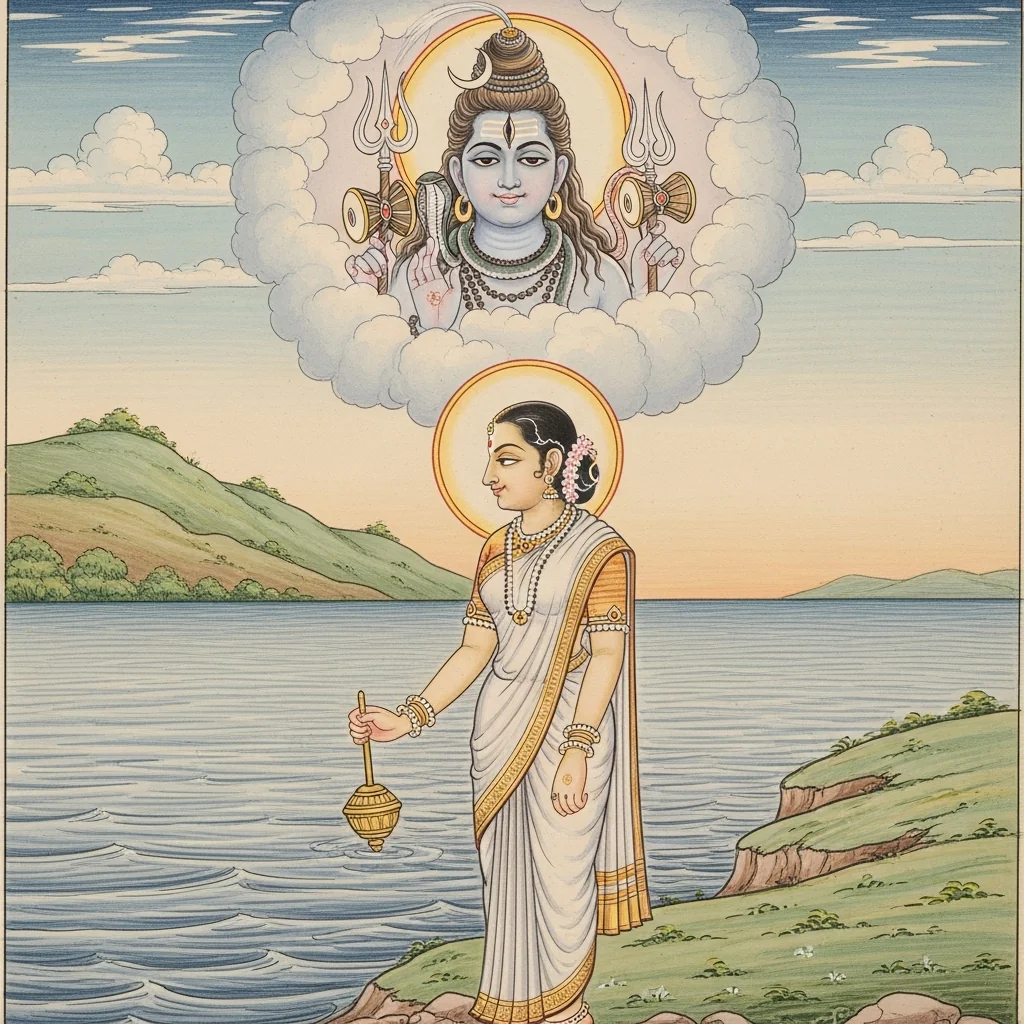
Sarvatīrtha-Māhātmya (मानसतीर्थ / सर्वतीर्थ माहात्म्य) — The Glory of the ‘All-Tīrthas’ Bath
The chapter begins with Sūta outlining a purificatory sequence: a disciplined pilgrim, after bathing at a prior liberative site, proceeds to Sarvatīrtha, praised as supremely meritorious and able to destroy even grave sins. Moral impurities are said to tremble before one who bathes there, and the text declares that fruits normally gained through long Vedic recitation, great sacrifices, deity worship, sacred fasts, and mantra-japa may be obtained here by a single immersion. When the ṛṣis ask how the place came to be called “Sarvatīrtha,” Sūta recounts the story of Sucaritā, an ascetic of the Bhṛgu lineage—blind, aged, and unable to undertake a pan-Indian pilgrimage. Seeking an equivalent means, he performs severe Śaiva austerities at Gandhamādana near the southern ocean, maintaining tri-kāla worship, honoring guests, seasonal penances, ash-marking, rudrākṣa practice, and steady ascetic discipline. Pleased, Śiva appears, restores his sight, and invites him to ask a boon. Sucaritā requests the fruit of bathing in all tīrthas without traveling; Śiva proclaims he will summon all tīrthas into that very place—purified by Rāma’s Setu—thus establishing it as Sarvatīrtha, also called a Mānasa Tīrtha that grants both worldly aims and liberation. Sucaritā bathes and is instantly rejuvenated, is told to dwell there, bathe regularly while remembering Śiva, and avoid distant pilgrimages; at life’s end he attains Śiva. The phalaśruti concludes that reading or hearing this account frees one from sins.
Adhyaya 30
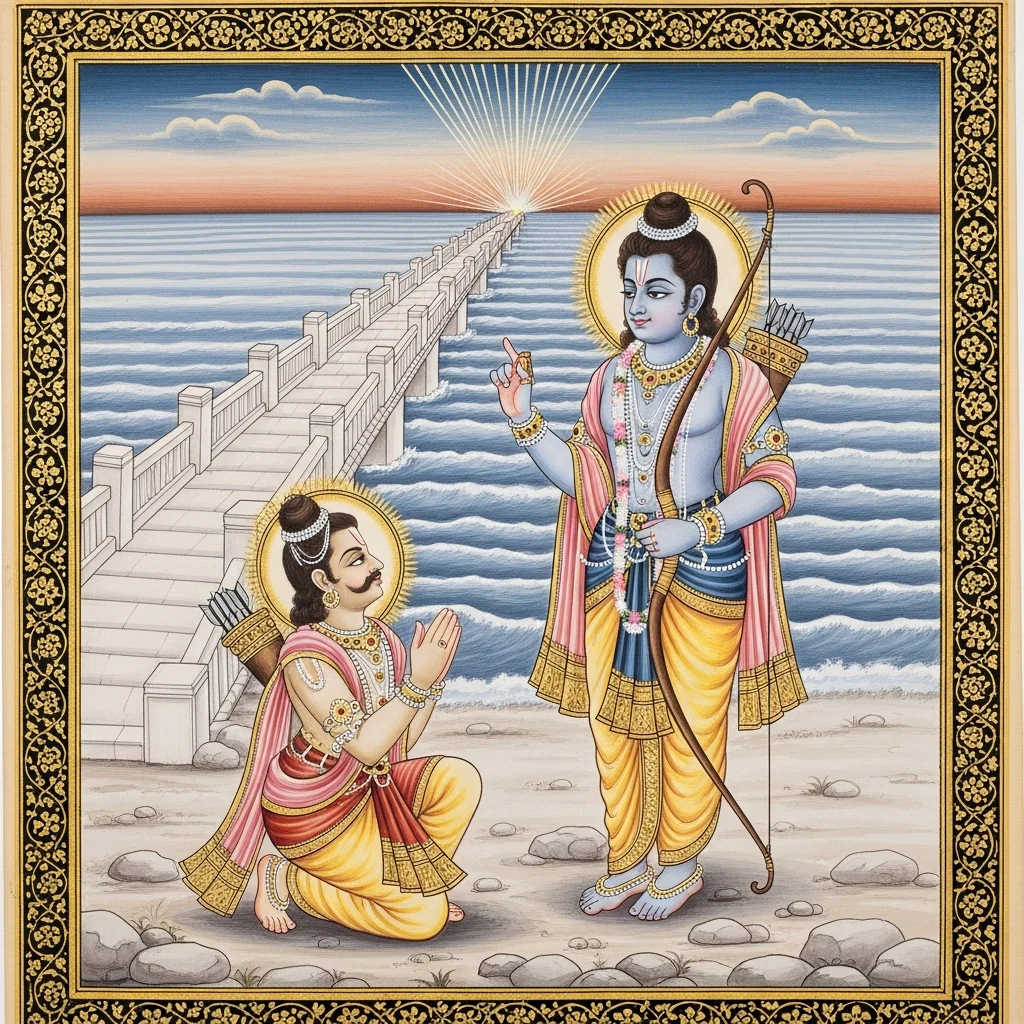
धनुष्कोटि-तीर्थमाहात्म्य (Dhanuskoṭi Tīrtha-Māhātmya)
This chapter is a tīrtha-māhātmya on Dhanuskoṭi, narrated by Sūta to the assembly at Naimiṣa. It first proclaims that disciplined bathing and proper observance at Dhanuskoṭi purify even grave sins. It then lists the standard twenty-eight narakas (hell-realms), declaring that those who bathe there—or even connect with the place through remembrance, narration, or praise—avoid these punitive destinations. A sequence of moral exempla follows: harmful deeds such as theft, betrayal, violence, dharma-opposed conduct, sexual transgression, abuse of authority, and disruption of ritual norms are each paired with corresponding narakas, repeatedly countered by the refrain that Dhanuskoṭi bathing prevents such downfall. The text expands into a register of phala, equating immersion here with major gifts and great sacrifices (aśvamedha-like merit), and promising spiritual attainments such as self-knowledge and a fourfold idiom of liberation. Finally, the chapter explains the place-name: after Rāvaṇa’s defeat and Vibhīṣaṇa’s installation, Vibhīṣaṇa petitions Rāma regarding the setu; the locale becomes “Dhanuskoṭi” through a bow-related act or mark of Rāma that consecrates it. The chapter closes by placing Dhanuskoṭi within a wider Setu triad of divine sites and reaffirming it as a comprehensive purifier and bestower of both bhukti and mukti.
Adhyaya 31
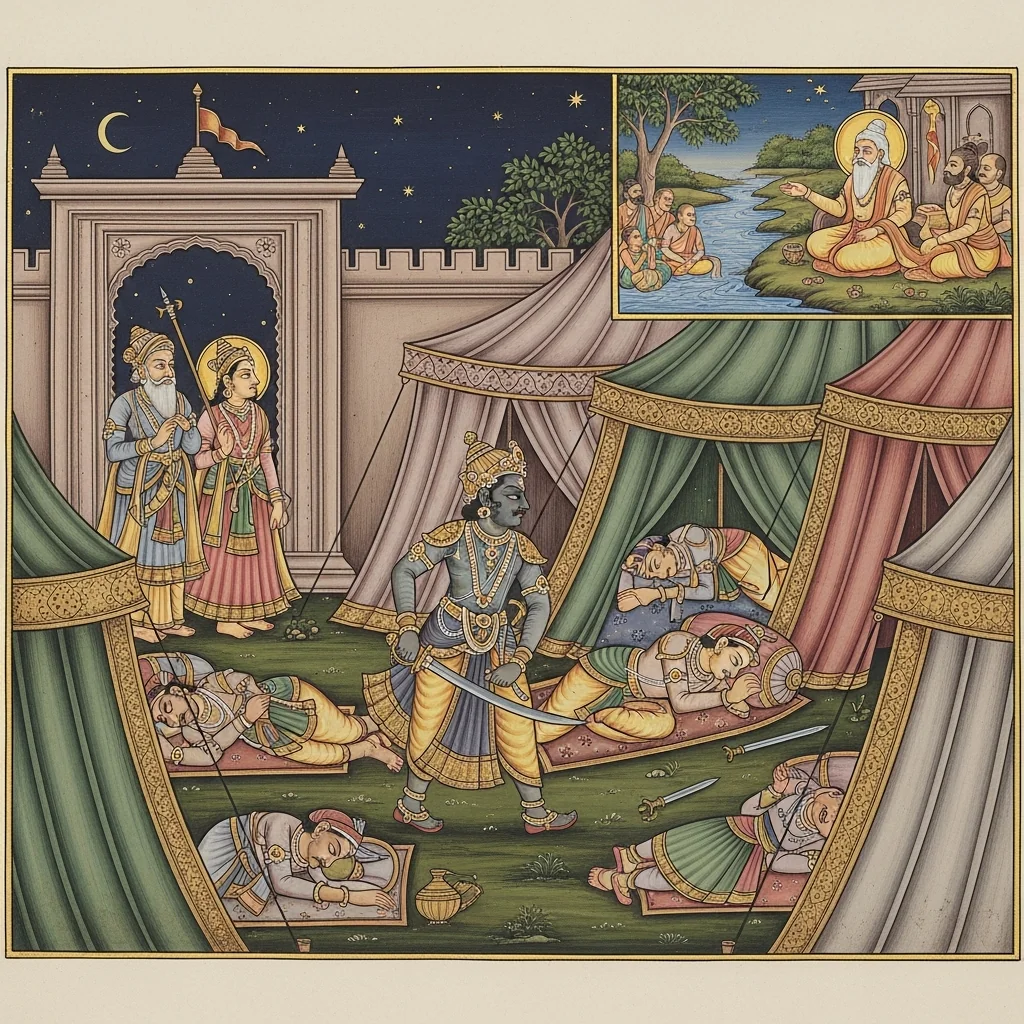
Aśvatthāmā’s Night Assault (Suptamāraṇa) and Prescribed Expiation (Prāyaścitta)
This chapter unfolds as a question-led theological discourse. The ṛṣis ask how Aśvatthāmā carried out the killing of sleepers (suptamāraṇa) and how he was freed from the demerit it produced, with reference to purification through immersion at a tīrtha, measured “to the tip of a bow.” The narrative then recounts the closing phase of the Mahābhārata war: after Duryodhana’s fall, Aśvatthāmā, Kṛpa, and Kṛtavarmā withdraw to a waterside forest. Seeing a predatory bird slay sleeping crows, Aśvatthāmā takes it as tactical instruction for a night massacre. Though Kṛpa objects on grounds of dharma, Aśvatthāmā worships Mahādeva (Śiva), receives a pure sword, and enters the sleeping camp to kill Dhṛṣṭadyumna and others, while Kṛpa and Kṛtavarmā guard the gate. Ascetics later condemn him for this grave fault. Seeking prāyaścitta (expiation), Aśvatthāmā approaches Vyāsa and is prescribed a month-long regimen of continuous bathing (snāna) to cleanse the suptamāraṇa-doṣa. The chapter ends with a phalāśruti: attentive recitation or hearing removes sins and grants honor in Śiva’s world.
Adhyaya 32
धनुष्कोटि-माहात्म्य (Dhanuṣkoṭi Māhātmya: The Glory of Dhanuṣkoṭi)
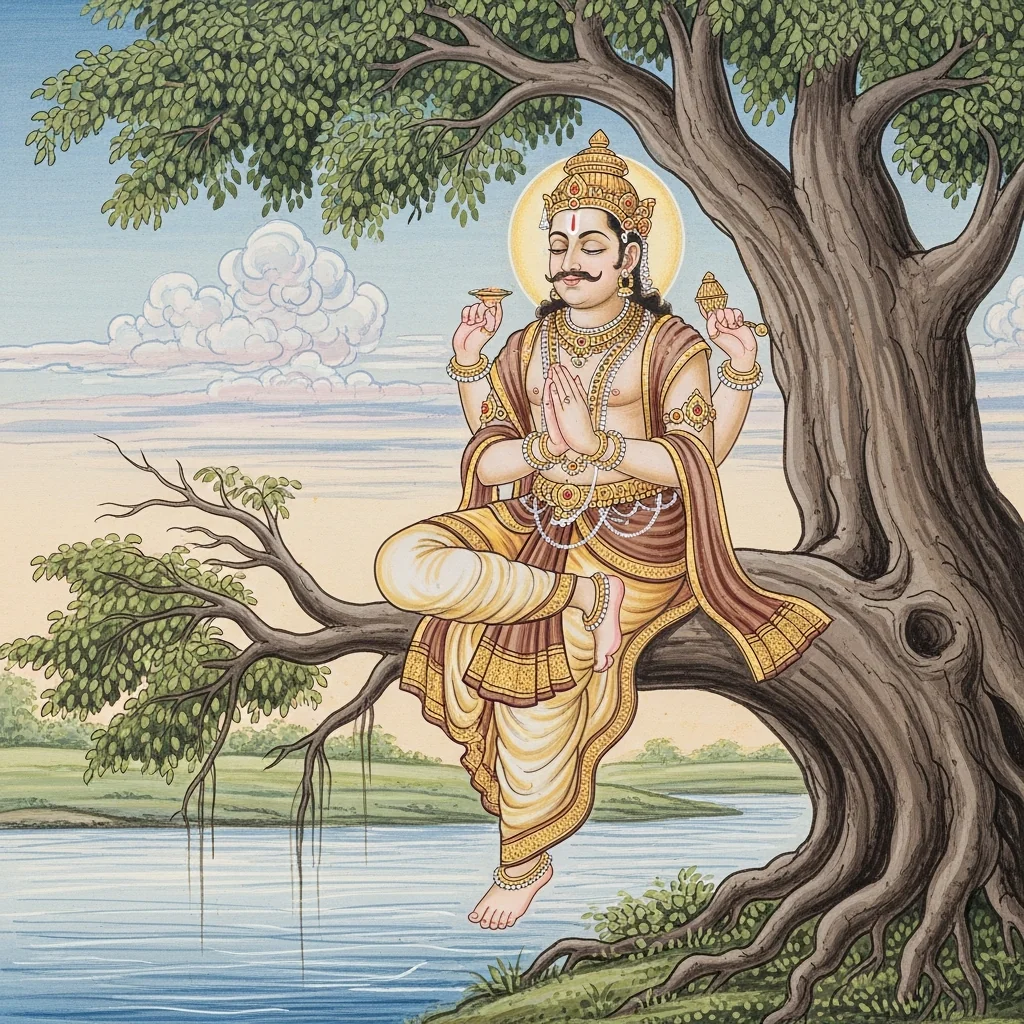
Sūta addresses the sages of Naimiṣāraṇya and proclaims the vaibhava (glory) of Dhanuṣkoṭi. King Nanda of the Soma-vaṃśa entrusts the realm to his son Dharmagupta and retires to an ascetic forest. Dharmagupta rules by dharma, performs many sacrifices, and supports the Brāhmaṇas; the land is portrayed as orderly and undisturbed. While hunting in a perilous forest, night falls; the king performs the evening observance and recites the Gāyatrī. A bear (ṛkṣa) fleeing a lion climbs the same tree and proposes a righteous pact of mutual protection through the night. When the bear sleeps, the lion urges betrayal, but the bear denounces viśvāsa-ghāta—betrayal of trust—as a sin heavier than others. Later the lion persuades the king to drop the sleeping bear; the bear survives by merit and reveals himself as Dhyanakāṣṭha, a sage of Bhṛgu’s lineage, in bear-form. He curses the king with madness for harming an innocent sleeper. The lion is then known to be a yakṣa, Bhadranāma, Kubera’s secretary, made a lion by Gautama’s curse; through dialogue with Dhyanakāṣṭha he is released and regains his yakṣa form. Dharmagupta, driven mad, is brought to Nanda, who consults the sage Jaimini. Jaimini prescribes bathing at Dhanuṣkoṭi on the southern ocean near Setu, a supremely purifying tīrtha that cleanses even grave impurities. Nanda takes his son there; by regulated bathing and worship of Rāmanātha (Śiva), the madness ends at once. Dharmagupta donates wealth and land and returns to righteous rule, and the text affirms the tīrtha’s power to relieve mental disturbance and affliction. The concluding phalaśruti declares that even hearing this account purifies, and that reciting “Dhanuṣkoṭi” three times before bathing yields exalted results.
Adhyaya 33
धनुष्कोटि-माहात्म्यं (Dhanuṣkoṭi Māhātmya) — Expiation through the Dhanuṣkoṭi Tīrtha
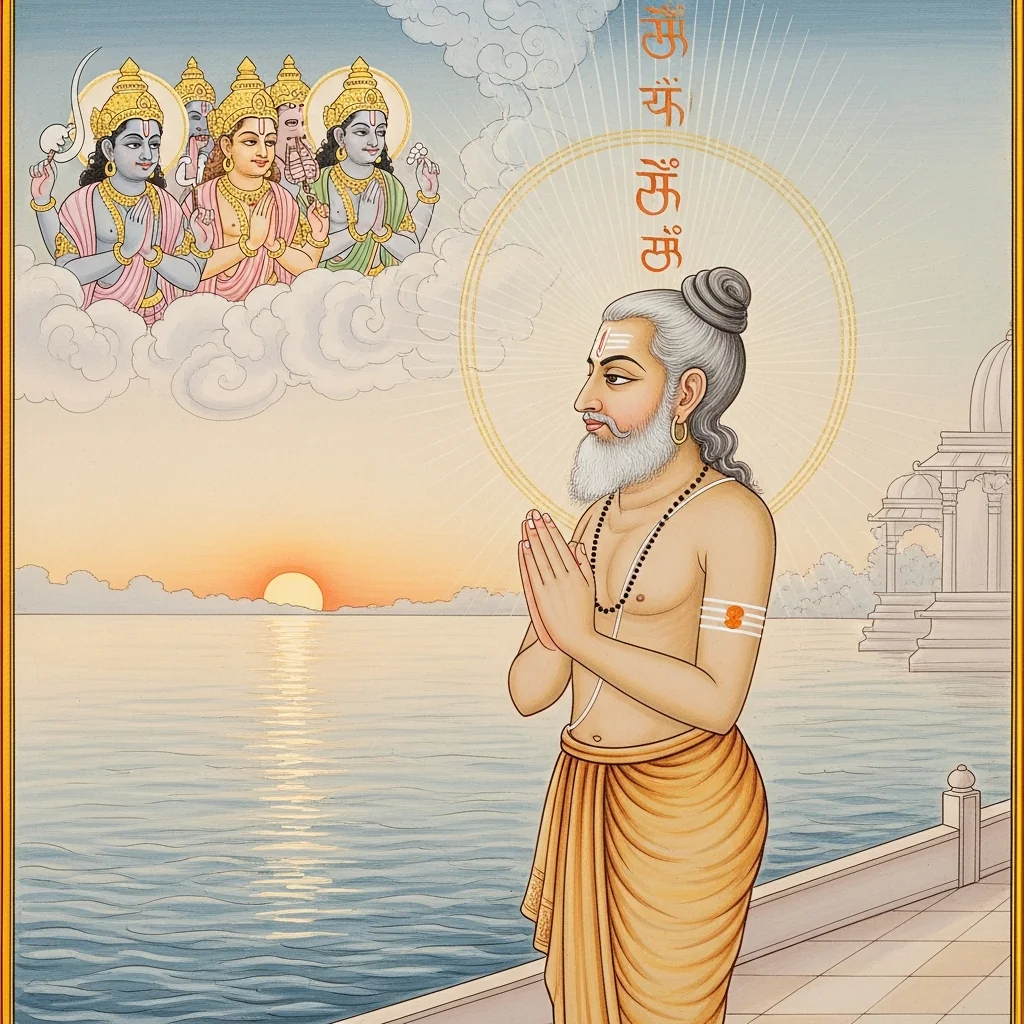
This adhyāya unfolds as a dialogue: urged by the ṛṣis, Sūta reveals the hidden and extraordinary vaibhava (glory) of Dhanuṣkoṭi Tīrtha. It tells of the brothers Arvāvasu and Parāvasu, sons of the learned ritualist Raibhya, who assist King Bṛhaddyumna’s long sattra-yajña with flawless ritual expertise. A grave crisis arises when Parāvasu returns at night and, mistaking his father in the forest for a deer, kills him unintentionally—an act framed as a catastrophic transgression in the brahmahatyā context. The brothers deliberate on responsibility and prāyaścitta (expiation): the younger Arvāvasu undertakes a prolonged vow on the elder’s behalf, while Parāvasu continues the sacrificial duties. Social and royal reactions lead to Arvāvasu’s exclusion despite his claim of innocence. He performs severe tapas and gains a divine audience, where the devas disclose a specific remedy: bathing at Dhanuṣkoṭi in the Setu-region destroys major faults, including the five great sins, and grants both worldly welfare and liberation-oriented fruit. Parāvasu bathes there with regulated intention; an incorporeal voice proclaims the grave fault destroyed, reconciliation follows, and the phalaśruti declares that reading/hearing this chapter and bathing at the site neutralizes severe afflictions.
Adhyaya 34
धनुष्कोटिप्रशंसनम् (Praise of Rāma-dhanus-koṭi) — Sṛgāla–Vānara Saṃvāda and the Expiatory Bath
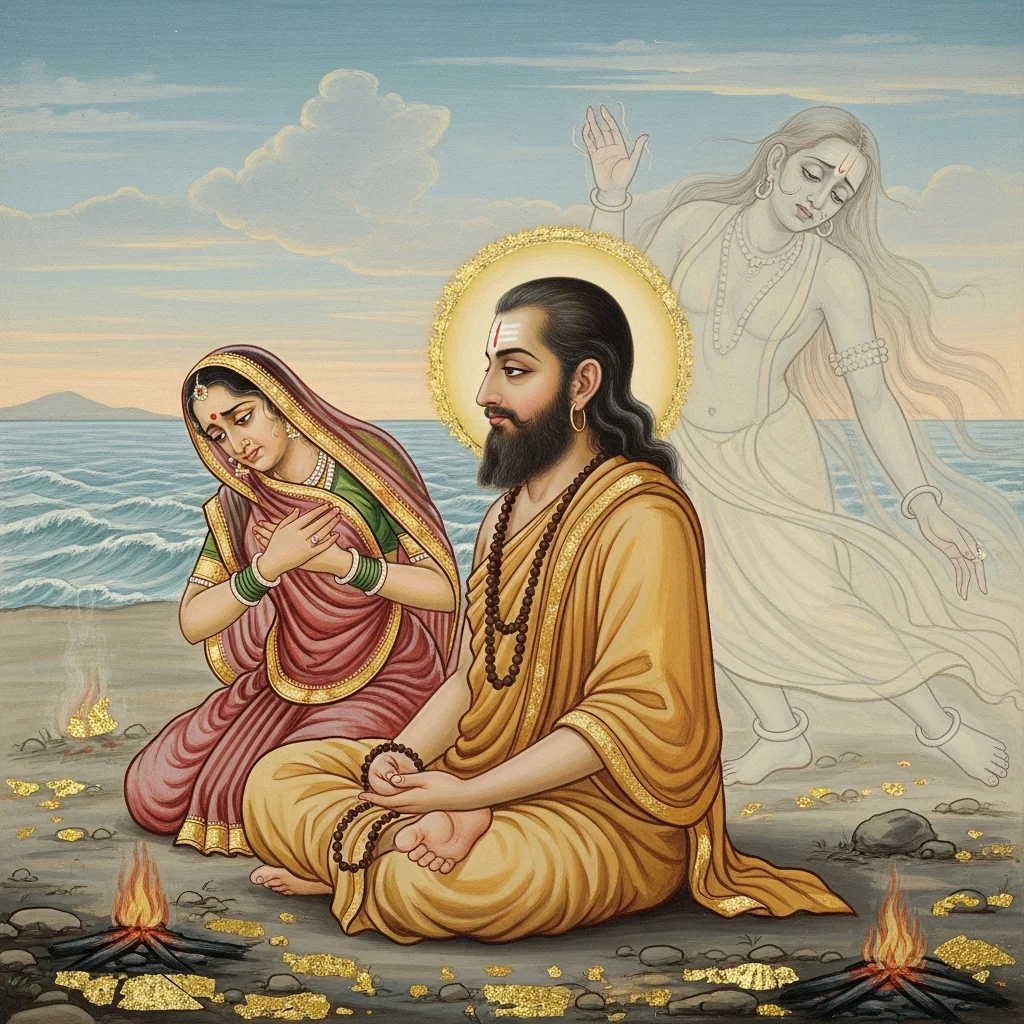
Sūta introduces this chapter as an itihāsa in praise of Dhanuṣkoṭi (Rāma-dhanus-koṭi). A jackal (sṛgāla) and a monkey (vānara), both jāti-smara who remember former births and were once human friends, meet in a cremation-ground. Questioned about his wretched state, the jackal explains that he was formerly the learned brāhmaṇa Vedaśarman, but by failing to give a promised gift to a brāhmaṇa (pratiśrutya-apradāna) he lost his accumulated merit and fell into jackal birth, with stern warnings about broken promises. The monkey then confesses his own cause: as the brāhmaṇa Vedanātha he stole vegetables from a brāhmaṇa’s house. The text stresses brahmasva-haraṇa—stealing brāhmaṇa property—as an exceptionally grave sin, leading through hell to animal rebirth. Seeking release, they approach the ash-smeared sage Sindhudvīpa, marked with tripuṇḍra and rudrākṣa, who confirms their past identities and prescribes expiation by bathing at Rāma-dhanus-koṭi in the southern ocean for purification. To establish the tīrtha’s power, Sindhudvīpa narrates the fall of Sumati, son of the brāhmaṇa Yajñadeva, into evil company, theft, intoxication, and even brahmahatyā, pursued by a personified Brahmahatyā. The episode culminates with Durvāsas declaring that a bath at Śrī Rāma-dhanuṣ-koṭi grants swift deliverance even from such terrible sins. Thus the chapter weaves ethical causality, the authority of sages, and tīrtha-based expiation into a single sacred instruction.
Adhyaya 35
धनुष्कोटिस्नानमाहात्म्यं — The Māhātmya of Bathing at Dhanuṣkoṭi
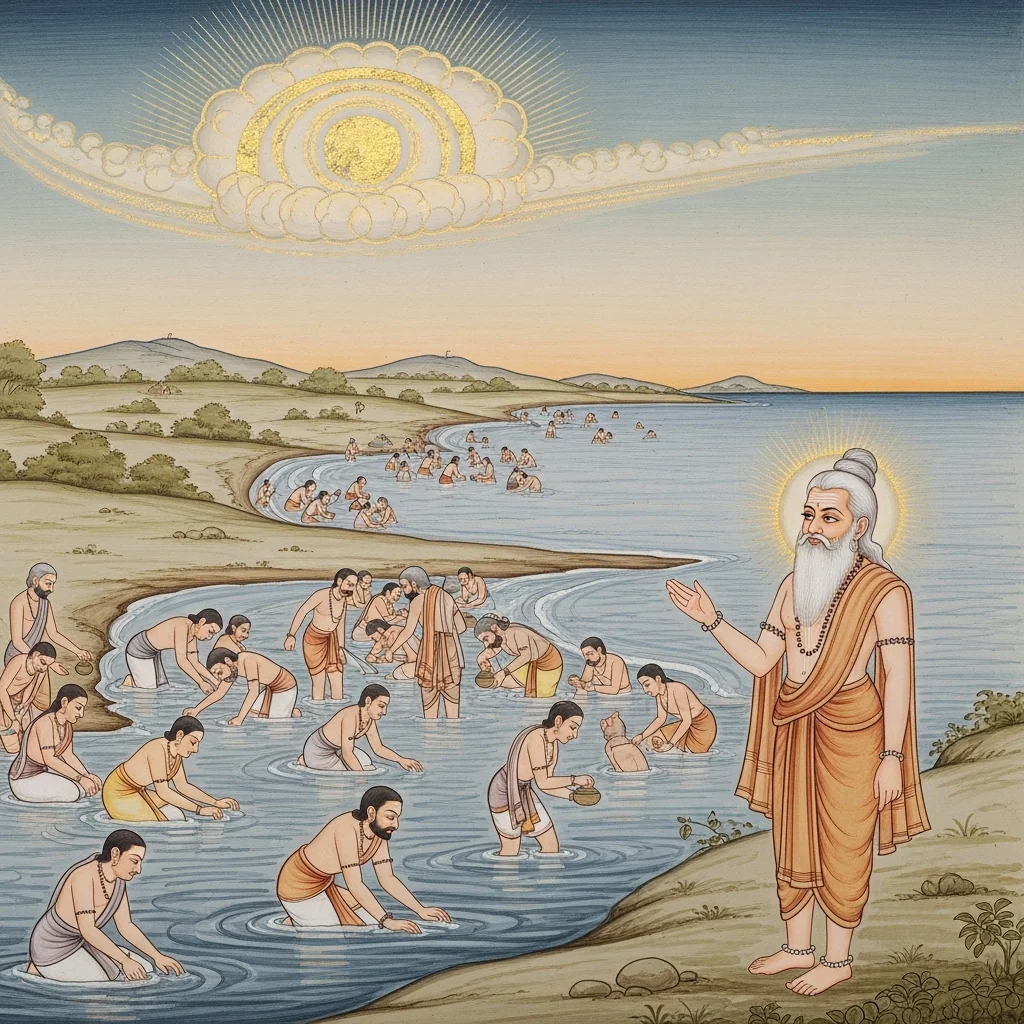
This chapter unfolds as a multi-voiced theological discourse on prāyaścitta—expiation through tīrtha practice. Yajñadeva asks Durvāsā about the brāhmin Durvinīta, who, deluded by desire, violated the sacred boundary owed to his mother and thereby incurred a grievous sin; later he is seized by remorse and seeks the counsel of sages. Durvāsā recounts his origins in the Pāṇḍya country, his famine-driven migration to Gokarṇa, his moral fall, and his turn toward penitence. Though some sages reject him, Vyāsa intervenes and prescribes a regimen bound to place and time: travel with his mother to Rāma-setu/Dhanuṣkoṭi, observe Māgha when the sun is in Makara, practice self-restraint, avoid harm and hostility, and undertake continuous bathing with fasting for a full month. The narrative declares purification for both son and mother, after which Vyāsa gives extended guidance for re-entering gṛhastha life—ahimsa, daily rites (sandhyā, nitya-karma), control of the senses, honoring guests and elders, study of śāstra, devotion to Śiva and Viṣṇu, mantra-japa, charity, and ritual cleanliness. A further frame follows: Sindhudvīpa tells how Yajñadeva brings his son to Dhanuṣkoṭi for release from brahmahatyā and other sins, and an incorporeal voice (aśarīriṇī vāk) confirms liberation. The phalaśruti concludes that hearing or reciting this adhyāya grants the fruit of bathing at Dhanuṣkoṭi and swiftly leads toward a liberation-like state, said to be difficult even for assemblies of yogins.
Adhyaya 36
धनुष्कोटि-माहात्म्यम् (Dhanushkoti Māhātmya: Bathing Merit and Mahālaya Śrāddha)
Chapter 36 unfolds as a dialogue between Sūta and the sages, using the case of the Brahmin Durācāra to teach two connected ethical-ritual principles. First is saṅga-dharma: sustained association with mahāpātakins steadily diminishes Brahminical merit and standing, culminating in an equal share of sin through shared dwelling, eating, and sleeping. Second is tīrtha-śakti: the waters of Dhanuṣkoṭi, linked to Rāmacandra’s bow and praised as a destroyer of great sins, grant immediate release from pāpa and even break the coercive possession of a vetāla. The chapter then gives calendrical instruction for Mahālaya śrāddha in the Bhādrapada kṛṣṇa pakṣa, listing tithi-specific devotional fruits and the demerit of neglect, and urging feeding Veda-competent, well-conducted Brahmins according to one’s means. It closes with a phalaśruti that hearing and knowing Dhanuṣkoṭi’s glory aids freedom from sins and supports the path to liberation.
Adhyaya 37
Kṣīrakuṇḍa–Kṣīrasaras Māhātmya (Origin and Merit of the Milk-Tīrtha)
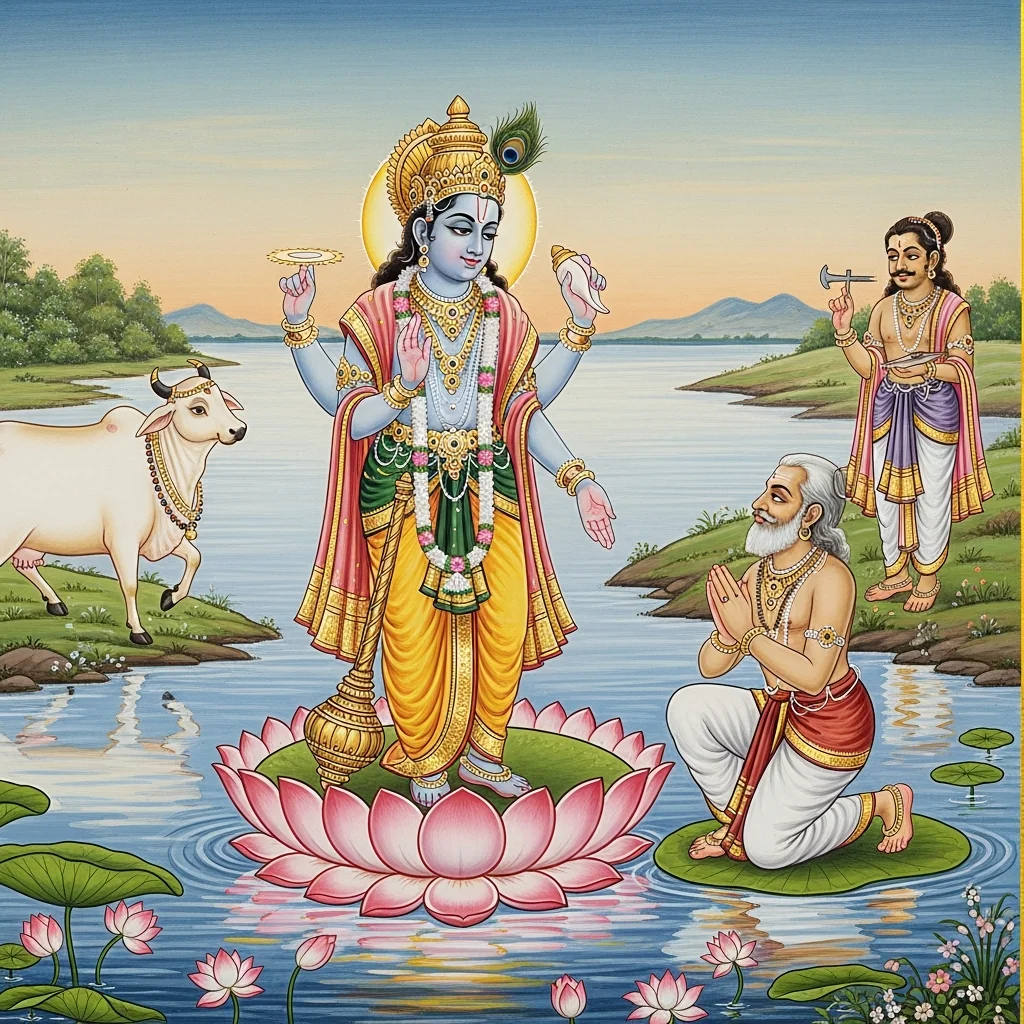
Chapter 37 unfolds as a dialogue: the assembled sages ask Sūta to explain the glory and origin of Kṣīrakuṇḍa, earlier mentioned near Cakratīrtha. Sūta places the tīrtha at Phullagrāma by the southern ocean, sanctified through its connection with Rāma’s undertaking of the Setu. It is praised as sin-destroying and liberation-bestowing through seeing it, touching it, meditating upon it, and reciting its eulogy. The narrative then tells of the sage Mudgala, who performs a Veda-approved sacrifice to please Nārāyaṇa. Viṣṇu appears in person, accepts the offerings, and grants boons. Mudgala asks chiefly for unwavering, non-deceptive devotion, and also for the ability to perform a twice-daily milk-offering (payo-homa) despite lacking resources. Viṣṇu summons Viśvakarmā to build a beautiful lake and commands Surabhī to fill it with milk each day, enabling the rite to continue without interruption. Viṣṇu declares the tīrtha will be famed as Kṣīrasaras, promises the destruction of great sins for those who bathe there, and assures Mudgala liberation at life’s end. The chapter closes with further praise of the tīrtha, an origin-note involving Kadru (wife of Kāśyapa), and a phalaśruti stating that hearing or reciting this chapter yields the merit of bathing at Kṣīrakuṇḍa.
Adhyaya 38
Kadrū–Vinatā Saṃvāda, Garuḍa-Amṛtāharaṇa, and Kṣīra-kuṇḍa Praśaṃsā (कद्रू-विनता संवादः, गरुडामृताहरणम्, क्षीरकुण्डप्रशंसा)
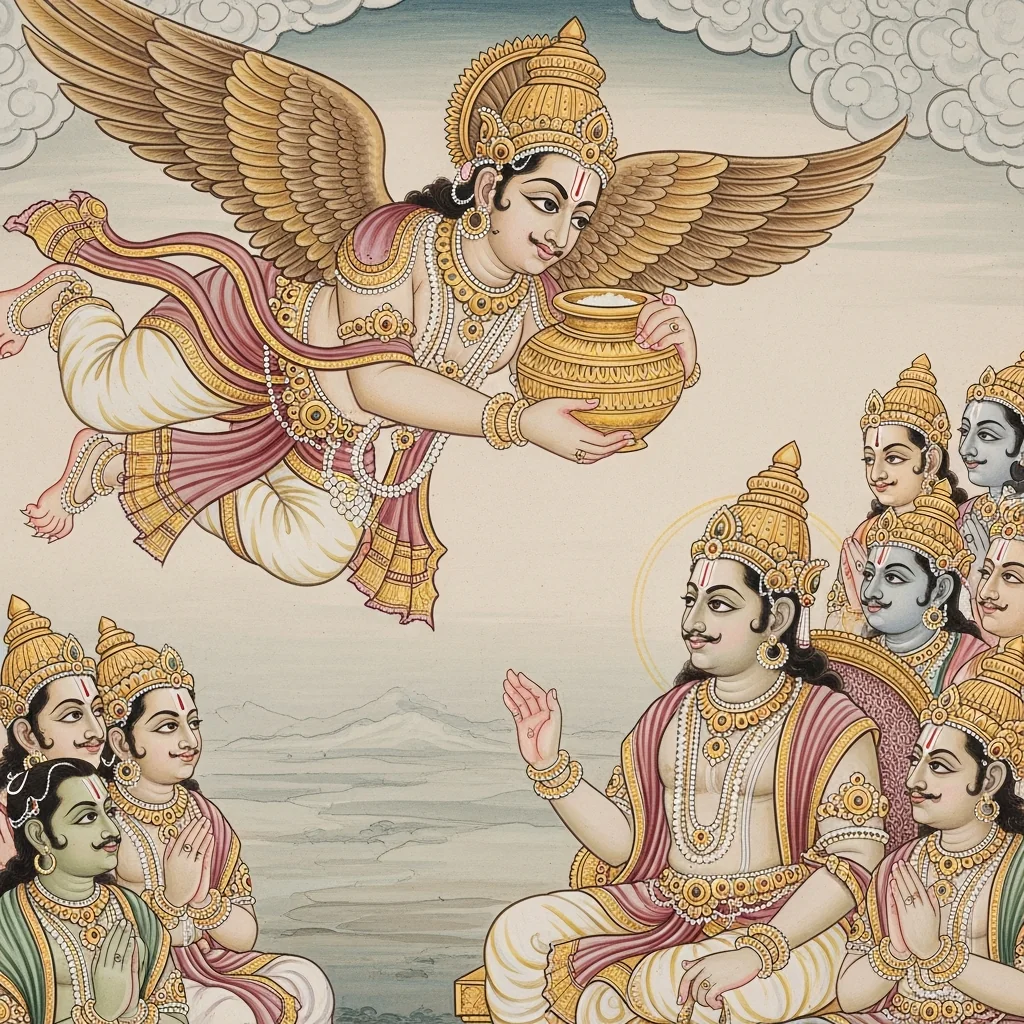
The sages ask Sūta how Kadrū was freed from her immersion in the Kṣīra-kuṇḍa, and how a deceitful wager came to bind Vinatā. Sūta recounts the Kṛtayuga tale: the sisters Kadrū and Vinatā become wives of Kaśyapa; Vinatā bears Aruṇa and Garuḍa, while Kadrū bears many nāgas led by Vāsuki. On seeing the celestial horse Uccaiḥśravas, they wager over the color of its tail; Kadrū plots deception by ordering her serpent-sons to darken it, and when they resist she curses them—foretelling their later ruin in a royal sacrifice. Vinatā loses and is enslaved; Garuḍa is born, learns the cause, and seeks to free his mother. The nāgas demand that he bring amṛta from the devas; Vinatā counsels him to act within dharma, including sparing a brāhmaṇa. Garuḍa consults Kaśyapa, consumes the elephant and tortoise (cursed rivals), protects the Vālakhilyas by relocating a branch, and confronts the devas to seize the amṛta. Viṣṇu grants boons and establishes Garuḍa as his vehicle, while Indra negotiates the amṛta’s return. Vinatā is released, and the Kṣīra-kuṇḍa observance—three days of fasting and sacred bathing—is praised; the phalaśruti declares that recitation bestows merit comparable to great gifts.
Adhyaya 39
कपितीर्थ-माहात्म्य तथा रंभा-शापमोचन (Kapitīrtha Māhātmya and Rambhā’s Release from the Curse)
This adhyāya unfolds in two movements. First, Sūta tells of Kapitīrtha’s origin and ritual power on Gandhamādana mountain: after Rāvaṇa and allied forces are defeated, the vānaras establish this tīrtha for the welfare of all, bathe there, and receive boons. Rāma then grants an expanded vara, declaring that bathing at Kapitīrtha yields fruits equal to bathing in the Gaṅgā and at Prayāga, equal to the combined merit of all tīrthas, to great soma-sacrifices such as Agniṣṭoma, to mahāmantra-japa (including Gāyatrī), to great gifts like cow-dāna, to Veda-recitation, and to deva-worship. Devas and sages gather, praise the site as unrivaled, and affirm that seekers of liberation should surely go there. Second, in response to the sages’ questions, Sūta narrates Rambhā’s curse and release. Viśvāmitra, once a Kuśika king, is humbled by Vasiṣṭha’s spiritual power and undertakes fierce tapas to attain brāhmaṇya; fearing his success, the devas send the apsaras Rambhā to distract him, but he perceives the ploy and curses her to become stone for a vast time, to be freed only through a brāhmaṇa’s intervention. Later, Śveta, Agastya’s disciple, is harassed by a rākṣasī, and through a subtle astral act the stone is propelled to Kapitīrtha; by the tīrtha’s touch Rambhā regains her form, is honored by the devas, and returns to heaven, repeatedly glorifying Kapitīrtha and venerating Rāmanātha and Śaṅkara. The concluding phalaśruti declares that hearing or reciting this adhyāya grants the fruit of bathing at Kapitīrtha.
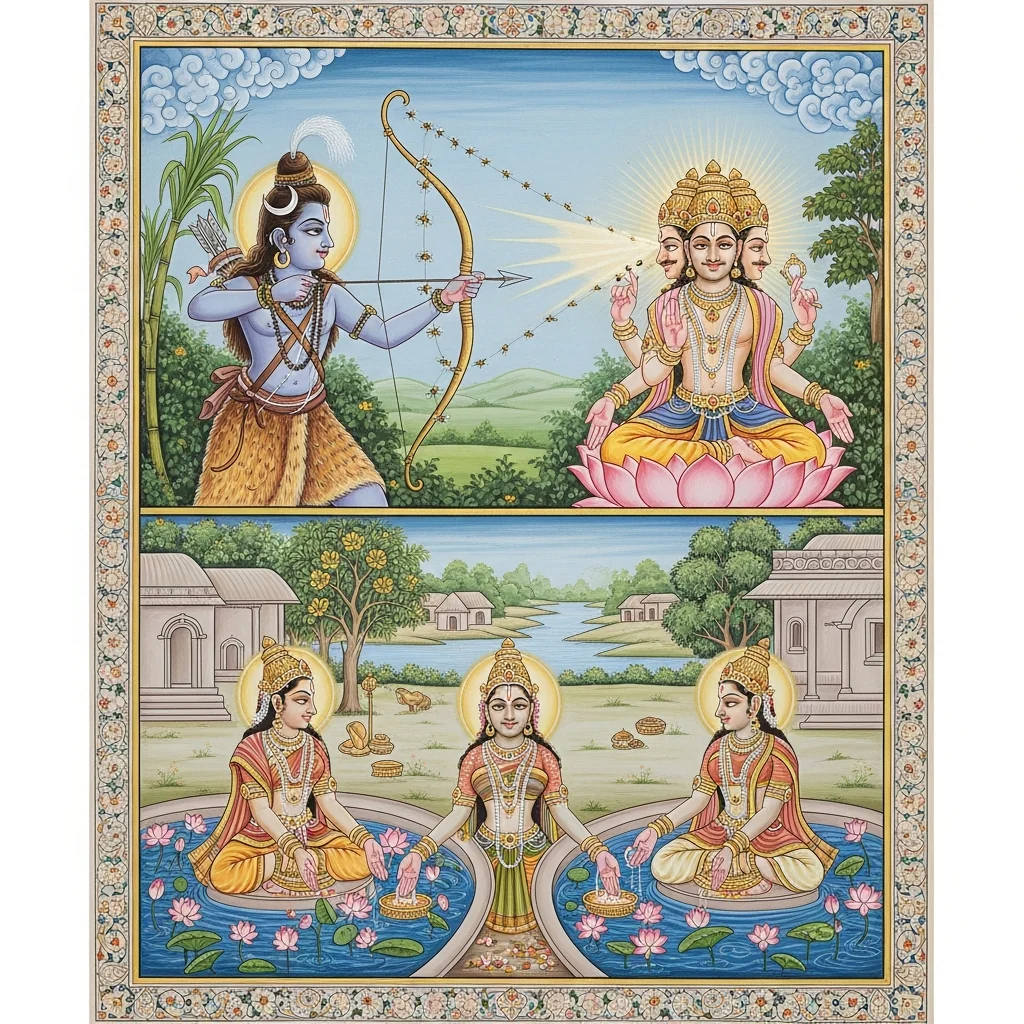
Adhyaya 40
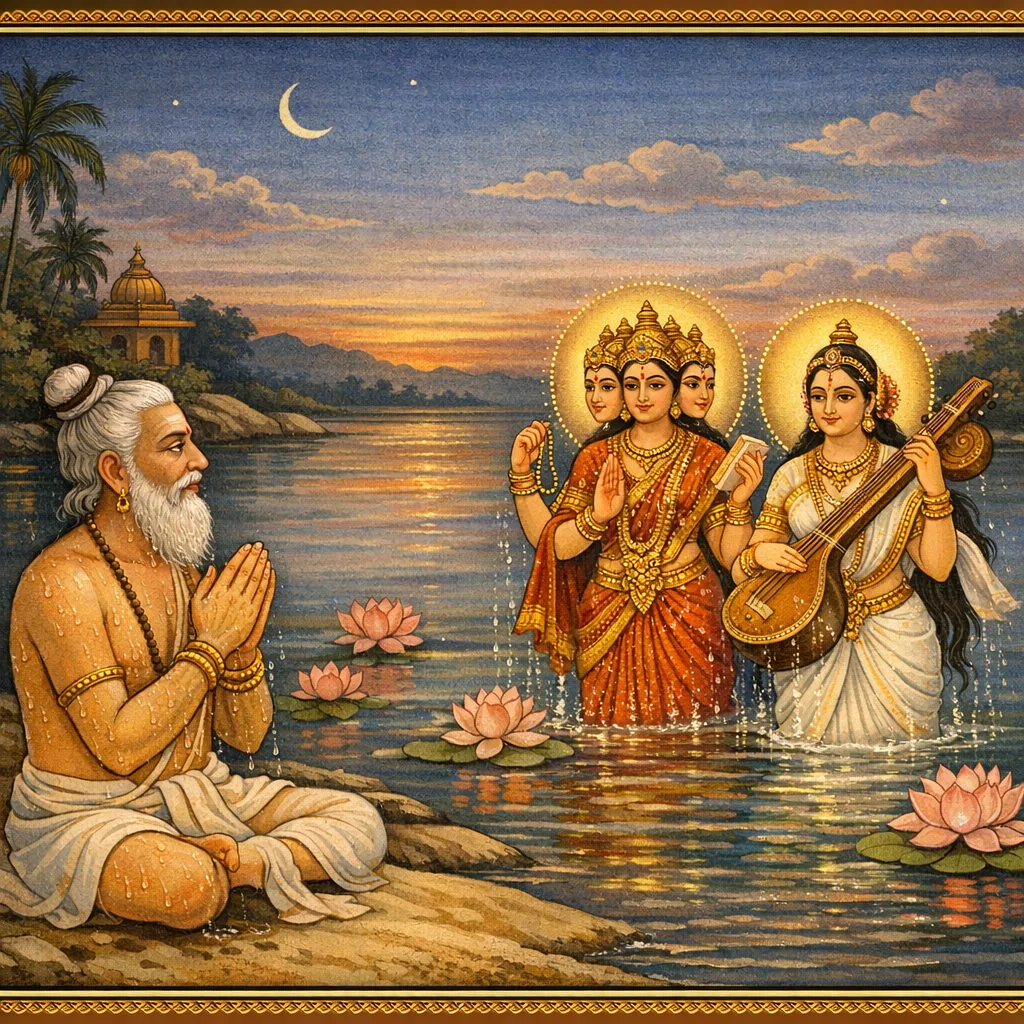
Gayatrī–Sarasvatī Sannidhāna at Gandhamādana and the Establishment of the Twin Kuṇḍas (गायत्रीसरस्वती-सन्निधानं तथा कुण्डद्वय-माहात्म्यम्)
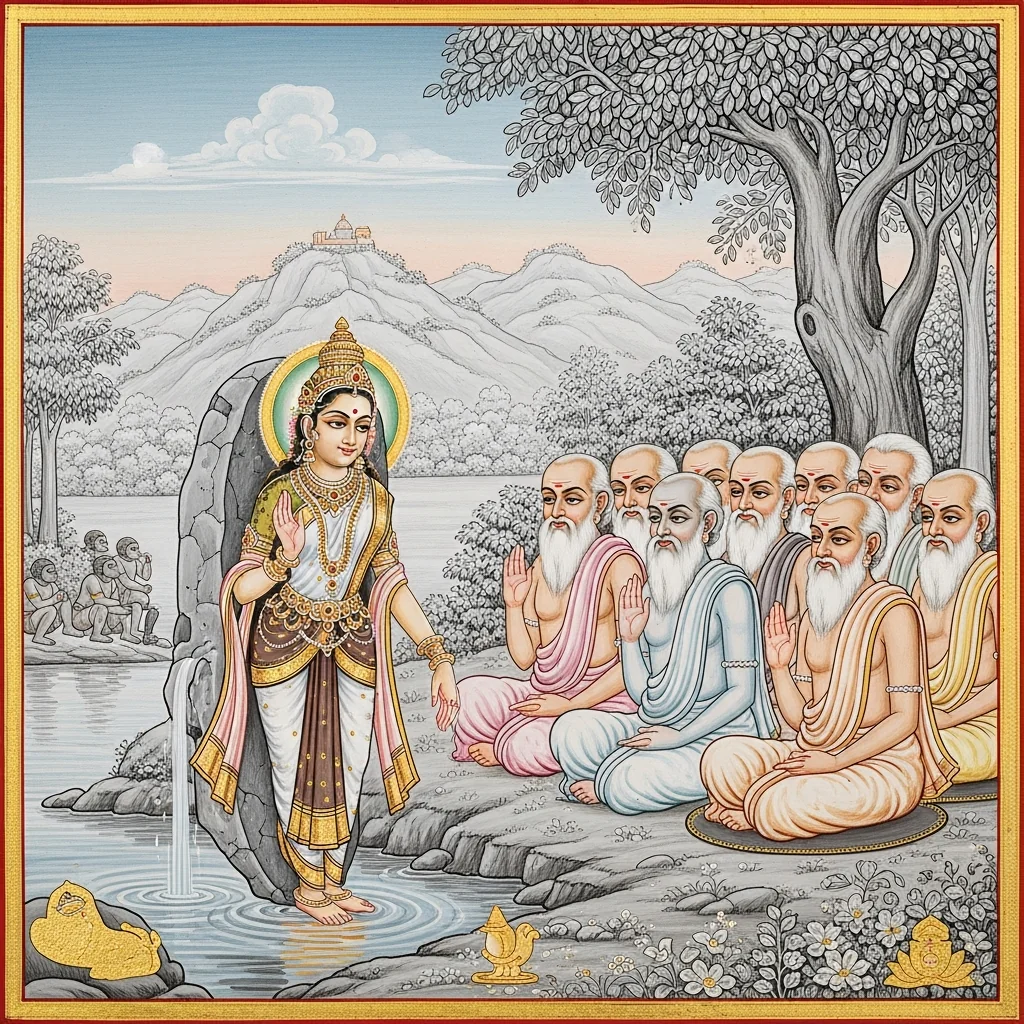
The chapter opens with Sūta addressing the sages, proclaiming the liberative (muktida) and sin-destroying greatness of the Gayatrī and Sarasvatī traditions, especially for those who hear and recite them. Joyful bathing in the Gayatrī and Sarasvatī tīrthas is said to prevent the return to rebirth, figured as dwelling in the womb (garbhavāsa), and to grant certain liberation. Asked why Gayatrī and Sarasvatī abide at Gandhamādana, Sūta relates an origin legend: Prajāpati/Brahmā becomes infatuated with his daughter Vāk; she takes the form of a roe-deer and Brahmā pursues her. The gods condemn this forbidden act. Śiva, assuming the form of a hunter, strikes Brahmā; from the wounded body arises a great light that becomes the Mṛgaśīrṣa constellation, with Śiva portrayed as pursuing it in astral symbolism. Grieving and seeking their husband’s restoration, Gayatrī and Sarasvatī perform severe tapas at Gandhamādana—fasting, restraint of passions, Śiva-dhyāna, and japa of the pañcākṣara-mantra. For their ablutions they create two tīrthas/kuṇḍas bearing their names and bathe at the three daily times (tri-savana). Pleased, Śiva appears with Pārvatī and attendant deities; they praise him with a stotra extolling his protection and his power to dissolve darkness. Śiva grants their boon by reconstituting Brahmā, bringing heads and joining them to the body, restoring the four-faced creator. Brahmā confesses and asks protection from repeating prohibited deeds; Śiva admonishes him against future negligence. Śiva then proclaims the enduring salvific power of the twin kuṇḍas: bathing there purifies, removes major sins, brings peace and desired aims, and even benefits those lacking Vedic study or daily rites. The chapter ends with a phalaśruti: devoted hearing or recitation of this adhyāya yields the fruit of bathing at both tīrthas.
Adhyaya 41
गायत्री-सरस्वतीतीर्थमाहात्म्य तथा कश्यपप्रायश्चित्तकथा (Glory of the Gayatrī–Sarasvatī Tīrthas and the Atonement Narrative of Kaśyapa)
This adhyāya opens with Sūta’s pledge to narrate a purificatory itihāsa centered on the twin tīrthas, Gayatrī and Sarasvatī. It first retells the famed episode of King Parīkṣit: while hunting he insults a sage in meditation by placing a dead serpent on the sage’s shoulder, and the sage’s son Śṛṅgī curses him to die within seven days by Takṣaka’s bite. Though Parīkṣit arranges protections and the brāhmaṇa-mantrika Kaśyapa hastens to counter the poison, Takṣaka intercepts him, burns a banyan to display lethal power, and is met by Kaśyapa’s mantra that revives the tree and a man upon it; yet Takṣaka turns Kaśyapa back with wealth. Parīkṣit is then slain when Takṣaka, disguised as a worm inside a fruit, bites him. The discourse shifts to Kaśyapa’s moral crisis: he is socially censured for failing to save a poisoned person despite having the ability, and he seeks guidance from the sage Śākalya. Śākalya lays down a severe ethical rule—knowingly refusing life-saving aid out of greed is an extreme transgression with harsh social and ritual consequences—and prescribes a remedy. He directs Kaśyapa to the southern ocean–Setu region, to a Ghaṇḍamādana-associated spot where the twin tīrthas Gayatrī and Sarasvatī abide. Observing niyama and bathing with saṅkalpa, Kaśyapa is purified at once; the goddesses Gayatrī and Sarasvatī manifest as the resident forms of the tīrthas, grant boons, and receive his hymn praising them as vidyā embodied and as mothers of the Veda. The chapter concludes with its phala: bathing there, or hearing of these tīrthas, bestows purificatory merit.
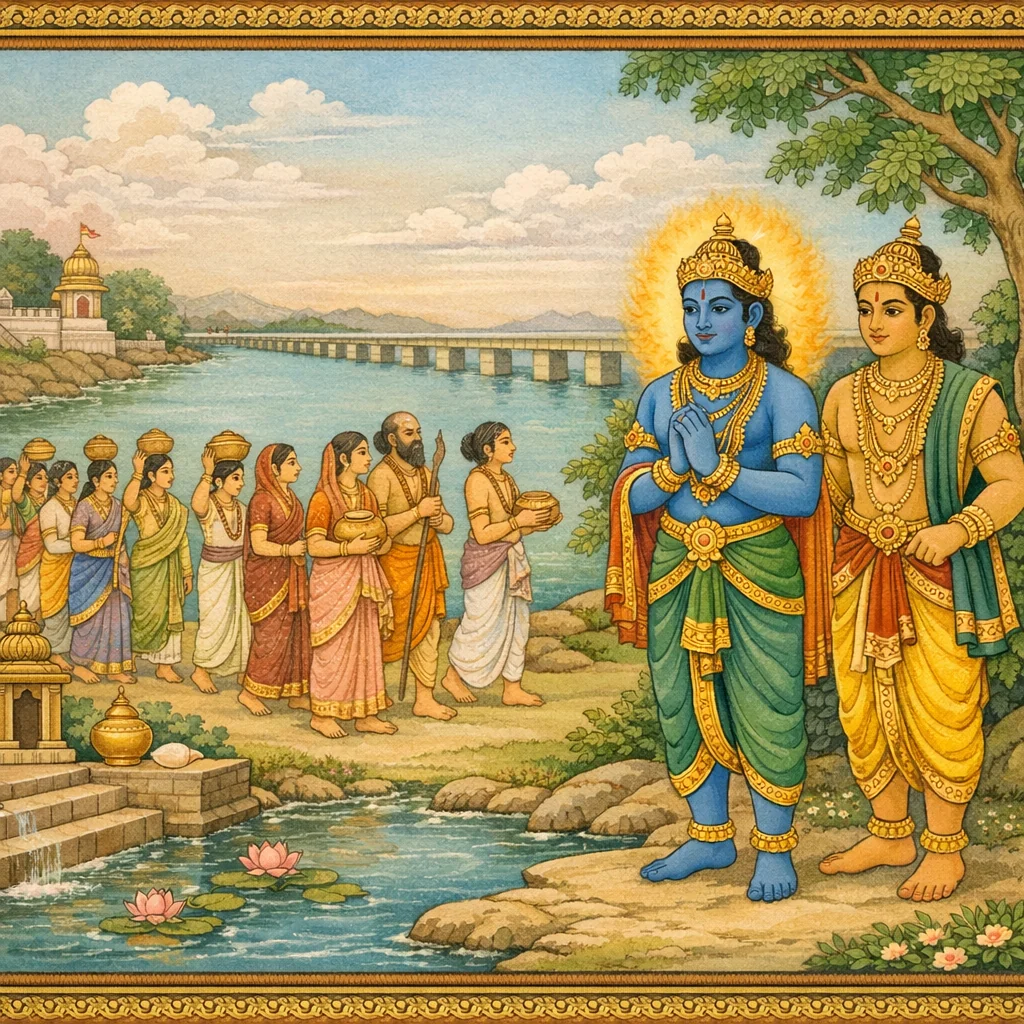
Adhyaya 42
ऋणमोचन–देवतीर्थ–सुग्रीव–नल–नीलादि तीर्थमाहात्म्य (Release from Debts and the Glories of Key Setu Tīrthas)
Narrated by Śrī Sūta to the sages, this chapter enumerates the “vaibhava” (glory and efficacy) of many tīrthas in the Setu region. It begins with Ṛṇamocana, a bathing-place said to dissolve the three classical debts—ṛṣi-ṛṇa, deva-ṛṇa, and pitṛ-ṛṇa—explaining that these liabilities arise from neglect of brahmacarya discipline, sacrifice (yajña), and the continuity of progeny and ancestral rites; bathing there is declared to grant release. A Pāṇḍava-associated “mahā-tīrtha” is then praised, where morning and evening remembrance is held equal to bathing at great tīrthas, and tarpaṇa, offerings, and feeding a brāhmaṇa are prescribed as highly meritorious. The discourse proceeds to Devatīrtha/Devakuṇḍa, portrayed as exceedingly rare to reach; bathing there is equated in merit to major Vedic rites, destroying sin and leading to higher lokas, with even a short stay (two to six days) and repeated baths deemed potent. Sugrīvatīrtha follows, granting attainment of the solar world, expiation of grave sins, and lofty ritual fruits through bathing, remembrance, fasting, and abhiṣeka with tarpaṇa. Nalatīrtha and Nīlatīrtha are next, each linked to purification and mahā-yajña equivalences, with Nīla honored as founder, the son of Agni. The chapter widens into a network of Vānara-founded tīrthas and culminates in Vibhīṣaṇa’s tīrtha(s), said to remove suffering, disease, poverty, bad dreams, and hellish afflictions, bestowing a Vaikuṇṭha-like non-return. The closing verses proclaim Setu/Gandhamādana as a perpetual abode of gods, pitṛs, sages, and other beings under Rāmacandra’s command, and the phalaśruti promises that reading or hearing this account dispels distress and leads to kaivalya.
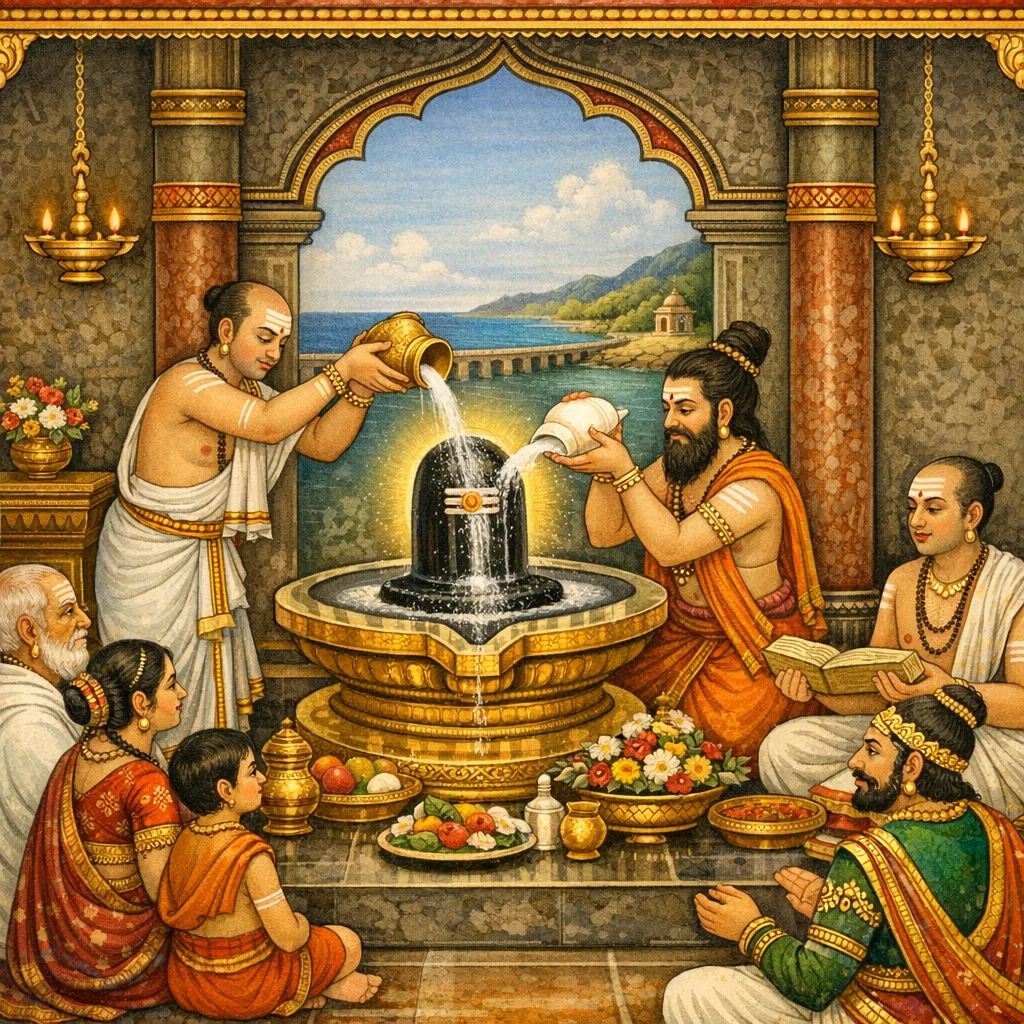
Adhyaya 43
रामनाथ-महालिङ्ग-माहात्म्यम् (Glory of the Rāmanātha Mahāliṅga)
Voiced by Śrīsūta, this adhyāya presents a tightly reasoned māhātmya of the Rāmanātha/Rāmeśvara Mahāliṅga established by Śrī Rāma. It begins with a phala claim that hearing this account frees a person from sins, and it extols even a single darśana of Rāma’s liṅga as liberation-giving, leading to Śiva-sāyujya (union with Śiva). Using yuga-calculus, it magnifies the shrine’s power in Kali-yuga, asserting faster and multiplied fruits through devotional contact. The site is portrayed as densely sacred, with all tīrthas, deities, sages, and ancestors present; remembrance, praise, worship, and even uttering the Name are taught as protections from suffering and post-mortem punishment. A long phalaśruti lists the destruction of major sins through seeing or praising the Lord. The chapter then formalizes an eightfold bhakti centered on the Mahāliṅga—service to devotees, pleasing worship, personal worship, bodily effort for the deity, attentive listening to the māhātmya, devotional bodily emotion, continuous remembrance, and livelihood oriented to the liṅga—emphasizing accessibility for all social groups. It concludes with temple-building and abhiṣeka methods (milk, curd, ghee, pañcagavya, juices, scented waters, Vedic recitations), assigning distinct fruits and lokas, and promising worldly prosperity and final liberation to sustained service.
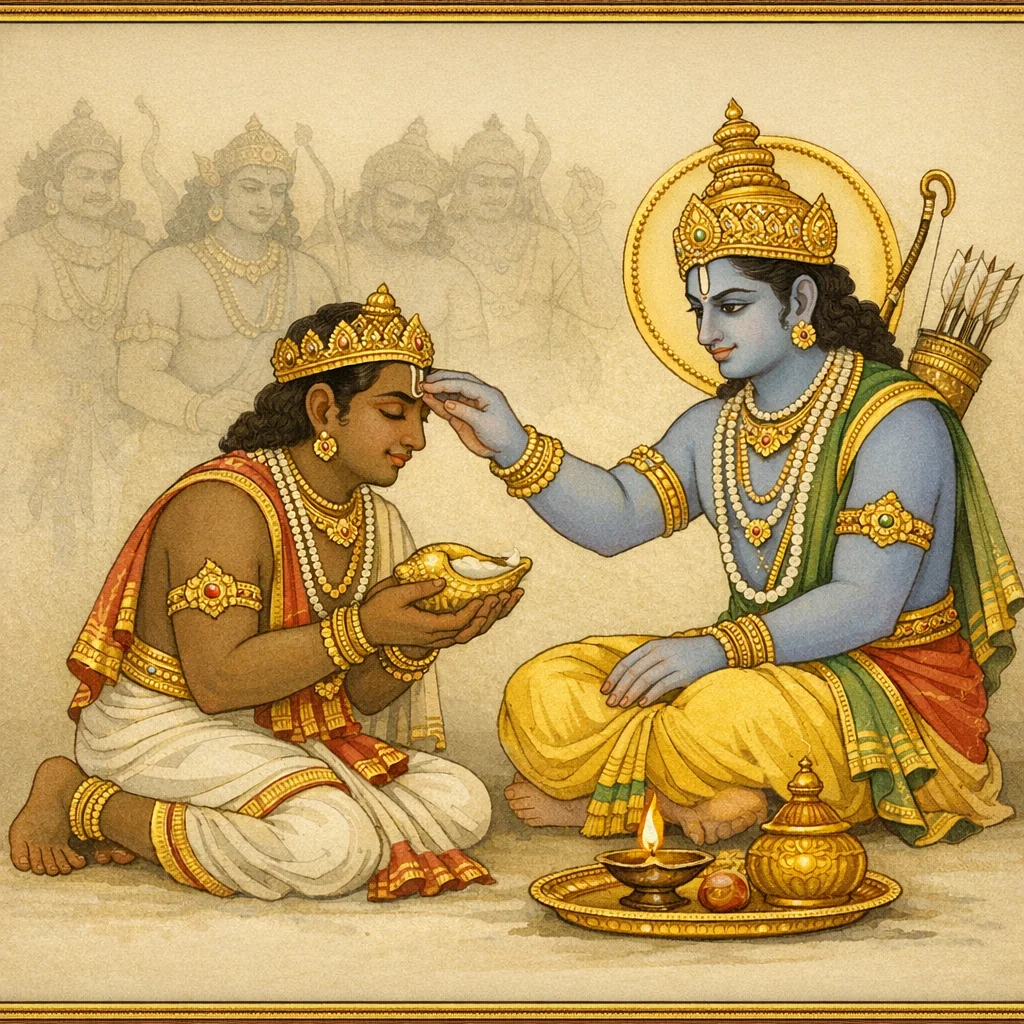
Adhyaya 44
रामेश्वरलिङ्गप्रतिष्ठा, कुबेरजलदर्शनविधि, तथा रामस्तोत्रफलश्रुति (Rāmeśvara Liṅga-Installation, Kubera’s Vision-Water Rite, and the Fruit of Rāma-Stotra)
Chapter 44, narrated by Sūta to the ṛṣis, recounts the Laṅkā campaign: Rāma reaches the ocean’s edge, builds the bridge, and fights a succession of rākṣasa leaders. When Rāma and Lakṣmaṇa are bound by the nāgāstra, Garuḍa arrives to free them. With divine aid—Mātali and an aindra ratha among it—Indrajit and then Rāvaṇa are finally defeated. The narrative then turns to ritual means: Vibhīṣaṇa introduces consecrated water sent by Kubera; applied to the eyes, it grants sight of concealed (antarhita) beings, restoring visibility and tactical clarity in battle. After victory, sages from Daṇḍakāraṇya, with Agastya prominent, arrive and recite an extended Rāma-stotra; its phalaśruti promises protection and purification to those who recite it. Rāma then asks about the residual impurity of pāpa connected with slaying Rāvaṇa. The sages prescribe Śiva-worship (śiva-arcana) and the installation of a liṅga on Gandhamādana for the welfare of the world. Hanumān is sent to Kailāsa to bring the liṅga, and the chapter culminates in the स्थापना and worship of the Śiva-liṅga known as “Rāmeśvara,” extolling immense merit in its darśana and service.
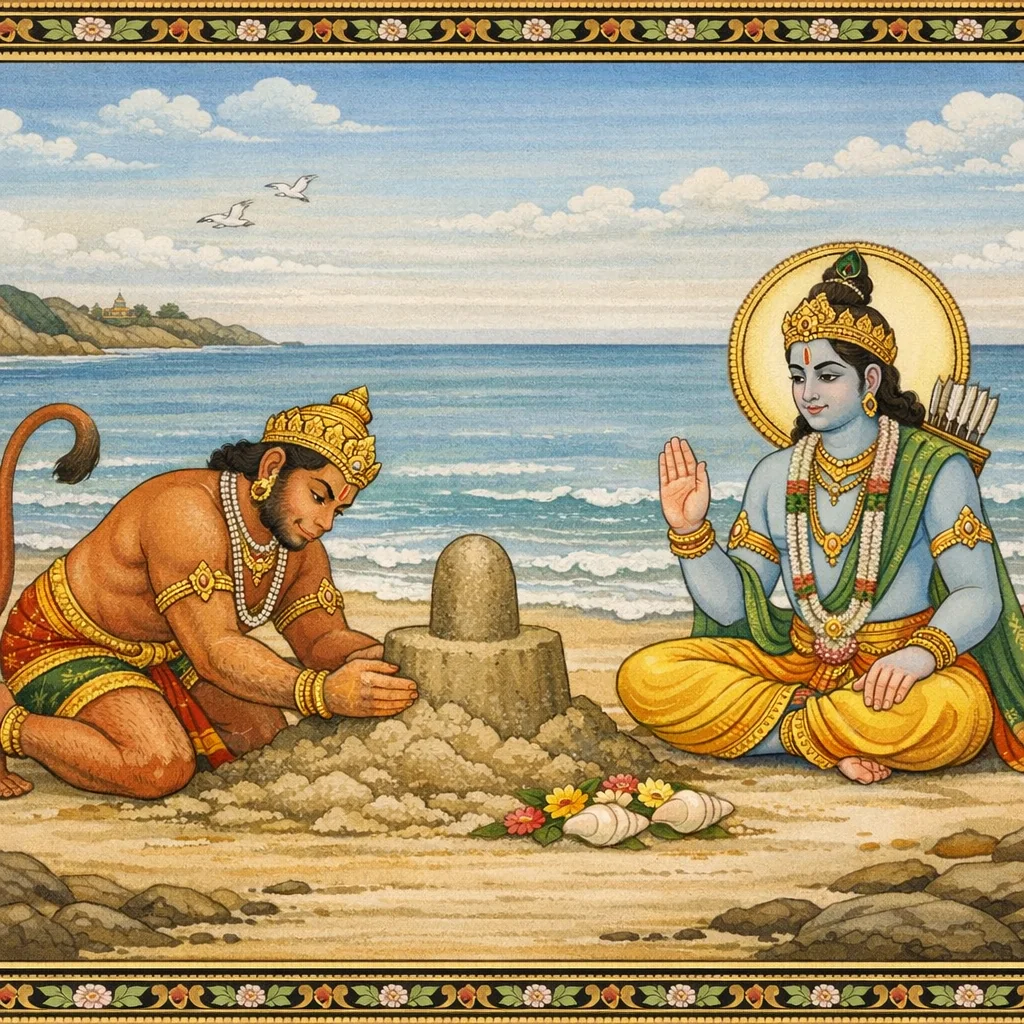
Adhyaya 45
हनूमद्विषाद-रामोपदेशः (Hanumān’s Distress and Rāma’s Instruction at Setu)
Chapter 45 unfolds a theological and ethical dialogue at Setu during the installation of a liṅga. Hanumān returns swiftly from Kailāsa with an auspicious liṅga gained through tapas and Śiva’s favor, but finds Rāma already worshipping a sand-made liṅga (sai-kata-liṅga) fashioned and installed by Sītā in the presence of sages and divine witnesses. Taking this as disregard for his service, Hanumān pours out grief, self-reproach, and anger, even entertaining the thought of abandoning his body. Rāma steadies him with instruction: distinguish the Self from the karmic cycle of birth and death, contemplate the non-dual nirguṇa ātman beyond the three bodies, and uphold ethical disciplines—truthfulness, non-injury, restraint of the senses, avoidance of fault-finding, and regular worship of the deities. He further undermines attachment to bodily “pleasantness” by stressing impurity and impermanence, cultivating vairāgya. The chapter then turns to ritual resolution. Rāma explains the time constraint that required Sītā’s sand-liṅga first, promises to install Hanumān’s Kailāsa-liṅga as well, and grants names and pilgrimage meaning: Hanūmadīśvara and Rāghaveśvara are linked through darśana. A listing of many liṅgas culminates in Śiva’s “eleven-formed” manifestation, ever-present. Hanumān attempts to uproot the sand-liṅga, fails despite escalating effort, collapses bleeding, and is compassionately approached by Rāma, Lakṣmaṇa, Sītā, and the vānaras—ending on the stark contrast between bodily limitation and sacred fixity.
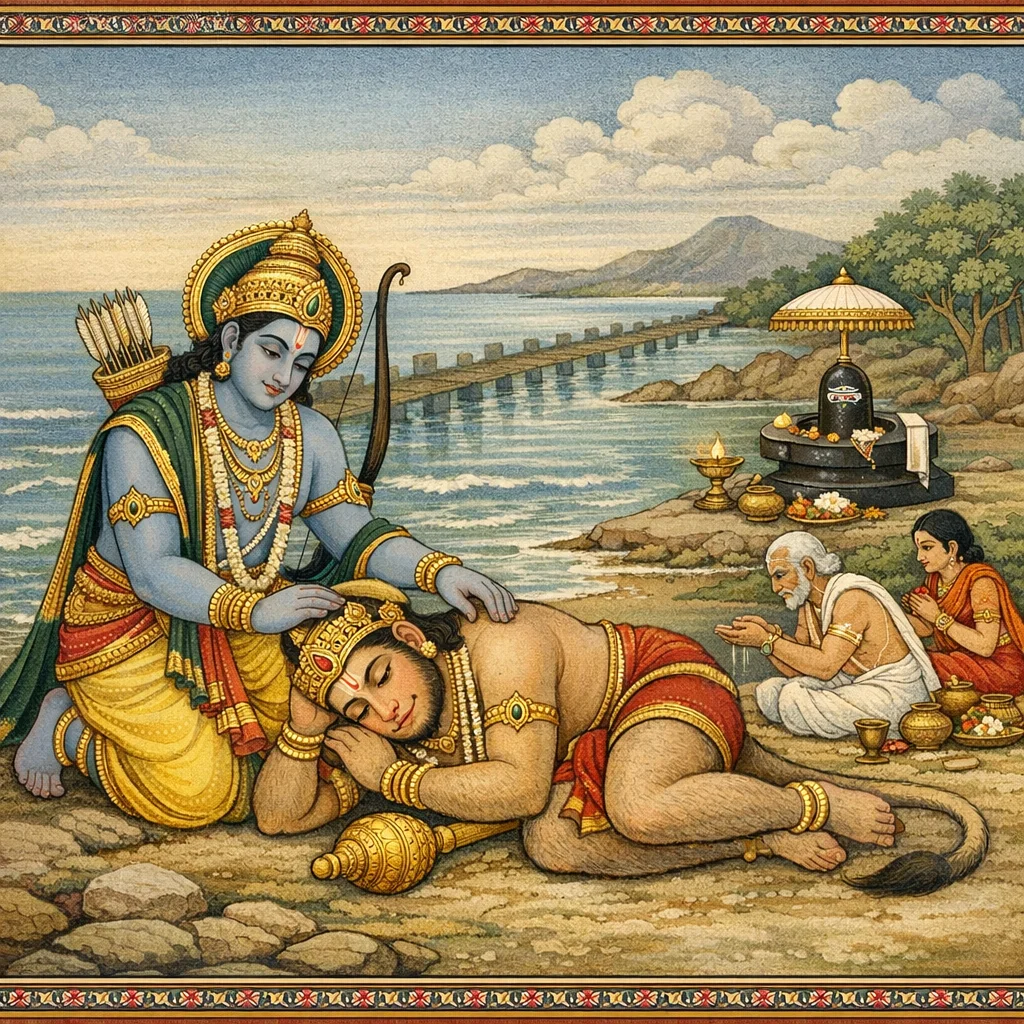
Adhyaya 46
Hanūmat-stuti, Hanūmat-kuṇḍa-māhātmya, and Setu-liṅga Context (हनूमत्स्तुति-हनूमत्कुण्डमाहात्म्य-सेतुलिङ्गप्रसङ्गः)
Adhyāya 46 moves in three closely linked parts. (1) Rāma speaks to the unconscious Hanumān, recalling his deeds in the Laṅkā mission—crossing the ocean, meeting Maināka and Surasā, defeating the shadow-seizing rākṣasī, entering Laṅkā, finding Sītā, receiving the cūḍāmaṇi, destroying the Aśoka grove, battling rākṣasas and their commanders, and returning. Rāma’s grief rises into an ethical vow: kingdom, kinship, even life itself are worthless without the devotee’s presence. (2) Hanumān revives and offers a formal stotra to Rāma as Hari/Viṣṇu and as many avatāra-forms (Narasimha, Varāha, Vāmana, and others). He then praises Sītā through a layered theology, identifying her with Lakṣmī/Śrī, prakṛti, vidyā, and the compassionate mother-principle. The hymn is declared pāpa-nāśana, granting worldly benefits and liberating fruit to those who recite or hear it. (3) The chapter ends with a place-theology: Rāma teaches that a transgression against a liṅga cannot be undone even by great deities, establishes the name and fame of “Hanūmat-kuṇḍa” where Hanumān fell, and proclaims its bathing merit superior to major rivers. He prescribes śrāddha and tilodaka offerings on its bank for the welfare of ancestors. Near Setu an installation is performed, and the phalaśruti promises purification and honor in Śiva’s realm for readers and listeners.
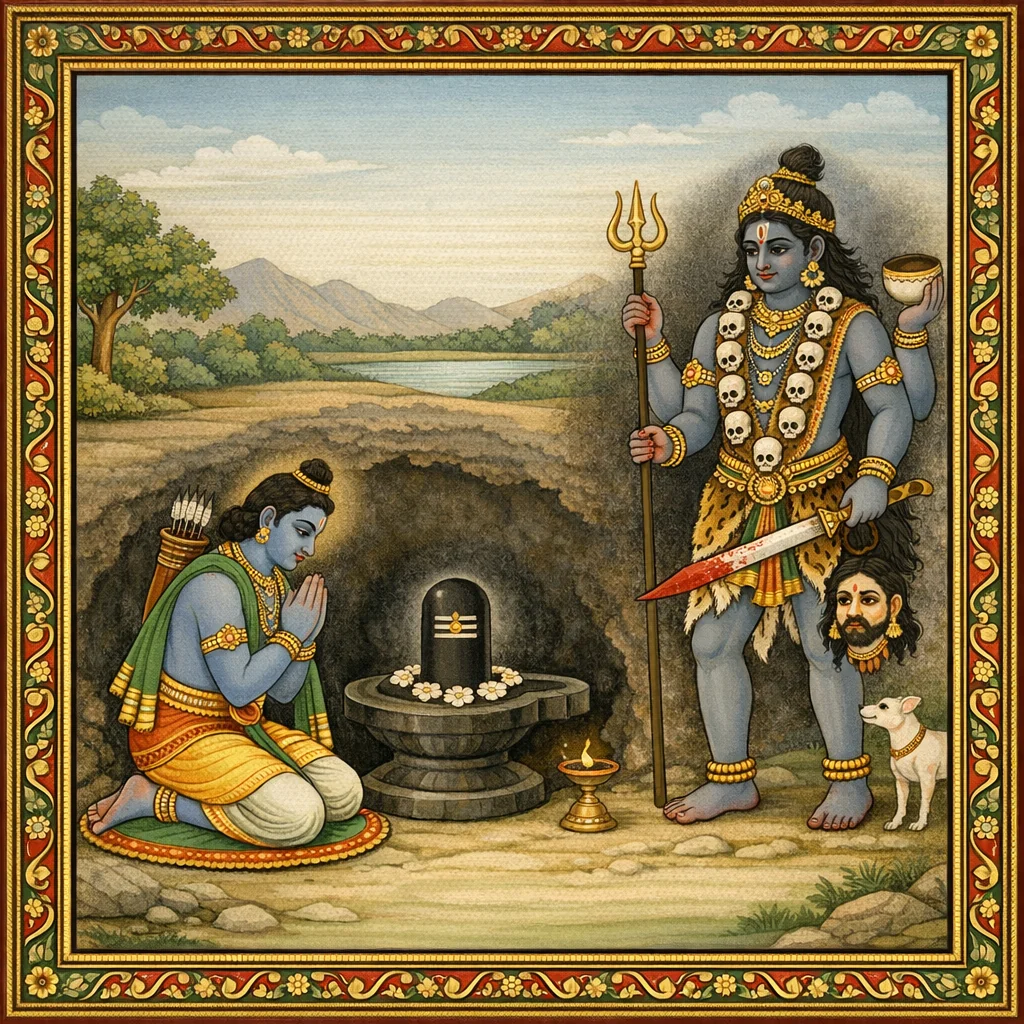
Adhyaya 47
Rāvaṇa-vadha-hetukā Brahmahatyā-śāntiḥ — Rāmeśvara-liṅga-pratiṣṭhā ca (Chapter 47)
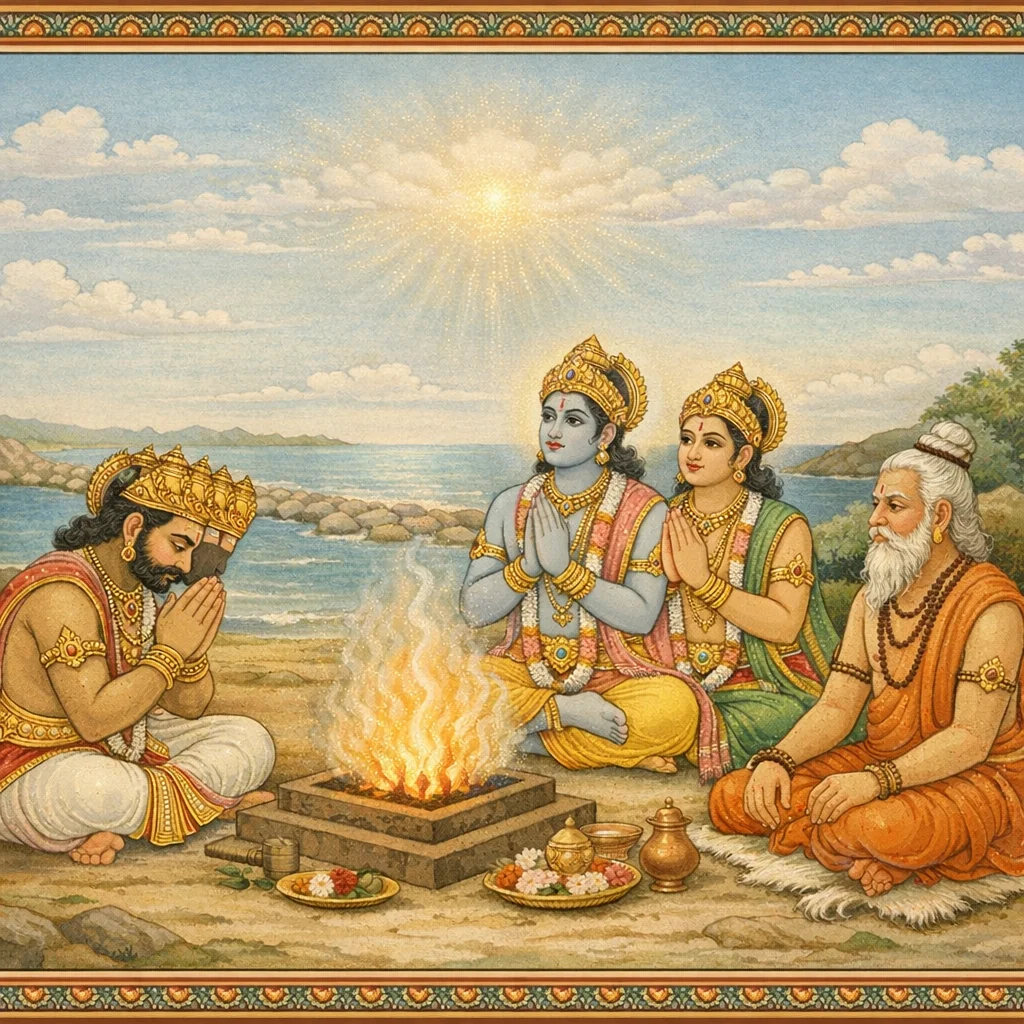
The chapter begins with the ṛṣis asking the Sūta a doctrinal-ethical question: how brahmahatyā—the grave impurity tied to killing a brāhmaṇa—could arise for Rāghava (Rāma) after slaying Rāvaṇa, who is usually classed as a rākṣasa. The Sūta answers by giving the lineage: Pulastya, the Brahmā-born sage, fathers Viśravas; Viśravas unites with Kaikasī, daughter of the rākṣasa Sumālī, and they beget four sons—Rāvaṇa (Daśagrīva), Kumbhakarṇa, Vibhīṣaṇa—and a daughter, Śūrpaṇakhā. Because Kaikasī approaches at an inauspicious twilight, Viśravas foretells fierce rākṣasa sons, though the last-born, Vibhīṣaṇa, will be dhārmika and learned in śāstra. The discourse then states that Rāvaṇa and Kumbhakarṇa are linked to a brahminical line through Viśravas and Pulastya, so their killing produces a brahmahatyā-type impurity for Rāma. To pacify and remove it, Rāma installs the Rāmeśvara (also called Rāmanātha) liṅga according to Vedic procedure, establishing a tīrtha famed for brahmahatyā-vimocana, release from such defilement. The sacred precinct is described with directional presences of deities—Āditya, Soma, Agni, Yama, Varuṇa, Vāyu, Kubera—and attendants such as Vināyaka, Kumāra, Vīrabhadra, and Śiva’s gaṇas. It further narrates that a powerful brahmahatyā is confined in a subterranean cavity, with Bhairava installed as guardian so the impurity cannot rise again. Finally, Rāma appoints brāhmaṇa officiants and grants donations—villages, wealth, ornaments, textiles—for ongoing worship. The phalaśruti concludes that reading or hearing this chapter frees one from sins and grants sāyujya, union with Hari.
Adhyaya 48
अध्याय ४८: रामनाथसेवा-माहात्म्यं तथा ब्रह्महत्या-प्रायश्चित्तोपदेशः (Chapter 48: The Glory of Service to Rāmanātha and Instruction on Expiation for Major Transgressions)
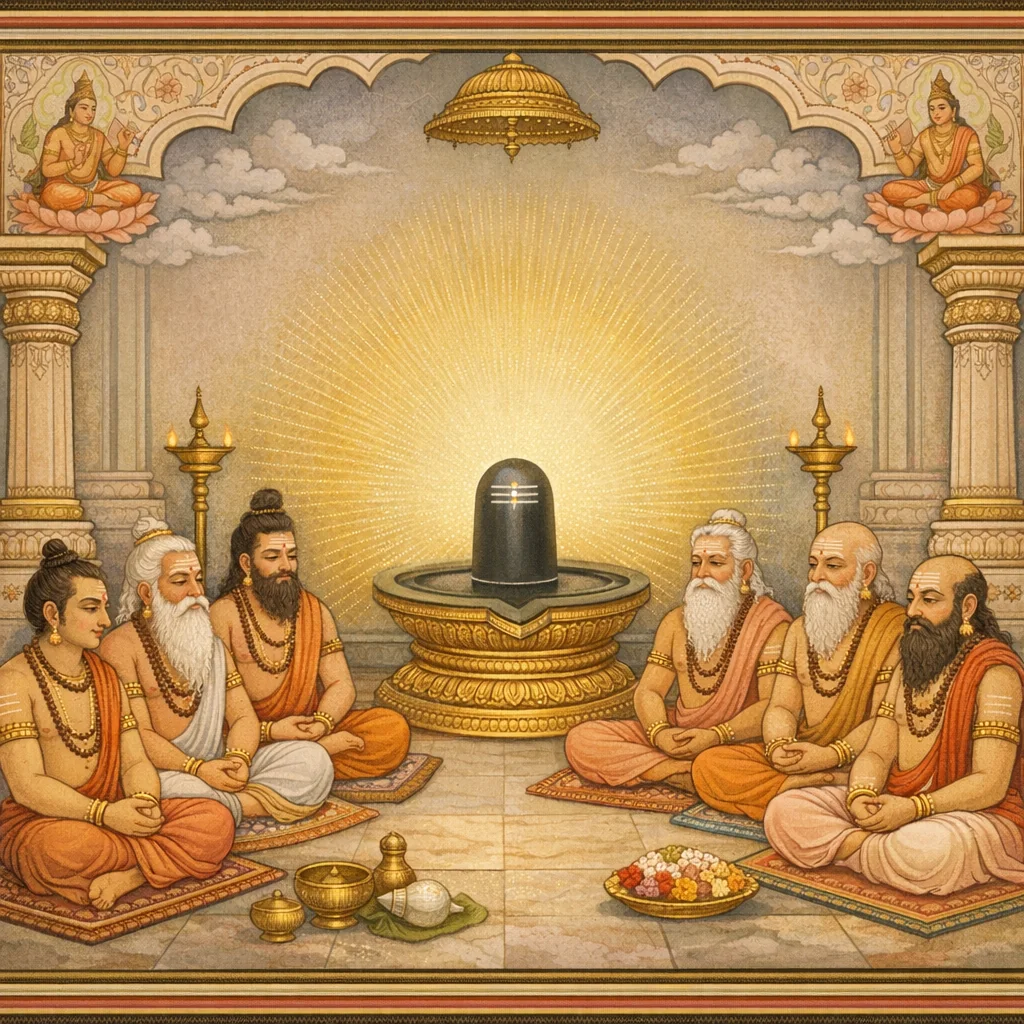
Sūta relates to the sages a place-centered moral account. Śaṅkara, a Pāṇḍya king learned in the Vedas and diligent in rites, enters a perilous forest on a hunt and, mistaking a tranquil ascetic for a wild beast, kills the muni; he then kills the muni’s wife as well, compounding grave sin—brahmahatyā and strī-hatyā. Their son laments, and the gathered sages console him with teaching on mortality, karmic causality, and the non-dual Brahman of the Upaniṣads. They also prescribe practical duties: gather the bones, perform śrāddha and related rites, and enshrine the remains at Rāmanātha’s field near Rāmasetu for purification. The son (Jāṅgala, Śākalya’s son) completes the rites and later receives a dream-vision of his parents in a Viṣṇu-like form, indicating their auspicious post-mortem state. The sages condemn the king and demand self-immolation as expiation; but an incorporeal voice stops him and gives a structured prāyaścitta instead: for one year, disciplined thrice-daily devotion to the Rāma-established liṅga, Rāmanātha—circumambulation, prostration, daily abhiṣeka with ghee, milk, and honey, offerings of naivedya and payasa, and lamp worship with sesame oil. The text declares that such service dissolves even major transgressions, and that attentive hearing and recitation purify and lead to Rāmanātha; the king follows the regimen, regains stable kingship, and rules prosperously.
Adhyaya 49
स्तोत्राध्यायः — Rāmanātha (Rāmeśvara) Stotra and Phalaśruti
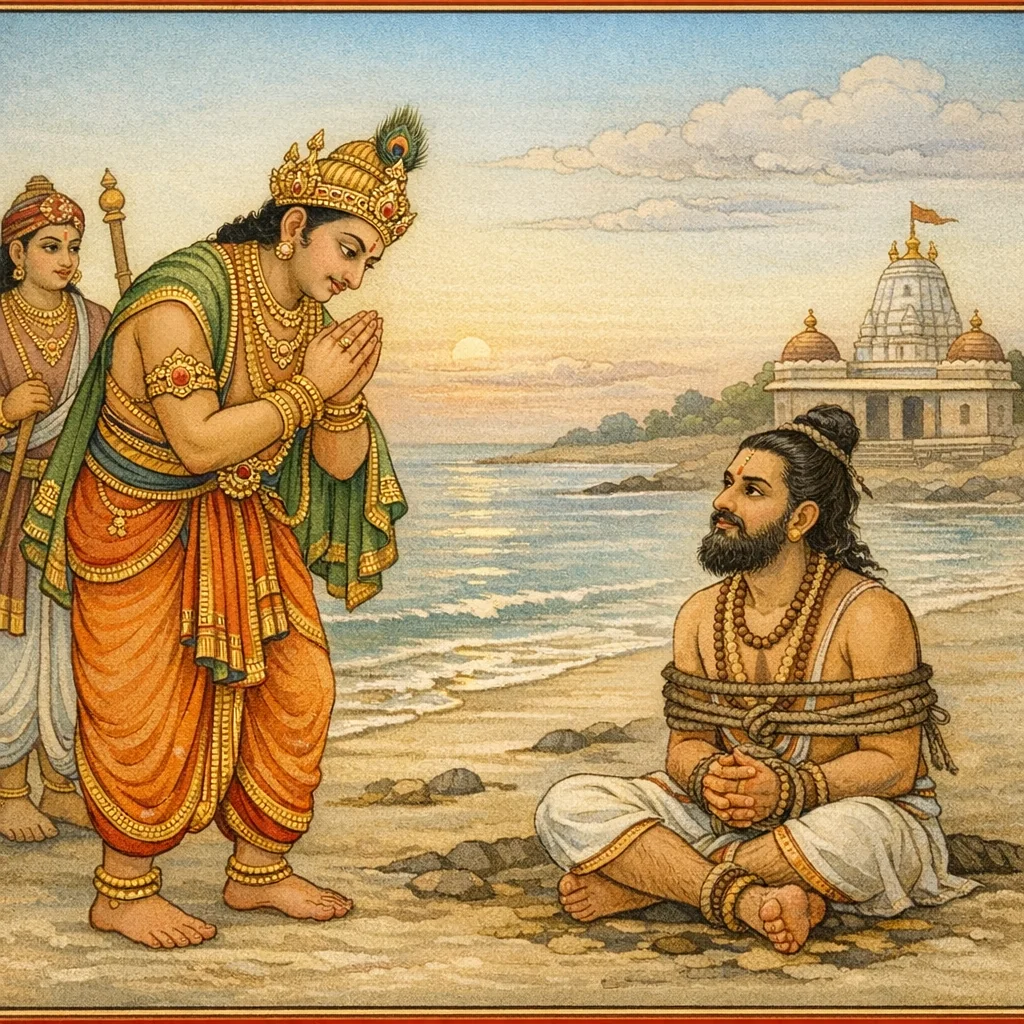
Sūta introduces a “mahāpuṇya” stotra-chapter centered on Rāmanātha (Rāmeśvara), Śiva abiding in the installed liṅga. Rāma, Lakṣmaṇa, Sītā, Sugrīva and the vānaras—followed by devas and ṛṣis—offer hymns in sequence, praising Śiva through devotional epithets (Śūlin, Gaṅgādhara, Umāpati, Tripuraghna) as well as philosophical predicates (sākṣin, sat-cit-ānanda, nirlepa, advaya). Each speaker voices ethical and liberating aims: Lakṣmaṇa seeks unwavering bhakti across births, fidelity to Vedic conduct, and avoidance of “asat-mārga”; Sītā prays for the safeguarding of marital fidelity and right intention; Sugrīva, Vibhīṣaṇa, and the vānaras beg rescue from saṃsāra, pictured as an ocean/forest filled with fear, disease, anger, greed, and delusion. Devas and sages affirm that without devotion, ritual learning and austerities are fruitless, while even a single darśana, touch, or namaskāra can transform. Śiva commends the stotra and proclaims its phalaśruti: reciting or hearing it grants the fruit of worship and merits likened to extraordinary tīrtha observances and residence at Rāmasetu. Continued chanting culminates in freedom from aging and death and the attainment of sāyujya-mukti—union with Rāmanātha.
Adhyaya 50
सेतुमाधववैभवम् (The Glory of Setumādhava and the Test of Royal Devotion)
Sūta recounts the episode of King Puṇyanidhi (also called Guṇanidhi), a Somavaṃśa ruler of Mathurā, who sets out on pilgrimage to Rāmasetu. Bathing at Dhanuṣkoṭi, he worships Rāmanātha and performs the prescribed rites and gifts, including tulāpuruṣa-style dāna. He then meets an orphaned eight-year-old girl who asks to be adopted and protected under strict conditions. The king and Queen Vindhyāvalī accept her as their daughter. A divine test follows: Lakṣmī is sent to examine the king’s devotion, and Viṣṇu arrives disguised as a brāhmaṇa ascetic. When the disguised Viṣṇu forcefully takes the girl’s hand, she cries out; the king intervenes, binds the “brāhmaṇa,” and confines him within the precinct of Rāmanātha. That night the king receives a revelatory dream: the captive is Viṣṇu, adorned with conch, discus, mace, lotus, and garlands, and the girl is Mahālakṣmī. At dawn he recognizes the Lord, offers an extensive stotra, and begs forgiveness for the binding. Viṣṇu declares the act pleasing, for it fulfilled the pledge of protection and displayed bhakti; Lakṣmī grants boons—stable sovereignty, unwavering devotion to their feet, and final liberation without return. The chapter concludes by declaring that Viṣṇu will abide at Setu as “Setumādhava,” that Setu is divinely safeguarded with Brahmā and Śaṅkara/Rāmanātha present, and that hearing or reciting this account bestows the path to Vaikuṇṭha.
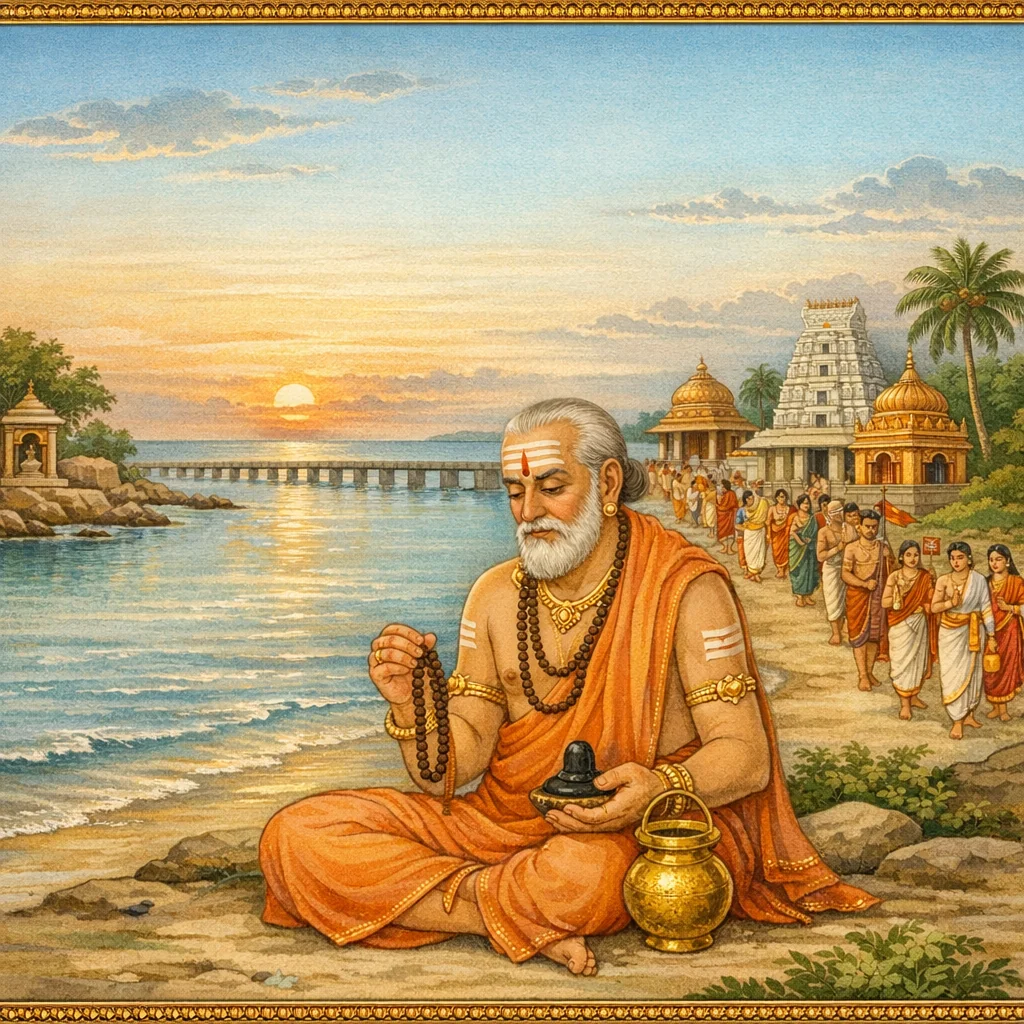
Adhyaya 51
सेतुयात्राक्रमः (Setu-yātrā-kramaḥ) — The Prescribed Order of the Setu Pilgrimage
This adhyāya sets forth the prescribed order of the Setu pilgrimage as a disciplined sequence of ethics and ritual. Sūta instructs the dvijas on preparatory purity—snāna, ācamanam, and daily observances—together with devotional resolve toward Rāmanātha/Rāghava and social-religious duties such as feeding Brāhmaṇas learned in the Veda. The pilgrim adopts outward marks and restraints (bhasma with tri-puṇḍra or ūrdhva-puṇḍra, rudrākṣa), undertakes austerity, guards speech, performs regulated japa of the aṣṭākṣara and pañcākṣara mantras, and avoids luxury and distraction. The journey is to be sustained by continuous recitation or reading of the Setu-māhātmya, the Rāmāyaṇa, or other Purāṇas, while upholding dharma, charity, hospitality, and worship along the way. On reaching the ocean, a distinctive rite is prescribed: pāṣāṇa-dāna (offering one or seven stones), followed by invocation, namaskāra, arghya, and a formal request for permission to bathe, each step supported by specific mantras. After snāna with further mantra-recitation, tarpaṇa is performed for sages, deities, monkeys/epic allies, and ancestors, with naming formulas indicated. A śrāddha sequence follows, with options according to one’s means (simple or elaborate with six tastes), and gifts such as cows, land, tila, gold, and more. The chapter then maps a circuit of tīrthas—Cakratīrtha, Kapitīrtha, Sītākuṇḍa, Ṛṇamocana, Lakṣmaṇatīrtha, Rāmatīrtha, Hanumatkuṇḍa, Brahmakuṇḍa, Nāgakuṇḍa, Agastyakuṇḍa, Agnitīrtha—culminating in worship of Rāmeśvara and Setumādhava, further dāna, and a disciplined return home with communal feeding. The concluding phalaśruti declares that hearing or reading the Setu-yātrā-krama and Setu-māhātmya grants purification and relief from suffering, even for those unable to undertake the pilgrimage in person.
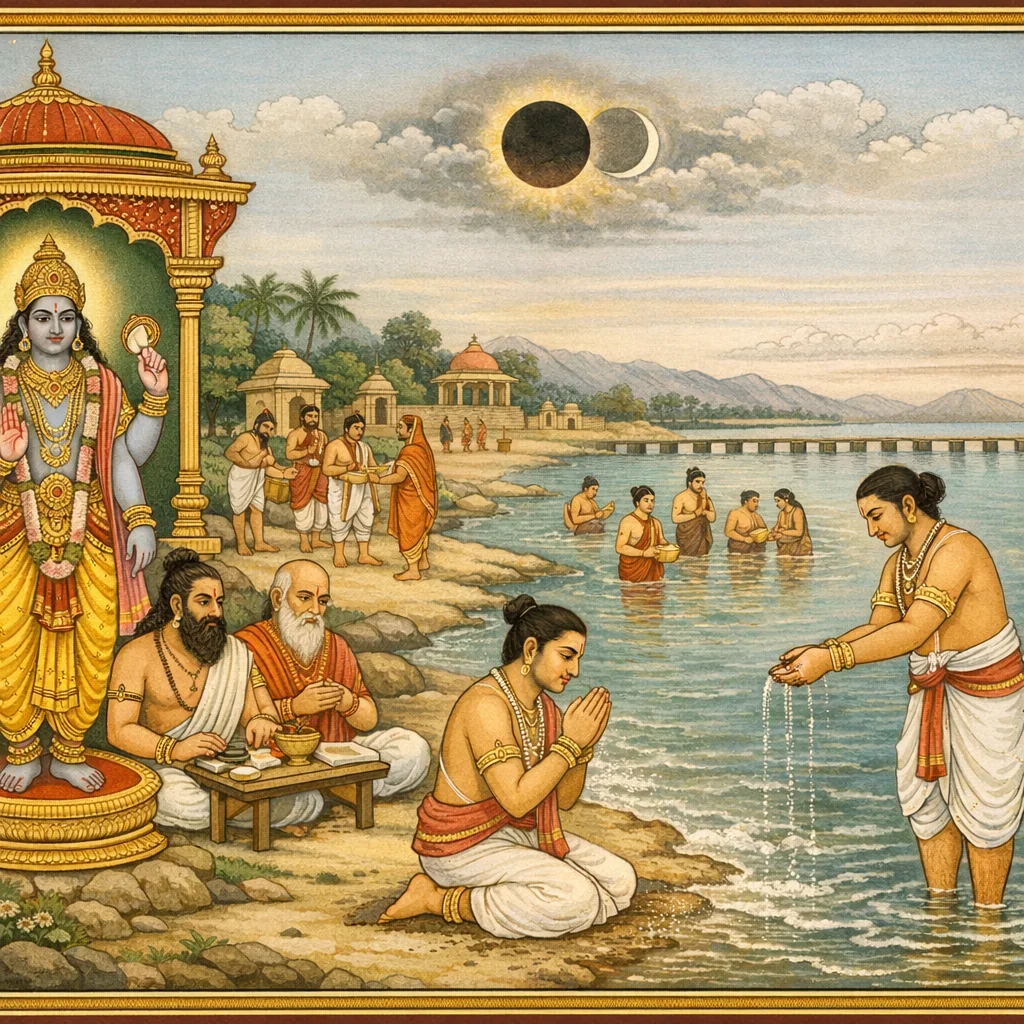
Adhyaya 52
धनुष्कोटिमाहात्म्य (Dhanuṣkoṭi Māhātmya) — Ritual Merit of Snāna, Dāna, and Setu-Observances
Chapter 52 is a structured māhātmya discourse in which Sūta tells the sages that Dhanuṣkoṭi at Rāmasetu is the supreme field of merit, where japa, homa, tapas, and dāna become akṣaya (imperishable). It offers comparative claims of merit—equal to prolonged residence or bathing at other famed tīrthas—and then marks times when the fruit intensifies: Māgha-month bathing, solar and lunar eclipses, and calendrical yogas such as ardha-udaya and mahā-udaya. Interwoven phalāśruti promises sin-destruction, svarga, and Vaiṣṇava/Śaiva attainments like sālokya, sāmīpya, sārūpya, and sāyujya, while also laying down ethical discipline: dāna must be given to a qualified recipient (satpātra), and improper gifting in a holy place is said to harm one spiritually. A Vasiṣṭha–Dilīpa dialogue defines satpātra (Vedic conduct, continuity of rites, poverty with integrity) and provides a fallback—saṅkalpa with a symbolic water-offering—when no worthy recipient is found. The chapter ends by portraying Setu as divinely guarded (Viṣṇu as Setumādhava, with deities and sages in attendance) and by extending the efficacy of remembering and reciting Setu to listeners and readers in fitting settings (temple/maṭha/sacred banks).
FAQs about Setubandha Mahatmya
It elevates Setu (the bridge-site) as a sanctified liminal geography where epic action becomes ritual memory, and where contact with designated tīrthas is framed as ethically transformative.
The section repeatedly associates Setu-related bathing and visitation with purification from transgressions (pāpa-kṣaya) and the accrual of merit through regulated acts such as snāna, recitation, and attentive listening.
The central legend is the Setubandha episode: Rāma’s alliance with the vānaras, the ocean’s propitiation, Nāla’s bridge-building, and the subsequent sanctification of multiple tīrthas along the Setu corridor.