Adhyaya 40
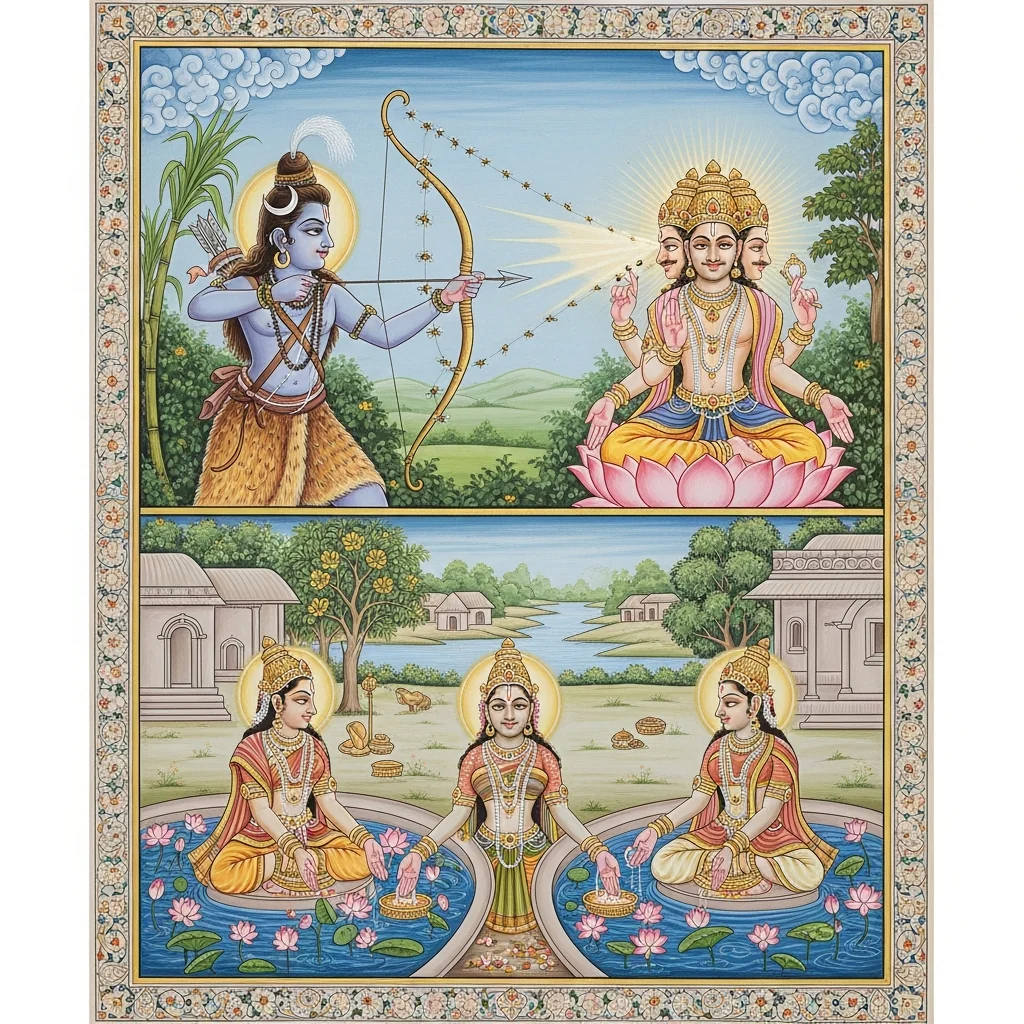
The chapter opens with Sūta addressing the sages, proclaiming the liberative (muktida) and sin-destroying greatness of the Gayatrī and Sarasvatī traditions, especially for those who hear and recite them. Joyful bathing in the Gayatrī and Sarasvatī tīrthas is said to prevent the return to rebirth, figured as dwelling in the womb (garbhavāsa), and to grant certain liberation. Asked why Gayatrī and Sarasvatī abide at Gandhamādana, Sūta relates an origin legend: Prajāpati/Brahmā becomes infatuated with his daughter Vāk; she takes the form of a roe-deer and Brahmā pursues her. The gods condemn this forbidden act. Śiva, assuming the form of a hunter, strikes Brahmā; from the wounded body arises a great light that becomes the Mṛgaśīrṣa constellation, with Śiva portrayed as pursuing it in astral symbolism. Grieving and seeking their husband’s restoration, Gayatrī and Sarasvatī perform severe tapas at Gandhamādana—fasting, restraint of passions, Śiva-dhyāna, and japa of the pañcākṣara-mantra. For their ablutions they create two tīrthas/kuṇḍas bearing their names and bathe at the three daily times (tri-savana). Pleased, Śiva appears with Pārvatī and attendant deities; they praise him with a stotra extolling his protection and his power to dissolve darkness. Śiva grants their boon by reconstituting Brahmā, bringing heads and joining them to the body, restoring the four-faced creator. Brahmā confesses and asks protection from repeating prohibited deeds; Śiva admonishes him against future negligence. Śiva then proclaims the enduring salvific power of the twin kuṇḍas: bathing there purifies, removes major sins, brings peace and desired aims, and even benefits those lacking Vedic study or daily rites. The chapter ends with a phalaśruti: devoted hearing or recitation of this adhyāya yields the fruit of bathing at both tīrthas.
Shlokas
Verse 1
।श्रीसूत उवाच । अथातः संप्रवक्ष्यामि मुनयो लोकपावनम् । गायत्र्या च सरस्वत्या माहात्म्यं मुक्तिदं नृणाम्
Śrī Sūta said: Now then, O sages, I shall expound that which purifies the worlds—the greatness of Gāyatrī and of Sarasvatī, which bestows liberation upon human beings.
Verse 2
शृण्वतां पठतां चैव महापातकनाशनम् । महापुण्यप्रदं पुंसा नरकक्लेशनाशनम्
For those who listen to it and for those who recite it, this account destroys the great sins; it bestows immense merit upon people and removes the torments of hell.
Verse 3
गायत्र्यां च सरस्वत्यां ये स्नांति मनुजा मुदा । न तेषां गर्भवासः स्यात्किं तु मुक्तिर्भवेद्ध्रुवम्
Those people who joyfully bathe at the tīrthas of Gāyatrī and Sarasvatī will not undergo rebirth in the womb again; rather, liberation surely becomes theirs.
Verse 4
सरस्वत्याश्च गायत्र्या गन्धमादनपर्वते । ब्रह्मपत्न्योः सन्निधानात्तन्नाम्ना कथिते इमे
On Gandhamādana Mountain, because of the presence of Sarasvatī and Gāyatrī—both consorts of Brahmā—these sacred places are spoken of by their names.
Verse 5
ऋषय ऊचुः । गायत्र्याश्च सरस्वत्या गन्धमादनपर्वते । किमर्थं संनिधानं वै सूताभूत्तद्वदस्व नः
The sages said: “O Sūta, for what reason did Gāyatrī and Sarasvatī come to dwell on Gandhamādana Mountain? Tell us that.”
Verse 6
सूत उवाच । प्रजापतिः पुरा विप्राः स्वां वै दुहितरं मुदा । वाङ्नाम्नीं कामुको भूत्वा स्पृहयामास मोहनः
Sūta said: “In former times, O brāhmaṇas, Prajāpati—deluded—became lustful and yearned for his own daughter, named Vāk.”
Verse 7
अथ प्रजापतेः पुत्री स्वस्मिन्वै तस्य कामिताम् । विलोक्य लज्जिता भूत्वा रोहिद्रूप दधार सा
Then Prajāpati’s daughter, seeing his desire directed toward herself, became ashamed and assumed the form of a doe (Rohiṇī).
Verse 8
ब्रह्मापि हरिणो भूत्वा तया रन्तुमनास्तदा । गच्छतीमनुयातिस्म हरिणीरूपधारिणीम्
Then Brahmā too became a stag, intent on sporting with her, and followed after her as she went—she who had taken the form of a doe.
Verse 9
तं दृष्ट्वा देवताः सर्वाः पुत्रीगमनसादरम् । करोत्यकार्यं ब्रह्मायं पुत्रीगमनलक्षणम्
Seeing him so eager in the pursuit of his daughter, all the gods remarked: ‘This Brahmā is doing what ought not be done—marked by the act of going after his own daughter.’
Verse 10
इति निन्दंति तं विप्राः स्रष्टारं जगतां पतिम् । निषिद्धकृत्यनिरतं तं दृष्ट्वा परमेष्ठिनम्
Thus, O brāhmaṇas, they censured him—though he is the Creator, the Lord of the worlds—when they saw that Parameṣṭhin was engrossed in a forbidden deed.
Verse 11
हरः पिनाकमादाय व्याधरूपधरः प्रभुः । आकर्णपूर्ण कृष्टेन पिनाकधनुषा शरम्
The Lord Hara, taking up Pināka and assuming the form of a hunter, set an arrow to the Pināka bow and drew it back to the ear’s full stretch.
Verse 12
संयोज्य वेधसं तेन विव्याध निशितेन सः । त्रिपुरांतक बाणेन विद्धोऽसौ न्यपतद्भुवि
Aiming thus at Vedhas (Brahmā), he pierced him with a keen shaft; struck by the arrow of Śiva, Tripurāntaka, he fell down upon the earth.
Verse 13
तस्य देहादथोत्थाय महज्ज्योतिर्महाप्रभम् । आकाशे मृगशीर्षाख्यं नक्षत्रमभवत्तदा
Then, rising up from his body, a great and intensely radiant light became in the sky the constellation known as Mṛgaśīrṣa.
Verse 14
आर्द्रानक्षत्ररूपी सन्हरोऽप्यनुजगाम तम् । पीडयन्मृगशीर्षाख्यं नक्षत्रं ब्रह्मरूपिणम्
Hara (Śiva) too, assuming the form of the Ārdrā constellation, pursued him—afflicting the Mṛgaśīrṣa constellation that bore the form of Brahmā.
Verse 15
अधुनापि मृगव्याधरूपेण त्रिपुरांतकः । अंबरे दृश्यते स्पष्टं मृगशीर्षांतिके द्विजाः
Even today, O twice-born ones, Tripurāntaka is clearly seen in the sky in the form of the hunter—near the star Mṛgaśīrṣa.
Verse 16
एवं विनिहते तस्मिञ्च्छंभुना परमेष्ठिनि । अनंतरं तु गायत्रीसरस्वत्यौ शुचार्पिते
Thus, when Parameṣṭhin (Brahmā) had been struck down by Śambhu (Śiva), immediately thereafter Gāyatrī and Sarasvatī, overwhelmed with grief, turned their minds to what should be done.
Verse 17
भर्तृहीने मुनिश्रेष्ठा भर्तृजीवनकांक्षया । किं करिष्यावहे ह्यावामित्यन्योयं विचार्य तु
O best of sages, bereft of their husband and longing for his life, the two conferred with each other: “What indeed shall we do?”
Verse 18
स्वपतिप्राणसिद्ध्यर्थं गायत्री च सरस्वती । सर्वोत्कृष्टं शिवस्थानं गन्धमादनपर्वतम्
For the accomplishment of restoring their husband’s life, Gāyatrī and Sarasvatī resolved upon Gandhamādana Mountain, the most excellent abode of Śiva.
Verse 19
सर्वाभीष्टप्रदं पुंसां तपः कर्तुं समुद्यते । जग्मतुर्नियमोपेतं तपः कर्तुं शिवं प्रति
To perform austerity—granting people all desired aims—they set forth; and, endowed with disciplined observances, the two went to undertake tapas directed to Śiva.
Verse 20
स्नानार्थमात्मनो विप्रा गायत्री च सरस्वती । तीर्थद्वयं स्वनाम्ना वै चक्रतुः पापनाशनम्
For their own bathing, O brāhmaṇas, Gāyatrī and Sarasvatī established two tīrthas in their own names—each a destroyer of sin.
Verse 21
तत्र त्रिषवणस्नानं प्रत्यहं चक्रतुर्मुदा । बहुकालमनाहारे कामक्रोधादिवर्जिते
There, with joy, they performed the thrice-daily sacred bath each day; and for a long time they remained fasting, free from desire, anger, and the like.
Verse 22
अत्युग्रनियमो पेते शिवध्यानपरायणे । पंचाक्षरमहामन्त्रजपैकनियते शुभे
She undertook a most austere discipline, wholly devoted to meditation upon Śiva, observing the single auspicious vow of repeating the great five-syllabled mantra.
Verse 23
स्वपतेर्जीवनार्थं वै गायत्री च सरस्वती । महादेवं समुद्दिश्य तप एवं प्रचक्रतुः
For the sake of their lord’s life, Gāyatrī and Sarasvatī performed austerities in this manner, directing their penance toward Mahādeva.
Verse 24
तयोरथ तपस्तुष्टो महादेवो महेश्वरः । सन्निधत्ते महामूर्तिस्तपसां फलदित्सया
Then Mahādeva, Maheśvara—pleased by their austerity—manifested His great form, desiring to bestow the fruits of their penance.
Verse 25
ततः सन्निहितं शंभुं पार्वतीरमणं शिवम् । गणेशकार्त्तिकेयाभ्यां पार्श्वयोः परिसेवितम
Thereupon they beheld Śambhu—Śiva, the beloved of Pārvatī—standing present, attended on both sides by Gaṇeśa and Kārttikeya.
Verse 26
दृष्ट्वा संतुष्टचित्ते ते गायत्री च सरस्वती । स्तोत्रैस्तुष्टुवतुः स्तुत्यं महादेवं घृणा निधिम्
Seeing Him, Gāyatrī and Sarasvatī were filled with gladness of heart, and with hymns they praised Mahādeva—worthy of praise, a treasure-house of compassion.
Verse 27
गायत्रीसरस्वत्यावूचतुः । नमो दुर्वारसंसारध्वांतध्वंसैकहेतवे । ज्वलज्ज्वालावलीभीमकालकूटविषादिने
Gāyatrī and Sarasvatī said: Salutations to You—the sole cause that destroys the impenetrable darkness of saṃsāra; salutations to You who consume the dreadful Kālakūṭa poison, terrifying with its blazing torrents of flame.
Verse 28
जगन्मोहन पंचास्त्रदेहनाथैकहेतवे । जगदंतकरक्रूर यमांतक नमोऽस्तु ते
Salutations to You—the single sovereign cause behind the Lord of the body armed with five weapons, the Enchanter of the worlds; O Yamāntaka, fierce to the cruel Yama who brings the world’s end, salutations to You.
Verse 29
गंगातरंगसंपृक्तजटामण्डलधारिणे । नमस्तेस्तु विरूपाक्ष बाल शीतांशुधारिणे
Salutations to You who bear the circle of matted locks mingled with the waves of the Gaṅgā; salutations to You, O Virūpākṣa, who wear the young moon.
Verse 30
पिनाकभीमटंकारत्रासितत्रिपुरौकसे । नमस्ते विविधाकारजगत्स्रष्टृशिरश्छिदे
Salutations to You whose dread twang of the Pināka bow terrified the dwellers of Tripura; salutations to You, of many forms, who severed the head of the world’s creator.
Verse 31
शांतामलकृपादृष्टिसंरक्षितमृ कण्डुज । नमस्ते गिरिजानाथ रक्षावां शरणागते
O protector of Mṛkaṇḍu’s son, kept safe by Your calm and stainless glance of compassion—salutations to You, Lord of Girijā; be a guardian to one who has come for refuge.
Verse 32
महादेव जगन्नाथ त्रिपुरांतक शंकर । वामदेव महादेव रक्षावां शरणागते
O Mahādeva, Lord of the universe—O Tripurāntaka, O Śaṅkara, O Vāmadeva! O great Lord, protect us, for we have come to You as those seeking refuge.
Verse 33
इति ताभ्यां स्तुतः शम्भुर्देवदेवो महेश्वरः । अब्रवीत्प्रीतिसंयुक्तो गायत्रीं च सरस्वतीम्
Thus praised by those two, Śambhu—the God of gods, Maheśvara—filled with delight, spoke to Gāyatrī and to Sarasvatī.
Verse 34
महादेव उवाच । भोः सरस्वति गायत्रि प्रीतोऽस्मि युवयोरहम् । वरं वरयतं मत्तो यद्वा मनसि वर्तते
Mahādeva said: “O Sarasvatī, O Gāyatrī, I am pleased with you both. Choose a boon from Me—whatever desire abides in your minds.”
Verse 35
इत्युक्ते ते तु गायत्रीसरस्वत्यौ हरेण वै । अब्रूतां पार्वतीकांतं महादेवं घृणानिधिम्
When he spoke thus, Gāyatrī and Sarasvatī indeed replied to Hara—to Mahādeva, beloved of Pārvatī, the very treasure-house of compassion.
Verse 36
गायत्रीसरस्वत्यावूचतुः । भगन्नावयोर्देव भर्त्तारं चतुराननम् । सप्राणं कुरु सर्वेश कृपया करुणाकर
Gāyatrī and Sarasvatī said: “O Blessed Lord, O Deva—restore life to our husband, the four-faced Brahmā. O Lord of all, by Your mercy, O fountain of compassion!”
Verse 37
त्वमावयोः पिता देव तवाप्यावां सुते उभे । रक्षावां पतिदानेन तस्मात्त्वं त्रिपुरांतक
“You are our father, O Deva, and we both are Your daughters. Therefore, O Tripurāntaka, protect us by granting our husband back to us.”
Verse 38
स एवं प्रार्थितः शम्भुस्ताभ्यां ब्राह्मणपुंगवाः । एवमस्त्विति संप्रोच्य गायत्रीं च सरस्वतीम्
Thus entreated by those two, Śambhu—foremost among those worshipped with Brahmanic rites—replied to Gāyatrī and Sarasvatī: “So be it.”
Verse 39
तदेव वेधसः कायं शिरसा योक्तुमुत्सुकः । तत्रैव वेधसः कायं शिरोभिः सहसुव्रताः
Eager to rejoin that very body of Vedhas (Brahmā) with a head, there itself the body of Vedhas was brought together along with the heads—O virtuous ones.
Verse 40
भूतैरानाययामास नंदिभृंगिमुखैस्तदा । शिरांसि तान्यनेकानि कायेन सह शंकरः
Then Śaṅkara caused many heads to be brought by his bhūtas—by Nandin, Bhṛṅgi, and others—together with the body.
Verse 41
क्षणात्संधारयामास वाणीगायत्रिसंनिधौ । संधितोऽथ हरेणासौ चतुर्वक्त्रो जगत्पतिः
In an instant, in the presence of Vāṇī (Sarasvatī) and Gāyatrī, he fitted them together. Then, joined by Hara, that four-faced Lord of the world (Brahmā) was restored.
Verse 42
उत्तस्थौ तत्क्षणादेव सुप्तोत्थित इव द्विजाः । ततः प्रजापतिर्दृष्ट्वा शंकरं शशिभूषणम् । तुष्टाव वाग्भिरग्र्याभिर्भार्याभ्यां च समन्वितः
At that very instant Brahmā rose up, as though awakened from sleep. Then Prajāpati, beholding Śaṅkara adorned with the moon, praised him with exalted words, accompanied by his two consorts.
Verse 43
ब्रह्मोवाच । नमस्ते देवदेवेश करुणाकर शंकर
Brahmā said: Salutations to you, Lord of the gods, O Śaṅkara—an ocean of compassion.
Verse 44
पाहि मां करुणासिंधो निषिद्धाचरणात्प्रभो । मम त्वत्कृपया शंभो निषिद्धाचरणे क्वचित्
Protect me, O Lord, ocean of compassion, from forbidden conduct. O Śambhu, by your grace may I never, at any time, fall into prohibited action.
Verse 45
मा प्रवृत्तिर्भवेद्भूयो रक्ष मां त्वं तथा सदा । तथैवास्त्विति संप्राह ब्रह्माणं गिरिजापतिः
“May such a tendency not arise again; protect me always in that way.” Thus spoke Brahmā. Girijā’s Lord (Śiva) replied, “So be it.”
Verse 46
इतः परं प्रमादं त्वं मा कुरुष्व विधे पुनः । उत्पथं प्रतिपन्नानां पुंसां शास्तास्मि सर्वदा
From this point onward, O Ordainer (Brahmā), do not fall into negligence again. For men who have taken to the wrong path, I am ever their chastiser and guide.
Verse 47
एवमुक्त्वा चतुर्वक्त्रं महादेवो द्विजोत्तमाः । सरस्वतीं च गायत्रीं प्रोवाच प्रीणयन्गिरा
Having thus addressed the four-faced Brahmā, Mahādeva then spoke—O best of the twice-born—pleasing Sarasvatī and Gāyatrī with his words.
Verse 48
महादेव उवाच । युवयोर्मत्प्रसादेन हे गायत्रि सरस्वति । अयं भर्ता समायातः सप्राणश्चतुराननः
Mahādeva said: O Gāyatrī and Sarasvatī, by my favor your husband—the four-faced one—has returned here alive.
Verse 49
सहानेन ब्रह्मलोकं यातं मा भूद्विलंबता । युवयोः संनिधानेन सदा कुंडद्वयेऽत्र वै
Go with him to Brahmaloka—let there be no delay. And by your presence, indeed, in these two sacred ponds here, may you abide forever.
Verse 50
भविष्यति नृणां मुक्तिः स्नानात्सायुज्यरूपिणी । युष्मन्नाम्ना च गायत्रीसर स्वत्याविति द्वयम्
For men there will arise liberation through bathing—liberation of the nature of sāyujya (union). And these two (ponds) will bear your names: ‘Gāyatrī’ and ‘Sarasvatī’.
Verse 51
इदं तीर्थं सर्वलोके ख्यातिं यास्यति शाश्वतीम् । सर्वेषामपि तीर्थानामिदं तीर्थद्वयं सदा
This sacred ford shall attain everlasting renown in all the worlds. Truly, among all tīrthas, this pair of tīrthas will ever remain pre-eminent.
Verse 52
शुद्धिप्रदं तथा भूयान्महापातकनाशनम् । महाशांतिकरं पुंसां सर्वाभीष्टप्रदायकम्
It bestows purification in full measure and destroys even the gravest sins. It grants great peace to people and fulfills all cherished desires.
Verse 53
मम प्रसादजननं विष्णुप्रीतिकरं तथा । एतत्तीर्थद्वयसमं न भूतं न भविष्यति
It brings forth my grace and likewise pleases Viṣṇu. Nothing equal to this pair of sacred tīrthas has existed in the past, nor will it exist in the future.
Verse 54
अत्र स्नानाद्धि सर्वेषां सर्वाभीष्टं भविष्यति । इदं कुंडद्वयं लोके भवतीभ्यां कृतं महत्
Indeed, by bathing here, all people will obtain all that they desire. This great pair of sacred pools in the world has been established by you two (goddesses).
Verse 55
युष्मन्नाम्ना प्रसिद्धं च भविष्यति विमुक्तिदम् । गायत्र्युपास्तिरहिता वेदाभ्यासविवर्जिताः
It will become renowned by your names and will grant liberation (mokṣa). Even those devoid of Gāyatrī worship and bereft of Vedic study—
Verse 56
औपासनविहीनाश्च पंचयज्ञविवर्जिताः । युष्मत्कुंडद्वये स्नानात्तत्त त्फलमवाप्नुयुः
And those who lack the daily aupāsana rite, and those who have forsaken the five great sacrifices—by bathing in your pair of sacred pools, they shall obtain the respective fruits of those neglected rites.
Verse 57
अन्ये च ये पातकिनो नित्यानुष्ठानवर्जिताः । स्नात्वा कुंडद्वये तत्र शुद्धाः स्युर्द्विजसत्तमाः
And other sinners too, who have abandoned their daily observances—having bathed there in the pair of pools, they become purified, O best of the twice-born.
Verse 58
सरस्वतीं च गाय त्रीमेवमुक्त्वा महेश्वरः । क्षणादंतरधात्तत्र सर्वेषामेव पश्यताम्
Having thus addressed Sarasvatī and Gāyatrī, Maheśvara vanished there in an instant, before the very eyes of all.
Verse 59
पतिं लब्ध्वाऽथ गायत्रीसरस्वत्यौ मुदान्विते । तेन साकं ब्रह्मलोकं जग्म तुर्द्विजसत्तमाः
Then Gāyatrī and Sarasvatī, filled with joy at having obtained a husband, went together with him to Brahmaloka, O best of the twice-born.
Verse 60
श्रीसूत उवाच । एवं वः कथितं विप्रा गंधमादनपर्वते । संनिधानं सरस्वत्या गायत्र्याश्च सहेतुकम्
Śrī Sūta said: Thus, O brāhmaṇas, on Mount Gandhamādana I have told you the reasoned account of the sacred presence of Sarasvatī and of Gāyatrī.
Verse 61
यः शृणोतीममध्यायं पठते वा सभक्तिकम् । एतत्तीर्थद्वयस्नानफलमाप्नोत्यसंशयः
Whoever hears this chapter, or recites it with devotion, surely attains—without doubt—the merit of bathing at this pair of sacred tīrthas.