Adhyaya 3
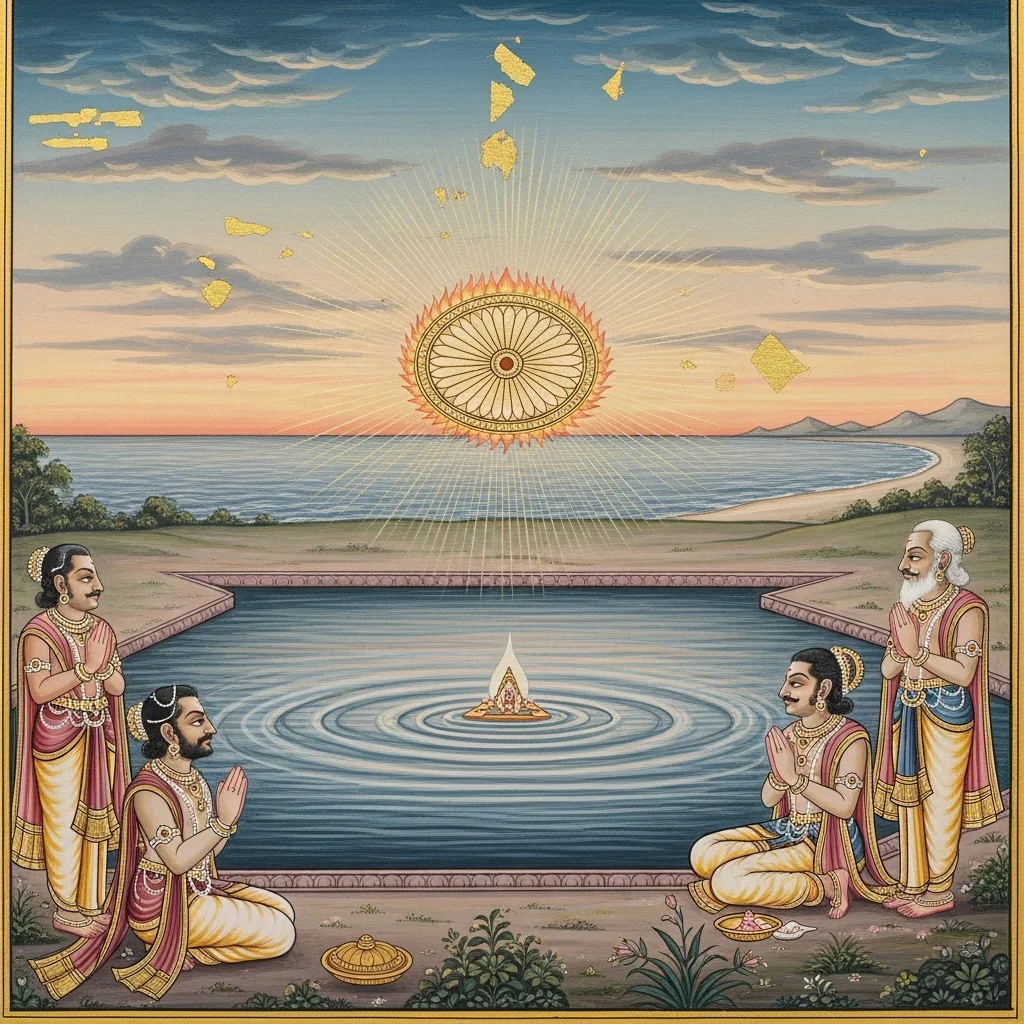
The chapter begins with the ṛṣis asking Sūta about the foremost among the twenty-four Setu tīrthas, especially the tradition’s first-ranked site called Cakratīrtha. Sūta declares its unequaled power to purify: mere remembrance, praise, or a single bath is said to dissolve even accumulated sins and remove the fear of repeated womb-dwelling (a liberation-tinged promise). He then recounts the origin. The sage Gālava, devoted to Viṣṇu, performs severe austerities on the southern seashore near Dharma Puṣkariṇī. Viṣṇu appears in a radiant theophany and grants boons—steadfast bhakti, continued residence in the āśrama, and assured protection by his discus, the Sudarśana cakra. An embedded account tells of Dharma personified doing tapas to Śiva, receiving the boon of becoming Śiva’s vehicle (vṛṣa), and establishing the bathing place Dharma Puṣkariṇī, praised as inexhaustibly fruitful. Returning to Gālava, a rākṣasa attacks him; he appeals to Nārāyaṇa, whereupon Sudarśana arrives, slays the rākṣasa, and proclaims a permanent protective presence at the pond. Because the cakra remains ever near, the place becomes famed as Cakratīrtha; bathing and ancestral offerings there are said to benefit descendants and forebears. The chapter closes with a phalaśruti: hearing or reciting this adhyāya yields the merit of Cakratīrtha’s consecratory bath, granting well-being here and auspicious results beyond.
Shlokas
Verse 1
ऋषय ऊचुः । चतुर्विंशतितीर्थानि यान्युक्तानि त्वया मुने । तेषां प्रधानतीर्थानां सेतौ पापविनाशने
The sages said: O sage, you have spoken of the twenty-four tīrthas. Among those chief tīrthas at Setu, destroyers of sin—(tell us further).
Verse 2
आदिमस्य तु तीर्थस्य चक्रतीर्थमिति प्रथा । कथं समागता सूत वदास्माकं हि पृच्छताम्
For the first tīrtha, the well-known name is ‘Cakratīrtha’. How did this designation arise, O Sūta? Tell us, for we ask.
Verse 3
श्रीसूत उवाच । चतुर्विंशतितीर्थानां प्रधानानां द्विजोत्तमाः । यदुक्तमादिमं तीर्थं सर्वलोकेषु विश्रुतम्
Śrī Sūta said: O best of brāhmaṇas, among the twenty-four principal tīrthas, the first tīrtha that was mentioned is renowned throughout all the worlds.
Verse 4
स्मरणात्तस्य तीर्थस्य गर्भवासो न विद्यते । विलयं यांति पापानि लक्षजन्मकृतान्यपि
By merely remembering that tīrtha, there is no further dwelling in the womb; sins—even those committed over a hundred thousand births—dissolve away.
Verse 5
तस्मिंस्तीर्थे सकृत्स्नाना त्स्मरणात्कीर्तनादपि । लोके ततोधिकं तीर्थं तत्तुल्यं वा द्विजोत्तमाः
O best of the twice-born, by bathing even once in that sacred tīrtha—and even by merely remembering it or singing its praise—there is, in this world, no other tīrtha equal to it, nor any that surpasses it.
Verse 6
न विद्यते मुनिश्रेष्ठाः सत्यमुक्तमिदं मया । गंगा सरस्वती रेवा पंपा गोदावरी नदी
O best of sages, what I say is true: even the Gaṅgā, Sarasvatī, Revā (Narmadā), Pampā, and the river Godāvarī do not equal this tīrtha.
Verse 7
कालिंदी चैव कावेरी नर्मदा मणिकर्णिका । अन्यानि यानि तीर्थानि नद्यः पुण्या महीतले
Likewise Kāliṇdī (Yamunā), Kāverī, Narmadā, Maṇikarṇikā, and whatever other tīrthas and holy rivers exist upon the earth—none is equal to this one.
Verse 8
अस्य तीर्थस्य विप्रेंद्राः कोट्यंशेनापि नो समाः । धर्मतीर्थमिति प्राहुस्तत्तीर्थं हि पुराविदः
O foremost of brāhmaṇas, other tīrthas are not equal to this one even by a ten-millionth part. Therefore the knowers of ancient lore call that sacred place ‘Dharma-tīrtha’.
Verse 9
यथा समागता तस्य चक्रतीर्थमिति प्रथा । तदिदानीं प्रवक्ष्यामि शृणुध्वं मुनिपुंगवाः
How it came to be renowned by the name ‘Cakra-tīrtha’—that I shall now explain. Listen, O bull-like leaders among sages.
Verse 10
सेतुमूलं हि तत्प्रोक्तं तद्दर्भशयनं मतम् । तत्रैव चक्रतीर्थं तु महापातकमर्द्दनम्
That place is proclaimed to be the very “root of Setu” and is revered as the “bed of darbha-grass.” There itself is Cakra-tīrtha, the crusher of great sins.
Verse 11
पुरा हि गालवोनाम मुनिर्विष्णुपरायणः । दक्षिणांभोनिधेस्तीरे हालास्यादविदूरतः
In ancient times there was a sage named Gālava, wholly devoted to Viṣṇu. He dwelt on the shore of the southern ocean, not far from Hālāsya.
Verse 12
फुल्लग्रामसमीपे च तथा क्षीरसरोंतिके । धर्म पुष्करिणीतीरे सोऽतप्यत महत्तपः
Near the village of Phulla, and close to the lake called Kṣīra-saras, on the bank of Dharma-puṣkariṇī, he performed great austerity.
Verse 13
युगानामयुतं ब्रह्म गृणन्विप्राः सनातनम् । दयायुक्तो निराहारः सत्यवान्विजितेंद्रियः
O brāhmaṇas, for ten thousand yugas he praised the eternal Brahman—full of compassion, fasting without food, devoted to truth, and master of his senses.
Verse 14
आत्मवत्सर्वभूतानि पश्यन्विषयनिःस्पृहः । सर्वभूतहितो दांतः सर्वद्वंद्वविवर्जितः
Seeing all beings as his own Self, free from craving for sense-objects—working for the welfare of all creatures, disciplined, and untouched by every pair of opposites.
Verse 15
वर्षाणि कतिचित्सोऽयं जीर्णपर्णाशनोऽभवत । किंचित्कालं जलाहारो वायुभक्षः कियत्समाः
For some years he lived on withered leaves as his food; for a time he subsisted only on water, and for certain years he lived as though feeding on air alone.
Verse 16
एवं पंचसहस्राणि वर्षाणि स महामुनिः । अतप्यत तपो घोरं देवैरपि सुदुष्करम्
Thus for five thousand years that great sage performed a fierce austerity—an undertaking exceedingly difficult even for the gods.
Verse 17
ततः पंचसहस्राणि वर्षाणि मुनिपुंगवः । निराहारो निरालोको निरुच्छ्वासो निरास्पदः
Then, for another five thousand years, that bull among sages remained without food, without worldly sight, with breath restrained, and without any resting-place or support.
Verse 18
वर्षास्वासारसहनं हेमंतेषु जलेशयः । ग्रीष्मे पंचाग्निमध्यस्थो विष्णुध्यानपरायणः
In the rains he endured the downpours; in winter he lay immersed in water; in summer he sat amid the five fires—ever devoted to meditation upon Viṣṇu.
Verse 19
जपन्नष्टाक्षरं मंत्रं ध्यायन्हृदि जनार्दनम् । तताप सुमहातेजा गालवो मुनिपुंगवः
Chanting the eight-syllabled mantra and meditating upon Janārdana within his heart, the radiant Gālava—the best of sages—continued his austerity.
Verse 20
एवं त्वयुतव वर्षाणि स समतीतानि वै मुनेः । अथ तत्तपसा तुष्टो भगवान्कमलापतिः
Thus ten thousand years passed for the sage. Then, pleased by that austerity, the Blessed Lord—the Consort of Kamalā (Lakṣmī)—was satisfied.
Verse 21
प्रत्यक्षतामगात्तस्य शंखचक्रगदाधरः । विकचांबुजपत्राक्षः सूर्यकोटिसमप्रभः
He became directly visible to him—bearing conch, discus, and mace; with wide-open eyes like blossomed lotus petals; radiant like ten million suns.
Verse 22
विनतानंदनारूढश्छत्रचामरशोभितः । हारकेयूरमुकुटकटकादिविभूषितः
Mounted upon Vinatā’s son (Garuḍa), adorned with parasol and fly-whisks, and ornamented with necklaces, armlets, crown, bracelets, and other jewels.
Verse 23
विष्वक्सेनसुनंदादिकिंकरैः परिवारितः । वीणावेणुमृदंगादिवादकैर्नारदादिभिः
Surrounded by attendants such as Viṣvaksena and Sunanda, and by musicians like Nārada and others playing vīṇā, flute, mṛdaṅga, and the rest.
Verse 24
उपगीयमानविजयः पीतांबरविराजितः । लक्ष्मीविराजितोरस्को नीलमेघसमच्छविः
His triumph was being sung; he shone in yellow garments; his chest was resplendent with Lakṣmī; his complexion was like a dark-blue raincloud.
Verse 25
धुनानः पद्ममेकेन पाणिना मधुसूदनः । सनकादिमहायोगिसेवितः पार्श्वयोर्द्वयोः
Madhusūdana (Viṣṇu), gently shaking a lotus with one hand, stood there; on both sides the great yogins, beginning with Sanaka, attended Him, revealing His auspicious presence at the sacred Setu.
Verse 26
मंदस्मितेन सकलं मोहयन्भुवनत्रयम् । स्वभासा भासयन्सर्वान्दिशो दश च भूसुराः
With a gentle smile He enchanted the whole threefold world; and by His own radiance He illumined all beings and the ten directions, O best of brāhmaṇas.
Verse 27
कंठलग्रेन मणिना कौस्तुभेन च शोभितः । सुवर्णवेत्रहस्तैश्च सौविदल्लैरनेकशः
Adorned with the Kaustubha jewel resting upon His neck, He shone resplendent; and many attendants bearing golden staffs stood around Him.
Verse 28
अनन्यदुर्लभाचिंत्यगीयमाननिजाद्भुतः । सुभक्तसुलभो देवो लक्ष्मीकांतो हरिः स्वयम्
He—Hari Himself, the beloved of Lakṣmī—whose wondrous nature is inconceivable and sung in praise, hard to attain by any other means, becomes easily accessible to devoted worshippers.
Verse 29
सन्न्यधत्त पुरस्तस्य गालवस्य महामुनेः । आविर्भूतं तदा दृष्ट्वा श्रीवत्सांकितवक्षसम्
He then manifested and stood before the great sage Gālava; and seeing the Lord revealed, bearing the Śrīvatsa mark upon His chest, the sage beheld Him in awe and reverence.
Verse 30
पीतांबरधरं देवं तुष्टिं प्राप महामुनिः । भक्त्या परमया युक्तस्तुष्टाव जगदीश्वरम्
Beholding the God clad in yellow garments, the great sage attained deep contentment; endowed with supreme devotion, he praised the Lord of the universe.
Verse 31
गालव उवाच । नमो देवादिदेवाय शंखचक्रगदाभृते । नमो नित्याय शुद्धाय सच्चिदानंदरूपिणे
Gālava said: Salutations to the God of gods, the bearer of conch, discus, and mace. Salutations to the Eternal, the Pure, whose very nature is Being, Consciousness, and Bliss.
Verse 32
नमो भक्तार्ति हंत्रे ते हव्यकव्यस्वरूपिणे । नमस्त्रिमूर्तये तुभ्यं सृष्टिस्थित्यंतकारिणे
Salutations to You, the remover of devotees’ distress, the very form of offerings made to gods and ancestors. Salutations to You as the Threefold One, who brings about creation, preservation, and dissolution.
Verse 33
नमः परेशाय नमो विभूम्ने नमोस्तु लक्ष्मीपतये विधात्रे । नमोस्तु सूर्येंदुविलोचनाय नमो विरिंच्याद्यभिवंदिताय
Salutations to the Supreme Lord, salutations to the All-pervading Great One. Salutations to the Consort of Lakṣmī, the Ordainer. Salutations to Him whose eyes are the sun and the moon; salutations to Him whom Brahmā and the foremost beings worship.
Verse 34
यो नामजात्यादिविकल्पहीनः समस्तदोषैरपि वर्जितो यः । स्रमस्तसंसारभयापहारिणे तस्मै नमो दैत्यविनाशनाय
Salutations to Him who is beyond all limiting distinctions such as name and birth; who is free from every fault; who removes all fear arising from worldly existence—to that destroyer of the Daityas, obeisance.
Verse 35
वेदांतवेद्याय रमेश्वराय वैकुण्ठवासाय विधातृपित्रे । नमोनमः सत्यजनार्तिहारिणे नारायणायामितविक्रमाय
Salutations again and again to Nārāyaṇa of immeasurable might—known through the Vedānta; Lord of Ramā; dweller in Vaikuṇṭha; the very Father of the Creator; remover of the suffering of the truthful and devoted.
Verse 36
नमस्तुभ्यं भग वते वासुदेवाय शार्ङ्गिणे । भूयोभूयो नमस्तुभ्यं शेषपर्यंकशायिने
Salutations to You, the Blessed Lord Vāsudeva, wielder of the Śārṅga bow. Again and again, salutations to You who recline upon the couch of Śeṣa.
Verse 37
इति स्तुत्वा हरिं विप्रास्तूष्णीमास्ते स गालवः । श्रुत्वा स्तुतिं श्रुति सुखां हरिस्तस्यमहात्मनः
Thus, having praised Hari, the brāhmaṇa Gālava fell silent. Hearing that hymn, delightful to the ear, Hari listened to the words of that great-souled sage.
Verse 38
अवाप परमं तोषं शंखचक्रगदाधरः । अथालिंग्य मुनिं शौरिश्चतुर्भिर्बाहुभिस्तदा
The bearer of conch, discus, and mace was filled with supreme delight. Then Śauri embraced the sage with His four arms.
Verse 39
बभाषे प्रीतिसं युक्तो वरो वै व्रियतामिति । तुष्टोऽस्मि तपसा तेऽद्य स्तोत्रेणापि च गालव
Filled with affection, He spoke: “Choose a boon indeed.” “O Gālava, today I am pleased with your austerity—and also with your hymn.”
Verse 40
नमस्कारेण च प्रीतो वरदोऽहं तवागतः । गालव उवाच । नारायण रमानाथ पीतांबर जगन्मय
“Pleased also by your obeisance, I have come to you as a bestower of boons.” Gālava said: “O Nārāyaṇa, Lord of Ramā, O wearer of yellow raiment, O You who pervade the universe…”
Verse 41
जनार्दन जगद्धामन्गोविंद नरकांतक । त्वद्दर्शनात्कृतार्थोऽस्मि सर्वस्मादधिकस्तथा
O Janārdana, abode of the worlds; O Govinda, destroyer of Naraka! By beholding You, my purpose is fulfilled, and I am satisfied beyond all else.
Verse 42
त्वां न पश्यंत्यधर्मिष्ठा यतस्त्वं धर्मपालकः । यन्न वेत्ति भवो ब्रह्मा यन्न वेत्ति त्रयी तथा
The unrighteous do not behold You, for You are the protector of Dharma. That which even Bhava and Brahmā do not fully know—nor even the threefold Veda—(is Your true nature).
Verse 43
तं वेद्मि परमात्मानं किमस्मा दधिकं वरम् । योगिनो यं न पश्यन्ति यं न पश्यंति कर्मठाः
I know Him as the Paramātman, the Supreme Self—what boon could be greater than this? Him whom even yogins do not behold, and whom those devoted only to ritual action do not see.
Verse 44
तं पश्यामि परात्मानं किमस्मादधिकं वरम् । एतेन च कृतार्थोऽस्मि जनार्दन जगत्पते
I behold that Supreme Spirit—what boon could be greater than this? By this alone I am fulfilled, O Janārdana, Lord of the world.
Verse 45
यन्नामस्मृतिमात्रेण महापातकिनोऽपिच । मुक्तिं प्रयांति मुनयस्तं पश्यामि जनार्दनम्
He whose Name, merely remembered, grants liberation even to those stained by great sins—Him, Janārdana, I behold before me.
Verse 46
त्वत्पादपद्मयुगले निश्चला भक्तिरस्तुमे । हरिरुवाच । मयि भक्तिर्दृढा तेऽस्तु निष्कामा गालवाधुना
“May my devotion be unwavering at the pair of Your lotus-feet.” Hari said: “Now, O Gālava, let firm devotion to Me arise in you—desireless and steadfast.”
Verse 47
शृणु चाप्यपरं वाक्यमुच्यमानं मया मुने । मदर्थं कर्म कुर्वाणो मद्ध्यानो मत्परायणः
“Listen also to another teaching I shall speak, O sage: performing actions for My sake, meditating on Me, and taking refuge in Me alone…”
Verse 48
एतत्प्रारब्धदेहांते मत्स्वरूपमवाप्स्यसि । अस्मिन्नेवाश्रमे वासं कुरुष्व मुनिपुंगव
“At the end of this body—sustained by its destined momentum—you shall attain My own nature. Therefore, O foremost of sages, dwell right here in this āśrama.”
Verse 49
धर्मपुष्करिणी चेयं पुण्या पापविनाशिनी । अस्यास्तीरे तपः कुर्वंस्तपःसिद्धिमवाप्नुयात्
“This is Dharmapuṣkariṇī—holy and a destroyer of sin. Performing tapas on its bank, one attains the fruition and perfection of austerity.”
Verse 50
धर्मः पुरा समागत्य दक्षिणस्योदधेस्तटे । तपस्तेपे महादेवं चिंतयन्मनसा तदा
In ancient times Dharma came to the shore of the southern ocean and performed austerities there, meditating within his mind upon Mahādeva.
Verse 51
स्नानार्थमेकं तीर्थं च चक्रे धर्मो महामुने । धर्मपुष्करिणी तेन प्रसिद्धा तत्कृता यतः
For bathing, O great sage, Dharma established a sacred tīrtha; because it was made by him, it became renowned as Dharmapuṣkariṇī.
Verse 52
त्वया यथा तपस्तप्तमिदानीं मुनिसत्तम । तथा तप्तं तपस्तेन धर्मेण हरसेविना
O best of sages, just as you have performed austerity now, so too was austerity performed here by that Dharma, devoted to the service of Hara (Śiva).
Verse 53
तपसा तस्य तुष्टः सञ्छूलपाणिर्महेश्वरः । प्रादुरासीस्त्वया दीप्त्या दिशोदशविभासयन्
Pleased with his austerity, Maheśvara, bearing the trident, manifested and with His radiance illumined the ten directions.
Verse 54
अथाश्रममनुप्राप्तं महादेवं कृपानिधिम् । धर्मः परमसन्तुष्टस्तुष्टाव परमेश्वरम्
Then, when Mahādeva—the treasure-house of compassion—arrived at the āśrama, Dharma, supremely delighted, praised that Supreme Lord.
Verse 55
धर्म उवाच । प्रणमामि जगन्नाथमीशानं प्रणवात्मकम् । समस्तदेवतारूपमादिमध्यांतवर्जितम्
Dharma said: “I bow to the Lord of the universe—Īśāna, whose very essence is the sacred syllable Oṁ; who embodies the forms of all the gods, and who is beyond beginning, middle, and end.”
Verse 56
ऊर्ध्वरेतं विरूपाक्षं विश्वरूपं नमाम्य हम् । समस्तजगदाधारमनन्तमजमव्ययम्
“I bow to the One of uplifted vital power, the Three-eyed Lord, the One whose form is the universe itself—support of all worlds; infinite, unborn, and imperishable.”
Verse 57
यमामनन्ति योगीन्द्रास्तं वन्दे पुष्टिवर्धनम् । नमो लोकाधिनाथाय वंचते परिवंचते
“I adore Him whom the lordly yogins proclaim—He who increases well-being and spiritual fullness. Homage to the sovereign of the worlds, who outwits the deceiver and the great deceiver.”
Verse 58
नमोऽस्तु नीलकण्ठाय पशूनां पतये नमः । नमः कल्मषनाशाय नमो मीढुष्टमाय च
“Salutations to Nīlakaṇṭha (the Blue-throated One); salutations to the Lord of beings (Paśupati). Homage to the destroyer of sin; and homage also to the most gracious bestower of blessings.”
Verse 59
नमो रुद्राय देवाय कद्रुद्राय प्रचेतसे । नमः पिनाकहस्ताय शूलहस्ताय ते नमः
“Homage to Rudra, the shining God; homage to the fierce Rudra, the all-knowing Overseer. Salutations to Him who bears the Pināka bow; salutations to You who bear the trident.”
Verse 60
नमश्चैतन्यरूपाय पुष्टीनां पतये नमः । नमः पंचास्यदेवाय क्षेत्राणां पतये नमः
Homage to You whose very form is pure Consciousness; homage to the Lord of all prosperities. Homage to the Five-faced God; homage to the Lord of sacred kṣetras and holy precincts.
Verse 61
इति स्तुतो महादेवः शंकरोलोकशंकरः । धर्मस्य परमां तुष्टिमापन्नस्तमुवाच वै
Thus praised, Mahādeva Śaṅkara—the benefactor of the worlds—became supremely pleased with Dharma and then spoke to him.
Verse 62
महेश्वर उवाच । प्रीतोस्म्यनेन स्तोत्रेण तव धर्म महामते । वरं मत्तो वृणीष्व त्वं मा विलंबं कुरुष्व वै
Maheśvara said: “O Dharma, great-minded one, I am pleased by this hymn of yours. Choose a boon from me—do not delay.”
Verse 63
ईश्वरेणैवमुक्तस्तु धर्मो देवमथाब्रवीत् । वाहनं ते भविष्यामि सदाहं पार्वतीपते
When Īśvara spoke thus, Dharma replied to the God: “O Lord of Pārvatī, I shall forever be your vehicle.”
Verse 64
अयमेव वरो मह्यं दातव्यस्त्रिपुरांतक । तवोद्वहनमात्रेण कृतार्थोऽहं भवामि भोः
“This boon alone be granted to me, O Destroyer of Tripura: by merely bearing You as Your mount, I am fulfilled, O Lord.”
Verse 65
इत्थं धर्मेण कथितो देवो धर्ममथाब्रवीत् । ईश्वर उवाच । वाहनं भव मे धर्म सर्वदा लोकपूजितः
Thus addressed by Dharma, the Lord spoke to Dharma: “O Dharma, become My mount, ever worshipped by the worlds.”
Verse 66
मम चोद्वहने शक्तिरमोघा ते भविष्यति । त्वत्सेविनां सदा भक्तिर्मयि स्यान्नात्र संशयः
“In bearing Me, your power shall be unfailing; and for those who serve you, devotion to Me will ever arise—of this there is no doubt.”
Verse 67
इत्युक्ते शंकरेणाथ धर्मोपि वृषरूपधृक् । उवाह परमेशानं तदाप्रभृति गालव
When Śaṅkara had spoken thus, Dharma too—assuming the form of a bull—bore the Supreme Lord from that time onward, O Gālava.
Verse 68
महादेवस्तमारुह्य धर्मं वै वृषरूपिणम् । शोभमानो भृशं धर्ममुवाच परमामृतम्
Mahādeva mounted Dharma in his bull-form; radiant with splendor, He spoke to Dharma words like supreme nectar.
Verse 69
ईश्वर उवाच । त्वया कृतं हि यत्तीर्थं दक्षिणस्योदधेस्तटे । धर्मपुष्करिणीत्येषा लोके ख्याता भविष्यति
Īśvara said: “The sacred ford you have established on the shore of the Southern Ocean shall become renowned in the world as ‘Dharmapuṣkariṇī’.”}]}
Verse 71
अनंतफलदा ज्ञेया नात्र कार्या विचारणा । इति दत्त्वा वरं तस्मै धर्मतीर्थाय शंकरः
“Know it to bestow endless fruits—no deliberation is needed here.” Thus, having granted the boon to that Dharma-tīrtha, Śaṅkara concluded.
Verse 72
आरुह्य वृषभं धर्मं कैलासं पर्वतं ययौ । धर्मपुष्करिणीतीरे गालव त्वमतोधुना
Mounting Dharma as the bull, He departed for Mount Kailāsa. “Therefore now, O Gālava, remain on the bank of Dharmapuṣkariṇī…”
Verse 73
शरीरपातपर्यंतं तपः कुर्वन्समाहितः । वस त्वं मुनि शार्दूल पश्चान्मामाप्स्यसे ध्रुवम्
“Perform austerity (tapas) with steady concentration until the fall of the body. Dwell here, O tiger among sages; afterward you shall surely attain Me.”
Verse 74
यदा ते जायते भीतिस्तदा तां नाशयाम्यहम् । ममायुधेन चक्रेण प्रेरितेन मया क्षणात्
“Whenever fear arises in you, then I shall destroy it—instantly—by My weapon, the discus (cakra), set in motion by Me.”
Verse 75
इत्युक्त्वा भगवान्विष्णुस्तत्रैवांतरधीयत । श्रीसूत उवाच । तस्मिन्नंतर्हिते विष्णौ गालवो मुनिपुंगवः
Having spoken thus, Lord Viṣṇu vanished there itself. Śrī Sūta said: When Viṣṇu had disappeared, Gālava—the foremost of sages—…
Verse 76
धर्मपुष्करिणीतीरे विष्णुध्यानपरायणः । त्रिकालमर्चयन्विष्णुं शालग्रामे विमुक्तिदे
On the bank of Dharmapuṣkariṇī, wholly devoted to meditation on Viṣṇu, he worshipped Viṣṇu at the three sacred times of day—He who grants liberation when adored in the form of Śālagrāma.
Verse 77
उवास मतिमान्धीरो विरक्तो विजितेंद्रियः । कदाचिन्माघमासे तु शुक्लपक्षे हरेर्दिने
The wise and steadfast one dwelt there, detached and master of his senses. And once, in the month of Māgha, in the bright fortnight, on the day sacred to Hari,
Verse 78
उपोष्य जागरं कृत्वा रात्रौ विष्णुमपूजयत् । स्नात्वा परेद्युर्द्वादश्यां धर्मपुष्करिणीजले
Having fasted and kept vigil, he worshipped Viṣṇu in the night. Then, on the next day—on Dvādaśī—he bathed in the waters of Dharmapuṣkariṇī.
Verse 79
संध्यावन्दनपूर्वाणि नित्यकर्माणि चाकरोत् । ततः पूजां विधातुं स हरेः समुपचक्रमे
He performed his daily duties, beginning with the Sandhyā prayers; thereafter, he set about arranging the worship of Hari.
Verse 80
तुलस्यादीनि पुष्पाणि समाहृत्य च गालवः । विधाय पूजां कृष्णस्य स्तोत्रमेतदुदैरयत्
Gathering flowers such as tulasī and others, Gālava performed the worship of Kṛṣṇa, and then recited this hymn of praise.
Verse 81
गालव उवाच । सहस्रशिरसं विष्णुं मत्स्यरूपधरं हरिम् । नमस्यामि हृषीकेशं कूर्मवाराहरूपिणम्
Gālava said: I bow to Viṣṇu of a thousand heads, to Hari who assumed the form of the Fish. I reverence Hṛṣīkeśa, who took the forms of the Tortoise and the Boar.
Verse 82
नारसिंहं वामनाख्यं जाम दग्न्यं च राघवम् । बलभद्रं च कृष्णं च कल्किं विष्णुं नमाम्यहम्
I bow to Viṣṇu as Narasiṃha, as Vāmana, as Jāmadagnya (Paraśurāma), and as Rāghava (Rāma); to Balabhadra and Kṛṣṇa, and to Kalki as well—I bow to Viṣṇu.
Verse 83
वासुदेवमनाधारं प्रणतार्तिविनाशनम् । आधारं सर्वभूतानां प्रणमामि जनार्दनम्
I bow to Vāsudeva, who has no support beyond Himself, who destroys the suffering of those who take refuge. I bow to Janārdana, the support of all beings.
Verse 84
सर्वज्ञं सर्वकर्तारं सच्चिदानंदविग्रहम् । अप्रतर्क्यमनिर्देश्यं प्रणतोऽस्मि जनार्दनम्
I bow to Janārdana—omniscient, the doer of all, whose form is Being-Consciousness-Bliss; beyond reasoning and beyond definitive description.
Verse 85
एवं स्तुवन्महा योगी गालवो मुनिपुंगवः । धर्मपुष्करिणीतीरे तस्थौ ध्यानपरायणः
Thus, praising the Lord, the great yogin Gālava—bull among sages—remained on the bank of Dharmapuṣkariṇī, wholly devoted to meditation.
Verse 86
एतस्मिन्नंतरे कश्चिद्राक्षसो गालवं मुनिम् । आययौ भक्षितुं घोरः क्षुधया पीडितो भृशम्
Just then, a certain terrifying rākṣasa came to devour the sage Gālava, grievously tormented by hunger.
Verse 87
गालवं तरसा सोऽयं राक्षसो जगृहे तदा । गृहीतस्तरसा तेन गालवो नैऋतेन सः
Then that rākṣasa seized Gālava with force; and Gālava was indeed violently grabbed by that demon.
Verse 88
प्रचुक्रोश दयां भोधिमापन्नानां परायणम् । नारायणं चक्रपाणिं रक्षरक्षेति वै मुहुः
He cried out to Nārāyaṇa, the wielder of the discus—an ocean of compassion, the sure refuge of the distressed—again and again: “Protect me, protect me!”
Verse 89
परेश परमानंद शरणागतपालक । त्राहि मां करुणासिंधो रक्षोवशे मुपागतम्
O Supreme Lord, O highest bliss, protector of those who seek refuge—save me, ocean of compassion, who have fallen under the power of a rākṣasa!
Verse 90
लक्ष्मीकांत हरे विष्णो वैकुंठ गरुडध्वज । मां रक्ष रक्षसाक्रांतं ग्राहाक्रांतं गजं यथा
O beloved of Lakṣmī, O Hari, O Viṣṇu—Lord of Vaikuṇṭha, whose banner is Garuḍa—protect me who am seized by a rākṣasa, as you once protected the elephant seized by the crocodile.
Verse 91
दामोदर जगन्नाथ हिरण्यासुर मर्द्दन । प्रह्रादमिव मां रक्ष राक्षसेनातिपीडितम्
O Dāmodara, Lord of the world, slayer of Hiraṇyāsura—protect me, sorely tormented by a rākṣasa, just as you protected Prahlāda.
Verse 92
इत्येवं स्तुवतस्तस्य गालवस्य द्विजोत्तमाः । स्वभक्तस्य भयं ज्ञात्वा चक्रपाणिवृषा कपिः
As Gālava thus praised the Lord, O best of brāhmaṇas, Cakrapāṇi—ever true to his devotees—knowing the fear of his own worshipper, prepared to act.
Verse 93
स्वचक्रं प्रेषयामास भक्तरक्षणकारणात् । प्रेरितं विष्णुचक्रं तद्विष्णुना प्रभविष्णुना
For the sake of protecting his devotee, he dispatched his own discus. That Viṣṇu-disc was set in motion by Viṣṇu himself, the all-powerful Lord.
Verse 94
आजगामाथ वेगेन धर्मपुष्करिणी तटम् । अनंतादित्यसंकाशमनंताग्निसमप्रभम्
Then, with great speed, it came to the bank of Dharmapuṣkariṇī—radiant like countless suns, blazing like innumerable fires.
Verse 95
महाज्वालं महानादं महासुरविमर्दनम् । दृष्ट्वा सुदर्शनं विष्णो राक्षसोऽथ प्रदुद्रुवे
Seeing Viṣṇu’s Sudarśana—flaming greatly, roaring loudly, and crushing mighty demons—the rākṣasa then fled in terror.
Verse 96
द्रवमाणस्य तस्याशु राक्षसस्य सुदर्शनम् । शिरश्चकर्त सहसा ज्वालामालादुरासदम्
As that rākṣasa fled swiftly, Sudarśana—unapproachable, wreathed in a garland of flames—at once cut off his head.
Verse 97
ततस्तु गालवो दृष्ट्वा राक्षसं पतितं भुवि । मुदा परमया युक्तस्तुष्टाव च सुदर्शनम्
Then Gālava, seeing the rākṣasa fallen upon the ground, filled with supreme joy, praised Sudarśana.
Verse 98
गालव उवाच । विष्णुचक्रं नमस्तेस्तु विश्वरक्षणदीक्षित । नारायणकरांभोजभूषणाय नमोऽस्तु ते
Gālava said: “Obeisance to you, O Viṣṇu’s discus—consecrated for the protection of the universe! O adornment of Nārāyaṇa’s lotus-hand, obeisance to you.”
Verse 99
युद्धेष्वसुरसंहारकुशलाय महारव । सुदर्शन नमस्तुभ्यं भक्तानामार्तिनाशिने
O Sudarśana, thunderous in roar, expert in destroying asuras in battle—salutations to you, the remover of devotees’ distress.
Verse 100
रक्ष मां भयसंविग्नं सर्वस्मादपि कल्मषात् । स्वामिन्सुदर्शन विभो धर्मर्तीर्थे सदा भवान्
Protect me, shaken by fear, from every taint of sin. O master Sudarśana, O all-pervading Lord—may you ever abide at Dharma-tīrtha.
Verse 101
संनिधेहि हिताय त्वं जगतो मुक्तिकांक्षिणः । गालवेनैवमुक्तं तद्विष्णुचक्रं मुनीश्वराः । तं प्राह गालवमुनिं प्रीणयन्निव सौहृदात्
“Abide here for the welfare of the world that longs for liberation.” Thus addressed by Gālava, that Viṣṇu-disc, O best of sages, spoke to the sage Gālava—pleasing him, as it were, out of friendliness.
Verse 102
सुदर्शन उवाच । गालवैतन्महापुण्यं धर्मतोर्थमनुत्तमम्
Sudarśana said: “O Gālava, this Dharma-tīrtha is supremely excellent and possessed of great merit.”
Verse 103
अस्मिन्वसामि सततं लोकानां हितकाम्यया । त्वत्पीडां परिचिंत्याह राक्षसेन दुरात्मना
“I dwell here constantly, desiring the welfare of the worlds. Reflecting upon the torment inflicted on you by that wicked rākṣasa…”
Verse 104
प्रेरितो विष्णुना विप्र त्वरया समुपागतः । त्वत्पीडकोथ निहतो मयायं राक्षसाधमः
“O brāhmaṇa, sent by Viṣṇu I came here in haste. Then this vilest rākṣasa—your tormentor—was slain by me.”
Verse 105
मोचितस्त्वं भयादस्मात्त्वं हि भक्तो हरेः सदा । पुष्करिण्यामहं त्वस्यां धर्मस्य मुनिपुंगव
“You have been freed from this fear, for you are always a devotee of Hari. And I abide in this sacred tank of Dharma, O bull among sages.”
Verse 106
सततं लोकरक्षार्थं संनिधानं करोमि वै । अस्यां मत्संनिधानात्ते तथान्येषामपि द्विज
For the unceasing protection of the worlds, I truly maintain my abiding presence here. By my presence in this place, O brāhmaṇa, protection and blessing come to you—and to others as well.
Verse 107
इतः परं न पीडा स्याद्भूतराक्षससंभवा । धर्मपुष्करिणी ह्येषा सर्वपापविनाशिनी
From this point onward, there shall be no affliction arising from bhūtas or rākṣasas. For this is the Dharmapuṣkariṇī, truly the destroyer of all sins.
Verse 108
देवीपट्टणपर्यंता कृता धर्मेण वै पुरा । अत्र सर्वत्र वत्स्यामि सर्वदा मुनिपुंगव
Formerly, by Dharma, this sacred domain was established up to Devīpaṭṭaṇa. Here, in all these places, I shall dwell forever, O best of sages.
Verse 109
अस्या मत्संनिधा नात्स्याच्चक्रतीर्थमिति प्रथा । स्नानं येऽत्र प्रकुर्वंति चक्रतीर्थे विमुक्तिदे
Because of my presence here, the renowned name “Cakratīrtha” arises. Those who bathe here—at this Cakratīrtha, the giver of liberation—attain freedom.
Verse 110
तेषां पुत्राश्च पौत्राश्च वंशजाः सर्व एव हि । विधूतपापा यास्यंति तद्विष्णोः परमं पदम्
Their sons and grandsons—indeed all descendants—having their sins shaken off, go to the supreme abode of Viṣṇu.
Verse 111
पितॄनुद्दिश्य पिंडानां दातारो येऽत्र गालव । स्वर्गं प्रयांति ते सर्वे पितरश्चापि तर्प्पिताः
Those who offer piṇḍas here, intending the Pitṛs, O Gālava—every one of them goes to heaven, and the ancestors too are satisfied.
Verse 112
इत्युक्त्वा विष्णुचक्रं तद्गालवस्यापि पश्यतः । अन्येषामपि विप्राणां पश्यतां सहसा द्विजाः
Having spoken thus, that discus of Viṣṇu—while Gālava himself was watching, and while other brāhmaṇas too were watching—then suddenly, O twice-born…
Verse 113
धर्मापुष्कारिणीं तां तु प्राविशत्पापनाशिनीम् । श्रीसूत उवाच । धर्मतीर्थस्य विप्रंद्राश्चक्रतीर्थमिति प्रथा
It entered that Dharmapuṣkariṇī, the destroyer of sins. Śrī Sūta said: “O best of brāhmaṇas, in the tradition of Dharmatīrtha it is famed as Cakratīrtha.”
Verse 114
प्राप्ता यथा तत्कथितं युष्माकं हि मया मुदा । चक्रतीर्थसमं तीर्थं न भूतं न भविष्यति
Just as it was told, so has it been conveyed to you by me with joy. No tīrtha equal to Cakratīrtha has existed, nor shall it ever exist.
Verse 116
अत्र स्नाता नरा विप्रा मोक्षभाजो न संशयः । कीर्तयेदिममध्यायं शृणुयाद्वा समाहितः । चक्र तीर्थाभिषेकस्य प्राप्नोति फलमुत्तमम् । इह लोके सुखं प्राप्य परत्रापिसुखं लभेत्
Those men, O brāhmaṇas, who bathe here become fit for liberation—of this there is no doubt. One who recites this chapter, or listens to it with collected mind, obtains the highest fruit of bathing at Cakratīrtha. Having gained happiness in this world, he also attains happiness in the next.
Verse 117
यो धर्मतीर्थं च तथैव गालवं कुर्वाणगत्युग्रसमाधियो गम् । सुदर्शनं राक्षसनाशनं च स्मरेत्सकृद्वा न स पापभाग्जनः
Whoever—even once—remembers Dharmatīrtha, the sage Gālava (of fierce, disciplined yogic samādhi), and Sudarśana, the destroyer of rākṣasas, does not become a sharer in sin.