Adhyaya 32
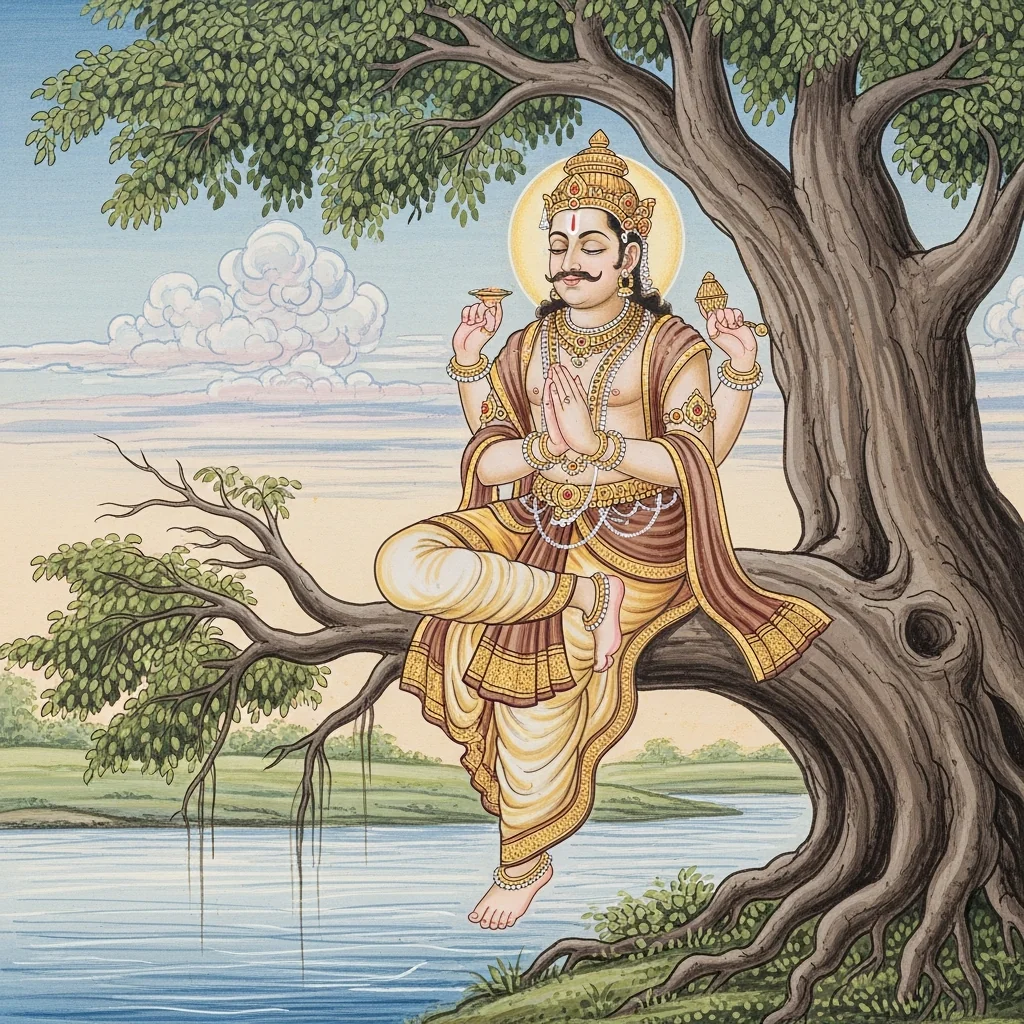
Sūta addresses the sages of Naimiṣāraṇya and proclaims the vaibhava (glory) of Dhanuṣkoṭi. King Nanda of the Soma-vaṃśa entrusts the realm to his son Dharmagupta and retires to an ascetic forest. Dharmagupta rules by dharma, performs many sacrifices, and supports the Brāhmaṇas; the land is portrayed as orderly and undisturbed. While hunting in a perilous forest, night falls; the king performs the evening observance and recites the Gāyatrī. A bear (ṛkṣa) fleeing a lion climbs the same tree and proposes a righteous pact of mutual protection through the night. When the bear sleeps, the lion urges betrayal, but the bear denounces viśvāsa-ghāta—betrayal of trust—as a sin heavier than others. Later the lion persuades the king to drop the sleeping bear; the bear survives by merit and reveals himself as Dhyanakāṣṭha, a sage of Bhṛgu’s lineage, in bear-form. He curses the king with madness for harming an innocent sleeper. The lion is then known to be a yakṣa, Bhadranāma, Kubera’s secretary, made a lion by Gautama’s curse; through dialogue with Dhyanakāṣṭha he is released and regains his yakṣa form. Dharmagupta, driven mad, is brought to Nanda, who consults the sage Jaimini. Jaimini prescribes bathing at Dhanuṣkoṭi on the southern ocean near Setu, a supremely purifying tīrtha that cleanses even grave impurities. Nanda takes his son there; by regulated bathing and worship of Rāmanātha (Śiva), the madness ends at once. Dharmagupta donates wealth and land and returns to righteous rule, and the text affirms the tīrtha’s power to relieve mental disturbance and affliction. The concluding phalaśruti declares that even hearing this account purifies, and that reciting “Dhanuṣkoṭi” three times before bathing yields exalted results.
Shlokas
Verse 1
श्रीसूत उवाच । भूयोऽपिसंप्रवक्ष्यामि धनुष्कोटेस्तु वैभवम् । युष्माकमादरेणाहं नैमिषारण्यवा सिनः
Śrī Sūta said: Once again I shall proclaim the greatness of Dhanuṣkoṭi. O dwellers of Naimiṣāraṇya, it is out of reverence for you that I speak.
Verse 2
नंदोनाम महाराजः सोमवंशसमुद्भवः । धर्मेण पालयामास सागरांतां धरामिमाम्
There was a great king named Nanda, born of the Lunar dynasty. By righteousness (dharma) he protected this earth, bounded by the oceans.
Verse 3
तस्य पुत्रः समभवद्धर्मगुप्त इति श्रुतः । राज्य रक्षाधुरं नंदो निजपुत्रे निधाय सः
His son was born, famed by the name Dharmagupta. Nanda entrusted to his own son the burden of protecting the kingdom.
Verse 4
जितेंद्रियो जिताहारः प्रविवेश तपोवनम् । ताते तपोवनं याते धर्मगुप्ताभिधो नृपः
Having conquered his senses and restrained his diet, he entered the forest of austerities. When his father had gone to the hermitage-forest, the king named Dharmagupta assumed the royal charge.
Verse 5
मेदिनीं पालया मास धर्मज्ञो नीतितत्परः । ईजे बहुविधैर्यज्ञैर्देवानिंद्रपुरोगमान्
He safeguarded the earth, knowing dharma and devoted to wise rule. He worshipped the gods, with Indra at their head, through sacrifices of many kinds.
Verse 6
ब्राह्मणेभ्यो ददौ वित्तं क्षेत्राणि च बहूनि सः । सर्वे स्वधर्मनिरतास्तस्मिन्राजनि शासति
He bestowed wealth and many lands upon the Brāhmaṇas. While that king ruled, all people remained devoted to their own duties.
Verse 7
बभूवुर्नाभवन्पीडास्तस्मिंश्चोरादिसंभवाः । कदाचिद्धर्मगुप्तोऽयमारूढस्तुरगोत्तमम्
There were no afflictions; troubles such as those caused by thieves did not arise while he ruled. Once, this Dharmagupta mounted an excellent horse.
Verse 8
वनं विवेश विप्रेंद्रा मृगयारसकौ तुकी । तमालतालहिंतालकुरवाकुलदिङ्मुखे
O best of Brāhmaṇas, delighting in the sport of the hunt, he entered a forest whose horizons were thick with tamāla, tāla, hiṃtāla, and kurava trees.
Verse 9
विचचार वने तस्मिन्सिंहव्याघ्रभयानके । मत्तालिकुलसंनादसंमूर्छितदिगंतरे
He roamed within that forest, fearful with lions and tigers, where the quarters were overwhelmed by the roaring of intoxicated swarms of bees.
Verse 10
पद्म कल्हारकुमुदनीलोत्पलवनाकुलैः । तटाकैरपि संपूर्णे तपस्विजनमंडिते
It was also filled with ponds crowded by thickets of lotuses—padma, kalhāra, kumuda, and blue nīlotpala—and adorned by communities of ascetics.
Verse 11
तस्मिन्वने संचरतो धर्मगुप्तस्य भूपतेः । अभूद्विभावरी विप्रास्त मसावृतदिङ्मुखा
O brāhmaṇas, as King Dharmagupta wandered in that forest, night fell, and all the directions became veiled in darkness.
Verse 12
राजापि पश्चिमां संध्यामुपास्य नियमान्वितः । जजाप तत्र च वने गायत्रीं वेदमातरम्
The king too—disciplined in observances—performed the evening twilight worship, and there in the forest he recited the Gāyatrī, the Mother of the Vedas.
Verse 13
सिंहव्याघ्रादिभीत्या स्मिन्वृक्षमेकं समास्थिते । राजपुत्रे तदाभ्यागादृक्षः सिंहभयार्दितः
When the prince, fearing lions, tigers, and the like, had climbed up into a certain tree, then a bear—tormented by fear of a lion—came rushing there.
Verse 14
अन्वधावतं तं ऋक्षमैकः सिंहो वनेचरः । अनुद्रुतः स सिंहेन ऋक्षो वृक्षमुपारुहत्
A forest-dwelling lion pursued that bear; chased by the lion, the bear climbed up the tree.
Verse 15
आरुह्य ऋक्षो वृक्षं तं ददर्श जगतीपतिम् । वृक्षस्थितं महात्मानं महाबलपराक्रमम्
Having climbed that tree, the bear beheld the lord of the earth—the great-souled king—standing upon the tree, mighty in strength and valor.
Verse 16
उवाच भूपतिं दृष्ट्वा ऋक्षोयं वनगोचरः । मा भीतिं कुरु राजेंद्र वत्स्यावो रजनीमिह
Seeing the king, the forest-roaming bear said: “O lord of kings, do not fear; let us pass this night here.”
Verse 17
महासत्त्वो महाकायो महादंष्ट्रासमाकुलः । वृक्षमूलं समायातः सिंहो यमतिभीषणः
A lion of immense ferocity and huge body, bristling with great fangs—terrifying like Yama—came to the foot of the tree.
Verse 18
रात्र्यर्धं भज निद्रा त्वं रक्ष्यमाणो मयादितः । ततः प्रसुप्तं मां रक्ष शर्वर्यर्धं महामते
“Sleep for half the night; I shall guard you first. Then, when I have fallen asleep, protect me for the remaining half of the night, O wise one.”
Verse 19
इति तद्वाक्यमादाय सुप्ते नंदसुते हरिः । प्रोवाच ऋक्षं सुप्तोऽयं नृपश्च त्यज्यतामिति
Having accepted that proposal, when the king’s son had fallen asleep, Hari—Nanda’s son—said to the bear: “This prince is asleep; abandon him.”
Verse 20
तं सिंहमब्रवीदृक्षो धर्मज्ञो द्विजसत्तमाः । भवान्धर्मं न जानीषे मृगराज वनेचर
O best of brāhmaṇas, the bear—knowing dharma—said to that lion: “O king of beasts, forest-roamer, you do not understand dharma.”
Verse 21
विश्वासघातिनां लोके महाकष्टा भवंति हि । न हि मित्रद्रुहां पापं नश्येयज्ञायुतैरपि
In this world, betrayers of trust surely meet with great suffering. The sin of treachery toward a friend does not perish—even by performing tens of thousands of sacrifices.
Verse 22
ब्रह्महत्यादिपापानां कथंचिन्निष्कृतिर्भवेत् । विश्वस्तघातिनां पापं न नश्येज्जन्मकोटिभिः
For sins such as brahmahatyā there may, somehow, be an expiation. But the sin of one who betrays a trusting person does not perish even through millions of births.
Verse 23
नाहं मेरुं महाभारं मन्ये पंचास्य भूतले । महाभारमिमं मन्ये लोके विश्वासघातकम्
I do not regard Mount Meru as the greatest burden upon the earth. I consider this—betrayal of trust—to be the truly crushing burden in the world.
Verse 24
एवमुक्तेऽथ ऋक्षेण सिंहस्तूष्णीमभूत्तदा । धर्मगुप्ते प्रबुद्धे तु ऋक्षः सुष्वाप भूरुहे
When the bear had spoken thus, the lion then fell silent. And when Dharmagupta awoke, the bear slept upon a tree.
Verse 25
ततः सिंहोऽब्रवीद्भूपमेनमृक्षं त्यजस्व मे । एवमुक्तेऽथ सिंहेन राजा सुप्तमशंकितः
Then the lion said to the king, “Leave this bear to me.” When the lion spoke thus, the king—without suspicion—abandoned the sleeping one.
Verse 26
स्वांकन्यस्तशिरस्कं तमृक्षं तत्याज भूतले । पात्यमानस्ततो राज्ञा नखालंबितपादपः
The king cast that bear—whose head had rested upon his own lap—down to the ground. As he was being thrown by the king, he clung to a tree with his claws and hung there.
Verse 27
ऋक्षः पुण्यवशाद्वृक्षान्न पपात महीतले । स ऋक्षो नृपमभ्येत्य कोपाद्वाक्यमभाषत
By the power of his merit, the bear did not fall from the tree to the ground. Then that bear approached the king and, in anger, spoke these words.
Verse 28
कामरूपधरो राजन्नहं भृगुकुलोद्भवः । ध्यानकाष्ठाभिधो नाम्ना ऋक्षरूपमधारयम्
O King, I am a shape-shifter, born in the lineage of Bhṛgu. By name I am Dhyānakāṣṭha, and I assumed the form of a bear.
Verse 29
यस्मादनागसं सुप्तमत्याक्षीन्मां भवान्नृप । मच्छापात्त्वमतः शीघ्रमुन्मत्तश्चर भूपते
Because you, O King, wronged me while I was asleep and innocent, therefore—by my curse—quickly roam about as one maddened, O ruler.
Verse 31
हिमवद्गिरिमासाद्य कदाचित्त्वं वधूसखः । अज्ञानाद्गौतमाभ्याशे विहारमतनोर्मुदा
Once, having reached the Himālaya mountain, you—accompanied by your wife—out of ignorance, sported joyfully in the vicinity of Ṛṣi Gautama.
Verse 32
गौतमोप्युटजाद्दैवात्समिदाहरणाय वै । निर्गतस्त्वां विवसनं दृष्ट्वा शापमुदाहरत्
Then Gautama too, by fate, came out of his hermitage to gather firewood; seeing you standing there unclothed, he pronounced a curse.
Verse 33
यस्मान्ममाश्रमेऽद्य त्वं विवस्त्रः स्थितवानसि । अतः सिंहत्वमद्यैव भविता ते न संशयः
“Since today you have stood unclothed within my āśrama, therefore—this very day—you shall become a lion; of this there is no doubt.”
Verse 34
इति गौतमशापेन सिंहत्वमगमत्पुरा । कुबेरसचिवो यक्षो भद्रनामा भवान्पुरा
Thus, by Gautama’s curse, you formerly became a lion. In earlier times you were a Yakṣa—Kubera’s minister—named Bhadra.
Verse 35
कुबेरो धर्मशीलो हि तद्भृत्याश्च तथैव हि । अतः किमर्थं त्वं हंसि मामृषिं वनगोचरम्
Kubera is indeed righteous, and so too are his attendants. Why then do you attack me—a ṛṣi who dwells in the forest?
Verse 36
एतत्सर्वमहं ध्याना ज्जानामीह मृगाधिप । इत्युक्ते ध्यानकाष्ठेन त्यक्त्वा सिंहत्वमाशु सः
“O lord of beasts, through meditation I know all of this here.” When Dhyānakāṣṭha spoke thus, he (the lion) quickly cast off his lion-form.
Verse 37
यक्षरूपं गतो दिव्यं कुबेरसचिवात्मकम् । ध्यानकाष्ठमसावाह प्रांजलिः प्रणतो मुनिम्
He assumed a divine Yakṣa form—of the nature of Kubera’s minister—and, with folded hands, bowed to the sage and spoke to Dhyānakāṣṭha.
Verse 38
अद्य ज्ञातं मया सर्वं पूर्ववृत्तं महामुने । गौतमः शापकाले मे शापांतमपि चोक्तवान्
“Today, O great sage, I have understood everything about my former history. At the time of cursing me, Gautama also told me the end of the curse.”
Verse 39
ध्यानकाष्ठे न संवाद ऋक्षरूपेण ते यदा । तदा निर्धूय सिंहत्वं यक्षरूपमवाप्स्यसि
“When you have a conversation with Dhyānakāṣṭha while he is in the form of a bear, then—shaking off lionhood—you will attain the form of a Yakṣa.”
Verse 40
इति मामब्रवीद्ब्रह्मन्गौतमो मुनिपुंगवः । अद्य सिंहत्वनाशान्मे जानामि त्वां महामुने
“Thus spoke to me Gautama, the foremost of sages, O Brahman. Today, through the destruction of my lionhood, O great sage, I recognize you.”
Verse 41
ध्यानकाष्ठाभिधं शुद्धं कामरूपधरं सदा । इत्युक्त्वा तं प्रणम्याथ ध्यानकाष्ठं स यक्षराट्
Having spoken thus, the Yakṣa lord bowed to him—Dhyānakāṣṭha, the pure one, ever able to assume forms at will.
Verse 42
विमानवरमा रुह्य प्रययावलकापुरीम् । तस्मिन्गते तु यक्षेशे ध्यानकाष्ठो महामुनिः
Mounting an excellent aerial chariot, the lord of the Yakṣas departed for the city of Alakā. After that Yakṣa-king had gone, the great sage Dhyānakāṣṭha remained there.
Verse 43
अव्याहतेष्टगमनो यथेष्ठः प्रययौ महीम् । ध्यानकाष्ठे गते तस्मि न्कामरूपधरे मुनौ
With his desired movement unobstructed, he went as he pleased upon the earth. When that sage Dhyānakāṣṭha—able to assume forms at will—had departed...
Verse 44
धर्मगुप्तौ मुनेः शापादुन्मत्तः प्रययौ पुरीम् । उन्मत्तरूपं तं दृष्ट्वा मंत्रिणस्तु नृपोत्तमम्
Because of the sage’s curse, Dharmagupta went to the city in a maddened state. Seeing him in that deranged condition, the ministers approached the excellent king...
Verse 45
पितुः सकाशमा निन्यू रेवातीरे मनोरमे । तस्मै निवेदयामासुर्मतिभ्रंशं सुतस्य ते
They led him to his father on the lovely bank of the Revā, and reported to him the loss of reason that had befallen his son.
Verse 46
ज्ञात्वा तु पुत्रवृत्तांतं नन्दस्तस्य पिता तदा । पुत्रमादाय तरसा जैमिनेरन्तिकं ययौ । तस्मै निवेदयामास पुत्रवृत्तान्तमादितः
Having learned the full account concerning his son, Nanda, the father, swiftly took the boy and went into Jaimini’s presence. There he related, from the very beginning, the entire matter of his son.
Verse 47
भगवञ्जैमिने पुत्रो ममाद्योन्मत्ततां गतः
O venerable Jaimini, my son has today fallen into madness.
Verse 48
अस्योन्मादविनाशाय ब्रूह्युपायं महामुने । इति पृष्टश्चिरं दध्यौ जैमिनिर्मुनिपुंगवः
“Tell me the means to destroy this madness, O great sage.” Thus questioned, Jaimini—the foremost among sages—pondered for a long time.
Verse 49
ध्यात्वा तु सुचिरं कालं नृपं नंदमथाब्रवीत् । ध्यानकाष्ठस्य शापेन ह्युन्म त्तस्ते सुतोऽभवत्
After meditating for a very long time, he spoke to King Nanda: “Indeed, by the curse of Dhyānakāṣṭha your son has become deranged.”
Verse 50
तस्य शापस्य मोक्षार्थमुपायं प्रब्रवीमि ते । दक्षिणांबुनिधौ सेतौ पुण्ये पापविनाशने
“For release from that curse I shall tell you the means. At the Setu, in the southern ocean—holy and destructive of sin—there lies the remedy.”
Verse 51
धनुष्कोटिरिति ख्यातं तीर्थमस्ति महत्तरम् । पवित्राणां पवित्रं च मंगलानां च मंगलम्
There is a supremely great tīrtha known as Dhanuṣkoṭi—purest among the pure, and most auspicious among all that is auspicious.
Verse 52
श्रुतिसिद्धं महापुण्यं ब्रह्महत्यादिशोधकम् । नीत्वा तत्र सुतं तेऽद्य स्नापयस्व महीपते
“That sacred rite, attested by the Vedas, is supremely meritorious and purifies even grave sins such as brahmahatyā. Take your son there today and have him bathe, O king.”
Verse 53
उन्मादस्तत्क्षणादेव तस्य नश्येन्न संशयः । इत्युक्तस्तं प्रणम्यासौ जैमिनिं मुनिपुंगवम्
“His madness will vanish that very instant—of this there is no doubt.” Thus instructed, he bowed down to Jaimini, foremost among sages.
Verse 54
नंदः पुत्रं समादाय धनुष्कोटिं ययौ तदा । तत्र च स्नापयामास पुत्रं नियमपूर्वकम्
Then Nanda took his son and went to Dhanuṣkoṭi. There he had his son bathe, following the proper observances and restraints.
Verse 55
स्नानमात्रात्ततः सद्यो नष्टोन्मादोऽभवत्सुतः । स्वयं सस्नौ स नन्दोपि धनुष्कोटौ सभक्तिकम्
By that bathing alone, the son’s madness was destroyed at once. Nanda too bathed there at Dhanuṣkoṭi, with devotion.
Verse 56
उषित्वा दिनमेकं तु सपुत्रस्तु पिता तदा । सेवित्वा रामनाथं च सांबमूर्तिं घृणानिधिम्
Then the father, together with his son, stayed for one day; and having worshiped Rāmanātha—Śiva in the form accompanied by Umā, the treasure-house of compassion—
Verse 57
पुत्रमापृच्छय नंदस्तं प्रययौ तपसे वनम् । गते पितरि पुत्रोऽपि धर्मगुप्तो नृपो द्विजाः
After taking leave of his son, Nanda departed to the forest for austerities. When the father had gone, the son too—King Dharmagupta, O brāhmaṇas—
Verse 58
प्रददौ रामनाथाय बहुवित्तानि भक्तितः । ब्राह्मणेभ्यो धनं धान्यं क्षेत्राणि च ददौ तदा
He offered abundant wealth to Rāmanātha with devotion; and then he gave the brāhmaṇas money, grain, and even lands.
Verse 59
प्रययौ मंत्रिभिः सार्धं स्वां पुरीं तदनंतरम् । धर्मेण पालयामास राज्यं निहतकण्टकम्
After that, he went with his ministers to his own city. He governed the kingdom by dharma, with its troubles and thorns removed.
Verse 60
पितृपैतामहं विप्रा धर्मगुप्तोऽतिधार्मिकः । उन्मादैरप्यपस्मारैर्ग्रहैर्दुष्टैश्च ये नराः
O brāhmaṇas, Dharmagupta—exceedingly righteous, in the manner of his fathers and grandfathers—(declared): those people who are afflicted by madness, epilepsy, and by evil-seizing forces (grahas)…
Verse 61
ग्रस्ता भवंति विप्रेंद्रास्तेऽपि चात्र निमज्जनात् । धनुष्कोटौ विमुक्ताः स्युः सत्यं सत्यं वदाम्यहम्
Even if they are seized by such afflictions, O best of brāhmaṇas, by immersion here they too shall be freed at Dhanuṣkoṭi. Truth—truth I speak.
Verse 62
परित्यज्य धनुष्कोटिं तीर्थमन्यद्व्रजेत्तु यः । सिद्धं स गोपयस्त्यक्त्वा स्नुहीक्षीरं प्रयाचते
Whoever abandons Dhanuṣkoṭi and goes to some other tīrtha is like a man who, leaving behind perfected cow’s milk, goes begging for the milky latex of the snuhī plant.
Verse 63
धनुष्कोटिर्धनुष्कोटिर्धनुष्कोटिरिति द्विजाः । त्रिः पठन्तो नरा ये तु यत्र क्वापि जलाशये
O twice-born ones, those people who—at any reservoir of water whatsoever, wherever it may be—recite three times, “Dhanuṣkoṭi, Dhanuṣkoṭi, Dhanuṣkoṭi,”
Verse 64
स्नांति सर्वे नरास्ते वै यास्यंति ब्रह्मणः पदम् । एवं वः कथिता विप्रा धर्मगुप्तकथा शुभा
—all such people truly become as though they have bathed in that tīrtha, and they will attain the abode of Brahmā. Thus, O brāhmaṇas, has this auspicious account of Dharmagupta been told to you.
Verse 65
यस्याः श्रवणमात्रेण ब्रह्महत्या विनश्यति । स्वर्णस्तेयादयश्चान्ये नश्येयुः पापसंचयाः
By the mere hearing of this holy account, the sin of brahma-hatyā is destroyed; and other accumulated sins—such as theft of gold—also perish.