Adhyaya 37
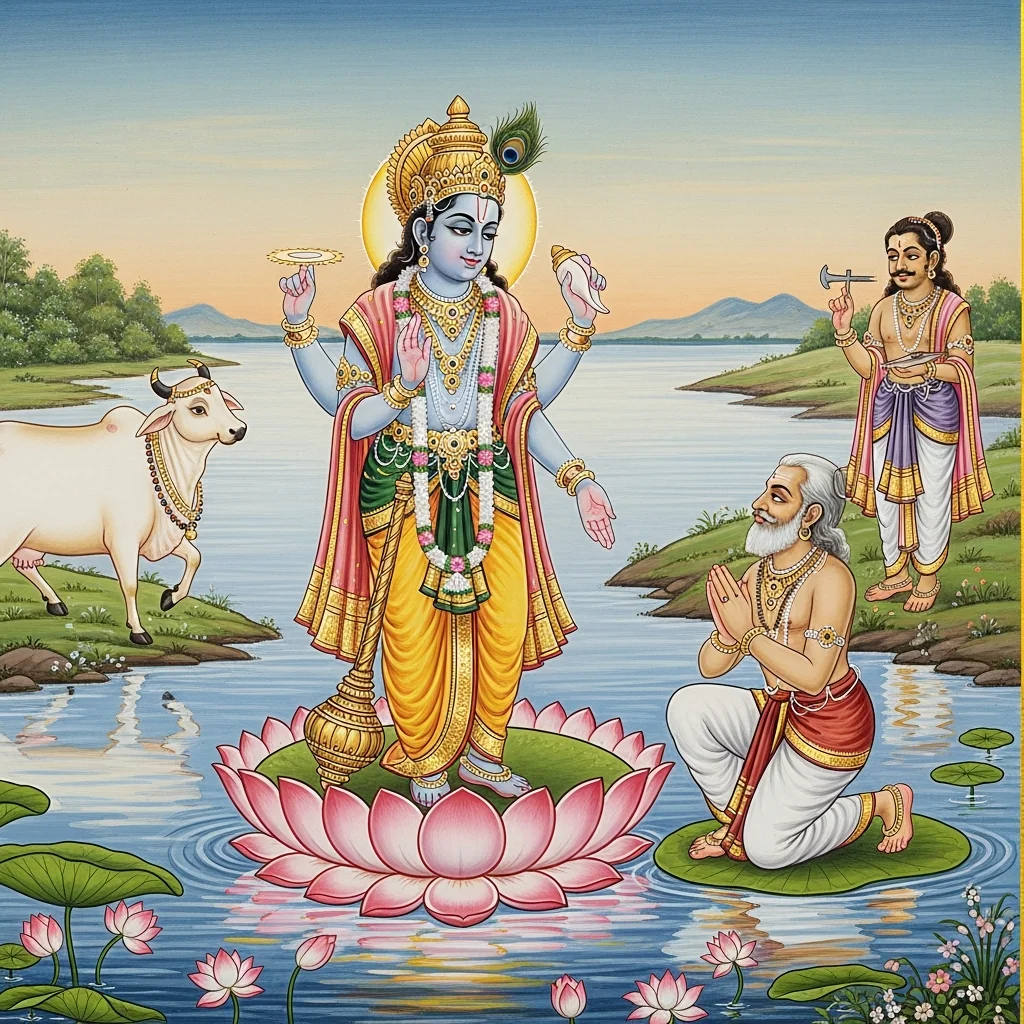
Chapter 37 unfolds as a dialogue: the assembled sages ask Sūta to explain the glory and origin of Kṣīrakuṇḍa, earlier mentioned near Cakratīrtha. Sūta places the tīrtha at Phullagrāma by the southern ocean, sanctified through its connection with Rāma’s undertaking of the Setu. It is praised as sin-destroying and liberation-bestowing through seeing it, touching it, meditating upon it, and reciting its eulogy. The narrative then tells of the sage Mudgala, who performs a Veda-approved sacrifice to please Nārāyaṇa. Viṣṇu appears in person, accepts the offerings, and grants boons. Mudgala asks chiefly for unwavering, non-deceptive devotion, and also for the ability to perform a twice-daily milk-offering (payo-homa) despite lacking resources. Viṣṇu summons Viśvakarmā to build a beautiful lake and commands Surabhī to fill it with milk each day, enabling the rite to continue without interruption. Viṣṇu declares the tīrtha will be famed as Kṣīrasaras, promises the destruction of great sins for those who bathe there, and assures Mudgala liberation at life’s end. The chapter closes with further praise of the tīrtha, an origin-note involving Kadru (wife of Kāśyapa), and a phalaśruti stating that hearing or reciting this chapter yields the merit of bathing at Kṣīrakuṇḍa.
Shlokas
Verse 1
श्रीसूत उवाच । भोभोस्तपोधनाः सर्वे नैमिषारण्यवासिनः । यावद्रामधनुष्कोटिचक्रतीर्थमुखानि वः
Śrī Sūta said: O all you treasure-houses of austerity, dwellers in Naimiṣāraṇya—thus far, the accounts beginning with Rāma’s Dhanuṣkoṭi and the Cakra-tīrtha have been set forth for you.
Verse 2
चतुर्विंशतितीर्थानि कथितानि मयाधुना । इतोऽन्यदद्भुतं यूयं किं भूयः श्रोतुमिच्छथ
I have now described the twenty-four tīrthas, the sacred fords. What other wonder beyond this do you still wish to hear?
Verse 3
मुनय ऊचुः । क्षीरकुंडस्य माहात्म्यं श्रोतुमिच्छामहे मुने । यत्समीपे त्वया चक्रतीर्थमित्युदितं पुरा
The sages said: O muni, we wish to hear the greatness of Kṣīrakuṇḍa, near which you formerly spoke of the Cakra-tīrtha.
Verse 4
क्षीरकुंडं च तत्कुत्र कीदृशं तस्य वैभवम् । क्षीरकुण्डमिति ख्यातिः कथं वास्य समागता
And where is that Kṣīrakuṇḍa? What is its grandeur like? And how did it come to be renowned by the name “Kṣīrakuṇḍa”?
Verse 5
एतन्नः श्रद्दधानानां विस्तराद्वक्तुमर्हसि । श्रीसूत उवाच । ब्रवीमि मुनयः सर्वे शृणुध्वं सुसमाहिताः
This, for us who are filled with faith, you should explain in detail. Śrī Sūta said: I shall tell it—O sages, listen all of you with steady, gathered attention.
Verse 6
देवीपुरान्महापुण्यात्प्रतीच्यां दिश्यदूरतः । फुल्लग्राममिति ख्यातं स्थानमस्ति महत्तरम्
Not far to the west of the supremely holy Devīpura, there is a very great place renowned as Phullagrāma.
Verse 7
यत आरभ्य रामेण सेतुबन्धो महार्णवे । तद्धि पुण्यतमं क्षेत्रं फुल्लग्रामाभिधं पुरम्
From that very spot, Rāma began the building of the bridge across the great ocean; indeed, that most sacred kṣetra is the city called Phullagrāma.
Verse 8
क्षीरकुण्डं तु तत्रैव महापातकनाशनम् । दर्शनात्स्पर्शनाद्ध्यानात्कीर्तनाच्चापि मोक्षदम्
There itself is the sacred Kṣīrakuṇḍa, the destroyer of the gravest sins. By merely seeing it, touching it, meditating upon it, or even praising it aloud, it bestows mokṣa—liberation.
Verse 9
तस्य तीर्थस्य पुण्यस्य क्षीरकुण्डमिति प्रथाम् । भवतां सादरं वक्ष्ये शृणुध्वं श्रद्धया सह
Now I shall respectfully relate to you the renowned account of that holy and meritorious tīrtha, famed as “Kṣīrakuṇḍa”. Listen with faith.
Verse 10
पुरा हि मुद्गलोनाम मुनिर्वेदोक्तमार्गकृत् । दक्षिणांबुनिधेस्तीरे फुल्लग्रामेतिपावने
In ancient times there was a sage named Mudgala, who followed the path enjoined by the Vedas. On the shore of the southern ocean, in the sanctifying place called Phullagrāma, he dwelt.
Verse 11
नारायणप्रीतिकरम करोद्यज्ञमुत्तमम् । तस्य विष्णुः प्रसन्नात्मा यागेन परितोषितः
He performed an excellent yajña that delighted Nārāyaṇa. Viṣṇu, pleased at heart, was fully satisfied by that act of worship.
Verse 12
प्रादुर्बभूव पुरतो यज्ञवाटे द्विजोत्तमाः । तं दृष्ट्वा मुद्गलो विष्णुं लक्ष्मीशोभितविग्रहम्
O best of the twice-born, in the sacrificial arena He manifested directly before them. Seeing Viṣṇu—His form adorned with Lakṣmī’s splendor—Mudgala stood in awe.
Verse 13
कालमेघतनुं कांत्या पीतांबरविराजितम् । विनतानंदनारूढं कौस्तुभालंकृतोरसम्
His body shone like a dark rain-cloud, resplendent in a yellow garment; mounted upon Vinatā’s son (Garuḍa), His chest was adorned with the Kaustubha jewel.
Verse 14
शंखचक्रगदापद्मराजद्बाहुचतु ष्टयम् । भक्त्या परवशो दृष्ट्वा पुलकांकुरमंडितः । मुद्गलः परितुष्टाव शब्दैः श्रोत्रसुखावहैः
Beholding Him with four radiant arms holding conch, discus, mace, and lotus, Mudgala was overwhelmed with devotion, his body adorned with sacred gooseflesh. He then praised the Lord with words that were a delight to the ear.
Verse 15
मुद्गल उवाच । प्रथमं जगतः स्रष्ट्रे पालकाय ततः परम्
Mudgala said: “First, salutations to You as the Creator of the world; and then, salutations to You as its Protector.”
Verse 16
संहर्त्रे च ततः पश्चान्नमो नारायणाय ते । नमः शफररूपाय कमठाय चिदात्मने
“And next, salutations to You as the Dissolver; salutations to You, Nārāyaṇa. Salutations to You in the form of the Fish, and to You as the Tortoise—You whose essence is pure consciousness.”
Verse 17
नमो वराहवपुषे नमः पंचास्यरूपिणे । वामनाय नमस्तुभ्यं जमदग्निसुताय ते
Salutations to You in the form of Varāha; salutations to You in the five-faced form. Salutations to You as Vāmana; salutations to You as Jamadagni’s son, Paraśurāma.
Verse 18
राघवाय नमस्तुभ्यं बलभद्राय ते नमः । कृष्णाय कल्कये तुभ्यं नमो विज्ञानरूपिणे
Salutations to You as Rāghava; salutations to You as Balabhadra. Salutations to You as Kṛṣṇa, and to You as Kalki—obeisance to You whose very form is pure spiritual knowledge.
Verse 19
रक्ष मां करुणासिंधो नारायण जगत्पते । निर्लज्जं कृपणं क्रूरं पिशुनं दांभिकं कृशम्
Protect me, O ocean of compassion—O Nārāyaṇa, Lord of the worlds. Protect me though I am shameless, miserly, cruel, malicious, hypocritical, and feeble.
Verse 20
परदारपरद्रव्यपरक्षेत्रैकलो लुपम् । असूयाविष्टमनसं मां रक्ष कृपया हरे
Protect me, O Hari, with Your mercy—me who clings to others’ wives, others’ wealth, and others’ lands; me whose mind is possessed by jealousy.
Verse 21
इति स्तुतो हरिः साक्षान्मुद्गलेन द्विजोत्तमाः । तमाह मुद्गलमुनिं मेघगंभीरया गिरा
Thus praised, Hari himself, manifest before them, spoke to the sage Mudgala, O best of the twice-born, in a voice deep and resonant like thunderclouds.
Verse 22
श्रीहरिरुवाच । प्रीतोऽस्म्यनेन स्तोत्रेण मुद्गल क्रतुना च ते । प्रत्यक्षेण हविर्भोक्तुमहं ते क्रतुमागतः
Śrī Hari said: “Mudgala, I am pleased by this hymn and by your sacrifice. I have come to your rite to partake of the oblation directly, in visible form.”
Verse 23
इत्युक्तो हरिणा तत्र मुद्गलस्तुष्टमानसः । उवाचाधोक्षजं विप्रो भक्त्या परमया युतः
Thus addressed there by Hari, Mudgala—his mind filled with joy—spoke to Adhokṣaja, the Transcendent Lord; the brāhmaṇa was endowed with supreme devotion.
Verse 24
मुद्गल उवाच । कृतार्थोऽस्मि हृषीकेश पत्नी मे धन्यतां ययौ । अद्य मे सफलं जन्म ह्यद्य मे सफलं तपः
Mudgala said: “O Hṛṣīkeśa, my purpose is fulfilled; my wife has attained blessedness. Today my birth is fruitful—today my austerities are fruitful.”
Verse 25
अदय मे सफलो वंशो ह्यद्य मे सफलाः सुताः । आश्रमः सफलोऽद्यैव सर्वं सफलमद्य मे
“Today my lineage is made fruitful; today my sons are made fruitful. Today indeed my āśrama is fruitful—everything of mine is fruitful today.”
Verse 26
यद्भवान्यज्ञवाटं मे हविर्भोक्तुमिहागतः । योगिनो योगनिरता हृदये मृगयंति यम्
“That you have come here to my sacrificial enclosure to accept the oblation—you whom yogins, devoted to yoga, seek within their own hearts—this indeed is my supreme fortune.”
Verse 27
तमद्य साक्षात्त्वां पश्ये सफ लोऽयं मम क्रतुः । इतीरयित्वा तं विष्णुमर्चयित्वाऽसनादिभिः
“Today I behold You directly before me; thus my sacrifice has become truly fruitful.” Having spoken so, he worshipped that Viṣṇu with offerings such as a seat and other honors.
Verse 28
चंदनैः कुसुमैरन्यैर्दत्त्वा चार्घ्यं स विष्णवे । प्रददौ विष्णवे प्रीत्या पुरो डाशादिकं हविः
After offering sandalwood, flowers, and other auspicious items, and presenting arghya to Viṣṇu, he joyfully offered to Viṣṇu the oblation—beginning with the puroḍāśa (sacrificial cake).
Verse 29
स्वयमेव समादाय पाणिना लोकभावनः । हविस्तद्बुभुजे विष्णुर्मुद्गलेन समर्पितम्
Then Viṣṇu—the sustainer of the worlds—took it with His own hand and consumed the oblation that Mudgala had offered.
Verse 30
तस्मिन्हविषि भुक्ते तु विष्णुना प्रभविष्णुना । साग्नयस्त्रिदशाः सर्वे तृप्ताः समभवन्द्विजाः
When that oblation was consumed by Viṣṇu, the all-powerful Lord, all the gods—together with Agni—became satisfied, O brāhmaṇas.
Verse 31
ऋत्विजो यजमानश्च तत्रत्या ब्राह्मणास्तथा । यत्किंचित्प्राणिलोकेऽ स्मिंश्चरं वा यदि वाऽचरम्
The priests (ṛtvij), the sacrificer (yajamāna), and the brāhmaṇas present there—as well as whatever exists in this world of living beings, whether moving or unmoving—
Verse 32
सर्वमेव जगत्तृप्तं भुक्ते हविषि विष्णुना । ततो हरिः प्रसन्नात्मा मुद्गलं प्रत्यभाषत
When Viṣṇu had partaken of the oblation, the entire universe was satisfied. Then Hari, pleased at heart, spoke to Mudgala.
Verse 33
प्रीतोऽहं वरदोऽस्म्येष वरं वरय सुव्रत । इत्युक्ते केशवेनाथ महर्षिस्तमभाषत
“I am pleased; I am the giver of boons. Choose a boon, O steadfast one.” Thus spoke Keśava; and then the great sage replied to Him.
Verse 34
मुद्गल उवाच । यत्त्वया मे हविर्भुक्तं यागे प्रत्यक्षरूपिणा । अनेनैव कृतार्थोऽस्मि किमस्मादधिकं वरम्
Mudgala said: “Because You—manifest before me in visible form—have consumed my oblation in this sacrifice, I am fulfilled by this alone. What boon could be greater than this?”
Verse 35
तथापि भगवन्विष्णो त्वयि मे निश्चला सदा । भक्तिर्निष्कपटा भूयादिदं मे प्रथमं वरम्
“Even so, O Lord Viṣṇu—may my devotion to You always remain unwavering. Let my bhakti be free from deceit; this is my first boon.”
Verse 36
माधवाहं प्रतिदिनं सायंप्रातरिहाग्नये । त्वद्रूपाय तव प्रीत्यै सुरभेः पयसा हरे
“O Mādhava, each day—at evening and at dawn—here into the fire, for Your pleasure, O Hari, I wish to offer oblations with the milk of Surabhī, to the fire that is Your very form.”
Verse 37
होतुमिच्छामि वरद तन्मे देहि वरांतरम् । पयसा नित्यहोमो हि द्विकालं श्रुतिचोदितः
“I wish to offer it regularly, O giver of boons; therefore grant me another boon. For the daily milk-homa, performed at the two times—dawn and dusk—is enjoined by the Veda.”
Verse 38
न मे सुरभयः संति तापसस्याधनस्य च । इत्युक्ते मुद्गलेनाथ देवो नारायणो हरिः
When Mudgala, the ascetic devoid of possessions, spoke thus—“I have no fears, O Surabhi”—then Lord Nārāyaṇa, Hari himself, responded.
Verse 39
आहूय विश्वकर्माणं त्वष्टारममृताशिनम् । एकं सरः कारयित्वा शिल्पिना तेन शोभनम्
Summoning Viśvakarman—Tvaṣṭṛ, the divine artisan who partakes of amṛta—he had a single splendid lake constructed by that master craftsman.
Verse 40
स्फटिकादि शिलाभेदैस्तेनासौ विश्वकर्मणा । समीचकार च पुनस्तत्प्राकाराद्यलंकृतम् । तत आहूय भगवान्सुरभिं वाक्यमब्रवीत्
Using varieties of stone such as crystal, Viśvakarman fashioned it well and further adorned it with surrounding walls and other embellishments. Then the Blessed Lord summoned Surabhi and spoke these words.
Verse 41
श्रीहरिरुवाच । मुद्गलो मम भक्तोऽयं सुरभे प्रत्यहं मुदा
Śrī Hari said: “O Surabhi, this Mudgala is my devotee; every day, with joy,”
Verse 42
मत्प्रीत्यर्थं पयोहोमं कर्तुमिच्छति सांप्रतम् । मत्प्रीत्यर्थमितो देवि त्वमतो मत्प्रचोदिता
At present he wishes to perform a payo-homa, a milk-offering, to please Me. Therefore, O Goddess, for My satisfaction you are now being directed by Me.
Verse 43
सायंप्रातरिहागत्य प्रत्यहं सुरभे शुभे । पयसा त्वत्प्रसूतेन सर एतत्प्रपूरय
O auspicious Surabhi, coming here each day at evening and morning, fill this lake completely with the milk that flows from you.
Verse 44
तेनासौ पयसा नित्यं सायंप्रातश्च होष्यति । ओमित्युक्त्वाथ सुरभिरेवं नारयणेरिता
With that milk he will perform offerings daily, both in the evening and in the morning. Saying “Oṃ,” Surabhi—thus instructed by Nārāyaṇa—assented.
Verse 45
अथ नारायणो देवो मुद्गलं प्रत्यभाषत । सुरभेः पयसा नित्यमस्मिन्सरसि तिष्ठता
Then Lord Nārāyaṇa spoke to Mudgala: “With Surabhi’s milk—available continually as she remains at this lake—”
Verse 46
सायंप्रातः प्रतिदिनं मत्प्रीत्यर्थमिहाग्नये । जुहुधि त्वं महाभाग तेन प्रीणाम्यहं तव
“Morning and evening, every day, offer it here into the sacred fire for My pleasure, O fortunate one; by that I shall be pleased with you.”
Verse 47
मत्प्रीत्या तेऽखिला सिद्धिर्भविष्यति च मुद्गल । इदं क्षीरसरोनाम तीर्थं ख्यातं भविष्यति
By my favor, O Mudgala, all your attainments shall arise. And this holy place shall become renowned as the tīrtha called Kṣīrasara—“the Lake of Milk.”
Verse 48
अस्मिन्क्षीरसरस्तीर्थे स्नातानां पंचपातकम् । अन्यान्यपि च पापानि नाशं यास्यंति तत्क्षणात्
In this Kṣīrasara tīrtha, for those who bathe, the five great sins—and even other impurities besides—are destroyed that very instant.
Verse 49
मुद्गल त्वं च मां याहि देहांते मुक्तबंधनः । इत्युक्त्वा भगवान्विष्णुस्तं समालिंग्य मुद्गलम्
“Mudgala, at the end of your life you too shall come to Me, freed from bondage.” Having spoken thus, the Blessed Lord Viṣṇu embraced Mudgala.
Verse 50
नमस्कृतश्च तेनायं तत्रैवांतरधीयत । मुद्गलोऽपि गते विष्णावनेकशतवत्सरम्
Having been saluted by him, the Lord vanished right there. And after Viṣṇu had departed, Mudgala remained there for many hundreds of years.
Verse 51
सुरभेः पयसा जुह्वन्नग्नये हरितुष्टये । उवास प्रयतो नित्यं फुल्ल ग्रामे विमुक्तिदे । देहांते मुक्तिमगमद्विष्णुसायुज्यरूपिणीम्
Offering Surabhī’s milk into the fire as an oblation for the delight of Hari, he dwelt there ever disciplined in Phulla-grāma, the giver of liberation. At life’s end he attained mokṣa, taking the form of union with Viṣṇu.
Verse 52
श्रीसूत उवाच । एवमेतद्द्विजवरा युष्माकं कथितं मया
Śrī Sūta said: “Thus indeed, O best of the twice-born, have I related this to you.”
Verse 53
यथा क्षीरसरो नाम तीर्थस्यास्य पुराऽभवत् । इदं क्षीरसरः पुण्यं सर्वलोकेषु विश्रुतम्
(I shall tell) how in former times this sacred tīrtha came to be named Kṣīrasara. This holy Kṣīrasara is renowned throughout all the worlds.
Verse 54
काश्यपस्य मुनेः पत्नी कद्रूर्यत्र द्विजोत्तमाः । स्नात्वा स्वभर्तृवाक्येन नोदिता नियमान्विता
O best of brāhmaṇas, it was here that Kadrū, the wife of the sage Kāśyapa, bathed—impelled by her husband’s word—and observed the appointed restraints.
Verse 55
छलेन मुमुचे सद्यः सपत्नीजयदोषतः । अतोऽत्र तीर्थे ये स्नांति मानवाः शुदमानसाः
By a stratagem she was immediately freed from the fault arising from triumph over a co-wife. Therefore, those who bathe at this tīrtha with purified minds are released from such taints.
Verse 56
तेषां विमुक्तबंधानां मुक्तानां पुण्यकर्मिणाम् । किं यागैः किमु वा वेदैः किं वा तीर्थनिषेवणैः
For those whose bonds are cut, who are liberated and devoted to meritorious conduct—what need is there of sacrifices, or even of Vedic rites, or of further resort to tīrthas?
Verse 57
जपैर्वा नियमैर्वापि क्षीर कुंडविलोकिनाम् । क्षीरकुंडस्य वातेन स्पृष्टदेहो नरो द्विजाः
Whether by japa or by sacred observances, those who merely behold the Kṣīra-kuṇḍa gain merit. And, O brāhmaṇas, even the man whose body is touched by the breeze of the Kṣīra-kuṇḍa is sanctified.
Verse 58
ब्रह्मलोकमनुप्राप्य तत्रैव परिमुच्यते । निमग्नाः क्षीरकुंडेऽस्मिन्नवमत्यापि भास्करिम्
Having reached Brahmaloka, one is liberated there itself. Those who immerse in this Kṣīra-kuṇḍa attain such a state—surpassing even the radiance and power associated with the Sun.
Verse 59
तस्य मूर्द्धनि तिष्ठेयुर्ज्वलतः पावकोपमाः । मग्नानां क्षीरकुंडेस्मिञ्छीता वैतरणी नदी
Upon his head stand flames like blazing fire; yet for those who immerse in this Kṣīra-kuṇḍa, the Vaitaraṇī river becomes cool—its terrors pacified.
Verse 60
सर्वाणि नरकाण्यद्धा व्यर्थानि च भवंति हि । कामधेनुसमे तस्मिन्क्षीरकुंडे स्थितेप्यहो
Truly, all hells become futile and powerless. Wondrous indeed is that Kṣīra-kuṇḍa—equal to Kāmadhenu in granting boons—even by merely being established there.
Verse 61
योन्यत्र भ्रमते स्नातुं स नरो विप्रसत्तमाः । गोक्षीरे विद्यमानेऽपि ह्यर्कक्षीराय गच्छति
O best of brāhmaṇas, the man who wanders elsewhere to bathe—though cow’s milk is available—goes instead in search of the milk of the arka plant; so too, he misses the supreme tīrtha by chasing lesser waters.
Verse 62
स्नातानां क्षीरकुंडेऽस्मिन्नालभ्यं किंचिदस्ति हि । करप्राप्तैव मुक्तिः स्यात्किमन्यैर्बहुभाषणैः
For those who bathe in this sacred Kṣīrakuṇḍa, there is nothing unattainable. Liberation itself becomes as if placed in one’s hand—what need is there for many words?
Verse 63
ब्रवीमि भुजमुद्धत्य सत्यंसत्यं ब्रवीमि वः । यः पठेदिममध्यायं शृणुयाद्वा समाहितः । स क्षीरकुंडस्नानस्य लभते फलमुत्तमम्
Raising my arm, I declare to you—truth, truth: whoever recites this chapter, or listens to it with focused attention, obtains the highest fruit of bathing in Kṣīrakuṇḍa.