Adhyaya 31
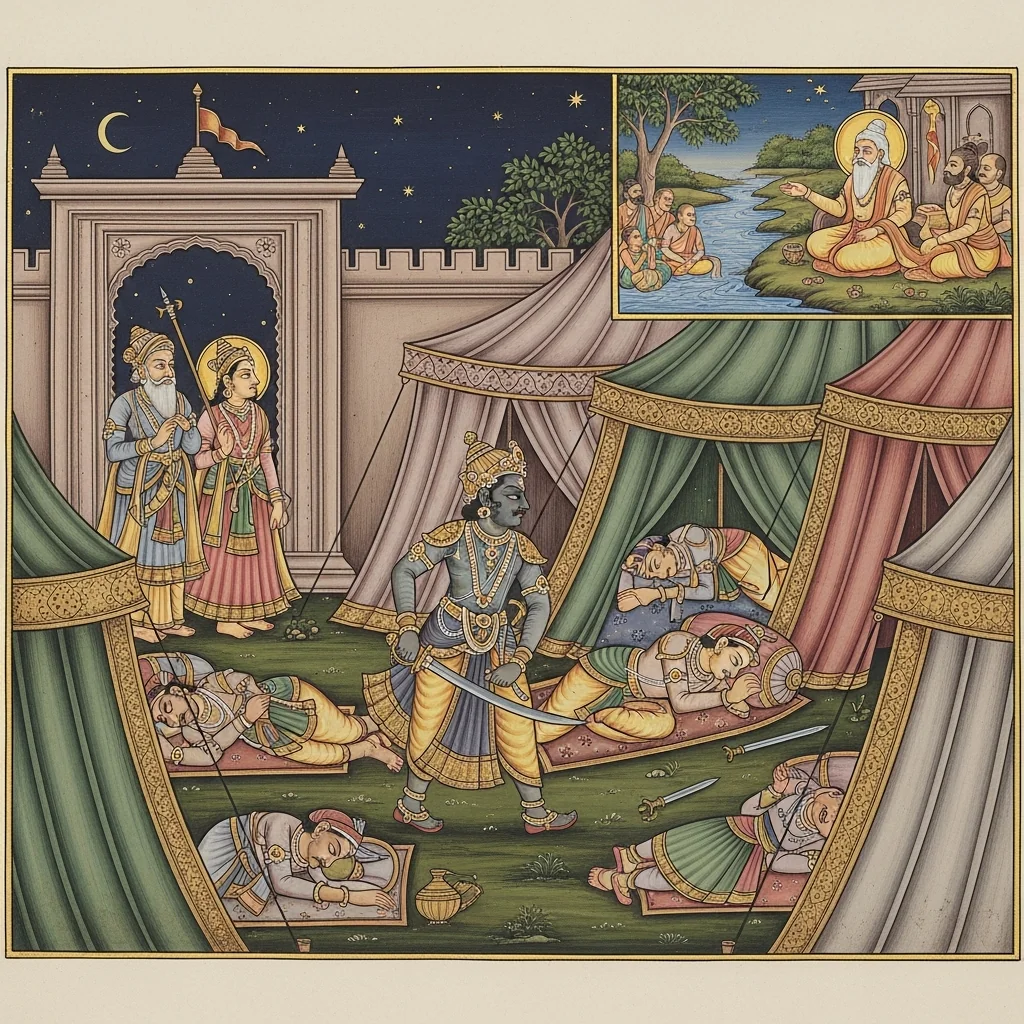
This chapter unfolds as a question-led theological discourse. The ṛṣis ask how Aśvatthāmā carried out the killing of sleepers (suptamāraṇa) and how he was freed from the demerit it produced, with reference to purification through immersion at a tīrtha, measured “to the tip of a bow.” The narrative then recounts the closing phase of the Mahābhārata war: after Duryodhana’s fall, Aśvatthāmā, Kṛpa, and Kṛtavarmā withdraw to a waterside forest. Seeing a predatory bird slay sleeping crows, Aśvatthāmā takes it as tactical instruction for a night massacre. Though Kṛpa objects on grounds of dharma, Aśvatthāmā worships Mahādeva (Śiva), receives a pure sword, and enters the sleeping camp to kill Dhṛṣṭadyumna and others, while Kṛpa and Kṛtavarmā guard the gate. Ascetics later condemn him for this grave fault. Seeking prāyaścitta (expiation), Aśvatthāmā approaches Vyāsa and is prescribed a month-long regimen of continuous bathing (snāna) to cleanse the suptamāraṇa-doṣa. The chapter ends with a phalāśruti: attentive recitation or hearing removes sins and grants honor in Śiva’s world.
Shlokas
Verse 1
ऋषय ऊचुः । अश्वत्थामा कथं सूत सुप्तमारणमाचरत् । कथं च मुक्तस्तत्पापाद्धनुष्कोटौ निमज्जनात्
The sages said: O Sūta, how did Aśvatthāmā commit the slaying of those who slept? And how was he freed from that sin by immersion at Dhanuskoṭi?
Verse 2
एतन्नः श्रद्दधानानां ब्रूहि पौराणिकोत्तम । तृप्तिर्न जायतेऽ स्माकं त्वद्वचोमृतपायिनाम्
Tell this to us who are full of faith, O best among the Purāṇic narrators; for we who drink the nectar of your words never become satisfied.
Verse 3
व्यास उवाच । एतत्पापस्य शांत्यर्थं प्रायश्चित्तं स्मृतौ न हि
Vyāsa said: “For the pacification of this sin, indeed no prāyaścitta—no expiatory rite—is prescribed in the Smṛti tradition.”
Verse 4
इति पृष्टस्तदा सूतो नैमिषारण्यवासिभिः । वक्तुं प्रचक्रमे तत्र व्यासं नत्वा गुरुं मुदा । श्रीसूत उवाच । राज्यार्थं कलहे जाते पांडवानां पुरा द्विजाः । धार्तराष्ट्रैर्महायुद्धे महदक्षौहिणीयुते
Thus questioned by the dwellers of Naimiṣāraṇya, Sūta began to speak there, joyfully bowing to his teacher Vyāsa. Śrī Sūta said: “Formerly, O brāhmaṇas, when a quarrel arose over sovereignty for the Pāṇḍavas, there occurred a great war with the sons of Dhṛtarāṣṭra, attended by vast armies (akṣauhiṇīs).”
Verse 5
युद्धं दशदिनं कृत्वा भीष्मे शांतनवे हते । द्रोणे पंचदिनं कृत्वा कर्णे च द्विदिनं तथा
After waging war for ten days, when Bhīṣma, son of Śāntanu, was slain; after fighting for five days, when Droṇa fell; and likewise after two days, when Karṇa fell—
Verse 6
तथैवैकदिनं युद्ध्वा शल्ये च निधनं गते । अष्टादशदिने तत्र रणे दुर्योधने द्विजाः
Likewise, after fighting for a single day, when Śalya too met his end—on the eighteenth day there, in that battle, when Duryodhana fell, O brāhmaṇas—
Verse 7
भग्नोरौ भीमगदया पतिते राजसत्तमे । सर्वे नृपतयो विप्रा निवेशाय कृतत्वराः
When the foremost of kings fell, his thighs shattered by Bhīma’s dreadful mace, all the kings, O brāhmaṇas, hastened to make camp and withdraw.
Verse 8
ये जीवितास्तु राजानस्ते ययुर्हृष्टमानसाः । धृष्टद्युम्नशिखंडयाद्याः सृञ्जयाः सर्व एव हि
Those kings who remained alive departed with gladdened minds—indeed all the Sṛñjayas, beginning with Dhṛṣṭadyumna and Śikhaṇḍin.
Verse 9
अन्ये चापि महीपाला जग्मुः स्वशिबिराण्यथ । अथ पार्था महावीरा कृष्णसात्यकिसंयुताः
Other kings too went to their own camps. Then the mighty Pārthas, accompanied by Kṛṣṇa and Sātyaki—
Verse 10
दुर्योधनस्य शिबिरं प्राविशन्निर्जनं द्विजाः । वृद्धैरमात्यैस्तत्रस्थैः षंढैः स्त्रीरक्षकैस्तथा
O brāhmaṇas, they entered Duryodhana’s camp, now deserted—where only aged ministers remained, along with eunuchs and guards appointed for the women.
Verse 11
कृतांजलिपुटैः प्रह्वैः काषायमलिनांबरैः । प्रणम्यमानास्ते पार्थाः कुरुराजस्य वेश्मनि
There, within the dwelling of the Kuru king, the Pārthas were bowed to—by those with hands joined in reverence, bent low, wearing soiled ochre garments.
Verse 12
तत्रत्यद्रव्यजातानि समादाय महा बलाः । सुयोधनस्य शिबिरे न्यवसंत सुखेन ते
Gathering up the goods and valuables found there, those mighty ones stayed at ease in Suyodhana’s (Duryodhana’s) camp.
Verse 13
अथ तानब्रवीत्पार्थाञ्छ्रीकृष्णः प्रीणयन्निव । मंगलार्थाय चास्माभिर्वस्तव्यं शिबिराद्बहिः
Then Śrī Kṛṣṇa, as though delighting the Pārthas, spoke to them: “For the sake of auspiciousness, we should spend the night outside the camp.”
Verse 14
इत्युक्ता वासुदेवेन तथेत्युक्त्वाथ पांडवाः । कृष्णसात्यकिसंयुक्ताः प्रययुः शिबिराद्बहिः
Thus addressed by Vāsudeva, the Pāṇḍavas replied, “So be it,” and—accompanied by Kṛṣṇa and Sātyaki—went out beyond the camp.
Verse 15
वासुदेवेन सहिता मंगलार्थं हि पांडवाः । ओघवत्याः समासाद्य तीरं नद्या नरोत्तमाः
Together with Vāsudeva, the Pāṇḍavas—those best of men—reached the bank of the river Oghavatī, seeking auspiciousness.
Verse 16
ऊषुस्तां रजनीं तत्र हतशत्रुगणाः सुखम् । कृतवर्मा कृपो द्रौणिस्तथा दुर्योधनांतिकम्
There they spent that night at ease, their foes having been struck down; and Kṛtavarmā, Kṛpa, and Droṇa’s son (Aśvatthāmā) were staying near Duryodhana.
Verse 17
आदित्यास्तमयात्पूर्वमपराह्णे समाययुः । सुयोधनं तदा दृष्ट्वा रणपांसुषु रूषितम्
In the late afternoon, before the sun had set, they arrived; and seeing Suyodhana lying in the dust of battle, they were filled with anguish and fury.
Verse 18
भग्नोरुदण्डं गदया भीमसेन स्य भीमया । रुधिरासिक्तसर्वांगं चेष्टमानं महीतले
His thighs shattered by Bhīmasena’s dreadful mace, his whole body smeared with blood, he writhed upon the ground.
Verse 19
अशोचंत तदा तत्र द्रोणपुत्रादयस्त्रयः । शुशोच सोऽपि तान्दृष्ट्वा रणे दुर्योधनो नृपः
Then there, the three—beginning with Droṇa’s son—lamented. And King Duryodhana too, seeing them on the battlefield, grieved.
Verse 20
दृष्ट्वा तथा तु राजानं बाष्पव्याकुललोचनम् । अश्वत्थामा तदा कोपाज्ज्वलन्निव महानलः
Seeing the king thus, his eyes clouded with tears, Aśvatthāmā blazed with anger, like a great fire.
Verse 21
पाणौ पाणिं विनिष्पिष्य क्रोध विस्फारितेक्षणः । अश्रुविक्लवया वाचा दुर्योधनमभाषत
Clenching hand upon hand, his eyes widened with rage, he spoke to Duryodhana in a voice unsteady with tears.
Verse 22
पिता मे पातितः क्षुद्रैश्छलेनैव रणाजिरे । न तथा तेन शोचामि यथा निष्पातिते त्वयि
My father was felled on the battlefield by petty men through mere deceit. Yet I do not grieve for that as much as I grieve over you, now struck down.
Verse 23
शृणु वाक्यं ममाद्य त्वं यथार्थं वदतो नृप । सुकृतेन शपे चाहं सुयोधन महामते
O king, hear my words today as I speak what is true. O wise Suyodhana, I swear by my accumulated merit.
Verse 24
अद्य रात्रौ हनिष्यामि पांडवा न्सह सृंजयैः । पश्यतो वासुदेवस्य त्वमनुज्ञां प्रयच्छ मे
Tonight I shall slay the Pāṇḍavas together with the Sṛñjayas, even as Vāsudeva looks on. Grant me your permission.
Verse 25
तस्य तद्वचनं श्रुत्वा द्रौणिं राजा तदाऽब्रवीत् । तथास्त्विति पुनः प्राह कृपं राजा द्विजोत्तमाः
Hearing those words, the king then spoke to Drauṇi: “So be it.” Again the king addressed Kṛpa—O best of brāhmaṇas.
Verse 26
आचार्यैनं द्रोणपुत्रं कलशोत्थेन वारिणा । सैनापत्येऽभिषिंचस्वेत्यथ सोपि तथाऽकरोत्
“O teacher, anoint this son of Droṇa with water drawn from a consecration vessel and install him as commander of the army.” Thus instructed, he too did so.
Verse 27
सोभिषिक्तस्तदा द्रौणिः परिष्वज्य नृपोत्तमम् । कृतवर्मकृपाभ्यां च सहितस्त्वरितं ययौ
Then Drauṇi, having received consecration, embraced the best of kings and quickly departed, together with Kṛtavarman and Kṛpa.
Verse 28
ततस्ते तु त्रयो वीराः प्रयाता दक्षिणोन्मुखाः । आदित्यास्तमयात्पूर्वं शिबिरांतिकमासत
Then those three heroes set out facing south; before the sun had set, they reached the vicinity of the camp.
Verse 29
पार्थानां भीषणं शब्दं श्रुत्वा तत्र जयैषिणः । पांडवानुद्रुता भीतास्तदा द्रौण्यादयस्त्रयः
Hearing there the dreadful uproar of the sons of Pṛthā, those three—beginning with Drauṇi—who sought victory, ran off in fear, driven back by the Pāṇḍavas.
Verse 30
प्राङ्मुखा दुद्रुवुर्भीत्या कियद्दूरं श्रमातुराः । मुहुर्तं ते ततो गत्वा क्रोधामर्षवशानुगाः
Facing east, they fled a certain distance in fear, exhausted with exertion; after going on for a short while, they fell under the sway of anger and wounded pride.
Verse 31
दुर्योधनवधार्तास्ते क्षणं तत्रावतस्थिरे । ततोऽपश्यन्नरण्यं वै नानातरुलतावृतम्
Afflicted by the slaying of Duryodhana, they halted there for a moment; then they saw a forest, covered with many kinds of trees and creepers.
Verse 32
अनेकमृगसंबाधं क्रूरपक्षिगणाकुलम् । समृद्धजलसंपूर्णतटाकपरिशोभितम्
It was thronged with many kinds of wild beasts, crowded with flocks of fierce birds, and beautified by ponds brimming with abundant water.
Verse 33
पद्मेंदीवरकह्लारसरसी शतसंकुलम् । तत्र पीत्वा जलं ते तु पाययित्वा हयांस्तथा
They came upon a lotus-lake thronged with hundreds of padmas, blue lotuses, and white water-lilies. There they drank the water and likewise gave their horses to drink.
Verse 34
अनेकशाखासंबाधन्यग्रोधं ददृशुस्ततः । संप्राप्य तु महावृक्षं न्यग्रोधं ते त्रयस्तदा
Then they saw a banyan tree dense with many branches. Reaching that great banyan, the three of them arrived there together.
Verse 35
अवतीर्य रथेभ्यश्च मोचयित्वा तुरंगमान् । उपस्पृश्य जलं तत्र सायंसंध्यामुपासत
Dismounting from their chariots and unharnessing the horses, they performed ācamana with water there and observed the evening sandhyā worship.
Verse 36
अथ चास्तगिरिं भानुः प्रपेदे च गतप्रभः । ततश्च रजनी घोरा समभूत्तिमिराकुला
Then the Sun, his radiance spent, reached the mountain of setting. Thereupon a fearsome night arose, filled with darkness.
Verse 37
रात्रिचराणि सत्त्वानि संचरंति ततस्ततः । दिवाचराणि सत्त्वानि निद्रावशमुपा ययुः
Creatures that roam by night began moving here and there; creatures that roam by day fell under the power of sleep.
Verse 38
कृतवर्मा कृपो द्रौणिः प्रदोषसमये हि ते । न्यग्रोधस्योपविविशुरंतिके शोककर्शिताः
At twilight, Kṛtavarmā, Kṛpa, and Drauṇi (Aśvatthāmā) sat down near the banyan tree, worn down by grief.
Verse 39
कृपभोजौ तदा निद्रां भेजातेऽतिप याक्रमौ । सुखोचितास्त्वदुःखार्हा निषेदुर्धरणीतले
Then Kṛpa and Bhoja (Kṛtavarmā) fell asleep, their strength greatly spent. Accustomed to comfort and unfit for hardship, they lay down upon the bare ground.
Verse 40
द्रोणपुत्रस्तु कोपेन कलुषीकृतमानसः । ययौ न निद्रां विप्रेंद्रा निश्वसन्नुरगो यथा
But Droṇa’s son, his mind darkened by anger, did not go to sleep—O best of brāhmaṇas—breathing hard like a serpent.
Verse 41
ततोऽवलोकयांचक्रे तदरण्यं भयानकम् । न्यग्रोधं च ततोऽपश्यद्बहुवायससंकुलम्
Then he looked about at that terrifying forest, and he saw the banyan tree crowded with many crows.
Verse 42
तत्र वायसवृन्दानि निशायां वासमाय युः । सुखं भिन्नासु शाखासु सुषुपुस्ते पृथक्पृथक्
There, in the night, flocks of crows made their dwelling. At ease upon separate branches, they slept—each apart from the other.
Verse 43
काकेषु तेषु सुप्तेषु विश्वस्तेषु समंततः । ततोऽपश्यत्समायांतं भासं द्रौणिर्भयंकरम्
When those crows had fallen asleep, trusting and unguarded on every side, Droṇa’s son then saw a terrifying bhāsa-bird approaching.
Verse 44
कूरशब्दं क्रूरकायं बभ्रुपिंगकलेवरम् । स भासोऽथ भृशं शब्दं कृत्वालीयत शाखिनि
With a harsh cry, fierce of body—brown and tawny in form—that bhāsa made a great sound and swooped onto the tree-branch.
Verse 45
उत्प्लुत्य तस्य शाखायां न्यग्रोधस्य विहंगमः । सुप्तान्काकान्निजघ्नेऽसावनेकान्वायसांतकः
Leaping onto the branch of that nyagródha (banyan), the bird—slayer of crows—struck down many crows as they slept.
Verse 46
काकानामभिनत्पक्षान्स केषांचिद्विहंगमः । इतरेषां च चरणाञ्छिरांसि चरणा युधः
That bird broke the wings of some of the crows; of others—whose weapons were their feet—it crushed their legs and heads.
Verse 47
विचकर्त क्षणेनासावुलूको वलवान्द्विजाः । स भिन्नदेहावयवैः काकानां बहुभिस्तदा
In a moment, that powerful owl tore them apart, O twice-born ones; and then many crows lay there with their limbs and bodies broken.
Verse 48
समंतादावृतं सर्वं न्यग्रोधपरि मण्डलम् । वायसांस्तान्निहत्यासावुलूको मुमुदे तदा
All around, the entire circle beneath and around the banyan was covered; having slain those crows, that owl rejoiced then.
Verse 49
द्रौणिर्दृष्ट्वा तु तत्कर्म भासेनैवं कृतं निशि । करिष्याम्यहमप्येवं शत्रूणां निधनं निशि
But Droṇa’s son, seeing that deed done at night by the bhāsa in this manner, thought: “I too will bring about the destruction of my enemies at night, in the same way.”
Verse 50
इत्यचिंतयदेकः सन्नुपदेशमिमं स्मरन् । जेतुं न शक्याः पार्था हि ऋजुमार्गेण युद्ध्यता
Thinking thus, alone, and recalling this ‘instruction’, he reflected: “Indeed the Pārthas cannot be conquered by one who fights by the straight and open path.”
Verse 51
मया तच्छद्मना तेऽथ हंतव्या जितकाशिनः । सुयोधनसकाशे च प्रतिज्ञातो मया वधः
“Therefore, by that very stratagem, they must be slain by me—those who have conquered and now rest at ease; and before Suyodhana I have vowed their killing.”
Verse 52
ऋजुमार्गेण युद्धे मे प्राणनाशो भविष्यति । छलेन युध्यमानस्य जयश्चास्य रिपुक्षयः
“If I fight by the straight path, my life will be lost; but if I fight by stratagem, there will be victory—and the enemy’s destruction.”
Verse 53
यच्च निंद्यं भवेत्कार्यं लोके सर्वजनैरपि । कार्यमेव हि तत्कर्म क्षत्रधर्मानुवर्तिना
Even a deed that would be condemned by all the world must still be done by one who follows the warrior’s dharma; for that act, as duty, is to be carried out by the adherent of kṣatriya-dharma.
Verse 54
पार्थैरपि छलेनैव कृतं कर्म सुयोधने । अस्मिन्नर्थे पुराविद्भिः प्रोक्ताः श्लोका भवंति हि
Even the Pārthas carried out their deed against Suyodhana by stratagem. Indeed, on this very matter, the ancients have spoken verses.
Verse 55
परिश्रांते विदीर्णे च भुंजाने च रिपोर्बले । प्रस्थाने च प्रवेशे च प्रहर्तव्यं न संशयः
When the enemy’s forces are exhausted, broken, or engaged in eating; and also at the time of setting out or entering—one should strike, without doubt.
Verse 56
निद्रार्तमर्धरात्रे च तथा त्यक्तायुधं रणे । भिन्नयोधं बलं सर्वं प्रहर्तव्यमरातिभिः
An enemy distressed by sleep at midnight, one who has cast aside weapons in battle, and an army whose fighters are scattered—against all these, foes should strike.
Verse 57
एवं स नियमं कृत्वा सुप्तमारणकर्मणि । प्राबोधयद्भोजकृपौ सुप्तौ रात्रौ स साहसी । द्रौणिर्ध्यात्वा मुहूर्तं तु तावुभावभ्यभाषत
Having thus resolved upon the act of killing men in their sleep, that bold one roused Bhoja and Kṛpa as they slept at night. Then Droṇi, after reflecting for a moment, addressed them both.
Verse 58
अश्वत्थामोवाच । मृतः सुयोधनो राजा महाबलपराक्रमः
Aśvatthāman said: “King Suyodhana, of great strength and valor, is dead.”
Verse 59
शुद्धकर्मा हतः पार्थैर्बहुभिः क्षुद्रकर्मभिः । भीमेनातिनृशंसेन शिरो राज्ञः पदा हतम्
Though of ‘pure conduct’, he was slain by the Pārthas through many petty acts; and by the exceedingly cruel Bhīma, the king’s head was struck with a foot.
Verse 60
ततोऽद्य रात्रौ पार्थानां समेत्य पटमण्डपम् । सुखसुप्तान्हनिष्यामः शस्त्रैर्नानाविधैर्वयम् । कृपः प्रोवाच तत्रैन मिति श्रुत्वा द्विजोत्तमाः
“Therefore, tonight we shall go to the Pārthas’ cloth-pavilion and kill them as they sleep in comfort, using weapons of many kinds.” Hearing this, the best of brāhmaṇas—Kṛpa—spoke to him there.
Verse 61
कृप उवाच । सुप्तानां मारणं लोके न धर्मो न च पूज्यते
Kṛpa said: “Killing those who are asleep is neither dharma in this world, nor is it honored.”
Verse 62
तथैव त्यक्तशस्त्राणां संत्यक्तरथवाजि नाम् । शृणु मे वचनं वत्स मुच्यतां साहसं त्वया
Likewise, it is not fitting to strike those who have laid down their weapons, nor those who have abandoned chariots and horses. Hear my words, dear boy—give up this reckless deed.
Verse 63
वयं तु धृतराष्टं च गांधारीं च पतिव्रताम् । पृच्छामो विदुरं चापि तदुक्तं करवा महे । इत्युक्तः स तदा द्रौणिः कृपं प्रोवाच वै पुनः
Let us ask Dhṛtarāṣṭra, and Gāndhārī the devoted wife, and also Vidura; we shall act according to what they advise. Thus addressed, Drauṇi (Aśvatthāman) then spoke again to Kṛpa.
Verse 64
अश्वत्थामोवाच । पांडवैश्च पुरा यन्मे छलाद्युद्धे पिता हतः
Aśvatthāman said: “Formerly, the Pāṇḍavas slew my father in battle through deceit.”
Verse 65
तन्मे सर्वाणि मर्माणि निकृन्तति हि मातुल । द्रोणहंताहमित्येतद्धृष्टद्युमस्य यद्वचः
That cuts into all my vital feelings, O uncle—those words of Dhṛṣṭadyumna: “I am the slayer of Droṇa.”
Verse 66
कथं जनसमक्षे तद्वचनं संशृणोम्यहम् । तैरेव पांडवैः पूर्वं धर्मसेतुर्निराकृतः
How can I bear to hear those words before the people? By those very Pāṇḍavas, the bridge of dharma was earlier cast aside.
Verse 67
समक्षमेव युष्माकं सर्वेषामेव भूभृताम् । त्यक्तायुधो मम पिता धृष्टद्युम्नेन पातितः
In the very presence of you all—the kings—my father, having laid down his weapons, was struck down by Dhṛṣṭadyumna.
Verse 68
तथा शांतनवो भीष्मस्त्यक्तचापो निरायुधः । शिखंडिनं पुरोधाय निहतः सव्यसाचिना
Likewise Bhīṣma, son of Śāṃtanu—his bow cast aside, unarmed—was slain by Savyasācin (Arjuna) after placing Śikhaṇḍin in front.
Verse 69
एवमन्येऽपि भूपालाश्छलेनैव हतास्तु तैः । तथैवाहं करिष्यामि सुप्तानां मारणं निशि
So too, other kings were slain by them through stratagem. In the same way, I shall kill the sleeping ones at night.
Verse 70
एवमुक्त्वा तदा द्रौणिः संयुक्ततुरगं रथम् । प्रायादभिमुखः शत्रून्समारुह्य क्रुधा ज्वलन्
Having spoken thus, Drauṇi then mounted his chariot yoked with horses and set out toward the enemies, blazing with anger.
Verse 71
तं यांतम न्वगातां तौ कृतवर्मकृपावुभौ । ययुश्च शिबिरे तेषां संप्रसुप्तजनं तदा
As he went, both Kṛtavarman and Kṛpa followed him. Then they went to that camp where the people were fast asleep.
Verse 72
शिबिरद्वारमासाद्य द्रोणपुत्रो व्यतिष्ठत । रात्रौ तत्र समाराध्य महादेवं घृणानिधिम्
Reaching the gate of the camp, Droṇa’s son halted there. In the night, at that very spot, he worshipped Mahādeva, the treasury of compassion.
Verse 73
अवाप विमलं खङ्गं महादेवाद्वरप्रदात् । ततो द्रौणिरवस्थाप्य कृतवर्मकृपावुभौ
He obtained a spotless sword from Mahādeva, the bestower of boons. Then Droṇa’s son stationed both Kṛtavarmā and Kṛpa in their appointed places.
Verse 74
द्वारदेशे महावीरः शिबि रांतः प्रविष्टवान् । प्रविष्टे शिबिरे द्रौणौ कृतवर्मकृपावुभौ
At the gate-area the great hero entered the camp. When Droṇa’s son had entered, both Kṛtavarmā and Kṛpa also entered the camp.
Verse 75
द्वारदेशे व्यतिष्ठेतां यत्तौ परमधन्विनौ । अथ द्रौणिः सुसंक्रुद्धस्तेजसा प्रज्वलन्निव
At the gate-area those two supreme archers took their stand, alert. Then Droṇa’s son, exceedingly enraged, blazed as if with fiery splendor.
Verse 76
खङ्गं विमलमादाय व्यचरच्छिबिरे निशि । ततस्तु धृष्टद्युम्नस्य शिबिरं मंदमाययौ
Taking up the spotless sword, he moved about the camp by night. Then he slowly approached the camp of Dhṛṣṭadyumna.
Verse 77
धृष्टद्युम्नादयस्तत्र महायुद्धेन कर्शिताः । सुषुपुर्निशि विश्वस्ताः स्वस्वसैन्यसमावृताः
There Dhṛṣṭadyumna and the others, worn down by the great battle, slept at night in trust, surrounded by their respective troops.
Verse 78
धृष्टद्युम्नस्य शिबिरं प्रविश्य द्रौणिरस्त्रवित् । तं सुप्तं शयने शुभ्रे ददर्शारान्महाबलम्
Entering Dhṛṣṭadyumna’s camp, Droṇa’s son—skilled in weapons—saw that mighty man asleep upon a bright and splendid bed.
Verse 79
पादेनाघातयद्रोषात्स्वपंतं द्रोणनंदनः । स बुद्धश्चरणाघातादुत्थाय शयनादथ
In anger Droṇa’s son struck the sleeping man with his foot. Awakened by that kick, he then rose up from the bed.
Verse 80
व्यलोकयत्तदा वीरो द्रोणपुत्रं पुरः स्थितम् । तमुत्पतंतं शयनाद्द्रोणाचार्यसुतो बली
Then the hero looked and saw Droṇa’s son standing before him. As he sprang up from the bed, the mighty son of Ācārya Droṇa confronted him.
Verse 81
केशेष्वाकृष्य बाहुभ्यां निष्पिपेष धरातले । धृष्टद्युम्नस्तदा तेन निष्पिष्टः स भया तुरः
Seizing him by the hair with both arms, he crushed him upon the ground. Thus Dhṛṣṭadyumna was crushed by him, stricken with fear.
Verse 82
निद्रांधः पादघातातो न शशाक विचेष्टितुम् । द्रौणिस्त्वाक्रम्य तस्योरः कण्ठं बद्ध्वा धनुर्गुणैः
Blinded by sleep and stunned by the kick, he could not struggle. But Droṇa’s son, pressing upon his chest, bound his throat with bow-strings.
Verse 83
नदंतं विस्फुरंतं तं पशुमारममारयत् । तस्य सैन्यानि सर्वाणि न्यवधीच्च तथैव सः
Roaring and raging, he slew that Paśumārā; and in the same manner he also struck down all of that one’s forces.
Verse 84
युधामन्युं महावीर्यममुत्तमौजसमेव च । तथैव द्रौपदीपुत्रानवशिष्टांश्च सोमकान्
He also slew the mighty hero Yudhāmanyu, and likewise Uttamaujā; and in the same way he killed the sons of Draupadī and the remaining Somakas.
Verse 85
शिखंडिप्रमुखानन्यान्खङ्गेनामारयद्बहून् । तद्भयाद्द्वारनिर्यातान्सर्वानेव च सैनिकान्
With his sword he killed many others, with Śikhaṇḍī at their head; and, out of fear of him, even the soldiers who rushed out through the gates—all of them—were slain.
Verse 86
प्रापयामासतुर्मृत्युं कृतवर्मकृपा वुभौ । एवं निहतसैन्यं तच्छिबिरं तैर्महाबलैः
Kṛtavarmā and Kṛpa—both of them—sent many to their death. Thus, by those men of great might, that camp was left with its army slain.
Verse 87
तत्क्षणे शून्यमभवत्त्रिजगत्प्रलये यथा । एवं हत्वा ततः सर्वान्द्रोणपुत्रादयस्त्रयः
In that very instant all became empty, as though at the dissolution of the three worlds. Thus, having slain them all, those three—beginning with Droṇa’s son—departed.
Verse 88
निरगुः शिबिरात्तस्मात्पार्थभीता भयातुराः । सर्वे पृथक्पृथग्देशान्दुद्रुवुः शीघ्रगामिनः
Terrified and panic-stricken, they fled from that camp in fear of Pārtha. All ran swiftly, each to a different place.
Verse 89
अथ द्रौणिर्ययौ विप्रा रेवातीरं मनोरमम् । तत्र ह्यनेकसाहस्रा ऋषयो वेदवादिनः
Then, O brāhmaṇas, Drauṇi went to the lovely bank of the Revā. There indeed were many thousands of ṛṣis, proclaimers of the Veda.
Verse 90
कथयंतः कथाः पुण्यास्तपश्चक्रुरनुत्तमम् । तत्रायं प्रययौ द्रौणिरृषीणामाश्रमेष्वथ
Telling holy narratives, they performed unsurpassed austerities. Then Drauṇi went there, approaching the hermitages of the sages.
Verse 91
प्रविष्टमात्रे तस्मिंस्तु मुनयो ब्रह्मवादिनः । द्रौणेर्दुश्चरितं ज्ञात्वा प्राहुर्योगबलेन तम्
But as soon as he entered, the sages—expounders of Brahman—knowing Drauṇi’s evil conduct, addressed him through the power of yoga.
Verse 92
सुप्तमा रणकृत्पापी द्रौणे त्वं ब्राह्मणाधमः । त्वद्दर्शनेन ह्यस्माकं पातित्यं भवति ध्रुवम्
“O Drauṇi—sinful slayer of those asleep—you are the lowest of brāhmaṇas. Indeed, by merely seeing you, our own defilement becomes certain.”
Verse 93
त्वत्संभाषणमात्रेण ब्रह्महत्यायुतं भ वेत् । अतोऽस्मदाश्रमेभ्यस्त्वं निर्गच्छ पुरुषाधम
“By merely speaking with you, a multitude of the sin of brahma-slaughter would arise. Therefore, leave our hermitages at once, O vilest of men.”
Verse 94
इत्यब्रुवंस्तदा द्रौणिं तत्रत्या मुनयो द्विजाः । इतीरितस्ततो द्रौणिर्मुनिभिर्ब्रह्म वादिभिः
Thus spoke the brāhmaṇa sages dwelling there to Drauṇi, Droṇa’s son. So addressed by those sages, the expounders of Brahman, Drauṇi was shaken and then departed.
Verse 95
लज्जितो निलात्तस्मादाश्रमान्मुनिसेवितात् । एवं काश्यादितीर्थेषु पुण्येषु प्रययौ च सः
Ashamed, he departed from that hermitage frequented by sages. Thus he wandered on to sacred and meritorious tīrthas—beginning with Kāśī and others.
Verse 96
तत्रतत्र द्विजैः सर्वै र्निंदितोऽसौ महात्मभिः । व्यासं शरणमापेदे प्रायश्चित्तचिकीर्षया
Here and there he was censured by all the twice-born, the great-souled ones. Wishing to undertake prāyaścitta—expiation—he sought refuge in Vyāsa.
Verse 97
ततो बदरिकारण्ये समासीनं महामुनिम् । द्वैपायनं समागम्य प्रणनाम सभक्तिकम्
Then, in the forest of Badarikā, he approached the great sage Dvaipāyana (Vyāsa), seated there, and bowed down with devotion.
Verse 98
ततो व्यासोऽब्रवीदेनं द्रोणाचार्यसुतं मुनिः । त्वमस्मदाश्रमादद्रौणे निर्याहि त्वरया त्विति
Then the sage Vyāsa spoke to him, the son of Droṇācārya: “O Drauṇi, leave my hermitage at once—quickly.”
Verse 99
सुप्तमारण दोषेण महापातकवान्भवान् । अतो मे भवतालापान्महत्पापं भविष्यति । इत्युक्तः स तदा द्रौणिः प्रोवाचेदं वचो मुनिः
“By the fault of killing men in their sleep, you are tainted by a great sin. Therefore, by conversing with you, a great sin would accrue to me.” Thus addressed, Drauṇi then spoke these words to the sage.
Verse 100
अश्वत्थामोवाच । भगवन्निंदितः सर्वैस्त्वामस्मि शरणं गतः
Aśvatthāman said: “O Blessed One, condemned by all, I have come to you for refuge.”
Verse 110
स्नानं कुरुष्व द्रौणे त्वं मासमात्रं निरं तरम् । सुप्तमारणदोषात्त्वं सद्यः पूतो भविष्यसि
“O Drauṇi, perform ritual bathing continuously for a full month. From the fault of killing sleepers, you will at once become purified.”
Verse 132
यः पठेदिममध्यायं शृणुयाद्वा समाहितः । स विधूयेह पापानि शिवलोके महीयते
Whoever, with a collected mind, recites this chapter—or even merely hears it—casts off sins here itself and is honored in Śiva’s world.