Adhyaya 45
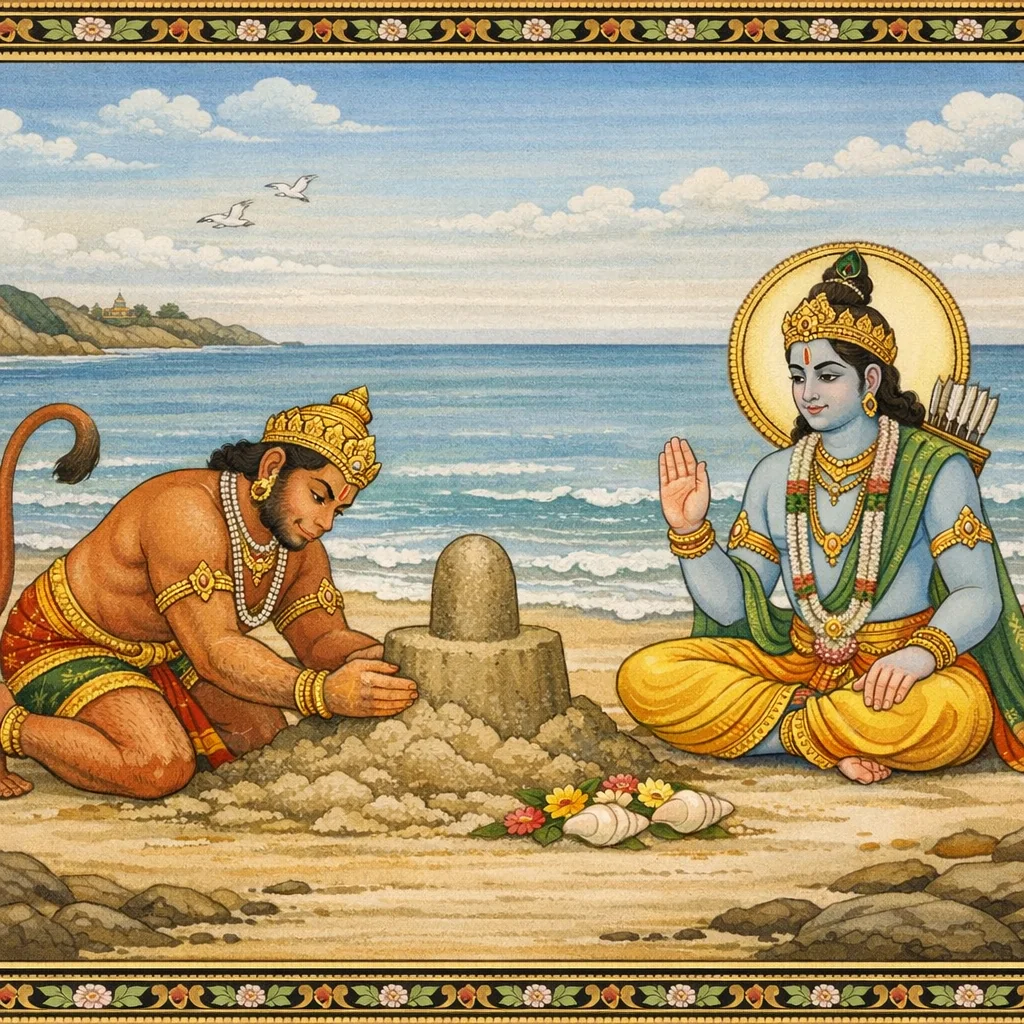
Chapter 45 unfolds a theological and ethical dialogue at Setu during the installation of a liṅga. Hanumān returns swiftly from Kailāsa with an auspicious liṅga gained through tapas and Śiva’s favor, but finds Rāma already worshipping a sand-made liṅga (sai-kata-liṅga) fashioned and installed by Sītā in the presence of sages and divine witnesses. Taking this as disregard for his service, Hanumān pours out grief, self-reproach, and anger, even entertaining the thought of abandoning his body. Rāma steadies him with instruction: distinguish the Self from the karmic cycle of birth and death, contemplate the non-dual nirguṇa ātman beyond the three bodies, and uphold ethical disciplines—truthfulness, non-injury, restraint of the senses, avoidance of fault-finding, and regular worship of the deities. He further undermines attachment to bodily “pleasantness” by stressing impurity and impermanence, cultivating vairāgya. The chapter then turns to ritual resolution. Rāma explains the time constraint that required Sītā’s sand-liṅga first, promises to install Hanumān’s Kailāsa-liṅga as well, and grants names and pilgrimage meaning: Hanūmadīśvara and Rāghaveśvara are linked through darśana. A listing of many liṅgas culminates in Śiva’s “eleven-formed” manifestation, ever-present. Hanumān attempts to uproot the sand-liṅga, fails despite escalating effort, collapses bleeding, and is compassionately approached by Rāma, Lakṣmaṇa, Sītā, and the vānaras—ending on the stark contrast between bodily limitation and sacred fixity.
Shlokas
Verse 1
श्रीसूत उवाच । एवं प्रतिष्ठिते लिंगे रामेणाक्लिष्टकारिणा । लिंगं वरं समादाय मारुतिः सहसाऽययौ
Śrī Sūta said: When the Liṅga had thus been duly installed by Rāma, the unfailing accomplisher of deeds, Māruti at once departed in haste, taking up the excellent Liṅga.
Verse 2
रामं दाशरथिं वीरमभिवाद्य स मारुतिः । वैदेहीलक्ष्मणौ पश्चात्सुग्रीवं प्रणनाम च
Having paid homage to heroic Rāma, son of Daśaratha, Māruti then bowed to Vaidehī (Sītā) and Lakṣmaṇa, and also offered obeisance to Sugrīva.
Verse 3
सीता सैकतलिंगं तत्पूजयंतं रघूद्वहम् । दृष्ट्वाथ मुनिभिः सार्द्धं चुकोप पवनात्मजः
Seeing Sītā—together with sages—beholding Raghu’s foremost (Rāma) worshipping that Liṅga made of sand, the Wind-god’s son (Hanūmān) then grew angry.
Verse 4
अत्यंतं खेदखिन्नः सन्वृथाकृतपरिश्रमः । उवाच रामं धर्मज्ञं हनूमानंजनात्मजः
Deeply distressed and feeling that his effort had been made in vain, Hanūmān, son of Añjanā, spoke to Rāma, the knower of dharma.
Verse 5
हनूमानुवाच । दुर्जातोऽहं वृथा राम लोके क्लेशाय केवलम् । खिन्नोऽस्मि बहुशो देव राक्षसैः क्रूरकर्मभिः
Hanūmān said: “Ill-born am I, O Rāma—useless in this world, fit only to bring distress. Many times, O Lord, I have been worn down by rākṣasas of cruel deeds.”
Verse 6
मा स्म सीमंतिनी काचिज्जनयेन्मादृशं सुतम् । यतोऽनुभूयते दुःखमनंतं भवसागरे
“Let no woman ever bear a son like me; for thereby one tastes endless sorrow in the ocean of worldly becoming.”
Verse 7
खिन्नोऽस्मि सेवया पूर्वं युद्धेनापि ततोधिकम् । अनन्तं दुःखमधुना यतो मामवमन्यसे
“I was already wearied by service—more so even than by battle. Now I suffer endless grief, because you disregard me.”
Verse 8
सुग्रीवेण च भार्यार्थं राज्यार्थं राक्षसेन च । रावणावरजेन त्वं सेवितो ऽसि रघूद्वह
“O best of the Raghus, you are served by Sugrīva for the sake of his wife, and by the rākṣasa Vibhīṣaṇa, the younger brother of Rāvaṇa, for the sake of a kingdom.”
Verse 9
मया निर्हेतुकं राम सेवितोऽसि महामते । वानराणामनेकेषु त्वयाज्ञप्तोऽहमद्य वै
“But I have served you without any motive, O Rāma of great wisdom. Yet today, among the many vānaras, it is I whom you have singled out and commanded.”
Verse 10
शिवलिंगं समानेतुं कैलासात्पर्वतो त्तमात् । कैलासं त्वरितो गत्वा न चापश्यं पिनाकिनम्
“To bring a Śiva-Liṅga from Kailāsa, the best of mountains, I hastened to Kailāsa—yet I did not behold Pinākin, Śiva who bears the bow Pināka.”
Verse 11
तपसा प्रीणयित्वा तं सांबं वृषभवाहनम् । प्राप्तलिंगो रघुपते त्वरितः समु पागतः
Having pleased Śiva—Umā’s consort, the Bull-bannered Lord—through austerity, he obtained the liṅga and hurried back to you, O Raghupati.
Verse 12
अन्यलिंगं त्वमधुना प्रतिष्ठाप्य तु सैकतम् । मुनिभिर्देवगन्धर्वैः साकं पूजयसे विभो
But now, O Lord, you have installed another liṅga made of sand, and you worship it together with sages, gods, and Gandharvas, O Mighty One.
Verse 13
मयानीतमिदं लिंगं कैलासा त्पर्वताद्वृथा । अहो भाराय मे देहो मन्दभाग्यस्यजायते
“I brought this liṅga from Mount Kailāsa—yet it has become futile. Alas for me, ill-fated as I am, this very body has turned into a burden.”
Verse 14
भूतलस्य महाराज जानकीरमण प्रभो । इदं दुःखमहं सोढुं न शक्नोमि रघूद्वह
O great king of the earth, O beloved of Jānakī, O Lord—this sorrow I cannot bear, O foremost of the Raghus.
Verse 15
किं करिष्यामि कुत्राहं गमिष्यामि न मे गतिः । अतः शरीरं त्यक्ष्यामि त्वयाहमवमानितः
What shall I do? Where shall I go? I have no refuge. Therefore I will abandon this body, for I have been dishonoured by you.
Verse 16
श्रीसूत उवाच । एवं स बहुशो विप्राः क्रुशित्वा पवनात्मजः । दण्डवत्प्रणतो भूमौ क्रोधशोकाकुलोऽभवत्
Śrī Sūta said: Thus, O brāhmaṇas, after crying out repeatedly, the son of the Wind prostrated on the ground like a staff, overcome by anger and grief.
Verse 17
तं दृष्ट्वा रघुनाथोऽपि प्रहसन्निदमब्रवीत् । पश्यतां सवदेवानां मुनीनां कपिरक्षसाम् । सांत्वयन्मारुतिं तत्र दुःखं चास्य प्रमार्जयन्
Seeing him, Raghunātha too, smiling, spoke these words—while all the gods, sages, monkeys, and Rākṣasas looked on—comforting Māruti there and wiping away his sorrow.
Verse 18
श्रीराम उवाच । सर्वं जानाम्यहं कार्यमात्मनोऽपि परस्य च
Śrī Rāma said: I know every matter—both what concerns oneself and what concerns another as well.
Verse 19
जातस्य जायमानस्य मृतस्यापि सदा कपे । जायते म्रियते जन्तुरेक एव स्वकर्मणा
O monkey-hero, whether one is already born, being born, or even dead—by one’s own karma alone the embodied being is born and dies again and again.
Verse 20
प्रयाति नरकं चापि परमात्मा तु निर्गुणः । एवं तत्त्वं विनिश्चित्य शोकं मा कुरु वानर
One may even go to hell; but the Supreme Self (Paramātman) is without qualities. Having ascertained this truth, do not grieve, O Vānara.
Verse 21
लिंगत्रयविनिर्मुक्तं ज्योतिरेकं निरंजनम् । निराश्रयं निर्विकारमात्मानं पश्य नित्यशः
Ever behold the Self—freed from the three bodies (liṅgas), a single light, stainless; without dependence, without change—thus contemplate it always.
Verse 22
किमर्थं कुरुषे शोकं तत्त्वज्ञानस्य बाधकम् । तत्त्वज्ञाने सदा निष्ठां कुरु वानरसत्तम
Why do you indulge in grief, which obstructs the knowledge of Reality? O best of Vānaras, establish yourself always in steadfastness toward true knowledge.
Verse 23
स्वयंप्रकाशमात्मानं ध्यायस्व सततं कपे । देहादौ ममतां मुंच तत्त्वज्ञानविरोधिनीम्
O Vānara, meditate constantly on the Self that shines by its own light; abandon possessiveness toward the body and the rest, for it opposes true knowledge.
Verse 24
धर्मं भजस्व सततं प्राणिहिंसां परित्यज । सेवस्व साधुपुरुषाञ्जहि सर्वेंद्रियाणि च
Practice dharma continually; abandon violence toward living beings. Serve holy persons, and subdue all the senses as well.
Verse 25
परित्यजस्व सततमन्येषां दोषकीर्तनम् । शिवविष्ण्वादिदेवानामर्चां कुरु सदा कपे
Ever abandon the recitation of others’ faults. O Vānara, always perform the sacred worship (arcā) of Śiva, Viṣṇu, and the other deities.
Verse 26
सत्यं वदस्व सततं परित्यज शुचं कपे । प्रत्यग्ब्रह्मैकताज्ञानं मोहवस्तुसमुद्गतम्
Speak truth continually and abandon sorrow, O Vānara. Know the oneness of the inner Brahman, which arises when the object of delusion is dispelled.
Verse 27
शोभनाशोभना भ्रांतिः कल्पि तास्मिन्यथार्थवत् । अध्यास्ते शोभनत्वेन पदार्थे मोहवैभवात्
The delusion of ‘pleasant’ and ‘unpleasant’ is imagined there as though it were real; through the splendor of delusion, one superimposes ‘beauty’ upon an object.
Verse 28
रोगो विजायते नृणां भ्रांतानां कपिसत्तम । रागद्वेषबलाद्बद्धा धर्मा धर्मवशंगताः
O best of Vānaras, for deluded people disease arises. Bound by the force of attachment and aversion, their ‘duties’ are driven by compulsion rather than true dharma.
Verse 29
देवतिर्यङ्मनुष्याद्या निरयं यांति मानवाः । चंदनागरुकर्पूरप्रमुखा अतिशोभनाः
Through such delusion, humans go to hell—whether they be devas, animals, or men by birth and station. Sandalwood, agaru, camphor, and the like may be exceedingly fragrant and pleasing, yet they still belong to the realm of perishable things.
Verse 30
मलं भवंति यत्स्पर्शात्तच्छरीरं कथं सुखम् । भक्ष्यभोज्यादयः सर्वे पदार्था अतिशोभनाः
That which, by mere touch, turns into filth—how can such a body be happiness? Foods to be eaten and enjoyed, and all such objects, may seem exceedingly fair, yet they do not bestow enduring bliss.
Verse 31
विष्ठा भवंति यत्संगात्तच्छरीरं कथं सुखम् । सुगंधि शीतलं तोयं मूत्रं यत्संगमाद्भवेत्
That whose association brings forth excrement—how can that body be a seat of happiness? And that whose association gives rise to urine—how could that water be fragrant and cool?
Verse 32
तत्कथं शोभनं पिंडं भवेद्ब्रूहि कपेऽधुना । अतीव धवलाः शुद्धाः पटा यत्संगमेनहि
Then tell me now, O monkey—how could this lump (the body) be truly beautiful? For by contact with it even cloth, though very white, becomes soiled.
Verse 33
भवंति मलिनाः स्वेदात्तत्कथं शोभनं भवेत । श्रूयतां परमार्थो मे हनूमन्वायुनंदन
From sweat it becomes unclean—how then could it be truly beautiful? Hear my highest teaching, O Hanumān, son of Vāyu.
Verse 34
अस्मिन्संसारगर्ते तु किंचित्सौख्यं न विद्यते । प्रथमं जंतुराप्नोति जन्म बाल्यं ततः परम्
In this pit of worldly existence there is no true happiness at all. First the embodied being attains birth, and thereafter comes childhood.
Verse 35
पश्चाद्यौवनमाप्नोति ततो वार्धक्यमश्नुते । पश्चान्मृत्युमवाप्नोति पुनर्जन्म तदश्नुते
Thereafter one reaches youth, then passes into old age. After that one meets death—and then again undergoes rebirth.
Verse 36
अज्ञानवैभवादेव दुःखमाप्नोति मानवः । तदज्ञान निवृत्तौ तु प्राप्नोति सुखमुत्तमम्
By the very power of ignorance, a human being falls into suffering. But when that ignorance is removed, one attains the highest happiness.
Verse 37
अज्ञानस्य निवृत्तिस्तु ज्ञानादेव न कर्मणा । ज्ञानं नाम परं ब्रह्म ज्ञानं वेदांतवाक्यजम्
The cessation of ignorance comes only from knowledge, not from ritual action. Knowledge is none other than the Supreme Brahman—knowledge born of the sentences of the Vedānta.
Verse 39
तज्ज्ञानं च विरक्तस्य जायते नेतरस्य हि । मुख्याधिकारिणः सत्यमाचार्यस्य प्रसादतः
That knowledge arises in one who is detached, not in another. For the truly qualified seeker, it comes—indeed—through the grace of the teacher.
Verse 40
जाग्रतं च स्वपंतं च भुंजंतं च स्थितं तथा । इमं जनं सदा क्रूरः कृतांतः परिकर्षति
Whether awake or asleep, whether eating or simply standing—this person is always being dragged along by relentless Death (Kṛtānta).
Verse 41
सर्वे क्षयांता निचयाः पतनांताः समुच्छ्रयाः । संयोगा विप्रयोगांता मरणांतं च जीवितम्
All accumulations end in depletion; all elevations end in falling. All unions end in separation—and life itself ends in death.
Verse 42
यथा फलानां पक्वानां नान्यत्र पतनाद्भयम् । यथा नराणां जातानां नान्यत्र पतनाद्भयम्
Just as ripe fruits have no fear except that of falling, so too for human beings who are born there is no fear except the inevitable fall into death.
Verse 43
यथा गृहं दृढस्तंभं जीर्णं काले विनश्यति । एवं विनश्यंति नरा जरामृत्युवशंगताः
As a house, even with sturdy pillars, when worn out, perishes in time—so do human beings perish, having come under the dominion of old age and death.
Verse 44
अहोरात्रस्य गमनान्नृणामायुर्विनश्यति । आत्मानमनुशोच त्वं किमन्यमनुशोचसि
With the passing of day and night, the lifespan of human beings is diminished. Grieve for and attend to your own self—why do you grieve for another?
Verse 45
नश्यत्यायुः स्थितस्यापि धावतोऽपि कपीश्वर । सहैव मृत्युर्व्रजति सह मृत्युर्निषीदति
Life ebbs away—whether one stands still or runs, O lord of monkeys. Death goes along with one, and death sits down with one as well.
Verse 46
चरित्वा दूरदेशं च सह मृत्युर्निवर्तते । शरीरे वलयः प्राप्ताः श्वेता जाताः शिरोरुहाः
Even if one has journeyed to far-off lands, death returns with him. Wrinkles come upon the body; the hair upon the head turns white.
Verse 47
जीर्यते जरया देहः श्वासकासादिना तथा । यथा काष्ठं च काष्ठं च समेयातां महोदधौ
The body decays through old age, and likewise through ailments such as breathlessness and cough—just as one piece of wood and another may meet upon the great ocean.
Verse 48
समेत्य च व्यपेयातां कालयोगेन वानर । एवं भार्या च पुत्रश्च वधुक्षेत्रधनानि च
Having met, they also part by the force of time, O Vānara. So too must one part from wife and son, daughter-in-law, fields, and wealth.
Verse 49
क्वचित्संभूय गच्छंति पुनरन्यत्र वानर । यथा हि पांथं गच्छंतं पथि कश्चित्पथि स्थितः
Sometimes people come together and then go elsewhere again, O Vānara—just as on a road, one who stands there meets a traveler passing by.
Verse 50
अहमप्या गमिष्यामि भवद्भिः साकमित्यथ । कंचित्कालं समेतौ तौ पुनरन्यत्र गच्छतः
“I too will go with you,” and thus they proceed. For some time the two travel together, and then they go again to different places.
Verse 51
एवं भार्यासुतादीनां संगमो नश्वरः कपे । शरीरजन्मना साकं मृत्युः संजायते ध्रुवम्
Thus the association with wife, children, and the rest is perishable, O Kapi. Along with the birth of the body, death is certainly born as well.
Verse 52
अवश्यंभाविमरणे न हि जातु प्रतिक्रिया । एतच्छरीरपाते तु देही कर्मगतिं गतः
For death that is inevitably to occur, there is never any countermeasure. When this body falls, the embodied self proceeds along the course determined by its own karma.
Verse 53
प्राप्य पिंडांतरं वत्स पूर्वपिंडं त्यजत्यसौ । प्राणिनां न सदैकत्र वासो भवति वानर
Having obtained another bodily form, dear one, it abandons the former body. For living beings do not dwell forever in a single place or state, O Vānara.
Verse 54
स्वस्वकर्मवशात्सर्वे वियुज्यंते पृथक्पृथक् । यथा प्राणिशरीराणि नश्यंति च भवंति च
Under the governance of each one’s own karma, all become separated—each from each—just as the bodies of living beings perish and again come into being.
Verse 55
आत्मनो जन्ममरणे नैव स्तः कपिसत्तम । अतस्त्वमंजनासूनो विशोकं ज्ञानमद्वयं
For the Self there is truly neither birth nor death, O best of monkeys. Therefore, O son of Añjanā, abide in the non-dual knowledge that is free from sorrow.
Verse 56
सद्रूपममलं ब्रह्म चिंतयस्व दिवानिशम् । त्वत्कृतं मत्कृतं कर्म मत्कृतं त्वाकृतं तथा
Meditate day and night on Brahman—pure, stainless, and of true being. And know this: the karma done by you becomes mine; the karma done by me becomes yours as well.
Verse 57
मल्लिंगस्थापनं तस्मात्त्वल्लिंग स्थापनं कपे । मुहूर्तातिक्रमाल्लिंगं सैकतं सीतया कृतम्
Therefore, my installing of the liṅga becomes your installing of the liṅga, O Vānara. For when the auspicious time was about to pass, Sītā fashioned a liṅga of sand.
Verse 58
मयात्र स्थापितं तस्मात्कोपं दुःखं च मा कुरु । कैलासादागतं लिंगं स्थापयास्मिच्छुभे दिने
Since I have installed it here, do not give way to anger or grief. On this auspicious day I shall install the liṅga that has come from Kailāsa.
Verse 59
तव नाम्ना त्विदं लिंगं यातु लोकत्रये प्रथाम् । हनूमदीश्वरं दृष्ट्वा द्रष्टव्यो राघवेश्वरः
Let this liṅga become renowned throughout the three worlds by your name. Having beheld Hanūmadīśvara, one should also behold Rāghaveśvara.
Verse 60
ब्रह्मराक्षसयूथानि हतानि भवता कपे । अतः स्वनाम्ना लिंगस्य स्थापनात्त्वं प्रमोक्ष्यसे
Hosts of brahma-rākṣasas have been slain by you, O Kapi. Therefore, by establishing the liṅga in your own name, you shall be fully released from that burden.
Verse 61
स्वयं हरेण दत्तं तु हनूमन्नामकं शिवम् । संपश्यन्रामनाथं च कृतकृत्यो भवेन्नरः
That Śiva-liṅga, bearing the name of Hanūmān, was truly bestowed by Hari himself. Whoever beholds it, and also Rāmanātha, becomes one whose life’s purpose is fulfilled.
Verse 62
योजनानां सहस्रेऽपि स्मृत्वा लिंगं हनूमतः । रामनाथेश्वरं चापि स्मृत्वा सायुज्यमाप्नुयात्
Even from a thousand yojanas away, one who remembers Hanūmān’s liṅga—and also remembers Rāmanātheśvara—attains sāyujya, intimate union with Śiva.
Verse 63
तेनेष्टं सर्वयज्ञैश्च तपश्चाकारि कृत्स्नशः । येन दृष्टौ महादेवौ हनूमद्राघवेश्वरौ
By this, it is as though all sacrifices have been performed and every austerity fully accomplished; for thereby the two Great Lords are beheld—Hanūmad-Īśvara and Rāghaveśvara.
Verse 64
हनूमता कृतं लिंगं यच्च लिंगं मया कृतम् । जानकीयं च यल्लिंगं यल्लिंगं लक्ष्मणेश्वरम्
The liṅga made by Hanūmān; the liṅga made by me; the liṅga of Jānakī (Sītā); and the liṅga known as Lakṣmaṇeśvara—these are the sacred forms here.
Verse 65
सुग्रीवेण कृतं यच्च सेतुकर्त्रा नलेन च । अंगदेन च नीलेन तथा जांबवता कृतम्
Also here is the liṅga made by Sugrīva; and that made by Nala, the builder of the bridge; and those made by Aṅgada, Nīla, and likewise by Jāmbavān.
Verse 66
विभीषणेन यच्चापि रत्नलिंगं प्रतिष्ठितम् । इन्द्राद्यैश्च कृतं लिंगं यच्छेषाद्यैः प्रतिष्ठितम्
And also the jeweled liṅga established by Vibhīṣaṇa; the liṅga fashioned by Indra and the other gods; and that which was set up by Śeṣa and others.
Verse 67
इत्येकादशरूपोऽयं शिवः साक्षाद्विभासते । सदा ह्येतेषु लिंगेषु संनिधत्ते महेश्वरः
Thus Śiva shines forth here, manifest indeed in eleven forms. For Maheśvara ever abides in living presence within these liṅgas.
Verse 68
तत्स्वपापौघशुद्ध्यर्थं स्थापयस्व महेश्वरम् । अथ चेत्त्वं महाभाग लिंगमुत्सादयिष्यसि
Therefore, for the cleansing of the multitude of your sins, establish Maheśvara. But if you, O greatly fortunate one, intend to remove and overturn the liṅga—
Verse 69
मयात्र स्थापितं वत्स सीतया सैकतं कृतम् । स्थापयिष्यामि च ततो लिंगमेतत्त्वया कृतम्
O dear one, I have established one here myself; and Sītā has fashioned one of sand. And after that, I shall establish this liṅga made by you as well.
Verse 70
पातालं सुतलं प्राप्य वितलं च रसातलम् । तलातलं च तदिदं भेदयित्वा तु तिष्ठति
Reaching down to Pātāla and Sutala, and piercing Vitala and Rasātala, and Talātala as well—this liṅga stands, having cleft through those nether realms.
Verse 71
प्रतिष्ठितं मया लिंगं भेत्तुं कस्य बलं भवेत् । उत्तिष्ठ लिंगमुद्वास्य मयैतत्स्थापितं कपे
“This liṅga has been established by me—whose strength could suffice to break it? Rise up; cease from removing the liṅga. O Vānara, this has been established by me.”
Verse 72
त्वया समाहृतं लिंगं स्थापयस्वाशु मा शुचः । इत्युक्तस्तं प्रणम्याथाज्ञातसत्त्वोऽथ वानरः
“Quickly install the liṅga that you have brought; do not grieve.” Thus addressed, the monkey-hero bowed to him; and then that vānara—his true strength not yet fully known—set about the task.
Verse 73
उद्वासयामि वेगेन सैकतं लिंगमुत्त मम् । संस्थापयामि कैलासादानीतं लिंगमादरात्
“Swiftly I shall remove the excellent sand-made liṅga, and with reverence I shall install the liṅga that has been brought from Kailāsa.”
Verse 74
उद्वासने सैकतस्य कियान्भारो भवेन्मम । चेतसैवं विचार्यायं हनूमान्मारुता त्मजः
“What burden could there be for me in removing a sand-made form?” Thinking thus in his mind, Hanumān, the son of Māruta, prepared to act.
Verse 75
पश्यतां सर्वदेवानां मुनीनां कपिरक्षसाम् । पश्यतो रामचन्द्रस्य लक्ष्मणस्यापि पश्यतः
While all the gods, the sages, the monkeys and the rākṣasas looked on—while Rāmacandra watched, and Lakṣmaṇa too watched—
Verse 76
पश्यंत्या अपि वैदेह्या लिंगं तत्सैकतं बलात् । पाणिना सर्वयत्नेन जग्राह तरसा बली
Even as Vaidehī (Sītā) looked on, the mighty one seized with his hand that liṅga made of sand, forcefully—exerting every effort and with swift speed.
Verse 77
यत्नेन महता चायं चालयन्नपि मारुतिः । नालं चालयितुं ह्यासीत्सैकतं लिंगमोजसा
Though Māruti strained with tremendous effort to move it, he could not—despite his power—shift that liṅga made of sand.
Verse 78
ततः किलकिलाशब्दं कुर्वन्वानरपुंगवः । पुच्छमुद्यम्य पाणिभ्यां निरास्थत्तन्निजौजसा
Then the bull among monkeys, raising a loud clamor, lifted his tail and struck at it with both hands, wielding his own might.
Verse 79
इत्यनेकप्रकारेण चाल यन्नपि वानरः । नैव चालयितुं शक्तो बभूव पवनात्मजः
Thus, though the monkey tried in many different ways to move it, the son of the Wind was still not able to shift it at all.
Verse 80
तद्वेष्टयित्वा पुच्छेन पाणिभ्यां धरणीं स्पृशन् । उत्पपाताथ तरसा व्योम्नि वायुसुतः कपिः
Wrapping it with his tail and touching the earth with both hands, Vāyu’s son—the monkey—then sprang up swiftly into the sky.
Verse 81
कंपयन्स धरां सर्वां सप्तद्वीपां सपर्वतम् । लिंगस्य क्रोशमात्रे तु मूर्च्छितो रुधिरं वमन्
Shaking the entire earth—with its seven continents and its mountains—he could only draw it a mere krośa; then, fainting, he vomited blood.
Verse 82
पपात हनुमान्विप्राः कंपितांगो धरातले । पततो वायुपुत्रस्य वक्त्राच्च नयनद्वयात्
O brāhmaṇas, Hanumān fell upon the ground, his body trembling. As the son of Vāyu collapsed, blood began to issue from his mouth and from both his eyes.
Verse 83
नासापुटाच्छ्रोत्ररंध्रादपानाच्च द्विजोत्तमाः । रुधिरौघः प्रसुस्राव रक्तकुण्ड मभूच्च तत्
O best of the twice-born, torrents of blood streamed forth from his nostrils, from the openings of his ears, and from below; and there, a pool of blood came into being.
Verse 84
ततो हाहाकृतं सर्वं सदेवासुरमानुषम् । धावंतौ कपिभिः सार्द्धमुभौ तौ रामलक्ष्मणौ
Then a cry of lamentation arose everywhere—among gods, asuras, and men alike. Rāma and Lakṣmaṇa, the two of them, ran forth together with the hosts of monkeys.
Verse 85
जानकीसहितौ विप्रा ह्यास्तां शोकाकुलौ तदा । सीतया सहितौ वीरौ वानरैश्च महाबलौ
O brāhmaṇas, then the two heroes—together with Jānakī (Sītā), and accompanied by the mighty monkeys—stood overwhelmed by grief.
Verse 86
रुरुचाते तदा विप्रा गन्धमादनपर्वते । यथा तारागणयुतौ रजन्यां शशि भास्करौ
O brāhmaṇas, then on Mount Gandhamādana the two shone brilliantly—like the moon and the sun together in the night, accompanied by clusters of stars.
Verse 87
ददर्शतुर्हनूमंतं चूर्णीकृतकलेवरम् । मूर्च्छितं पतितं भूमौ वमन्तं रुधिरं मुखात्
They saw Hanumān—his body crushed and broken—fainted and fallen upon the earth, vomiting blood from his mouth.
Verse 88
विलोक्य कपयः सर्वे हाहाकृत्वाऽपतन्भुवि । कराभ्यां सदयं सीता हनूमंतं मरुत्सुतम्
Seeing this, all the monkeys cried out in anguish and fell upon the ground. With compassion, Sītā touched Hanumān, the son of the Wind, with her hands.
Verse 89
ताततातेति पस्पर्श पतितं धरणीतले । रामोऽपि दृष्ट्वा पतितं हनूमंतं कपीश्वरम्
Crying, “Father! Father!”, she touched him as he lay fallen upon the earth. Rāma too, seeing Hanumān—the lord of the monkeys—lying struck down, (was shaken with grief).
Verse 90
आरोप्यांकं स्वपाणिभ्यामाममर्श कलेवरम् । विमुंचन्नेत्रजं वारि वायुजं चाव्रवीद्द्विजाः
Lifting him onto his lap with his own hands, (Rāma) gently stroked his body. Shedding tears from his eyes, he spoke to Hanumān, the son of Vāyu—O brāhmaṇas.