Adhyaya 1
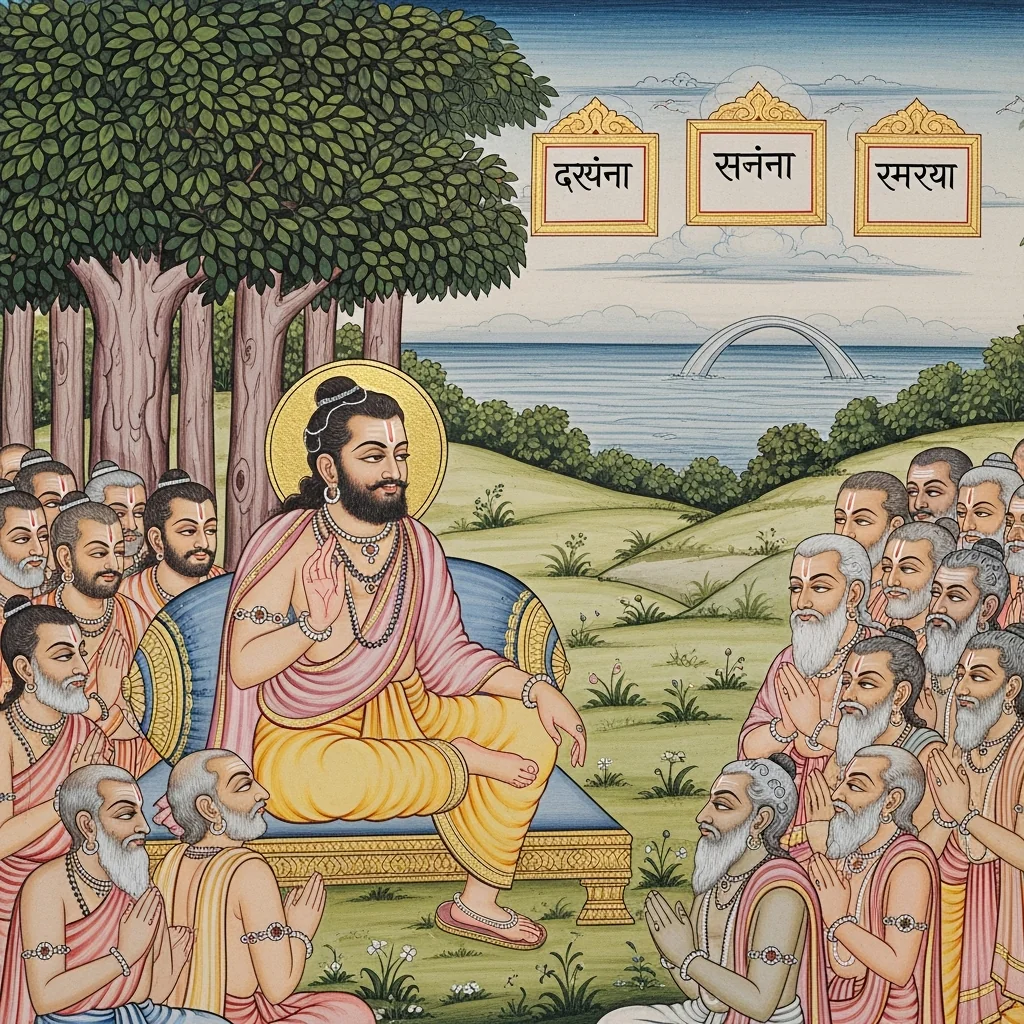
The chapter begins with invocatory verses and a depiction of liberation-seeking sages at Naimiṣāraṇya—disciplined, non-possessive, truth-oriented, and devoted to Viṣṇu. A great assembly of ṛṣis gathers to hear sin-destroying sacred narratives and to ask about worldly welfare and the path to liberation. Sūta, the renowned Purāṇic narrator and disciple of Vyāsa, arrives and is ritually honored by Śaunaka and the others. The sages question him about holy fields and tīrthas, attaining mokṣa from saṃsāra, the arising of devotion to Hari and Hara, and the efficacy of threefold karma. Sūta replies by proclaiming Rāmeśvara at Rāmasetu as the foremost of all tīrthas: the mere sight of Setu is said to loosen bondage to saṃsāra, while bathing and remembrance are taught as means of purification. A lengthy phalaśruti promises the destruction of grave faults, avoidance of punitive afterlife states, and merit comparable to sacrifices, vows, gifts, and austerities. The discourse also lays down pilgrimage ethics—sincerity of intention, the propriety of seeking support for the journey, limits on accepting gifts, and condemnation of deceit involving funds for the Setu pilgrimage. It concludes by presenting Setu as a remedy across the yugas: knowledge in Kṛta, sacrifice in Tretā, gifting in later ages, yet Setu-practice is praised as broadly beneficial in every time.
Shlokas
Verse 1
। अथ ब्राह्मखण्डे प्रथमं सेतुमाहात्म्यम् । श्रीगणेशाय नमः । श्रीवेदव्यासायनमः । शुक्लांबरधरं विष्णुं शशिवर्णं चतुर्भुजम् । प्रसन्नवदनं ध्यायेत्सर्वविघ्नोपशांतये
Now begins, in the Brāhma-khaṇḍa, the first narration of the Setu Māhātmya. Salutations to Śrī Gaṇeśa; salutations to Śrī Vedavyāsa. One should meditate on Viṣṇu—clad in white garments, moon-hued, four-armed, and serene-faced—so that all obstacles may be pacified.
Verse 2
मुमुक्षवो महात्मानो निर्ममा ब्रह्मवादिनः । धर्मज्ञा अनसूयाश्च सत्यवतपरायणाः
They were seekers of liberation—great-souled, free from possessiveness, devoted to the teaching of Brahman; knowers of dharma, without envy, and firmly established in truth and righteous conduct.
Verse 3
जितेंद्रिया जितक्रोधाः सर्वभूतदयालवः । भक्त्या परमया विष्णुमर्चयंतः सनातनम्
With senses conquered and anger subdued, compassionate to all beings, they worshipped the eternal Viṣṇu with supreme devotion.
Verse 4
तपस्तेपुर्महापुण्ये नैमिषे मुक्तिदायिनि । एकदा ते महात्मानः समाजं चक्रुरुत्तमम्
In the supremely meritorious Naimiṣa—bestower of liberation—they performed austerities. Once, those great souls convened an excellent assembly.
Verse 5
कथयंतो महापुण्याः कथाः पापप्रणाशिनी । भुक्तिमुक्त्योरुपायं च जिज्ञासंतः परस्परम्
They recounted supremely holy tales that destroy sin, and questioned one another about the means to both worldly well-being and liberation (mokṣa).
Verse 6
षड्विंशतिसहस्राणामृषीणां भावितात्मनाम् । तेषां शिष्यप्रशिष्याणां संख्या कर्तुं न शक्यते
Of those twenty-six thousand sages (ṛṣi)—self-cultivated and spiritually refined—the number of their disciples and grand-disciples could not be counted.
Verse 7
अत्रांतरे महाविद्वान्व्यासशिष्यो महामुनिः । आगमन्नैमिषारण्यं सूतः पौराणिकोत्तमः
Meanwhile, the great sage Sūta—highly learned, a disciple of Vyāsa, and foremost among the Purāṇic narrators—arrived at Naimiṣāraṇya.
Verse 8
तमागतं मुनिं दृष्ट्वा ज्वलंतमिव पावकम् । अर्घ्याद्यैः पूजयामासुर्मुनयः ।शौनकादयः
Seeing that sage who had arrived—radiant like a blazing fire—the sages headed by Śaunaka honored him with arghya and other offerings of welcome.
Verse 9
सुखोपविष्टं तं सूतमासने परमे शुभे । पप्रच्छुः परमं गुह्यं लोकानुग्रहकांक्षया
When Sūta was comfortably seated upon a most auspicious seat, they questioned him about the highest secret, desiring the welfare and uplift of the world.
Verse 10
सूत धर्मार्थतत्त्वज्ञ स्वागतं मुनिपुंगव । श्रुतवांस्त्वं पुराणानि व्यासात्सत्यवतीसुतात्
O Sūta, knower of the true principles of dharma and artha, welcome, best among sages. You have heard the Purāṇas from Vyāsa, the son of Satyavatī.
Verse 11
अतः सर्वपुराणानामर्थज्ञोऽसि महामुने । कानि क्षेत्राणि पुण्यानि कानि तीर्थानि भूतले
Therefore, O great sage, you are a knower of the meanings of all the Purāṇas. Which sacred fields (kṣetras) are meritorious, and which tīrthas are there upon the earth?
Verse 12
कथं वा लप्स्यते मुक्तिर्जीवानां भवसागरात् । कथं हरे हरौ वापि नृणां भक्तिः प्रजायते
How indeed is liberation attained by beings from the ocean of worldly becoming? And how does devotion arise in people—toward Hari, or toward Hara (Śiva) as well?
Verse 13
केन सिध्येत च फलं कर्मणास्त्रिविधा त्मनः । एतच्चान्यच्च तत्सर्वं कृपया वद सूतज
By what means is the fruit accomplished through action, with the self in its threefold mode? This—and everything else besides—tell us all of it, out of compassion, O son of Sūta.
Verse 14
ब्रूयुः स्निग्धाय शिष्याय गुरवो गुह्यमप्युत । इति पृष्टस्तदा सूतो नैमिषारण्यवासिभिः
Teachers speak even what is secret to a loving and fit disciple. Thus, Sūta was then questioned by the dwellers of Naimiṣāraṇya.
Verse 15
वक्तुं प्रचक्रमे नत्वा व्यासं स्वगुरुमादितः । श्रीसूत उवाच । सम्यक्पृष्टमिदं विप्रा युष्माभिर्जगतो हितम्
Having first bowed to Vyāsa, his own guru, he began to speak. Śrī Sūta said: “O brāhmaṇas, you have asked rightly—(a question) for the welfare of the world.”
Verse 16
रहस्यमे तद्युष्माकं वक्ष्यामि शृणुतादरात् । मया नोक्तमिदं पूर्वं कस्यापि मुनिपुंगवाः
This is a secret teaching; for your sake I shall declare it—listen with reverence. O foremost of sages, I have never spoken this earlier to anyone.
Verse 17
मनो नियम्य विप्रेंद्राः शृणुध्वं भक्तिपूर्वकम् । अस्ति रामेश्वरं नाम रामसेतौ पवित्रितम्
Restrain the mind, O best of brāhmaṇas, and listen with devotion. There is a holy place named Rāmeśvara, sanctified upon Rāmasetu.
Verse 18
क्षेत्राणामपि सर्वेषां तीर्थानामपि चोत्तमम् । दृष्टमात्रे रामसेतौ मुक्तिः संसारसागरात्
Among all sacred regions and among all tīrthas, it is the supreme. By merely beholding Rāmasetu, liberation is gained from the ocean of saṃsāra.
Verse 19
हरे हरौ च भक्तिः स्यात्तथा पुण्यसमृद्धिता । कर्मणस्त्रिविधस्यापि सिद्धिः स्यान्नात्र संशयः
Devotion arises toward Hari and toward Hara as well, and merit becomes abundant. Even the success of threefold action is attained—of this there is no doubt.
Verse 20
यो नरो जन्ममध्ये तु सेतुं भक्त्यावलोकयेत् । तस्य पुण्यफलं वक्ष्ये शृणुध्वं मुनिपुंगवाः
O foremost of sages, I shall declare the fruit of merit: whoever, at any time in the course of life, beholds the sacred Setu with devotion—his puṇya is truly great.
Verse 21
मातृतः पितृतश्चैव द्विकोटिकुलसंयुतः । निर्विश्य शंभुना कल्पं ततो मोक्षं समश्नुते
Along the lines of both mother and father—together with two crores of family members—one gains entry with Śambhu for a kalpa, and thereafter attains liberation (mokṣa).
Verse 22
गण्यंते पांसवो भूमेर्गण्यंते दिवि तारकाः । सेतुदर्शनजं पुण्यं शेषेणापि न गण्यते
The grains of dust upon the earth can be counted; the stars in the sky can be counted. But the puṇya born of beholding the Setu cannot be measured—even in the slightest remainder.
Verse 23
समस्तदेवतारूपः सेतुवंधः प्रकीर्तितः । तद्दर्शनवतः पुंसः कः पुण्यं गणितुं क्षमः
Setubandha is proclaimed to embody the forms of all the deities. For one who has beheld it, who could possibly calculate his puṇya?
Verse 24
सेतुं दृष्ट्वा नरो विप्राः सर्वयागकरः स्मृतः । स्नातश्च सर्वतीर्थेषु तपोऽतप्यत चाखिलम्
O brāhmaṇas, a man who has seen the Setu is remembered as one who has performed all yajñas; as though he had bathed in all tīrthas and fully undertaken every tapas (austerity).
Verse 25
सेतुं गच्छेति यो ब्रूयाद्यं कं वापि नरं द्विजाः । सोऽपि तत्फलमाप्नोति किमन्यैर्बहुभाषणः
O twice-born ones, whoever tells any person, “Go to the Setu,” he too attains that very fruit—what need is there of many more words?
Verse 26
सेतुस्नानकरो मर्त्यः सप्तकोटिकुलान्वितः । संप्राप्य विष्णुभवनं तत्रैव परिमुच्यते
A mortal who performs bathing at the Setu—together with seven crores of family members—reaches Viṣṇu’s abode and is liberated there itself.
Verse 27
सेतुं रामेश्वरं लिंगं गंधमादनपर्वतम् । चिंतयन्मनुजः सत्यं सर्वपापैः प्रमुच्यते
Truly, a person who meditates upon the Setu, the Rāmeśvara Liṅga, and the Gandhamādana mountain is freed from all sins.
Verse 28
मातृतः पितृतश्चैव लक्षकोटिकुलान्वितः । संप्राप्य विष्णुभवनं तत्रैव परिमुच्यते । कल्पत्रयं शंभुपदे स्थित्वा तत्रैव मुच्यते
From the mother’s and father’s lines alike—together with lakhs and crores of family members—one reaches Viṣṇu’s abode and is liberated there. Having abided in Śambhu’s state for three kalpas, one is released there itself.
Verse 29
मूषावस्थां वसाकूपं तथा वैतरणी नदीम् । श्वभक्षं मूत्रपानं च सेतुस्नायी न पश्यति
One who bathes at the Setu does not behold the states of torment—being made like a mouse, the “well of fat,” the Vaitaraṇī river, nor the horrors of dog-eating and urine-drinking.
Verse 30
तप्तशूलं तप्तशिलां पुरी षह्रदमेव च । तथा शोणितकूपं च सेतुस्नायी न पश्यति
One who bathes at Setu does not behold the hells called Heated Spear, Heated Rock, the Lake of Excrement, and the Well of Blood.
Verse 31
शाल्मल्यारोहणं रक्तभोजनं कृमिभोजनम् । स्वमांसभोजनं चैव वह्निज्वालाप्रवेशनम्
For the Setu-bather there is no vision of torments such as climbing the śālmali tree, eating blood, eating worms, eating one’s own flesh, or entering blazing fire-flames.
Verse 32
शिलावृष्टिं वह्निवृष्टिं नरकं कालसूत्रकम् । क्षारोदकं चोष्णतोयं नेयात्सेत्ववलोककः
One who merely beholds Setu is not led to the hells of stone-rain, fire-rain, Kālasūtra, caustic waters, or scalding waters.
Verse 33
सेतुस्नायी नरो विप्राः पंचपातकवानपि । मातृतः पितृतश्चैव शतकोटिकुलान्वितः
O brāhmaṇas, even a man stained with the five great sins—together with a hundred million families on his mother’s and father’s sides—is uplifted by bathing at Setu.
Verse 34
कल्पत्रयं विष्णुपदे स्थित्वा तत्रैव मुच्यते । अधःशिरःशोषणं च नरकं क्षारसेवनम्
Having dwelt for three kalpas in Viṣṇu’s abode, one is released there itself; thus one does not attain the hells of being dried while hanging head-down, nor that of consuming caustic alkali.
Verse 35
पाषाणयन्त्रपीडां च मरुत्प्रपतनं तथा । पुरीषलेपनं चैव तथा क्रकचदारणम्
The one who bathes at Setu does not behold torments such as being crushed by stone-engines, hurled by violent winds, smeared with filth, or torn apart by saws.
Verse 36
पुरीषभोजनं रेतःपानं संधिषु दाहनम् । अंगारशय्याभ्रमणं तथा मुसलमर्द्दनम्
He does not face hells such as eating filth, drinking semen, being burned at the joints, rolling upon a bed of embers, or being pounded with clubs.
Verse 37
एतानि नरकाण्यद्धा सेतुस्नायी न पश्यति । सेतु स्नानं करिष्येऽहमिति बुद्ध्या विचिंतयन्
Truly, the Setu-bather does not see these hells. Even by steadfastly contemplating, “I shall perform bathing at Setu,” one gains its protecting merit.
Verse 38
गच्छेच्छतपदं यस्तु स महापातकोऽपि सन् । बहूनां काष्ठयंत्राणां कर्षणं शस्त्रभेदनम्
But whoever turns aside and goes elsewhere—though he be a great sinner—meets torments such as being dragged by many wooden contraptions and being pierced by weapons.
Verse 39
पतनोत्पतनं चैव गदादण्डनिपीडनम् । गजदन्तैश्च हननं नानाभुजगदंशनम्
There are also torments such as being made to fall and be thrown up again, being crushed by maces and staffs, being struck with elephant tusks, and being bitten by many kinds of serpents.
Verse 40
धूमपानं पाशबन्धं नानाशूलनिपीडनम् । मुखे च नासिकायां च क्षारोदकनिषेचनम्
Forced inhalation of smoke, binding with nooses, crushing pains from many spears, and the pouring of caustic alkaline water into the mouth and nostrils.
Verse 41
क्षारांबुपानं नरकं तप्तायः सूचिभक्षणम् । एतानि नरकान्यद्धा न याति गतपातकः
Drinking caustic alkaline water, the hell of consuming red-hot iron needles—one whose sins have been removed does not, indeed, go to these hells.
Verse 42
क्षारांबुपूर्णरंध्राणां प्रवेशं मलभोजनम् । स्नायुच्छेदं स्नायुदाहमस्थिभेदनमेव च
Entering into bodies whose pores are filled with caustic alkaline water, being forced to eat filth, the cutting of sinews, the burning of sinews, and even the splitting of bones.
Verse 43
श्लेष्मादनं पित्तपानं महातिक्तनिषेवणम् । अत्युष्ण तैलपानं च पानं क्षारोदकस्य च
Eating phlegm, drinking bile, consuming intensely bitter substances, drinking scalding hot oil, and drinking caustic alkaline water.
Verse 44
कषायोदकपानं च तप्तपाषाणभोजनम् । अत्युष्णसिकतास्नानं तथा दशनमर्दनम्
Drinking astringent decoctions, eating red-hot stones, bathing in scorching sand, and the grinding of teeth—such are described among the agonies of hell.
Verse 45
तप्तायःशयनं चैव संतप्तांबुनिषेचनम् । सूचिप्रक्षेपणं चैव नेत्रयोर्मुखसंधिषु
Lying upon red-hot iron, being drenched with boiling water, and the thrusting of needles into the eyes and the joints of the mouth.
Verse 46
शिश्ने सवृषणे चैव ह्ययोभारस्य बन्धनम् । वृक्षाग्रात्पतनं चैव दुर्गंधपरिपूरिते
Binding heavy iron weights upon the genitals, and being made to fall from the top of a tree into a place filled with foul stench.
Verse 47
तीक्ष्णधारास्त्रशय्यां च रेतःपानादिकं तथा । इत्यादि नरकान्घोरासेतुस्नायी न पश्यति
A bed of weapons with razor-sharp edges, drinking semen and the like—such dreadful hells are not seen by one who bathes at Setu.
Verse 48
सेतुसैकतमध्ये यः शेते तत्पांसुकुंठितः । यावन्तः पांसवो लग्नास्तस्यांगे विप्रसत्तमाः
O best of Brāhmaṇas, whoever lies down in the midst of Setu’s sands, covered with its dust—whatever grains of sand cling to his body...
Verse 49
तावतां ब्रह्महत्यानां नाशः स्यान्नात्र संशयः । सेतुमध्यस्थ वातेन यस्यांगं स्पृश्यतेऽखिलम्
Without doubt, countless sins of brahmin-slaying are destroyed. And he whose entire body is touched by the wind that blows in the midst of Setu,
Verse 50
सुरापानायुतं तस्य तत्क्षणादेव नश्यति । वर्तंते यस्य केशास्तु वपनात्सेतुमध्यतः
For him, the sin of drinking liquor—even in countless measures—perishes that very instant, if his hair is shaved within the midst of Setu.
Verse 51
गुरुतल्पा युतं तस्य तत्क्षणादेव नश्यति । यस्यास्थि सेतुमध्ये तु स्थापितं पुत्रपौत्रकैः । स्वर्णस्तेयायुतं तस्य तत्क्षणादेव नश्यति
For him, the sin of violating the guru’s bed—even in vast measure—perishes instantly. And for the one whose bones are placed in the midst of Setu by sons and grandsons, the sin of stealing gold—even in countless measure—also perishes that very moment.
Verse 52
स्मृत्वा यं सेतुमध्ये तु स्नानं कुर्याद्द्विजोत्तमाः । महापातकिसंसर्गदोषस्तस्य लयं व्रजेत्
O best of the twice-born, if one bathes in the midst of Setu while remembering Him, the fault arising from association with great sinners comes to dissolution.
Verse 53
मार्गभेदी स्वार्थपाकी यतिब्राह्मणदूषकः । अत्याशी वेदविक्रेता पंचैते ब्रह्मघातकाः
The road-breaker, the one who cooks only for his own gain, the defiler of ascetics and brāhmaṇas, the glutton, and the seller of the Veda—these five are declared to be equal to slayers of a brāhmaṇa.
Verse 54
ब्राह्मणान्यः समाहूय दास्यामीति धनादिकम् । पश्चान्नास्तीति यो ब्रूते ब्रह्महा सोपि कीर्तितः
He who summons brāhmaṇas saying, “I shall give wealth and the like,” but later declares, “There is nothing,” is also proclaimed a slayer of a brāhmaṇa.
Verse 55
परिज्ञाय यतो धर्मांस्तस्मै यो द्वेषमाचरेत् । अवजानाति वा विप्रान्ब्रह्महा सोपि कीर्तितः
He who, knowing that one teaches dharma, yet bears hatred toward him—or who shows contempt for brāhmaṇas—is also declared a slayer of a brāhmaṇa.
Verse 56
जलपानार्थमायातं गोवृन्दं तु जलाशये । निवारयति यो विप्रा ब्रह्महा सोपि कीर्तितः
O brāhmaṇas, he who prevents a herd of cows that has come to a water-reservoir to drink is also declared a slayer of a brāhmaṇa.
Verse 57
सेतुमेत्य तु ते सर्वे मुच्यंते दोषसंचयैः । ब्रह्मघातकतुल्या ये संति चान्ये द्विजोत्तमाः
But having come to Setu, all of them are freed from accumulated faults—yes, even those others, O best of the twice-born, who are comparable to slayers of a brāhmaṇa.
Verse 58
ते सर्वे सेतुमागत्य मुच्यंते नात्र संशयः । औपासनपरित्यागी देवतान्नस्य भोजकः
All of them, having reached Setu, are freed—of this there is no doubt: even one who has abandoned the household sacred fire, and one who eats food offered to the deities.
Verse 59
सुरापयोषित्संसर्गी गणिकान्नाशनस्तथा । गणान्नभोजकश्चैव पतितान्नरतश्च यः
One who keeps company with liquor and with fallen women; one who eats a courtesan’s food; one who partakes of food belonging to impure groups; and one who delights in the food of the fallen—whoever is such is counted among those needing purification.
Verse 60
एते सुरापिनः प्रोक्ताः सर्वकर्मबहिष्कृताः । सेतुस्नानेन मुच्यंते ते सर्वे हतकिल्बिषाः
These are declared drinkers of intoxicants, excluded from all sacred rites; yet by bathing at Setu they are released—every one of them—having their sins destroyed.
Verse 61
सुरापतुल्या ये चान्ये मुच्यंते सेतुमज्जनात् । कन्दमूलफलानां च कस्तूरीपट्टवाससाम्
And others too, whose offenses are equal to the sin of drinking liquor, are freed by immersion at Setu. So too are those involved with roots, tubers, and fruits, and with musk and silk garments.
Verse 62
पयश्चंदनकर्पूरक्रमुकाणां तथैव च । मध्वाज्यता म्रकांस्यानां रुद्राक्षाणां तथैव च
Likewise it is said regarding milk, sandalwood, camphor, and areca nuts; likewise regarding honey and ghee, and regarding emeralds and bronzes, and likewise regarding rudrākṣa beads.
Verse 64
अन्ये च स्तेयिनः सर्वे सेतुस्नानेन वै द्विजाः । मुच्यंते सर्वपापेभ्यो नात्र कार्या विचारणा
And all other thieves as well, O twice-born ones, are freed by bathing at Setu; they are released from every sin—no deliberation is to be made here.
Verse 65
भगिनीं पुत्रभार्यां च तथैव च रजस्वलाम् । भ्रातृभार्यां मित्रभार्यां मद्यपां च परस्त्रियम्
(One who violates) a sister, a son’s wife, likewise a menstruating woman; a brother’s wife, a friend’s wife, a woman given to drink, and another man’s wife—
Verse 66
हीनस्त्रियं च विश्वस्तां योऽभिगच्छति रागतः । गुरुतल्पी स विज्ञेयः सर्वकर्मबहिष्कृतः
He who, out of passion, approaches a woman of low condition or one who has trusted him is to be known as a violator of the guru’s bed, excluded from all sacred rites.
Verse 67
एते चान्ये च ये संति गुरुतल्पगतुल्यकाः । ते सर्वे प्रविमुच्यंते सेतुस्नानेन वै द्विजाः
These—and others too—who are of the same class as violators of the guru’s bed: all of them are completely freed by bathing at Setu, O twice-born ones.
Verse 69
चोरकास्तु परिज्ञेया सुवर्णस्तेयिनः समाः । ते सेतुक्षेत्रमागत्य मुच्यन्ते नात्र संशयः
Robbers are to be understood as equal to thieves of gold. Having come to Setu Kṣetra, they are freed—of this there is no doubt.
Verse 71
तिलान्भूमिं सुवर्णं च धान्यं तंदुलमेव च । अदत्त्वेच्छंति ते स्वर्गं स्नातुं सेतौ तु ते द्विजाः
Those who desire heaven without having given sesame, land, gold, grain, or rice—those twice-born come to bathe at Setu.
Verse 72
उपवासैर्व्रतैः कृत्स्नैरसंताप्य निजां तनुम् । स्वर्गाभिलाषिणः पुंसः स्नांतु सेतौ विमुक्तिदे
Without tormenting their own bodies by complete fasts and vows, men who long for heaven should bathe at Setu—the giver of liberation.
Verse 73
सेतुस्नानं मोक्षदं हि मनःशुद्धिप्रदं तथा । जपाद्धोमात्तथा दानाद्यागाच्च तपसोऽपि च
Bathing at Setu indeed grants liberation (moksha) and likewise bestows purity of mind—surpassing even japa, homa, charity, sacrifice (yajña), and austerity (tapas).
Verse 74
सेतुस्नानं विशिष्टं हि पुराणे परिपठ्यते । अकामनाकृतं स्नानं सेतौ पापविनाशने
Setu-bathing is declared in the Purāṇa to be exceptional. Bathing at Setu without selfish desire is a destroyer of sins.
Verse 75
अपुनर्भवदं प्रोक्तं सत्यमुक्तं द्विजोत्तमाः । यः संपदं समुद्दिश्य स्नाति सेतौ नरो मुदा
O best of the twice-born, it is truly said that Setu-bathing grants freedom from rebirth. Yet a man who bathes at Setu joyfully with wealth in mind seeks a different fruit.
Verse 76
स संपदमवाप्नोति विपुलां द्विजपुंगवाः । शुद्ध्यर्थं स्नाति चेत्सेतौ तदा शुद्धिमवाप्नुयात्
He attains abundant prosperity, O foremost among the twice-born. But if he bathes at Setu for the sake of purification, then he indeed gains purification.
Verse 77
रत्यर्थं यदि च स्नायादप्सरोभिर्नरो दिवि । तदा रतिमवाप्नोति स्वर्गलोकेऽमरीजनैः
If a man bathes with the aim of pleasure, then in heaven, in the realm of Svarga, he attains that pleasure among the Apsarases and the divine hosts.
Verse 78
मुक्त्यर्थं यदि च स्नायात्सेतौ मुक्तिप्रदायिनि । तदा मुक्तिमवाप्नोति पुनरावृत्तिवर्जिताम्
If one bathes at Setu with liberation as the aim—at that Setu which bestows mokṣa—then one attains mokṣa, free from return to rebirth.
Verse 79
सेतुस्नानेन धर्मः स्यात्सेतुस्नानादघक्षयः । सेतुस्नानं द्विजश्रेष्ठाः सर्वकामफलप्रदम्
Through bathing at Setu, dharma is strengthened; through Setu-bathing, sin is destroyed. O best of the twice-born, Setu-snāna grants the fruits of all desires.
Verse 80
सर्वव्रताधिकं पुण्यं सर्वयज्ञोत्तरं स्मृतम् । सर्वयोगाधिकं प्रोक्तं सर्व तीर्थाधिकं स्मृतम्
Its merit is remembered as surpassing all vows and greater than all yajñas; it is declared superior to all yogas and esteemed beyond all tīrthas.
Verse 81
इंद्रादिलोकभोगेषु रागो येषां प्रवर्तते । स्नातव्यं तैर्द्विजश्रेष्ठाः सेतौ रामकृते सकृत्
O best of the twice-born, those in whom longing arises for the enjoyments of Indra’s and other worlds should bathe at Rāma’s Setu—even once.
Verse 82
ब्रह्मलोके च वैकुण्ठे कैलासेऽपि शिवालये । रंतुमिच्छा भवेद्येषां ते सेतौ स्नांतु सादरम्
Those who wish to revel in Brahmaloka, in Vaikuṇṭha, or even on Kailāsa—the abode of Śiva—should bathe at Setu with reverence.
Verse 83
आयुरारोग्यसंपत्तिमतिरूपगुणाढ्यताम् । चतुर्णामपि वेदानां सांगानां पारगामिनाम्
Longevity, freedom from disease, prosperity, keen intelligence, beauty, and a wealth of virtues—even the mastery that carries one across the four Vedas together with their auxiliary disciplines—these are the fruits proclaimed in the greatness of Setu.
Verse 84
सर्वशास्त्राधिगंतृत्वं सर्वमंत्रेष्वभिज्ञताम् । समुद्दिश्य तु यः स्नायात्सेतौ सर्वार्थसिद्धिदे
Whoever bathes at Setu with a stated intention gains mastery of all śāstras and proficiency in all mantras; for Setu is the giver of success in every rightful aim.
Verse 85
तत्तत्सिद्धिम वाप्नोति सत्यं स्यान्नात्र संशयः । दारिद्र्यान्नरकाद्ये च मनुजा भुवि बिभ्यति
He attains that very accomplishment—this is true; there is no doubt here. On earth, people fear poverty and also hell and the like.
Verse 86
स्नानं कुर्वंतु ते सर्वे रामसेतौ विमुक्तिदे । श्रद्धया सहितो मर्त्यः श्रद्धया रहितोऽपि वा
Let all of them perform bathing at Rāmasetu, the giver of liberation—whether a mortal is endowed with faith or even devoid of faith.
Verse 87
इहलोके परत्रापि सेतुस्नायी न दुःखभाक् । सेतुस्नानेन सर्वेषां नश्यते पापसंचयः
In this world and in the next, one who bathes at Setu is not a sharer in suffering. By Setu-bathing, the accumulated heap of sins of all is destroyed.
Verse 88
वर्द्धते धर्मराशिश्च शुक्लपक्षे यथा शशी । यथा रत्नानि वर्द्धंते समुद्रे विविधान्यपि
One’s store of dharma increases, as the moon waxes in the bright fortnight; and as within the ocean, diverse jewels too are found in ever greater abundance.
Verse 89
तथा पुण्यानि वर्द्धंते सेतुस्नानेन वै द्विजाः । काम धेनुर्यथा लोके सर्वाकामान्प्रयच्छति
So too, O twice-born ones, merits increase through bathing at Setu. Just as Kāmadhenu in the world bestows all desires,
Verse 90
चिंतामणिर्यथा दद्यात्पुरुषाणां मनोरथान् । यथाऽमरतरुर्दद्यात्पुरुषाणामभीप्सितम्
Just as the wish-gem Cintāmaṇi grants people the desires of the heart; and just as the divine wish-tree Amarataru bestows what they long for—
Verse 91
सेतुस्नानं तथा नृणां सर्वाभीष्टान्प्रदास्यति । अशक्तः सेतुयात्रायां दारिद्र्येण च मानवः
So too, bathing at Setu will grant people all that they desire. But if a person is unable to undertake the pilgrimage to Setu because of poverty,
Verse 92
याचित्वा स धनं शिष्टात्सेतौ स्नानं समाच रेत् । सेतुस्नानसमं पुण्यं तत्र दाता समश्नुते
Let him request funds from the virtuous and duly perform the bathing at Setu. Merit equal to Setu-bathing is gained there by the donor as well.
Verse 93
तथा प्रतिगृहीतापि प्राप्नोत्यविकलं फलम् । सेतुयात्रां समुद्दिश्य गृह्णीयाद्ब्राह्मणाद्ध नम्
Even when such support is accepted, one attains the full, undiminished merit—provided it is received with the Setu pilgrimage in view. For the sake of the Setu-yātrā, one should accept wealth from a brāhmaṇa.
Verse 94
क्षत्रियादपि गृह्णीयान्न दद्युर्ब्राह्मणा यदि । वैश्याद्वा प्रतिगृह्णीयान्न प्रयच्छंति चेन्नृपाः
If brāhmaṇas do not give, one may accept even from a kṣatriya; or one may accept from a vaiśya, if rulers do not provide support.
Verse 95
शूद्रान्न प्रतिगृह्णीयात्कथंचिदपि मानवः । यः सेतुं गच्छतः पुंसो धनं वा धान्यमेव वा
A person should not, under any circumstance, accept from a śūdra—whether it be money or even grain—as support for one who is going to Setu.
Verse 96
दत्त्वा वस्त्रादिकं वापि प्रवर्तयति मानवः । सोऽश्वमेधादियज्ञानां फलमाप्तो त्यनुत्तमम्
A person who, by giving garments and the like, enables another’s Setu pilgrimage attains the unsurpassed fruit of sacrifices such as the Aśvamedha.
Verse 97
चतुर्णामपि वेदानां पारायणफलं लभेत् । तुलापुरुषमुख्यानां दानानां फलमश्नुते
He gains the merit of reciting all four Vedas, and enjoys the fruit of great gifts such as the Tulāpuruṣa (weighing-gift) and other foremost dānas.
Verse 98
ब्रह्महत्यादिपापानां नाशः स्या न्नात्र संशयः । बहुना किं प्रलापेन सर्वान्कामान्समश्नुते
Sins beginning with brahmahatyā are destroyed—of this there is no doubt. Why speak at length? One attains the fulfillment of all rightful desires.
Verse 99
एवं प्रतिगृहीतापि तत्तुल्यफलमश्नुते । याचतः सेतुयात्रार्थं न प्रतिग्रहकल्मषम्
Thus, even when one has accepted support, one enjoys a fruit equal to that merit. For one who begs only for the sake of the Setu pilgrimage, there is no stain of ‘sin from acceptance’.
Verse 100
सेतुं गच्छ धनं तेऽहं दास्यामीति प्रलोभ्य यः । पश्चान्नास्तीति च ब्रूयात्तमाहुर्ब्रह्मघातकम्
Whoever entices someone, saying, “Go to Setu; I will give you wealth,” and later says, “There is nothing to give,” is called a slayer of Brahman (brahma-ghātaka).
Verse 101
लोभेन सेतुयात्रार्थं संपन्नोऽपि दरिद्रवत् । मानवो यदि याचेत तमाहुस्तेयिनं बुधाः
If, out of greed, a person who is well-provided still begs for the sake of the Setu pilgrimage as though he were poor, the wise call him a thief.
Verse 102
गमिष्ये सेतुमिति वै यो गृहीत्वा धनं नरः । न याति सेतुं लोभेन तमाहुर्ब्रह्मघा तकम्
A man who takes money saying, “I will go to Setu,” but then, out of greed, does not go to Setu—him they call a brahma-ghātaka.
Verse 103
येन केनाप्युपायेन सेतुं गच्छेन्नरो मुदा । अशक्तो दक्षिणां दत्त्वा गमयेद्वा द्विजोत्तमम्
By whatever means, a man should go with joy to Setu. If he cannot go himself, then—having given the proper dakṣiṇā—he should send an excellent brāhmaṇa in his stead.
Verse 104
याचित्वा यज्ञकरणे यथा दोषो न विद्यते । याचित्वा सेतुयात्रायां तथा दोषो न विद्यते
Just as there is no fault in requesting resources to perform a yajña, so too there is no fault in requesting resources for the pilgrimage to Setu.
Verse 105
याचित्वाप्यन्यतो द्रव्यं सेतुस्नाने प्रवर्तयेत् । सोऽपि तत्फलमाप्नोति सेतु स्नायी नरो यथा
Even if one obtains wealth from elsewhere by requesting and uses it to undertake bathing at Setu, he too attains that very fruit—just as one who bathes at Setu does.
Verse 106
ज्ञानेन मोक्षमभियांति कृते युगे तु त्रेतायुगे यजनमेव विमुक्तिदायि । श्रेष्ठं तथान्ययुगयोरपि दानमाहुः सर्वत्र सेत्व भिषवो हि वरो नराणाम्
In the Kṛta Yuga, liberation is attained through knowledge; in the Tretā Yuga, sacrifice (yajña) alone bestows release. Likewise, in the other yugas they proclaim charity (dāna) to be the foremost means. Yet in every age, Setu—like a supreme physician—stands as a boon to humankind.