Adhyaya 39
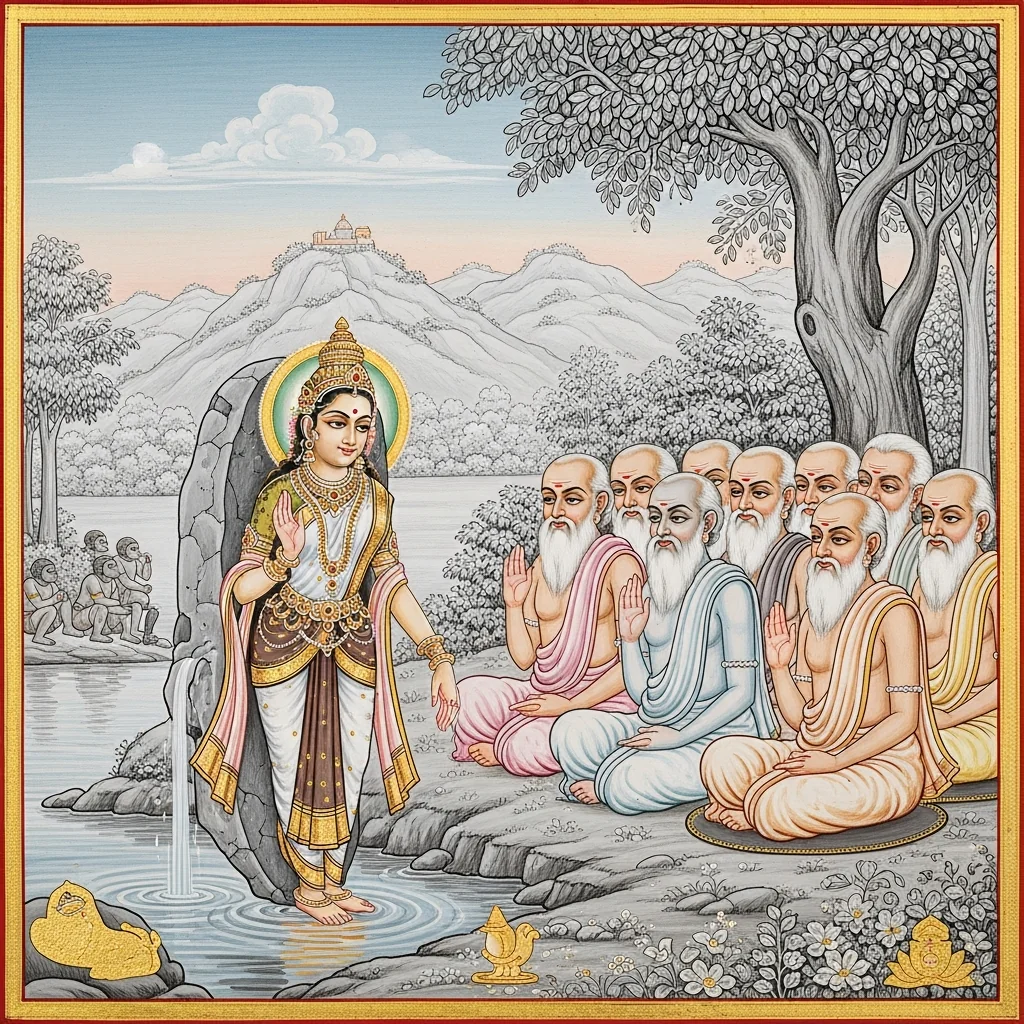
This adhyāya unfolds in two movements. First, Sūta tells of Kapitīrtha’s origin and ritual power on Gandhamādana mountain: after Rāvaṇa and allied forces are defeated, the vānaras establish this tīrtha for the welfare of all, bathe there, and receive boons. Rāma then grants an expanded vara, declaring that bathing at Kapitīrtha yields fruits equal to bathing in the Gaṅgā and at Prayāga, equal to the combined merit of all tīrthas, to great soma-sacrifices such as Agniṣṭoma, to mahāmantra-japa (including Gāyatrī), to great gifts like cow-dāna, to Veda-recitation, and to deva-worship. Devas and sages gather, praise the site as unrivaled, and affirm that seekers of liberation should surely go there. Second, in response to the sages’ questions, Sūta narrates Rambhā’s curse and release. Viśvāmitra, once a Kuśika king, is humbled by Vasiṣṭha’s spiritual power and undertakes fierce tapas to attain brāhmaṇya; fearing his success, the devas send the apsaras Rambhā to distract him, but he perceives the ploy and curses her to become stone for a vast time, to be freed only through a brāhmaṇa’s intervention. Later, Śveta, Agastya’s disciple, is harassed by a rākṣasī, and through a subtle astral act the stone is propelled to Kapitīrtha; by the tīrtha’s touch Rambhā regains her form, is honored by the devas, and returns to heaven, repeatedly glorifying Kapitīrtha and venerating Rāmanātha and Śaṅkara. The concluding phalaśruti declares that hearing or reciting this adhyāya grants the fruit of bathing at Kapitīrtha.
Shlokas
Verse 1
श्रीसूत उवाच । अथातः संप्रवक्ष्यामि कपितीर्थस्य वैभवम् । तत्तीर्थं सकलैः पूर्वं गंधमादनपर्वते
Śrī Sūta said: Now, then, I shall fully declare the greatness of Kapitīrtha— that sacred ford which, in ancient times, was known to all upon Gandhamādana Mountain.
Verse 2
सर्वेषामुपकाराय कपिभिर्निर्मितं द्विजाः । रावणादिषु रक्षःसु हतेषु तदनंतरम्
O twice-born ones, it was constructed by the Vānara hosts for the welfare of all—immediately after the Rākṣasas led by Rāvaṇa were slain.
Verse 3
तीर्थं निर्माय तत्रैव सस्नुस्ते कपयो मुदा । तीर्थाय च वरं प्रादुः कपयः कामरूपिणः
Having established the tīrtha, the Vānaras bathed right there with joy; and those wish-forming Vānaras bestowed a boon upon the tīrtha itself.
Verse 4
अस्मिंस्तीर्थे निमग्ना ये भक्तिप्रवणचेतसः । ते सर्वे मुक्तिभाजः स्युर्महापातकमोचिताः
Those who immerse themselves in this tīrtha with minds inclined to devotion—all of them become sharers in liberation (mokṣa), released from great sins.
Verse 5
अत्र तीर्थे निमग्नानां न स्यान्नरकजं भयम् । अत्र स्नाता नराः सर्वे दारिद्रयं नाप्नुवंति हि
For those who immerse in this tīrtha, there is no fear born of hell. Indeed, all who bathe here do not fall into poverty.
Verse 6
अत्र तीर्थे निमग्नानां यमपीडापि नो भवेत् । कपितीर्थं प्रयास्येऽहमिति यः सततं ब्रुवन्
For those who immerse in this tīrtha, even the torment of Yama does not arise. And whoever constantly declares, “I shall go to Kapitīrtha,” …
Verse 7
व्रजेच्छतपदं विप्राः स यायात्परमं पदम् । एतत्तीर्थसमं तीर्थं न भूतं न भविष्यति
O brāhmaṇas, even if he goes but a hundred steps, he attains the supreme state. No tīrtha equal to this tīrtha has existed, nor will exist.
Verse 8
एवं वरं तु ते दत्त्वा तीर्थायास्मै कपीश्वराः । रामं दाशरथिं सर्वे प्रणम्याथ ययाचिरे
Thus, having granted this boon to the tīrtha, the lords of the Vānaras all bowed to Rāma, the son of Daśaratha, and then made their request.
Verse 9
स्वामिंस्त्वयास्मै तीर्थाय दीयतां वरमद्भुतम् । कपिभिः प्रार्थितो विप्रा रामचंद्रोऽतिहर्षितः
“O Lord, let a wondrous boon be granted by you to this tīrtha.” Thus entreated by the Vānaras, O brāhmaṇas, Rāmacandra was filled with great delight.
Verse 10
तत्तीर्थाय वरं प्रादात्कपीनां प्रीतिकारणात् । अत्र तीर्थे निमग्नानां गंगास्नानफलं लभेत्
Out of affection for the monkeys, Rāma granted a boon to that sacred tīrtha: whoever immerses here attains the same merit as bathing in the Gaṅgā.
Verse 11
प्रयागस्नानजं पुण्यं सर्वतीर्थफलं तथा । अग्निष्टोमादियागानां फलं भूयादनुत्तमम्
Here one gains the merit born of bathing at Prayāga, the fruit of all tīrthas; and even the unsurpassed results of sacrifices such as the Agniṣṭoma become abundantly manifest.
Verse 12
गायत्र्यादिमहामंत्रजपपुण्यं तथा भवेत् । गोसहस्रप्रदनृणां प्राप्नोत्यविकलं फलम्
Here arises the merit of japa of the great mantras beginning with the Gāyatrī; and one attains in full measure the fruit gained by those who donate a thousand cows.
Verse 13
चतुर्णामपि वेदानां पारायणफलं लभेत् । ब्रह्मविष्णुमहेशादिदेवपूजाफलं लभेत्
One obtains the reward of reciting all four Vedas, and also the fruit of worshipping the deities beginning with Brahmā, Viṣṇu, and Maheśa.
Verse 14
कपितीर्थाय रामोयं प्रादादेवं वरं द्विजाः । एवं रामेण दत्ते तु वरे तत्र कुतूहलात्
Thus, O brāhmaṇas, did Rāma grant such a boon to Kapitīrtha. When this boon was bestowed by Rāma, curiosity arose there among the assembled beings.
Verse 15
षडर्धनयनो ब्रह्मा सहस्राक्षो यमस्तथा । वरुणोग्निस्तथा वायुः कुबेरश्चंद्रमा अपि
Brahmā of many eyes, Yama the thousand-eyed, and also Varuṇa, Agni, Vāyu, Kubera, and even the Moon came there.
Verse 16
आदित्यो निरृतिश्चैव साध्याश्च वसवस्तथा । अन्येऽपि त्रिदशाः सर्वे विश्वेदेवादयस्तथा
Āditya, Nirṛti, the Sādhyas, and the Vasus likewise—and all the other gods too, including the Viśvedevas—came there as well.
Verse 17
अत्रिर्भृगुस्तथा कुत्सो गौतमश्च पराशरः । कण्वोऽगस्त्यः सुतीक्ष्णश्च विश्वामित्रादयोऽपरे
Atri, Bhṛgu, Kutsa, Gautama, and Parāśara; Kaṇva, Agastya, and Sutīkṣṇa; and others too—Viśvāmitra and the rest—came there.
Verse 18
योगिनः सनकाद्याश्च नारदाद्याः सुरर्षयः । रामदत्तवरं तीर्थं श्लाघंते बहुधा तदा
Then yogins such as Sanaka and divine seers such as Nārada praised in many ways that tīrtha which had received its boon from Rāma.
Verse 19
सस्नुश्च तत्र तीर्थे ते सर्वाभीष्टप्रदायिनि । कपिभिर्निर्मितं यस्मादेतत्तीर्थमनुत्तमम्
They bathed there in that tīrtha which bestows all desired aims. And because this unsurpassed tīrtha was built by the monkeys, it is famed as supreme.
Verse 20
कपितीर्थमिति ख्यातिमतो लोके प्रयास्यति । इत्यप्यवोचंस्ते सर्वे देवाश्च मुनयस्तथा
“It shall become renowned in the world by the name ‘Kapitīrtha.’” Thus did all of them declare—both the gods and the sages alike.
Verse 21
तस्मादवश्यं गंतव्यं कपितीर्थं मुमुक्षुभिः । रंभा कौशिकशापेन शिलाभूता पुरा द्विजाः
Therefore, Kapitīrtha must certainly be visited by those who seek liberation. For in former times, O twice-born ones, Rambhā—by Kauśika’s curse—became a stone.
Verse 22
तत्र स्नात्वा निजं रूपं प्रपेदे च दिवं ययौ । अस्य तीर्थस्य माहात्म्यं मया वक्तुं न शक्यते
Bathing there, she regained her own true form and went to heaven. The greatness of this tīrtha is not possible for me to fully describe.
Verse 23
मुनय ऊचुः । रंभां किमर्थमशपत्कौशिकः सूतनंदन । कथं गता शिलाभूता कपितीर्थं सुरांगना । एतन्नः सर्वमाचक्ष्व विस्तरान्मुनिसत्तम
The sages said: “For what reason did Kauśika curse Rambhā, O son of Sūta? And how did that celestial maiden—turned into stone—reach Kapitīrtha? Tell us all of this in detail, O best of sages.”
Verse 24
श्रीसूत उवाच । विश्वामित्राभिधो राजा प्रागभूत्कुशिकान्वये
Śrī Sūta said: “In former times there was a king named Viśvāmitra, born in the lineage of Kuśika.”
Verse 25
स कदाचिन्महाराजः सेनापरिवृतो बली । मेदिनीं परिचक्राम राज्यवीक्षणकौतुकी
Once, that mighty great king—surrounded by his army—traversed the earth, eager to inspect his realm.
Verse 26
अटित्वा स बहून्देशान्वसिष्ठस्याश्रमं ययौ । आतिथ्याय वृतः सोऽयं वसिष्ठेन महात्मना
After roaming through many regions, he came to the hermitage of Vasiṣṭha. There the great-souled Vasiṣṭha invited him to receive hospitality.
Verse 27
तथास्त्वित्यब्रवीत्सोयं दंडवत्प्रणतो नृपः । कामधेनुप्रभावेन विश्वामित्राय भूभुजे
“So be it,” said the king, bowing down prostrate. And by the wondrous power of Kāmadhenū, hospitality was provided to Viśvāmitra, the lord of the earth.
Verse 28
आतिथ्यमकरोद्विप्रा वसिष्ठो ब्रह्मनंदनः । कामधेनुप्रभावं वै ज्ञात्वा कुशिकनंदनः
O brāhmaṇas, Vasiṣṭha—the delight of Brahmā, the great ṛṣi—performed hospitality. And Viśvāmitra, Kuśika’s son, having come to know Kāmadhenū’s extraordinary power…
Verse 29
वसिष्ठं प्रार्थयामास कामधेनुमभीष्टदाम् । प्रत्याख्यातो वसिष्ठेन प्रचकर्ष च तां बलात्
He entreated Vasiṣṭha for Kāmadhenū, the bestower of wished-for boons. Refused by Vasiṣṭha, he nevertheless dragged her away by force.
Verse 30
कामधेनुविसृष्टैस्तु म्लेच्छाद्यैः स पराजितः । महादेवं समाराध्य तस्मादस्त्राण्यवाप्य च
Yet he was defeated by the mlecchas and other hosts sent forth by Kāmadhenū. Then he propitiated Mahādeva, and from Him he obtained divine weapons as well.
Verse 31
वसिष्ठस्याश्रमं गत्वा व्यसृजच्छरसंचयान् । सर्वाण्यस्त्राणि मुमुचे ब्रह्मास्त्रं च नृपोत्तमः
Going to Vasiṣṭha’s hermitage, the best of kings loosed volleys of arrows. He unleashed every weapon, even the Brahmāstra.
Verse 32
तानि सर्वाणि चास्त्राणि वसिष्ठो ब्रह्मनंदनः । एकेन ब्रह्मदंडेन निजघ्न स्वतपोबलात्
But Vasiṣṭha, the delight of the Brahmanical order, destroyed all those weapons. With a single Brahma-staff, by the power of his own austerities, he struck them down.
Verse 33
ततः पराजितो विप्रा विश्वामित्रोऽतिलज्जितः । ब्राह्मण्यावाप्तये स्वस्य तपः कर्तुं वनं ययौ
Then, O brāhmaṇas, Viśvāmitra—defeated and deeply ashamed—went to the forest to undertake tapas, seeking to attain Brahmanhood for himself.
Verse 34
पूर्वासु पश्चिमांतासु त्रिषु दिक्षु तपोऽचरत् । प्रादुर्भूतमहा विघ्नस्तत्तद्दिक्षु स कौशिकः
Kauśika (Viśvāmitra) practiced austerities in three directions—toward the east and to the farthest west; yet in each of those directions mighty obstacles arose before him.
Verse 35
उत्तरां दिशमासाद्य हिमवत्पर्वतेऽमले । कौशिक्यास्सरितस्तीरे पुण्ये पापविनाशिनि
Reaching the northern quarter, upon the spotless Himālaya mountain, he stayed on the bank of the Kauśikī river—holy and a destroyer of sins.
Verse 36
दिव्यं वर्षसहस्रं तु निराहारो जितेंद्रियः । निरालोको जितश्वासो जितक्रोधः सुनिश्चलः
For a thousand divine years he remained without food, master of his senses—undistracted, controlling his breath, conquering anger, and utterly unmoving.
Verse 37
ग्रीष्मे पंचाग्निमध्यस्थः शिशिरे वारिषु स्थितः । वर्षास्वाकाशगो नित्यमूर्ध्वबाहुर्निराश्रयः
In summer he stood amid the five fires; in winter he remained in the waters; in the rains he stayed ever exposed to the sky—arms uplifted, without support.
Verse 39
ब्राह्मण्यसिद्धयेऽत्युग्रं चचार सुमहत्तपः । उद्विग्नमनसस्तस्य त्रिदशास्त्रिदिवालयाः । जंभारिणा च सहिता रंभां प्रोचुरिदं वचः
To attain the perfection of Brahmanhood, he undertook austerity immense and exceedingly fierce. The gods who dwell in heaven, their minds anxious because of him, together with Jambhāri (Indra), addressed Rambhā with these words.
Verse 40
विश्वामित्रं तपस्यंतं विलोभय विचेष्टितैः । यथा तत्तपसो विघ्नो भविष्यति तथा कुरु
“Entice Viśvāmitra as he performs tapas with your gestures and arts; act so that his austerity may be obstructed.”
Verse 41
एवमुक्ता तदा रंभा देवैरिंद्रपुरोगमैः । प्रत्युवाच सुरान्सर्वान्प्रांजलिः प्रणता तदा
Thus addressed by the gods led by Indra, Rambhā—hands folded in reverence and bowing—then replied to all the deities.
Verse 42
रंभोवाच । अतिक्रूरो महाक्रोधो विश्वामित्रो महामुनिः । स शप्स्यते मां क्रोधेन बिभेम्यस्मादहं सुराः
Rambhā said: “Viśvāmitra, the great muni, is exceedingly fierce and prone to mighty wrath. In anger he will curse me—therefore, O gods, I am afraid of him.”
Verse 43
त्रायध्वं कृपया यूयं मां युष्मत्परिचारिकाम् । इत्युक्तो रंभया तत्र जंभारिस्ताम भाषत
“Out of compassion, protect me—your attendant,” she pleaded. Thus addressed by Rambhā, thereupon Jambhāri (Indra) spoke to her.
Verse 44
इन्द्र उवाच । रंभे त्वया न भीः कार्या विश्वामित्रात्तपोधनात् । अहमप्यागमिष्यामि त्वत्सहायः समन्मथः
Indra said: “Rambhā, you should not fear Viśvāmitra, rich in tapas. I too will come as your helper—together with Manmatha, the god of love.”
Verse 45
कोकिलालापमधुरो वसन्तोऽप्यागमिष्यति । अतिसुंदररूपा त्वं प्रलोभय महामुनिम्
Spring too will arrive, sweet with the cuckoo’s cooing. You, of exceedingly beautiful form—go and entice the great sage.
Verse 46
इतींद्रकथिता रंभा विश्वामित्राश्रमं ययौ । तद्दृष्टिगोचरा स्थित्वा ललितं रूपमास्थिता
Thus instructed by Indra, Rambhā went to Viśvāmitra’s hermitage. Standing within the range of his sight, she assumed a graceful and charming form.
Verse 47
सा मुनिं लोभयामास मनोहरविचेष्टितः । पिकोपि तस्मिन्समये चुकूजानंदयन्मनः
With captivating gestures she sought to entice the sage. At that very time the cuckoo too began to sing, delighting the mind.
Verse 48
श्रुत्वा पिकस्वरं रंभां दृष्ट्वा च मुनिपुंगवः । संशयाविष्टहृदयो विदित्वा शक्रकर्म तत् । शशाप रंभां क्रोधेन विश्वामित्रस्तपोधनः
Hearing the cuckoo’s call and seeing Rambhā, that foremost of sages—his heart seized by suspicion—recognized it as Śakra’s scheme. Then Viśvāmitra, rich in austerity, angrily cursed Rambhā.
Verse 49
विश्वामित्र उवाच । यस्मात्कोपयसे रंभे मां त्वं कोपजयैषिणम्
Viśvāmitra said: “Since, O Rambhā, you provoke me—one who strives to conquer anger—”
Verse 50
शिला भवात्र तस्मात्त्वं रंभे वर्षशतायुतम् । तदंतरे ब्राह्मणेन रक्षिता मोक्षमाप्स्यसि
“Therefore, O Rambhā, become a stone here for a million years. In the meantime, protected by a brāhmaṇa, you shall attain liberation.”
Verse 51
विश्वामित्रस्य शापेन तदंते सा शिलाऽभवत् । बहुकालं शिलाभूता तस्थौ तस्याश्रमे द्विजाः
By Viśvāmitra’s curse, in the end she became a stone. For a long time, having become stone, she remained there in that āśrama, O twice-born ones.
Verse 52
विश्वामित्रोपि धर्मात्मा पुनस्तप्त्वा महत्तपः । लेभे वसिष्ठवाक्येन ब्राह्मण्यं दुर्लभं नृपैः
And Viśvāmitra too, righteous-souled, performed great tapas again; and by Vasiṣṭha’s word he attained brāhmaṇa-status—something difficult for kings to obtain.
Verse 53
बहुकालं शिलाभूता रंभाप्यासीत्तदाश्रमे । तस्मिन्नेवाश्रमे पुण्ये शिष्योऽगस्त्यस्य संमतः
For a long time Rambhā too remained in that āśrama as stone. In that very sacred āśrama there was also a disciple of Agastya, held in high esteem.
Verse 54
श्वेतोनाम मुनिश्चक्रे मुमुक्षुः परमं तपः । चिरकालं तपस्तस्मिन्प्रकुर्वति महामुनौ
A sage named Śveta, desiring mokṣa, undertook the supreme tapas. For a long time this great seer continued that penance.
Verse 55
अंगारकेति विख्याता राक्षसी काचिदागता । तस्याश्रममतिक्रूरा मेघस्वनमहास्वना
A rākṣasī renowned as Aṅgārakī came there—utterly cruel, roaring with a vast sound like thunderclouds—toward that hermitage.
Verse 56
मूत्ररक्तपुरीषाद्यैर्दूषयामास भीषणा । उपद्रवैस्तथा चान्यैर्बाधयामास तं मुनिम्
Terrifying, she defiled the place with urine, blood, excrement, and the like; and with such disturbances and other vexations she tormented that sage.
Verse 57
अथ क्रुद्धो मुनिः श्वेतो वायव्यास्त्रेण योजयन् । शप्तां कुशिकपुत्रेण राक्षस्यै प्राक्षिपच्छिलाम्
Then the sage Śveta, enraged, employing the Vāyavya weapon, hurled at the rākṣasī the stone that had been cursed by the son of Kuśika (Viśvāmitra).
Verse 58
राक्षसी सा प्रदुद्राव वायव्यास्त्रेण योजिता । वायव्यास्त्रप्रयुक्तेन दृषदानुद्रुता च सा
That rākṣasī ran off, struck by the Vāyavya weapon; and, driven by the Vāyavya-astrā, she was also chased by the stone.
Verse 59
दक्षिणांबुनिधेस्तीरं धावति स्म भयार्दिता । धावन्तीमनुधावन्ती सा शिलास्त्रप्रयोजिता
Stricken with fear, she ran to the shore of the southern ocean; as she ran, the stone-missile—once set in motion—ran after her in pursuit.
Verse 60
पपातोपरि राक्षस्या मज्जंत्याः कपितीर्थके । मृता सा राक्षसी तत्र शिलापातात्स्वमूर्द्धनि
At Kapitīrthaka, as the rākṣasī was sinking, a stone fell upon her. There she died, struck upon her own head by the fall of the stone.
Verse 61
विश्वामित्रेण शप्ता सा कपितीर्थे निमज्जनात् । शिलारूपं परित्यज्य रंभारूपमुपेयुषी
Cursed by Viśvāmitra, she—by immersing herself at Kapitīrtha—cast off her stone-form and once more attained the form of Rambhā.
Verse 62
देवैः कुसुमधाराभिरभिवृष्टा मनोरमा । दिव्यं विमानमारूढा दिव्यांबरविराजिता
The lovely one was showered by the gods with streams of flowers; she mounted a celestial vimāna and shone in divine garments.
Verse 63
हारकेयूरकटकनासाभरणभूषिता । उर्वश्याद्यप्सरोभिश्च सखिभिः परिवारिता
Adorned with necklaces, armlets, bracelets, and nose-ornaments, she was surrounded by her companion apsarases, beginning with Urvaśī.
Verse 64
कपितीर्थस्य माहात्म्यं प्रशंसन्ती पुनःपुनः । निषेव्य रामनाथं च शंकरं शशिभूषणम्
Praising again and again the greatness of Kapitīrtha, she worshipped Rāmanātha—Śaṅkara, the Lord adorned with the moon.
Verse 65
आखण्डलपुरीं रम्यां प्रययावमरावतीम् । राक्षसी सापि शापेन कुम्भजस्य महौजसः
She journeyed to the lovely city of Ākhaṇḍala—Amarāvatī. Yet she too had become a rākṣasī through the curse of the mighty Kumbhaja (Agastya).
Verse 66
घृताची देववेश्या हि राक्षसीरूपमागता । साप्यत्र कपितीर्थाप्सु स्नानात्स्वं रूपमाययौ
Ghṛtācī, indeed a celestial courtesan, had assumed a rākṣasī-form; she too here, by bathing in the waters of Kapitīrtha, regained her own true form.
Verse 67
एवं रंभाघृताच्यौ ते कपितीर्थे निमज्जनात् । अगस्त्यशिष्यश्वेतस्य प्रसादाद्द्विजसत्तमाः
Thus Rambhā and Ghṛtācī—by immersion at Kapitīrtha—were freed, through the grace of Śveta, the disciple of Agastya, O best of the twice-born.
Verse 68
राक्षसीत्वं शिलात्वं च हित्वा स्वं रूपमागते । तस्मात्सर्वप्रयत्नेन स्नातव्यं कपितीर्थके
Casting off both demonesshood and stoneness, they returned to their own form. Therefore, with every effort one should bathe at Kapitīrtha.
Verse 69
यः शृणोतीममध्यायं पठते वापि मानवः । प्राप्नोति कपितीर्थस्य स्नानजं फलमुत्तमम्
Any person who hears this chapter, or even recites it, attains the supreme fruit that arises from bathing at Kapitīrtha.