Adhyaya 43
Voiced by Śrīsūta, this adhyāya presents a tightly reasoned māhātmya of the Rāmanātha/Rāmeśvara Mahāliṅga established by Śrī Rāma. It begins with a phala claim that hearing this account frees a person from sins, and it extols even a single darśana of Rāma’s liṅga as liberation-giving, leading to Śiva-sāyujya (union with Śiva). Using yuga-calculus, it magnifies the shrine’s power in Kali-yuga, asserting faster and multiplied fruits through devotional contact. The site is portrayed as densely sacred, with all tīrthas, deities, sages, and ancestors present; remembrance, praise, worship, and even uttering the Name are taught as protections from suffering and post-mortem punishment. A long phalaśruti lists the destruction of major sins through seeing or praising the Lord. The chapter then formalizes an eightfold bhakti centered on the Mahāliṅga—service to devotees, pleasing worship, personal worship, bodily effort for the deity, attentive listening to the māhātmya, devotional bodily emotion, continuous remembrance, and livelihood oriented to the liṅga—emphasizing accessibility for all social groups. It concludes with temple-building and abhiṣeka methods (milk, curd, ghee, pañcagavya, juices, scented waters, Vedic recitations), assigning distinct fruits and lokas, and promising worldly prosperity and final liberation to sustained service.
Shlokas
Verse 1
श्रीसूत उवाच । अथेदानीं प्रवक्ष्यामि रामनाथस्य वैभवम् । यच्छ्रुत्वा सर्वपापेभ्यो मु्च्यते मानवो भुवि
Śrī Sūta said: “Now I shall proclaim the glory of Rāmanātha; by hearing it, a human being on earth is freed from all sins.”
Verse 2
रामप्रतिष्ठितं लिंगं यः पश्यति नरः सकृत् । स नरो मुक्तिमाप्नोति शिवसायुज्यरूपिणीम्
Whoever, even once, beholds the liṅga established by Rāma—such a person attains mokṣa, liberation in the form of union with Śiva.
Verse 3
दशवर्षैस्तु यत्पुण्यं क्रियते तु कृते युगे । त्रेतायामेकवर्षेण तत्पुण्यं साध्यते नृभिः
Whatever merit (puṇya) is produced in the Kṛta Yuga by ten years of practice, that same merit is achieved by people in the Tretā Yuga in a single year.
Verse 4
द्वापरे तच्च मासेन तद्दिनेन कलौ युगे । तत्फलं कोटिगुणितं निमिषे निमिषे नृणाम्
In the Dvāpara Yuga, that same merit is gained in a month; in the Kali Yuga, in a single day. Indeed, its fruit is multiplied a koṭi-fold for people, moment after moment.
Verse 5
निःसंदेहं भवेदेवं रामनाथविलोकिनाम् । रामेश्वर महालिंगे तीर्थानि सकलान्यपि
Without doubt, so it is for those who behold Rāmanātha. In the great liṅga of Rāmeśvara, all tīrthas too are present within it.
Verse 6
विद्यंते सर्वदेवाश्च मुनयः पितरस्तथा । एककालद्विकालं वा त्रिकालं सर्वदैव वा
There all the gods are present, and the sages, and likewise the Pitṛs—at one time, or two times, or three times, or indeed always.
Verse 7
ये स्मरंति महादेवं रामनाथं विमुक्तिदम् । कीर्तयंत्यथवा विप्रास्ते विमुक्ताघपंजराः
O brāhmaṇas, those who remember Mahādeva—Rāmanātha, the giver of liberation—or who sing His praises, are freed from the cage of sin.
Verse 8
सच्चिदानंदमद्वैतं सांबं रुद्रं प्रयांति वै । रामेश्वराख्यं यल्लिंगं रामचन्द्रेण पूजि तम्
Indeed they attain Rudra—nondual, of the nature of existence-consciousness-bliss, and accompanied by Umā—through that liṅga called Rāmeśvara, which was worshipped by Rāmacandra.
Verse 9
यस्य स्मरणमात्रेण यमपीडापि नो भवेत् । रामेश्वरमहालिंगं येऽर्चयंति सकृन्नराः
By His mere remembrance, even the torment of Yama does not arise; those who worship even once the great liṅga of Rāmeśvara gain that protection.
Verse 10
न मानुषास्ते विज्ञेयाः किं तु रुद्रा न संशयः । रामेश्वरमहालिंगं नार्चितं येन भक्तितः
They are not to be regarded as mere humans; rather, without doubt, they are Rudras—those who worship with devotion the great liṅga of Rāmeśvara.
Verse 11
चिरकालं स संसारे संसरेद्दुःखसंकुले । रामेश्वरमहालिंगं ये पश्यंति सकृन्नराः
For a long time he wanders in saṃsāra, thronged with suffering—the one who beholds the great liṅga of Rāmeśvara only once and does not take it to heart.
Verse 12
किं दानैः किं व्रतैस्तेषां किं तपोभिः किमध्वरैः । रामेश्वरमहालिंगं यो न चिंतयति क्षणम्
What use are gifts, vows, austerities, or sacrifices to those who do not contemplate, even for a moment, the great liṅga of Rāmeśvara?
Verse 13
अज्ञानी स च पापी स्यात्स मूको बधिरस्तथा । स जडोंऽधश्च विज्ञेयश्छिद्रं तस्य सदा भवेत्
He is to be known as ignorant and sinful—mute and likewise deaf; indeed, as dull and blind. A flaw ever remains with him.
Verse 14
धनक्षेत्रसुतादीनां तस्य हानिस्तथा भवेत् । रामेश्वरमहालिंगे सकृद्दृष्टे मुनीश्वराः
O lords among sages, in his case there arises loss of wealth, land, sons, and the like—even though the great liṅga of Rāmeśvara has been seen once.
Verse 15
किं काश्या गयया किं वा प्रयागेणापि किं फलम् । दुर्लभं प्राप्य मानुष्यं मानवा यत्र भूतले
What gain is there in Kāśī, what in Gayā, and what fruit even in Prayāga—when, having obtained the rare human birth, people still do not seek the Highest here on earth?
Verse 16
रामनाथमहालिंगं नमस्यंत्यर्चयंति च । जन्म तेषां हि सफलं ते कृतार्थाश्च नेतरे
Those who bow down and worship the great Liṅga of Rāmanātha—truly their birth is fruitful; they are fulfilled in purpose, and not others.
Verse 17
रामेश्वरमहालिंगे पूजिते वा स्मृतेपि वा । विष्णुना ब्रह्मणा किं वा शक्रेणाप्यखिलामरैः
Whether the great Liṅga of Rāmeśvara is worshipped or even merely remembered—be it by Viṣṇu, by Brahmā, or by Śakra (Indra) together with all the gods—such an act is proclaimed supremely meritorious.
Verse 18
रामनाथमहालिंगं भक्तियुक्ताश्च ये नराः । तेषां प्रणामस्मरणपूजायुक्तास्तु ये नराः
Those who are endowed with devotion toward the great Liṅga of Rāmanātha—and those who engage in prostration, remembrance, and worship of it—are especially blessed.
Verse 19
न ते पश्यंति दुःखानि नैव यांति यमालयम् । ब्रह्महत्यासहस्राणि सुरापानायुतानि च
They do not behold suffering, nor do they go to Yama’s abode; even sins as grave as thousands of brahma-hatyās and tens of thousands of acts of drinking liquor are overcome.
Verse 20
दृष्टे रामेश्वरे देवे विलयं यांति कृत्स्नशः । ये वांछंति सदा भोगं राज्यं च त्रिदशालये
Upon beholding the Lord Rāmeśvara, (sins and afflictions) wholly perish. Those who ever desire enjoyment and sovereignty in the abode of the thirty gods (heaven) also attain their aims.
Verse 21
रामे श्वरमहालिंगं ते नमंतु सकृन्मुदा । यानि कानि च पापानि जन्मकोटिकृतान्यपि
Let them bow, even once and with joy, to the great Liṅga of Rāmeśvara. Whatever sins there may be—even those wrought through countless births—are met and dissolved by that act.
Verse 22
तानि रामेश्वरे दृष्टे विलयं यांति सर्वदा । संपर्कात्कौतुकाल्लोभाद्भयाद्वापि च संस्मरन्
Those sins ever perish when Rāmeśvara is beheld. Even if one remembers Him from mere contact, curiosity, greed, or even fear, that remembrance still bears purifying power.
Verse 23
रामेश्वरमहालिंगं नेहामुत्र च दुःखभाक् । रामेश्वरमहालिंगं कीर्तयन्नर्चयन्नपि
One who is joined to the great Liṅga of Rāmeśvara suffers neither here nor hereafter. Even by praising it and worshipping it, one is freed from sorrow.
Verse 24
अवश्यं रुद्रसारूप्यं लभते नात्र संशयः । यथैधांसि समिद्धोऽग्निर्भस्मसात्कुरुते क्षणात्
He surely attains likeness in form to Rudra—of this there is no doubt. Just as a blazing fire reduces fuel to ashes in an instant,
Verse 25
तथा पापानि सर्वाणि रामेश्वरविलोकनात् । रामेश्वरमहालिंगभक्तिरष्टविधा स्मृता
So too, all sins are consumed by the mere beholding of Rāmeśvara. Devotion to the great Liṅga of Rāmeśvara is remembered as eightfold.
Verse 26
तद्भक्तजनवात्सल्यं तत्पूजापरितोषणम् । स्वयं तत्पूजनं भक्त्या तदर्थे देहचेष्टितम्
(These are forms of that devotion:) loving kindness and goodwill toward His devotees; delight in His worship; personally worshipping Him with bhakti; and exerting one’s body in deeds undertaken for His sake.
Verse 27
तन्माहात्म्यकथानां च श्रवणेष्वादरस्तथा । स्वरनेत्रशरीरेषु विकारस्फुरणं तथा
Reverence for hearing the narratives of His sacred greatness; and likewise the arising of devotional transformations—tremors and changes in voice, eyes, and body—(are also recognized as signs).
Verse 28
रामेश्वरमहालिंगस्मरणं संततं तथा । रामेश्वरमहालिंगमाश्रित्यैवोपजीवनम्
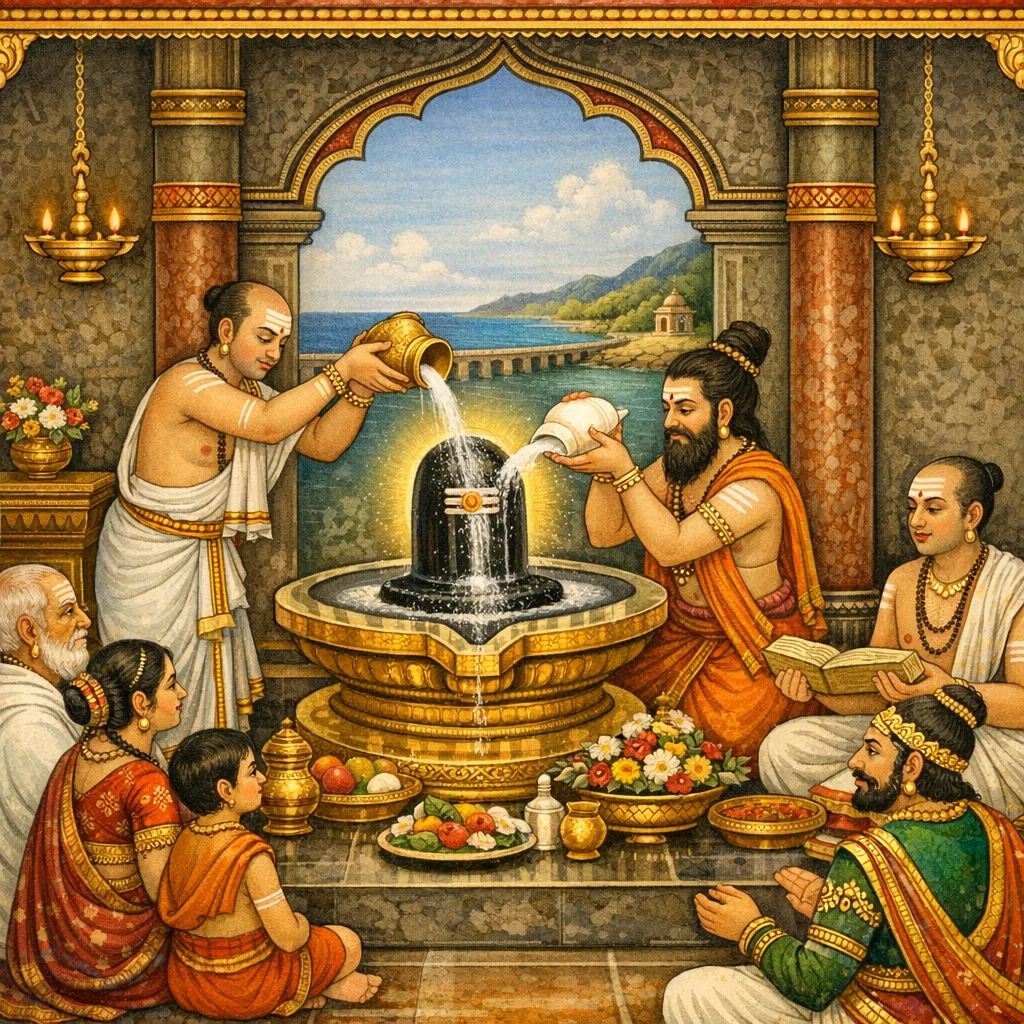
And constant remembrance of the Great Liṅga of Rāmeśvara; and living one’s life by taking refuge in that Great Liṅga of Rāmeśvara alone.
Verse 29
एवमष्टविधा भक्तिर्यस्मिन्म्लेच्छेऽपिविद्यते । स एव मुक्तिक्षेत्राणां दायभाक्परिकीर्त्यते
Thus, even if such eightfold devotion is found in a foreigner, he is proclaimed an inheritor of the holy fields of liberation.
Verse 30
भक्त्या त्वनन्यया मुक्तिर्ब्रह्मज्ञानेन निश्चिता । वेदांतशास्त्रश्रवणाद्यतीनामूर्ध्वरेतसाम्
Liberation is assured through exclusive devotion, and is confirmed through realization of Brahman—attained by ascetics of disciplined continence through hearing the Vedānta scriptures.
Verse 31
सा च मुक्तिर्विना ज्ञानदर्शनश्रवणोद्भवम् । यत्राश्रमं विना विप्रा विरक्तिं च विना तथा
That liberation arises from knowledge, right vision, and sacred hearing; yet here, O brāhmaṇas, even without formal āśrama-discipline, and likewise even without dispassion, it is attained.
Verse 32
सर्वेषां चैव वर्णानामखिलाश्रमिणामपि । रामेश्वरमहालिंगदर्शनादेव केवलात्
For all the varṇas, and indeed for those in every āśrama as well—by the mere sight alone of the Great Liṅga of Rāmeśvara.
Verse 33
अपुनर्भवदा मुक्तिर्भ विष्यत्यविलंबिता । कृमिकीटाश्च देवाश्च मुनयश्च तपोधनाः
Liberation that ends rebirth will come without delay. Worms and insects, gods, and sages rich in austerity—all alike attain it here.
Verse 34
तुल्या रामेश्वरक्षेत्रे रामनाथप्रसादतः । पापं कृतं मयानेकमिति मा क्रियतां भयम्
In the holy field of Rāmeśvara, by the grace of Rāmanātha, all become equal. Do not be afraid thinking, “I have committed many sins.”
Verse 35
मा गर्वः क्रियतां पुण्यं मयाकारीति वा जनैः । रामेश्वरमहालिंगे सांबरुद्रे विलोकिते
Let no one indulge in pride, thinking, “I have performed merit.” When the Rāmeśvara Mahāliṅga—Rudra together with Ambā—is beheld, such boasting is out of place.
Verse 36
न न्यूना नाधिकाश्च स्युः किं तु सर्वे जनाः समाः । रामेश्वरमहालिंगं यः पश्यति सभक्तिकम्
None are inferior and none superior; rather, all people are equal in the Lord’s sight. Whoever beholds the Rāmeśvara Mahāliṅga with devotion is graced.
Verse 37
न तेन तुल्यतामेति चतुर्वेद्यपि भूतले । रामेश्वरमहालिंगे भक्तो यः श्वपचोऽपि सन्
Even a knower of all four Vedas on earth does not equal that devotee who, though born as a śvapaca (outcaste), is devoted to the great Liṅga of Rāmeśvara.
Verse 38
तस्मै दानानि देयानि नान्यस्मै च त्रयीविदे । या गतिर्योगयुक्तानां मुनीनामूर्ध्वरेतसाम्
Gifts should be given to that devotee, and not to another—even if he knows the Vedic triad—for such a devotee attains the very state reached by yogic sages who have mastered the senses and sublimated their vital energy.
Verse 39
सा गतिः सर्वजंतूनां रामेश्वरविलोकिनाम् । रामनाथशिवक्षेत्रे ये वसंति नरा द्विजाः
That very supreme state belongs to all beings who behold Rāmeśvara. And the men—especially the dvijas—who dwell in the sacred Śiva-field of Rāmanātha share in it as well.
Verse 40
ते सर्वे पञ्चवक्त्राः स्युश्चंद्रालंकृतमस्तकाः । नागाभरणसंयुक्तास्तथैव वृषभध्वजाः
All of them become five-faced, their heads adorned by the moon; adorned with serpent-ornaments, and bearing the bull as their emblem.
Verse 41
त्रिनेत्रा भस्मदिग्धांगाः कपालाकृतिशेखराः । साक्षात्सांबा महादेवा भवेयुर्नात्र संशयः
Three-eyed, their limbs anointed with sacred ash and crowned with skull-like ornaments—they become Mahādeva himself, together with Śambā; of this there is no doubt.
Verse 42
रामनाथशिवक्षेत्रं ये व्रजंति नरा मुदा । पदेपदेऽश्वमेधानां प्राप्नुयुः सुकृतानि ते
Those who joyfully go to the Śiva-kṣetra of Rāmanātha obtain, at every step, merits equal to those of Aśvamedha sacrifices.
Verse 43
रामसेतुं समाश्रित्य रामनाथस्य तुष्टये । ददाति ग्राममेकं यो ब्राह्मणाय सभक्तिकम्
Taking refuge at Rāma-Setu, to please Rāmanātha, whoever devoutly donates a single village to a brāhmaṇa—
Verse 44
तेन भूः सकला दत्ता सशैलवनकानना । पत्रं पुष्पं फलं तोयं रामनाथाय यो नरः
By that act, the entire earth—with its mountains, forests, and groves—is considered donated. And any person who offers to Rāmanātha a leaf, a flower, a fruit, or water—
Verse 45
भक्त्या ददाति तं रक्षेद्रामनाथो ह्यहर्निशम् । रामनाथमहालिंगे सांबे कारुणिके शिवे
Whoever gives with devotion—Rāmanātha surely protects that person day and night; for this is Rāmanātha’s great Liṅga: Śiva, compassionate, together with Śambā.
Verse 46
अत्यंतदुर्लभा भक्तिस्तत्पूजाप्यतिदुर्लभा । स्तोत्रं च दुर्लभं प्रोक्तं स्मरणं चातिदुर्लभम्
Devotion is exceedingly rare; rarer still is worship of Him. Hymns of praise are said to be hard to obtain, and even remembrance of Him is most difficult.
Verse 47
रामनाथेश्वरं लिंगं महादेवं त्रिलोचनम् । शरणं ये प्रपद्यंते भक्तियुक्तेन चेतसा
Those who, with a mind united to devotion, take refuge in the Liṅga of Rāmanātheśvara—Mahādeva, the Three-eyed Lord—attain the sure protection of Śiva at this sacred Setu.
Verse 48
लाभस्तेषां जयस्तेषा मिह लोके परत्र च । रामनाथमहालिंगविषया यस्य शेमुषी
Gain is theirs, victory is theirs—both in this world and in the next—whose understanding remains focused upon the great Liṅga of Rāmanātha.
Verse 49
दिवारात्रं च भवति स वै धन्यतरो भुवि । रामनाथेश्वरं लिंगं यो न पूजयते शिवम्
Day and night he becomes truly the most blessed upon the earth—he who worships Śiva as the Liṅga of Rāmanātheśvara.
Verse 50
नायं भुक्तेश्च मुक्तेश्च राज्यानामपि भाजनम् । रामेश्वरमहालिंगं यः पूजयति भक्तितः
He becomes a worthy recipient of enjoyment, liberation (mokṣa), and even sovereignty—he who worships the great Liṅga of Rāmeśvara with devotion.
Verse 51
भुक्तिमुक्त्योश्च राज्यानामसौ परमभाजनम् । रामनाथार्चनसमं नाधिकं पुण्यमस्ति वै
He is the supreme recipient of enjoyment, liberation, and sovereignty. Truly, there is no merit greater than—or even equal to—the worship of Rāmanātha.
Verse 52
रामनाथेश्वरं लिंगं द्वेष्टि यो मोहमास्थितः । ब्रह्महत्यायुतं तेन कृतं नरककारणम्
One who, overcome by delusion, hates the Liṅga of Rāmanātheśvara incurs sin equal to ten thousand brahma-hatyās, becoming a cause for hellish downfall.
Verse 53
तत्संभाषणमात्रेण मानवो नरकं व्रजेत् । रामनाथपरा देवा रामनाथपरा मखाः
By mere association and conversation with such a hater, a person may go to hell. The gods are devoted to Rāmanātha; the sacrifices (yajñas) too are devoted to Rāmanātha.
Verse 54
रामनाथपराः सर्वे तस्माद न्यन्न विद्यते । अतः सर्वं परित्यज्य रामनाथं समाश्रयेत्
All are devoted to Rāmanātha; therefore nothing else truly remains as a higher refuge. Hence, abandoning all else, one should take shelter in Rāmanātha.
Verse 55
रामनाथमहालिंगं शरणं याति चेन्नरः । दौर्मत्यं तस्य नास्त्येव शिवलोकं च यास्यति
If a person takes refuge in the great Liṅga of Rāmanātha, wicked-mindedness will not remain in him, and he will go to Śiva’s world.
Verse 56
सर्वयज्ञतपोदानतीर्थस्नानेषु यत्फलम् । तत्फलं कोटिगुणितं रामनाथस्य सेवया
Whatever fruit arises from all sacrifices, austerities, charities, and baths at holy fords—by service to Rāmanātha, that very fruit is multiplied ten millionfold.
Verse 57
रामनाथेश्वरं लिंगं चिंतयन्घटिका द्वयम् । कुलैकवंशमुद्धृत्य शिवलोके महीयते
Whoever contemplates the liṅga of Rāmanātheśvara for two ghaṭikās uplifts even a single line of one’s family and is honored in Śiva’s world.
Verse 58
दिनमेकं तु यः पश्येद्रामनाथं महेश्वरम् । इहैव धनवान्भूत्वा सोंऽते रुद्रश्च जायते
But whoever beholds Rāmanātha, the Great Lord, for even a single day—here itself he becomes prosperous, and at life’s end he attains the state of Rudra.
Verse 59
यः स्मरेत्प्रातरुत्थाय रामनाथं महेश्वरम् । अनेनैव शरीरेण स शिवो वर्तते भुवि
Whoever, rising in the morning, remembers Rāmanātha the Great Lord—he, in this very body, lives upon the earth as one established in Śiva.
Verse 60
रामनाथमहालिंगद्रष्टुर्दर्शनमात्रतः । अन्येषां प्राणिनां पापं तत्क्षणादेव नश्यति
By the mere sight of the beholder of Rāmanātha’s great liṅga, the sins of other beings are destroyed at that very moment.
Verse 61
रामनाथेश्वरं लिंगं मध्याह्ने यस्तु पश्यति । सुरापानसहस्राणि तस्य नश्यंति तत्क्षणात्
Whoever beholds the liṅga of Rāmanātheśvara at midday—thousands of sins born of drinking intoxicants are destroyed for him that very instant.
Verse 62
सायंकाले पश्यति यो रामनाथं सभक्तिकम् । गुरुस्त्रीगमनोत्पन्नपातकं तस्य नश्यति
Whoever, in the evening, beholds Rāmanātha with devotion—his sin produced by approaching the wife of one’s guru is destroyed.
Verse 63
सायंकाले महास्तोत्रैः स्तौति रामेश्वरं तु यः । स्वर्णस्तेयसहस्राणि तस्य नश्यंति तत्क्षणात्
But whoever praises Rāmeśvara in the evening with great hymns—thousands of sins of gold-theft are destroyed for him at once.
Verse 64
स्नानं च धनुषः कोटौ रामनाथस्य दर्शनम् । इति लभ्येत वै पुंसां किं गंगाजलसेवया
Bathing at Dhanuṣkoṭi and beholding Rāmanātha—by these, people attain the desired fruit; what further need is there of resorting to the waters of the Gaṅgā?
Verse 65
रामनाथमहालिंगसेवया यन्न लभ्यते । तदन्यद्धर्मजालेन नैव लभ्येत कर्हिचित्
Whatever is not attained through service to Rāmanātha’s great liṅga can never be attained by any other net of religious observances.
Verse 66
रामनाथं महालिगं यः कदापि न पश्यति । संकरः स तु विज्ञेयो न पितुर्बीजसंभवः
He who never beholds Rāmanātha’s great Liṅga should be known as one of mixed and fallen condition—no true offspring of his father’s seed.
Verse 67
रामनाथेतिशब्दं यस्त्रिः पठेत्प्रातरुत्थितः । तस्य पूर्वदिनोत्पन्नपातकं नश्यति क्षणात्
Whoever, upon rising in the morning, recites the word “Rāmanātha” three times—his sins incurred on the previous day are destroyed in an instant.
Verse 68
रामनाथे महालिंगे भक्तरक्षणदीक्षिते । भोजने विद्यमानेऽपि याचनाः किं प्रयास्यथ
When Rāmanātha—the great Liṅga, vowed to protect devotees—is present, why would petitions and desperate entreaties arise at all, even when sustenance is already at hand?
Verse 69
रामनाथमहालिंगे प्रसन्ने करुणानिधौ । नश्यंति सकलाः क्लेशा यथा सूर्योदये हिमम्
When the great Liṅga of Rāmanātha—the treasure-house of compassion—is pleased, all afflictions vanish, just as frost disappears at sunrise.
Verse 70
प्राणोत्क्रमणवेलायां रामनाथं स्मरेद्यदि । जन्मनेऽसौ न कल्पेत भूयः शंकरतामियात्
If, at the moment when life departs, one remembers Rāmanātha, he is not fit for another birth; rather, he attains Śaṅkara-nature again—union with Śiva.
Verse 71
रामनाथ महादेव मां रक्ष करुणानिधे । इति यः सततं ब्रूयात्कलिनासौ न बाध्यते
Whoever continually says, “O Rāmanātha, O Mahādeva, protect me, O treasure of compassion,” is not afflicted by the Kali age.
Verse 72
रामनाथ जगन्नाथ धूर्जटे नीललोहित । इति यः सततं ब्रूयाद्बाध्यतेऽसौ न मायया
Whoever continually says, “O Rāmanātha, Lord of the universe, O Dhūrjaṭi, O Nīlalohita,” is not overpowered by māyā (delusion).
Verse 73
नीलकण्ठ महादेव रामेश्वरसदाशिव । इति ब्रुवन्सदा जंतुर्नैव कामेन बाध्यते
A being who always says, “O Nīlakaṇṭha, O Mahādeva, O Rāmeśvara, O Sadāśiva,” is never tormented by kāma (lustful craving).
Verse 74
रामेश्वर यमाराते कालकूटविषादन । इतीरयञ्जनो नित्यं न क्रोधेन प्रपीड्यते
A person who daily utters, “O Rāmeśvara, foe of Yama, remover of the Kālakūṭa poison,” is not oppressed by anger.
Verse 75
रामनाथालयं यस्तु दारुभिः कुरुते नरः । स पुमान्स्वर्गमाप्नोति त्रिकोटिकुलसंयुतः
The man who builds a shrine for Rāmanātha using wood attains heaven, together with three crores of his family line.
Verse 76
इष्टकाभिस्तु यः कुर्यात्स वैकुण्ठमवाप्नुयात् । शिलाभिः कुरुते यस्तु स गच्छेद्ब्रह्मणः पदम्
Whoever builds it with bricks attains Vaikuṇṭha; but whoever builds it with stone reaches the abode of Brahmā.
Verse 77
स्फटिकादिशिलाभेदैः कुर्वन्नस्यालयं जनः । शिवलोकमवाप्नोति विमानवरमास्थितः
One who builds a shrine for Him (Rāmanātha) with various stones such as crystal attains Śiva’s world, seated in an excellent celestial aerial car.
Verse 78
रामनाथालयं ताम्रैः कुर्वन्भक्तिपुरःसरम् । शिवसामीप्यमाप्नोति शिवस्यार्द्धासनस्थितः
Led by devotion, one who builds Rāmanātha’s temple with copper attains closeness to Śiva, abiding beside Him as though sharing half His seat.
Verse 79
रामेश्वरालयं रूप्यैः कुर्वन्वै मानवो मुदा । शिवसारूप्यमाप्नोति शिववन्मोदते सदा
A person who joyfully builds Rāmeśvara’s temple with silver attains likeness to Śiva and ever rejoices, as though he were Śiva himself.
Verse 80
रामनाथालयं हेम्ना यः करोति सभक्तिकम् । स नरो मुक्तिमाप्नोति शिवसायुज्यरूपिणीम्
Whoever, with devotion, builds Rāmanātha’s temple with gold attains liberation, in the form of union with Śiva (sāyujya).
Verse 81
रामनाथालयं हेम्ना धनाढ्यः कुरुते नरः । मृदा दरिद्रः कुरुते तयोः पुण्यं समं स्मृतम्
A wealthy man builds the shrine of Rāmanātha with gold; a poor man builds it with clay—yet the merit of both is remembered as equal.
Verse 82
रामनाथमहालिंगस्नानकाले द्विजोत्तमाः । त्रिसंध्यं गेयनृत्ते च मुखवाद्यैश्च काहलम्
O best of the twice-born, at the bathing of the great liṅga of Rāmanātha, let there be worship at the three sandhyās, with singing and dancing, and the sounding of wind-instruments and trumpets.
Verse 83
वाद्यान्यन्यानि कुरुते यः पुमान्भक्तिपूर्वकम् । स महापातकैर्मुक्तो रुद्रलोके महीयते
Whoever, with devotion, plays various other musical instruments is freed from great sins and is honored in Rudra’s world.
Verse 84
योभिषेकस्य समये रामनाथस्य शूलिनः । रुद्राध्यायं च चमकं तथा पुरुषसूक्तकम्
Whoever, at the time of the abhiṣeka of Rāmanātha—the trident-bearing Lord—recites the Rudrādhyāya, the Camaka, and also the Puruṣa Sūkta…
Verse 85
त्रिसुपर्णं पंचशांतिं पावमान्यादिकं तथा । जपेत्प्रीतियुतो विप्रा नरकं न समश्नुते
…and whoever lovingly chants the Trisuparṇa, the Pañcaśānti, and the Pāvamānī and other such hymns, O Brāhmaṇas, does not fall into hell.
Verse 86
गवां क्षीरेण दध्ना च पंचगव्यैर्घृतैस्तथा । रामनाथमहालिंगस्नानं नरकनाशनम्
Bathing the great Liṅga of Rāmanātha with cow’s milk and curd, with pañcagavya, and likewise with ghee, destroys hell—nullifying the fate of naraka.
Verse 87
रामनाथमहालिंगं घृतेन स्नापयेच्च यः । कल्पजन्मार्जितं पापं तत्क्षणादेव नश्यति
Whoever bathes the great Liṅga of Rāmanātha with ghee—sin amassed through births across an entire kalpa is destroyed that very instant.
Verse 88
रामनाथमहालिंगं गोक्षीरैः स्नापयन्नरः । कुलैकविंशमुत्तार्य शिवलोके महीयते
A man who bathes the great Liṅga of Rāmanātha with cow’s milk uplifts twenty-one generations of his lineage and is honored in Śiva’s world.
Verse 89
रामनाथमहालिंगं दध्ना संस्नापयन्नरः । सर्वपापविनिर्मुक्तो विष्णुलोके महीयते
He who bathes the great Liṅga of Rāmanātha with curd is freed from all sins and is honored in Viṣṇu’s world.
Verse 90
अभ्यंगं तिलतैलेन रामेश्वरशिवस्य यः । करोति हि सकृद्भक्त्या स कुबेरगृहे वसेत्
Whoever, even once and with devotion, performs the oil-anointing (abhyaṅga) with sesame oil for Śiva of Rāmeśvara—he dwells in Kubera’s abode.
Verse 91
रामनाथमहालिंगे स्नानमिक्षुरसेन यः । सकृदप्याचरेद्भ क्त्या चन्द्रलोकं समश्नुते
Whoever, even once and with devotion, performs the abhiṣeka of the great Liṅga of Rāmanātha with sugarcane juice attains the world of the Moon.
Verse 92
लिकुचाम्ररसोत्पन्नसारेण स्नापयन्नरः । रामनाथमहालिंगं पितृलोकं समश्नुते
A man who bathes the great Liṅga of Rāmanātha with the essence produced from the juices of likuca and mango attains the world of the Pitṛs (ancestors).
Verse 93
नालिकेरजलैः स्नानं रामनाथमहेश्वरे । ब्रह्महत्यादिपापानां नाशनं परिकीर्तितम्
Bathing Rāmanātha Maheśvara with coconut water is proclaimed to destroy sins such as brahmahatyā (the killing of a brāhmaṇa) and the like.
Verse 94
रामनाथमहालिंगं रंभापक्वैर्विमर्दयन् । विनाश्य सकलं पापं वायुलोके मही यते
He who worshipfully rubs the great Liṅga of Rāmanātha with ripe plantains destroys all sin and is honored in the world of Vāyu.
Verse 95
वस्त्रपूतेन तोयेन रामनाथं महेश्वरम् । स्नापयन्वारुणं लोकमाप्नोति द्विजसत्तमाः
O best of the twice-born, he who bathes Rāmanātha Maheśvara with water filtered through cloth attains Varuṇa’s world.
Verse 96
चंदनोदकधाराभी रामनाथं महेश्वरम् । स्नापयेत्पुरुषो विप्रा गांधर्वं लोकमाप्नुयात्
O brāhmaṇas, the man who bathes Rāmanātha Maheśvara with streams of sandal-water attains the world of the Gandharvas.
Verse 97
पुष्पवासिततोयेन हेमसंपृक्तवारिणा । पद्मवासिततोयेन स्नानाद्रामेश्वरस्य तु
But by bathing at Rāmeśvara with water perfumed by flowers, with water mingled with gold, and with water scented by lotus, one attains the sacred fruit proclaimed for that holy bathing.
Verse 98
महेंद्रासनमारुह्य तेनैव सह मोदते । पाटलोत्पलकल्हारपुन्नागकरवीरकैः
Ascending the throne of great Indra, one rejoices in his very company—honoured with offerings of pāṭala blossoms, lotuses, kalhāra water-lilies, punnāga flowers, and karavīra blooms.
Verse 99
वासितैर्वारिभिर्विप्रा रामेश्वरमहेश्वरम् । अभिषिच्य महद्भिश्च पातकैः स विमुच्यते
O brāhmaṇas, by anointing Rāmeśvara—Maheśvara—with perfumed waters in abhiṣeka, a person is released even from great sins.
Verse 100
यानि चान्यानि पुष्पाणि सुरभीणि महांति च । तद्गंधवासितैस्तोयैरभिषिच्य दयानिधिम्
And with whatever other flowers are fragrant and great, by performing abhiṣeka with waters perfumed by their scent upon the Treasure-house of compassion (Śiva), one gains the praised sacred benefit.
Verse 110
कर्तुः शतगुणं ज्ञेयं तस्य पुण्यफलं द्विजाः । छिन्नं भिन्नं च यः सम्यग्रामनाथशिवालयम्
O twice-born ones, know that the meritorious fruit for the one who causes such service to be done is a hundredfold. Whoever duly repairs the Śiva-temple of Rāmanātha, though cut, broken, or damaged…
Verse 120
आयुः प्रयाति त्वरितं त्वरितं याति यौवनम् । त्वरितं संपदो यांति दारपुत्रादयस्तथा
Life passes swiftly; youth too departs swiftly. Wealth quickly vanishes, and so likewise do wife, children, and the rest.
Verse 130
श्रुते दृष्टे च विप्रेंद्रा दुर्लभं नास्ति किंचन । रामनाथमहालिंगं सेवितुं यः पुमान्व्रजेत्
O best of brāhmaṇas, once this is heard and seen, nothing remains unattainable. Any man who goes forth to serve the great Liṅga of Rāmanātha…
Verse 140
भुक्त्वा भोगान्बहुसुखान्पुत्रदारयुता भृशम् । एतच्छरीरपातांते मुक्तिं यास्यंति शाश्वतीम्
Having enjoyed many delights and great happiness—abundantly endowed with spouse and children—at the fall of this body they will attain everlasting liberation.