Adhyaya 28
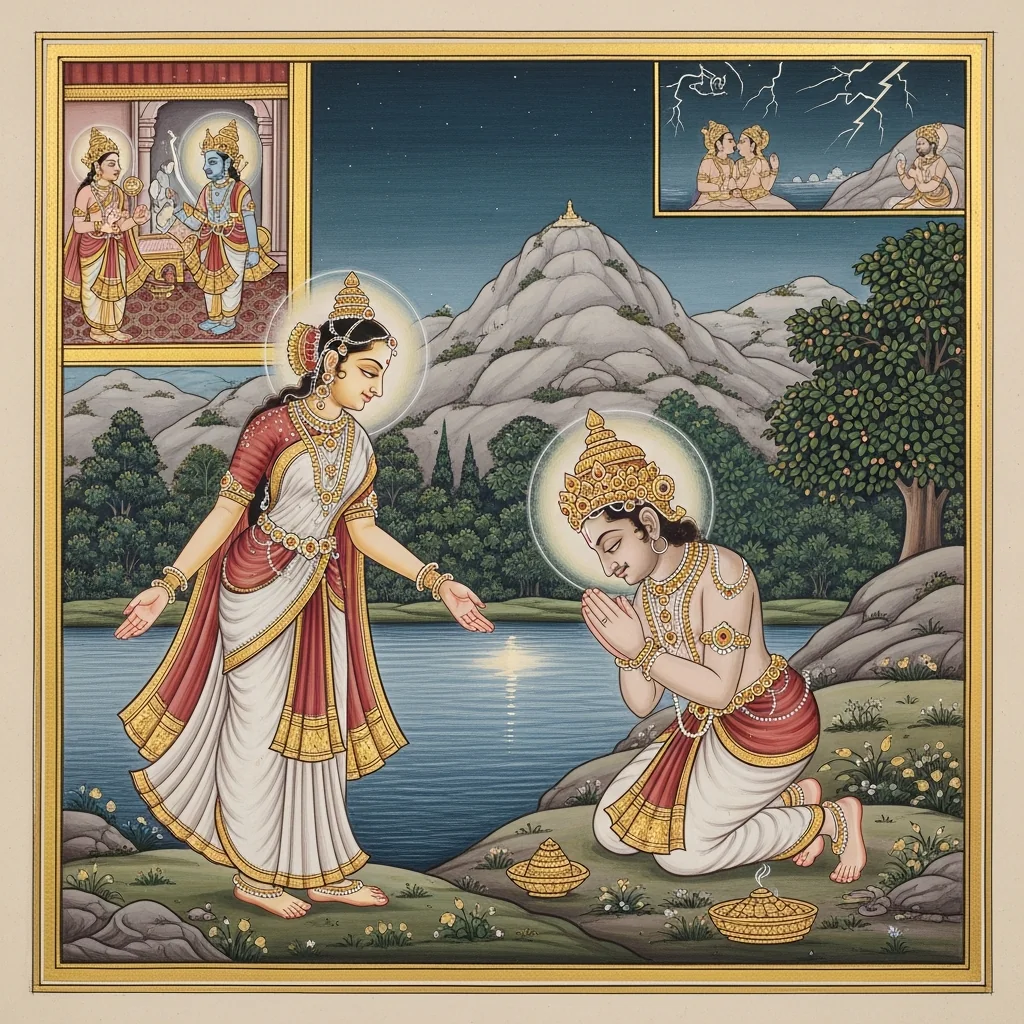
The chapter begins with Sūta describing Koṭitīrtha and then turning to Sādhyāmṛta, a great tīrtha on Gandhamādana, praised as uniquely powerful for ritual bathing. A series of phala statements declares that bathing at Sādhyāmṛta surpasses austerities, celibacy, sacrifice, and charity in purifying and granting higher destinies: mere contact with its waters destroys embodied sin at once. Penitential bathers are honored in Viṣṇuloka, and even those burdened by heavy karma are said to avoid dreadful hell-realms. The discourse then offers an exemplum: King Purūravas and the apsaras Urvaśī live together under conditions (no seeing of nudity, no eating of food remnants, and protection of two lambs). The Gandharvas contrive a breach; a flash of lightning reveals the king unclothed, and Urvaśī departs. Later, in Indra’s court, both laugh during Urvaśī’s dance, and Tumburu curses them with immediate separation. Purūravas appeals to Indra, who prescribes pilgrimage to Sādhyāmṛta—served by gods, siddhas, and yogic sages—and explicitly extols it as granting both bhukti and mukti and removing curses. Purūravas bathes there, is freed from the curse, reunites with Urvaśī, and returns to Amarāvatī. The chapter closes with a phalaśruti: bathing there yields desired aims and heaven; bathing without desire yields mokṣa; and reciting or hearing this chapter grants a destiny oriented toward Vaikuṇṭha.
Shlokas
Verse 1
श्रीसूत उवाच । कोटितीर्थं महापुण्यं सेवित्वा केवलं नरः । स्नातुं जितेंद्रियस्तीर्थं ततः साध्यामृतं व्रजेत्
Śrī Sūta said: Having merely served the greatly meritorious Koṭitīrtha, a man—self-controlled—should bathe at that tīrtha; then he should proceed to Sādhyāmṛta.
Verse 2
साध्यामृतं महातीर्थ महापुण्यफलप्रदम् । महादुःखप्रशमनं गन्धमादनपर्वते
Sādhyāmṛta is a great tīrtha, bestowing the fruits of vast merit; it soothes mighty sorrows, upon Mount Gandhamādana.
Verse 3
अस्ति पापहरं पुंसां सर्वाभीष्टप्रदायकम् । यत्र स्नात्वा नरो भक्त्या सर्वान्कामानवाप्नुयात्
There is a sacred tīrtha that removes people’s sins and grants every cherished desire. Bathing there with devotion, one attains all wished-for aims.
Verse 4
तपसा ब्रह्मचर्येण यज्ञैर्दानेन वा पुनः । गतिं तां न लभेन्मर्त्यो यां साध्यामृतमज्जनात्
By austerity, brahmacarya, sacrifices (yajña), or even charity (dāna), a mortal does not attain that gati which is gained through immersion in Sādhyāmṛta.
Verse 5
स्पृष्टानि येषामंगानि साध्यामृतजलैः शुभैः । तेषां देहगतं पापं तत्क्षणादेव नश्यति
For those whose limbs are touched by the auspicious waters of Sādhyāmṛta, the sin lodged in the body perishes that very instant.
Verse 6
साध्यामृतजले यस्तु साघमर्षणकृन्नरः । स विधूयेह पापानि विष्णुलोके महीयते
But the one who, in the waters of Sādhyāmṛta, performs the sin-expiating rite—shaking off sins here itself—is honored in Viṣṇu’s world (Viṣṇuloka).
Verse 7
पूर्वे वयसि पापानि कृत्वा कर्माणि यो नरः । पश्चात्साध्यामृतं सेवेत्पश्चात्तापसमन्वितः
Even the man who, in early life, performed sinful deeds—if later he takes refuge in Sādhyāmṛta and thereafter lives endowed with austerity—
Verse 8
अन्ते वयसि मुक्तः स्यात्स नरो नात्र संशयः । साध्यामृते नरः स्नात्वा देहबंधाद्विमुच्यते
In the later stage of life he becomes liberated—of this there is no doubt. Having bathed in Sādhyāmṛta, a man is released from the bondage of embodiment.
Verse 9
साध्यामृतजले स्नाता मनुष्याः पापक र्मिणः । अनेकक्लेशघोराणि नरकाणि न यांति हि
Even people who have committed sinful acts—once they have bathed in the waters of Sādhyāmṛta—do not go to the dreadful hells filled with many torments.
Verse 10
साध्यामृतजले स्नानात्पुंसां या स्याद्गतिर्द्विजाः । न सा गतिर्भवेद्यज्ञैर्न वेदैः पुण्यकर्मभिः
O twice-born ones, the spiritual destination that men attain by bathing in the waters of Sādhyāmṛta cannot be matched by sacrifices (yajñas), by the Vedas as mere recitation or learning, or by other meritorious deeds.
Verse 11
यावदस्थि मनुष्याणां साध्यामृतजले स्थितम् । तावद्वर्षाणि तिष्ठंति शिवलोके सुपूजिताः
For as long as a person’s bone-remains remain in the waters of Sādhyāmṛta, for that many years they abide in Śiva’s world (Śivaloka), greatly honored.
Verse 12
अपहत्य तमस्तीव्रं यथा भात्युदये रविः । तथा साध्यामृतस्नायी भित्त्वा पापानि राजते
Just as the sun at dawn shines forth, dispelling thick darkness, so the one who bathes in Sādhyāmṛta—having shattered sins—radiantly flourishes.
Verse 13
वांछितांल्लभते कामानत्र स्नातो नरः सदा । यत्र स्नात्वा महापुण्ये पुरा राजा पुरूरवाः । विप्रयोगं सहोर्वश्या जहौ तुंबुरुशापजम्
A man who bathes here ever attains the desires he longs for. In this supremely meritorious place, King Purūravā of old, having bathed, cast off the separation from Urvaśī that had arisen from Tumburu’s curse.
Verse 14
ऋषय ऊचुः । कथं सूत महाभाग सहोर्वश्यामरस्त्रिया
The sages said: “How, O fortunate Sūta, did (King Purūravā) come to be with Urvaśī, that celestial woman?”
Verse 15
प्रथमं लब्धवान्योगं मर्त्यो राजा पुरूरवाः । विप्रयोगं सहोर्वश्या जहौ तुंबुरुशापजम्
King Purūravā—though mortal—first attained union (with her); and he removed the separation from Urvaśī that had arisen from Tumburu’s curse.
Verse 16
हेतुना केन राजानं शशाप तुंबुरुर्मुनिः । एतत्सर्वं समाचक्ष्व विस्तरान्मुनिपुंगव
“For what reason did the sage Tumburu curse the king? O best among sages, recount all of this to us in detail.”
Verse 17
सूत उवाच । आसीत्पुरूरवानाम शक्रतुल्यपराक्रमः । राजराजसमो राजा पुरा ह्यमरपूजितः
Sūta said: “There once was a king named Purūravā, whose valor equaled Indra’s. In former times he stood as a king among kings, and was honored even by the Immortals.”
Verse 18
धर्मतः पालयामास मेदिनीं स नृपोत्तमः । ईजे च बहुभिर्यज्ञैर्ददौ दानानि सर्वदा
That best of kings safeguarded the earth in accordance with dharma. He performed many yajñas as well, and continually bestowed gifts in charity.
Verse 19
प्रशासति महीं सर्वां राज्ञि तस्मिन्महामतौ । मित्रावरुणशापेन भुवं प्रापोर्वशी द्विजाः
While that great-minded king ruled the whole earth, O twice-born ones, Urvaśī came down into the world because of the curse of Mitra and Varuṇa.
Verse 20
सा चचारोर्वशी तत्र राज्ञस्तस्य पुरांतिके । कोकिलालापमधुरवीणयोपवने जगौ
There Urvaśī moved about near the king’s city. In a grove she sang, accompanied by a vīṇā, sweet as the cuckoo’s call.
Verse 21
स राजोपवने रंतुं कदाचिद्धृतकौतुकः । आरूढतुरगः प्रायाल्ललनाशतसंवृतः
Once, eager for delight, the king set out to sport in the royal garden—mounted on a horse and surrounded by hundreds of women.
Verse 22
तादृशीमुर्वशीं तत्र करसम्मितमध्यमाम् । उवाच चैनां राजासौ भार्या मम भवेति वै
Seeing Urvaśī there—slender-waisted, as though her waist were measured by a hand—the king addressed her: “Truly, become my wife.”
Verse 23
सापि कामातुरा तत्र राजानं प्रत्यभाषत । भवत्वेवं नरश्रेष्ठ समयं यदि मे भवान्
Then she too, stirred by desire, spoke to the king: “So be it, O best of men—if you will accept my condition and keep the agreed rule.”
Verse 24
करिष्यति तवाभ्याशे वत्स्यामि धृतकौतुका । करिष्ये समयं सुभ्रु तवाहमिति सोऽब्रवीत्
“I shall dwell near you, eager and resolved.” He replied: “O fair-browed one, I will keep your condition—so I pledge.”
Verse 25
अथोर्वशी बभाषे तं पुरूरवसमुत्सुका । पुत्रभूतं मम यदि रक्षस्युरणकद्वयम्
Then Urvaśī, eager, spoke to Purūravas: “If you will protect my two rams, which are to me like sons…”
Verse 26
न नग्नो दृश्यसे राजन्कदापि यदि वै तथा । नोच्छिष्टं मम दद्याश्चेत्तदा वत्स्ये तवांतिके
“O King, if you are never seen naked—and if you do not give me what is leftover, made impure by prior eating—then I shall live by your side.”
Verse 27
घृतमात्राशना चाहं भविष्यामि नृपोत्तम । एवमस्त्विति राजोक्तां तां निनाय निजं गृहम्
“I shall eat only ghee, O best of kings.” The king replied, “So be it,” and led her to his own home.
Verse 28
अलकायां स भूपालस्तथा चैत्ररथे वने । रेमे सरस्वतीतीरे पद्मखण्डमनोरमे
That king sported in Alakā, and likewise in the Caitraratha forest—rejoicing on the bank of the Sarasvatī, in the charming Padmakhaṇḍa grove.
Verse 29
एकषष्टिं स वर्षाणि रममाणस्तयानयत् । तेनोर्वशी प्रतिदिनं वर्धमानानुरागिणी
For sixty-one years he lived in delight with her; and because of that, Urvaśī’s affection grew day by day.
Verse 30
स्पृहां न देवलोकेऽपि चकार तनुमध्यमा । नाभवद्रमणीयोऽसौ देवलोकस्तया विना
The slender-waisted one felt no longing even for heaven; without him, that heavenly realm itself did not seem delightful to her.
Verse 31
अतस्तामानयिष्यामि देवलोकमिति द्विजाः । विश्वावसुर्विचार्यैवं भूर्लोकमगमत्क्षणात्
“Therefore I will bring her back to heaven,” he resolved, O twice-born ones. Having thus reflected, Viśvāvasu went at once to the mortal world.
Verse 32
उर्वश्याः समयं राज्ञा विश्वावसुरयं सह । विदित्वा सह गन्धर्वैः समवेतो निशांतरे
Having learned of the covenant between Urvaśī and the king, Viśvāvasu, together with the Gandharvas, assembled in the deep of night.
Verse 33
उर्वश्याः शयनाभ्याशाज्जग्राहोरणकं जवात् । आकाशे नीयमानस्य तस्य श्रुत्वोर्वशी पतिम्
Swiftly, from beside Urvaśī’s bed, a Gandharva seized the ram; as it was borne away through the sky, Urvaśī heard her husband, Purūravas.
Verse 34
अब्रवीन्मत्सुतः केन गृह्यते त्यज्यतामयम् । अनाथा शरणं यामि कं नरं गतचेतना
She cried, “By whom is my child being seized? Release him! Helpless, my senses stolen away—unto what man shall I go for refuge?”
Verse 35
पुरूरवाः समाकर्ण्य वाक्यं तस्या निशांतरे । मां न नग्नं निरीक्षेत देवीति न ययौ तदा
Hearing her words in the midst of night, Purūravas did not go at once, thinking, “Let the goddess not behold me unclothed.”
Verse 36
अथान्यमप्युरणकं गन्धर्वाः प्रतिगृह्य ते । ययुस्तस्योरणस्यापि शब्दं शुश्राव चोर्वशी
Then those Gandharvas seized another ram as well and went away; and Urvaśī heard the cry of that ram too.
Verse 37
अनाथाया मम सुतो गृह्यते तस्करैरिति । चुक्रोश देवी परुषं कं यामि शरणं नरम्
“I am without protection—thieves are carrying off my child!” Thus the goddess cried out harshly: “To what man shall I go for refuge?”
Verse 38
अमर्षवशमापन्नः श्रुत्वा तद्वचनं नृपः । तिमिरेणावृतं सर्वमिति मत्त्वा स खङ्गधृक्
Hearing her words, the king was overcome by anger. Thinking, “All is covered in darkness,” he, sword in hand, prepared to rush forth.
Verse 39
दुष्टदुष्ट कुतो यासीत्यभ्यधावद्वचो वदन् । तावत्सौदामिनी दीप्ता गन्ध र्वैर्जनिता भृशम्
Shouting, “Wretch, wretch—where are you going?”, he ran forward. Just then, a blazing flash of lightning, powerfully produced by the Gandharvas, appeared.
Verse 40
तत्प्रभामंडलैर्देवी राजानं विगतांबरम् । दृष्ट्वा निवृत्तसमया तत्क्षणादेव निर्ययौ
By the circle of that radiance, the goddess saw the king without garments. Her appointed time and condition thus being broken, she departed at that very instant.
Verse 41
त्यक्त्वा ह्युरणकौ तत्र गंधर्वा अपि निर्ययुः । राजा मेषौ समादाय हृष्टः स्वशयनांतिकम्
Leaving the two rams there, the Gandharvas also went away. The king, taking up the two rams, delighted, returned to the side of his own bed.
Verse 42
आगतो नोर्वशीं तत्र ददर्शायतलोचनाम् । तां चापश्यन्विवस्त्रश्च बभ्रामोन्मत्तवद्भुवि
Having returned, he did not see Urvaśī there, she of long, wide eyes. Not seeing her—and finding himself unclothed—he wandered upon the earth like one maddened.
Verse 43
कुरुक्षेत्रं गतो राजा तटाके पद्मसंकुले । चतुर्भिरप्सरस्त्रीभिः क्रीडमाना ददर्श ताम्
Having gone to Kurukṣetra, the king saw her sporting in a lotus-filled lake, accompanied by four Apsarā-women.
Verse 44
हे जाये तिष्ठ मनसा घोरेति व्याहरन्मुहुः । एवं बहुप्रकारं वै स सूक्तं प्रालपन्नृपः
Again and again the king uttered words such as, “O wife, stand firm in your resolve—alas, how terrible!” Thus, in many ways, he kept speaking those phrases.
Verse 45
अब्रवीदुर्वशी तं च क्रीडती साप्सरोगणैः । महाराजालमेतेन चेष्टितेन तवानघ
Urvaśī, while playing with the host of Apsarās, said to him: “O great king, enough of this behavior of yours, O sinless one.”
Verse 46
त्वत्तो गर्भिण्यहं पूर्वमब्दांते भवतात्र वै । आगंतव्यं कुमारस्ते भविष्यत्यतिधार्मिकः
“By you I had conceived earlier. At the end of the year you must come here indeed; your son will be born—exceedingly righteous, devoted to Dharma.”
Verse 47
एकां विभावरीं राजंस्त्वया वत्स्यामि वै तदा । इत्युक्तो नृपतिर्हृष्टः स्वपुरीं प्राविशद्द्विजाः
“O king, then I shall dwell with you for one night.” Thus addressed, the king rejoiced and entered his own city, O Brāhmaṇas.
Verse 48
तासामप्सरसां सा तु कथयामास तं नृपम् । अयं स पुरुषश्रेष्ठो येनाहं कामरूपिणा
Then she spoke to those Apsarās about that king: “This is that best of men for whom I—able to assume forms at will—became involved.”
Verse 49
एतावंतं महाकालमनुरागवशातुरा । उषितास्मि सहानेन सख्यो नृपतिना चिरम्
“For so long a great span of time, tormented by the power of affection, I have dwelt with him—my friend, that king—for a long while.”
Verse 50
एवमुक्तास्ततः सख्यस्तामूचुः साधुसाध्विति । अनेन साकमास्यामः सर्वकालं वयं सखि
Thus spoken to, her friends said to her, “Good, good indeed!” and added, “O friend, we too shall stay with him always.”
Verse 51
इत्यूचुरुर्वशीं तत्र सखीमप्सरसस्तदा । अब्देऽथ पूर्णे राजापि तटाकांति कमाययौ
Thus the Apsarās spoke there to Urvaśī, their friend. Then, when the year was completed, the king too came, desiring to reach the lake-shore.
Verse 52
आगतं नृपतिं दृष्ट्वा पुरूरवसमुर्वशी । कुमारमायुषं तस्मै ददौ संप्रीतमानसा
Seeing King Purūravas arrive, Urvaśī—her heart brimming with joy—gave him their son, the boy Āyuṣ.
Verse 53
तेन साकं निशामेकामुषिता सानु रागिणी । पंचपुत्रप्रदं गर्भं तस्मादापाशु सोर्वशी
Spending but a single night with him, Urvaśī—filled with affection—quickly conceived by him a womb destined to bestow five sons.
Verse 54
उवाच चैनं राजानमुर्वशी परमांगना । वरं दास्यंति गन्धर्वा मत्प्रीत्या तव भूपते
Then Urvaśī, most excellent among women, said to that king: “O ruler, the Gandharvas will grant you a boon, out of affection for me.”
Verse 55
भवतां प्रार्थ्यतां तेभ्यो वरो राजर्षिसत्तम । इत्युक्तः स तया राजा प्राह गन्धर्वसत्तमान्
Thus addressed by her, that king—best among royal sages—sought a boon from them and spoke to the foremost of the Gandharvas.
Verse 56
अहं संपूर्णकोशश्च विजिताराति मंडलः । सलोकतां विनोर्वश्याः प्राप्तव्यं नान्यदस्ति मे
“My treasury is full, and I have conquered the circles of my foes. I seek nothing else—only to attain the same world as Urvaśī.”
Verse 57
अतस्तया सहोर्वश्या कालं नेतुमहं वृणे । एवमुक्ते नृपेणाथ गन्धर्वास्तुष्ट मानसाः । अग्निस्थालीं प्रदायास्मै प्रोचुश्चैनं नृपं तदा
“Therefore, I choose to pass my time together with Urvaśī.” When the king had spoken thus, the Gandharvas—pleased at heart—gave him a vessel for the sacred fire (agnisthālī) and then instructed the king.
Verse 58
गन्धर्वा ऊचुः । अग्निं वेदानुसारी त्वं त्रिधा कृत्वा नृपोत्तम
The Gandharvas said: “O best of kings, following the Vedas, divide the sacred fire into three.”
Verse 59
इष्ट्वा यज्ञेन चोर्वश्याः सालोक्यं याहि भूपते । इतीरितस्तैरादाय स्थालीमग्नेर्ययौ नृपः
“Having worshipped by a sacrifice (yajña), O king, go to the sālokya—the shared world—of Urvaśī.” Thus instructed by them, the king took up the fire-vessel and departed.
Verse 60
अहो बतातिमूढोहमिति मध्ये वनं नृपः । उर्वशी न मया लब्धा वह्निस्थाल्या तु किं फलम्
In the midst of the forest the king lamented, “Alas, how utterly deluded I am! I have not obtained Urvaśī—what benefit, then, is this fire-vessel?”
Verse 61
निधायैव वने स्थालीं स्वपुरं प्रययौ नृपः । अर्धरात्रे व्यतीतेऽसौ विनिद्रोऽचिंतयत्स्वयम्
Leaving the vessel there in the forest, the king returned to his own city. When half the night had passed, he lay sleepless, reflecting to himself.
Verse 62
उर्वशीलोकसिद्ध्यर्थं मम गन्धर्वपुंगवैः । अग्निस्थाली संप्रदत्ता सा च त्यक्ता मया वने
For the sake of attaining Urvaśī’s world, the foremost Gandharvas bestowed upon me the vessel of fire—yet I abandoned it in the forest.
Verse 63
आहरिष्ये पुनः स्थालीमित्युत्थाय ययौ वनम् । नाग्निस्थालीं ददर्शासौ वने तत्र पुरूरवाः
Thinking, “I shall bring back the fire-vessel again,” Purūravas rose and went into the forest; but there, in that woodland, he did not see the vessel of the sacred fire.
Verse 64
शमीगर्भमथाश्वत्थमग्निस्थाने विलोक्य सः । व्यचिंतयन्मया स्थाली निक्षिप्तात्र वने पुरा
Then, seeing an aśvattha tree springing from within a śamī at the very spot where the fire had been kept, he reflected: “Formerly, I myself placed the vessel here in this forest.”
Verse 65
सा चाश्वत्थः शमीगर्भः समभूदधुना त्विह । तस्मादेनं समादाय वह्निरूपमहं पुरम्
“And now, here, that very (fire) has become an aśvattha within the śamī. Therefore, taking this wood, I shall bring forth the form of Agni and return to the city.”
Verse 66
गत्वा कृत्वारणीं सम्यक्तदुत्पन्नाग्निमादरात् । उपास्यामीति निश्चित्य स्वपुरं गतवान्नृपः
Having gone there and properly preparing the araṇis, the king reverently kindled the fire that arose from them; resolved, “I shall worship with it,” he returned to his own city.
Verse 67
रमणीयारणीं चक्रे स्वांगुलैः प्रमिता मसौ । निर्माणसमये राजा गायत्रीमजपद्द्विजाः
He fashioned a lovely araṇi, measuring it by his own fingers. At the time of its making, the king recited the Gāyatrī mantra, O twice-born ones.
Verse 68
गायत्र्याः पठ्यमानाया यानि संत्यक्षराणि हि । तावदंगुलिमर्यादामकरोदरणीं नृपः
As the Gāyatrī was being recited, by whatever number of syllables it contains, by that same count of finger-lengths the king set the measure of the araṇi.
Verse 69
तत्र निर्मथनादग्नित्रयमुत्पाद्य भूपतिः । उर्वशीलोकसंप्राप्तिफलमुद्दिश्य कांक्षितम्
There, by churning the araṇis, the king brought forth the three sacred fires, desiring the wished-for fruit: attainment of the world of Urvaśī.
Verse 70
वेदानुसारी नृपतिर्जुहावाग्नित्रयं मुदा । तेनैव चाग्निविधिना बहून्यज्ञानथातनोत्
Following the Vedas, the king joyfully offered oblations into the three fires. By that very discipline of the fire-ritual, he then performed many sacrifices.
Verse 71
तेन गन्धर्वलोकांश्च संप्राप्य जगतीपतिः । सहोर्वश्या चिरं रेमे देवलोके द्विजोत्तमाः
By that merit, the lord of the earth reached the worlds of the Gandharvas; and together with Urvaśī he long delighted in the divine realm, O best of the twice-born.
Verse 72
अथ सर्वामरोपेतः कदाचिद्बलवृत्रहा । नृत्यं सुरांगनानां वै व्यलोकयत संसदि
Then, on a certain occasion, Indra—the mighty slayer of Vṛtra—surrounded by all the gods, beheld in the assembly the dance of the celestial maidens.
Verse 73
पुरूरवा नृपोप्यायात्तदा देवेंद्रसंसदम् । द्रष्टुं सुरांगनानृत्यं मनोहारि दिवौकसाम्
Then King Purūravā too came to Indra’s assembly-hall, longing to behold the captivating dance of the celestial maidens—enchanting even to the dwellers of heaven.
Verse 74
एकैकशस्ताः शक्रस्य ननृतुः पुरतोंऽगनाः । अथोर्वशी समागत्य ननर्त पुरतो हरेः
One by one, those celestial maidens danced before Śakra. Then Urvaśī arrived and danced before Hari.
Verse 75
नृत्ताभिनयसामर्थ्यगर्वयुक्ता तदोर्वशी । तं पुरूरवसं दृष्ट्वा जहासातिमनोहरा
Then Urvaśī—proud of her mastery in dance and expressive performance—caught sight of Purūravā and laughed, she who was exceedingly enchanting.
Verse 76
जहास तत्र राजापि तां विलोक्य तदोर्वशीम् । हाससंकुपितस्तत्र नाट्याचार्योऽथ तुंबुरुः । शशाप तावुभौ कोपादुर्वशीं च नृपोत्तमम्
There the king too laughed upon seeing Urvaśī. Then Tuṃburu, the preceptor of dramatic art, angered by that laughter, cursed them both in wrath—Urvaśī and the foremost of kings.
Verse 77
तुंबुरुरुवाच । अनेकदेवसंपूर्णसभायामत्र यत्कृतम्
Tuṃburu said: “In this assembly filled with many devas, what has been done here…”
Verse 78
युवाभ्यां हसितं नृत्तमध्ये निष्कारणं वृथा । तस्माज्झटिति राजेंद्र वियोगो युवयोः क्षणात्
“You two laughed, without cause and in vain, in the midst of the dance. Therefore, O lord of kings, there shall be a sudden separation between you in a moment.”
Verse 79
भूयादिति शशापैनं सर्वदैवतसंनिधौ । अथ शप्तो नृपस्तत्र नाट्याचार्येण दुःखितः
Saying, “So be it,” he cursed him in the presence of all the devas. Then the king, thus cursed by the master of dramaturgy, was sorrowful there.
Verse 80
जगाम शरणं तत्र पाहिपाहीति वज्रिणम् । उवाच दीनया वाचा पुरुहूतं पुरूरवाः
There he sought refuge, crying, “Protect me, protect me!” to the wielder of the thunderbolt. In a humble voice, Purūravā spoke to Puruhūta (Indra).
Verse 81
उर्वश्या सह सालोक्यसिद्ध्यर्थमहमिष्टवान् । अतस्तस्मा वियोगो मेऽसह्यः स्यात्पाकशासन
“I have performed worship to attain sālokya—dwelling in the same world—together with Urvaśī. Therefore, O Pākaśāsana, separation from her would be unbearable to me.”
Verse 82
इत्युक्तवंतं तं प्राह सहस्राक्षः शचीपतिः । शापमोक्षं प्रवक्ष्यामि मा भैषीस्त्वं नृपोत्तम
When he had spoken thus, Sahasrākṣa, the lord of Śacī, said to him: “I shall proclaim the release from the curse—fear not, O best of kings.”
Verse 83
दक्षिणांभोनिधौ पुण्ये गंधमादनपर्वते । साध्यामृतमिति ख्यातं तीर्थमस्ति महत्तरम्
In the sacred southern ocean, upon Mount Gandhamādana, there is a supremely great holy ford renowned by the name “Sādhyāmṛta.”
Verse 84
सेवितं सर्वदेवैश्च सिद्धचारणकिन्नरैः । सनकादि महायोगिमुनिवृंदनिषेवितम्
It is frequented by all the gods, by Siddhas, Cāraṇas, and Kinnaras, and is also attended by the host of great yogic sages beginning with Sanaka.
Verse 85
भुक्तिमुक्तिप्रदं पुंसां सर्वशापविमोक्षदम् । अस्ति तीर्थं भवांस्तत्र गच्छस्व त्वरया नृप
O King, there is a holy ford there that bestows both worldly enjoyment and liberation upon people, and releases one from every curse. Go there quickly.
Verse 86
सर्वेषाममृतं स्नानादत्र साध्यं यतस्ततः । साध्यामृतमिति ख्यातं सर्वलोकेषु विश्रुतम्
Because, for all, the nectar-like fruit is accomplished here through bathing, it is therefore called “Sādhyāmṛta,” and is celebrated throughout all the worlds.
Verse 87
तत्र स्नानात्तवोर्वश्याः पुनर्योगो भविष्यति । मम लोके निवासश्च भविष्यति न संशयः
By bathing there, your reunion with Urvaśī will come to pass again; and you shall dwell in my world as well—of this there is no doubt.
Verse 88
इति प्रतिसमादिष्टो नृपः संप्रीतमानसः । साध्यामृतं महातीर्थं समुद्दिश्य ययौ क्षणात्
Thus instructed in reply, the king—his heart filled with joy—set out at once, aiming for the great holy ford, Sādhyāmṛta.
Verse 89
सस्नौ साध्यामृते तत्र महापातकनाशने । तत्र स्नानान्नृपो विप्राः सद्यः शापेन मोचितः
There he bathed at Sādhyāmṛta, the destroyer of great sins. By that bathing, O Brāhmaṇas, the king was instantly freed from the curse.
Verse 90
स्नानानंतरमेवासावुर्वश्या सह संगतः । तया सह विमानस्थः प्रययावमरावतीम्
Immediately after bathing, he was reunited with Urvaśī; and seated with her in a celestial chariot, he departed for Amarāvatī.
Verse 91
रेमे पुनस्तया सार्धं देववद्देवमंदिरे । एवंप्रभावं तत्तीर्थं साध्यामृतमनुत्तमम्
Again he delighted with her, in a divine manner, within the temple of the gods. Such is the power of that unsurpassed tīrtha, Sādhyāmṛta.
Verse 92
पुरूरवा सहोर्वश्या यत्र स्नानेन संगतः । अतोऽत्र तीर्थे यः स्नायान्महापातकनाशने
Where Purūravas, by sacred bathing, was reunited with Urvaśī—therefore, whoever bathes at this tīrtha, the destroyer of great sins…
Verse 93
वांछितांल्लभते कामान्यास्यति स्वर्गमुत्तमम् । निष्कामः स्नाति चेद्वि प्रा मोक्षमाप्नोति मानवः
He who bathes here gains the desires he longs for and attains the highest heaven. But if a man bathes free of worldly desire, O brāhmaṇas, he attains liberation (mokṣa).
Verse 94
इमं पवित्रं पापघ्नमध्यायं पठते तु यः । शृणुयाद्वा मनुष्योऽसौ वैकुंठे लभते स्थितिम्
Whoever recites this purifying, sin-destroying chapter—or even hears it—such a person attains an abode in Vaikuṇṭha.
Verse 95
एवं वः कथितं विप्रा वैभवं पापनाशनम् । साध्यामृतस्य तीर्थस्य विस्तराच्छ्रद्धया मया
Thus, O brāhmaṇas, I have faithfully narrated to you in detail the glory of Sādhyāmṛta Tīrtha—its power to destroy sins.
Verse 96
यत्पुरा सनकादिभ्यः प्रोक्तवांश्चतुराननः
—that which, in ancient times, the Four-faced Lord (Brahmā) had taught to Sanaka and the other sages.