Adhyaya 10
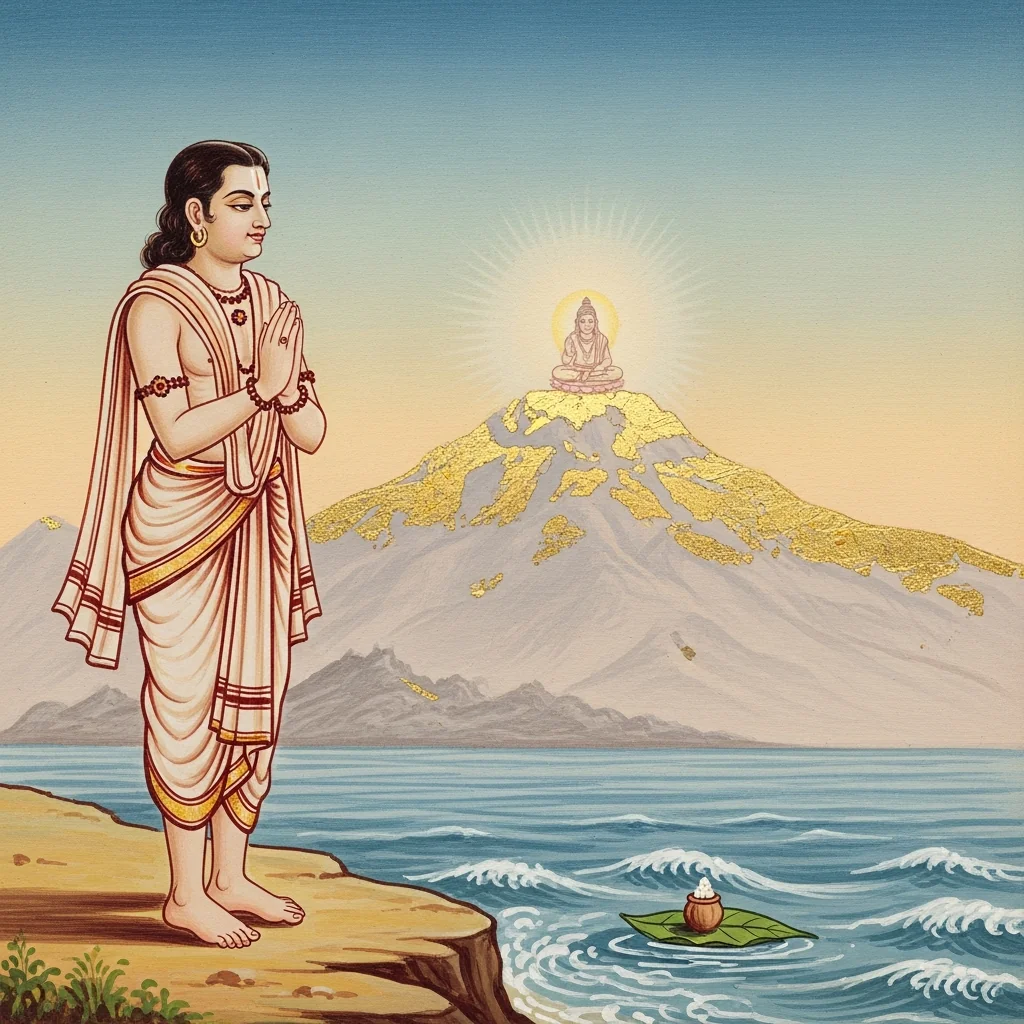
The chapter begins with Sūta’s itinerary for pilgrims: after bathing at Vetālavaradā-tīrtha, one proceeds gradually toward Gandhamādana, portrayed as standing amid the ocean in a “setu-form,” a divinely fashioned passage linked with Brahmaloka. The region is described as thick with sanctity—lakes, rivers, seas, forests, āśramas, and Vedic shrines—inhabited by sages such as Vasiṣṭha, along with siddhas, cāraṇas, and kinnaras, while major deities are said to dwell there day and night. Gandhamādana’s winds are praised for erasing vast stores of sin, and its mere sight for granting mental well-being. Ritual decorum is then prescribed: the pilgrim should beg the mountain—revered bearer of the setu—for forgiveness for stepping upon it, pray for the darśana of Śaṅkara on its summit, and continue with gentle steps. Ocean-bathing at Gandhamādana is enjoined, as is piṇḍadāna for the ancestors, even as small as a mustard seed, said to bring them lasting satisfaction. A second discourse begins when the ṛṣis ask about the tīrtha called Pāpavināśana. Sūta tells of an āśrama near Himavat, filled with disciplined Vedic practitioners. A śūdra named Dṛḍhamati seeks initiation and instruction, but the kulapati refuses, stressing social and ritual restrictions on teaching. Dṛḍhamati nonetheless builds a separate hermitage and serves with devotional hospitality. The brāhmaṇa Sumati grows attached and eventually teaches him confidential Vedic rites (havyakavya, śrāddha, mahālaya, and others), bringing Sumati severe karmic ruin—hells and many rebirths—and later, in another life, a brahmarakṣasa affliction. The afflicted son is taken to Agastya, who explains the karmic cause and prescribes the sole remedy: three days of bathing at Pāpavināśana-tīrtha, located above Gandhamādana in the Setu-region. The rite succeeds—affliction ends, health and prosperity return, and liberation is promised at death. The chapter closes by reaffirming Pāpavināśana as a widely efficacious expiatory tīrtha, granting heaven and mokṣa and revered by Brahmā, Viṣṇu, and Maheśa, while offering the narrative as an ethical caution about transmitting ritual knowledge only with proper authorization and as a map of purification through rightly performed pilgrimage.
Shlokas
Verse 1
श्रीसूत उवाच । वेतालवरदे तीर्थे नरः स्नात्वा द्विजोत्तमाः । ततः शनैःशनैर्गच्छेद्गन्धमादनपर्वतम्
Śrī Sūta said: O best of the twice-born, having bathed at the Vētālavarada Tīrtha, a man should then proceed gradually to Mount Gandhamādana.
Verse 2
योंऽबुधौ सेतुरूपेण वर्तते गन्धमादनः । स मार्गो ब्रह्मलोकस्य विश्वकर्त्रा विनिर्मितः
That Gandhamādana which stands in the ocean in the form of a bridge—this is the path to Brahmaloka, fashioned by the Creator of the universe.
Verse 3
लक्षकोटिसहस्राणि सरांसि सरितस्तथा । समुद्राश्च महापुण्या वनान्यप्याश्रमाणि च
There are hundreds of thousands and even crores of lakes, and likewise rivers; oceans too, supremely holy; and forests as well—together with hermitages (āśramas).
Verse 4
पुण्यानि क्षेत्रजातानि वेदारण्या दिकानि च । मुनयश्च वसिष्ठाद्या सिद्धचारणकिन्नराः
There are holy kṣetras—sacred fields—and ‘Veda-forests’ in every direction; and sages, beginning with Vasiṣṭha, along with Siddhas, Cāraṇas, and Kinnaras.
Verse 5
लक्ष्म्या सह धरण्या च भगवान्मधुसूदनः । सावित्र्या च सरस्वत्या सहैव चतु राननः
Bhagavān Madhusūdana (Viṣṇu) is there along with Lakṣmī and Dharaṇī (Earth); and Caturānana (Brahmā) as well, together with Sāvitrī and Sarasvatī.
Verse 6
हेरंबः षण्मुखश्चैव देवाश्चेंद्रपुरोगमाः । आदित्यादिग्रहाश्चैव तथाष्टौ वसवो द्विजाः
Heraṃba (Gaṇeśa) and Ṣaṇmukha (Skanda) are there, and the gods led by Indra; the celestial luminaries beginning with the Ādityas, and likewise the eight Vasus, O twice-born.
Verse 7
पितरोलोकपालाश्च तथान्ये देवता गणाः । महापातकसंघानां नाशने लोकपावने
The Pitṛs (ancestral spirits), the Lokapālas (guardians of the worlds), and other hosts of deities are there—in that purifier of the worlds which destroys multitudes of great sins.
Verse 9
दिवानिशं वसंत्यत्र पर्वते गंधमादने । अत्र गौरी सदा तुष्टा हरेण सह वर्तते । अत्र किन्नरकांतानां क्रीडा जागर्ति नित्यशः । तस्य दर्शनमात्रेण बुद्धिसौख्यं नृणां भवेत्
Day and night they dwell there on Gandhamādana Mountain. There Gaurī ever remains delighted, abiding together with Hara (Śiva). There the play of the beloveds of the Kinnaras is ever awake. By the mere sight of that mountain, humans attain ease and happiness of mind and understanding.
Verse 10
तन्मूर्धनि कृतावासाः सिद्धचारणयोषितः । पूजयंति सदा कालं शंकरं गिरिजापतिम्
Upon its summit dwell the women of the Siddhas and Cāraṇas; and at all times they worship Śaṅkara, the Lord of Girijā (Pārvatī).
Verse 11
कोटयो ब्रह्महत्यानामगम्यागमकोटयः । अंगलग्नैर्विनश्यंति गन्धमादनमारुतैः
Crores of sins as grievous as brahmahatyā, and countless crores of other forbidden transgressions—even when clinging to one’s very body—are destroyed by the winds of Gandhamādana.
Verse 12
असावुल्लोलकल्लोले तिष्ठन्मध्ये महांबुधौ । आसीन्मुनिगणैः सेव्यः पुरा वै गन्धमादनः
This Gandhamādana, standing amid the great ocean with its surging, rolling waves, was formerly a place revered and frequented by hosts of sages.
Verse 13
ततो नलेन सेतौ तु बद्धे तन्मध्यगोचरः । रामाज्ञयाखिलैः सेव्यो बभूव मनुजैरपि
Then, when the Setu was built by Nala, this (mountain) came within the range of passage in the middle of that way; and by Rāma’s command it became a place to be visited and honored by all—even by human beings.
Verse 14
सेतुरूपं गिरिं तं तु प्रार्थयेद्गंधमादनम् । क्षमाधर महापुण्य सर्वदेवनमस्कृत
Then one should pray to Gandhamādana Mountain, which bears the form of the Setu: “O bearer of the earth, O greatly meritorious one, O you who are revered by all the gods!”
Verse 15
विष्ण्वा दयोऽपि ये देवास्सेवंते श्रद्धया सह । तं भवंतमहं पद्भ्यामाक्रमामि नगोत्तम
“Even the gods—Viṣṇu and the rest—serve you with faith. Yet I, O best of mountains, am stepping upon you with my feet.”
Verse 16
क्षमस्व पादघातं मे दयया पापचेतसः । त्वन्मूर्द्धनि कृतावासं शंकरं दर्शयस्व मे
“Forgive, out of compassion, my footfall—born of a sinful mind. Show me Śaṅkara who has made his dwelling upon your summit.”
Verse 17
प्रार्थयित्वा नरस्त्वेवं सेतुरूपं नगोत्तमम् । ततो मृदुपदं गच्छेत्पावनं गन्धमादनम्
Having thus prayed to the best of mountains, which bears the form of the Setu, one should then proceed with gentle steps to the purifying Gandhamādana.
Verse 18
अब्धौ तत्र नरः स्नात्वा पर्वते गन्धमादने । पिंडदानं ततः कुर्यादपि सर्षपमात्रकम्
There, having bathed in the ocean and then gone to Gandhamādana Mountain, one should perform the piṇḍa-offering—even if it is only as small as a mustard seed.
Verse 19
तृप्तिं प्रयांति पितरस्तस्य यावद्युगक्षयः । शमीदलसमानान्वा दद्यात्पिंडान्पितॄन्प्रति
His forefathers attain satisfaction until the end of the age. Or else, one should offer piṇḍas to the Pitṛs, each measured to the size of a śamī leaf.
Verse 21
सर्वतीर्थोत्तमं पुण्यं नाम्ना पापविनाशनम् । अस्ति पुण्यतमं विप्राः पवित्रे गन्धमादने
O Brāhmaṇas, on holy Gandhamādana there exists a supremely meritorious tīrtha, the best among all sacred fords, renowned by the name “Pāpavināśana”, the Destroyer of sins.
Verse 22
यस्य संस्मरणादेव गर्भवासो न विद्यते । तत्प्राप्य तु नरः स्नायात्स्वदे हमलनाशनम् । तत्र स्नानान्नरो याति वैकुण्ठं नात्र संशयः
By merely remembering it, one no longer undergoes residence in the womb again. Having reached it, a man should bathe there to remove the impurity of his own body; by bathing in that place, a man goes to Vaikuṇṭha—of this there is no doubt.
Verse 23
ऋषय ऊचुः । सूत पापविनाशाख्य तीर्थस्य ब्रूहि वैभवम् । व्यासेन बोधितस्त्वं हि वेत्सि सर्वं महामुने
The sages said: O Sūta, tell us the greatness of the tīrtha called Pāpavināśana. For you have been instructed by Vyāsa, and thus, O great sage, you know everything.
Verse 24
श्रीसूत उवाच । ब्रह्माश्रमपदे वृत्तां पार्श्वे हिमवतः शुभे । वक्ष्यामि ब्राह्मणश्रेष्ठा युष्माकं तु कथां शुभाम्
Śrī Sūta said: O best of Brāhmaṇas, I shall relate to you an auspicious account that took place at the sacred Brahmāśrama, on the blessed flank of Himavat.
Verse 25
अस्याश्रमपदं पुण्यं ब्रह्माश्रमपदे शुभे । नानावृक्षगणाकीर्णं पार्श्वे हिमवतः शुभे
That hermitage-site—holy and auspicious, called Brahmāśrama—stood on the blessed side of Himavat, filled with multitudes of many kinds of trees.
Verse 26
वहुगुल्मलताकीर्णं मृगद्विपनिषेवितम् । सिद्धचारणसंघुष्टं रम्यं पुष्पितकाननम्
It was thick with many shrubs and creepers, frequented by deer and elephants; resonant with the presence of Siddhas and Cāraṇas, a delightful grove blooming with flowers.
Verse 27
वृतिभिर्बहुभिः कीर्णं तापसैरुशोभितम् । ब्राह्मणैश्च महाभागैः सूर्यज्वलनसंनिभैः
It was surrounded by many enclosures and beautified by ascetics, and also by fortunate Brāhmaṇas—radiant like the blazing sun.
Verse 28
नियमव्रतसं पन्नैः समाकीर्णं तपस्विभिः । दीक्षितैर्यागहेतोश्च यताहारैः कृतात्मभिः
It was crowded with ascetics endowed with disciplines and vows—initiated for the sake of sacrifice—self-controlled, restrained in diet, and masters of themselves.
Verse 29
वेदाध्ययनसंपन्नैर्वैदिकैः परिवेष्टितम् । वर्णिभिश्च गृहस्थैश्च वानप्रस्थैश्च भिक्षुभिः
It was encompassed by Vedic men accomplished in the study of the Vedas—along with celibate students, householders, forest-dwellers, and mendicants.
Verse 30
स्वाश्रमाचारनिरतैः स्ववर्णोक्तविधायिभिः । वालखिल्यैश्च मुनिभिः संप्राप्तैश्च मरीचिभिः
There, in that hermitage, were sages devoted to the duties of their own āśramas and faithfully performing the rites prescribed for their respective varṇas; the Vālakhilya sages were present as well, and Marīci and others had also arrived.
Verse 31
तत्राश्रमे पुरा कश्चिच्छूद्रो दृढमतिर्द्विजाः । साहसी ब्राह्मणाभ्याशमाजगाम मुदान्वितः
O twice-born ones, long ago in that hermitage there was a Śūdra named Dṛḍhamati; bold by nature, he came joyfully into the vicinity of the Brahmins.
Verse 32
आगतो ह्याश्रमपदं पूजितश्च तपस्विभिः । नाम्ना दृढमतिः शूद्रः साष्टांगं प्रणनाम वै
Having come to the hermitage, he was received with honour by the ascetics. That Śūdra, named Dṛḍhamati, then bowed in full prostration with the eight limbs.
Verse 33
तान्स दृष्ट्वा मुनिगणान्देवकल्पान्महौजसः । कुर्वतो विविधान्यज्ञान्संप्रहृष्य स शूद्रकः
Seeing those companies of sages—godlike and radiant with great spiritual power—performing various yajñas, that Śūdra was filled with delight.
Verse 34
अथास्य बुद्धिरभवत्तपःकर्तुमनुत्तमम् । ततोऽब्रवीत्कुलपतिं मुनिमागत्य तापसम्
Then the thought arose in him to undertake unsurpassed tapas. Approaching the kulapati, the sage who was head of the hermitage, the ascetic, he spoke.
Verse 35
दृढमतिरुवाच । तपोधन नमस्तेऽस्तु रक्ष मां करुणानिधे । तव प्रसादादिच्छामि धर्मं चर्तुं द्विजर्षभ
Dṛḍhamati said: “O treasure of austerity, salutations to you. Protect me, O ocean of compassion. By your grace I wish to practise dharma, O bull among the twice-born.”
Verse 36
तस्मादभिगतं मां त्वं यागे दीक्षय सुव्रत । ब्रह्मन्नवरवर्णोऽहं शूद्रो जात्यास्मि सत्तम
“Therefore, since I have come to you, initiate me for a sacrifice, O man of excellent vows. O Brahmin, I am of the lowest varṇa—by birth I am a Śūdra, O noble one.”
Verse 37
शुश्रूषां कर्तुमिच्छामि प्रपन्नाय प्रसीद मे । एवमुक्ते तु शूद्रेण तमाह ब्राह्मणस्तदा
“I wish to render service; be gracious to me who has taken refuge.” When the Śūdra spoke thus, the Brahmin then replied to him.
Verse 38
कुलपतिरुवाच । यागे दीक्षयितुं शक्यो न शूद्रो हीनजन्मभाक् । श्रूयतां यदि ते बुद्धिः शुश्रूषानिरतो भव
The kulapati said: “A Śūdra, being of inferior birth-status (by the prevailing rule), is not eligible to be initiated for a sacrifice. But listen—if you truly have this resolve, then devote yourself to service.”
Verse 39
उपदेशो न कर्तव्यो जातिहीनस्य कर्हिचित् । उपदेशे महान्दोष उपाध्यायस्य विद्यते
“Instruction should never be given to one deemed ‘lacking in jāti-status’ (by the ritual-social rule). If instruction is given, a grave fault is said to accrue to the teacher.”
Verse 40
नाध्यापयेद्बुधः शूद्रं तथा नैव च याजयेत् । न पाठयेत्तथा शूद्रं शास्त्रं व्याकरणादिकम्
A learned man should not teach a Śūdra, nor should he officiate sacrifices for him. Likewise, he should not have a Śūdra study the śāstras, such as grammar and related disciplines.
Verse 41
काव्यं वा नाटकं वापि तथालंकारमेव च । पुराणमितिहासं च शूद्रं नैव तु पाठयेत्
Nor should one have a Śūdra study poetry, drama, or treatises on literary ornamentation; nor should one teach him the Purāṇas and the Itihāsas.
Verse 42
यदि चोपदिशेद्विप्रः शूद्रं चैतानि कर्हिचित् । त्यजेयुर्ब्राह्मणा विप्रं तं ग्रामाद्ब्रह्मसंकुलात्
If a Brāhmaṇa were ever to teach these matters to a Śūdra, then the Brāhmaṇas should expel that Brāhmaṇa from the village, from that place filled with Vedic sanctity.
Verse 43
शूद्राय चोपदेष्टारं द्विजं चंडालवत्त्यजेत् । शूद्रं चाक्षरसंयुक्तं दूरतः परिवर्जयेत्
A twice-born man who instructs a Śūdra should be cast out as though he were a Caṇḍāla. And a Śūdra who has taken up letters (scriptural learning) should be avoided from afar.
Verse 44
अतः शुश्रूष भद्रं ते ब्राह्मणाञ्छ्रद्धया सह । शूद्रस्य द्विजशुश्रूषा मन्वादिभिरुदीरिता
Therefore, for your welfare, serve the Brāhmaṇas with faith and reverence. For the Śūdra, service to the twice-born is declared as proper conduct by Manu and other authorities.
Verse 45
नहि नैसर्गिकं कर्म परित्यक्तुं त्वमर्हसि । एवमुक्तस्तु मुनिना स शूद्रोऽचिंतयत्तदा
“You should not abandon your natural, appointed duty.” Thus addressed by the sage, that Śūdra then reflected deeply.
Verse 46
किं कर्तव्यं मया त्वद्य व्रते श्रद्धा हि मे पुरा । यथा स्यान्मम विज्ञानं यतिष्येऽहं तथाद्य वै
(He thought:) “What should I do today? Formerly I truly had faith in the vow. So that understanding may arise in me, I will strive accordingly—today indeed.”
Verse 47
इति निश्चित्य मनसा शूद्रो दृढमतिस्तदा । गत्वाश्रमपदाद्दूरं कृतवानुटजं शुभम्
Having thus decided in his mind, the Śūdra—firm in resolve—went far from the hermitage-site and built an auspicious hut.
Verse 48
तत्र वै देवतागारं पुण्यान्यायतनानिच । पुष्पारामादिकं चापि तटाकखननादिकम्
There he established a shrine for the deity and other sacred structures; he also made flower-gardens and undertook works such as digging a pond.
Verse 49
श्रद्धया कारयामास तपःसिद्ध्यर्थमात्मनः । अभिषेकांश्च नियमानुपवासादिकानपि
With faith he had these done for the sake of perfecting his austerities; and he also undertook abhiṣeka consecrations, disciplined observances (niyamas), and fasts and the like.
Verse 50
बलिं च कृत्वा हुत्वा च दैवतान्यभ्यपूजयत् । संकल्पनियमोपेतः फलाहारो जितेंद्रियः
Having offered bali and performed homa, he duly worshipped the deities. Steadfast in sacred resolve and disciplined observances, living on fruits alone, he kept his senses under control.
Verse 51
नित्यं कंदैश्च मूलैश्च पुष्पैरपि तथा फलैः । अतिथीन्पूजयामास यथावत्समुपागतान्
Daily, with bulbs, roots, flowers, and fruits, he honoured the guests who arrived, serving them properly in accordance with dharma.
Verse 52
एवं हि सुमहान्कालो व्यतिचक्राम तस्य वै । अथाश्रममगात्तस्य सुमतिर्नाम नामतः
Thus a very long time passed for him. Then a sage, known by name as Sumati, came to his hermitage.
Verse 53
द्विजो गर्गकुलोद्भूतः सत्यवादी जितेंद्रियः । स्वागतेन मुनिं पूज्य तोषयित्वा फलादिकैः
A twice-born man, sprung from the lineage of Garga—truthful and self-controlled—welcomed the sage, honoured him, and satisfied him with fruits and other simple offerings.
Verse 54
कथयन्वै कथाः पुण्याः कुशलं पर्यपृच्छत । इत्थं सप्रणिपाताद्यैरुपचारैस्तु पूजितः
He spoke sacred, merit-giving stories and inquired after the sage’s well-being. In this way the sage was honoured with courtesies beginning with reverent prostration and other services.
Verse 55
आशीर्भिरभिनंद्यैनं प्रतिगृह्य च सत्क्रियाम् । तमापृछ्य प्रहृष्टाप्मा स्वाश्रमं पुनराययौ
Blessing him with benedictions and accepting the reverent hospitality, the sage took leave of him and, joyful at heart, returned again to his own āśrama.
Verse 56
एवं दिनेदिने विप्रः शूद्रेस्मिन्पक्षपातवान् । आगच्छदाश्रमं तस्य द्रष्टुं तं शूद्रयोनिजम्
Thus, day after day, the brāhmaṇa—showing partiality toward this śūdra—kept coming to his āśrama to see that man born in a śūdra family.
Verse 57
बहुकालं द्विजस्याभूत्संसर्गः शूद्रयोनिना । स्नेहस्य वशमापन्नः शूद्रोक्तं नातिचक्रमे
For a long time the twice-born kept close company with the man of śūdra birth. Under the sway of affection, he did not overstep what the śūdra said, but complied with it.
Verse 58
अथागतं द्विजं शूद्रः प्राह स्नेहवशीकृतम् । हव्यकव्यविधानं मे कृत्स्नं ब्रूहि मुनीश्वर
Then the śūdra addressed the dvija, now brought under the power of affection: “O lord among sages, tell me in full the procedure for havis offered to the devas and kavya offered to the ancestors.”
Verse 59
पितृकार्यविधानार्थं देवकार्यार्थमेव च । मंत्रानुपदिश त्वं मे महालयविधिं तथा
“To set forth the rites due to the pitṛs and likewise the rites due to the devas, teach me the mantras—and also the proper procedure for the Mahālaya observance.”
Verse 60
अष्टकाश्राद्धकृत्यं च वैदिकं यच्च किंचन । सर्वमेतद्रहस्यं मे ब्रूहि त्वं वै गुरुर्मतः
Teach me the secret principles of the Aṣṭakā-Śrāddha rites and whatever else is Vedic. Tell me all of it, for you are regarded as my guru.
Verse 61
एवमुक्तः स शूद्रेण सर्वमेतदुपादिशत् । कारयामास तस्यायं पितृकार्यादिकं तथा
Thus addressed by the Śūdra, the twice-born taught him all of that; and he also had him perform the ancestral rites and the other connected duties.
Verse 62
पितृकार्ये कृते तेन विसृष्टः स द्विजो गतः । अथ दीर्घेण कालेन पोषितः शूद्रयोनिना
When the ancestral rites had been completed by him, that twice-born was dismissed and went away. Then, after a long time, he was sustained in a Śūdra birth.
Verse 63
त्यक्तो विप्रगणैः सोऽयं पंचत्वमगमद्द्विजः । वैवस्वतभटैर्नीत्वा पातितो नरकेष्वपि
Abandoned by the community of Brāhmaṇas, this twice-born met death. Carried away by Yama’s attendants, he was cast down into the hells as well.
Verse 64
कल्पकोटिसहस्राणि कल्पकोटिशतानि च । भुक्त्वा क्रमेण नरकांस्तदंते स्था वरोऽभवत्
After enduring, in due order, the hells for thousands of crores of kalpas and for hundreds of crores of kalpas, at the end of that he became a sthāvara—an immobile being.
Verse 65
गर्दभस्तु ततो जज्ञे विड्वराहस्ततः परम् । जज्ञेऽथ सारमेयोऽसौ पश्चाद्वायसतां गतः
Then he was born as a donkey; after that, as a boar that feeds on filth. Next he was born as a dog; and afterward he entered the state of a crow.
Verse 66
अथ चंडालतां प्राप शूद्रयोनिमगात्ततः । गतवान्वैश्यतां पश्चात्क्षत्रियस्तदनंतरम्
Then he attained the condition of a Caṇḍāla; after that he went into a Śūdra birth. Next he attained Vaiśya-hood, and immediately afterward was born as a Kṣatriya.
Verse 67
प्रबलैर्बाध्यमानोऽसौ ब्राह्मणो वै तदाऽभवत् । उपनीतः स पित्रा तु वर्षे गर्भाष्टमे द्विजः
Pressed hard by powerful forces of fate, he then indeed became a Brāhmaṇa. That twice-born was invested with the sacred thread by his father in the eighth year from conception.
Verse 68
वर्तमानः पितुर्गेहे स्वाचाराभ्यासतत्परः । गच्छन्कदाचिद्गहने गृहीतो ब्रह्मरक्षसा
Living in his father’s house and devoted to practicing proper conduct, once, while walking in a dense forest, he was seized by a Brahmarākṣasa.
Verse 69
रुदन्भ्रमन्स्खल न्मूढः प्रहसन्विलपन्नसौ । शश्वद्धाहेति च वदन्वैदिकं कर्म सोऽत्यजत्
Crying, reeling about, stumbling in confusion—now laughing, now lamenting—continually uttering ‘Burn! Burn!’, he abandoned the performance of Vedic duties.
Verse 70
दृष्ट्वा सुतं तथाभूतं पिता दुःखेन पीडितः । सुतमादाय च स्नेहा दगस्त्यं शरणं ययौ
Seeing his son in that dreadful condition, the father, crushed by grief, took the boy in loving care and went to Agastya seeking refuge.
Verse 71
भक्त्या मुनिं प्रणम्यासौ पिता तस्य सुतस्य वै । तस्मै निवेदयामास स्वपुत्रस्य विचेष्टितम्
With devotion, the father bowed to the sage and then reported the strange and troubling behavior of his own son.
Verse 72
अब्रवीच्च तदा विप्रः कुम्भजं मुनिपुंगवम् । एष मे तनयो ब्रह्मन्गृहीतो ब्रह्मरक्षसा
Then the brāhmaṇa spoke to Kumbhaja, the foremost of sages: “O revered one, this son of mine has been seized by a brahma-rākṣasa.”
Verse 73
सुखं न भजते ब्रह्मन्रक्ष तं करुणादृशा । नास्ति मे तनयोऽ प्यन्यः पितॄणामृणमुक्तये
“O venerable one, he finds no happiness—please protect him with your compassionate glance. I have no other son by whom I may be freed from the debt owed to the ancestors.”
Verse 74
अस्य पीडाविनाशार्थमुपायं ब्रूहि कुम्भज । त्वत्समस्त्रिषु लोकेषु तपःशीलो न विद्यते
“O Kumbhaja, tell me the means to destroy this affliction. In the three worlds there is none equal to you in austerity (tapas) and disciplined conduct.”
Verse 75
अग्रणीः शिवभक्तानामुक्तस्त्वं हि महर्षिभिः । त्वां विनास्य परित्राणं न मेपुत्रस्य विद्यते
The great seers have proclaimed you the foremost among the devotees of Śiva. Without you, I find no protection for my son.
Verse 76
पित्रे कृपां कुरुष्व त्वं दयाशीला हि साधवः । श्रीसूत उवाच । एवमुक्तस्तदा तेन कुम्भजो ध्यानमास्थितः
Show mercy to a father, for the virtuous are compassionate by nature. Sūta said: Thus addressed by him, Kumbhaja (Agastya) then entered into meditation.
Verse 77
ध्यात्वा तु सुचिरं कालमब्रवीद्ब्राह्मणं ततः । अगस्त्य उवाच । पूर्वजन्मनि ते पुत्रो ब्राह्मणोऽयं महामते
After meditating for a long time, he then spoke to the brāhmaṇa. Agastya said: “O wise one, in a former birth this son of yours was a brāhmaṇa.”
Verse 78
सुमतिर्नाम विप्रोऽयं मतिं शूद्राय वै ददौ । कर्माणि वैदिकान्येष सर्वाण्युपदि देश वै
This brāhmaṇa was named Sumati. He imparted sacred learning to a śūdra and even instructed him in all the Vedic rites.
Verse 79
अतोऽयं नरकान्भुक्त्वा कल्पकोटिसहस्रकम् । जातो भुवि तदंतेषु स्थावरादिषु योनिषु
Therefore he endured the hells for thousands of crores of kalpas; and after that, he was born on earth in wombs such as immobile beings and other lower births.
Verse 80
इदानीं ब्राह्मणो जातः कर्मशेषेण ते सुतः । यमेन प्रेषितेनात्र गृहीतो ब्रह्मरक्षसा
Now your son has been born as a brāhmaṇa through the remaining residue of past karma; yet here he has been seized by a Brahmarākṣasa sent forth by Yama.
Verse 81
क्रूरेण पातकेनाद्धा पूवजन्मकृतेन वै । उपायं ते प्रवक्ष्यामि ब्रह्मरक्षोविनाशने
Indeed, because of a cruel sin committed in a former birth, I shall tell you the means for destroying this Brahmarākṣasa.
Verse 82
शृणुष्व श्रद्धया युक्तः समाधाय च मानसम् । दक्षिणांभोनिधौ विप्र सेतुरूपो महागिरिः
Listen with faith, steadying and collecting your mind: in the southern ocean, O brāhmaṇa, there stands a great mountain in the form of a bridge (Setu).
Verse 83
वर्तते दैवतैः सेव्यः पावनो गन्धमादनः । तस्योपरि महातीर्थं नाम्ना पापविनाशनम्
There stands the purifying Gandhamādana, honored and served by the gods; upon it is a great tīrtha named ‘Pāpavināśana’ (Destroyer of Sin).
Verse 84
अस्ति पुण्यं प्रसिद्धं च महापातकनाशनम् । भूतप्रेतपिशाचानां वेतालब्रह्म रक्षसाम्
It is holy and renowned, a destroyer of great sins—effective against bhūtas, pretas, piśācas, vetālas, and Brahmarākṣasas.
Verse 85
महतां चैव रोगाणां तीर्थं तन्नाशकं स्मृतम् । सुतमादाय गच्छ त्वं तत्तीर्थं सेतुमध्यगम्
That tīrtha is also remembered as the destroyer of grievous diseases. Taking your son, go to that sacred ford situated in the midst of the Setu region.
Verse 86
प्रयतः स्नापय सुतं तीर्थे पापविनाशने । स्नानेन त्रिदिनं तत्र ब्रह्मरक्षो विनश्यति
With due discipline, bathe your son at the Pāpavināśana-tīrtha, the destroyer of sins. By bathing there for three days, the Brahmarākṣasa is destroyed.
Verse 87
नैवोपायांतरं तस्य विनाशे विद्यते भुवि । तस्माच्छीघ्रं प्रयाहि त्वं रामसेतुं विमुक्तिदम्
For its destruction, no other remedy exists on earth. Therefore go quickly to Rāmasetu, the giver of liberation.
Verse 88
तत्र पापविनाशाख्यतीर्थे स्नापय ते सुतम् । मा विलंबं कुरुष्वात्र त्वरया याहि वै द्विज
There, at the tīrtha called Pāpavināśana, bathe your son. Do not delay here—go quickly indeed, O twice-born.
Verse 89
इत्युक्तः स द्विजोऽगस्त्यं प्रणम्य भुवि दण्डवत् । अनुज्ञातश्च तेनासौ प्रययौ गंधमादनम्
Thus instructed, that brāhmaṇa bowed to Agastya, prostrating upon the earth like a staff; and, having received his permission, he departed for Gandhamādana.
Verse 91
सस्नौ स्वयं च विप्रेंद्राः पिता पापविनाशने । अथ तस्य सुतस्तत्र विमुक्तो ब्रह्मरक्षसा
Then the eminent brāhmaṇa father himself bathed at the sacred ford called Pāpavināśana. There, in that very place, his son was released from the affliction of a brahmarākṣasa.
Verse 92
समजायत नीरोगः स्वस्थः सुन्दररूपधृक् । सर्वसंपत्समृद्धोऽसौ भुक्त्वा भोगाननेकशः
He became free from disease, wholly well, and endowed with a handsome form. Abounding in every prosperity, he enjoyed many kinds of pleasures again and again.
Verse 93
देहांते प्रययौ मुक्तिं स्नानात्पापविनाशने । पितापि तत्र स्नानेन देहांते मुक्तिमाप्तवान्
At the end of his life, through bathing at Pāpavināśana, he attained liberation. His father too—by bathing there—obtained liberation at the end of the body.
Verse 94
तेनोपदिष्टो यः शूद्रः स भुक्त्वा नरकान्क्रमात् । अनेकासु जनित्वा च कुत्सितास्वपियोनिषु
A certain śūdra who had been instructed by him, after undergoing the hells in due sequence and being born many times, even in blameworthy wombs,
Verse 95
गृध्रजन्मा भवत्पश्चाद्गंधमादनपर्वते । स कदाचिज्जलं पातुं तीर्थे पापविनाशने
Afterwards, on Mount Gandhamādana, he was born as a vulture. At a certain time, he came to the Pāpavināśana tīrtha to drink water,
Verse 96
समागतः पपौ तोयं सिषिचे चात्मनस्तनुम् । तदैव दिव्यदेहः सन्सर्वाभरणभूषितः
Having arrived, he drank the water and sprinkled his own body. At that very moment he assumed a divine body, adorned with every ornament.
Verse 97
दिव्यमाल्यांबरधरो रक्तचंदनरूषितः । दिव्यं विमानमारुह्य शोभितश्छत्रचामरैः
Wearing heavenly garlands and garments, anointed with red sandal-paste, he mounted a divine aerial car, splendid with parasols and yak-tail fans.
Verse 98
उत्तमस्त्रीपरिवृतः प्रययावमरालयम्
Surrounded by excellent celestial women, he departed to the abode of the gods.
Verse 99
श्रीसूत उवाच । एवं प्रभावमेतद्वै तीर्थं पापविनाशनम् । स्वर्गदं मोक्षदं पुण्यं प्रायश्चित्तकरं तथा । ब्रह्मविष्णुमहे शानैः सेवितं सुरसेवितम्
Śrī Sūta said: ‘Such indeed is the power of this sacred ford, Pāpavināśana—the destroyer of sin—bestowing heaven, bestowing liberation, holy, and a maker of expiation as well; served by Brahmā, Viṣṇu, and Maheśa, and worshipped by the gods.’
Verse 101
इत्थं रहस्यं कथितं मुनींद्रास्तद्वैभवं पापविनाशनस्य । यत्राभिषेकात्सहसा विमुक्तौ द्विजश्च शूद्रश्च विनिंद्यकृत्यौ
Thus, O lords of sages, the secret has been told—the grandeur of Pāpavināśana, where by ablution alone a brāhmaṇa and a śūdra, even though guilty of censurable deeds, are suddenly set free.