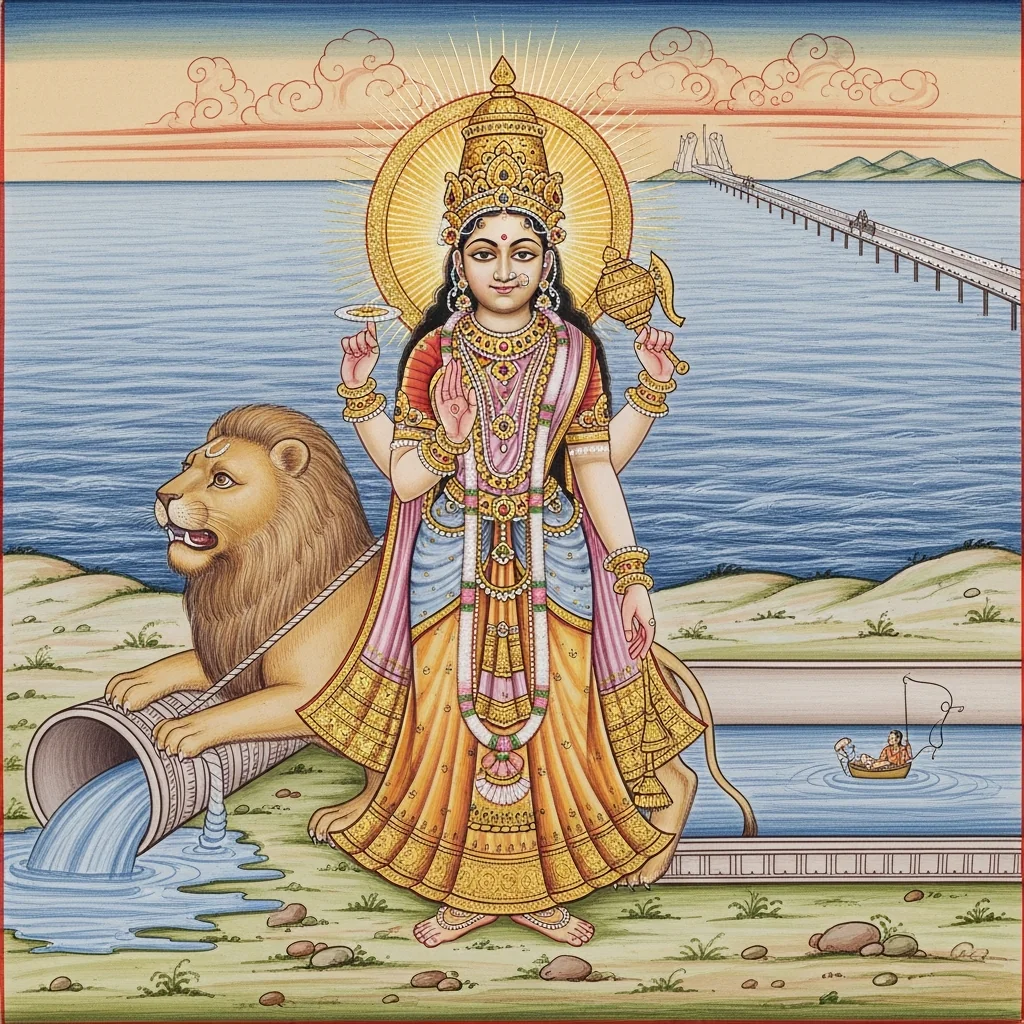
Adhyaya 7
This chapter weaves a twofold sacred account, joining the myth of battle with the guidance of pilgrimage. Sūta recounts how Devī—revered as Ambikā, Caṇḍikā, Durgā, and Bhadrakālī—defeats Mahiṣāsura’s ministers and champions such as Caṇḍakopa, Citrabhānu, and Karāla through divine weapons, martial skill, and irresistible śakti. Mahiṣāsura repeatedly assumes deceptive forms (buffalo, lion-like guise, sword-bearing man, elephant, and again buffalo), while Devī’s lion-mount fights alongside her. A disembodied voice (aśarīrā vāc) reveals that the asura hides within the waters of Dharmapuṣkariṇī; the lion drinks the waters dry, exposing him, and Devī subdues him—foot upon his head, spear at his throat—then beheads him, restoring cosmic order amid hymns of praise. The narrative then turns to tīrtha-māhātmya and route-instruction. Devī establishes a city on the southern seashore; the tīrthas receive their names and boons, including an association with amṛta. A ritual itinerary is prescribed: bathe at the navapāṣāṇa area, visit Cakratīrtha, and proceed with saṅkalpa toward Setubandha. The chapter also recalls Rāma’s building of the Setu through Nala and the vānaras, affirms its dimensions and sanctity, and concludes with a phalaśruti promising spiritual attainments to those who read or hear this chapter with devotion.
Shlokas
Verse 1
श्रीसूत उवाच । स्वसैन्यमवलोक्याथ महिषो दानवेश्वरः । हतं देव्या महाक्रोधाच्चंडकोपमथाब्रवीत्
Śrī Sūta said: Then Mahīṣa, lord of the dānavas, seeing his own army slain by the Goddess, spoke to Caṇḍakopa in great wrath.
Verse 2
महिष उवाच । चंडकोप महावीर्य युद्ध्यस्वैनां दुरात्मिकाम् । तथास्त्विति स चोक्त्वाथ चंडकोपः प्रतापवान्
Mahīṣa said: “O Caṇḍakopa of great prowess, fight this wicked-minded woman!” Saying “So be it,” the mighty Caṇḍakopa prepared to engage.
Verse 3
अवाकिरद्बाणवर्षैर्देवीं समरमूर्द्धनि । बाणजालानि तस्याशु चंडकोपस्य लीलया
At the very height of the battle he covered the Goddess with a rain of arrows; swiftly, as if in Caṇḍakopa’s mere sport, volleys of arrow-nets were cast forth.
Verse 4
छित्त्वा जघान शस्त्रेण चंडकोपस्य सांबिका । चकर्त वाजिनोऽप्यस्य सारथिं च ध्वजं धनुः
Having cut him down, Ambikā struck Caṇḍakopa with her weapon; she also severed his horses, his charioteer, his banner, and his bow.
Verse 5
उन्ममाथ रथं चापि तं बाणैर्हृद्यताडयत् । स भग्नधन्वा विरथो हताश्वो हतसारथिः
She shattered his chariot as well and struck him in the chest with arrows. With his bow broken, his chariot ruined, his horses slain, and his charioteer killed, he was left helpless.
Verse 6
चंडकोपस्ततो देवीं खड्गचर्मधरोऽभ्यगात् । खड्गेन सिंहमाजघ्ने देव्या वाहं महासुरः
Then Caṇḍakopa, bearing sword and shield, advanced toward the Goddess. With his sword the great asura struck the lion, the mount of the Devī.
Verse 7
देवीमपि भुजे सव्ये खड्गेन प्रजघान सः । खङ्गो देव्या भुजे सव्ये व्यशीर्यत सहस्रधा
He struck the Goddess as well on her left arm with his sword. But the sword, upon the Goddess’s left arm, shattered into a thousand pieces.
Verse 8
ततः शूले न महता चंडकोपं तदांबिका । जघान हृदये सोऽपि पपात च ममार च
Then Ambikā struck Caṇḍakopa in the heart with a not-so-large spear. He fell down and died.
Verse 9
चंडकोपे हते तस्मिन्महावीर्ये महाबले । चित्रभानुर्गजारूढो देवीं तामभ्यधावत
When Caṇḍakopa, of mighty valor and great strength, had been slain, Citrabhānu, mounted upon an elephant, charged toward the Goddess.
Verse 10
दिव्यां शक्तिं ससर्जाथ महाघंटारवाकुलाम् । न्यवारयत हुंकारैर्देवी शक्तिं निराकुलाम्
He then hurled a divine spear, amid a tumult like the roar of a great bell. Unperturbed, the Goddess checked that missile with her thunderous hūṃkāras.
Verse 11
ततः शूलेन सा देवी चित्रभानुं व्यदारयत् । मृते तस्मिंस्ततो युद्धे करालो द्रुतमभ्यगात्
Then the Goddess tore Citrabhānu apart with her trident. When he fell dead in battle, Karāla swiftly advanced.
Verse 12
करमुष्टिप्रहारेण सोऽपि देव्या निपातितः । ततो देवी मदोन्मत्तं गदया व्यसुमातनोत्
He too was struck down by the Goddess with blows of her hands and fists. Then the Goddess felled the foe, intoxicated with pride, with her mace, depriving him of life.
Verse 13
बाष्कलं पट्टिशेनापि चक्रेणापि तथांतिकम् । प्राहिणोद्यमलोकाय दुर्गा देवी द्विजोत्तमाः
O best of the twice-born, the Goddess Durgā sent Bāṣkala to Yama’s realm—bringing him to his end—by the battle-axe (paṭṭiśa) and also by her discus, at close quarters.
Verse 14
एवमन्यान्महाकायान्मंत्रिणो महिषस्य च । शूलेन प्रोथयित्वाथ प्राहिणोद्यमसादनम्
Thus, having pierced with her trident the other huge-bodied ministers of Mahiṣa as well, she dispatched them to Yama’s abode, the realm of death.
Verse 15
आत्मसैन्ये हते त्वेवं दुर्गया महिषासुरः । माहिषेणाथ रूपेण गणान्देव्या अभक्षयत्
When his own army had thus been slain by Durgā, Mahiṣāsura assumed the form of a buffalo and began to devour the Devī’s attendant hosts.
Verse 16
तुण्डेन निजघानैकान्सुराघातैस्तथापरान् । निश्वासवायुभिश्चान्यान्पातयामास रोषितः
Enraged, he struck down some with his snout, others with blows like a raging beast, and still others he felled by the gusts of his breath.
Verse 17
देव्या भूतगणं त्वेवं निहत्य महिषासुरः । सिंहं मारयितुं देव्याश्चुक्रोध च ननाद च
Having thus slain the Goddess’s host of beings, Mahiṣāsura grew furious and roared, seeking to kill the lion of the Devī.
Verse 18
ततः सिंहोऽभवत्क्रुद्धो महावीर्यो महाबलः । सुराभि घातनिर्भिन्नमहीतलमहीधरः
Then the lion became enraged—mighty in valor and immense in strength—like a great mountain that, by its forceful impact, has shattered the earth’s surface.
Verse 19
महिषासुरमायांतं नखैरेनं व्यदारयत् । चंडिकापि ततः क्रुद्धा वधे तस्याकरोन्मतिम्
As Mahiṣāsura charged forward, the lion tore him with its claws. Then Caṇḍikā too, enraged, resolved upon his death.
Verse 21
सिंहवेषोऽभवद्दैत्यो महाबलपराक्रमः । देवी तस्य शिरोयावच्छेत्तुं बुद्धिमधारयत्
The demon assumed a lion’s guise, endowed with great strength and prowess. The Goddess formed the intention to cut off his head.
Verse 22
तावत्स पुरुषो भूत्वा खड्गपाणिरदृश्यत । अथ तं पुरुषं देवी खड्गहस्तं शरोत्करैः
Then, in the meantime, he appeared having become a man, sword in hand. Thereupon the Goddess confronted that sword-wielding man with volleys of arrows.
Verse 23
जघान तीक्ष्णधाराग्रैः परमर्मविदारणैः । ततः स पुरुषो विप्रा गजोऽभूद्धस्तदन्तवान्
She struck him with arrow-points sharp as blades, tearing vital joints. Then that man, O brāhmaṇas, became an elephant, with trunk and tusks.
Verse 24
दुर्गाया वाहनं सिंहं करेण विचकर्ष च । ततः सिंहः करं तस्य विचकर्त नखांकुरैः
He seized and dragged Durgā’s mount—the lion—with his hand. Then the lion tore that hand apart with its claw-tips.
Verse 25
भूयो महासुरो जातो माहिषं वेषमाश्रितः । ततः क्रुद्धा भद्रकाली महत्पानमसेवत
Once more the great Asura arose, taking on the guise of a buffalo. Then Bhadrakālī, inflamed with wrath, drank deeply of mead, preparing herself for the decisive encounter.
Verse 26
ततः पानवशा न्मत्ता जहासारुणलोचना । महिषः सोऽपि गर्वेण शृंगाभ्यां पर्वतोत्करान्
Then, overcome by drink, she grew intoxicated and laughed, her eyes glowing red. That buffalo-demon too, swollen with pride, began to heave up heaps of mountains with his horns.
Verse 27
चंडिकां प्रतिं चिक्षेप सा च तानच्छिनच्छरैः । ततो देवी जग न्माता महिषासुरमब्रवीत्
He hurled them toward Caṇḍikā, but she cut them down with her arrows. Then the Goddess, the Mother of the world, spoke to Mahīṣāsura.
Verse 28
देव्युवाच । कुरु गर्वं क्षणं मूढ मधु यावत्पिबाम्यहम् । निवृत्तमधुपानाहं त्वां नयिष्ये यमक्षयम्
The Goddess said: “Indulge your pride for a moment, you fool, while I drink this mead. When I have finished drinking, I shall lead you to Yama’s abode—your destruction.”
Verse 29
हते त्वयि दुराधर्षे मया दैवतकंटके । स्वंस्वं स्थानं प्रपद्यंतां सिद्धा साध्या मरुद्गणाः
“When you—hard to overcome, a thorn to the gods—are slain by me, let the Siddhas, the Sādhyas, and the hosts of the Maruts return, each to their own proper abodes.”
Verse 31
दक्षिणस्योदधेस्तीरेप्रदुद्राव त्वरान्वितः । अनुदुद्राव तं देवी सिंहमारुह्य वाहनम्
In hurried flight he ran along the shore of the southern ocean. The Goddess pursued him, mounting her lion as her sacred vehicle.
Verse 32
अनुद्रुतस्ततो देव्या महिषो दानवेश्वरः । धर्मपुष्कीरणीतोये दशयोजनमायते
Thus pursued by the Goddess, Mahīṣa—the lord of the Dānavas—entered the waters of Dharmapuṣkarī lake, stretching for ten yojanas.
Verse 33
प्रविश्यांतर्हितस्तस्थौ दुर्गाताडनविह्वलः । ततो दुर्गा समासाद्य धर्मपुष्करिणीतटम्
Entering it, he stayed there concealed, shaken by Durgā’s blows. Then Durgā came to the bank of the Dharmapuṣkariṇī.
Verse 34
नददर्शासुरं तत्र महिषं चंडिका तदा । अशरीरा ततो वाणी दुर्गा देवीमभाषत
Then Caṇḍikā did not see Mahīṣa, the buffalo-asura, there. At that moment a bodiless voice spoke to the Goddess Durgā.
Verse 35
भद्रकालि महादेवि महिषो दानवस्त्वया । ताडितो मुष्टिना भद्रे धर्मपुष्करिणीजले
“O Bhadrakālī, O great Goddess—this Mahīṣa, the Dānava, has been struck by you with your fist, O auspicious one, in the waters of Dharmapuṣkariṇī.”
Verse 36
अस्मिन्नंतर्हितः शेते भयार्तो मारयस्व तम् । येनकेनाप्युपायेन चैनं प्राणैर्वियोजय
“He lies hidden here, stricken with fear—kill him. By whatever means, sever him from his life-breath.”
Verse 37
एवं वाचाऽशरी रिण्या कथिता चंडिका तदा । प्राह स्ववाहनं सिंहमसुरेंद्रवधोद्यता
Thus addressed by the bodiless voice, Caṇḍikā then spoke to her own mount, the lion—poised to slay the lord of the asuras.
Verse 38
मृगेंद्र सिंहविक्रांत महावलपराक्रम । धर्मपुष्कीरणीतोयं निःशेषं पीय तां त्वया
“O lord of beasts—lion-like in stride, mighty in strength and valor—drink up completely this water of Dharmapuṣkariṇī.”
Verse 39
देव्यैवमुक्तः पंचास्यो धर्मपुष्करिणीजलम् । निःशेषं च पपौ विप्रा यथा पांसुर्भवेत्तथा
So commanded by the Goddess, the five-mouthed one drank up entirely the water of Dharmapuṣkariṇī, O brāhmaṇas—until it seemed as though only dust remained.
Verse 40
निरगान्महिषो दीनस्ततस्तस्मा ज्जलाशयात् । आयांतमसुरं देवी पादेनाक्रम्य मूर्द्धनि
Then the buffalo-demon emerged, wretched, from that reservoir. As the asura came forward, the Goddess set her foot upon his head.
Verse 41
कंठं शूलेन तीक्ष्णेन पीडयामास कोपिता । ततो देव्यसिमादाय चकर्तास्य शिरो महत्
Enraged, she pressed his throat with a sharp spear; then the Goddess took up her sword and cut off his great head.
Verse 42
एवं स महिषो विप्राः सभृत्यबलवाहनः । दुर्गया निहतो भूमौ पपात च ममार च
Thus, O brāhmaṇas, that buffalo-demon—together with his attendants, forces, and mounts—was slain by Durgā; he fell to the ground and died.
Verse 43
ततो देवाः सगंधर्वाः सिद्धाश्च परमर्षयः । स्तुत्वा देवीं ततः स्तोत्रैस्तुष्टा जहृषिरे तदा
Then the gods—along with the Gandharvas, the Siddhas, and the supreme sages—praised the Goddess with hymns; satisfied, they rejoiced.
Verse 44
अनुज्ञातास्ततो देव्या देवा जग्मुर्यथागतम् । ततो देवी जगन्माता स्व नाम्ना पुरमुत्तमम्
Then, permitted by the Goddess, the gods departed as they had come. Thereafter the Goddess, the Mother of the world, established an excellent city in her own name.
Verse 45
दक्षिणस्य समुद्रस्य तीरे चक्रे तदोत्तरे । ततो देव्यनुशिष्टास्ते देवाः शक्रपुरोगमाः
She established it on the northern side of the shore of the southern ocean. Then those gods—led by Śakra (Indra)—acted in accordance with the Goddess’s instructions.
Verse 46
पूरयामासुरमृतैर्धर्मपुष्क रिणीं तदा । ततो ह्यमृततीर्थाख्यां लेभे तत्तीर्थमुत्तमम्
Then they filled the sacred Dharmapuṣkariṇī with amṛta, the nectar of immortality. From that time onward, that excellent ford became renowned as “Amṛta-tīrtha,” the supremely auspicious holy place.
Verse 47
ततो देवी वरमदात्स्वपुरस्य मुदान्विता । पशव्यं चापरोगं च पुरमेतद्भवत्विति
Then the Goddess, filled with joy, granted a boon to her own city: “May this city be rich in cattle and free from disease.”
Verse 49
ददौ तीर्थाय च वरं स्नातानामत्र वै नृणाम् । यथाभिलाषं सिद्धिः स्यादित्युक्त्वा सा दिवं ययौ
She also granted a boon to the tīrtha itself: for men who bathe here, may fulfillment arise according to their desire. Having said this, she departed to heaven.
Verse 50
देवीपत्तनमारभ्य सुमुहूर्ते दिने द्विजाः । विघ्नेश्वरं प्रणम्यादौ सलिलस्वामिनं तथा
Beginning from Devīpattana, on an auspicious day and at a favorable moment, the brāhmaṇas first bowed to Vighneśvara, and likewise to Salilasvāmin.
Verse 51
महादेवाभ्यनुज्ञातो रामचंद्रोऽतिधार्मिकः । स्थापयित्वा स्वहस्तेन पाषाणनवकं मुदा
Rāmacandra, supremely righteous and with Mahādeva’s permission, joyfully set in place with his own hand nine stones.
Verse 52
सेतुमारब्धवान्विप्रा यावल्लंकामतंद्रितः । सिंहासनं समारुह्य रामो नलकृतं शुभम्
O brāhmaṇas, tirelessly he began the building of the bridge up to Laṅkā. Rāma mounted the auspicious throne fashioned by Nala.
Verse 53
वानरैः कारयामास सेतुमब्धौ नलादिभिः । पर्वताञ्छाखिनोवृक्षान्दृषदः काष्ठसंचयान्
He had the bridge built in the ocean by the vānaras under Nala and others—using mountains, branching trees, rocks, and heaps of timber.
Verse 54
तृणानि च समाजह्रुर्वानरा वनमध्यतः
The vānaras also gathered grasses from the midst of the forest.
Verse 55
नलस्तानि समादाय चक्रे सेतुं महोदधौ । पंचभिर्दिवसैः सेतुर्यावल्लंकासमीपतः
Nala took those materials and built the bridge across the great ocean. In five days the bridge extended up to the vicinity of Laṅkā.
Verse 56
दशयोजनविस्तीर्णश्शतयोजनमायतः । कृतः सेतुर्नलेनाब्धौ पुण्यः पापविनाशनः
In the ocean Nala made the bridge—ten yojanas wide and a hundred yojanas long—a holy Setu that is meritorious and destroys sin.
Verse 57
देवीपुरस्य निकटे नवपाषाणरूपके । सेतुमूले नरः स्नायात्स्वपापपरिशुद्धये
Near Devīpura, at the very root of the Setu, marked by nine stone-forms, one should bathe; thereby one’s own sins are purified.
Verse 58
चक्रतीर्थे तथा स्नायाद्भजेत्सेत्वधिपं हरिम् । देवीपत्तनमारभ्य यत्कृतं सेतुबंधनम्
Likewise, one should bathe at Cakratīrtha and worship Hari, the Lord of the Setu; for from Devīpattana the building of the Setu-bridge was undertaken.
Verse 59
तत्सेतुमूलं विप्रेंद्रा यथार्थं परिकल्पितम् । सेतोस्तु पश्चिमा कोटिर्दर्भशय्या प्रकीर्तिता
That place is truly established as Setumūla, O best of brāhmaṇas; and the western extremity of the Setu is renowned as Darbhaśayyā.
Verse 60
देवीपुरी च प्राक्कोटिरुभयं सेतुमूलकम् । उभयं पुण्यमाख्यातं पवित्रं पापनाशनम्
Devīpurī is the eastern extremity, and both ends belong to Setumūla; both are declared meritorious—purifying and destroyers of sin.
Verse 61
यत्सेतुमूलं गच्छंति येन मार्गेण वै नराः । तत्तन्मार्गगतास्ते ते तस्मिंस्तस्मिन्विमुक्तिदे
Whichever Setumūla people go to, and by whatever path they travel—those who proceed along that very path receive liberation there and there, at each sacred point.
Verse 62
स्नात्वादौ सेतुमूले तु चक्रतीर्थे तथैव च । संकल्पपूर्वकं पश्चाद्गच्छेयुः सेतुबंधनम्
Having first bathed at Setumūla, and likewise at Cakratīrtha, then—after making the proper saṅkalpa—one should proceed to Setu-bandhana, the sacred Bridge-site.
Verse 63
देवीपुरे तथा दर्भशय्यायामपि भूसुराः । चक्रतीर्थे शिवे स्नानं पुण्यपापविनाशनम्
O bhūsuras (brāhmaṇas), in Devīpura and also at Darbhaśayyā, bathing at the auspicious Cakratīrtha destroys sin and bestows merit (puṇya).
Verse 64
स्मरणादुभयत्रापि चक्रतीर्थस्य वै द्विजाः । भस्मीभवंति पापानि लक्षजन्मकृतान्यपि
O twice-born, merely by remembering Cakratīrtha—here and there, in both places—sins, even those committed over a hundred-thousand births, are reduced to ash.
Verse 65
जन्मापि विलयं यायान्मुक्तिश्चापि करे स्थिता । चक्रतीर्थसमं तीर्थं न भूतं न भविष्यति
Even rebirth would come to an end, and liberation (mokṣa) would rest, as it were, in one’s hand; no tīrtha equal to Cakratīrtha has existed, nor will there ever be.
Verse 66
भूलोके यानि तीर्थानि गंगादीनि द्विजोत्तमाः । चक्रतीर्थस्य तान्यद्धा कलां नार्हंति षोडशीम्
O best of the twice-born, whatever tīrthas exist on earth—beginning with the Gaṅgā—truly, they do not equal even a sixteenth part of Cakratīrtha’s glory.
Verse 67
आदौ तु नवपाषाणमध्येऽब्धौ स्नानमाचरेत् । क्षेत्रपिंडे ततः कुर्याच्चक्रतीर्थे तथैव च
First, one should bathe in the ocean amid the Nine Stones. Then one should perform the sacred offering called kṣetra-piṇḍa; and likewise at Cakra-tīrtha as well.
Verse 68
सेतुनाथं हरिं सेवेत्स्वपापपरिशुद्धये । एवं हि दर्भशय्यायां कुर्युस्तन्मार्गतो गताः
One should worship Hari, the Lord of Setu, for the complete purification of one’s own sins. Thus, those who proceed by that sacred route should do so, resting upon a bed of darbha grass.
Verse 69
आरूढं रामचंद्रेण यो नमस्कुरुते जनः । सिंहासनं नलकृतं न तस्य नरकाद्भयम्
That person who bows in reverence to the throne mounted by Rāmacandra—the lion-throne made by Nala—has no fear of hell.
Verse 70
सेतुमादौ नमस्कुर्याद्रामं ध्यायन्हृदा तदा । रघुवीरपदन्यास पवित्रीकृतपांसवे
At the outset, one should bow to the Setu, then meditate upon Rāma within the heart—(to the Setu) whose very dust has been sanctified by the footprints of the hero of the Raghu line.
Verse 71
दशकंठशिरश्छेदहेतवे सेतवे नमः । केतवे रामचंद्रस्य मोक्षमार्गैकहेतवे
Salutations to the Setu, the cause of severing the heads of Daśakaṇṭha (Rāvaṇa); salutations to it as the banner-sign of Rāmacandra, the sole cause of the path to liberation (mokṣa).
Verse 72
सीताया मानसांभोजभानवे सेतवे नमः । साष्टांगं प्रणिपत्यादौ मंत्रेणानेन वै द्विजाः
Salutations to the Setu, the sun upon the lotus of Sītā’s mind. O twice-born ones, first bow down in full eight-limbed prostration, and then worship with this very mantra.
Verse 73
ततो वेतालवरदं तीर्थं गच्छेन्महाबलम् । तत्र स्नानादवाप्नोति सिद्धिं पारामिकां नरः
Thereafter one should go to the mighty tīrtha called Vetāla-varada. By bathing there, a person attains the supreme siddhi, the highest spiritual accomplishment.
Verse 74
योऽध्यायमेनं पठते मनुष्यः शृणोति वा भक्तियुतो द्विजेंद्राः । स्वर्गादयस्तस्य न दुर्लभाः स्युः कैवल्यमप्यस्य करस्थमेव
O best of the twice-born, whoever recites this chapter—or even hears it with devotion—finds heaven and the like not hard to attain; even kaivalya, final release, is as though in his very hand.