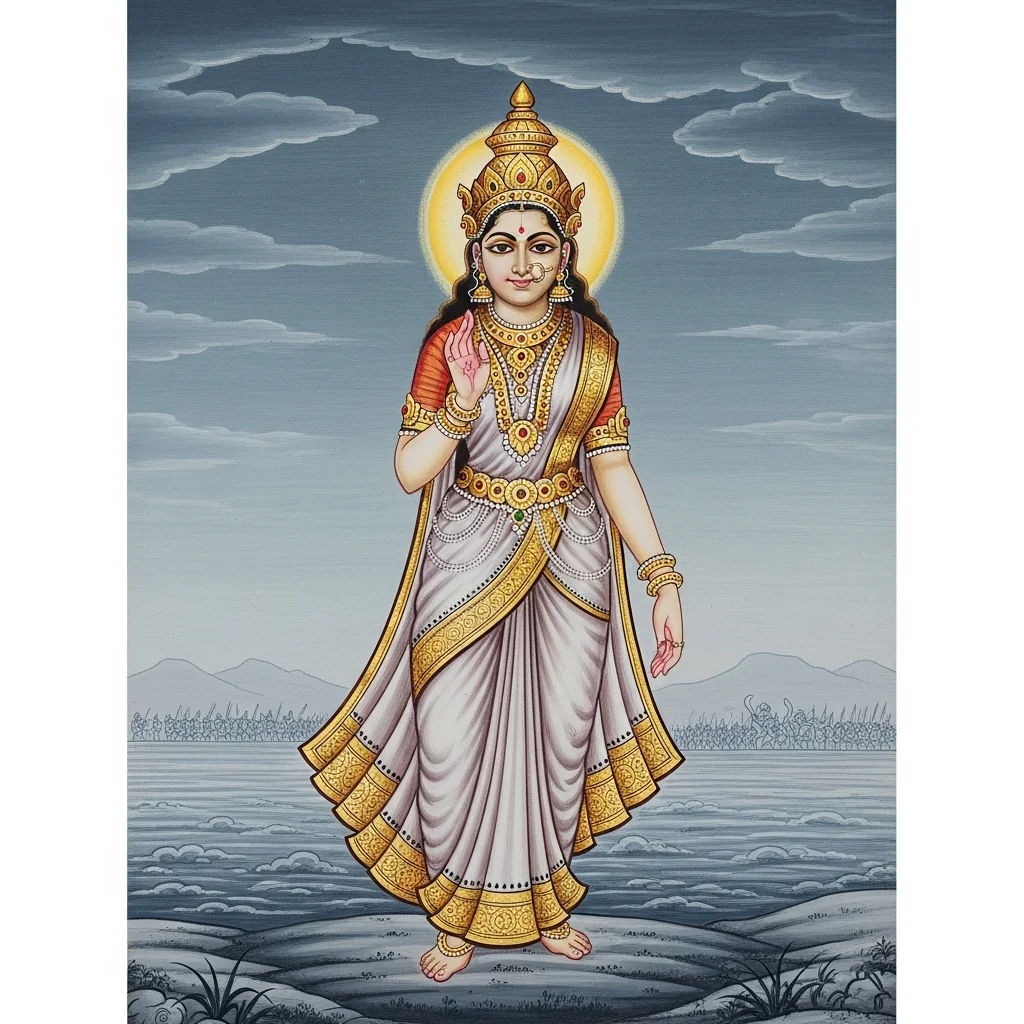
Adhyaya 6
Chapter 6 begins with the ṛṣis questioning Sūta about the exact location and origin of the name Devīpura/Devīpattana, and about the boundary and extent of the revered Cakratīrtha, especially as it relates to the “Setu-root” where pilgrims bathe. Sūta presents the account as a purificatory Purāṇic narrative for readers and listeners, and anchors the sacred geography by recalling Rāma’s first act of laying stones to establish the Setu, placing Devīpura in that same holy vicinity. The narration then turns to a Devī-centered mythic past. Diti, grieving after the deva–asura conflict, commissions her daughter to perform severe tapas to obtain a son who will challenge the devas. The sage Supārśva grants a boon foretelling Mahīṣa—buffalo-faced yet human-bodied—destined to torment Indra and disrupt the celestial order. Mahīṣa grows in might, gathers asura leaders, and wages a prolonged war that drives the devas from their offices, compelling them to seek Brahmā’s intercession. Brahmā approaches Viṣṇu and Śiva; from their wrath and the gathered tejas of many deities a radiant feminine form arises—Durgā—whose limbs are explicitly identified with divine energies. The devas arm and adorn her, and her roar shakes the cosmos. Battle follows: Durgā and her gaṇas confront Mahīṣa’s vast armies and ministers, destroying hosts of asuras with arrows and weapons, while the devas regain courage through her empowering presence. Thus the chapter links a named tīrtha landscape with teaching on the Goddess’s power, cosmic order, and the ritual merit of hearing Purāṇic narration.
Shlokas
Verse 1
ऋषय ऊचुः । द्वैपायनविनेय त्वं सूत पौराणिकोत्तम । देवीपत्तनपर्यंतं चक्रतीर्थमनुत्तमम्
The sages said: O Sūta, disciple of Dvaipāyana, best among the knowers of the Purāṇas—tell us of the unsurpassed Cakratīrtha that extends up to Devīpattana.
Verse 2
इत्यब्रवीः पुरास्माकमतः पृच्छाम किंचन । देवीपुरं हि तत्कुत्र यदन्तं चक्रतीर्थकम्
You spoke thus to us formerly; therefore we ask something: where indeed is that Devīpura, the point at which Cakratīrtha comes to its end?
Verse 3
देवीपत्तन मित्याख्या कथं तस्याभवत्तथा । श्रीरामसेतुमूले च स्नातानां पापिनामपिः
How did it come to be known by the name ‘Devīpattana’? And at the very root of Śrī Rāmasetu, what is the spiritual outcome for those who bathe there—even if they are sinful?
Verse 4
कीदृशं वा भवेत्पुण्यं चक्रतीर्थे तथैव च । एतच्चान्यान्विशे षांश्च ब्रूहि पौराणिकोत्तम
And what kind of merit (puṇya) arises at Cakratīrtha as well? Tell us this, and other particular distinctions too, O best among the knowers of the Purāṇas.
Verse 5
श्रीसूत उवाच । सर्वमेतत्प्रवक्ष्यामि शृणुध्वं मुनिपुंगवाः । पठतां शृण्वतां चैतदाख्यानं पापनाश नम्
Śrī Sūta said: I shall declare all this—listen, O best of sages. This sacred account destroys sins for those who recite it and for those who hear it.
Verse 6
यत्र पाषाणनवकं स्थापयित्वा रघूद्वहः । बबन्ध प्रथमं सेतुं समुद्रे मैथिलीपतिः
There, after setting down the first nine stones, the scion of Raghu—the lord of Maithilī—first bound and built the bridge upon the ocean.
Verse 7
देवीपुरं तु तत्रैव यदन्तं चक्रतीर्थकम् । देवीपत्तनमित्याख्या यथा तस्य समागता
There itself is Devīpura, the point where Cakratīrtha comes to an end. How it came to be known as ‘Devīpattana’, I shall relate.
Verse 8
तद्ब्रवीमि मुनिश्रेष्ठाः शृणुध्वं श्रद्धया सह । पुरा देवासुरे युद्धे देवैर्नाशितपुत्रिणी । दितिः प्रोवाच तनयामात्मनः शोकमोहिता
That I shall tell, O best of sages—listen with faith. Long ago, in the war between devas and asuras, Diti—bereft of her sons by the devas—overwhelmed by her grief and delusion, spoke to her daughter.
Verse 9
दितिरुवाच । याहि पुत्रि तपः कर्तुं तपोवनमनुत्तमम्
Diti said: Go, my daughter, to perform tapas—holy austerities—in the unsurpassed forest of penance, the tapovana.
Verse 10
पुत्रार्थं तव सुश्रोणि नियता नियतेन्द्रिया । इन्द्रादयो न शिष्येरन्येन पुत्रेण वै सुराः
“For the sake of gaining a son, O fair-hipped lady, abide in discipline and self-mastery, with the senses restrained. Truly, by no other son would Indra and the other gods be brought into subjection.”
Verse 11
उदिता तनया चैवं जनन्या तां प्रणम्य सा । स्वीकृत्य माहिषं रूपं वनं पञ्चाग्निमध्यगा
Thus instructed, the daughter bowed to her mother. Assuming the form of a buffalo, she entered the forest and undertook the fierce observance of standing amid the five fires.
Verse 12
तपोऽतप्यत सा घोरं तेन लोकाश्चकंपिरे । तस्यां तपः प्रकुर्वंत्यां त्रिलोक्यासीद्भयातुरा
She performed dreadful austerities, and because of them the worlds trembled. As she continued her tapas, the three worlds became distressed with fear.
Verse 13
इन्द्रादयः सुर गणा मोहमापुर्द्विजोत्तमाः । सुपार्श्वस्तपसा तस्या मुनिः क्षुब्धोऽवदत्तु ताम्
Indra and the hosts of gods fell into bewilderment, O best of the twice-born. The sage Supārśva, disturbed by her austerity, then spoke to her.
Verse 14
सुपार्श्व उवाच । परितुष्टोऽस्मि सुश्रोणि पुत्रस्तव भविष्यति । मुखेन महिषाकारो वपुषा नररूपवान्
Supārśva said: “I am pleased with you, O fair-hipped one. A son shall be born to you—buffalo-faced in countenance, yet in body bearing a man’s form.”
Verse 15
महिषो नामपुत्रस्ते भविष्यत्यतिवीर्यवान् । पीडयिष्यति यः स्वर्गं देवेन्द्रं च ससैनिकम्
“Your son will be named Mahiṣa, endowed with extraordinary might. He will oppress heaven itself, and even Indra together with his armies.”
Verse 16
सुपार्श्वस्त्वेवमुक्त्वा तां विनिवार्य तपस्तथा । आगच्छदात्मनो लोकमनुनीय तपस्विनीम्
Having spoken thus, Supārśva restrained her from continuing that austerity. Appeasing the ascetic woman, he departed to his own abode.
Verse 17
अथ जज्ञे स महिषो यथोक्तं ब्रह्मणा पुरा । व्यवर्द्धत महावीर्यः पर्वणीव महोदधिः
Then Mahiṣa was born, just as Brahmā had foretold earlier. Endowed with great prowess, he grew and swelled like the ocean at the time of the full tide.
Verse 18
ततः पुत्रो विप्रचित्तेर्विद्युन्माल्यसुराग्रणीः । अन्येऽप्यसुरवर्यास्ते संति ये भूतले द्विजाः
Then Vidyunmālī, the foremost among the asuras and son of Vipracitti, came forth, along with other eminent asuras who were upon the earth, O twice-born.
Verse 19
ते सर्वे महिषस्यास्य श्रुत्वा दत्तवरं मुदा । समागम्य मुनिश्रेष्ठाः प्रावदन्महिषासुरम्
Hearing with delight that a boon had been granted to this Mahiṣa, they all assembled together and addressed Mahiṣāsura with words of acclaim.
Verse 20
स्वर्गाधिपत्यमस्माकं पूर्व मसीन्महामते । देवैर्विष्णुं समाश्रित्य राज्यं नो हृतमोजसा
O great-minded one, sovereignty over heaven once belonged to us. But the gods, taking refuge in Viṣṇu, have forcefully seized our kingdom by their might.
Verse 21
तद्राज्यमानय वलादस्माकं महिषासुर । वीर्यं प्रकटयस्वाद्य प्रभावमपि चात्मनः
Therefore, O Mahiṣāsura, bring back that kingdom for us by force. Reveal today your valor—and also the full measure of your own power and splendor.
Verse 22
अतुल्यबलवीर्यस्त्वं ब्रह्मदत्तवरोद्धतः । पुलोमजापतिं युद्धे जहि देवगणैः सह
You possess incomparable strength and valor, and are made proud by the boon granted by Brahmā. In battle, slay the lord of Pulomajā (Indra), along with the hosts of gods.
Verse 23
दनुजैरेवमुक्तोऽसौ योद्धुकामोऽमरैः सह । महा वीर्योऽथ महिषः प्रययावमरावतीम्
Thus addressed by the Danujas, that mighty Mahiṣa—eager to fight the immortals—set out for Amarāvatī.
Verse 24
देवानामसुराणां च संवत्सरशतं रणम् । पुरा बभूव विप्रेंद्रास्तुमुलं रोमहर्षणम्
O best of brahmins, in ancient times the battle between gods and asuras raged for a hundred years—tumultuous and hair-raising.
Verse 25
देववृन्दं ततो भी त्या पुरस्कृत्य पुरन्दरम् । कांदिशीकमभूद्विप्रा ब्रह्माणं च ययौ तदा
Then, O brahmins, the host of gods—out of fear, placing Purandara (Indra) at their head—became distressed and went at once to Brahmā.
Verse 26
ब्रह्मा तानमरासर्वान्समादाय ययौ पुनः । नारायणशिवौ यत्र वर्तेते विश्वपालकौ
Brahmā gathered all those gods and went again to the place where Nārāyaṇa and Śiva abide—the two guardians of the universe.
Verse 27
तत्र गत्वा नमस्कृत्य स्तुत्वा स्तोत्रैरनेकशः । ब्रह्मा निवेदयामास महिषासुरचेष्टितम्
Having gone there, Brahmā bowed down and praised them repeatedly with many hymns, and then reported the deeds and aggression of Mahiṣāsura.
Verse 28
सुराणामसुरैः पीडां देवयोः शंभुकृष्णयोः । इंद्राग्नियमसूर्येंदुकुबेरवरुणादिकान्
He described the oppression of the gods by the asuras, and how the deities under Śambhu and Kṛṣṇa—Indra, Agni, Yama, Sūrya, the Moon, Kubera, Varuṇa, and others—were driven from their offices.
Verse 29
निराकृत्याधिकारेषु तेषां तिष्ठत्ययं स्वयम् । अन्येषां देववृंदानामधिकारेपि तिष्ठति
Having cast them out from their rightful offices, he himself stands established in those powers; and he likewise occupies the offices of other assemblies of gods as well.
Verse 30
निरस्तं देववृंदं तत्स्वर्लोकादवनीतले । मनुष्यवद्विचरते महिषासुरबाधितम्
Driven out, that host of gods fell from heaven onto the earth; and, harassed by the demon Mahiṣāsura, they wandered about like mere mortals.
Verse 31
एतज्ज्ञापयितुं देवौ युवयोरहमागतः । सार्द्धं देव गणैरत्र रक्षतं तान्समागतान्
“O two gods, I have come to inform you of this. Together with the companies of the gods who have assembled here, protect those who have come.”
Verse 32
ब्रह्मणो वचनं श्रुत्वा रमेश्वरमहेश्वरौ । कोपात्करालवदनौ दुष्प्रेक्ष्यौ तौ बभूवतुः
Hearing Brahmā’s words, Rameśvara and Maheśvara blazed with fury; their faces grew fearsome, dreadful to behold.
Verse 33
अत्यन्तकोपज्वलितान्मुखाद्विष्णोरथ द्विजाः । निश्चक्राम महत्तेजः शंभोः स्रष्टुस्तथैव च
O brāhmaṇas, from Viṣṇu’s face, blazing with intense wrath, there issued a mighty radiance; likewise from Śambhu and from the Creator, Brahmā.
Verse 34
अपरेषां सुराणां च देहादिंद्रशरीरतः । तेजः समुदभूत्क्रूरं तदेकं समजायत
From the bodies of the other gods—and from Indra’s own body as well—there arose a fierce radiance; and that radiance became one single mass.
Verse 35
तेषां तु तेजसां राशिर्ज्वलत्पर्वतसंनिभः । ददृशे देववृंदैस्तैर्ज्वालाव्याप्तदिगंतरः
That mass of their radiances appeared like a blazing mountain; the hosts of gods beheld it, its flames filling the spaces between all directions.
Verse 36
तेजसां समुदायोऽसौ नारी काचि दभूत्तदा । शिवतेजो मुखमभूद्विष्णुतेजो भुजौ द्विजाः
That gathered host of radiances then became a certain woman. Śiva’s radiance became her face, and Viṣṇu’s radiance her arms, O brāhmaṇas.
Verse 37
ब्रह्मतेजस्तु चरणौ मध्यमैंद्रेण तेजसा । यमस्य तेजसा केशाः कुचौ चंद्रस्य तेजसा
Brahmā’s radiance became her feet; by Indra’s radiance her waist was formed. By Yama’s radiance her hair came to be, and by the Moon’s radiance her breasts.
Verse 38
जंघोरू कल्पितौ विप्रा वरुणस्य तु तेजसा । नितंबः पृथिवीतेजः पादांगुल्योऽर्कतेजसा
O brāhmaṇas, by Varuṇa’s radiance her shanks and thighs were fashioned. Her hips were formed from the Earth’s radiance, and her toes from the Sun’s radiance.
Verse 39
करांगुल्यो वसूनां च तेजसा कल्पितास्तथा । कुबेरतेजसा विप्रा नासिकापरिकल्पिता
Likewise, her fingers were fashioned from the radiance of the Vasus; and, O brāhmaṇas, her nose was formed from Kubera’s radiance.
Verse 40
नवप्रजापतीनां च तेजसा दंतपंक्तयः । चक्षुर्द्वयं समजनि हव्यवाहनतेजसा
From the radiance of the nine Prajāpatis her rows of teeth were formed; and from the blazing splendour of Havyavāhana (Agni) her pair of eyes came into being.
Verse 41
उभे संध्ये भ्रुवौ जाते श्रवणे वायुतेजसा । इतरेषां च देवानां तेजोभिरतिदारुणैः
Her two twilight-junctions became her eyebrows, and by the brilliance of Vāyu her ears were formed; and by the exceedingly formidable energies of the other gods the rest of her features were produced.
Verse 42
कृतान्यावयवा नारी दुर्गा परमभास्वरा । बभूव दुर्धर्षतरा सर्वैरपि सुरासुरैः
Thus formed in all her limbs, that Woman—Durgā, supremely radiant—became utterly unassailable even to all the gods and demons alike.
Verse 43
सर्ववृंदारकानीकतेजःसंघसमुद्भवा । तां दृष्ट्वा प्रीतिमापुस्ते देवा महिषबाधिताः
Born from the collected splendour of all the hosts of the gods, on seeing her those devas—harassed by Mahisha, the Buffalo-demon—were filled with joy.
Verse 44
ततो रुद्रा दयो देवा विनिष्कृष्यायुधान्निजात् । आयुधानि ददुस्तस्यै शूलादीनि द्विजोत्तमाः
Then the Rudras and the other gods, drawing forth their own weapons, bestowed those weapons upon her—tridents and the rest, O best of the twice-born.
Verse 45
भूषणानि ददुस्तस्यै वस्त्रमाल्यानि चंदनम् । सापि देवी तदा वस्त्रैर्भूषणैश्चंदनादिभिः
They gave her ornaments, garments, garlands, and sandal paste; and the Goddess then, with garments, ornaments, sandal and the like, stood forth beautifully adorned.
Verse 46
कुसुमैरायुधैर्हारैर्भूषिता परिचारकैः । साट्टहासं प्रमुंचंती भैरवी भैरवस्वना
Adorned by her attendants with flowers, weapons, and necklaces, Bhairavī—whose sound was like Bhairava’s—burst forth into loud, ringing laughter.
Verse 47
ननाद कंपयतीव रोदसी देवसेविता । देव्या भैरवनादेन चचाल सकलं जगत्
Worshipped by the gods, she roared as though shaking heaven and earth; by the Goddess’s Bhairava-like roar the entire world trembled.
Verse 49
सिंहवाहनमारूढां देवीं ताममरास्तदा । मुनयः सिद्धगंधर्वास्तुष्टुवुर्जयश ब्दतः
Then the immortals beheld that Goddess mounted upon a lion; sages, Siddhas, and Gandharvas praised her with cries of “Victory!”
Verse 50
महिषोऽपि महाक्रोधात्समुद्यत महायुधः । तं शब्दमवलक्ष्याथ ययावसुरसंवृतः
Mahiṣa too, in great fury, raised his mighty weapons; noticing that sound, he advanced, surrounded by the asuras.
Verse 51
व्यलोकयत्ततो देवीं तेजोव्याप्तजगत्त्रयीम् । सायुधानंतबाह्वाढयां नादकंपितभूतलाम्
Then he beheld the Goddess, whose radiance pervaded the three worlds—armed and endowed with countless mighty arms—whose roaring sound made the very earth tremble.
Verse 52
क्षोभिताशेषशेषादिमहानागपरंपराम् । विलोक्य देवीमसुराः समनह्यन्नुदायुधाः
Seeing the Goddess—whose presence stirred even the endless line of great Nāgas beginning with Śeṣa—the Asuras armed themselves and prepared for combat.
Verse 53
ततो देव्या तया सार्द्धमसुराणामभूद्रणः । अस्त्रैः शस्त्रैः शरैश्चक्रैर्गदाभिर्मुसलैरपि
Then a battle arose between the Asuras and that Goddess—fought with missiles and weapons, with arrows, discus-weapons, maces, and clubs as well.
Verse 54
गजाश्वरथपादातैरसंख्येयैर्महावलः । महिषो युयुधे तत्र देव्या साकमरिंदमः
There Mahiṣa, the great and formidable one, fought against the Goddess amid innumerable troops of elephants, horses, chariots, and foot-soldiers—an enemy-crusher in battle.
Verse 55
लक्षको टिसहस्राणि प्रधानासुरयूथपाः । एकैकस्य तु सेनायास्तेषां संख्या न विद्यते
The chief leaders of the Asura hordes numbered in hundreds of thousands, in crores, and in thousands; yet the size of each one’s army was beyond counting.
Verse 56
ते सर्वे युगपद्देवीं शस्त्रैरावव्रुरोजसा । सापि देवी ततो भीमा दैत्यमुक्तास्त्रसंचयम्
All of them at once surrounded the Goddess with weapons, with fierce force. But that terrible Goddess then faced and shattered the mass of missiles released by the Daityas.
Verse 57
बिभेद लीलया बाणैः स्वकार्मुकविनिःसृतैः । ससर्ज दैत्यकायेषु बाणपूगान्यनेकशः
With arrows released from her own bow, she pierced them playfully; and again and again she sent forth volleys of arrows into the bodies of the Daityas.
Verse 58
देव्याश्रयबला द्देवा निर्भया दैत्ययूथपैः । युयुधुः संयुगे शस्त्रैरस्त्रैरप्यायुधांतरैः
Supported by the Goddess and strengthened by taking refuge in her, the Devas fought fearlessly in the battle against the leaders of the Daitya hordes—using weapons, missiles (astras), and other instruments of war.
Verse 59
ततो देवा बलोत्सिक्ता देवीशक्त्युपबृंहिताः । निःशेषमसुरान्सर्वानायु धैर्निरमूलयन्
Then the Devas, exulting in strength and invigorated by the Goddess’s power, uprooted all the Asuras without remainder by their weapons.
Verse 60
स्वसैन्ये तु क्षयं याते संक्षुब्धो महिषासुरः । चापमादाय वेगेन विकृष्य च महास्वनम्
When his own army had been destroyed, Mahiṣāsura became enraged; seizing his bow, he swiftly drew it back, producing a mighty, resounding twang.
Verse 61
संधाय मुमुचे बाणान्देव सैन्येषु भूसुराः । इंद्रे तु दशसाहस्रं यमे पंचसहस्रकम्
Having fixed their aim, the brahmin-born warriors loosed volleys of arrows into the host of the Devas—ten thousand at Indra, and five thousand at Yama.
Verse 62
वरुणे चाष्टसाहस्रं कुबेरे षट्सहस्रकम् । सूर्ये चंद्रे च वह्नौ च वायौ वसुषु चाश्विनोः
Eight thousand were aimed at Varuṇa, and six thousand at Kubera; and volleys were also shot at Sūrya, at Candra, at Agni, at Vāyu, at the Vasus, and at the Aśvins.
Verse 63
अन्येष्वपि च देवेषु महिषो दानवेश्वरः । प्रत्येकमयुतं बाणान्मुमुचे बलिनां वरः
And against the other gods as well, Mahiṣa—the lord of the Dānavas—released ten thousand arrows at each, he being the foremost among the mighty.
Verse 64
पलायंते ततो देवा महिषासुरमर्द्दिताः । देवीं शरणमाजग्मुस्त्राहित्राहीतिवादिनः
Then the gods, crushed by Mahiṣāsura, fled away and came to the Devī for refuge, crying, “Save us! Save us!”
Verse 65
ततो देवी गणान्स्वस्य भूतवेतालकादिकान् । यूयं नाशयत क्षिप्रमासुरं बलमित्यशात्
Then the Devī commanded her own hosts—bhūtas, vetālas, and the rest: “You all, quickly destroy the army of the asuras!”
Verse 66
अहं तु महिषं युद्धे योधयामि वलोद्धतम् । ततो देव्या गणैः सर्वमासुरं क्षतमाशु वै
“But I shall fight Mahiṣa in battle, swollen with strength.” Then indeed, by the Devī’s hosts, the entire asuric force was swiftly cut down.
Verse 67
ततः सैन्यं क्षयं नीते गणै र्देवीप्रचोदितैः । योद्धुकामः स महिषो गणैः साकं व्यतिष्ठत
Then, when the army had been brought to destruction by the hosts urged on by the Devī, that Mahiṣa—eager to fight—stood facing the hosts.
Verse 68
अत्रांतरे महानादः सुचक्षुश्च महाहनुः । महाचंडो महाभक्षो महोदरम होत्कटौ
In the meantime there appeared Mahānāda, and Sucakṣu, and Mahāhanu; and also Mahācaṇḍa, Mahābhakṣa, and the fearsome pair Mahodara and Mahotkaṭa.
Verse 69
पञ्चास्यः पादचूडश्च बहुनेत्रः प्रबाहुकः । एकाक्षस्त्वेकपादश्च बहुपादोऽप्यपादकः
There were Pañcāsya and Pādacūḍa; Bahunetra and Prabāhuka; Ekākṣa and Ekapāda; and also Bahupāda and even Apādaka.
Verse 70
एते चान्ये च बहवो महिषासुर मंत्रिणः । योद्धुकामा रणे देव्याः पुरतस्त्ववतस्थिरे
These, and many others besides—ministers of Mahiṣāsura—desiring to fight, took their stand in battle before the Devī.
Verse 71
सिंहं वाहनमारुह्य ततो देवी मनोजवम् । प्रलयांबुदनिर्घोषं चापमादाय भैरवम्
Then the Goddess, mounting her lion—swift as thought—took up her dreadful bow, whose roar was like the thunder of clouds at the time of dissolution.
Verse 72
विस्फोट्य मुमुचे बाणान्वज्रवेगसमान्युधि । दशलक्षगजैश्चापि शतलक्षैश्च वाजिभिः
In battle she loosed her arrows with a crack, swift as the rush of a thunderbolt—against forces with ten million elephants and a hundred million horses.
Verse 73
शतलक्षै रथैश्चापि लक्षायुतपदातिभिः । युक्तो महाहनुर्दैत्यो देव्या युधि निपातितः
Though supported by a hundred million chariots and by infantry numbering in the tens of millions, the demon Mahāhanu was struck down by the Goddess in battle.
Verse 74
सैन्ये च तस्य निहता देव्या बाणैर्द्विजोत्तमाः । लक्षकोटिसहस्राणि प्रधानासुरनायकाः
And in his army, O best of twice-born ones, countless chief leaders of the asuras—by the Goddess’ arrows—were slain, in numbers of lakhs, crores, and thousands.
Verse 75
महिषस्य हि विद्यन्ते महाबलपराक्रमाः । एकैकस्य प्रधानस्य चतुरङ्गबलं तथा
For Mahīṣa indeed had commanders of immense strength and prowess; and each principal leader likewise possessed a full fourfold army.
Verse 76
महाहनोर्यथा विप्रास्तथैवास्ति महद्बलम् । तत्सर्वं निहतं देव्या शरैः कांचनपुंखितैः
Just as with Mahāhanu, O brāhmaṇas, so too a great might was arrayed against Her; yet all of it was slain by the Goddess with arrows fitted with golden fletching.
Verse 77
याममात्रेण विप्रेंद्रास्तदद्भुतमिवाभवत्
Within merely a yāma, O foremost of brāhmaṇas, it became as though a wonder had occurred.