Adhyaya 48
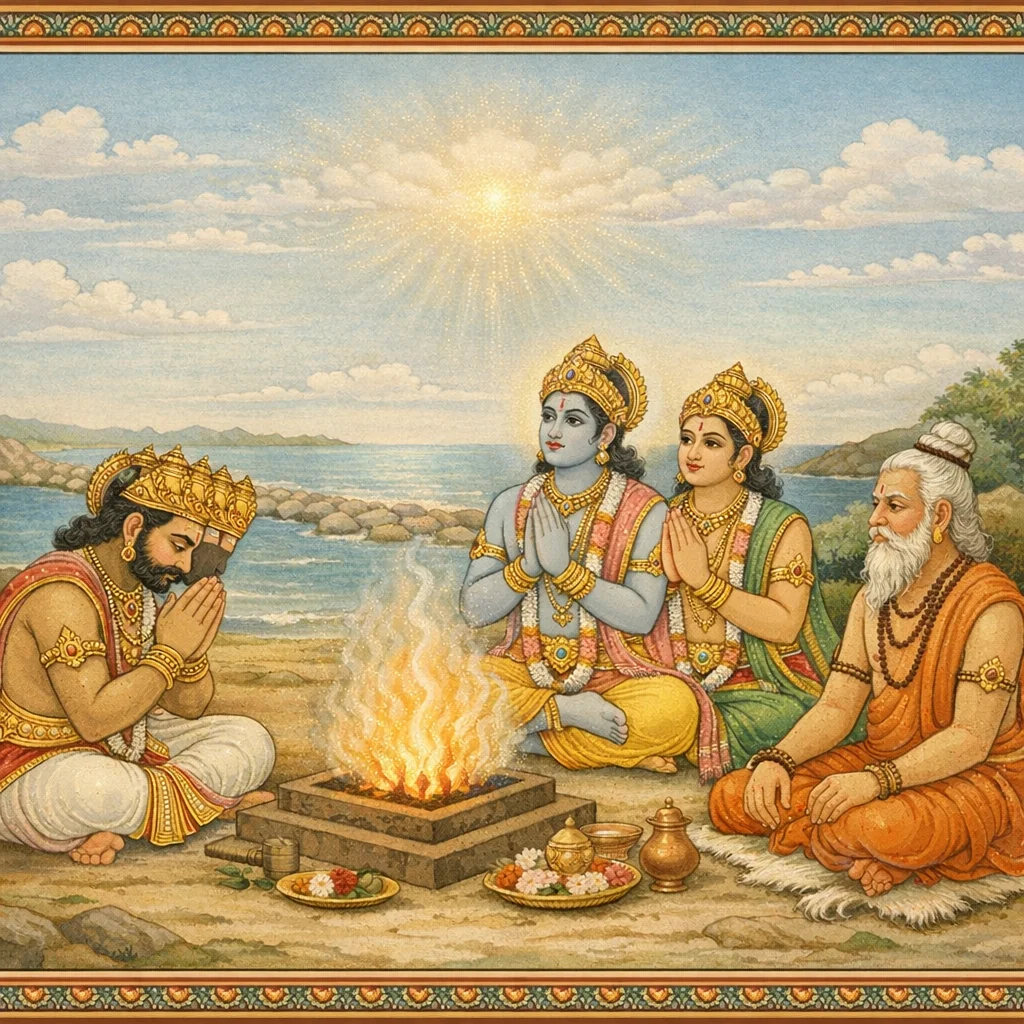
Sūta relates to the sages a place-centered moral account. Śaṅkara, a Pāṇḍya king learned in the Vedas and diligent in rites, enters a perilous forest on a hunt and, mistaking a tranquil ascetic for a wild beast, kills the muni; he then kills the muni’s wife as well, compounding grave sin—brahmahatyā and strī-hatyā. Their son laments, and the gathered sages console him with teaching on mortality, karmic causality, and the non-dual Brahman of the Upaniṣads. They also prescribe practical duties: gather the bones, perform śrāddha and related rites, and enshrine the remains at Rāmanātha’s field near Rāmasetu for purification. The son (Jāṅgala, Śākalya’s son) completes the rites and later receives a dream-vision of his parents in a Viṣṇu-like form, indicating their auspicious post-mortem state. The sages condemn the king and demand self-immolation as expiation; but an incorporeal voice stops him and gives a structured prāyaścitta instead: for one year, disciplined thrice-daily devotion to the Rāma-established liṅga, Rāmanātha—circumambulation, prostration, daily abhiṣeka with ghee, milk, and honey, offerings of naivedya and payasa, and lamp worship with sesame oil. The text declares that such service dissolves even major transgressions, and that attentive hearing and recitation purify and lead to Rāmanātha; the king follows the regimen, regains stable kingship, and rules prosperously.
Shlokas
Verse 1
श्रीसूत उवाच । रामनाथं समुद्दिश्य कथां पापविनाशिनीम् । प्रवक्ष्यामि मुनिश्रेष्ठाः शृणुध्वं सुसमाहिताः
Śrī Sūta said: “With Rāmanātha as the theme, I shall narrate an account that destroys sin. O best of sages, listen with full concentration.”
Verse 2
पांड्यदेशाधिपो राजा पुरासीच्छंकराभिधः । ब्रह्मण्यः सत्यसंधश्च यायजूकश्च धार्मिकः
Formerly there was a king, ruler of the Pāṇḍya land, named Śaṅkara—devoted to brāhmaṇas, true to his vows, a patron of yajñas, and righteous.
Verse 3
वेदवेदांगतत्त्वज्ञः परसैन्यविदारणः । चतुरोऽप्याश्रमान्वर्णान्धर्मतः परिपालयन्
He knew the true purport of the Vedas and Vedāṅgas, shattered hostile armies, and—according to dharma—protected the four āśramas and the varṇas.
Verse 4
वैदिकाचारनिरतः पुराणस्मृतिपारगः । शिवविष्ण्वर्चको नित्यमन्यदैवतपूजकः
He was devoted to Vedic conduct, well-versed in the Purāṇas and Smṛtis, a constant worshipper of Śiva and Viṣṇu, and one who also honored other deities.
Verse 5
महादानप्रदो नित्यं ब्राह्मणानां महात्मनाम् । मृगयार्थं ययौ धीमान्स कदाचित्तपोवनम्
Ever a bestower of great gifts upon noble brāhmaṇas, those great-souled ones, the wise king once set out for the hunt and went to a forest of austerities.
Verse 6
सिंहव्याघ्रेभमहिष क्रूरसत्वभयंकरम् । झिल्लिकाभीषणरवं सरीसृपसमाकुलम्
It was a dreadful region, terrifying with lions, tigers, elephants, and wild buffalo—made fearsome by savage beasts—resounding with the ominous chirring of crickets and swarming with crawling reptiles.
Verse 7
भीमश्वापदसंपूर्णं दावानलभयंकरम् । महारण्यं प्रविश्याथ शंकरो राजशेखरः
That vast forest was filled with dreadful beasts of prey and made terrifying by the threat of wildfire. Then Śaṅkara, the crest-jewel among kings, entered that great wilderness.
Verse 8
अनेकसैनिकोपेत आखेटिकुलसंकुलः । पादुकागूढचरणो रक्तोष्णीषो हरिच्छदः
He was accompanied by many soldiers and surrounded by families of hunters; his feet were covered with sandals, he wore a red turban, and his garment was green.
Verse 9
बद्धगोधांगुलित्राणो धृतकोदण्डसायकः । कक्ष्याबद्धमहाखङ्गः श्वेताश्ववरमास्थितः
He wore finger-guards fastened with iguana-leather, carried a bow and arrows, had a great sword strapped at his waist, and was mounted upon an excellent white horse.
Verse 10
सुवेषधारी सन्नद्धः पत्तिसंघसमावृतः । कांतारेषु च सर्वेषु पर्वतेषु गुहासु च
Well-adorned and fully armed, surrounded by companies of foot-soldiers, he moved through every wild tract—over mountains and into caves as well.
Verse 11
समुत्तीर्ण महास्रोता युवा सिंहपराक्रमः । विचचार बलैः साकं दरीषु मृगयन्मृगान्
Having crossed a great torrent, the young man—lion-like in valor—roamed with his forces, hunting animals in the ravines.
Verse 12
बध्यतां वध्यतामेष याति वेगान्मृगो वने । एवं वदत्सु सैन्येषु स्वयमुत्प्लुत्य शंकरः
“Catch it! Kill it! The deer is fleeing swiftly into the forest!”—as the soldiers shouted thus, Śaṅkara himself leapt forward.
Verse 13
मृगं हंति महाराजो विगाह्य विपिनस्थलीम् । सिंहान्वराहान्महिषान्कुञ्जराच्छरभांस्तथा
Plunging into the forest-ground, the great king struck down deer—and also lions, boars, buffalo, elephants, and even śarabhas as well.
Verse 14
विनिघ्नन्स मृगानन्यान्वन्याञ्छंकरभूपतिः । कुत्रचिद्विपिनोद्देशे दरीमध्यनिवासिनम्
Thus, as Śaṅkara the king kept slaying other beasts of the wild, in a certain part of the forest he came upon one who dwelt in the midst of a ravine.
Verse 15
व्याघ्रचर्मधरं शांतं मुनिं नियतमानसम् । व्याघ्रबुद्ध्या जघानाशु शरेणानतपर्वणा
He saw a tranquil sage, self-restrained in mind, clad in a tiger-skin; yet, mistaking him for a tiger, he swiftly struck him with an arrow whose joints were unbent and straight.
Verse 16
अतिवेगेन विप्रेंद्रास्तत्पत्नीं च ससायकः । निजघान पतिप्राणां निविष्टां पत्युरंतिके
O best of brāhmaṇas, in great haste the archer struck down the sage’s wife as well—she whose life clung to her lord’s very breath, seated close beside her husband.
Verse 17
विलोक्य मातापितरौ तत्पुत्रो निहतौ वने । रुरोद भृशदुःखार्तो विललाप च कातरः
Seeing his mother and father slain in the forest, their son wept aloud—overwhelmed by intense sorrow—and lamented in helpless anguish.
Verse 18
भोस्तात मातर्मां हित्वा युवां यातौ क्व वाधुना । अहं कुत्र गमिष्यामि को वा मे शरणं भवेत्
“O father! O mother! Leaving me behind, where have you gone now? Where shall I go, and who indeed will become my refuge?”
Verse 19
को मामध्यापयेद्वेदाञ्छास्त्रं वा पाठयेत्पितः । अंब मे भोजनं का वा दास्यते सोपदेशकम्
“Who will teach me the Vedas, or instruct me in the śāstras, O father? And who, O mother, will give me food—together with guidance and counsel?”
Verse 20
आचाराञ्च्छिक्षयेत्को वा तात त्वयि मृतेऽधुना । अंब बालं प्रकुपितं का वा मामुपलाप येत्
“Who will train me in right conduct now that you are dead, O father? And, O mother, when I—still a child—am angered, who will gently correct and counsel me?”
Verse 21
युवां निरागसावद्य केन पापेन सायकैः । निहतौ वै तपोनिष्ठौ मत्प्राणौ मद्गुरू वने
“You two were faultless and free from blame—by what sin were you slain with arrows? You were devoted to austerity, my very life-breath, my teachers—there in the forest.”
Verse 22
एवं तयोः सुतो विप्रा मुक्तकण्ठं रुरोद वै । अथ प्रलपितं श्रुत्वा शंकरो विपिने चरन्
Thus, O brāhmaṇas, their son wept with unrestrained voice. Then Śaṅkara, wandering in the forest, heard his lamentation.
Verse 23
तच्छब्दाभिमुखः सद्यः प्रययौ स दरीमुखम् । तत्रत्या मुनयोऽप्याशु समागच्छंस्तमाश्रमम्
Turning at once toward that sound, he hurried to the mouth of the cave. The sages dwelling there, too, quickly gathered at that hermitage.
Verse 24
ते दृष्ट्वा मुनयः सर्वे शरेण निहतं मुनिम् । तत्पत्नीं च हतां विप्रा राजानं च धनुर्धरम्
All those sages, seeing the ascetic slain by an arrow—and his wife also killed—beheld as well the king, the bow-bearing man, standing there.
Verse 25
विलपंतं सुतं चापि विलोक्य भृशविह्वलाः । पुत्रमाश्वासयामासुर्मा रोदीरिति कातरम्
Seeing the son lamenting, the sages—greatly shaken—comforted the distressed child, saying, “Do not weep.”
Verse 26
मुनय ऊचुः । आढ्ये वापि दरिद्रे वा मूर्खे वा पंडितेऽपि वा । पीने वाथ कृशे वापि समवर्ती परेतराट्
The sages said: Whether one is wealthy or poor, foolish or learned, stout or emaciated—King Yama, the ruler of the departed, deals with all in the same way.
Verse 27
वने वा नगरे ग्रामे पर्वते वा स्थलांतरे । मृत्योर्वशे प्रयातव्यं सर्वैरपि हि जंतुभिः
Whether in a forest, a city, a village, a mountain, or any other place—every creature must inevitably go under the dominion of death.
Verse 28
वत्स नित्यं च गर्भस्थैर्जातैरपि च जंतुभिः । युवभिः स्थविरैः सर्वैर्यातव्यं यमपत्तनम्
Dear child, constantly—by beings still in the womb, by those already born, by the young and by the old—everyone must go to Yama’s city.
Verse 29
वर्णिभिश्च गृहस्थैश्च वानप्रस्थैश्च भिक्षुभिः । काले प्राप्ते त्वयं देहस्त्यक्तव्यो द्विजपुत्रक
By students of sacred discipline, householders, forest-dwellers, and renunciants alike—when the appointed time arrives, this body must be abandoned, O son of a brāhmaṇa.
Verse 30
ब्राह्मणैः क्षत्रियैर्वैश्यैः शूद्रैरपि च संकरैः । यातव्यं प्रेतनिलये द्विजपुत्र महामते
By brāhmaṇas, kṣatriyas, vaiśyas, śūdras, and those of mixed orders as well—one must go to the abode of the departed, O wise son of a brāhmaṇa.
Verse 31
देवाश्च मुनयो यक्षा गंधर्वोरगराक्षसाः । अन्ये च जंतवः सर्वे ब्रह्मविष्णुहरादयः
Gods, sages, yakṣas, gandharvas, nāgas, and rākṣasas—and all other beings too, including Brahmā, Viṣṇu, and Hara (Śiva) and the rest—
Verse 32
सर्वे यास्यंति विलयं न त्वं शोचितुमर्हसि । अद्वयं सच्चिदानंदं यद्ब्रह्मोपनिषद्गतम्
All will pass into dissolution; you ought not to grieve. For that Brahman taught in the Upaniṣads is non-dual—Existence, Consciousness, and Bliss.
Verse 33
न तस्य विलयो जन्म वर्धनं चापि सत्तम । मलभांडे नवद्वारे पूयासृक्छोणितालये
For That (Brahman) there is no dissolution, no birth, and no growth either, O best of beings. (But) in this foul vessel with nine gates—an abode of pus, blood, and gore—
Verse 34
देहेऽस्मिन्बुद्बुदाकारे कृमियूथसमाकुले । कामक्रोधभयद्रोहमोहमात्सर्यकारिणि
—in this body, bubble-like in nature, swarming with hosts of worms, producing lust, anger, fear, malice, delusion, and envy—
Verse 35
परदारपरक्षेत्रपरद्रव्यैकलोलुपे । हिंसासूयाशुचिव्याप्ते विष्ठामूत्रैकभाजने
—greedy only for others’ wives, others’ lands, and others’ wealth; pervaded by violence, envy, and impurity; a mere vessel of feces and urine—
Verse 36
यः कुर्याच्छोभनधियं स मूढः स च दुर्मतिः । बहुच्छिद्रघटाकारे देहेऽस्मिन्नशुचौ सदा
Whoever imagines this body to be fine and admirable is truly deluded and of perverse understanding; for this body is ever impure, like a pot riddled with many holes.
Verse 37
वायोरवस्थितिः किं स्यात्प्राणाख्यस्य चिरं द्विज । अतो मा कुरु शोकं त्वं जननीं पितरं प्रति
How long can the vital breath called prāṇa remain steady, O twice-born one? Therefore, do not grieve for your mother and father.
Verse 38
तौ स्वकर्मवशाद्यातौ गृहं त्यक्त्वा त्विदं क्वचित् । तव कर्मवशात्त्वं च तिष्ठस्यस्मिन्महीतले
Those two (your parents), driven by their own karma, have departed—leaving the home and going elsewhere. And you too, driven by your karma, remain here upon the earth.
Verse 39
यदा कर्मक्षयस्ते स्यात्तदा त्वं च मरिष्यसि । मरिष्यमाणप्रेतो हि मृतप्रेतस्य शोचति
When your store of karma is exhausted, then you too will die. Indeed, one who is himself bound for death laments another who has already become a departed spirit.
Verse 40
यस्मिन्काले समुत्पन्नौ तव माता पिता तथा । न तस्मिंस्त्वं समुत्पन्नस्ततो भिन्ना गतिर्हि वः
At the time when your mother and father were born, you were not born then; therefore, your paths and destinies are indeed distinct.
Verse 41
यदि तुल्या गतिस्ते स्यात्ताभ्यां सह महामते । तर्हि त्वयापि यातव्यं मृतौ यत्र हि तौ गतौ
If your destiny were truly the same as theirs, O great-minded one, then you too should have gone at death to where they have gone.
Verse 42
मृतानां बांधवा ये तु मुंचंत्यश्रूणि भूतले । पिबंत्यश्रूणि तान्यद्धा मृताः प्रेताः परत्र वै
Those relatives who shed tears upon the ground for the dead—those very tears are indeed drunk by the departed spirits in the other world.
Verse 43
अतः शोकं परित्यज्य धृतिं कृत्वा समाहितः । अनयोः प्रेतकार्याणि कुरु त्वं वैदिकानि तु
Therefore, abandoning grief, becoming steady and composed, perform for these two the Vedic rites due to the departed (preta-kāryas).
Verse 44
शरघातान्मृतावेतौ यस्मात्ते जननी पिता । अतस्तद्दोषशांत्यर्थमस्थीन्यादाय वै तयोः
Since your mother and father have died from the blow of arrows, therefore, to pacify the fault connected with such a death, take up their bones.
Verse 45
रामनाथशिवक्षेत्रे रामसेतौ विमुक्तिदे । स्थापयस्व तथा श्राद्धं सपिंडीकरणादिकम्
In Rāmanātha’s Śiva-kṣetra, at Rāmasetu—the giver of liberation—establish and perform the śrāddha, including the rites beginning with sapiṇḍīkaraṇa.
Verse 46
तत्रैव कुरु शुद्ध्यर्थं तयोर्बाह्मणपुत्रक । तेन दुर्मृत्युदोषस्य शांतिर्भवति नान्यथा
Right there itself, O son of a brāhmaṇa, perform the purificatory rite for those two; by that alone the taint of an inauspicious death (durmṛtyu-doṣa) is pacified—there is no other way.
Verse 47
श्रीसूत उवाच । एवमुक्तः स मुनिभिः शाकल्यस्य सुतो द्विजाः । जांगलाख्यस्तयोः सर्वं पितृमेधं चकार वै
Śrī Sūta said: Thus instructed by the sages, O twice-born ones, Jāṃgala—son of Śākalya—indeed performed for those two the entire pitṛmedha, the full set of ancestral rites.
Verse 48
अन्येद्युरस्थीन्यादाय हालास्यं प्रययौ च सः । तस्माद्रामेश्वरं सद्यो गत्वाऽयं जांगलो द्विजः
On the next day, taking up the bones (of the departed), he set out for Hālāsyam; from there, this brāhmaṇa Jāṃgala promptly went on to Rāmeśvara.
Verse 49
मुनिप्रोक्तप्रकारेण तस्मिन्रामेश्वरस्थले । निधाय पित्रोरस्थीनि श्राद्धादीन्यकरोत्तथा
At that holy place of Rāmeśvara, following the method taught by the sages, he deposited the bones of his father and mother and duly performed śrāddha and the other prescribed rites.
Verse 51
आब्दिकांते दिने विप्रो रात्रौ स्वप्ने विलोक्य तु । स्वमातरं च पितरं शंखचक्रगदाधरौ
At the close of the annual rite, at night the brāhmaṇa beheld in a dream his mother and father, bearing the conch, the discus, and the mace.
Verse 52
गरुडोपरि संविष्टौ पद्ममालाविभूषितौ । शोभितौ तुलसीदाम्ना स्फुरन्मकरकुंडलौ
Seated upon Garuḍa, adorned with garlands of lotuses, beautified by strings of tulasī, and wearing gleaming makara-earrings—thus they appeared.
Verse 53
कौस्तुभालंकृतोरस्कौ पीतांबरविराजितौ । एवं दृष्ट्वा मुनिसुतो जांगलः सुप्रसन्नधीः
Their chests were adorned with the Kaustubha jewel, and they shone in yellow garments. Seeing them thus, Jāṃgala, the sage’s son, became serene and deeply gladdened in mind.
Verse 54
स्वाश्रमं पुनरागत्य सुखेन न्यवसद्द्विजाः । स्वप्नदृष्टं च वृत्तांतं मातापित्रोः स जांगलः
Returning again to his own hermitage, the brāhmaṇa lived at ease. And Jāṃgala reflected upon what he had seen in the dream concerning his mother and father.
Verse 55
तेभ्यो न्यवेदयत्सर्वं ब्राह्मणेभ्योऽतिहर्षितः । श्रुत्वा ते मुनयो वृत्तमासन्संप्रीतमानसाः
Overjoyed, he reported everything to those brāhmaṇas. Hearing the event, the sages became satisfied and pleased at heart.
Verse 56
अथ राजानमालोक्य सर्वे तेऽपि महर्षयः । अवदन्कुपिता विप्राः शपंतः शंकरं नृपम्
Then, seeing the king, all those great sages—angered brāhmaṇas—spoke out, cursing King Śaṅkara.
Verse 57
पांड्यभूप महामूर्ख क्रौर्याद्ब्राह्मणघातक । स्त्रीहत्या ब्रह्महत्या च कृता यस्मात्त्वयाधुना
“O Pāṇḍya king, great fool—through cruelty you have become a slayer of a brāhmaṇa. Since you have now committed both the killing of a woman and brahma-slaughter (brahmahatyā),”
Verse 58
अतः शरीरसंत्यागं कुरु त्वं हव्यवाहने । नोचेत्तव न शुद्धिः स्यात्प्रायश्चित्तशतैरपि
“Therefore, give up your body in the fire (Agni). Otherwise, you would not attain purification—even by hundreds of acts of expiation.”
Verse 59
त्वत्संभाषणमात्रेण ब्रह्महत्यायुतं भवेत् । अस्मत्सकाशाद्गच्छ त्वं पांड्यानां कुलपांसन
“By mere conversation with you, one would incur a multitude of brahmahatyās. Go away from our presence, O disgrace (dust) upon the lineage of the Pāṇḍyas!”
Verse 60
इत्युक्तो मुनिभिः पांड्यः शंकरो द्विजपुंगवाः । तथास्तु देहसंत्यागं करिष्ये हव्यवाहने
Thus addressed by the sages, the Pāṇḍya king Śaṅkara said to those foremost among the twice-born: “So be it. I shall abandon my body in the fire (Agni).”
Verse 61
ब्रह्महत्याविशुद्ध्यर्थं भवतां सन्निधावहम् । अनुग्रहं मे कुर्वंतु भवंतो मुनिसत्तमाः
For the sake of purification from brahmahatyā, I stand here in your presence. O best of sages, be gracious to me and grant your favor.
Verse 62
तथा शरीर संत्यागात्पातकं मे लयं व्रजेत् । एवमुक्त्वा मुनीन्सर्वाञ्च्छंकरः पांड्यभूपतिः
And thus, by relinquishing this body, may my sin be dissolved and brought to an end. Having spoken so to all the sages, Śaṅkara, the Pāṇḍya ruler, proceeded to act.
Verse 63
स्वान्मंत्रिणः समाहूय बभाषे वचनं त्विदम् । भो मंत्रिणो ब्रह्महत्या मयाऽकार्यविचारतः
Summoning his own ministers, he spoke these words: “O ministers, through my failure to discern what should not be done, brahmahatyā has been committed by me.”
Verse 64
स्त्रीहत्या च तथा क्रूरा महानरकदायिनी । एतत्पातकशुद्ध्यर्थं मुनीनां वचनादहम्
“And the killing of a woman too—so cruel—bestows great hell. For the purification from these sins, on the word of the sages, I…”
Verse 65
प्रदीप्ते ऽग्नौ महाज्वाले परित्यक्ष्ये कलेवरम् । काष्ठान्यानयत क्षिप्रं तैरग्निश्च समिध्यताम्
“In the blazing fire with its great flames, I shall relinquish this body. Bring firewood quickly, and with it let the fire be kindled well.”
Verse 66
मम पुत्रं च सुरुचिं राज्ये स्थापयताचिरात् । मा शोकं कुरुतामात्या दैवतं दुरतिक्रमम्
“Establish my son Suruci upon the kingdom without delay. Do not grieve, O ministers; the will of Daiva (destiny) is hard to overcome.”
Verse 67
इतीरिता नृपतिना मंत्रिणो रुरुदुस्तदा । पांड्यनाथ महाराज रिपूणामपि वत्सल
When the king had spoken thus, the ministers wept at that very moment—for the Pāṇḍya lord, the great king, was affectionate even toward his enemies.
Verse 68
वयं हि भवता नित्यं पुत्रवत्परिपालिताः । त्वां विना न प्रवेक्ष्याम पुरीं देवपुरोपमाम्
“Truly, you have always protected us as though we were your own sons. Without you, we will not enter that city, which is like the city of the gods.”
Verse 69
हव्यवाहं प्रवेक्ष्यामो महा काष्ठसमेधितम् । तेषां प्रलपितं श्रुत्वा पांड्य शंकरभूपतिः । प्रोवाच मंत्रिणः सर्वान्वचनं सांत्वपूर्वकम्
“We shall enter the fire, kindled with great heaps of wood.” Hearing their lamenting words, the Pāṇḍya king Śaṅkara spoke to all the ministers with speech meant to console them.
Verse 70
शंकर उवाच । किं करिष्यथ भोऽमात्या महापातकिना मया
Śaṅkara said: “O ministers, what will you do with me—one who is a great sinner?”
Verse 71
सिंहासनं समारुह्य न कर्तुं युज्यते बत । चतुरर्णवपर्यंतधरापालनमंजसा
“Alas, it is not fitting for me to ascend the throne and easily govern the earth bounded by the four oceans.”
Verse 72
मत्पुत्रं सुरुचिं शीघ्रमतः स्थापयतासने । काष्ठान्यानयत क्षिप्रं प्रवेष्टुं हव्यवाहनम्
“Therefore, quickly seat my son Suruci upon the throne. Bring wood at once—I am going to enter the fire.”
Verse 73
मम मंत्रिवरा यूयं विलंबं त्यजताधुना । इत्युक्ता मंत्रिणः काष्ठं समानिन्युः क्षणेन ते
“You are my best ministers—give up delay now.” Thus addressed, those ministers brought the wood in an instant.
Verse 74
अग्निं प्रज्वलितं काष्ठैर्दृष्ट्वा शंकरभूपतिः । स्नात्वाचम्य विशुद्धात्मा मुनीनां संनिधौ तदा
Seeing the fire blazing, fed by wood, King Śaṅkara—having bathed and performed ācamana, his mind purified—stood then in the presence of the sages.
Verse 75
अग्निं प्रदक्षिणीकृत्य तान्मुनीनपि सत्वरम् । अग्निं मुनीन्नमस्कृत्य ध्यात्वा देवमुमापतिम्
Having circumambulated the fire, and also those sages, without delay, he bowed to the fire and to the sages; then, meditating on the divine Lord, Umāpati (Śiva),
Verse 76
अग्नौ पतितुमारेभे धैर्यमालंब्य भूपतिः । तस्मिन्नवसरे विप्रा मुनीनामपि शृण्वताम्
The king began to fall into the fire, holding fast to courage. At that very moment, O brāhmaṇas—while the sages too were listening—
Verse 77
अशरीरा समुदभूद्वाणी भैरवनादिनी । भोः शंकर महीपाल मानलं प्रविशाधुना
Then a bodiless voice arose, resonant like the roar of Bhairava: “O Śaṅkara, O king of the earth—enter Mānala at once.”
Verse 78
ब्रह्महत्यानिमित्तं ते भयं मा भून्महामते । तवोपदेशं वक्ष्यामि रहस्यं वेदसंमितम्
“O great-minded one, let there be no fear for you on account of brahmin-slaying. I shall declare to you an instruction—a secret teaching, consonant with the Veda.”
Verse 79
शृणुष्वावहितो राजन्मदुक्तं क्रियतां त्वया । दक्षिणांबुनिधेस्तीरे गंधमादनपर्वते
“Listen attentively, O king, and do as I say: on the shore of the southern ocean, upon Gandhamādana Mountain…”
Verse 80
रामसेतौ महापुण्ये महापातकनाशने । रामप्रतिष्ठितं लिगं रामनाथं महेश्वरम्
“At Rāmasetu—supremely meritorious and the destroyer of great sins—there is the liṅga established by Rāma: Maheśvara known as Rāmanātha.”
Verse 81
सेवस्व वर्षमेकं त्वं त्रिकालं भक्तिपूर्वकम् । प्रदक्षिणप्रक्रमणं नमस्कारं च वै कुरु
Serve that Lord for one full year—three times a day, with devotion. Perform circumambulation (pradakṣiṇā) and reverential prostration as well.
Verse 82
महाभिषेकः क्रियतां रामनाथस्य वै त्वया । नैवेद्यं विविधं राजन्क्रियतां च दिनेदिने
Perform the great consecratory bathing (mahābhiṣeka) of Rāmanātha. And, O king, offer diverse naivedya—food offerings—day after day.
Verse 83
चन्दनागरुकर्पूरै रामलिंगं प्रपूजय । भारद्वयेन गव्येन ह्याज्येन त्वभिषेचय
Worship the Rāma-liṅga with sandalwood, agaru, and camphor. And with two bhāras of ghee made from cow’s produce, perform its abhiṣeka.
Verse 84
प्रत्यहं च गवां क्षीरैर्द्विभारपरिसंमितैः । मधुद्रोणेन तल्लिंगं प्रत्यहं स्नापय प्रभोः
And every day bathe that liṅga of the Lord with cow’s milk measured as two bhāras, and with a droṇa-measure of honey; bathe it daily.
Verse 85
प्रत्यहं पायसान्नेन नैवेद्यं कुरु भूपते । प्रत्यहं तिलतैलेन दीपाराधनमाचर
Every day, O king, make a naivedya offering of pāyasa, sweet rice. And every day perform lamp-worship using sesame oil.
Verse 86
एतेन तव राजेंद्र रामनाथस्य शूलिनः । स्त्रीहत्य्रा ब्रह्महत्या च तत्क्षणादेव नश्यतः
By this observance, O lord of kings, through Rāmanātha, the Trident-bearer, the sins of woman-slaying and brahmin-slaying are destroyed for you that very instant.
Verse 87
दर्शनाद्रामनाथस्य भ्रूणहत्याशतानि च । अयुतं ब्रह्महत्यानां सुरापानायुतं तथा
By merely beholding Rāmanātha, hundreds of sins of foetus-slaying are destroyed; likewise, ten-thousands of sins of brahmin-slaying, and ten-thousands of sins of drinking intoxicants are wiped away.
Verse 88
स्वर्णस्तेयायुतं राजन्गुरुस्त्रीगमनायुतम् । एतत्संसर्गदोषाश्च विनश्यंति क्षणाद्विभो
O King, ten-thousands of sins of stealing gold, and ten-thousands of sins of approaching the guru’s wife—along with the taints arising from such contact—perish in an instant, O mighty one.
Verse 89
महापातकतुल्यानि यानि पापानि संति वै । तानि सर्वाणि नश्यंति रामनाथस्य सेवया
Whatever sins exist that are equal to the great mortal crimes (mahāpātakas)—all of them are destroyed through service to Rāmanātha.
Verse 90
महती रामनाथस्य सेवा लभ्येत चेन्नृणाम् । किं गंगया च गयया प्रयागेणाध्वरेण वा
If people can obtain the great service of Rāmanātha, then what need is there of the Gaṅgā, of Gayā, of Prayāga, or even of sacrificial rites?
Verse 91
तद्गच्छ रामसेतुं त्वं रामनाथं भजानिशम् । विलंबं मा कुरु विभो गमने च त्वरां कुरु
Therefore go to Rāmasetu and worship Rāmanātha day and night. Do not delay, O mighty one—hasten your departure.
Verse 92
इत्युक्त्वा विररामाथ सापि वागशरीरिणी । तच्छ्रुत्वा मुनयः सर्वे त्वरयंति स्म भूपतिम्
Having spoken thus, that bodiless voice then fell silent. Hearing it, all the sages urged the king to make haste.
Verse 93
गच्छ शीघं महाराज रामसेतुं विमुक्तिदम् । रामनाथस्य माहात्म्यमज्ञात्वास्माभिरीरितम्
Go quickly, O great king, to Rāmasetu, the giver of liberation. Not fully knowing its full extent, we have proclaimed the greatness of Rāmanātha.
Verse 94
देहत्यागं कुरुष्वेति वह्नौ प्रज्वलितेऽधुना । अनुज्ञातो मुनिवरैरिति राजा स शंकरः
“Perform the casting off of the body now, in the fire that is blazing,”—thus permitted by the best of sages, that king named Śaṅkara prepared to act.
Verse 95
चतुरंगबलं पुर्यां प्रापयित्वा त्वरान्वितः । नमस्कृत्य मुनीन्सर्वान्प्रहृष्टेनांतरात्मना
In haste, having sent the fourfold army back to the city, and having bowed to all the sages, he proceeded with an inward heart filled with joy.
Verse 96
वृतः कतिपयैः सैन्यैः समादाय धनं बहु । रामनाथस्य सेवार्थमयासीद्गंधमादनम्
Accompanied by a few soldiers and bearing much wealth, he set out for Gandhamādana for the sake of service to Rāmanātha.
Verse 97
उवास वर्षमेकं च रामसेतौ विशुद्धिदे । एकभुक्तो जितक्रोधो विजितेंद्रियसंचयः
He dwelt for a full year at Rāmasetu, the giver of purification. Eating only once a day, having conquered anger and restrained the host of senses, he lived in disciplined devotion.
Verse 98
त्रिसंध्यं रामनाथं च सेवमानः सभक्तिकम् । प्रददौ रामनाथाय दशभारं धनं मुदा
Serving Rāmanātha with devotion at the three junctions of the day, he joyfully offered to Rāmanātha wealth measured as ten bhāras.
Verse 99
प्रत्यहं रामनाथस्य महापूजामकारयत् । अकरोच्च धनुष्कोटौ प्रत्यहं भक्तिपूर्वकम्
Each day he arranged a grand worship (pūjā) of Rāmanātha; and at Dhanuṣkoṭi too, every day, he performed reverent acts of devotion.
Verse 100
स्नानं प्रतिदिनं चान्नं ब्राह्मणेभ्य ददौ मुदा । अशरीरावचःप्रोक्तमखिलं पूजनं तथा
He bathed each day and, with gladness, gave food to the brāhmaṇas. Likewise, he carried out the complete worship as prescribed by the incorporeal voice.
Verse 110
भूयोभूयो नमस्यामि पातकं मे विनश्यतु । भक्त्यैवं स्तुवतस्तस्य रामनाथं महेश्वरम्
Again and again I bow; may my sin be destroyed. Thus, praising with devotion, he extolled Rāmanātha, the Great Lord (Maheśvara)…
Verse 120
नाशयाम्यहमेतेषां महापातकसंचयम् । प्रीतोऽहं तव भक्त्या च स्तोत्रेण मनुजेश्वर
“I shall destroy this accumulation of great sins. I am pleased by your devotion and by your hymn, O lord among men.”
Verse 130
पुत्रदारयुतो राजा प्राप्य राज्यमकण्टकम् । मंत्रिभिः सहितो विप्रा ररक्ष पृथिवीं चिरम्
O brāhmaṇas, the king—together with sons and wife—attained a kingdom free of obstacles; and, accompanied by his ministers, he protected the earth for a long time.
Verse 133
शृण्वन्पठन्वा मनुजस्त्विममध्यायमादरात् । सर्वपापविनिर्मुक्तो रामनाथं समश्नुते
A person who, with reverence, hears or recites this chapter is freed from all sins and attains communion with Rāmanātha.