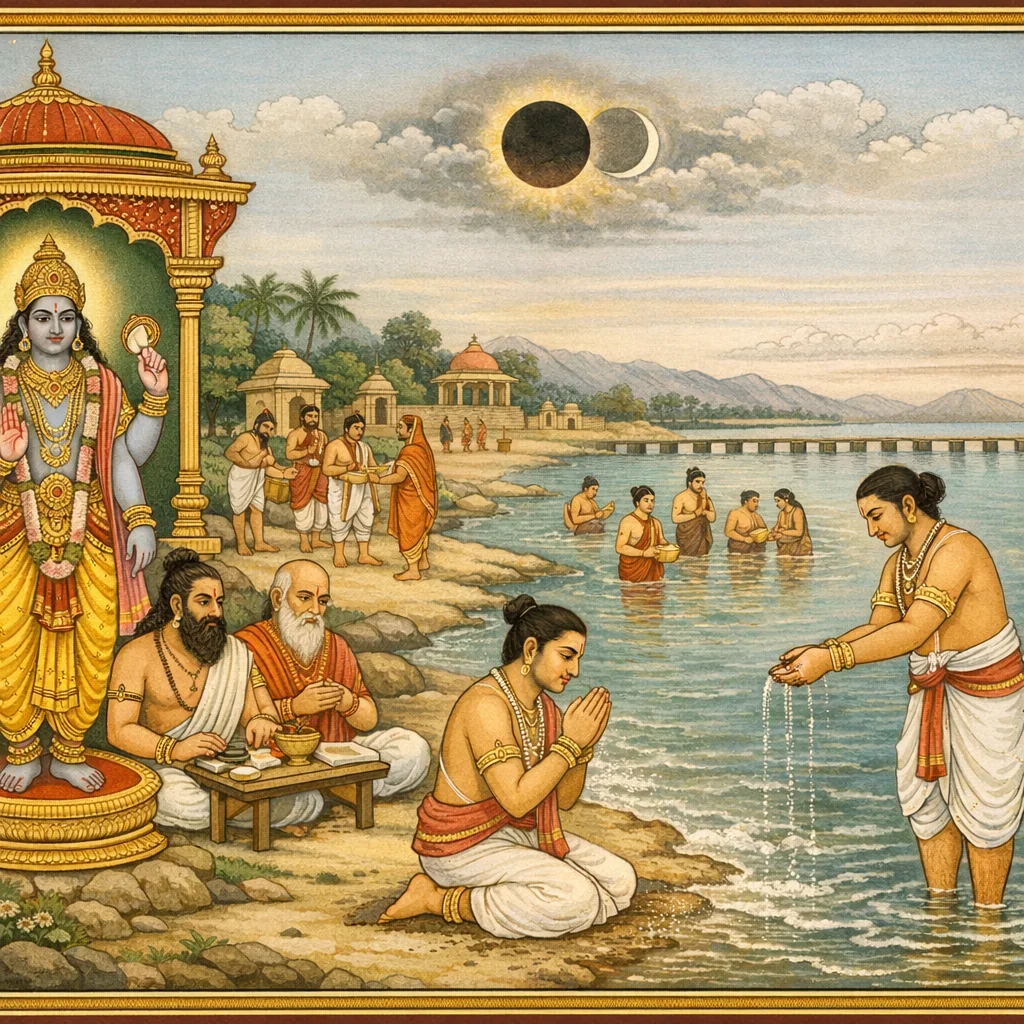
Adhyaya 52
Chapter 52 is a structured māhātmya discourse in which Sūta tells the sages that Dhanuṣkoṭi at Rāmasetu is the supreme field of merit, where japa, homa, tapas, and dāna become akṣaya (imperishable). It offers comparative claims of merit—equal to prolonged residence or bathing at other famed tīrthas—and then marks times when the fruit intensifies: Māgha-month bathing, solar and lunar eclipses, and calendrical yogas such as ardha-udaya and mahā-udaya. Interwoven phalāśruti promises sin-destruction, svarga, and Vaiṣṇava/Śaiva attainments like sālokya, sāmīpya, sārūpya, and sāyujya, while also laying down ethical discipline: dāna must be given to a qualified recipient (satpātra), and improper gifting in a holy place is said to harm one spiritually. A Vasiṣṭha–Dilīpa dialogue defines satpātra (Vedic conduct, continuity of rites, poverty with integrity) and provides a fallback—saṅkalpa with a symbolic water-offering—when no worthy recipient is found. The chapter ends by portraying Setu as divinely guarded (Viṣṇu as Setumādhava, with deities and sages in attendance) and by extending the efficacy of remembering and reciting Setu to listeners and readers in fitting settings (temple/maṭha/sacred banks).
Shlokas
Verse 1
श्रीसूत उवाच । भूयोऽप्यहं प्रवक्ष्यामि सेतुमुद्दिश्य वैभवम् । युष्माकमादरेणाहं शृणुध्वं मुनिपुंगवाः
Śrī Sūta said: Once again I shall describe the greatness pertaining to Setu. Listen with reverence, O foremost of sages.
Verse 2
स्थानानामपि सर्वेषामेतत्स्थानं महत्तरम् । अत्र जप्तं हुतं तप्तं दत्तं चाक्षय मुच्यते
Among all sacred places, this place is the greatest. Here, whatever is recited as japa, offered into the fire, undertaken as austerity, or given in charity becomes inexhaustible.
Verse 3
अस्मिन्नेव महास्थाने धनुष्कोटौ निमज्जनात् । वाराणस्यां दशसमावासपुण्यफलं भवेत्
In this very great sacred place, by immersing oneself at Dhanuṣkoṭi, one obtains the meritorious fruit equal to residing in Vārāṇasī for ten years.
Verse 4
तस्मिंस्थले धनुष्कोटौ स्नात्वा रामेश्वरं शिवम् । दृष्ट्वा नरो भक्तियुक्तस्त्रिदिनानि वसेद्द्विजाः
O brāhmaṇas, having bathed there at Dhanuṣkoṭi and having beheld Śiva as Rāmeśvara, a man endowed with devotion should stay for three days.
Verse 5
पुण्डरीकपुरे तेन दशवत्सरवासजम् । पुण्यं भवति विप्रेंद्रा महापातकनाश नम्
O best of brāhmaṇas, by that observance in Puṇḍarīkapura, merit equal to residing for ten years is obtained, and it becomes a destroyer of the great sins (mahāpātakas).
Verse 6
अष्टोत्तरसहस्रं तु मंत्रमाद्यं षडक्षरम् । अत्र जप्त्वा नरो भक्त्या शिवसायुज्यमाप्नुयात्
But if a person, with devotion, chants here the primordial six-syllabled mantra one thousand and eight times, he attains union with Śiva (śiva-sāyujya).
Verse 7
मध्यार्जुने कुंभकोणे मायूरे श्वेतकानने । हालास्ये च गजारण्ये वेदारण्ये च नैमिषे
At Madhyārjuna, at Kuṃbhakoṇa, at Māyūra, in Śvetakānana; at Hālāsya, in Gajāraṇya, in Vedāraṇya, and at Naimiṣa—at all these sacred places the kṣetra-merit is proclaimed.
Verse 8
श्रीपर्वते च श्रीरंगे श्रीमद्वृद्धगिरौ तथा । चिदंबरे च वल्मीके शेषाद्रावरुणाचले
Likewise at Śrīparvata, at Śrīraṅga, and at the glorious Vṛddhagiri; at Cidambara, at Vālmīka, and at Śeṣādri and Aruṇācala—these too are renowned sacred seats.
Verse 9
श्रीमद्दक्षिणकैलासे वेंकटाद्रौ हरिस्थले । कांचीपुरे ब्रह्मपुरे वैद्येश्वरपुरे तथा
At the glorious Dakṣiṇa-Kailāsa, on Veṅkaṭādri, at Haristhala; at Kāñcīpura, at Brahmapura, and likewise at Vaidyeśvarapura—the holiness of such kṣetras is acknowledged.
Verse 10
अन्यत्रापि शिवस्थाने विष्णुस्थाने च सत्तमाः । वर्षवासभवं पुण्यं धनुष्कोटौ नरो मुदा
O noble ones, even in other abodes of Śiva and in abodes of Viṣṇu, the merit born of a year’s residence is praised; yet at Dhanuṣkoṭi a person obtains it with gladness, through this kṣetra’s power.
Verse 11
माघमासे यदि स्नायादाप्नोत्येव न संशयः । इमं सेतुं समुद्दिश्य द्वौ समुद्राविति श्रुतिः
If one bathes in the month of Māgha, he surely attains the promised merit—there is no doubt. Regarding this Setu, the śruti even speaks of ‘two oceans’.
Verse 12
विद्यते ब्राह्मणश्रेष्ठा मातृभूता सनातनी । अदो यद्दारुरित्यन्या यत्रास्ति मुनिपुंगवाः
O best of brāhmaṇas, there exists an eternal śruti, mother-like in authority. Another śruti too is found—beginning with ‘ado yad dāruḥ…’—where, O foremost sages, it is present as testimony.
Verse 13
विष्णोः कर्माणि पश्यंती सेतुवैभवशंसिनी । श्रुतिरस्ति तथान्यापि तद्विष्णोरिति चापरा
There is a śruti that ‘beholds the deeds of Viṣṇu’ and proclaims the grandeur of Setu. And there is yet another śruti as well; another says, ‘tad viṣṇoḥ…’.
Verse 14
इतिहासपुराणानि स्मृतयश्च तपोधनाः । एकवाक्यतया सेतुमाहात्म्यं प्रबुवंति हि
O treasures of austerity, the Itihāsas and Purāṇas, and the Smṛtis as well, with one voice indeed proclaim the greatness of Setu.
Verse 15
चंद्रसूर्योपरागेषु कुर्व न्सेत्ववगाहनम् । अविमुक्ते दशाब्दं तु गंगास्नानफलं लभेत्
If one bathes at Setu during lunar or solar eclipses, one gains the merit of bathing in the Gaṅgā at Avimukta (Kāśī) for ten years.
Verse 16
कोटिजन्मकृतं पापं तत्क्षणेनैव नश्यति । अश्वमेधसहस्रस्य फलमाप्नोत्य नुत्तमम्
Sin accumulated over ten million births is destroyed in that very instant, and one attains the unsurpassed fruit equal to a thousand Aśvamedha sacrifices.
Verse 17
विषुवायनसंक्रांतौ शशिवारे च पर्वणि । सेतुदर्शनमात्रेण सप्तजन्मार्जिताशुभम्
At the equinoxes, at the transitions of ayana (solstices), at the Sun’s saṅkrānti, and on holy observance-days that fall on a Monday—by the mere sight of Setu, inauspiciousness amassed across seven births is removed.
Verse 18
नश्यते स्वर्गतिं चैव प्रयांति द्विजपुंगवाः । मकरस्थे रवौ माघे किंचिदभ्युदिते रवौ
O best of the twice-born, they attain the heavenly state; when the Sun is in Makara (Capricorn) in the month of Māgha, when the Sun has risen but a little—this time is especially efficacious.
Verse 19
स्नात्वा दिनत्रयं मर्त्यो धनुष्कोटौ विपातकः । गंगादिसर्वतीर्थेषु स्नानपुण्यमवाप्नुयात्
Even a great sinner, if he bathes at Dhanuṣkoṭi for three days, attains the merit of bathing at all tīrthas, beginning with the holy Gaṅgā.
Verse 20
धनुष्कौटौ नरः कुर्यात्स्नानं पंचदिनेषु यः । अश्वमेधादिपुण्यं च प्राप्नुयाद्ब्राह्मणोत्तमाः
O best of brāhmaṇas, whoever bathes at Dhanuṣkoṭi for five days attains the merits of the Aśvamedha and other great rites.
Verse 21
चांद्रायणादिकृच्छ्राणामनुष्ठानफलं लभेत् । चतुर्णामपि वेदानां पारायणफलं तथा
One gains the fruit of performing austerities such as the Cāndrāyaṇa and other Kṛcchra vows, and likewise the fruit of reciting all four Vedas.
Verse 22
माघमासे दशाहःसु धनुष्कोटौ निमज्जनात् । ब्रह्महत्यायुतं नश्येन्नात्र कार्या विचारणा
In the month of Māgha, by immersing at Dhanuṣkoṭi for ten days, even ten thousand acts of brahmahatyā are destroyed—of this there is no need for doubt or debate.
Verse 23
माघमासे धनुष्कोटौ दशपंचदिनानि यः । स्नानं करोति मनुजः स वैकुंठमवाप्नुयात्
In the month of Māgha, the person who bathes at Dhanuṣkoṭi for fifteen days attains Vaikuṇṭha, the Lord’s abode.
Verse 24
माघमासे रामसैतौ स्नानं विंशद्दि नं चरन् । शिवसामीप्यमाप्नोति शिवेन सह मोदते
In the month of Māgha, one who continues bathing at Rāma-setu for twenty days attains nearness to Śiva and rejoices together with Śiva.
Verse 25
पंचविंशद्दिनं स्नानं कुर्वन्सारूप्यमाप्नुयात् । स्नानं त्रिंशद्दिनं कुर्वन्सायुज्यं लभते ध्रुवम्
By performing the sacred bath for twenty-five days, one attains sārūpya—likeness to the divine form. By performing it for thirty days, one surely gains sāyujya—complete union with the Lord.
Verse 26
अतोऽवश्यं रामसेतौ माघमासे द्विजोत्तमाः । स्नानं समाचरेद्विद्वान्किंचिदभ्युदिते रवौ
Therefore, O best of the twice-born, in the month of Māgha one should certainly perform the sacred bath at Rāmasetu; let the wise do so when the sun has risen slightly.
Verse 27
चंद्रसूर्योपरागे च तथैवार्द्धोदये द्विजाः । महोदये रामसेतौ स्नानं कुर्वन्द्विजोत्तमाः
At lunar and solar eclipses, and likewise at arddhodaya (the half-rise), O twice-born—especially at mahodaya (the great conjunction)—the best of the twice-born perform sacred bathing at Rāmasetu.
Verse 28
अनेकक्लेशसंयुक्तं गर्भवासं न पश्यति । ब्रह्महत्यादिपापानां नाशकं च प्रकीर्तितम्
One does not behold again the womb-dwelling bound up with many sufferings. It is proclaimed as a destroyer of sins, beginning with brahmahatyā, the gravest transgression.
Verse 29
सर्वेषां नरकाणां च बाधकं परिकीर्तितम् । संपदामपि सर्वासां निदानं परिकीर्तितम्
It is praised as that which wards off all hells; it is also praised as the very source of every prosperity.
Verse 30
इन्द्रादिसर्वलोकानां सालोक्यादिप्रदं तथा । चंद्रसूर्योपरागे च तथैवार्द्धोदये द्विजाः
It grants sālokya and other divine states in all worlds beginning with Indra’s. And at lunar and solar eclipses, and likewise at arddhodaya, O twice-born—
Verse 31
महोदये धनुष्कोटौ मज्जनं त्वतिनिश्चितम् । रावणस्य विनाशार्थं पुरा रामेण निर्मि तम्
At mahodaya, bathing at Dhanuṣkoṭi is declared most assuredly beneficial. Long ago it was constructed by Rāma for the destruction of Rāvaṇa.
Verse 32
सिद्धचारणगंधर्वकिन्नरोरगसेवितम् । ब्रह्मदेवर्षिराजर्षिपितृसंघनिषेवितम्
It is frequented by Siddhas, Cāraṇas, Gandharvas, Kinnaras, and Nāgas; and it is attended by Brahmā, the divine seers, royal seers, and hosts of Pitṛs.
Verse 33
ब्रह्मादिदेवतावृंदैस्सेवितं भक्तिपूर्वकम् । पुण्यं यो रामसेतुं वै संस्मरन्पुरुषो द्विजाः
Served with devotion by hosts of deities beginning with Brahmā—O twice-born—holy indeed is that person who remembers Rāmasetu.
Verse 34
स्नायाच्च यत्र कुत्रापि तटाकादौ जलाशये । न तस्य दुष्कृतं किंचिद्भविष्यति कदाचन
Even if he bathes anywhere—whether in a pond or any other body of water—no wrongdoing whatsoever will ever remain for him.
Verse 35
सेतुमध्यस्थतीर्थेषु मुष्टिमात्रप्रदानतः । नश्यंति सकला रोगा भ्रूणहत्यादयस्तथा
At the sacred tīrthas situated in the middle of the Setu, even by offering a mere handful as dāna, all diseases are destroyed—and likewise sins such as bhrūṇa-hatyā and other grave offenses.
Verse 36
रामेण धनुषः पुण्यां यो रेखां पश्यते कृताम् । न तस्य पुनरावृत्तिर्वैकुंठात्स्यात्कदाचन
Whoever beholds the holy line made by Rāma with his bow—there is never, at any time, a return for him from Vaikuṇṭha.
Verse 37
धनुष्कोटिरिति ख्याता या लोके पापनाशिनी । विभीषणप्रार्थनया कृता रामेण धीमता
That place is renowned in the world as ‘Dhanuṣkoṭi’, the destroyer of sins. It was established by wise Rāma at the request of Vibhīṣaṇa.
Verse 38
धनुष्कोटिर्महापुण्या तस्यां स्नात्वा सभक्तिकम् । दद्याद्दानानि वित्तानां क्षेत्राणां च गवां तथा
Dhanuṣkoṭi is exceedingly meritorious. After bathing there with devotion, one should give dāna—wealth, land, and likewise cows.
Verse 39
तिलानां तंडुलानां च धान्यानां पयसां तथा । वस्त्राणां भूषणानां च माषाणामोदनस्य च
Gifts may also be of sesame, rice, grains, and milk; of garments and ornaments; and of black-gram (māṣa) and cooked food as well.
Verse 40
दध्नां घृतानां वारीणां शाकानामप्युदश्विताम् । शुद्धानां शर्कराणां च सस्यानां मधुनां तथा
Also as gifts: curd (dadhi), ghee, water, vegetables and greens; pure sugar; produce from the fields; and honey as well.
Verse 41
मोदकानामपूपानामन्येषां दानमेवच । रामसेतौ द्विजाः प्रोक्तं सर्वाभीष्टप्रदायकम्
And indeed, gifts of modakas, cakes (apūpa), and other items too—at Rāmasetu, O brāhmaṇas—are declared to bestow all desired aims.
Verse 42
अतो दद्याद्रामसेतौ वित्तलोभ विवर्जितः । दत्तं हुतं च तप्तं च जपश्च नियमादिकम्
Therefore, at Rāmasetu one should give, free from greed for wealth. Gifts, offerings into fire, austerities, japa, and disciplines beginning with observances—(all these) are to be practiced there.
Verse 43
श्रीरामधनुषः कोटावनंतफलदं भवेत् । तेन वेदाश्च तुष्यंति तुष्यंति पितरस्तथा
At the tip of Śrī Rāma’s bow (Dhanuṣkoṭi), such practice becomes a giver of endless results. By that, the Vedas are satisfied, and likewise the Pitṛs (ancestors) are satisfied.
Verse 44
तुष्यंति मुनयः सर्वे ब्रह्माविष्णुः शिवस्तथा । नागाः किंपुरुषा यक्षाः सर्वे तुष्यंति निश्चितम्
All sages are pleased; Brahmā, Viṣṇu, and Śiva as well. The Nāgas, Kiṃpuruṣas, and Yakṣas—indeed, all are certainly pleased.
Verse 45
स्वयं च पूतो भवति धनुष्कोट्यवलो कनात् । स्ववंशजान्नरान्सर्वान्पावयेच्च पितामहान्
By merely beholding the tip of the bow, one becomes purified oneself; and one also purifies all men born in one’s lineage, as well as one’s forefathers.
Verse 46
तारयेच्च कुलं सर्वं धनुष्कोट्यवलोकनात् । रामस्य धनुषः कोट्या कृतरेवावगाहनात्
By beholding the tip of the bow, one delivers one’s entire family line; and by bathing where the line was made by the tip of Śrī Rāma’s bow, one truly attains that saving merit.
Verse 47
पंचपातककोटीनां नाशः स्यात्तत्क्षणे ध्रुवम् । श्रीरामधनुषः कोट्या रेखां यः पश्यते कृताम्
For one who beholds the line made by the tip of Śrī Rāma’s bow, the destruction of crores of the ‘five great sins’ occurs at that very moment—certainly.
Verse 48
अनेकक्लेशसंपूर्णं गर्भवासं न पश्यति । यत्र सीताऽनलं प्राप्ता तस्मिन्कुंडे निमज्जनात्
By immersing in that pool where Sītā entered the fire, one need not behold again the womb-dwelling that is filled with many afflictions.
Verse 49
भ्रूणहत्याशतं विप्रा नश्यति क्षणमात्रतः । यथा रामस्तथा सेतुर्यथा गंगा तथा हरिः
O brāhmaṇas, a hundred sins of embryo-slaying perish in a single instant. As Rāma is, so is Setu; and as Gaṅgā is, so is Hari (Viṣṇu).
Verse 50
गंगे हरे रामसेतो त्विति संकीर्तयन्नरः । यत्र क्वापि बहिः स्नायात्तेन याति परां गतिम्
Whoever chants, “O Gaṅgā, O Hari, O Rāma‑setu!”—even if he bathes anywhere outside, in any water—by that very act attains the highest state.
Verse 51
सेतावर्धोदये स्नात्वा गन्धमादनपर्वते । पितॄनुद्दिश्य यः पिंडान्दद्यात्सर्षपमात्रकान्
Having bathed at Setu at the auspicious time of “Setu‑wardha‑udaya,” and at Mount Gandhamādana, whoever offers piṇḍas to the ancestors—each no more than the size of a mustard seed—
Verse 52
पितरस्तृप्तिमायांति यावच्चंद्रदिवाकरौ । शमीपत्रप्रमाणं तु पितॄनुद्दिश्य भक्तितः
The ancestors attain satisfaction for as long as the moon and the sun endure, when—dedicated to the Pitṛs—an offering even of the measure of a śamī leaf is given with devotion.
Verse 53
द्विजेन पिण्डं दत्तं चेत्सर्वपापविमोचितः । स्वर्गस्थो मुक्तिमायाति नरकस्थो दिवं व्रजेत्
If a brāhmaṇa offers a piṇḍa, the beneficiary is freed from all sins: one who is in heaven attains liberation, and one who is in hell goes to the celestial world.
Verse 54
सेतौ च पद्मनाभे च गोकर्णे पुरुषोत्तमे । उदन्वदंभसि स्नानं सार्वकालिकमीप्सितम्
At Setu, at Padmanābha, at Gokarṇa, and at Puruṣottama, bathing in the ocean’s waters is desired and meritorious at all times.
Verse 55
शुक्रांगारकसौरीणां वारेषु लवणांभसि । संतानकामी न स्नाया त्सेतोरन्यत्र कर्हिचित्
One who desires offspring should not bathe in the salt ocean on the days of Śukra (Friday), Aṅgāraka (Tuesday), and Śani (Saturday)—anywhere other than at Setu, at any time.
Verse 56
अकृतप्रेतकार्यो वा गर्भिणीपतिरेव वा । न स्नायादुदधौ विद्वान्सेतोरन्यत्र कर्हिचित्
A wise person should not bathe in the sea—anywhere other than at Setu—if he has not yet performed the rites for the departed, or if he is the husband of a pregnant woman.
Verse 57
न कालापेक्षणं सेतोर्नित्यस्नानं प्रशस्यते । वारतिथ्यृक्षनियमाः सेतोरन्यत्र हि द्विजाः
At Setu, daily bathing is praised without dependence on time-constraints; but elsewhere, O twice-born, rules regarding weekday, tithi, and nakṣatra must indeed be observed.
Verse 58
उद्दिश्य जीवतः स्नायान्न तु स्नायान्मृतान्प्रति । कुशैः प्रतिकृतिं कृत्वा स्नापयेत्तीर्थवारिभिः
Here one should bathe with the intention of benefiting the living, not by directing the bath toward the dead. For the departed, having made a symbolic representation with kuśa-grass, one should bathe that effigy with the waters of the tīrtha.
Verse 59
इमं मंत्रं समुच्चार्य प्रसन्नेंद्रियमानसः । कुशोऽसि त्वं पवित्रोऽसि विष्णुना विधृतः पुरा
Reciting this mantra with serene senses and mind: “You are kuśa; you are pure; in ancient times you were upheld by Viṣṇu.”
Verse 60
त्वयि स्नाते स च स्नातो यस्यैतद्ग्रंधिवन्धनम् । सर्वत्र सागरः पुण्यः सदा पर्वणि पर्वणि
When you (the kuśa-effigy) are bathed, that person too—whose knot-binding (granthi-bandhana) this is—has been bathed. The ocean is holy everywhere, especially at every parvan (sacred junction-day).
Verse 61
सेतौ सिन्ध्वब्धिसंयोगे गंगासागर संगमे । नित्यस्नानं हि निर्दिष्टं गोकर्णे पुरुषोत्तमे
Daily bathing is indeed enjoined at Setu, at the confluence of river and ocean, and at the meeting of the Gaṅgā and the sea; likewise at Gokarṇa and at Puruṣottama.
Verse 62
नापर्वणि सरिन्नाथं स्पृशेदन्यत्र कर्हिचित् । पितॄणां सर्वदेवानां मुनीनामपि शृण्वताम्
At a time that is not a parvan, one should not touch the Lord of rivers—the sacred stream—anywhere else at any time; so declare the Pitṛs, all the gods, and even the sages as they listen.
Verse 63
प्रतिज्ञामकरोद्रामः सीतालक्ष्मणसंयुतः । मया ह्यत्र कृते सेतौ स्नानं कुर्वंति ये नराः
Rāma, accompanied by Sītā and Lakṣmaṇa, made a vow: “Indeed, those men who bathe here at the Setu built by me…”
Verse 64
मत्प्रसादेन ते सर्वे यास्यंति पुनर्भवम् । नश्यंति सर्वपापानि मत्सेतोरवलोकनात्
By my grace, all of them shall attain a blessed rebirth; and by merely beholding my Setu, all sins are destroyed.
Verse 65
रामनाथस्य माहात्म्यं मत्सेतोरपि वैभवम् । नाहं वर्णयितुं शक्तो वर्षकोटिशतैरपि
The greatness of Rāmanātha and the majesty of my Setu (Rāmasetu)—I am not able to describe them, even in hundreds of crores of years.
Verse 66
इति रामस्य वचनं श्रुत्वा देवमहर्षयः । साधुसाध्विति संतुष्टाः प्रशशंसुश्च तद्वचः
Having heard these words of Rāma, the divine great sages, pleased, exclaimed, “Well said, well said!” and praised that utterance.
Verse 67
सेतुमध्ये चतुर्वक्त्रः सर्वदेवसमन्वितः । अध्यास्ते तस्य रक्षार्थमीश्वरस्याज्ञया सदा
In the very midst of the Setu sits Caturvaktra (Brahmā), accompanied by all the gods, ever stationed there for its protection by the command of Īśvara.
Verse 68
रक्षार्थं रामसेतौ हि सेतुमाधवसंज्ञया । महाविष्णुः समध्यास्ते निबद्धो निगडेन वै
Indeed, for the protection of Rāmasetu, Mahāviṣṇu remains seated there, known as Setu-Mādhava—bound, as it were, by a fetter of divine ordinance.
Verse 69
महर्षयश्च पितरो धर्मशास्त्रप्रवर्तकाः । देवाश्च सहगन्धर्वाः सकिन्नरमहोरगाः
There abide the great ṛṣis, the Pitṛs (ancestral fathers), the promulgators of dharma-śāstra, and the gods—together with Gandharvas, Kinnaras, and the mighty serpents (Mahoragas).
Verse 70
विद्याधराश्चारणाश्च यक्षाः किंपुरुषास्तथा । अन्यानि सर्वभूताति वसंत्यस्मिन्नहर्निशम्
Here dwell Vidyādharas, Cāraṇas, Yakṣas, and Kiṃpuruṣas as well, and other beings of every kind—abiding in this place day and night.
Verse 71
सोऽहं दृष्टः श्रुतो वापि स्मृतः स्पृष्टोऽवगाहितः । सर्वस्माद्दुरिता त्पाति रामसेतुर्द्विजोत्तमाः
O best of the twice-born, Rāmasetu shields one from every sin—whether it be seen, heard, remembered, touched, or entered (by bathing therein).
Verse 72
सेतावर्धोदये स्नानमानंदप्राप्तिकारणम् । मुक्तिप्रदं महापुण्यं महानरकनाशनम्
Bathing at the Setu on the sacred Ardhodaya becomes a cause of bliss; it bestows mokṣa, yields vast puṇya, and destroys the great hells of terrible suffering.
Verse 73
पौषे मासे विष्णुभस्थे दिनेशे भानोर्वारे किंचिदुद्यद्दिनेशे । युक्ताऽमा चेन्नागहीना तु पाते विष्णोरृक्षे पुण्यमर्धोदयं स्यात्
In the month of Pauṣa, when the Sun is in Makara (Capricorn), on a Sunday, at the very moment the Sun has just risen—if Amāvāsyā (new moon) is conjoined, the occasion is not bereft of the nāga-related yoga, and the Moon stands in Viṣṇu’s constellation—then that auspicious time is called the meritorious Ardhodaya.
Verse 74
तस्मिन्नर्धोदये सेतौ स्नानं सायुज्यकारणम् । व्यतीपातसहस्रेण दर्शमेकं समं स्मृतम्
On Ardhodaya, bathing at the sacred Setu becomes a cause of sāyujya, union with the Divine. One darśa (new-moon day) is remembered as equal to a thousand Vyatīpāta occasions.
Verse 75
दर्शायुतसमं पुण्यं भानुवारो भवेद्यदि । श्रवणर्क्ष यदि भवे द्भानुवारेण संयुतम्
If a Sunday (Ravi’s day) occurs, it yields merit equal to ten thousand darśa observances. And if the Śravaṇa nakṣatra also coincides with that Sunday, the auspiciousness is heightened all the more.
Verse 76
पुण्यमेव तु विज्ञेयमन्योन्यस्यैव योगतः । एकैकमप्यमृतदं स्नानदानजपार्चनात्
This should be understood as true merit (puṇya), arising from the mutual conjunction of auspicious factors. Even each single observance—bathing, dāna (charity), japa, and worship—bestows a nectar-like, deathless fruit.
Verse 77
पंचस्वपि च युक्तेषु किमु वक्तव्यमत्र हि । श्रवणं ज्योतिषां श्रेष्ठममा श्रेष्ठा तिथिष्वपि
And when all five auspicious factors are conjoined, what more need be said? Among the nakṣatras, Śravaṇa is supreme; and among the tithis as well, Amāvasyā, the new-moon day, is held to be the best.
Verse 78
व्यतीपात तु योगानां वारं वारेषु वै रवेः । चतुर्णामपि यो योगो मकरस्थे रवौ भवेत्
Among astrological yogas, Vyatīpāta is foremost; and among weekdays, Sunday, Ravi’s day, is supreme. When the conjunction of four auspicious factors occurs while the Sun is in Makara (Capricorn), it becomes especially significant.
Verse 79
तस्मिन्काले रामसेतौ यदि स्नायात्तु मानवः । गर्भं न मातुराप्नोति किन्तु सायुज्यमाप्नुयात्
At that very time, if a person bathes at Rāmasetu, he does not return again to a mother’s womb; rather, he attains sāyujya—complete union with the Divine.
Verse 80
अर्धोदयसमः कालो न भूतो न भविष्यति । एवं महोदयः कालो धर्मकालः प्रकीर्तितः
A time equal to Ardhodaya has not existed before, nor will it exist again. Thus this Mahodaya time is proclaimed as the supreme time for dharma.
Verse 81
एतेषु पुण्यकालेषु सेतौ दानं प्रकीर्तितम् । आचारश्च तपो वेदो वेदांतश्रवणं तथा
During these auspicious times, charity (dāna) at Setu is especially praised. So too are right conduct, tapas (austerity), Vedic study, and the hearing of Vedānta.
Verse 82
शिवविष्ण्वादिपूजापि पुराणार्थप्रवक्तृता । यस्मिन्विप्रे तु विद्यंते दानपात्रं तदुच्यते
Worship of Śiva, Viṣṇu, and the other deities is also commended, as is expounding the meaning of the Purāṇas. That brāhmaṇa in whom these qualities are found is called a worthy recipient of gifts (dāna-pātra).
Verse 83
पात्राय तस्मै दानानि सेतौ दद्याद्द्विजातये । यदि पात्रं न लभ्येत सेतावाचारसंयुतम्
To such a worthy recipient, one should give gifts at Setu—to the dvija, the twice-born. If no worthy recipient, endowed with proper conduct, can be found at Setu, then one should still uphold disciplined conduct at Setu.
Verse 84
संकल्प्योद्दिश्य सत्पात्रं प्रदद्याद्ग्राममागतः । अतो नाधमपात्राय दातव्यं फलकांक्षिभिः । उत्तमं सेतुमाहात्म्यं वक्तुर्देयं न चान्यतः
Even after returning to one’s village, one should form a sacred resolve and dedicate the gift to a worthy recipient. Therefore, those who seek the fruit of dharma should not give to the unworthy. And the excellent “Greatness of Setu” should be offered and supported for the one who teaches it—and not elsewhere.
Verse 85
अत्रेतिहासं वक्ष्यामि वसिष्ठोक्तमनुत्तमम् । दिलीपाय महाराज्ञे दानपात्रवि वित्सवे
Here I shall relate an unsurpassed ancient account, spoken by Vasiṣṭha to Mahārāja Dilīpa, who longed to know in truth the proper marks of a worthy recipient for dāna.
Verse 86
दिलीप उवाच । दानानि कस्मै देयानि ब्रह्मपुत्र पुरोहित । एतन्मे तत्त्वतो ब्रूहि त्वच्छिष्यस्य महामुने
Dilīpa said: “O priest, O son of Brahmā! To whom should gifts be given? Tell me this in truth, O great sage, for I am your disciple.”
Verse 87
वसिष्ठ उवाच । पात्राणामुत्तमं पात्रं वेदाचारपरायणम् । तस्मादप्यधिकं पात्रं शूद्रान्नं यस्य नोदरे
Vasiṣṭha said: “Among recipients, the best recipient is one devoted to Vedic conduct. Even superior is the recipient in whose belly there is no food obtained from a Śūdra—one who maintains strict purity in livelihood and sustenance.”
Verse 88
वेदाः पुराणमंत्राश्च शिवविष्ण्वादिपूजनम् । वर्णाश्रमाद्यनुष्ठानं वर्तते यस्य संततम्
“He in whom there is constant engagement in the Vedas and Purāṇic mantras, worship of Śiva, Viṣṇu, and other deities, and the regular observances of the duties of varṇa and āśrama—such a person is truly established in dharma.”
Verse 89
दरिद्रश्च कुटुंबी च तत्पात्रं श्रेष्ठमुच्यते । तस्मिन्पात्रे प्रदत्तं वै धर्म कामार्थमोक्षदम्
Even if one is poor and burdened with family duties, such a person is said to be an excellent recipient. A gift given to that recipient bestows dharma, kāma, artha, and mokṣa.
Verse 90
पुण्यस्थले विशेषेण दानं सत्पात्रगर्हितम् । अन्यथा दशजन्मानि कृकलासो भविष्यति
Especially in a sacred place, giving (to an unworthy person) is censured by the standard of the worthy recipient. Otherwise, one will be born as a lizard for ten births.
Verse 91
जन्मत्रयं रासभः स्यान्मंडूकश्च द्विजन्मनि । एकजन्मनि चाण्डालस्ततः शूद्रो भविष्यति
For three births he becomes a donkey; for two births, a frog; for one birth, an outcaste (cāṇḍāla); and thereafter he becomes a Śūdra.
Verse 92
ततश्च क्षत्रियो वैश्यः क्रमाद्विप्रश्च जायते । दरिद्रश्च भवेत्तत्र बहुरोगसमन्वितः
Then, in due order, he is born as a Kṣatriya, a Vaiśya, and then a Brāhmaṇa; yet even then he becomes poor and afflicted with many diseases.
Verse 93
एवं बहुविधा दोषा दुष्टपात्रप्रदानतः । तस्मात्सर्वप्रयत्नेन सत्पात्रेषु प्रदापयेत्
Thus, many kinds of faults arise from giving to an unworthy recipient. Therefore, with every effort, one should give to worthy recipients.
Verse 94
न लभ्यते चेत्तत्पात्रं तदा संकल्पपूर्वकम् । एकं सत्पात्रमुद्दिश्य प्रक्षिपेदुदकं भुवि
If such a worthy recipient cannot be found, then, after making the solemn saṅkalpa, one should, keeping a single true recipient (satpātra) in mind, pour water upon the ground as an offering.
Verse 95
उद्दिष्टपात्रस्य मृतौ तत्पुत्राय समर्पयेत् । तस्यापि मरणे प्राप्ते महादेवे समर्प येत् । अतोनाधमपात्राय दद्यात्तीर्थे विशेषतः
If the intended recipient has died, one should offer it to his son; if he too has passed away, it should be dedicated to Mahādeva. Therefore, especially at a sacred tīrtha, one should not give to an unworthy and fallen recipient.
Verse 96
श्रीसूत उवाच । एवमुक्तो वसिष्ठेन दिलीपः स द्विजोत्तमाः
Śrī Sūta said: Thus instructed by Vasiṣṭha, Dilīpa—O best of the twice-born—proceeded accordingly.
Verse 97
तदा प्रभृति सत्पात्रे प्रायच्छद्दानमुत्तमम् । अतः पुण्यस्थले सेतावत्रापि मुनिपुंगवाः
From that time onward he continually bestowed the finest dāna upon worthy recipients (satpātra). Therefore, O best of sages, here too at Setu—this supremely meritorious place—the same principle should be followed.
Verse 98
यदि लभ्येत सत्पात्रं तदा दद्याद्धनादिकम् । नो चेत्संकल्पपूर्वं तु विशिष्टं पात्रमुत्तमम्
If a worthy recipient (satpātra) is available, one should give wealth and the like. If not, one should first make the solemn saṅkalpa and designate a specific, excellent recipient (to whom it may later be given).
Verse 99
समुद्दिश्य जलं भूमौ प्रक्षिपेद्भक्तिसंयुतः । स्वग्राममागतः पश्चात्तस्मिन्पात्रे समर्पयेत्
With devotion, having mentally designated the intended recipient, one should pour water upon the ground as a sacred token. Later, upon returning to one’s own village, one should offer the gift to that designated recipient.
Verse 100
पूर्वंसंकल्पितं वित्तं धर्मलोपोऽन्यथा भवेत् । न दुःखं पुनराप्नोति किं तु सायुज्यमाप्नुयात्
Wealth previously vowed for charity must not be diverted; otherwise there is a lapse of dharma. By honoring that vow, one does not fall again into sorrow, but attains sāyujya—union with the Divine.
Verse 110
उपरागसहस्रेण सममर्धोददयं स्मृतम् । अर्धोदयसमः कालो नास्ति संसारमोचकः
Ardhodaya is remembered as equal to a thousand eclipses. There is no time comparable to Ardhodaya for freeing one from the bondage of saṃsāra.
Verse 120
संसारेषु निमज्जंति ते यथांधाः पतंत्यधः । सेतावर्धोदये स्नात्वा भित्त्वा भास्करमण्डलम्
They sink in saṃsāra and, like the blind, fall downward. But by bathing at Setu during Ardhodaya, one breaks through the sun’s sphere, transcending the ordinary cosmic circuit.
Verse 130
यथाशक्त्यन्नपानाद्यैः पृथङ्मंत्रैः समर्चयेत् । कांस्यपात्रं समादाय नूतनं दारवं तु वा
According to one’s capacity, one should worship with food, drink, and other offerings, using distinct mantras. One should take a bronze vessel, or else a new wooden one.
Verse 140
प्रतिमामर्पयेत्तस्मै गां च छत्रमुपानहम् । एवमर्द्धोदये सेतौ व्रतं कुर्याद्द्वि जोत्तमाः
One should offer him a sacred image (pratimā), a cow, a parasol, and footwear. Thus, O best of the twice-born, one should undertake the Ardhodaya vow at Setu.
Verse 150
ऐन्द्रे श्वेताचले पुण्ये पद्मनाभे महास्थले । फुल्लाख्ये घटिकाद्रौ च सारक्षेत्रे हरि स्थले
In the sacred Aindra region—on holy Śvetācala, at the great seat of Padmanābha, at the place called Phullā, on the mountain Ghaṭikādri, and in Sārakṣetra, the abode of Hari—these are renowned as supremely meritorious holy spots.
Verse 160
शिवं वा केशवं वापि तथान्यानपि वै सुरान् । न पूजयंति वेदोक्त मार्गेण द्विजपुंगवाः
Even Śiva or Keśava—or any of the other gods—are not truly worshipped by those ‘best of twice-born’ who do not follow the Vedic path of worship.
Verse 170
दोर्द्वंद्वे च गले सम्यक्सर्वपापौघशांतये । रुद्राक्षं तुलसीकाष्ठं यो न धारयते नरः
For the complete pacification of the flood of all sins—upon both arms and upon the neck—whoever does not wear rudrākṣa beads and a rosary of tulasī-wood (fails to adopt these purifying marks of devotion).
Verse 180
अन्यन्नैमित्तिकं श्राद्धं ये न कुर्वंति लोभतः । ये चैत्रे तु पौर्णमास्यां चित्रगुप्तस्य तुष्टये
Those who, out of greed, do not perform the occasional (naimittika) śrāddha; and those who, on the full-moon day of Caitra, do not perform the rite for the satisfaction of Citragupta…
Verse 190
महादुःखप्रशमनं महारोगनिबर्हणम् । दुःस्वप्ननाशनं पुण्यमपमृ त्युनिवारणम्
This sacred recitation soothes great sorrow, destroys grievous disease, dispels evil dreams, bestows merit, and wards off untimely death.
Verse 200
यः पंचाशत्तमाध्यायान्पठते शृणुतेऽपि वा । स सांबं हरमाप्नोति शिवं चन्द्रार्धशेखरम्
Whoever reads—or even merely hears—these fifty chapters attains Śiva, Hara, the Lord with Umā (Sāmbā), the One crowned with the crescent moon.
Verse 210
तथान्येष्वपि तीर्थेषु सेतुमध्यगतेषु वै । तत्फलं समवाप्नोति पाठेन श्रवणेन वा
Likewise, at other sacred tīrthas within the Setu region, one gains the same fruit through recitation or through hearing.
Verse 220
पठनीयमिदं पुण्यं मठे देवालयेऽपि वा । नदीतटाकतीरेषु पुण्ये वारण्यभूतले । श्रोत्रियाणां गृहे वापि नैवान्यत्र तु कर्हिचित्
This meritorious text should be recited in a maṭha or in a temple; on the banks of rivers and lakes; upon holy forest-ground; or in the home of Veda-learned brāhmaṇas—never elsewhere, at any time.
Verse 230
पूजिते श्रावके तस्मिन्पूजिताः स्युस्त्रिमूर्तयः । जगत्त्रयं पूजितं स्यात्पूजितासु त्रिमूर्तिषु
When that devout listener is honored, the Trimūrti are honored; and when the Trimūrti are honored, the three worlds are honored.
Verse 240
व्यासस्य चरणांभोजे दंडवत्प्रणिपत्य तु । जलमानंदजं तत्र नेत्राभ्यांपर्यवर्तयत्
Having bowed full-length at the lotus-feet of Vyāsa, he there let flow from his eyes the water born of joy—tears of bliss.
Verse 250
ऋषयो नैमिषारण्यनिलयास्तुष्टिमागताः । प्रत्यहं सेतुमाहात्म्यं शृण्वंति च पठंति च
The sages who dwell in Naimiṣāraṇya attained deep contentment, for every day they both listen to and recite the glory of Setu (Rāmeśvaram).