Adhyaya 26
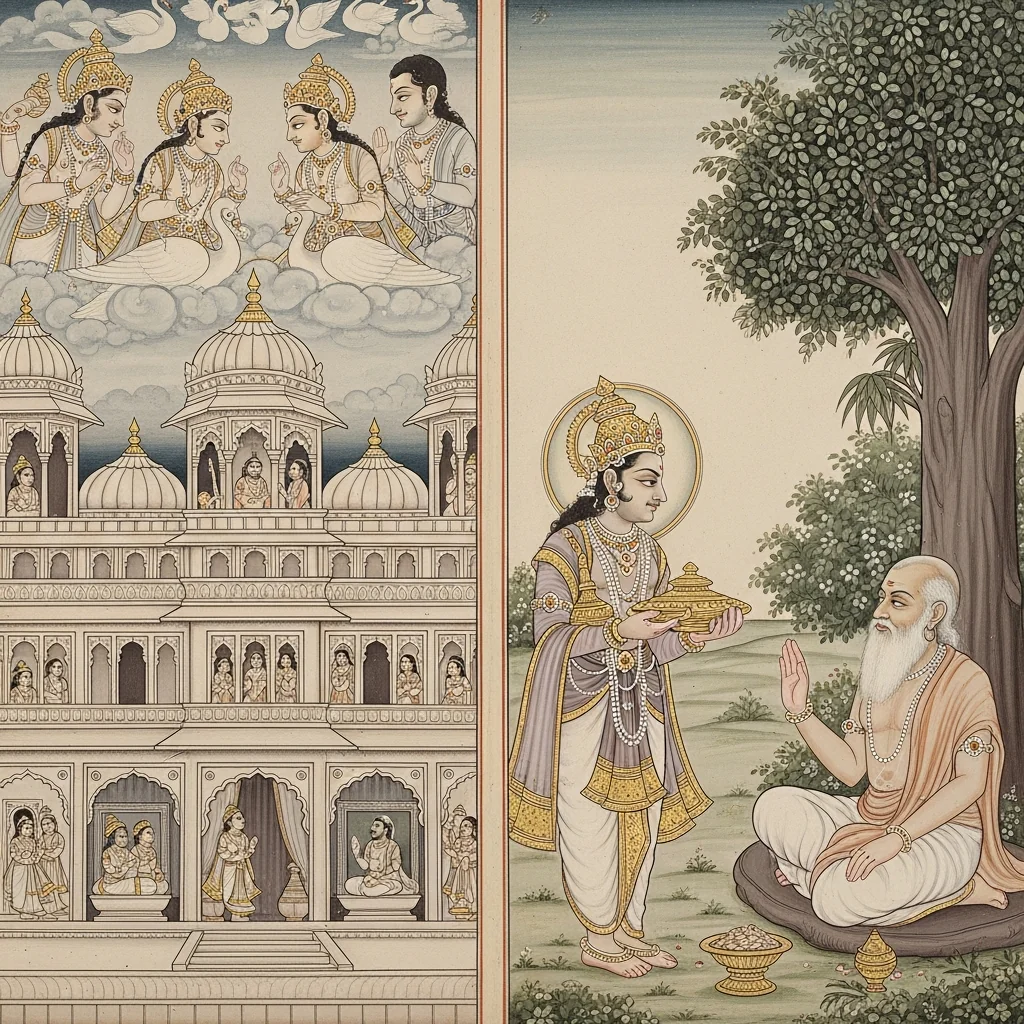
This adhyāya begins with Sūta outlining a sequential pilgrimage: after performing rites at Śaṅkhatīrtha, one proceeds to Yamunā, Gaṅgā, and Gayā—three celebrated tīrthas famed for removing obstacles and easing afflictions, and especially for destroying ignorance and bestowing knowledge. The ṛṣis ask how these three tīrthas came to be present at Gandhamādana, and how King Jānaśruti gained knowledge through bathing. Sūta then describes the sage Raikva (also called Sayugvāṅ), physically impaired from birth yet possessed of immense tapas. Unable to travel, he resolves to invoke the tīrthas through mantra and meditation (āvāhana). Yamunā, Gaṅgā (Jāhnavī), and Gayā rise from the subterranean realm, take human form, and are requested to remain where they emerged. Those emergence-points become Yamunātīrtha, Gaṅgātīrtha, and Gayātīrtha, where bathing is said to remove avidyā and awaken knowledge. The narrative shifts to King Jānaśruti, renowned for hospitality and generosity. Through a dialogue of celestial sages in the form of geese, his merit is contrasted with Raikva’s superior brahmajñāna. Troubled, the king seeks Raikva, offers wealth, and asks for instruction; Raikva rejects material valuation. The chapter culminates in the teaching that dispassion toward saṃsāra and toward merit/demerit is prerequisite for non-dual knowledge, the decisive dispeller of ignorance leading toward brahmabhāva.
Shlokas
Verse 1
। श्रीसूत उवाच । विधायाभिषवं मर्त्याः शंखतीर्थे द्विजोत्तमाः । यमुनां चैव गंगां च गयां चापि क्रमाद्व्रजेत्
Śrī Sūta said: “O best of the twice-born, having performed the prescribed ablutions at Śaṅkha-tīrtha, the pilgrim should then proceed in due order to Yamunā, to Gaṅgā, and also to Gayā.”
Verse 2
यमुनाख्यं महातीर्थं गंगातीर्थमनुत्तमम् । गयातीर्थं च मर्त्यानां महापातकनाशनम्
Yamunā is called a great tīrtha; the Gaṅgā-tīrtha is unsurpassed; and the Gayā-tīrtha, for mortals, is the destroyer of great sins.
Verse 3
एतत्तीर्थत्रयं पुण्यं सर्वलोकेषु विश्रुतम् । सर्वविघ्नप्रशमनं सर्वरोगनिबर्हणम्
This triad of tīrthas is holy and renowned in all worlds; it pacifies every obstacle and drives away all diseases.
Verse 4
एतद्धि तीर्थत्रितयं सकलाज्ञाननाशनम् । अविद्यायां विनष्टायां तथा ज्ञानप्रदं नृणाम्
Indeed, this triad of tīrthas destroys all ignorance; when nescience is dispelled, it then bestows true knowledge upon people.
Verse 5
जानश्रुतिर्महाराज एषु तीर्थेषु वै पुरा । स्नात्वा रैक्वाद्द्विजश्रेष्ठात्प्राप्तवाञ्ज्ञानमुत्तमम्
O great king, in former times Jānaśruti, after bathing at these tīrthas, received the highest knowledge from Raikva, the foremost of brāhmaṇas.
Verse 6
ऋषय ऊचुः । सूत सर्वार्थतत्त्वज्ञ व्यासशिष्य महामते । यमुना चैव गंगा च गया चैवेति विश्रुतम्
The sages said: “O Sūta, knower of the truth of all matters, O wise disciple of Vyāsa—we have heard that Yamunā, Gaṅgā, and Gayā are famed as supremely holy.”
Verse 7
एतत्तीर्थत्रयं कस्मादागतं गंधमादने । जानश्रुतेश्च राजर्षेः स्नानात्तीर्थत्रयेऽपि च । ज्ञानावाप्तिः कथं रैक्वादस्माकं सूत तद्वद
“From where did this triad of tīrthas arise at Gandhamādana? And how did the royal sage Jānaśruti attain knowledge by bathing in that very triad of tīrthas? O Sūta, tell us how this came about through Raikva.”
Verse 8
श्रीसूत उवाच । रैक्वनामा महर्षिस्तु पुरा वै गन्धमादने
Śrī Sūta said: “Formerly, at Gandhamādana, there was a great sage named Raikva.”
Verse 9
तपस्सुदुश्चरं कुर्वन्न्यवसत्तपसां निधिः । दीर्घकालं तपः कुर्वन्स वै रैक्वो महामुनिः
That great ascetic Raikva—a very treasury of austerities—dwelt there, performing extremely difficult penance for a long time.
Verse 10
तपोबलेन महता दीर्घमायुरवाप्तवान् । जन्मना पंगुरेवासीद्रैक्वनामा महामुनिः
By the great power of his austerity he attained long life; yet by birth the great sage named Raikva was lame.
Verse 11
पंगुत्वादसमर्थोऽभूद्गंतुं तीर्थान्यसौ मुनिः । संति यानि तु तीर्थानि गन्धमादनपर्वते
Because of his lameness, that sage, the muni, was unable to journey far to other tīrthas. Yet sacred tīrthas do exist upon Mount Gandhamādana.
Verse 12
तानि गच्छति सामीप्याच्छकटेनैव संचरन् । स यद्रैक्वो मुनिवरो युग्वेन सह वर्तते
Moving about by means of a cart, he would go to those nearby tīrthas. Thus the excellent sage Raikva lived together with a ‘yugva’—a cart.
Verse 13
तपस्वी वैदिकैर्लोके सयुग्वैत्यभिधीयते । युग्वेति शकटं प्रोक्तं स तेन सह वर्तते
Among the Vedic folk of the world, such an ascetic is called ‘Sa-yugva’. ‘Yugva’ is said to mean a cart; therefore he lived together with that cart.
Verse 14
स खल्वेवं मुनिश्रेष्ठः सयुग्वानाम वै मुनिः । पूर्णज्ञानस्तपस्तेपे गन्धमादनपर्वते
Thus indeed that best of sages—the muni truly known as Sa-yugva—performed austerities on Mount Gandhamādana, possessed of complete knowledge.
Verse 15
ग्रीष्मे पञ्चाग्निमध्यस्थः सोऽतप्यत महत्तपः । वर्षायां कण्ठदघ्नेषु जलेषु समवर्तत
In summer, seated amidst the five fires, he undertook great tapas; and in the rainy season he remained in waters rising up to his throat.
Verse 16
तपसा शोषिते गात्रे पामा तस्य व्यजायत । कण्डूयत स पामानं दिवारात्रं मुनीश्वरः
When his body had been dried by austerity, the itch-disease (pāmā) arose upon him. That lordly sage kept scratching the eruption day and night.
Verse 17
कण्डूयमान एवायं पामानं न तपोऽत्यजत् । अजायत मनस्त्वेवं तस्य सयुग्वनो मुनेः
Though continually scratching that itch, he did not abandon his austerity. In this way, such a thought arose in the mind of the sage Sayugvā.
Verse 18
यमुनायां च गंगायां गयायां चाधुनैव हि । अस्मिंस्तीर्थे त्रये पुण्ये स्नातव्यं हि मया त्विति
“Indeed, I must bathe right now in the Yamunā, in the Gaṅgā, and in Gayā. In this single holy place—this auspicious triple tīrtha—I must perform the bath,” he resolved.
Verse 19
एवं विचिंत्य स मुनिरन्यां चिंतामथाकरोत् । अहं हि जन्मना पंगुरतः स्नानं हि दुर्लभम्
Having reflected thus, the sage then fell into another concern: “Since birth I am lame; for me, bathing is indeed difficult to obtain.”
Verse 20
अतिदूरं मया गन्तुं शकटेन न शक्यते । किं करोम्यधुनेत्येवं स वितर्क्य महामतिः
“It is too far for me to go; even by cart it is not possible. What shall I do now?” Thus the great-minded one deliberated.
Verse 21
तीर्थत्रयेषु स्नानार्थं कर्तव्यं निश्चिकाय वै । अप्रसह्यमनाधृष्यं विद्यते मे तपोबलम्
He resolved firmly: “For the sake of bathing in the three tīrthas, it must be done. Within me abides the power of tapas—irresistible and unassailable.”
Verse 22
तेनैवावाहयिष्यामि तद्धि तीर्थत्रयं त्विह । इति निश्चित्य मनसा प्राङ्मुखो नियतेंद्रियः
“By that very power I shall invoke that triple tīrtha here itself.” Having thus resolved in his mind, facing east and with senses restrained, (he prepared).
Verse 23
त्रिराचम्य च सयुग्वान्दध्यौ क्षणमतंद्रितः । तस्य मंत्रप्रभावेन यमुना सा महानदी
Sayugvā sipped water thrice for purification and meditated for a moment without slackness. By the power of his mantra, the great river Yamunā (responded).
Verse 24
गंगा च जह्नुतनया गया सा पापनाशिनी । भूमिं निर्भिद्य तिस्रोपि पातालात्सहसोत्थिताः
And Gaṅgā—the daughter of Jahnu—and Gayā, the destroyer of sins: all three, bursting through the earth, rose up at once from the netherworlds.
Verse 25
मानुषं रूपमास्थाय सयुग्वानमुपेत्य च । ऊचुः परमसंहृष्टा हर्षयंत्यश्च तं मुनिम्
Assuming human forms and drawing near to Sayugvā, they spoke in supreme delight, gladdening and pleasing that sage.
Verse 26
सयुग्वन्रैक्व भद्रं ते ध्यानादस्मादुपारम । त्वन्मत्रेण समाकृष्टा वयमत्र समागताः
“O Sayugvan, O Raikva—blessings upon you. Cease this meditation. Drawn here solely by your presence and power, we have come to this place.”
Verse 27
कि कर्तव्यं तवास्माभिस्तद्वदस्व मुनीश्वर । इति तासां वचः श्रुत्वा सयुग्वान्हि महामुनिः
“What should we do for you? Tell us, O lord among sages.” Hearing their words, the great sage Sayugvan…
Verse 28
ध्यानादुपारमत्तूर्णं ताश्चापश्यत्पुरः स्थिताः । स ताः संपूज्य विधिवद्रैक्वो वाचमभाषत
He quickly withdrew from meditation and saw them standing before him. Having duly honored them according to rite, Raikva spoke these words.
Verse 29
यमुने देवि हे गंगे हे गये पापनाशिनि । सन्निधानं कुरुध्वं मे गन्धमादनपर्वते
“O goddess Yamunā, O Gaṅgā, O Gayā—the destroyer of sins—be present for me here on Mount Gandhamādana.”
Verse 30
यत्र भूमिं विनिर्भिद्य भवत्य इह निर्गताः । तानि पुण्यानि तीर्थानि भवेयुर्वोऽभिधानतः
“Wherever you burst forth here, splitting the earth, those places shall become holy tīrthas, known by your very names.”
Verse 31
सहसांतरधीयंत तथास्त्वित्येव तत्र ताः । तदाप्रभृति तीर्थानि तानि त्रीण्यपि भूतले
In an instant they vanished there, saying, “So be it.” From that time onward, those three tīrthas came to be upon the earth.
Verse 32
तेनतेनाभिधानेन गीयन्ते सर्वदा जनैः । यत्र भूमिं विनिर्भिद्य यमुना निर्गता तदा
They are always sung and praised by people under those very names. Where Yamunā broke through the earth and emerged—there indeed…
Verse 33
यमुनातीर्थमिति वै तज्जनैरभिधीयते । यतो वै पृथिवीरंध्राज्जाह्नवी सहसोत्थिता
That place is indeed called ‘Yamunā-tīrtha’ by people. And where Jāhnavī (Gaṅgā) suddenly rose up from a fissure in the earth…
Verse 34
गंगातीर्थमिति ख्यातं तल्लोके पापनाशनम् । गया हि मानुषं रूपं यत आस्थाय निर्ययौ
It is famed in the world as ‘Gaṅgā-tīrtha,’ a destroyer of sins. And from where Gayā, assuming a human form, came forth…
Verse 35
तदेव भूमिविवरं गयातीर्थं प्रचक्षते । एवमेतन्महापुण्यं तीर्थत्रयमनुत्तमम्
That very opening in the earth is called ‘Gayā-tīrtha.’ Thus this supremely excellent triad of tīrthas is of great merit.
Verse 36
रैक्वमंत्रप्रभावेण पृथिव्याः सहसोत्थितम् । अत्र तीर्थत्रये स्नानं ये कुर्वंति नरोत्तमाः
By the power of Raikva’s mantra, this sacred place sprang forth suddenly from the earth. The best of men who bathe here at the triad of tīrthas gain great merit (puṇya).
Verse 37
तेषामज्ञाननाशः स्याज्ज्ञानमप्युदयं लभेत् । स्वमंत्रेण समाकृष्टे तत्र तीर्थत्रये मुनिः
For them, ignorance is destroyed and knowledge rises within. There, at that triad of tīrthas drawn forth by his own mantra, the sage Raikva abode.
Verse 38
स्नानं समाचरन्नित्यं स कालानत्यवाहयत् । एतस्मिन्नेव काले तु राजा जानश्रुतिर्महान्
Practising the bath-rites daily, he passed his time there. And at that very time there lived the great king named Janāśruti.
Verse 39
पुत्रसंज्ञस्य राजर्षेः पौत्रो धर्मैकतत्परः । देयमन्नादि स तदा ह्यर्थिभ्यः श्रद्धयैव यत्
He was the grandson of the royal sage called Putrasaṃjña, devoted solely to dharma. At that time he gave to supplicants food and the like—whatever was fit to be offered—moved by faith alone.
Verse 40
तस्मादेनं नजालोके श्रद्धादेयं प्रचक्षते । यतो बहुतरं वाक्यमन्नाद्यस्य महीपतेः
Therefore people in the world call him “Śraddhādeya”—“the one whose gifts are offered in faith”—because the king’s proclamation concerning food and provisions was abundant and far-reaching.
Verse 41
अर्थिनां क्षुधितानां तु तृप्त्यर्थं वर्तते गृहे । अतोयमर्थिभिः सर्वैर्बहुवाक्य इतीर्यते
In his house there was provision to satisfy supplicants and the hungry; therefore all seekers spoke of him as “Bahuvākya,” one whose call and promise were widely heard.
Verse 42
स वै पौत्रायणो राजा जानश्रुतसुतो बली । प्रियातिथिर्बभूवासौ बहुदायी तथाऽभवत्
That mighty king, Pautrāyaṇa—son of Janāśruti—became a lover of guests, and indeed he became one who gave abundantly.
Verse 43
नगरेषु च राष्ट्रेषु ग्रामेषु च वनेषु च । चतुष्पथेषु सर्वेषु महामार्गेषु सर्वशः
In cities and kingdoms, in villages and forests—in every crossroads and along all the great highways everywhere—
Verse 44
बह्वन्नपान संयुक्तं सूपशाकादिसंयुतम् । आतिथ्यं कल्पयामास तृप्तयेऽर्थिजनस्य वै
He arranged hospitality furnished with abundant food and drink, along with soups, vegetables, and the like—so that the company of supplicants might truly be satisfied.
Verse 45
अन्नपानादिकं सर्वमुपयुड्ध्वमिहार्थिनः । इत्यसौ घोषयामास तत्र तत्र जनास्पदे
“Let all who seek come here and partake of everything—food, drink, and whatever else is needed!” Thus he had it proclaimed again and again in every place where people gathered.
Verse 46
तस्य प्रियातिथेरेव नृपस्य बहुदायिनः । अर्थिभ्यो दानशौंडस्य गुणाः सर्वत्र विश्रुताः
The virtues of that king—delighting in honoring guests, abundant in gifts, and steadfast in charity toward supplicants—were renowned everywhere.
Verse 47
अथ पौत्रायणस्यास्य गुण ग्रामेण वर्ततः । देवर्षयो महाभागास्तस्यानुग्रहकांक्षिणः
Now, as this descendant of Pautrāyaṇa lived adorned with a whole host of virtues, the blessed divine seers, longing to bestow their grace upon him, drew near.
Verse 49
हंसरूपं समास्थाय निदाघसमये निशि । रमणीयां विधायाशु श्रेणीमाकाशमागतः
Assuming the form of swans, in the night of the hot season, they swiftly formed a lovely flight-formation and rose into the sky.
Verse 50
तरसा पततां तेषां हंसानां पृष्ठतो व्रजन् । एको हंसस्तु संबोध्य हंसमग्रेसरं तदा
As those swans flew swiftly, one swan, moving behind them, then addressed the leading swan.
Verse 51
सोपहासमिदं वाक्यं प्राह शृण्वति राजनि । भोभो भल्लाक्ष भल्लाक्ष पुरो गच्छन्मरालक
With a touch of laughter he spoke these words, while the king listened: “Ho! ho! O sharp-eyed one—sharp-eyed! O swan, going in front!”
Verse 52
सौधमध्ये पुरस्ताद्वै जानश्रुतसुतो नृपः । वर्तते पूजनीयोऽयं न पश्यसि किमंधवत्
Right before you, in the midst of the palace, stands the king—the son of Jānaśruta—worthy of worship. Why do you not see him, as though blind?
Verse 53
यस्य तेजो दुराधर्षमाब्रह्म भवनादिदम् । अनंतादित्यसंकाशं ज्वलते पुरतो भृशम्
His splendor is unassailable—reaching up to Brahmā’s abode; blazing fiercely before you, it shines like the boundless sun.
Verse 54
तमतिक्रम्य राजर्षिं मा गास्त्वमुपरि द्रुतम् । यदि गच्छसि तत्तेजस्सांप्रतं त्वां प्रधक्ष्यति
Do not swiftly fly over that royal seer by passing beyond him. If you go on, his radiance will burn you up right now.
Verse 55
इत्युक्तवंतं तं हंसमग्रतः प्रत्यभाषत । अहो भवानभिज्ञोऽसि श्लाघनीयोऽसि सूरिभिः
Thus spoken to, the swan in front replied to that swan: “Ah! You are discerning; the wise should praise you.”
Verse 56
अश्लाघनीयं कितवं यत्त्वमेनं प्रशंससे । प्रशंससे किमर्थं त्वमल्पं संतमिमं जनम्
“You cheat—this one is not worthy of praise, yet you praise him! Why do you praise this insignificant fellow?”
Verse 57
भस्रावत्पशुवच्चैव केवलं श्वासधारिणम् । न ह्ययं वेत्ति धर्माणां रहस्यं पृथिवी पतिः
Like a beast, he is merely a bearer of breath—life reduced to ashes. This lord of the earth does not know the inner secret of dharma.
Verse 58
तत्त्वज्ञानी यथा रैक्वः सयुग्वान्ब्राह्मणोत्तमः । रैक्वस्य हि महज्ज्योतीरहस्यं दैवतैरपि
Raikva—called Sayugvān, the best of brāhmaṇas—is a knower of Reality. Indeed, the secret of his great inner Light is known even among the gods.
Verse 59
न ह्यस्य प्राणमात्रस्य तेजस्तादृशमस्ति वै । रैक्वस्य पुण्यराशीनामियत्ता नैव विद्यते
For this man—living only at the level of breath—such splendor does not exist. But the measure of Raikva’s accumulated merits is truly beyond knowing.
Verse 60
गण्यते पांसवो भूमेर्गण्यंते दिवि तारकाः । रैक्वपुण्यमहामेरुसमूहो नैव गण्यते
The grains of dust on the earth can be counted; the stars in the sky can be counted. But the vast mountain-range of Raikva’s merit cannot be counted at all.
Verse 61
किं च तिष्ठंत्विमे धर्मा नश्वरास्तस्य वै मुनेः । ब्रह्मज्ञानमबाध्यं यत्तेन स श्लाघ्यते मुनिः
Let the other virtues remain—yet for that sage they are perishable. Because he possesses unobstructed knowledge of Brahman, the muni is truly worthy of praise.
Verse 62
जानश्रुतेस्तु तादृक्षो धर्म एव न विद्यते । दुर्लभं यत्तु योगीन्द्रैः कुतस्तज्ज्ञानवैभवम्
But in Jānaśruti no such dharma is found. When that realization is difficult even for the lords of yogins, how could he possess such splendor of knowledge?
Verse 63
परित्यज्य दुरात्मानं तद्वराकमिमं जनम् । स एव रैक्वः सयुग्वाञ्छ्लाघ्यतां भवता मुनिः
Abandoning this wretched person of evil disposition, may that very Raikva—Sayugvān—be praised by you, O sage.
Verse 64
जन्मना पंगुरपि यः स्वस्य स्नानचिकीर्षया । गंगां च यमुनां चापि गयामपि मुनीश्वरः
Though crippled from birth, that lordly sage—wishing to perform his own sacred bath—(summoned) even the Gaṅgā, the Yamunā, and Gayā itself.
Verse 65
आह्वयामास मन्त्रेण निजाश्रमसमीपतः । तस्य ब्रह्मविदो रैक्वमहर्षेर्धर्मसंचये
By mantra he invoked them to the vicinity of his own hermitage—he, Raikva, the great ṛṣi and knower of Brahman—rich in accumulated dharma.
Verse 66
अंतर्भवंति धर्मौघास्त्रैलोक्योदरवर्तिनाम् । रैक्वस्य धर्मकक्षा तु न हि त्रैलोक्यवर्तिनाम्
The torrents of dharma of those who dwell within the womb of the three worlds may still be encompassed; but Raikva’s “sphere of dharma” cannot be encompassed by anything within the three worlds.
Verse 67
प्राणिनां धर्मकक्षायामन्तर्भवति कर्हिचित । एवमग्रेसरे हंसे कथित्वोपरते सति
Thus, O foremost among swans, it sometimes happens that a living being enters the very precincts of dharma. When the leading Swan had spoken in this way and fell silent,
Verse 68
हंसरूपा मुनींद्रास्ते ब्रह्मलोकं ययुः पुनः । अथ पौत्रायणो राजा जानश्रुतिररिंदमः
Those lordly sages, assuming the form of swans, departed once more to Brahmā’s world. Then King Jānaśruti, the descendant of Pautrāyaṇa, the subduer of foes,
Verse 69
रैक्वं चोत्कर्षकाष्ठायां निशम्य परमावधिम् । विषण्णोऽभवदत्यर्थं वराकोऽक्षजितो यथा
And hearing that Raikva had reached the supreme summit of excellence, he became exceedingly dejected—like a poor man who has been defeated in a contest of dice.
Verse 70
चिंतयामास स नृपः पौनःपुन्येन निःश्वसन् । हंस उत्कर्षयन्रैक्वं निकृष्टं मामिहाब्रवीत्
That king reflected again and again, sighing deeply: “The swan, exalting Raikva, spoke of me here as one who is low.”
Verse 71
अहो रैक्वस्य माहात्म्यं यं प्रशंसंति पक्षिणः । तत्परित्यज्य संसारं सर्वं राज्यमिहाधुना
Ah, the greatness of Raikva—whom even the birds praise! Casting aside worldly entanglement, I shall abandon this entire kingdom here and now.
Verse 72
सयुग्वानं महात्मानं तमेव शरणं व्रजे । कृपानिधिः स वै रैक्वः शरणं मामु पागतम्
I shall take refuge in that great-souled Sayugvāna alone. Raikva is indeed a treasury of compassion; he will grant refuge to me who have come seeking shelter.
Verse 73
प्रतिगृह्यात्मविज्ञानं मह्यं समुपदेक्ष्यति । इत्यसौ चिंतयन्नेव कथंकथमपि द्विजाः
Accepting me, he will surely instruct me in the knowledge of the Self.” Thinking thus, he somehow managed to proceed, O twice-born ones,
Verse 74
जाग्रन्नेवायमुद्वेलां रात्रिं तामत्यवाह यत् । निशावसाने संप्राप्ते बंदिवृन्दप्रवर्तितम्
He spent that restless night awake. And when the night’s end arrived, there began the customary waking proclamation of the bards’ assembly,
Verse 75
अशृणोन्मंगलरवं तूर्यघोषसमन्वितम् । तदाकर्ण्य महाराजस्तदा तल्पस्थ एव सन्
He heard auspicious cries accompanied by the blare of musical instruments. Hearing that, the great king—still lying upon his couch—
Verse 76
सारथिं शीघ्रमाहूय बभाषे सादरं वचः । सारथे सत्वरं गत्वा रथमारुह्य वेगवत्
Summoning the charioteer at once, he spoke with reverence: “O charioteer, go swiftly, mount the chariot, and drive with speed.”
Verse 77
आश्रमेषु महर्षीणां पुण्येषु विपिनेषु च । विविक्तेषु प्रदेशेषु सतामावासभूमिषु
“(Seek him) in the hermitages of the great seers, in sanctified forests, in solitary regions, and in those grounds that are the dwelling-places of the holy.”
Verse 78
तीर्थानां च नदीनां च कूलेषु पुलिनेषु च । अन्येषु च प्रदेशेषु यत्र संति मुनीश्वराः
“(Seek him) on the banks and sandbars of sacred fords and rivers, and in other regions too—wherever the lordly sages are found.”
Verse 79
तेषु सर्वेषु योगींद्रं पंगुं शकटसंस्थितम् । रैक्वाभिधानं सर्वेषां धर्माणामेकसंश्रयम्
“Among all those places is the lord of yogins—lame, seated in a cart—named Raikva, the single refuge and support of all dharmas.”
Verse 80
ब्रह्मज्ञानैकनिलयं सयुग्वानं गवेषय । अन्विष्य तूर्णं मत्प्रीत्यै पुनरागच्छ सारथे
“Search for that one called Sayugvāna, the sole abode of Brahma-knowledge. Having found him, return quickly—so that I may be satisfied, O charioteer.”
Verse 81
स तथेति विनिर्गत्य वेगवद्रथसंस्थितः । सर्वत्रान्वेषयामास रैक्वं ब्रह्मविदं मुनिम्
Saying, “So be it,” he set forth, mounted upon a swift chariot, and began searching everywhere for Raikva, the sage who knows Brahman.
Verse 82
गुहासु पर्वतानां च मुनीनामाश्रमेषु च । संचचार महीं कृत्स्नां तत्र तत्र गवेषयन्
Searching here and there, he traversed the whole earth—through mountain caves and through the hermitages of sages—seeking in every place.
Verse 83
अन्विष्य विविधान्देशान्सारथिस्त्वरया सह । क्रमान्महर्षिसंबाधं गंधमादनमन्वगात्
After searching many lands, the charioteer, with haste, in due course reached Gandhamādana, thronged with great seers.
Verse 84
मार्गमाणः स तत्रापि तं ददर्श मुनीश्वरम् । कंडूयमानं पामानं शकटीयस्थलस्थि तम्
While searching there as well, he saw that lord among sages—afflicted with itching sores, scratching himself, and lying upon the ground near a cart.
Verse 85
अद्वैतनिष्कलं ब्रह्म चिंतयंतं निरन्तरम् । तं दृष्ट्वा सारथिस्तत्र सयुग्वानं महामुनिम्
Ever without interruption contemplating the non-dual, partless Brahman, the charioteer there beheld that great sage, Sayugvāna.
Verse 86
रैक्वोऽयमिति संचिंत्य तमासाद्य प्रणम्य च । विनयान्मुनिमप्राक्षीदुपविश्य तदन्तिके
Thinking, “This is Raikva,” he approached and bowed down. Then, in humility, he questioned the sage, sitting close by his side.
Verse 87
सयुग्वान्रैक्वनामा च ब्रह्मन्किं वै भवानिति । तस्य वाक्यं समाकर्ण्य स मुनिः प्रत्यभाषत
“O Brahmin, are you Sayugvān, also called Raikva—who indeed are you?” Hearing his words, the sage replied.
Verse 88
अहमेव सयुग्वान्वै रैक्वनामेति वै तदा । इत्याकर्ण्य मुने र्वाक्यमिंगितैर्बहुभिस्तथा
“I alone am Sayugvān indeed, also called Raikva,” he said then. Hearing the sage’s words, the other understood as well through many subtle signs.
Verse 89
कुटुम्बभरणार्थाय धनेच्छामवगम्य च । सर्वं न्यवेदयद्राज्ञे निवृत्तो गंधमादनात्
Understanding that he acted from a desire for wealth to support his family, he reported everything to the king after returning from Gandhamādana.
Verse 90
जानश्रुतिर्निशम्याथ सारथेर्वाक्यमादरात् । षट्शतानि गवां चापि निष्कभारं धनस्य च
Then Jānaśruti, respectfully hearing the charioteer’s report, prepared six hundred cows and also a load of wealth in niṣkas (gold coins).
Verse 91
रथं चाश्वतरीयुक्तं समादाय त्वरान्वितः । पौत्रायणः स राजर्षिस्तं रैक्वं प्रतिचक्रमे
Taking a chariot yoked with swift mares, Pautrāyaṇa—the royal seer—set out in haste toward Raikva.
Verse 92
गत्वा च वचनं प्राह तं रैक्वं स महीपतिः । भगवन्रैक्व सयुग्वन्मद्दत्तं प्रतिगृह्यताम्
Having gone there, the lord of the land addressed Raikva: “O Blessed Raikva, O Sayugvān, please accept what has been offered by me.”
Verse 93
षट्शतानि गवां चापि निष्कभारं धनस्य च । रथं चाश्वतरीयुक्तं प्रतिगृह्णीष्व मामकम्
“Accept from me six hundred cows, a load of wealth in niṣkas, and a chariot yoked with mares.”
Verse 94
गृहीत्वा सवमेतत्तु भो ब्रह्मन्ननुशाधि माम् । अद्वैतब्रह्मविज्ञानं मह्यं समुपदिश्यताम्
“Having accepted all this, O Brahmin, instruct me. Please teach me the knowledge of non-dual Brahman.”
Verse 95
इति तस्य वचः श्रुत्वा सस्पृहं च संसभ्रम् । रैक्वः प्रत्याह सयुग्वाञ्जानश्रुतिमरिंदमम्
Hearing his words—eager and earnest—Raikva, the sage Sayugvān, replied to Jānaśruti, the crusher of foes.
Verse 96
रैक्व उवाच । एता गावस्तवैवास्तु निष्कभारस्तथा रथः । किमल्पेन ममानेन बहुकल्पेषु जीवतः
Raikva said: “Let these cows be yours alone, and so too the load of niṣkas and the chariot. What use is this small gift to me, who have lived through many kalpas?”
Verse 97
न मे कुटुंब निर्वाहे पर्याप्तमिदमंजसा । एवं शतगुणं चापि यदि दत्तं त्वया मम
This is by no means sufficient to maintain my household. Even if you gave me a hundred times this, it would still be only worldly wealth.
Verse 98
नालं तदपि राजेंद्र कुटुंबभरणाय वै । इति रैक्ववचः श्रुत्वा जानश्रुतिरभाषत
“Even that is not enough, O best of kings, to support a household.” Hearing Raikva’s words, Jānaśruti replied.
Verse 99
जानश्रुतिरुवाच । त्वयोपदिश्यमानस्य ब्रह्मज्ञानस्य वै मुने । न हि मूल्यमिदं ब्रह्मन्गोधनं रथ एव च
Jānaśruti said: “O sage, for the Brahman-knowledge you are to teach—O revered Brāhmaṇa—cattle-wealth and even chariots are not its ‘price’.”
Verse 100
प्रतिगृह्णीष्व वा मा वा ममैतत्तु गवादिकम् । निष्कलाद्वैतविज्ञानं ब्रह्मन्नुपदिशस्व मे । तदाकर्ण्य वचस्तस्य सयुग्वान्वाक्य मब्रवीत्
“Accept—or do not accept—these gifts of mine, cattle and the rest. But, O Brāhmaṇa, teach me the knowledge of the partless, non-dual Reality.” Hearing his words, Sayugvān spoke in reply.
Verse 101
रैक्व उवाच । निर्वेदो यस्य संसारे तथा वै पुण्यपापयोः
Raikva said: “He who feels dispassion toward worldly existence—and likewise toward both merit and sin…”
Verse 110
उपातिष्ठत राजासौ सयुग्वानं गुरुं पुनः । सयुग्वा स च रैक्वोऽपि मुनींद्रैरपि दुर्लभम्
That king again attended upon Sayugvān as his guru. Sayugvān—and Raikva as well—were difficult to obtain even for the greatest of sages.
Verse 116
निर्भिद्याज्ञानतिमिरं ब्रह्मभूयाय कल्पते
By piercing through the darkness of ignorance, one becomes fit for Brahmanhood—union with Brahman.