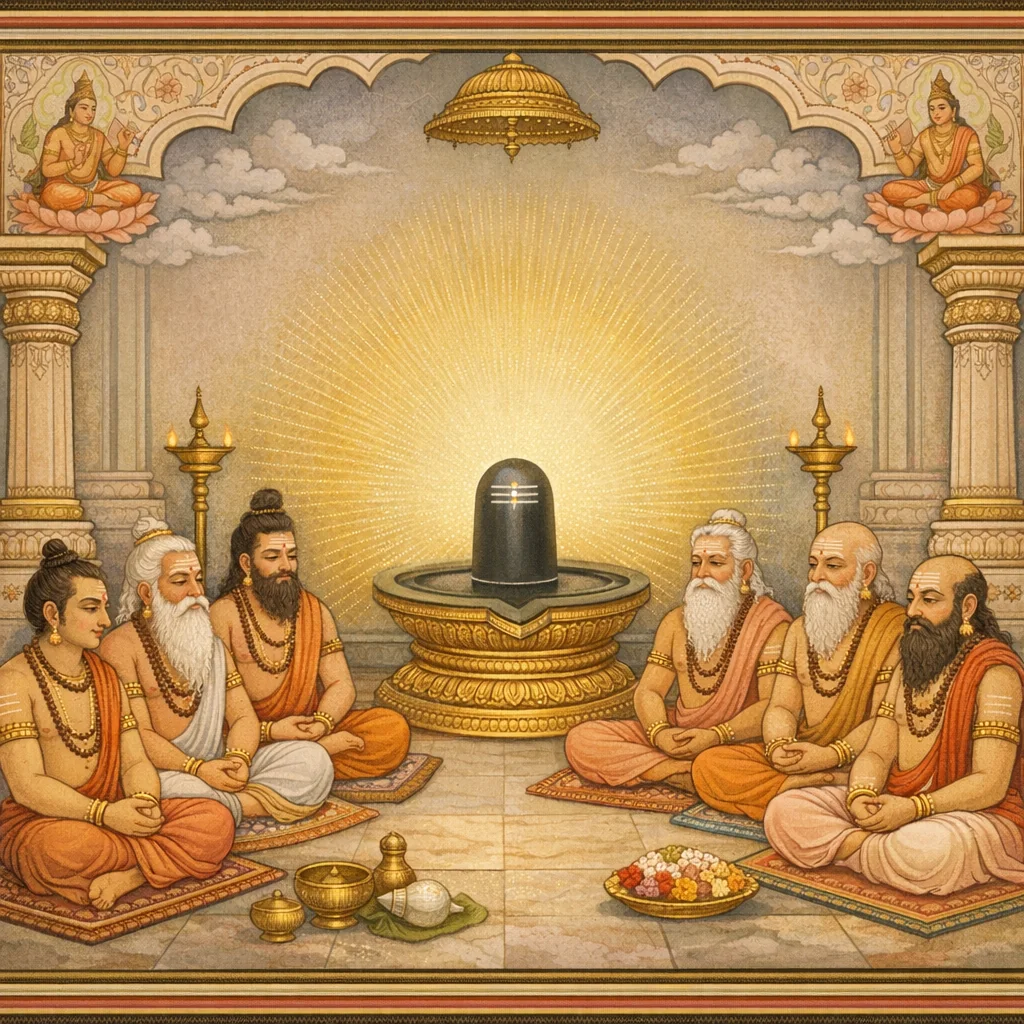
Adhyaya 49
Sūta introduces a “mahāpuṇya” stotra-chapter centered on Rāmanātha (Rāmeśvara), Śiva abiding in the installed liṅga. Rāma, Lakṣmaṇa, Sītā, Sugrīva and the vānaras—followed by devas and ṛṣis—offer hymns in sequence, praising Śiva through devotional epithets (Śūlin, Gaṅgādhara, Umāpati, Tripuraghna) as well as philosophical predicates (sākṣin, sat-cit-ānanda, nirlepa, advaya). Each speaker voices ethical and liberating aims: Lakṣmaṇa seeks unwavering bhakti across births, fidelity to Vedic conduct, and avoidance of “asat-mārga”; Sītā prays for the safeguarding of marital fidelity and right intention; Sugrīva, Vibhīṣaṇa, and the vānaras beg rescue from saṃsāra, pictured as an ocean/forest filled with fear, disease, anger, greed, and delusion. Devas and sages affirm that without devotion, ritual learning and austerities are fruitless, while even a single darśana, touch, or namaskāra can transform. Śiva commends the stotra and proclaims its phalaśruti: reciting or hearing it grants the fruit of worship and merits likened to extraordinary tīrtha observances and residence at Rāmasetu. Continued chanting culminates in freedom from aging and death and the attainment of sāyujya-mukti—union with Rāmanātha.
Shlokas
Verse 1
श्रीसूत उवाच । अथातः संप्रवक्ष्यामि रामनाथस्य शूलिनः । स्तोत्राध्यायं महापुण्यं शृणुत श्रद्धया द्विजाः
Śrī Sūta said: “Now I shall expound the highly meritorious chapter of hymns to Rāmanātha, the Trident-bearer. Listen with faith, O twice-born.”
Verse 2
रामः प्रतिष्ठिते लिंगे तुष्टाव परमेश्वरम् । लक्ष्मणो जानकी सीता सुग्रीवाद्याः कपीश्वराः
When the liṅga had been established, Rāma praised Parameśvara. Lakṣmaṇa, Jānakī Sītā, and Sugrīva with the other lords of the monkeys were present.
Verse 3
ब्रह्मप्रभृतयो देवाः कुम्भजाद्या महर्षयः । अस्तुवन्भक्तिसंयुक्ताः प्रत्येकं राघवेश्वरम्
Brahmā and the other gods, together with the great sages beginning with Kumbhaja (Agastya), each in turn, filled with devotion, praised Rāghaveśvara.
Verse 4
तद्वक्ष्याम्यानुपूर्व्येण शृणुतादरपूर्वकम् । एतच्छ्रवणमात्रेण मुक्तः स्या न्मानवो द्विजाः
I shall relate it in proper sequence—listen with reverent attention. By merely hearing this, O twice-born ones, a person may attain liberation.
Verse 5
श्रीराम उवाच । नमो महात्मने तुभ्यं महामायाय शूलिने । स्वपदांबुजभक्तार्तिहारिणे सर्प हारिणे
Śrī Rāma said: Salutations to You, the Great-Souled One—to the wielder of the trident, the Lord of mighty māyā; to Him who removes the distress of devotees at His lotus feet, and who bears the serpent as an adornment.
Verse 6
नमो देवाधिदेवाय रामनाथाय साक्षिणे । नमो वेदांतवेद्याय योगिनां तत्त्वदायिने
Salutations to the God beyond gods, the Lord of Rāma, the inner Witness. Salutations to Him who is known through Vedānta, who bestows true reality upon yogins.
Verse 7
सर्वदानंदपूर्णाय विश्वनाथाय शंभवे । नमो भक्तभयच्छेदहेतुपादाब्जरेणवे
Salutations to Śambhu, Viśvanātha, ever-full of bliss. Salutations to the dust of His lotus feet—the very cause that cuts away the fear of devotees.
Verse 8
नमस्तेऽखिलनाथाय नमः साक्षात्परात्मने । नमस्तेऽद्भुतवीर्याय महापातकनाशिने
Salutations to You, Lord of all; salutations to You who are directly the Supreme Self. Salutations to You of wondrous power, the destroyer of great sins.
Verse 9
कालकालाय कालाय कालातीताय ते नमः । नमोऽविद्यानिहंत्रे ते नमः पापहराय च
Salutations to You who are the Death of death, who are Time itself, and who transcend time. Salutations to You, the destroyer of ignorance; salutations also to You, the remover of sin.
Verse 10
नमः संसारतप्तानां तापनाशैकहेतवे । नमो मद्ब्रह्महत्याविनाशिने च विषाशिने
Salutations to You, the sole cause for ending the burning of those scorched by saṃsāra. Salutations to You who destroy even my sin of brahmin-slaying, and who drank the poison.
Verse 11
नमस्ते पार्वतीनाथ कैलासनिलयाव्यय । गंगाधर विरूपाक्ष मां रक्ष सकलापदः
Salutations to You, Lord of Pārvatī, the imperishable dweller on Kailāsa. O bearer of the Gaṅgā, O Virūpākṣa—protect me from every calamity.
Verse 12
तुभ्यं पिनाकहस्ताय नमो मदनहारिणे । भूयोभूयो नमस्तुभ्यं सर्वावस्थासु सर्वदा
Salutations to You whose hand bears the Pināka bow; salutations to the destroyer of Madana (Kāma). Again and again I bow to You—always, in every state of life.
Verse 13
लक्ष्मण उवाच । नमस्ते रामनाथाय त्रिपुरघ्नाय शंभवे । पार्वतीजीवितेशाय गणेशस्कन्दसूनवे
Lakṣmaṇa said: Salutations to Rāmanātha; to Śaṃbhu, the slayer of Tripura. Salutations to the Lord who is the very life of Pārvatī, the Father of Gaṇeśa and Skanda.
Verse 14
नमस्ते सूर्यचद्राग्निलोचनाय कपर्दिने । नमः शिवाय सोमाय मार्कंडेय भयच्छिदे
Salutations to You whose eyes are the Sun, the Moon, and Fire; to the Lord of matted locks. Salutations to Śiva, to Soma, who cut away the fear of Mārkaṇḍeya.
Verse 15
नमः सर्वप्रपंचस्य सृष्टिस्थित्यंतहेतवे । नम उग्राय भीमाय महादेवाय साक्षिणे
Salutations to the cause of the entire manifested world—its creation, preservation, and dissolution. Salutations to the fierce and awesome Mahādeva, the witnessing Consciousness.
Verse 16
सर्वज्ञाय वरेण्याय वरदाय वराय ते । श्रीकण्ठाय नमस्तुभ्यं पंचपातकभेदिने
Salutations to You, the all-knowing, the most worthy of worship, the giver of boons, the supreme refuge. O Śrīkaṇṭha, salutations to You, the destroyer of the five great sins.
Verse 17
नमस्तेऽस्तु परानंदसत्यविज्ञानरूपिणे । नमस्ते भवरोगघ्न स्नायूनां पतये नमः
Salutations to You, whose very nature is supreme bliss, truth, and awakened knowledge. Salutations to You, destroyer of the disease of worldly becoming; salutations to the Lord of the vital bonds (snāyus).
Verse 18
पतये तस्कराणां ते वनानां पतये नमः । गणानां पतये तुभ्यं विश्वरूपायसाक्षिणे
Salutations to You as the Lord even of thieves; salutations as the Lord of forests. Salutations to You, the Lord of the Gaṇas—O Witness whose form is the universe.
Verse 19
कर्मणा प्रेरितः शम्भो जनिष्ये यत्रयत्र तु । तत्रतत्र पदद्वंद्वे भवतो भक्तिरस्तु मे
O Śambhu, wherever I may be born—impelled by my karma—there, in every such place, may I have devotion to Your pair of feet.
Verse 20
असन्मार्गे रतिर्मा भूद्भवतः कृपया मम । वैदिकाचारमार्गे च रतिः स्याद्भवते नमः
By Your compassion, may I not delight in a wrong path. May I delight in the path of Vedic conduct—salutations to You.
Verse 21
सीतोवाच । परमकारण शंकर धूर्जटे गिरिसुतास्तनकुंकुमशोभित । मम पतौ परिदेहि मतिं सदा न विषमां परपूरुषगोचराम्
Sītā said: O Śaṅkara, the supreme cause; O Dhūrjaṭi, adorned with the saffron of the mountain-daughter’s breasts—grant my mind always to rest upon my husband, never becoming wayward or turning toward another man.
Verse 22
गंगाधर विरूपाक्ष नीललोहित शंकर । रामनाथ नमस्तुभ्यं रक्ष मा करुणाकर
O bearer of Gaṅgā, O Virūpākṣa, O Nīlalohita, O Śaṅkara—O Rāmanātha, salutations to You. Protect me, O ocean of compassion.
Verse 23
नमस्ते देवदेवेश नमस्ते करुणालय । नमस्ते भवभीतानां भवभीतिविमर्दन
Salutations to You, Lord of the gods; salutations to You, abode of compassion. Salutations to You who crush the fear of saṃsāra for those terrified of worldly existence.
Verse 24
नाथ त्वदीयचरणांबुजचिंतनेन निर्द्धूय भास्करसुताद्भयमाशु शम्भो । नित्यत्वमाशु गतवान्स मृकंडुपुत्रः किं वा न सिध्यति तवाश्रयणात्परेश
O Lord—by meditating on Your lotus-feet, O Śambhu, one quickly shakes off the fear of Yama, the Sun’s son. Mārkaṇḍeya, Mṛkaṇḍu’s son, swiftly attained deathlessness; what indeed cannot be accomplished by taking refuge in You, O Supreme Lord?
Verse 25
परेशपरमानंद शरणागतपालक । पातिव्रत्यं मम सदा देहि तुभ्यं नमोनमः
O Supreme Lord, supreme bliss, protector of those who seek refuge—grant me always pātivratya, the virtue of unwavering, devoted marital fidelity. Again and again, I bow to You.
Verse 26
हनूमानुवाच । देवदेव जगन्नाथ रामनाथ कृपानिधे । त्वत्पादांभोरुहगता निश्चला भक्तिरस्तु मे
Hanūmān said: O God of gods, Lord of the universe, Rāmanātha, treasure-house of compassion—may my devotion be unwavering, ever resting at Your lotus-feet.
Verse 27
यं विना न जगत्सत्ता तद्भानमपि नो भवेत् । नमः सद्भानरूपाय रामनाथाय शंभवे
Without Him, the world’s very existence would not be, nor would its shining arise; salutations to Śambhu, Rāmanātha, whose form is true Being and true Radiance.
Verse 28
अंगद उवाच । यस्य भासा जगद्भानं यत्प्रकाशं विना जगत् । न भासते नमस्तस्मै रामनाथाय शंभवे
Aṅgada said: By whose radiance the universe shines, and without whose light the world does not shine—salutations to that Śambhu, Rāmanātha.
Verse 29
जांबुवानुवाच । सर्वानंदो यदानंदो भासते परमार्थतः । नमो रामेश्वरायास्मै परमानंदरूपिणे
Jāmbavān said: That bliss which is the bliss of all, shining in truth as the highest Reality—salutations to that Rāmeśvara, whose very form is supreme bliss.
Verse 30
नील उवाच । यद्देशकालदिग्भेदैरभिन्नं सर्वदा द्वयम् । तस्मै रामेश्वरायास्मै नमोऽभिन्नस्व रूपिणे
Nīla said: He who is ever non-different, unpartitioned by distinctions of place, time, or direction—salutations to that Rāmeśvara, whose very nature is indivisible oneness.
Verse 31
नल उवाच । ब्रह्मविष्णुमहेशाना यदविद्याविजृंभिताः । नमोऽविद्याविहीनाय तस्मै रामेश्वराय ते
Nala said: From whom even Brahmā, Viṣṇu, and Maheśa are unfolded through ignorance—salutations to that Rāmeśvara, to You who are free from ignorance.
Verse 32
कुमुद उवाच । यस्त्वरूपापरिज्ञानात्प्रधानं कारणत्वतः । कल्पितं कारणायास्मै रामनाथाय शंभवे
Kumuda said: When Your formless Reality is not understood, the Pradhāna is imagined as the cause. Salutations to that true Cause—Śambhu, Rāmanātha.
Verse 33
पनस उवाच । जाग्रत्स्वप्नसुषुप्त्यादियदविद्याविजृंभितम् । जाग्रदादिविहीनाय नमोऽस्मै ज्ञानरूपिणे
Panasa said: Waking, dreaming, and deep sleep are but the unfoldment of ignorance. Salutations to the One beyond all such states, whose very nature is pure Knowledge.
Verse 34
गज उवाच । यत्स्वरूपापरिज्ञानात्कार्याणां परमा णवः । कल्पिताः कारणत्वेन तार्किकापसदैर्वृथा
Gaja said: Because Your true nature is not understood, the “atoms” of effects are vainly imagined—by the lowest disputants—as though they were the ultimate cause.
Verse 35
तमहं परमानंदं रामनाथं महेश्वरम् । आत्मरूपतया नित्यमुपासे सर्वसाक्षिणम्
I ever worship Mahādeva—Rāmanātha—supreme Bliss itself, the witness of all, abiding eternally as the very Self.
Verse 36
गवाक्ष उवाच । अज्ञानपाशबद्धानां पशूनां पाशमोचकम् । रामेश्वरं शिवं शांतमुपैमि शरणं सदा
Gavākṣa said: For beings bound by the noose of ignorance, He is the releaser of bonds. I ever take refuge in Rāmeśvara—Śiva, the Peaceful One.
Verse 37
गवय उवाच । साध्वस्तजगदाधारं चंद्रचूडमुमापतिम् । रामनाथं शिवं वन्दे संसारामयभेषजम्
Gavaya said: I bow to Śiva, Rāmanātha—the support of the universe, the Moon-crested Lord, the consort of Umā—who is the medicine for the disease of worldly existence.
Verse 38
शरभ उवाच । अंतःकरणमात्मेति यदज्ञानाद्विमोहितैः । भण्यते रमनाथं तमात्मानं प्रणमाम्यहम्
Śarabha said: Deluded by ignorance, some say that the inner instrument (mind) is the Self. I bow to that true Self—Rāmanātha.
Verse 39
गन्धमादन उवाच । रामनाथमुमानाथं गणनाथं च त्र्यंबकम् । सर्वपातकशुद्ध्यर्थमुपासे जगदीश्वरम्
Gandhamādana said: I worship Jagadīśvara—Rāmanātha, the Lord of Umā, the Lord of the Gaṇas, the Three-eyed One—for the purification from all sins.
Verse 40
सुग्रीव उवाच । संसारांभोधि मध्ये मां जन्ममृत्युजले भये । पुत्रदारधनक्षेत्रवीचिमालासमाकुले
Sugrīva said: In the midst of the ocean of worldly existence, I am afraid in the waters of birth and death—tossed about by the turbulent waves of sons, wife, wealth, and land.
Verse 41
मज्जद्ब्रह्मांडखंडे च पतितं नाप्तपारकम् । क्रोशंतमवशं दीनं विषयव्या लकातरम्
Drowning in a fragment of this vast universe, I have fallen and found no means to cross. Helpless and wretched, I cry out, terrified by the serpents of sense-objects.
Verse 42
व्याधिनक्रसमुद्विग्नं तापत्रयझषार्तिदम् । मां रक्ष गिरिजानाथ रामनाथ नमोऽस्तु ते
Disturbed by the crocodiles of disease and afflicted by the fish of the threefold sufferings, protect me, O Lord of Girijā—O Rāmanātha. Salutations to You.
Verse 43
विभीषण उवाच । संसारवनमध्ये मां विनष्टनिजमार्गके । व्याधिचौरे क्रोधसिंहे जन्मव्याघ्रे लयोरगे
Vibhīṣaṇa said: In the forest of worldly existence, I have lost my own path. There the thief called disease robs me, anger stands like a lion, birth is like a tiger, and dissolution coils like a serpent.
Verse 44
बाल्ययौवनवार्धक्यमहाभीमांधकूपके । क्रोधेर्ष्या लोभवह्नौ च विषयक्रूरपर्वते
In the dreadful blind well of childhood, youth, and old age; in the fires of anger, jealousy, and greed; and upon the cruel mountain of sense-objects—I am trapped.
Verse 45
त्रासभूकंटकाढ्ये च सीदंतमधुनांधकम् । शोभनां पदवीं शंभो नय रामेश्वराधुना
In this land filled with thorns of fear I now sink in darkness. O Śambhu, lead me at once to the auspicious path—lead me now to Rāmeśvara.
Verse 46
सर्वे वानरा ऊचुः । निंद्यानिंद्येषु सर्वत्र जनित्वा योनिषु प्रभो । कुंभीपाकादिनरके पतित्वा च पुनस्तथा
All the Vānaras said: O Lord, having been born everywhere in countless wombs—whether blameworthy or not—and having fallen into hells such as Kumbhīpāka, again and again we wander in the same way.
Verse 47
जनित्वा च पुनर्योनौ कर्मशेषेण कुत्सिते । संसारे पतितानस्मान्रामनाथ दयानिधे
Born again in a contemptible womb through the residue of karma, we have fallen into saṃsāra. O Rāma-nātha, ocean of compassion, look upon us with grace.
Verse 48
अनाथान्विवशान्दीनान्क्रोशतः पाहि शंकर । नमस्तेस्तु दयासिंधो रामनाथ महेश्वर
Protect us, O Śaṅkara—helpless, destitute, and without refuge, crying out. Salutations to You, O ocean of mercy, O Rāma-nātha, O Maheśvara.
Verse 49
ब्रह्मोवाच । नमस्ते लोकनाथाय रामनाथाय शंभवे । प्रसीद मम सर्वेश मदविद्यां विनाशय
Brahmā said: Salutations to You, Lord of the worlds—Rāma-nātha, Śambhu. Be gracious, O Lord of all, and destroy my ignorance.
Verse 50
इंद्र उवाच । यस्य शक्तिरुमा देवी जगन्माता त्रयीमयी । तमहं शंकरं वंदे रामनाथमुमापतिम्
Indra said: He whose power is the Goddess Umā—Mother of the universe, embodying the Vedic triad—I worship that Śaṅkara: Rāma-nātha, the Lord of Umā.
Verse 51
यम उवाच । पुत्रौ गणेश्वरस्कंदौ वृषो यस्य च वाहनम् । तं वै रामेश्वरं सेवे सर्वाज्ञाननिवृत्तये
Yama said: He whose sons are Gaṇeśvara and Skanda, and whose vehicle is the bull—I serve that very Rāmeśvara for the cessation of all ignorance.
Verse 52
वरुण उवाच । यस्य पूजाप्रभावेन जित मृत्युर्मृकंडुजः । मृत्युंजयमुपासेऽहं रामनाथं हृदा तु तम्
Varuṇa said: By the power of worship of Him, Mṛkaṇḍu’s son conquered death; with my very heart I adore Rāma-nātha, the Conqueror of Death.
Verse 53
कुबेर उवाच । ईश्वराय लसत्कर्णकुंडलाभरणाय ते । लाक्षारुणशरीराय नमो रामेश्वराय वै
Kubera said: Salutations to You, O Lord, whose ear-ornaments gleam; to You whose body shines with a lac-red radiance—to Rāmeśvara indeed I bow.
Verse 54
आदित्य उवाच । नमस्तेऽस्तु महादेव रामनाथ त्रियंबक । दक्षाध्वरविनाशाय नमस्ते पाहि मां शिव
Āditya said: Homage to You, O Mahādeva—O Rāmanātha, O Three-eyed One. O Destroyer of Dakṣa’s sacrifice, salutations to You; protect me, O Śiva.
Verse 55
सोम उवाच । नमस्ते भस्मदिग्धाय शूलिने सर्पमालिने । रामनाथ दयांभोधे स्मशाननिलयाय ते
Soma said: Salutations to You, smeared with sacred ash; to the Trident-bearer garlanded with serpents. O Rāmanātha, ocean of compassion—homage to You who abides in the cremation-ground.
Verse 56
अग्निरुवाच । इन्द्राद्यखिलदिक्पालसंसेवितपदांबुज । रामनाथाय शुद्धाय नमो दिग्वाससे सदा
Agni said: Homage to Him whose lotus-feet are served by Indra and all the guardians of the directions. To the pure Rāmanātha—salutations always to the sky-clad Lord.
Verse 57
वायुरुवाच । हराय हरिरूपाय व्याघ्रचर्मांबराय च । रामनाथ नमस्तुभ्यं ममाभीष्टप्रदो भव
Vāyu said: Salutations to Hara, who bears the form of Hari and wears a tiger-skin garment. O Rāmanātha, I bow to You—be the granter of my cherished aims.
Verse 58
बृहस्पतिरुवाच । अहंतासाक्षिणे नित्यं प्रत्यगद्वयवस्तुने । रामनाथ ममाज्ञानमाशु नाशय ते नमः
Bṛhaspati said: Salutations to You, the eternal Witness of egoity, the inward, non-dual Reality. O Rāmanātha, quickly destroy my ignorance—homage to You.
Verse 59
शुक्र उवाच । वंचकानामलभ्याय महामंत्रार्थरूपिणे । नमो द्वैतविहीनाय रामनाथाय शंभवे
Śukra said: Homage to You who are unattainable to deceivers, who embody the very meaning of the great mantra. Salutations to the One free from duality—to Rāmanātha, to Śambhu.
Verse 60
अश्विनावूचतुः । आत्मरूपतया नित्यं योगिनां भासते हृदि । अनन्य भानवेद्याय नमस्ते राघवेश्वर
The Aśvins said: Ever as the very Self, You shine in the hearts of yogins. O Lord knowable by the unwavering inner light alone—salutations to You, O Rāghaveśvara.
Verse 61
अगस्त्य उवाच । आदिदेव महादेव विश्वेश्वर शिवाव्यय । रामनाथांबिकानाथ प्रसीद वृष भध्वज
Agastya said: O Primordial God, O Mahādeva, Lord of the universe—O imperishable Śiva. O Rāmanātha, Lord of Ambikā, be gracious—O You whose banner bears the bull.
Verse 62
अपराधसहस्रं मे क्षमस्व विधुशेखर । ममाहमिति पुत्रादावहंतां मम मोचय
Forgive my thousands of offenses, O Moon-crested One. From the notions of “mine” and “I”—beginning with attachment to son and the rest—release me from egoity.
Verse 63
सुतीक्ष्ण उवाच । क्षेत्राणि रत्नानि धनानि दारा मित्राणि वस्त्राणि गवाश्वपुत्राः । नैवोपकाराय हि रामनाथ मह्यं प्रयच्छ त्वमतो विरक्तिम्
Sutīkṣṇa said: “Fields, jewels, wealth, wife, friends, garments, cows, horses, and sons—O Rāmanātha, none of these truly help me. Therefore, grant me detachment from them.”
Verse 64
विश्वामित्र उवाच । श्रुतानि शास्त्राण्यपि निष्फलानि त्रय्यप्यधीता विफलैव नूनम् । त्वयीश्वरे चेन्न भवेद्धि भक्तिः श्रीरामनाथे शिव मानुषस्य
Viśvāmitra said: “Even the scriptures one has heard become fruitless; even study of the Veda-triad is surely in vain, O Śiva, if a human being does not develop devotion to you, Śrī Rāmanātha.”
Verse 65
गालव उवाच । दानानि यज्ञा नियमास्तपांसि गंगादितीर्थेषु निमज्जनानि । रामेश्वरं त्वां न नमंति ये तु व्यर्थानि तेषामिति निश्चयोऽत्र
Gālava said: “Charities, sacrifices, religious observances, austerities, and even immersions in Gaṅgā and other tīrthas—if people do not bow to you, O Rāmeśvara, all these are declared fruitless; this is the conclusion here.”
Verse 66
वसिष्ठ उवाच । कृत्वापि पापान्यखिलानि लोकस्त्वामेत्य रामेश्वर भक्तियुक्तः । नमेत चेत्तानि लयं व्रजेयुर्यथांधकारो रवितेजसाऽद्धा
Vasiṣṭha said: “Even if a person has committed every sin, if he comes to you, O Rāmeśvara, endowed with devotion, and bows, then those sins dissolve—just as darkness is certainly destroyed by the sun’s radiance.”
Verse 67
अत्रिरुवाच । दृष्ट्वा तु रामेश्वरमेकदापि स्पृष्ट्वा नमस्कृत्य भवंतमीशम् । पुनर्न गर्भं स नरः प्रयायात्किं त्वद्वयं ते लभतं स्वरूपम्
Atri said: “Having even once beheld Rāmeśvara, having touched that holy presence (the liṅga), and having bowed to You, the Lord—such a man does not enter the womb again. What wonder is it? He attains Your non-dual essential nature.”
Verse 68
अंगिरा उवाच । यो रामनाथं मनुजो भवंतमुपेत्य बंधून्प्रणमन्स्मरेत । संतारयेत्तानपि सर्वपापात्किम द्भुतं तस्य कृतार्थतायाम्
Aṅgiras said: “That man who approaches You, O Rāmanātha, and while bowing remembers his kinsmen—he can ferry even them across from all sins. What is astonishing in his fulfilled success?”
Verse 69
गौतम उवाच । श्रीरामनाथेश्वर गूढमेत्तद्रहस्यभूतं परमं विशोकम् । त्वत्पादमूलं भजतां नृणां ये सेवां प्रकुर्वंति हि तेऽपि धन्याः
Gautama said: “O Śrī Rāmanātheśvara, this is a hidden teaching, a secret—supreme and sorrowless. Those who worship at the root of Your feet, and those who render service to such worshippers, they too are blessed.”
Verse 70
शतानंद उवाच । वेदांतविज्ञानरहस्यविद्भिर्विज्ञेयमेतद्धि मुमुक्षुभिस्तु । शास्त्राणि सर्वाणि विहाय देव त्वत्सेवनं यद्रघुवीरनाथ
Śatānanda said: “This is to be understood by those who know the secret of Vedāntic wisdom—especially by seekers of liberation: abandoning all (mere) scriptural disputation, O Deva, one should engage in Your service, O Lord of Raghu’s hero (Rāma).”
Verse 71
भृगुरुवाच । रामनाथ तव पादपंकजं द्वंद्वचिंतनविधूतकल्मषः । निर्भयं व्रजति सत्सुखा द्वयं सुप्रभं त्वथ अमोघचिद्धनम्
Bhṛgu said: “O Rāmanātha, he whose impurities are shaken off by reflecting on the pairs of opposites, and who takes refuge in Your lotus-feet, proceeds fearlessly to the radiant, unfailing wealth of consciousness—Your true, auspicious bliss beyond duality.”
Verse 72
कुत्स उवाच । रामनाथ तव पादसेवनं भोगमोक्षवरदं नृणां सदा । रौरवादिनरकप्रणाशनं कः पुमान्न भजते रसग्रहः
Kutsa said: “O Rāmanātha, service to Your feet ever grants humankind both enjoyment and liberation, and it destroys hells such as Raurava. Who, having tasted its sweetness, would not worship You?”
Verse 73
काश्यप उवाच । रामनाथ तव पादसेविनां किं व्रतैरुत तपोभिरध्वरैः । वेदशास्त्र जपचिन्तया च किं स्वर्गसिन्धुपयसापि किं फलम्
Kāśyapa said: “O Rāmanātha, for those who serve Your feet, what need is there of vows, austerities, or sacrificial rites? What need of Vedic and śāstric study, of japa and meditation? What further ‘fruit’ could even the waters of the celestial river bestow?”
Verse 74
श्रीरामनाथ त्वमागत्य शीघ्रं ममोत्क्रांतिकाले भवान्या च साकम् । मां प्रापय स्वात्मपादारविन्दं विशोकं विमोहं सुखं चित्स्वरूपम्
“O Śrī Rāmanātha, come swiftly at the time of my departing, together with Bhavānī. Lead me to Your own lotus-feet—into the state free from sorrow and delusion, into bliss, the very nature of pure consciousness.”
Verse 75
गन्धर्वा ऊचुः । रामनाथ त्वमस्माकं भजतां भवसागरे । अपारे दुःखकल्लोले न त्वत्तोन्या गतिर्हि नः
The Gandharvas said: “O Rāmanātha, for us who worship You amid the ocean of becoming—boundless and surging with waves of sorrow—there is truly no other refuge than You.”
Verse 76
किन्नरा ऊचुः । रामनाथ भवारण्ये व्याधिव्याघ्रभयानके । त्वामंतरेण नास्माकं पदवीदर्शको भवेत्
The Kinnaras said: “O Rāmanātha, in this forest of worldly existence—terrifying with the tiger of disease—without You there could be none to show us the path.”
Verse 77
यक्षा ऊचुः । रामनाथेंद्रियारातिबाधा नो दुःसहा सदा । तान्विजेतुं सहायस्त्वमस्माकं भव धूर्जटे
The Yakṣas said: “O Rāmanātha, the torment from the enemies of the senses is ever unbearable for us. To conquer them, be our helper, O Dhūrjaṭi.”
Verse 78
नागा ऊचुः । अचिन्त्यमहिमानं त्वा रामनाथ वयं कथम् । स्तोतुमल्पधियः शक्ता भविष्यामोंऽबिकापते
The Nāgas said: “O Rāmanātha, Your greatness is beyond conception. How could we—small in understanding—ever be capable of praising You, O Lord of Ambikā?”
Verse 79
किंपुरुषा ऊचुः । नानायोनौ च जननं मरणं चाप्यनेकशः । विनाशय तथाऽज्ञानं रामनाथ नमोऽस्तु ते
The Kiṃpuruṣas said: “In countless wombs there is birth, and again and again there is death. Destroy that ignorance, O Rāmanātha—salutations to You.”
Verse 80
विद्याधरा ऊचुः । अंबिकापतये तुभ्यमसंगाय महात्मने । नमस्ते रामनाथाय प्रसीद वृषभध्वज
The Vidyādharas said: “Salutations to You, the Lord of Ambikā—detached and great-souled. O Rāmanātha, be gracious; O You whose banner is the bull!”
Verse 81
वसव ऊचुः । रामनाथगणेशाय गणवृंदार्चितांघ्रये । गंगाधराय गुह्याय नमस्ते पाहि नः सदा
The Vasus said: “Salutations to You—Rāmanātha, Lord of the Gaṇas, whose feet are worshipped by hosts of Gaṇas; bearer of the Gaṅgā, the mysterious One. Protect us always.”
Verse 82
विश्वेदेवा ऊचुः । ज्ञप्तिमात्रैकनिष्ठानां मुक्तिदाय सुयोगिनाम् । रामनाथाय सांबाय नमोऽस्मान्रक्ष शंकर
The Viśvedevas said: “Salutations to Rāmanātha, to Sāṃba—bestower of liberation upon the true yogins who abide with one-pointed steadiness in pure awareness alone. O Śaṅkara, protect us.”
Verse 83
मरुत ऊचुः । परतत्त्वाय तत्त्वानां तत्त्वभूताय वस्तुतः । नमस्ते रामनाथाय स्वयंभानाय शंभवे
The Maruts said: “Salutations to You, O Rāmanātha—Śambhu, self-manifest—supreme Reality beyond all principles, and in truth the very essence of all tattvas.”
Verse 84
साध्या ऊचुः । स्वातिरिक्तविहीनाय जगत्सत्ताप्रदायिने । रामेश्वराय देवाय नमोऽविद्या विभेदिने
The Sādhyas said: “Salutations to the divine Rāmeśvara, who has nothing apart from His own Self, who grants existence to the world, and who severs ignorance.”
Verse 85
सर्वे देवा ऊचुः । सच्चिदानंदसंपूर्णं द्वैतवस्तुविवर्जितम् । ब्रह्मात्मानं स्वयंभानमादिमध्यांतवर्जितम्
All the gods said: “You are complete as Existence, Consciousness, and Bliss (Sat-Cit-Ānanda), free from all dualistic ‘thingness’; the very Self of Brahman, self-manifest, devoid of beginning, middle, and end.”
Verse 86
अविक्रियमसंगं च परिशुद्धं सनातनम् । आकाशादिप्रपंचानां साक्षिभूतं परामृतम्
Unchanging, unattached, perfectly pure, and eternal—You are the Witness of the manifested expanse beginning with ether (ākāśa), and the supreme nectar of immortality.
Verse 87
प्रमातीतं प्रमाणानामपि बोधप्रदायिनम् । आविर्भावतिरोभाव संकोचरहितं सदा
Transcending even the instruments of knowledge, yet bestowing awakening—ever free from contraction amid appearing and disappearing.
Verse 88
स्वस्मिन्नध्यस्तरूपस्य प्रपंचस्यास्य साक्षिणम् । निर्लेपं परमानंदं निरस्तसकलक्रियम्
You are the witness of this world-appearance superimposed upon Yourself—unstained, of supreme bliss, with all compulsive activity stilled.
Verse 89
भूमानंदं महात्मानं चिद्रूपं भोगवर्जितम् । रामनाथं वयं सर्वे स्वपातकविशुद्धये
All of us seek Rāmanātha—vast bliss, the Great Soul, pure consciousness, beyond sense-enjoyment—for the cleansing of our own sins.
Verse 91
रामनाथाय रुद्राय नमः संसारहारिणे । ब्रह्मविष्ण्वादिरूपेण विभिन्नाय स्वमायया
Salutations to Rāmanātha, to Rudra who removes saṃsāra—who, by His own māyā, appears differentiated in forms such as Brahmā and Viṣṇu.
Verse 92
विभीषणसचिवा ऊचुः । वरदाय वरेण्याय त्रिनेत्राय त्रिशूलिने । योगिध्येयाय नित्याय रामनाथाय ते नमः
Vibhīṣaṇa’s ministers said: Salutations to You, O Rāmanātha—bestower of boons, most worthy of reverence, three-eyed, trident-bearing, ever-existent, and the perpetual object of yogins’ meditation.
Verse 93
सूत उवाच । इति रामादिभिः सर्वैः स्तुतो रामेश्वरः शिवः । प्राह सर्वान्समाहूय रामादीन्द्विजसत्तमाः
Sūta said: Thus was Śiva, Rāmeśvara, praised by all, beginning with Rāma. Then, having summoned everyone, he spoke to Rāma and the others, O best of the twice-born.
Verse 94
रामराम महाभाग जानकीरमण प्रभो । सौमित्रे जानकि शुभे हे सुग्रीव मुखास्तथा
“Rāma, Rāma—O greatly fortunate Lord, beloved of Jānakī! O Saumitrī (Lakṣmaṇa)! O auspicious Jānakī! And you, Sugrīva, foremost among speakers—listen!”
Verse 95
अन्ये ब्रह्ममुखा यूयं शृणुध्वं सुसमास्थिताः । स्तोत्राध्यायमिमं पुण्यं युष्माभिः कृतमादरात्
“And you others—foremost among the divine ones, headed by Brahmā—listen attentively, seated in composure. This holy chapter of praise has been composed by you with reverence and devotion.”
Verse 96
ये पठंति च शृण्वंति श्रावयंति च मानवाः । मदर्चनफलं तेषां भविष्यति न संशयः
“Those who recite this, who listen to it, and who cause others to hear it—without doubt, they shall obtain the fruit of worshipping Me.”
Verse 97
रामचंद्रधनुष्कोटिस्नानपुण्यं च वै भवेत् । वर्षमेकं रामसेतौ वासपुण्यं भविष्यति
“Indeed, one gains the merit of bathing at the ‘tip of Rāmacandra’s bow’. And by dwelling at Rāmasetu for even one year, the merit of such residence surely accrues.”
Verse 98
गन्धमादनमध्यस्थसर्वर्तीर्थाभिमज्जनात् । यत्पुण्यं तद्भवेत्तेन नात्र संशयकारणम्
Whatever merit arises from bathing in all the sacred fords situated in the midst of Gandhamādana—one attains that very merit here; there is no cause for doubt.
Verse 99
उक्त्वैवं रामनाथोऽपि स्वात्मलिंगे तिरोदधे । स्तोत्राध्यायमिमं पुण्यं नित्यं संकीर्तयन्नरः
Having spoken thus, Rāmanātha too disappeared into His own liṅga. The man who daily chants this holy chapter of praise…
Verse 100
जरामरणनिर्मुक्तो जन्मदुःखविवर्जितः । रामनाथस्य सायुज्यमुक्तिं प्राप्नोत्यसंशयः
Freed from old age and death, and devoid of the sorrow of repeated birth, he attains—without doubt—the liberation of union (sāyujya) with Rāmanātha.