Adhyaya 5
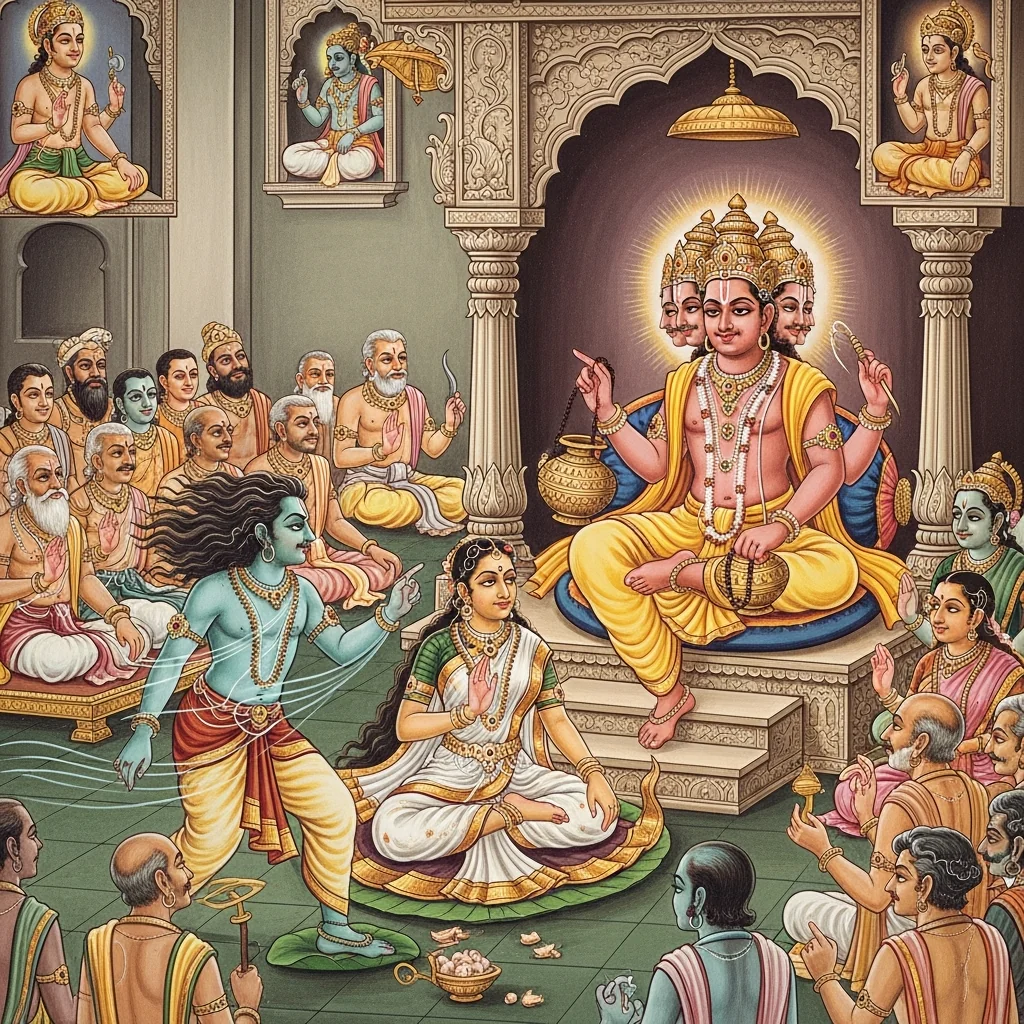
Sūta tells the sages of the wondrous power of Cakratīrtha, praised as a pāpa-vināśana tīrtha that destroys sin. The tale begins with the Vasu Vidhūma and the celestial dancer Alambusā, both struck by a severe curse from Brahmā. In Brahmā’s assembly, the wind lifts Alambusā’s garment; seeing desire arise in Vidhūma, Brahmā condemns him to human birth and appoints Alambusā as his future wife. When Vidhūma pleads, Brahmā sets a limit: after ruling as a king, begetting an heir, and installing that heir on the throne, Vidhūma must bathe with his wife at Cakratīrtha near Phullagrāma on the southern ocean shore—only then will the curse end. The narrative traces the curse’s unfolding through the Somavaṃśa-linked king Śatānīka and queen Viṣṇumatī; by the sage Śāṇḍilya’s grace, Sahasrānīka is born (Vidhūma himself), and his attendants are reborn as royal companions. Alambusā is born as Mṛgāvatī, daughter of king Kṛtavarman. A separation follows: a bird carries Mṛgāvatī away; she finds refuge at Jamadagni’s āśrama, gives birth to Udayana, and later reunion is achieved through recognition tokens and the sage’s intervention. After Udayana is enthroned, Sahasrānīka fulfills the ordained pilgrimage to Cakratīrtha with Mṛgāvatī and their companions; upon bathing, the human state vanishes instantly, divine forms return, and their ascent to heaven is described. The chapter ends with a phalaśruti: reciting or hearing it grants desired fruits and affirms the tīrtha’s ritual authority.
Shlokas
Verse 1
श्रीसूत उवाच । प्रस्तुत्य चक्रतीर्थं तु पुण्यं पापविनाशनम् । पुनरप्यद्भुतं किञ्चित्प्रब्रवीमि मुनीश्वराः
Śrī Sūta said: “Having spoken of Cakra-tīrtha—holy and destructive of sin—I shall now tell you again something further that is wondrous, O lords among sages.”
Verse 2
विधूमनामा हि वसुर्देवस्त्री चाप्यलंबुषा । ब्रह्मशापान्महाघोरात्पुरा प्राप्तौ मनुष्यताम्
Indeed, a Vasu named Vidhūma—and his divine wife, Alambuṣā—once, through Brahmā’s most dreadful curse, came to assume human status.
Verse 3
चक्रतीर्थे महापुण्ये स्नात्वा शापाद्विमोचितौ । ऋषय ऊचुः । सूतसूत महाप्राज्ञ पुराणार्थविशारद
Having bathed at the greatly meritorious Cakra-tīrtha, the two were freed from the curse. The sages said: “O Sūta’s son, greatly wise one, skilled in the meanings of the Purāṇas—”
Verse 4
प्राज्ञत्वाद्व्यासशिष्य त्वादज्ञातं ते न किंचन । ब्रह्मा केनापराधेन सहालंबुसया वसुम्
Because you are wise, and because you are Vyāsa’s disciple, nothing is unknown to you. For what offense did Brahmā curse the Vasu along with Alambuṣā?
Verse 5
पुरा विधूमनामानं शप्तवांश्चतुराननः । ब्रह्मशापेन घोरेण कयोस्तौ पुत्रतां गतौ
Formerly, the Four-faced Lord (Brahmā) cursed the one named Vidhūma. By that dreadful curse of Brahmā, those two entered the state of sonship—namely, they were born as the children of someone.
Verse 6
शापस्यान्तः कथमभूद्ब्रह्मणा शप्तयोस्तयोः । एतन्नः श्रद्दधानानां विस्तराद्वक्तुमर्हसि
How did the curse come to an end for those two who were cursed by Brahmā? Please tell this to us, who listen with faith, in full detail.
Verse 7
श्रीसूत उवाच । पुरा हि भगवान्ब्रह्मा स्वयम्भूश्चतुराननः । सावित्र्या च सरस्वत्या पार्श्वयोः प्रविराजितः
Śrī Sūta said: In ancient times, the Blessed Lord Brahmā—the self-born, four-faced Creator—shone resplendently, with Sāvitrī and Sarasvatī radiant at his two sides.
Verse 8
सनातनेन मुनिना सनकेन च धीमता । सनत्कुमारनाम्ना च नारदेन महात्मना
He was attended by the sage Sanātana, by the wise Sanaka, by the one famed as Sanatkumāra, and by the great-souled Nārada.
Verse 9
सनन्दनादिभिश्चान्यैः सेव्यमानो मुनीश्वरैः । सुपर्ववृन्दजुष्टेन स्तूयमानो बिडौजसा
Served by Sanandana and other lordly sages, and accompanied by hosts of exalted celestial beings, he was continually praised by the mighty divine ones.
Verse 10
आदित्यादि ग्रहैश्चैव स्तूयमानपदांबुजः । सिद्धैः साध्यैर्मरुद्भिश्च किंनरैश्च समावृतः
His lotus-feet were praised even by Āditya and the other planetary deities; and he was surrounded by Siddhas, Sādhyas, Maruts, and Kiṃnaras.
Verse 11
गणैः किंपुरुषाणां च वसुभिश्चाष्टभिर्वृतः । उर्वशीप्रमुखानां च स्वर्वेश्यानां मनोरमम्
He was encircled by groups of Kiṃpuruṣas and by the eight Vasus; and the charming presence of the heavenly Apsarases—led by Urvaśī—also graced that assembly.
Verse 12
नृत्यं वादित्रसहितं वीक्ष्यमाणो मुहुर्मुहुः । गोष्ठीं चक्रे सभामध्ये सत्यलोके कदाचन
Watching again and again the dance accompanied by musical instruments, he once convened a sacred discourse in the midst of the assembly in Satyaloka.
Verse 13
मेघगर्जितगम्भीरो जनानां नंदयन्मुहुः । वीणावेणुमृदंगानां ध्वनिस्तत्र व्यसर्पत
Deep as the rumble of thunderclouds and delighting the gathered beings again and again, the sound of vīṇās, flutes, and mṛdaṅgas spread throughout that place.
Verse 14
गंगातरंगमालानां शीकरस्पर्शशीतलः । पवमानः सुखस्पर्शो मन्दं मन्दं ववौ तदा
Then a gentle breeze began to blow—cool with the touch of spray from Gaṅgā’s garland of waves, and pleasing to the skin.
Verse 15
पर्यायेण तदा सर्वा ननृतुर्देवयोषितः । नृत्यश्रमेण खिन्नासु वेश्यास्वन्यासु सादरम्
Then, taking turns, all the divine maidens danced. When some were wearied by the exertion of dancing, others—like skilled courtesan-performers—stepped forward with eager grace.
Verse 16
अलंबुसा देवनारी रूपयौ वनशालिनी । मदयन्ती जनान्सर्वान्सभामध्ये ननर्त वै
Then the celestial lady Alambusā—youthful in beauty and radiant with graceful charm—truly danced in the midst of the assembly, enchanting all those present.
Verse 17
तस्मिन्नवसरे तस्या नृत्यंत्याः संसदि द्विजाः । वस्त्रमाभ्यंतरं वायुर्लीलया समुदक्षिपत्
At that very moment, O twice-born ones, as she danced in the assembly, the wind, in playful sport, lifted her inner garment.
Verse 19
तत्क्षिप्ते वसने स्पष्टमूरुमूलमदृश्यत । तथाभूतां तु तां दृष्ट्वा सर्वे ब्रह्मादयो ह्रिया
When her garment was thus tossed aside, the root of her thighs became plainly visible; seeing her in that condition, all—beginning with Brahmā—were filled with shame.
Verse 20
तामेव ब्रह्मभवने दृष्ट्वानिलहृतांशुकाम् । हर्षसंफुल्लनयनो हृष्टरोमा ततोऽभवत्
Seeing her there in Brahmā’s abode, with her garment carried away by the wind, he became delighted—his eyes blooming with excitement and his hair standing on end.
Verse 21
अलंबुसायां तस्यां तु जातकामं विलोक्य तम् । वसुं विधूमनामानं शशाप चतुराननः
But when the Four-faced Lord saw that desire had arisen in him toward that Alambusā, he cursed the Vasu named Vidhūma.
Verse 22
यस्मात्त्वमीदृशं कार्यं विधूम कृतवानसि । तस्माद्धि मर्त्यलोके त्वं मानुषत्वमवाप्स्यसि
“Because you, Vidhūma, have done such a deed, therefore in the mortal world you shall indeed attain human birth.”
Verse 23
इयं च देवयोषित्ते तत्र भार्या भविष्यति । एवं स ब्रह्मणा शप्तो विधूमः खिन्नमानसः
“And this celestial maiden shall there become your wife.” Thus cursed by Brahmā, Vidhūma became downcast at heart.
Verse 24
प्रसादयामास वसुर्ब्रह्माणं प्रणिपत्य तु । विधूम उवाच । अस्य शापस्य घोरस्य भगवन्भक्तवत्सल
The Vasu bowed down and sought to appease Brahmā. Vidhūma said: “O Blessed Lord, tender to your devotees—regarding this dreadful curse…”
Verse 25
नाहमर्होऽस्मि देवेश रक्ष मां करुणानिधे । एवं प्रसादितस्तेन भारतीपतिरव्ययः
“I am not worthy, O Lord of the gods; protect me, O treasure-house of compassion.” Thus entreated by him, the imperishable Lord of Bhāratī (Brahmā) was appeased.
Verse 26
कृपया परया युक्तो विधूमं प्राह सांत्वयन् । ब्रह्मोवाच । त्वयि शापोऽप्ययं दत्तो न चासत्यं ब्रवीम्यहम्
Endowed with supreme compassion, Brahmā spoke to Vidhūma, consoling him: “This curse has indeed been laid upon you, and I do not speak falsehood.”
Verse 27
ततोऽवधिं कल्पयामि शापस्यास्य तवाधुना । मर्त्यभावं समापन्नः सहालंबुसयाऽनया
“Therefore, I now appoint a limit to this curse of yours: having entered the mortal condition together with this Alambusā…”
Verse 28
तत्र भूत्वा महाराजः शासयित्वा चिरं महीम् । पुत्रमप्रतिमं त्वस्यां जनयित्वा महीपतिम्
There he would become a great king; and after ruling the earth for a long time, he would beget in her an incomparable son—one fit to be a sovereign of the land.
Verse 29
अभिषिच्य च राज्ये तं राज्यरक्षाविचक्षणम् । एतच्छापस्य शांत्यर्थं दक्षिणस्योदधेस्तटे । फुल्लग्रामसमीपस्थे चक्रतीर्थे महत्तरे
After installing that son—skilled in protecting the kingdom—upon the throne, in order to bring this curse to peace, (he should go) to the shore of the southern ocean, to the great Cakratīrtha situated near Phullagrāma.
Verse 30
अनया भार्यया सार्द्धं यदा स्नानं करिष्यसि । तदा त्वं मानुषं भावं जीर्णत्वचमिवोरगः
When you perform the sacred bath together with this wife, then you will assume a human state—like a serpent casting off its worn-out skin.
Verse 31
विसृज्य भार्यया सार्द्धं स्वं लोकं प्रतिपत्स्यसे । चक्रतीर्थे विना स्नानं न नश्येच्छाप ईदृशः
After fulfilling this course along with your wife, you will regain your own world. Without bathing at Cakratīrtha, a curse of this kind would not be destroyed.
Verse 32
इति ब्रह्मवचः श्रुत्वा विधूमो नातिहृष्टवान् । स्ववेश्म प्राविशत्तूर्णमामंत्र्य चतुराननम्
Having heard these words of Brahmā, Vidhūma was not greatly pleased. After taking leave of the Four-faced Lord, he quickly entered his own dwelling.
Verse 33
चिंतयामास तत्रासौ मर्त्यतां यास्यतो मम । को वा पिता भवेद्भूमौ का वा माता भविष्यति
Then he reflected: “As I am to enter mortality, who indeed will be my father on earth, and who will become my mother?”
Verse 34
बहुधेत्थं समालोच्य विधूमो निश्चिकाय सः । कौशांबीनगरे राजा शतानीक इति श्रुतः
Having deliberated in many ways, Vidhūma came to a decision: in the city of Kauśāmbī there is a king famed by the name Śatānīka.
Verse 35
अस्ति वीरो महाभागो भार्या चापि पतिव्रता । तस्य विष्णुमतीनाम विष्णोः श्रीरिव वल्लभा
He is a heroic and fortunate man, and his wife too is devoted, faithful to the vow of pativratā. She is named Viṣṇumatī—beloved to him, as Śrī is to Viṣṇu.
Verse 36
तमेव पितरं कृत्वा मातरं च विधाय ताम् । संभविष्यामि भूलोके स्वकर्मपरिपाकतः
Choosing him alone as my father, and appointing her as my mother, I shall be born in the earthly world—by the ripening of my own deeds.
Verse 37
ततः स माल्यवन्तं च पुष्पदंतं बलोत्कटम् । त्रीनाहूयात्मनो भृत्यान्वृत्तमेतन्न्यवे दयत्
Then he summoned three of his attendants—Mālyavant and Puṣpadanta, formidable in strength—and informed them of all that had occurred.
Verse 38
भृत्याः शृणुत भद्रं वो ब्रह्मशापान्महाभयात् । जनिष्यामि शतानीकाद्विष्णुमत्यामहं सुतः
“Servants, listen—may good befall you. Out of the great terror of a Brahmin’s curse, I shall be born as a son of King Śatānīka, from Viṣṇumatī.”
Verse 39
इति श्रुत्वा वचो भृत्यास्तस्या प्राणा बहिश्चराः । वाष्पपूर्णमुखाः सर्वे विधूमं वाक्यमब्रुवन्
Having heard those words, the attendants—his very life-breath as though moving outside him—stood with faces filled with tears, and all of them spoke to Vidhūma.
Verse 40
भृत्या ऊचुः । त्वद्वियोगं वयं सर्वे त्रयोऽपि न सहामहे । तस्मान्मानुष भावत्वमस्माभिः सह यास्यसि
The attendants said: “We three cannot endure separation from you. Therefore, you will enter human embodiment together with us.”
Verse 41
शतानीकस्य राजर्षेर्मंत्री योऽयं युगन्धरः । सेनानीर्विप्रतीकश्च योऽयं प्राग्रसरो रणे
“This Yugandhara, who is minister to the royal sage Śatānīka, and this Vipratīka, the commander who advances foremost in battle—”
Verse 42
नर्मकर्मसु हृद्विप्रो वल्लभाख्यो महांश्च यः । तेषां पुत्रास्त्रयोऽप्येते भविष्यामो न संशयः
“And Vallabha—great-hearted, a Brahmin skilled in the arts of pleasing and friendly fellowship—of those men, we three shall indeed become the sons; of this there is no doubt.”
Verse 43
शतानीकस्य राजर्षेः पुत्रभावं गतस्य ते । शुश्रूषां संविधास्यामस्तेषु तेषु च कर्मसु । तानेवंवादिनः सोऽयं विधूमो वाक्यमब्रवीत्
“When you have entered the state of being a son to the royal sage Śatānīka, we shall serve you in every duty and in every task.” As they spoke thus, Vidhūma replied to them.
Verse 44
विधूम उवाच । जानेऽहं भवतां स्नेहं तादृशं मय्य नुत्तमम्
Vidhūma said: “I know your affection—such unsurpassed love you bear toward me.”
Verse 45
तथापि कथयाम्यद्य तच्छृणुध्वं हितं वचः । ब्रह्मशापेन घोरेण स्वेन दुष्कर्मणा कृतम्
“Yet today I shall speak—listen to these beneficial words. This dreadful Brahmin’s curse has been brought about by my own evil deed.”
Verse 46
कुत्सितं मानुषं भावमहमेकोऽनुवर्तये । विहितं न हि युष्माकमेतच्छापानुवर्तनम्
“I alone shall undergo this blameworthy human condition. It is not ordained for you to follow this curse.”
Verse 47
जुगुप्सितेऽतो मानुष्ये मा कुरुध्वं मनोऽधुना । अतः शापावधिर्यावन्मद्वियोगो विषह्यताम्
“Therefore, do not set your minds now on this loathsome human state. Until the curse reaches its end, let separation from me be endured.”
Verse 48
इत्युक्तवन्तं ते सर्वे माल्यवत्प्रमुखास्तदा । ऊचुः प्रणम्य शिरसा प्रार्थयंतः पुनःपुनः
When he had spoken thus, all of them—led by Mālyavat—bowed their heads in reverence and, imploring again and again, addressed him.
Verse 49
रक्षित्वा कृपया ह्यस्मान्मा कुरुष्व च साहसम् । परित्यजसि नः सर्वान्भक्तानद्य निरागसः
Having protected us out of compassion, do not now commit a rash act. Do not abandon all of us—your devoted ones—today, though we are without fault.
Verse 50
त्वद्वियोगान्महाघोरान्मानुष्यमपि कुत्सितम् । बहु मन्यामहे देव तस्मान्नस्त्राहि सांप्रतम्
Because of separation from you, even human life appears utterly dreadful and contemptible to us. Therefore, O Lord, protect us right now.
Verse 51
एवं स याचमानांस्त्रीनन्वमन्यत भृत्यकान् । तैस्त्रिभिः सहितः सोऽयं कौशांबीं गन्तुमैच्छत
Thus, he assented to the three servants who were pleading. Accompanied by those three, he then desired to go to Kauśāmbī.
Verse 52
एतस्मिन्नेव काले तु सोमवंशविवर्द्धनः । अर्जुनाभिजने जातो जनमेजयसंभवः
At that very time, there was born one who would augment the Lunar dynasty (Somavaṃśa)—descended from Arjuna’s lineage—an offspring of Janamejaya.
Verse 53
शतानीको महीपालः पृथिवीमन्वपालयत् । बुद्धिमान्नीतिमान्वाग्मी प्रजापालनतत्परः
King Śatānīka ruled the earth—wise, skilled in statecraft, eloquent, and steadfastly devoted to the protection of his subjects.
Verse 54
चतुरंगबलोपेतो विक्रमैकधनो युवा । स कौशांबीं महाराजो नगरीमध्युवास वै
Endowed with the fourfold army, youthful, and rich only in valor, that great king indeed dwelt in the city of Kauśāmbī.
Verse 55
तस्य मन्त्ररहस्यज्ञो मन्त्री जातो युगंधरः । सेनानीर्विप्रतीकश्च तस्य प्राग्रसरो रणे
His minister was Yugandhara, a knower of the secrets of counsel; and his commander was Vipratīka, who stood foremost for him in battle.
Verse 56
नर्मकर्मसु तस्यासीद्वल्लभाख्यः सखा द्विजः । तस्य विष्णुमती नाम विष्णोः श्रीरिव वल्लभा
In playful and intimate affairs, he had a Brāhmaṇa friend named Vallabha. Vallabha’s beloved was named Viṣṇumatī—dear to him as Śrī is to Viṣṇu.
Verse 57
स सर्वगुणसंपन्नः शतानीको महामतिः । पुत्रमात्मसमं तस्यां भार्यायां नान्वविंदत
That great-minded Śatānīka, endowed with every virtue, did not obtain from that wife a son equal to himself.
Verse 58
आत्मानमसुतं ज्ञात्वा स भृशं पर्यतप्यत । स युगंधरमाहूय मंत्रिणं मन्त्रवित्तमम्
Realizing that he was without a son, the king was sorely distressed. He then summoned Yugandhara, his minister—supremely skilled in counsel.
Verse 59
पुत्रलाभः कथं मे स्यादिति कार्यममन्त्रयत् । युगन्धरो मही पालं पुत्रालाभेन पीडितम् । हर्षयन्वचसा स्वेन वाक्यमेतदभाषत
He deliberated: “How may I obtain a son?” Then Yugandhara, seeing the ruler of the earth afflicted by the lack of offspring, spoke these words to console and gladden him.
Verse 60
युगन्धर उवाच । अस्ति शांडिल्यनामा तु महर्षिः सत्यवाक्छुचिः
Yugandhara said: “There is a great sage named Śāṇḍilya—truth-speaking and pure.”
Verse 61
शत्रुमित्रसमो दांतस्तपःस्वाध्यायतत्परः । तमेव मुनिमासाद्य ज्वलंतमिव पावकम्
He is equal-minded toward foe and friend, self-controlled, and devoted to austerity and sacred study. Approach that very muni—blazing like fire—
Verse 62
पुत्रमात्मसमं राजन्प्रार्थयेथा विनीतवत् । कृपावान्स महर्षिस्तु पुत्रं ते दास्यति ध्रुवम्
“O King, humbly request from him a son equal to yourself. That great sage, compassionate by nature, will surely grant you a son.”
Verse 63
इति तद्वचनं श्रुत्वा हर्षसंफुल्ललोचनः । मंत्रिणा तेन संयुक्तस्तस्यागादाश्रमं मुनेः
Hearing those words, his eyes blossoming with joy, the king—accompanied by that minister—went to the sage’s āśrama.
Verse 64
तमाश्रमे समासीनं प्रणनाम महीपतिः । शांडिल्यस्तु महातेजा राजानं प्राप्तमाश्रमम्
In the āśrama, the king bowed to the sage seated there. And Śāṇḍilya, radiant with great spiritual splendor, saw that the king had come to the āśrama.
Verse 65
दृष्ट्वा पाद्यादिभिः पूज्य स्वागतं व्याजहार सः । शांडिल्य उवाच । शतानीक किमर्थं त्वमाश्रमं प्राप्तवान्मम
Seeing him, the sage honored him with the rites of welcome—water for the feet and the like—and offered greetings. Śāṇḍilya said: “Śatānīka, for what purpose have you come to my āśrama?”
Verse 66
यत्कर्तव्यमिदानीं ते तद्वदस्व करोम्यहम् । मुनिमेवं वदंतं तं प्रत्यवादीद्युगंधरः
“Tell me what should be done for you now; I shall do it.” As the sage spoke thus, Yugandhara replied to him.
Verse 67
भगवन्नेष वै राजा पुत्रालाभेन कर्षितः । भवंतं शरणं प्राप्तः सांप्रतं पुत्रकारणात्
“O Bhagavān, this king is worn down by the non-attainment of a son. He has now come to you for refuge, seeking the cause of obtaining a son.”
Verse 68
अस्यापुत्रत्वजं दुःखं त्वमपाकर्तुमर्हसि । इति तस्य वचः श्रुत्वा शांडिल्यो मुनिसत्तमः
“You should remove this sorrow born of childlessness.” Hearing those words, Śāṇḍilya—the foremost of sages—responded.
Verse 69
पुत्रलाभवरं तस्मै प्रतिजज्ञे नृपाय वै । स राज्ञो वरदः श्रीमान्कौशांबीमेत्य सादरम्
To that king he indeed promised the boon of obtaining a son. Then that illustrious giver of boons came respectfully to Kauśāmbī for the king.
Verse 70
पुत्रेष्ट्या पुत्रकामस्य याजकोऽभून्महामुनिः । ततो मुनिप्रसादेन राजा दशरथोपमः
For the son-desiring king, the great sage became the officiating priest for the Putreṣṭi sacrifice. Then, by the sage’s grace, the king became like Daśaratha, blessed with offspring.
Verse 71
यज्वा राममिव प्राप सहस्रानीकमात्मजम् । एवं विधूमः संजज्ञे शतानीकान्नृपोत्तमात्
Having performed the sacrifice, he obtained a son named Sahasrānīka, like (Daśaratha obtained) Rāma. Thus Vidhūma was born from the excellent king Śatānīka.
Verse 72
अत्रांतरे मंत्रिवरस्सेनानीस्तु महीपतेः । द्विजो नर्मवयस्यश्च पुत्रान्प्रापुः कुलोचितान्
Meanwhile, the king’s excellent minister and his commander, along with a brāhmaṇa and a witty companion, obtained sons worthy of their noble families.
Verse 73
पुत्रो युगंधरस्यासीन्माल्यवान्नाम भृत्यकः । यौगंधरायणो नाम्ना मन्त्रशास्त्रेषु कोविदः
Yugandhara’s son was a servant named Mālyavān—also called Yaugaṃdharāyaṇa—well versed in the śāstras of counsel and the art of statecraft.
Verse 74
विप्रतीकस्य तनयः पुष्पदन्तो बभूव ह । रुमण्वानिति विख्यातः परसैन्यविमर्दनः
Vipratīka’s son was Puṣpadanta, famed as Rumaṇvān, a crusher of hostile armies.
Verse 75
वल्लभस्य तदा जज्ञे तनयो वै बलोत्कटः । वसंतक इति ख्यातो नर्मकर्मसु कोविदः
Then Vallabha begot a son of formidable strength, famed as Vasaṃtaka, skilled in witty arts and pleasant amusements.
Verse 76
अथ ते ववृधुः सर्वे राजपुत्रपुरोगमाः । पञ्चहायनतां तेषु यातेषु तदनंतरम्
Thereafter they all grew up, led by the prince; and when they had reached the age of five years, then the ensuing events came to pass.
Verse 77
अलंबुसापि स्वर्वेश्या भूपतेः कृतवर्मणः । अयोध्यायां महापुर्यां कन्या जाता मृगावती
And Alambusā, the celestial apsarā, came to King Kṛtavarman; in the great city of Ayodhyā a daughter was born—Mṛgāvatī.
Verse 78
एवं विधूममुख्यास्ते जज्ञिरे क्षितिमण्डले । अत्रांतरे महासत्त्वो दुष्टसानुचरो बली
Thus those chiefs—beginning with Vidhūmamukha—were born upon the face of the earth. Meanwhile a mighty being arose, powerful and attended by wicked followers.
Verse 79
अहिदंष्ट्र इति ख्यातो महादैत्यो बलोत्कटः । युक्तः स्थूलशिरोनामा सहायेन दुरात्मना
A great Dānava, fierce in strength, became renowned as Ahidaṃṣṭra. He was joined by a wicked companion named Sthūlaśiras.
Verse 80
रुरोध देवनगरं बबाध विबुधानपि । वर्तमाने दिवि महासमरे सुररक्षसाम्
He blockaded the city of the gods and tormented even the celestial beings. At that time, in heaven, a great battle between the Devas and the Rākṣasas raged.
Verse 81
आनिनाय शतानीकं सहायार्थं पुरंदरः । स यौवराज्ये तनयं विधाय विधिना नृपः
Purandara (Indra) brought Śatānīka as an ally. That king, in due manner, installed his son as heir-apparent (yauvarāja).
Verse 82
प्रतस्थे रथमास्थाय युद्धाय दितिजैः सह । नीतो मातलिनाभ्येत्य सादरं स धनुर्धरः
Mounting his chariot, that bow-bearing hero set out to fight the Diti-born foes. Approaching him, Mātali respectfully escorted him onward.
Verse 83
विधाय प्रेक्षकान्देवाञ्जघान दितिजान्रणे । अथ दैत्याधिपः सोऽपि निहतः समरे दिवि
Having set the Devas as witnesses, he struck down the Diti-born demons in battle. Then that lord of the Daityas too was slain in the combat in heaven.
Verse 84
ततः शक्रस्य वचसा परेतं नृपपुंगवम् । रथमारोप्य सहसा कौशांबीं मातलिर्ययौ
Then, at Śakra’s command, Mātali swiftly placed that bull among kings—now deceased—upon the chariot and went to Kauśāmbī.
Verse 85
नीत्वा महीतलमसौ तत्सुताय न्यवेदयत् । ततः सहस्रानीकोपि विलप्य वहुदुखितः
Bringing him down to the earth, he informed the king’s son. Then Sahasrānīka too lamented, overwhelmed with great sorrow.
Verse 86
मंत्रिभिः सह संभूय प्रेतकार्यं न्यवर्तयत् । मृतं ज्ञात्वा पतिं राज्ञी सहैवानुममार च
Assembling with the ministers, he duly carried out the rites for the departed. The queen, learning that her husband had died, followed him in death as well.
Verse 87
महिष्या सह संप्राप्ते भूपाले कीर्तिशेषताम् । भेजे राज्यं शतानीकतनयो मंत्रिणां गिरा
When the king, along with his chief queen, had passed into a state where only his fame remained, Śatānīka’s son assumed the kingdom at the counsel of the ministers.
Verse 88
युगन्धरे विप्रतीके वल्लभे च मृते सति । यौगन्धरायणमुखास्तत्पुत्राः सर्व एव हि
When Yugandhara, Vipratīka, and Vallabha had passed away, all his sons—beginning with Yaugandharāyaṇa—remained to carry on the royal duties.
Verse 89
शतानीक सुतस्यास्य तत्तत्कार्यमकुर्वत । एवं स पालयामास महीं राजसुतो बली
They carried out each and every duty for this son of Śatānīka. Thus that mighty prince governed and protected the earth.
Verse 90
याते काले महेन्द्रेण सनन्दनमहोत्सवे । निमंत्रितस्तत्कथितां भाविनीमशृणोत्कथाम्
In due course, when Mahendra held the great festival of Sanandana, he was invited there and heard from him the account of what was to happen in the future.
Verse 91
स्वर्योषिद्ब्रह्मणः शापादयोध्यायायामलंबुसा । जाता मृगावती कन्या भूपतेः कृतवर्मणः
Because of Brahmā’s curse, the celestial maiden Alaṃbusā was born at Ayodhyā as Mṛgāvatī, the daughter of King Kṛtavarman.
Verse 92
विधूम नामा च वसुस्त्वं नाकललनां पुरा । तामेव ब्रह्मसदने दृष्ट्वानिलहृतांशुकाम्
Formerly you were a Vasu named Vidhūma, and she was a celestial maiden. Seeing her in Brahmā’s court, with her garment carried away by the wind, you were stirred within.
Verse 93
तदैव मादनाक्रांतः शापान्मर्त्यत्वमागतः । सैव ते दयिता राजन्भाविनी न चिरात्सखे
At that very moment, overpowered by infatuation, you fell under a curse and entered mortal life. And that very one shall soon become your beloved, O King—my friend.
Verse 94
यदा त्वमात्मनः पुत्रं राज्ये संस्थाप्य भूपते । मृगावत्या स्त्रिया सार्द्धं दक्षिणस्योदधेस्तटे
When you, O King, have installed your own son upon the throne, and together with the lady Mṛgāvatī reach the shore of the southern ocean—
Verse 95
चक्रतीर्थे महापुण्ये फुल्लग्रामसमीपतः । स्नानं करिष्यसि तदा शापान्मुक्तो भविष्यसि
Near the village of Phullagrāma, at the supremely meritorious Cakratīrtha, you shall bathe; then you will be freed from the curse.
Verse 96
इति प्रोवाच भगवन्सत्यलोके पितामहः । इतींद्रवचनं श्रुत्वा सहस्रानीकभूपतिः
Thus spoke the venerable Grandsire (Brahmā) in Satyaloka. Hearing these words of Indra, King Sahasrānīka—
Verse 97
तथोद्वाहकृतोत्साहः समामंत्र्य शचीपतिम् । कौशांबीं प्रस्थितो हृष्टः स तिलोत्तमया पथि
Accordingly, eager to arrange the marriage, he took leave of Śacī’s lord (Indra) and, delighted, set out for Kauśāmbī—accompanied on the way by Tilottamā.
Verse 98
स्मरन्किमपि तां कांतां भाषमाणामनन्यधीः । ध्यायञ्छतक्रतुवचो नालुलोके महीपतिः
While she was speaking, the king—though his mind seemed fixed on her alone—remembered another beloved; and, absorbed in the words of Śatakratu (Indra), the lord of the earth did not even look at her.
Verse 99
सा शशाप नृपं सुभ्रूरनादरतिर स्कृता । आहूयमानोपि मया सहस्रानीक भूपते
Spurned with indifference, the fair-browed lady cursed the king: “O lord of a thousand hosts, O king—though I was calling you, you paid no heed.”
Verse 100
मृगावतीं हृदा ध्यायन्किमर्थं मामुपेक्षसे । सौभाग्यमत्ता मानिन्यो न सहंतेऽवधीर णाम्
“Thinking in your heart of Mṛgāvatī, why do you neglect me? Proud women, intoxicated by their good fortune, do not endure being slighted.”
Verse 101
मामवज्ञाय यां राजन्हृदा ध्यायसि सांप्रतम् । तया चतुर्दशसमा वियुक्तस्त्वं भविष्यसि
“O king, disregarding me, the woman whom you now contemplate in your heart—separated from her, you shall remain for fourteen years.”
Verse 102
इति शप्तवतीं राजा तामु वाच तिलोत्तमाम् । तामेव यदि लभ्येयं तनुजां कृतवर्मणः
Thus, when she had uttered the curse, the king spoke to Tilottamā: “If only I might obtain her—Kṛtavarman’s daughter.”
Verse 103
चतुर्दशसमा दुःखं सहिष्ये तद्वियोगजम् । इत्युक्त्वा तद्गतमना नृपः प्राया न्निजां पुरीम्
“For fourteen years I shall endure the sorrow born of separation.” Having spoken thus, the king—his mind fixed upon her—set out for his own city.
Verse 104
ततः कालेन तनया भूपतेः कृतवर्मणः । तमाससाद दयिता सर्वस्वं पुष्पधन्वनः
Then, in due course, the daughter of King Kṛtavarman came to him—she who was the beloved, the very all-in-all of Puṣpadhanvan (Kāma).
Verse 105
मृगावती समासाद्य विला सतरुवल्लरीम् । विभ्रमांभोधिलहरीं ननंद मदनद्युतिः
Having attained Mṛgāvatī—like a creeper of delight upon the tree of play, like a wave upon the ocean of grace—he rejoiced, radiant with the splendor of love.
Verse 106
सा तस्माद्गर्भमाधत्त भवानीवेंदुशेखरात् । पांडिम्ना शशिलेखेव पीपूषक्षालिता बभौ
From him she conceived, like Bhavānī from the moon-crested Lord (Śiva); and with a gentle pallor she shone—like the crescent moon, washed by the sun’s rays.
Verse 107
सुन्दरी दौर्हृदव्यक्तेरथ पौरंदरीव दिक् । रराज राजमहिषी रजनीकरगर्भिणी
Then the beautiful queen, as the longings of pregnancy began to show, shone forth like the eastern quarter presided over by Purandara, bearing within her the “maker of night” (the moon).
Verse 108
सा दौर्हृदवशाद्राज्ञी यंयं काममकाम यत् । सुदुर्लभमपिप्रेम्णा तत्तत्सर्वं समाहरत्
Swayed by her longing, the queen—whatever desire arose within her heart—had it procured; and the king, out of love, gathered each and every thing, even if it was exceedingly hard to obtain.
Verse 109
पत्यौ समीहितकरे सा कदाचिन्मृगावती । स्वेच्छया वै मतिं चक्रे रक्तवापीनिमज्जने
Though her husband fulfilled her wishes, Mṛgāvatī one day, of her own accord, resolved to bathe by immersing herself in a red-hued lake.
Verse 110
अभिलाषं सविज्ञाय मृगावत्या महीपतिः । कौसुम्भसलिलैः पूर्णां क्षणाद्वापीमकारयत्
Understanding Mṛgāvatī’s desire, the king had a pond made in an instant, filled with crimson-tinted waters, as though dyed with safflower.
Verse 111
तस्मिन्रक्तजले राज्ञी स्नानं सादरमातनोत् । ततस्तां रक्ततोयार्द्रां फुल्लकिंशुकसन्निभाम्
In that red water the queen bathed with reverent care; afterward she appeared drenched in crimson, resembling the kiṃśuka tree in full bloom.
Verse 112
राजस्त्रीमामिषधिया सुपर्णकुलसंभवः । जहार विकटः पक्षी मुग्धां दग्धविधेर्वशात्
Mistaking the royal lady for flesh, a huge bird born of the Suparṇa lineage seized the innocent woman, driven by the overpowering compulsion of a scorched fate.
Verse 113
नीत्वा विहायसा दूरं स तामचलसन्निभः । तत्याजमोहविवशामुदयाचलकंदरे
Bearing her far away through the sky, that mountain-like bird abandoned her—overcome by bewilderment—in a cave of the eastern mountain.
Verse 114
लब्धसंज्ञा शनैः कंपविलोलतनुवल्लरी । दृग्भ्यामुत्पलतुल्याभ्यां मुहुरश्रूण्यवर्तयत्
Gradually regaining consciousness, her slender body trembled and swayed like a creeper; and with lotus-like eyes she repeatedly let tears flow.
Verse 115
हा नाथ मंदभाग्याहं त्वद्वियोगेनपीडिता । का गतिः क्व नु गच्छामि द्रक्ष्यामि त्वन्मुखं कदा
“Alas, my lord! Ill-fated am I, tormented by separation from you. What refuge do I have—where shall I go? When shall I behold your face again?”
Verse 116
इत्युक्त्वा गजसिंहानां पुरोभूद्वधकांक्षिणी । सा सर्वकेसरिगजैस्त्यक्ता न निधनं गता
Having spoken thus, longing for death, she went before the elephants and lions; but though abandoned by all those lions and elephants, she did not meet her end.
Verse 117
आपत्काले नृणां नूनं मरणं नैव लभ्यते । अतिदीनं समाकर्ण्य तस्याः क्रंदितमुन्मुखाः
Surely, in times of calamity, people do not easily obtain even death. Hearing her exceedingly piteous weeping, they turned their faces toward her.
Verse 118
मृगा निष्पंदगतयो न तृणान्यप्यभक्षयन् । ततस्तां करुणासिंधुर्मुनिपुत्रस्तथास्थिताम्
The deer became motionless and did not even graze on grass. Then the sage’s son—an ocean of compassion—noticed the queen standing there in that condition.
Verse 119
रुदतीं कृपया राज्ञीं समानीय स्वमाश्रमम् । न्यवेदयच्च तां राज्ञीं गुरवे जमदग्नये । जमदग्निस्तु धर्मात्मा तामाश्वासयदंतिके
Moved by compassion, he brought the weeping queen to his own hermitage and reported her to his teacher, Jamadagni. Jamadagni, a righteous-souled sage, then consoled her nearby.
Verse 120
जमदग्निरुवाच । तथा जानीहि मां भद्रे कृतवर्मा यथा तव
Jamadagni said: “O auspicious lady, know me to be just as Kṛtavarmā is to you.”
Verse 121
एवमाश्वासिता तत्र कृपया जमदग्निना । चक्रे तत्रैव सा वासमाश्रमे मुनिसंकुले
Thus comforted there by Jamadagni’s compassion, she made her dwelling right there in the hermitage, thronged with sages.
Verse 122
ततस्स्वल्पेन कालेन विशाखमिव पार्वती । असूत तनयं बाला शौर्यधैर्यगुणान्वितम्
Then, after a short time, the young woman gave birth to a son—like Pārvatī giving birth to Viśākha—endowed with the virtues of valor and steadfastness.
Verse 123
सूतिकागृहकृत्यानि यानि कार्याणि बंधुभिः । चक्रिरे मातृवत्तानि मृगावत्या मुनिस्त्रियः
The sages’ womenfolk performed for Mṛgāvatī, as though she were their own mother, all the duties that relatives carry out in the maternity chamber.
Verse 124
तं सुजातं नृपसुतं कापि वागशरीरिणी । उदयाचलजातत्वाच्चकारोदयनाभिधम्
For that well-born prince, a certain bodiless voice spoke; and because he was born near Udayācala, the Eastern Mountain, it bestowed on him the name “Udayana”.
Verse 125
आश्रमे स मुनीन्द्रेण कृतचूडादिकव्रतः । जग्राह सकला विद्या जमदग्नेर्महामुनेः
In the hermitage, after the chief of sages had performed for him the cūḍā (tonsure) and other rites, he learned every branch of knowledge from the great sage Jamadagni.
Verse 126
युवा नृपसुतः सोऽयं कदाचिन्मृगयापरः । अपश्यदेकं भुजगं व्याधेन दृढसंयतम्
Once, that young prince, intent on hunting, saw a serpent tightly restrained by a hunter.
Verse 127
उवाच स कृपायुक्तो व्याध मुंच भुजंगमम् । किं करिष्यस्यनेन त्वं नैनं हिंसितुर्महसि
Compassionate at heart, he said: “Hunter, release the serpent. What will you do with it? You ought not to harm it.”
Verse 128
तमुवाच ततो व्याधः सर्पेणानेन पूरुष । धनधान्यादिकं लप्स्ये ग्रामेषु नगरेषु च
Then the hunter said to the man: “By means of this snake I shall obtain wealth—grain, riches, and the like—in villages and in towns as well.”
Verse 129
अतोहं जीविकामेनं नैव मोक्ष्ये कथंचन । इत्युक्त्वा पेटिकायां तं वबंध शबराधमः
“Therefore, for the sake of my livelihood, I will not release him in any way.” Saying so, that vile outcaste bound him up in a small box.
Verse 130
बद्धमालोक्य भुजगं शबराय धनार्थिने । अमोचयत्स्वजननीदत्तं दत्त्वा स कंकणम्
Seeing the serpent bound, he released it—giving to the money-seeking Śabara a bracelet that had been given by his own mother.
Verse 131
मोचितस्तेन सर्पोऽसौ नरो भूत्वा कृतांजलिः । सख्यं कृत्वा च सहसा तं पातालं निनाय वै
Freed by him, that serpent became a man with hands joined in reverence. Having quickly formed friendship, he indeed took him down to Pātāla.
Verse 132
किन्नराख्येन नागेन धृतराष्ट्रसुतेन सः । पातालं प्राविशत्तत्र न्यवसत्पूजितस्सुखम्
With the Nāga named Kinnara—son of Dhṛtarāṣṭra—he entered Pātāla. There he dwelt comfortably, honored with worship.
Verse 133
धृतराष्ट्रस्य तनयां भगिनीं किन्नरस्य च । ललिताख्यां गुणोपेतां प्रियां भेजे नृपात्मजः
The prince took as his beloved Lalitā—virtuous and endowed with noble qualities—daughter of Dhṛtarāṣṭra and also sister of Kinnara.
Verse 134
सा तस्माज्जनयामास पुत्रमप्रतिमौजसम् । ततः सा ललिता प्राह त्वरितोदयनं प्रति
From him she bore a son of incomparable vigor. Then Lalitā spoke to Tvaritodayana.
Verse 135
ललितोवाच । अहं विद्या धरी पूर्वं सुकर्णी नाम नामतः । शापात्सर्पत्वमाप्तास्मि शापांतो गर्भ एष मे
Lalitā said: “Formerly I was a Vidyādharī, known by the name Sukarṇī. Through a curse I attained the state of a serpent; this pregnancy is the ending of that curse.”
Verse 136
ततोऽमुं प्रतिगृह्णीष्व पुत्रमप्रतिमौजसम् । तांबूलीं स्रजमम्लानां वीणां घोषवतीमपि
“Therefore, accept this son of incomparable vigor; accept also betel, an unfading garland, and a resonant vīṇā.”
Verse 137
तथेति प्रतिजग्राह तत्सर्वं नृपनंदनः । पश्यतां सर्वसर्पाणां साप्यगच्छद्विहायसम्
Saying, “So be it,” the prince accepted all of that. While all the serpents looked on, she too departed into the sky.
Verse 138
ततः सोऽपि गृहीत्वा तु वीणां मालां च पुत्रकम् । दुःखितामात्मजननीं द्रषुकामस्त्वरान्वितः
Then he too, taking up the vīṇā, the garland, and his little son, hastened—eager to see his own mother, distressed with grief.
Verse 139
श्वशुरादीननुज्ञाप्य सहसा स्वाश्रमं ययौ । जननीं शोकसंतप्तामाश्वस्तां जमदग्निना
Having obtained permission from his father-in-law and the others, he quickly went to his own hermitage—where his mother, scorched by sorrow, had been consoled by Jamadagni.
Verse 140
समेत्य तोषयामास वृत्तं चास्यै न्यवेदयत् । तदा प्रहृष्टहृदया सा बभूव मृगावती
On meeting her, he brought her comfort and related to her all that had occurred. Then Mṛgāvatī’s heart became filled with joy.
Verse 141
अत्रांतरे स शबरः कौशांब्यां वणिजं ययौ । सहस्रानीकनामांकं विक्रेतुं मणिकंकणम्
Meanwhile, that Śabara went to a merchant in Kauśāmbī to sell a jeweled bracelet bearing the name-mark of Sahasrānīka.
Verse 142
राजमुद्रां समालोक्य कंकणे स वणिग्वरः । शबरेण समं गत्वा सर्वं राज्ञे न्यवेदयत्
Seeing the royal seal upon the bracelet, that foremost merchant went together with the Śabara and reported everything to the king.
Verse 143
ततः सहस्रानीकोऽयं तत्प्राप्य मणिकंकणम् । मृगावतीविप्रयोगविषाग्निपरिपीडितः
Then Sahasrānīka, upon receiving that jeweled bracelet, remained tormented by the poison-fire of separation from Mṛgāvatī.
Verse 144
तद्बाहुसंगपीयूष शीकरासारशीतलम् । कंकणं हृदये न्यस्य विललाप सुदुःखितः
Placing that bracelet upon his heart—cool like the nectarean spray of her embrace—he lamented, overwhelmed with sorrow.
Verse 145
उवाच च कथं लब्धं कंकणं शबर त्वया । स चैवमुक्तस्तत्प्राप्ति क्रमं तस्मै न्यवेदयत्
And he asked, “Śabara, how did you obtain this bracelet?” Thus addressed, the Śabara explained to him the entire sequence of how it was acquired.
Verse 146
शबरस्य वचः श्रुत्वा सहस्रानीकभूपतिः । प्रतस्थे मंत्रिभिः सार्द्धं प्रियालोकनकौतुकी
Hearing the Śabara’s words, King Sahasrānīka set out with his ministers, eager with the hope of seeing his beloved.
Verse 147
यत्रेंदुभास्क रमुखा लभंते सहसोदयम् । तमेव गिरिमुद्दिश्य सहसा सोऽभ्यगच्छत
Toward the very mountain where the moon and the sun are said to rise together, he hastened straight away and approached it.
Verse 148
किंचिन्मार्गं समुल्लंघ्य तस्थौ विश्रांतसैनिकः । तस्मिन्विनिद्रे दयितासंगमध्यानतत्परे
Having crossed a short stretch of the road, he halted and let his troops rest. There, as drowsiness came upon him, his mind became absorbed in meditation on union with his beloved.
Verse 149
वसंतको विचित्रास्तु कथयामास वै कथाः । तत्कथाश्रवणेनैव तां रात्रिं स निनाय वै
Vasantaka then related many wondrous tales; and by listening to those stories alone, he passed that entire night.
Verse 150
ततः कालेन ककुभं प्राप्य जंभारिपालिताम् । जमदग्न्याश्रमं गत्वा निर्वैरहरिकुंजरम्
Then, in due course, he reached Kakubha, protected by the foe of Jambha (Indra). Going on to the hermitage of Jamadagni—where even lion and elephant dwell without enmity—he arrived there.
Verse 151
तपस्यंतं मुनिं दृष्ट्वा शिरसा प्रणनाम सः । आशीर्वादेन स मुनिः प्रतिजग्राह तं नृपम्
Seeing the muni engaged in tapas (austerity), he bowed his head in reverence. The sage, in turn, received the king with a blessing.
Verse 152
विधिवत्पूजयामास पाद्यार्घ्याचमनीयकैः । उवाच च महीपालं धर्मार्थसहितं वचः
In due form he honored him with water for the feet (pādya), an offering of reverence (arghya), and water for sipping (ācamanīya). Then he spoke to the king words grounded in dharma and rightful purpose.
Verse 154
भविष्यति दिशां जेता सिंहसंहननो युवा । पौत्र एष महाभाग तथा द्युदयनात्मजः
“O greatly fortunate one, this grandson of yours—this son of Dyudayana—will become a youthful conqueror of the quarters, lion-built in strength.”
Verse 155
इयं मृगावती भार्या पाति व्रत्यपरायणा । तदेतांस्त्रीन्महाराज प्रतिगृह्णीष्व मा चिरम्
“This is Mṛgāvatī, a wife devoted to sacred observances; therefore, O great king, accept this woman without delay.”
Verse 156
उक्त्वैवं मुनिना दत्तांस्तान्गृहीत्वा महीपतिः । प्रियासहायः स्वपुरीं प्रतस्थे मंत्रिभिर्वृतः
Thus addressed, the king accepted the gifts bestowed by the sage; and, accompanied by his beloved and surrounded by ministers, he set out for his own city.
Verse 157
ततः प्रविश्य कौशांबीं नगरीं स नृपोत्तमः । स्मरञ्छक्रस्य वचनं मानुषं जन्म कुत्सयन्
Then the excellent king entered the city of Kauśāmbī, remembering Indra’s words and scorning the condition of human birth.
Verse 158
महीमुदयनायैव ददौ पुत्राय धीमते । तस्मिन्नुदयने पुत्र राज्यपालनदक्षिणे
He entrusted the earth—the kingdom—to his wise son Udayana. And when that son Udayana was skilled in protecting and governing the realm,
Verse 159
राज्यभारं विनिक्षिप्य स शापविनिवृत्तये । वसंतकरुमण्वद्भ्यां मृगावत्या च भार्यया
Setting aside the burden of kingship, he—seeking release from the curse—set out together with Vasantakarumaṇva and with his wife, Mṛgāvatī.
Verse 160
यौगन्धरायणेनापि मंत्रिपुत्रेण संयुतः । चक्रतीर्थे महापुण्ये दक्षिणस्योदधेस्तटे
He was also accompanied by Yaugandharāyaṇa, the minister’s son, and they went to the greatly meritorious Cakratīrtha on the shore of the southern ocean.
Verse 161
स्नानं कर्तुं ययौ तूर्णं सर्वतीर्थोत्त मोत्तमे । वाहनैर्वातरंहोभिरचिराल्लवणोदधिम्
To perform the sacred bath, he swiftly went to that most excellent of all tīrthas; borne by vehicles as swift as the wind, he soon reached the salt ocean.
Verse 162
संप्राप्य चक्रतीर्थं च स्नानं चक्रुर्यथाविधि । तेषु च स्नातमात्रेषु चक्रतीर्थे नृपादिषु
Having reached Cakratīrtha, they performed the bath according to rule; and the very moment the king and the others had bathed there at Cakratīrtha…
Verse 163
विनष्टं तत्क्षणादेव मानुष्यमतिकुत्सितम् । ततो विधूतपापास्ते स्वं रूपं प्रतिपेदिरे
At that very instant their most contemptible human condition vanished; then, their sins shaken off, they regained their own true form.
Verse 164
दिव्यांबरधराः सर्वे दिव्यमाल्यानुलेपनाः । विमानानि महार्हाणि समारुह्य विभूषिताः
All of them, clad in divine garments, adorned with heavenly garlands and fragrant unguents, ascended splendid and precious vimānas, radiant with ornament.
Verse 165
तत्तीर्थं बहु मन्वानाः स्वशापच्छेदकारणम् । पश्यतां सर्वलोकानां स्वर्गलोकं ययुस्तदा
Greatly honoring that tīrtha as the cause for cutting off their own curse, they then departed to the heavenly world while all people looked on.
Verse 166
तदाप्रभृति ते सर्वे ज्ञात्वा तत्तीर्थवैभवम् । पावने चक्रतीर्थेऽस्मिन्स्नानं कुर्वंति सर्वदा
From that time onward, all of them—knowing the greatness of that tīrtha—always perform ritual bathing in this purifying Cakratīrtha.
Verse 167
एवं प्रभावं तत्तीर्थं ये समागत्य मानवाः । स्नानं सकृच्च कुर्वंति ते सर्वे स्वर्गवासिनः
Such is the power of that tīrtha: those who come there and perform bathing even once—all of them become dwellers in heaven.
Verse 168
एवं वः कथितं विप्रा विधूमचरितं महत् । यः पठेदिममध्यायं शृणुयाद्वा समाहितः । यं यं कामयते कामं तं सर्वं शीघ्रमाप्नुयात्
Thus, O brāhmaṇas, has this great account of Vidhūma been told to you. Whoever, with collected mind, recites this chapter or listens to it—whatever desire he desires, he quickly attains it in full.
Verse 193
नरनाथ मृगावत्यां जातोऽयं तनयस्तव । यशोनिधिर्महातेजा रामचंद्र इवापरः
O king of men, from Mṛgāvatī this son of yours has been born—an ocean of fame, of great splendor, like another Rāmacandra himself.