यममार्गे सुखदायकधर्माः (Dharmas that Grant Ease on the Path to Yama)
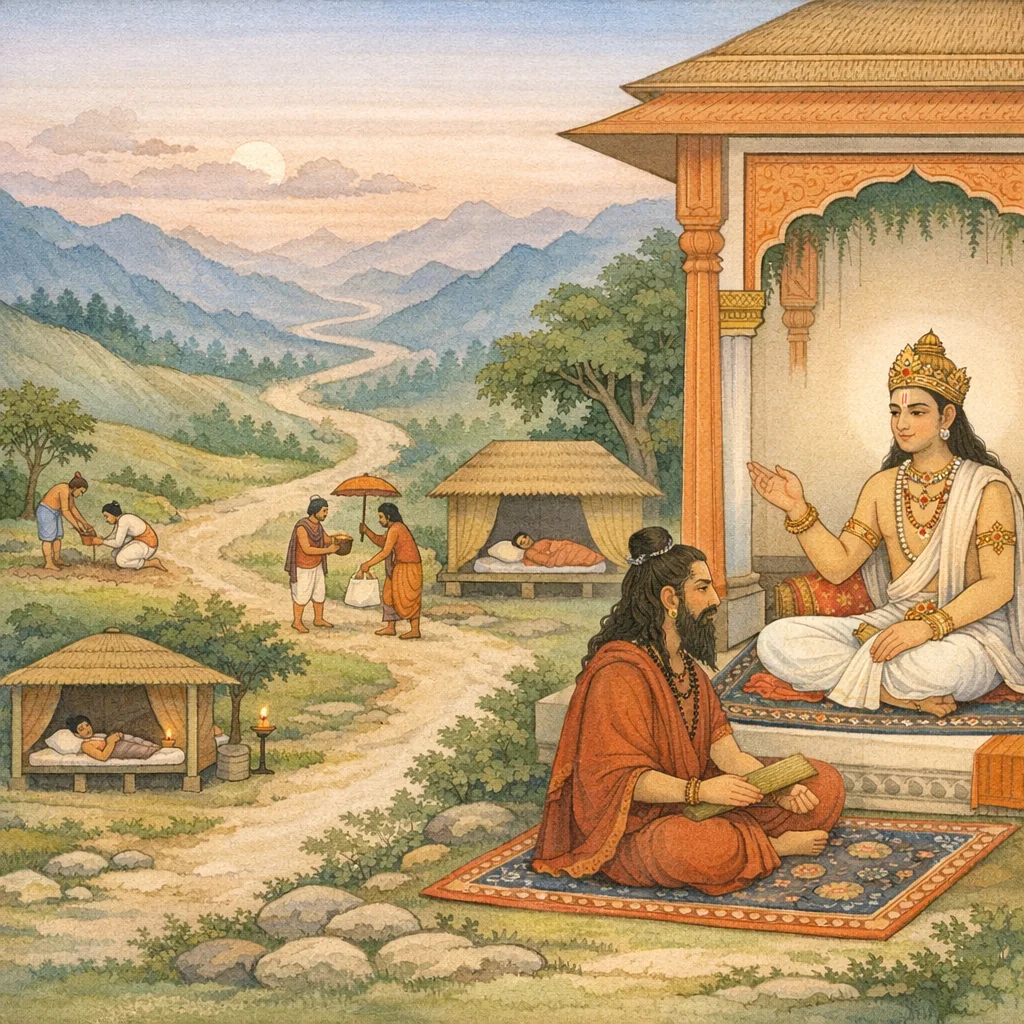
Adhyaya 11 unfolds as a didactic dialogue in which Vyāsa asks Sanatkumāra about the dharmas that lessen the suffering of those weighed down by sin and the practices by which beings may traverse the fearsome Yama-mārga with relative ease. Sanatkumāra bases the teaching on the inevitability of karmic fruition—deeds done must surely be experienced—then defines auspicious conduct through an inner gentleness and compassion, and through outward dāna (giving) and reverence. The chapter sets forth clear correspondences: particular gifts yield particular post-mortem comforts—footwear for swift passage, umbrellas for protection, bedding or seats for rest, lamps for guidance, and shelters to remove illness and distress. It then extends to civic-religious patronage—creating gardens, planting roadside trees, building temples, āśramas for renunciants, and halls for the unprotected—presenting these as merit-bearing infrastructures with consequences for the afterlife journey. Overall, it reads as an applied taxonomy of karma, a catalog of meritorious acts whose symbols of protection, illumination, and refuge are mirrored in the subtle economy of the soul’s passage after death.
Shlokas
Verse 1
व्यास उवाच । कृतपापा नरा यांति दुःखेन महतान्विताः । यममार्गे सुखं यैश्च तान्धर्मान्वद मे प्रभो
Vyāsa said: “Men laden with sin proceed along Yama’s path, burdened with great suffering. O Lord, tell me of those righteous duties by which there is ease and well-being even on Yama’s road.”
Verse 2
सनत्कुमार उवाच । अवश्यं हि कृतं कर्म भोक्तव्यमविचारतः । शुभाशुभमथो वक्ष्ये तान्धर्म्मान्सुखदायकान्
Sanatkumāra said: Indeed, whatever action has been done must inevitably be experienced in its result, without exception. Now I shall explain the dharmas connected with auspicious and inauspicious deeds—those disciplines that become givers of well-being.
Verse 3
अत्र ये शुभकर्म्माणः सौम्यचित्ता दयान्विताः । सुखेन ते नरा यांति यममार्गं भयावहम्
Here, those people who perform auspicious deeds—gentle in mind and endowed with compassion—proceed with ease along the path of Yama, even though it is fearful for others.
Verse 4
यः प्रदद्याद् द्विजेन्द्राणामुपानत्काष्ठपादुके । स नरोऽश्वेन महता सुखं याति यमालयम्
Whoever offers to the foremost of the twice-born (brāhmaṇas) footwear—sandals or wooden slippers—such a person journeys in comfort to Yama’s abode, mounted upon a great horse.
Verse 5
छत्रदानेन गच्छंति यथा छत्रेण देहिनः । शिबिकायाः प्रदानेन तद्रथेन सुखं व्रजेत्
Just as embodied beings walk along protected by an umbrella, so by gifting an umbrella one gains that very shelter. And by donating a palanquin, one attains the comfort of riding in a chariot, moving on in ease through life’s journey.
Verse 6
शय्यासनप्रदानेन सुखं याति सुविश्रमम् । आरामच्छायाकर्तारो मार्गे वा वृक्षरोपकाः । व्रजन्ति यमलोकं च आतपेऽति गतक्लमाः
By gifting beds and seats, a person attains comfort and deep repose. Those who create resting-places and shade—gardens, shelters, or who plant trees along the road—after toil beneath the sun, in due course depart to Yama’s realm with their fatigue removed, receiving the fruit of that merit.
Verse 7
यांति पुष्पगयानेन पुष्पारामकरा नराः । देवायतनकर्तारः क्रीडंति च गृहोदरे
Men who establish flower-gardens attain passage by a flower-borne conveyance; and those who build temples for the Deities delight and sport within splendid celestial mansions.
Verse 8
कर्तारश्च तथा ये च यतीनामाश्रमस्य च । अनाथमण्डपानां तु क्रीडंति च गृहोदरे
And those who found and care for the hermitages of ascetics, and those connected with shelters for the orphaned—even such people, while remaining within the bounds of household life, sport about in worldly pursuits.
Verse 9
देवाग्निगुरुविप्राणां मातापित्रोश्च पूजकाः । पूज्यमाना नरा यांति कामुकेन यथासुखम्
Those men who worship the Devas, the sacred fire, the Guru, the Brahmins, and their own mother and father—being themselves honored in return—attain their cherished aims and move through life as they desire, in accordance with rightful happiness.
Verse 10
द्योतयंतो दिशस्सर्वा यांति दीपप्रदायिनः । प्रतिश्रयप्रदानेन सुखं यांति निरामयाः
Those who offer lamps go forth, illumining all the directions. By granting shelter to others, they attain happiness and remain free from illness—through the merit that upholds dharma and pleases Lord Śiva.
Verse 11
विश्राम्यमाणा गच्छंति गुरुशुश्रूषका नराः । आतोद्यविप्रदातारस्सुखं यांति स्वके गृहे
Those men who have been devoted in service to their guru depart in peace, as if resting; and those who give musical instruments to brāhmaṇas return happily to their own homes.
Verse 12
सर्वकामसमृद्धेन यथा गच्छंति गोप्रदाः । अत्र दत्तान्नपानानि तान्याप्नोति नरः पथि
Just as those who gift cows proceed on their journey endowed with the fulfillment of all desires, so too does a man, while on the road (after death), obtain the very food and drink that he has given here (in this world).
Verse 13
पादशौचप्रदानेन सजलेन पथा व्रजेत् । पादाभ्यंगं च यः कुर्यादश्वपृष्ठेन गच्छति
One should travel by a path made wet by the offering of water for washing the feet. And whoever performs a massage of the feet attains the merit of riding upon a horse’s back—swift and auspicious progress.
Verse 14
पादशौचं तथाभ्यंगं दीपमन्नं प्रतिश्रयम् । यो ददाति सदा व्यास नोपसर्पति तं यमः
O Vyāsa, Yama does not draw near to one who continually gives others water for washing the feet, oil for anointing, a lamp for light, food, and shelter. Such steady charity is Shaiva compassion: it loosens the bonds of pāśa and protects the devotee from the fear of death.
Verse 15
हेमरत्नप्रदानेन याति दुर्गाणि निस्तरन् । रौप्यानडुत्स्रग्दानेन यमलोकं सुखेन सः
By gifting gold and precious gems, a person crosses beyond hardships and perilous passages. By the gift of releasing a bull adorned with silver, he reaches Yama’s realm with ease.
Verse 16
इत्येवमादिभिर्दानैस्सुखं यांति यमालयम् । स्वर्गे तु विविधान्भोगान्प्राप्नुवंति सदा नराः
By such gifts and similar acts of charity, people depart in peace to Yama’s abode; and thereafter, in heaven, they continually obtain many kinds of enjoyments.
Verse 17
सर्वेषामेव दानानामन्नदानं परं स्मृतम् । सद्यः प्रीतिकरं हृद्यं बलबुद्धिविवर्धनम्
Among all forms of charity, the gift of food is remembered as the highest. It brings immediate joy, delights the heart, and increases strength and clarity of understanding.
Verse 18
नान्नदानसमं दानं विद्यते मुनिसत्तम । अन्नाद्भवंति भूतानि तदभावे म्रियंति च
O best of sages, no gift is equal to the gift of food. From food all beings arise, and in its absence they perish.
Verse 19
रक्तं मांसं वसा शुक्रं क्रमादन्नात्प्रवर्धते । शुक्राद्भवंति भूतानि तस्मादन्नमयं जगत्
From food, in due order, blood, flesh, fat, and seed arise and are nourished. From the seed, embodied beings come into existence; therefore this world is constituted of food.
Verse 20
हेमरत्नाश्वनागेन्द्रैर्नारीस्रक्चंदनादिभिः । समस्तैरपि संप्राप्तैर्न रमंति बुभुक्षिताः
Even if one obtains gold, jewels, fine horses, lordly elephants, women, garlands, sandalwood and the like—all of them in abundance—those who are still hungry do not find joy.
Verse 21
गर्भस्था जायमानाश्च बालवृद्धाश्च मध्यमाः । आहारमभिकांक्षंति देवदानवराक्षसाः
Whether abiding in the womb, newly born, young, aged, or in their prime—gods, dānavas, and rākṣasas alike all long for nourishment, for food.
Verse 22
क्षुधा निश्शेषरोगाणां व्याधिः श्रेष्ठतमः स्मृतः । स चान्नौषधिलेपेन नश्यतीह न संशयः
Hunger is declared the foremost affliction among all diseases. And that hunger is surely dispelled here by food, by medicine, and by therapeutic applications—of this there is no doubt.
Verse 23
नास्ति क्षुधासमं दुःखं नास्ति रोगः क्षुधासमः । नास्त्यरोगसमं सौख्यं नास्ति क्रोधसमो रिपुः
There is no sorrow equal to hunger; there is no disease equal to hunger. There is no happiness equal to freedom from illness; and there is no enemy equal to anger.
Verse 24
अतएव महत्पुण्यमन्नदाने प्रकीर्तितम् । तथा क्षुधाग्निना तप्ता म्रियंते सर्वदेहिनः
Therefore, the giving of food is proclaimed to be a great merit; for all embodied beings, scorched by the fire of hunger, indeed perish.
Verse 25
अन्नदः प्राणदः प्रोक्तः प्राणदश्चापि सर्वदः । तस्मादन्नप्रदानेन सर्वदानफलं लभेत्
It is declared that the giver of food is the giver of life; indeed, the giver of life is the giver of everything. Therefore, by the offering of food, one attains the fruit of all gifts.
Verse 26
यस्यान्नपानपुष्टाङ्गः कुरुते पुण्यसंचयम् । अन्नप्रदातुस्तस्यार्द्धं कर्तुश्चार्द्धं न संशयः
When a person—whose body is nourished by another’s food and drink—performs acts that accumulate merit, then half of that merit belongs to the giver of food, and half belongs to the doer; of this there is no doubt.
Verse 27
त्रैलोक्ये यानि रत्नानि भोगस्त्रीवाहनानि च । अन्नदानप्रदस्सर्वमिहामुत्र च तल्लभेत्
Whatever jewels exist in the three worlds—along with enjoyments, noble women, and vehicles—indeed all of that is gained by the giver of food, both here in this world and in the world beyond.
Verse 28
धर्म्मार्थकाममोक्षाणां देहः परमसाधनम् । तस्मादन्नेन पानेन पालयेद्देहमात्मनः
For attaining dharma, artha, kāma, and mokṣa, the human body is the supreme instrument. Therefore, by proper food and drink, one should sustain and protect one’s own body.
Verse 29
अन्नमेव प्रशंसंति सर्वमेव प्रतिष्ठितम् । अन्नेन सदृशं दानं न भूतं न भविष्यति
They praise food alone, for everything is established upon food. No gift equal to the gift of food has existed in the past, nor will it exist in the future.
Verse 30
अन्नेन धार्य्यते सर्वं विश्वं जगदिदं मुने । अन्नमूर्जस्करं लोके प्राणा ह्यन्ने प्रतिष्ठिताः
O sage, this entire universe—this moving world—is sustained by food. In the world, food is the source of strength and vitality, for the life-breaths are indeed established in food.
Verse 31
दातव्यं भिक्षवे चान्नं ब्राह्मणाय महात्मने । कुटुंबं पीडयित्वापि ह्यात्मनो भूतिमिच्छता
One who seeks one’s own true welfare should give food to a mendicant and to a great-souled Brāhmaṇa—even if, in doing so, one must strain one’s household resources.
Verse 32
विददाति निधिश्रेष्ठं यो दद्यादन्नमर्थिने । ब्राह्मणायार्तरूपाय पारलौकिकमात्मनः
Whoever gives food to one in need—especially to a Brahmin in distress—wins for oneself the supreme treasure in the world beyond.
Verse 33
अर्चयेद्भूतिमन्विच्छन्काले द्विजमुपस्थितम् । श्रांतमध्वनि वृत्त्यर्थं गृहस्थो गृहमागतम्
Seeking auspicious prosperity, a householder should, at the proper time, honor the twice-born (Brahmin) who has arrived—wearied from the journey—coming to the home for his livelihood.
Verse 34
अन्नदः पूजयेद्व्यासः सुशीलस्तु विमत्सरः । क्रोधमुत्पतितं हित्वा दिवि चेह महत्सुखम्
One who gives food, honors the wise—like Vyāsa—, is of good conduct and free from envy, and abandons anger the moment it arises, attains great happiness both here in this world and in heaven.
Verse 35
नाभिनिंदेदधिगतं न प्रणुद्यात्कथंचन । अपि श्वपाके शुनि वा नान्नदानं प्रणश्यति
One should not disparage what has been rightly learned, nor should one ever reject it. Even if food is given to a dog or to a dog‑eater (an outcaste), the merit of offering food does not perish.
Verse 36
श्रांतायादृष्टपूर्वाय ह्यन्नमध्वनि वर्तते । यो दद्यादपरिक्लिष्टं स समृद्धिमवाप्नुयात
For one who is weary and unknown—a stranger upon the road—food is truly a support on the journey. Whoever gives such a person food without causing hardship or distress shall attain prosperity.
Verse 37
पितॄन्देवांस्तथा विप्रानतिथींश्च महामुने । यो नरः प्रीणयत्यन्नैस्तस्य पुण्यफलं महत्
O great sage, the man who satisfies the ancestors (pitṛs), the gods, the brāhmaṇas, and guests by offering food attains a vast fruit of merit. Such nourishment, offered in reverence, loosens the bonds of pāśa and supports the soul’s movement toward Śiva’s grace.
Verse 38
अन्नं पानं च शूद्रेऽपि ब्राह्मणे च विशिष्यते । न पृच्छेद्गोत्रचरणं स्वाध्यायं देशमेव च
Food and drink should be offered with due honor, whether the recipient is a Śūdra or a Brāhmaṇa. One should not interrogate a guest about lineage (gotra) and Vedic branch (caraṇa), about personal study (svādhyāya), or even about his place of origin.
Verse 39
भिक्षितो ब्राह्मणेनेह दद्यादन्नं च यः पुमान् । स याति परमं स्वर्गं यावदाभूतसंप्लवम्
In this world, the man who, when asked by a brāhmaṇa, gives food attains the highest heaven and remains there until the dissolution of all beings.
Verse 40
अन्नदस्य च वृक्षाश्च सर्वकामफलान्विताः । भवंतीह यथा विप्रा हर्षयुक्तास्त्रिविष्टपे
For the giver of food, even the trees here become endowed with the fruits of every desired enjoyment; just so do the blessed Brahmins, filled with joy, flourish hereafter in the heavenly worlds.
Verse 41
अन्नदानेन ये लोकास्स्वर्गे विरचिता मुने । अन्नदातुर्महादिव्यास्ताञ्छृणुष्व महामुने
O sage, the worlds in heaven fashioned through the gift of food—those supremely divine abodes that belong to the giver of food—hear of them, O great sage.
Verse 42
भवनानि प्रकाशंते दिवि तेषां महात्मनाम् । नानासंस्थानरूपाणि नाना कामान्वितानि च
In heaven, the radiant celestial dwellings of those great-souled beings shine forth—manifold in their structures and forms, and endowed with a variety of desired enjoyments.
Verse 43
सर्वकामफलाश्चापि वृक्षा भवनसंस्थिताः । हेमवाप्यः शुभाः कूपा दीर्घिकाश्चैव सर्वशः
And there were trees set about the dwelling that granted the fruits of every desired aim. Everywhere there were auspicious wells, long ponds, and even golden reservoirs—abounding on all sides.
Verse 44
घोषयंति च पानानि शुभान्यथ सहस्रशः । भक्ष्यभोज्यमयाश्शैला वासांस्याभरणानि च
They proclaim, by the thousands, auspicious drinks; and there are mountains made of foods to be eaten and enjoyed, along with garments and ornaments as well.
Verse 45
क्षीरं स्रवंत्यस्सरितस्तथैवाज्यस्य पर्वताः । प्रासादाः पाण्डुराभासाश्शय्याश्च कनकोज्ज्वलाः
Rivers there flow with milk, and mountains are made of clarified butter (ghee). The palaces shine with a pale, radiant splendor, and the beds gleam brilliantly like gold.
Verse 46
तानन्नदाश्च गच्छंति तस्मादन्नप्रदो भवेत् । यदीच्छेदात्मनो भव्यमिह लोके परत्र च
Those who give food attain those auspicious states; therefore one should become a giver of food. If one desires well-being for oneself in this world and in the world beyond, one should surely practice the gift of food.
Verse 47
एते लोकाः पुण्यकृतामन्नदानां महाप्रभाः । तस्मादन्नं विशेषेण दातव्यं मानवैर्ध्रुवम्
These worlds—radiant and greatly splendid—belong to the meritorious who give food in charity. Therefore, human beings should certainly give food, and do so with special care and priority.
Verse 48
अन्नं प्रजापतिस्साक्षादन्नं विष्णुस्स्वयं हरः । तस्मादन्नसमं दानं न भूतं न भविष्यति
Food is verily Prajāpati himself; food is Viṣṇu; and food is Śiva (Hara) in person. Therefore, no gift has ever been, nor will ever be, equal to the gift of food.
Verse 49
कृत्वापि सुमहत्पापं यः पश्चादन्नदो भवेत् । विमुक्तस्सर्वपापेभ्यस्स्वर्गलोकं स गच्छति
Even if a person has committed a very great sin, if afterward he becomes a giver of food, he is freed from all sins and attains the heavenly world.
Verse 50
अन्नपानाश्वगोवस्त्रशय्याच्छत्रासनानि च । प्रेतलोके प्रशस्तानि दानान्यष्टौ विशेषतः
Food and drink, a horse, a cow, clothing, a bed, an umbrella, and a seat—these eight gifts are praised above all as especially beneficial for the departed in the realm of the pretas.
Verse 51
एवं दानविशेषेण धर्मराजपुरं नरः । यस्माद्याति विमानेन तस्माद्दानं समाचरेत्
Thus, by this particular form of charitable giving, a man goes to the city of Dharmarāja (Yama) in a celestial aerial car; therefore one should diligently practise such giving.
Verse 52
एतदाख्यानमनघमन्नदानप्रभावतः । यः पठेत्पाठयेदन्यान्स समृद्धः प्रजायते
By the power born of offering food in charity, this spotless sacred narrative bears fruit: whoever recites it, or causes others to recite it, is born endowed with prosperity.
Verse 53
शृणुयाच्छ्रावयेच्छ्राद्धे ब्राह्मणान्यो महामुने । अक्षय्यमन्नदानं च पितॄणामुपतिष्ठति
O great sage, whoever, at the time of the Śrāddha, listens to the prescribed recitation and also causes brāhmaṇas to listen, for him the offering of food becomes inexhaustible—and it stands as a lasting satisfaction and support for the Pitṛs (ancestors).
Frequently Asked Questions
That karmic results are unavoidable (karma must be experienced), but the quality of one’s passage through post-mortem states—especially the Yama-mārga—can be materially improved through auspicious conduct, compassion, and merit-bearing gifts and public welfare works.
Each item functions as a moral-symbolic analogue: footwear signifies enabled movement and reduced hardship; umbrella signifies protection; bedding/seating signifies rest and relief; lamps signify knowledge/visibility and the removal of directional confusion; shelters signify refuge and the reduction of affliction. The chapter encodes a principle that what one provides to others as protection, illumination, and support returns as subtle support in liminal states.
No specific Śiva or Umā form is foregrounded in the sampled portion; the chapter is primarily an ethical-eschatological instruction delivered by Sanatkumāra. Its Śaiva character lies in integrating dharma, merit, and reverence into the Purāṇic framework associated with Śiva-oriented soteriology rather than in iconographic description.