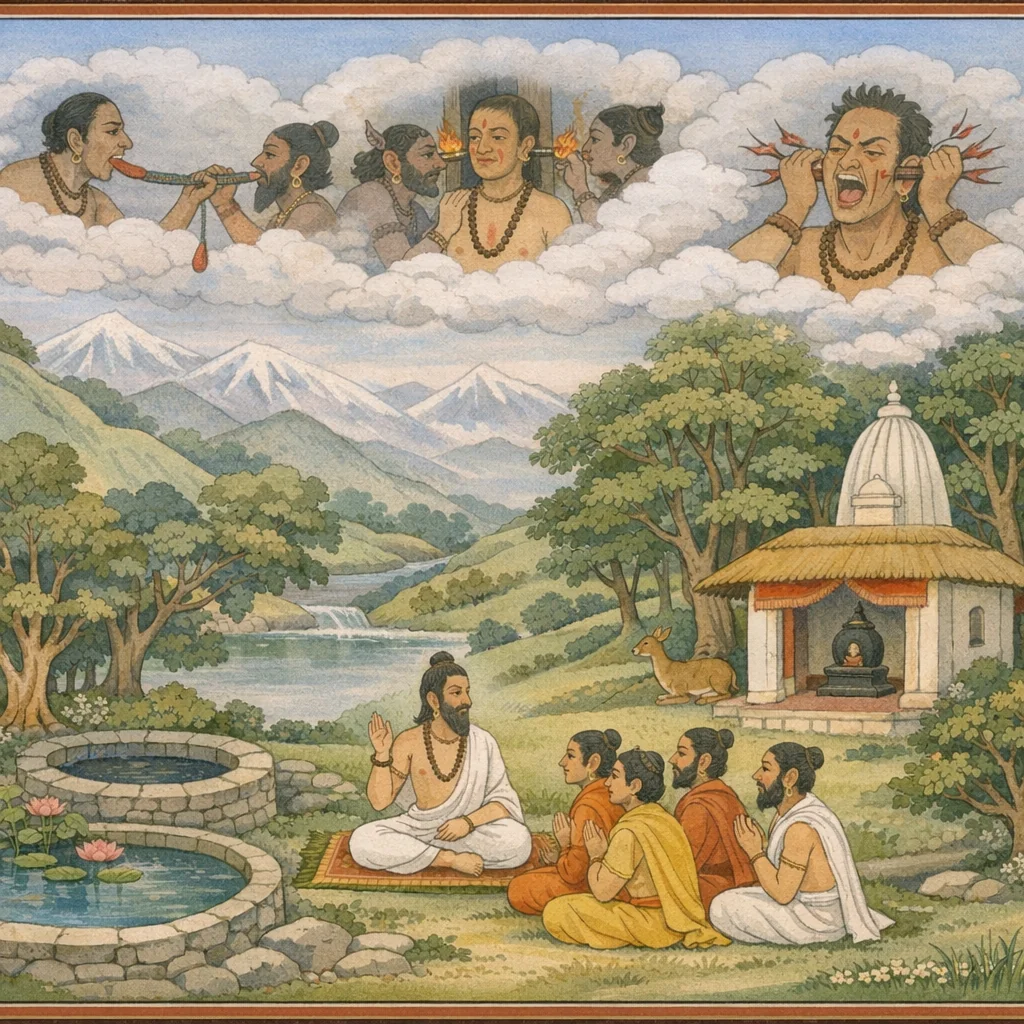
नरकयातनावर्णनम् / Description of Hell-Torments for Specific Transgressions
In this adhyāya Sanatkumāra teaches, in a didactic voice, the hell-torments (naraka-yātanā) that arise as karmic retribution for specific ethical and religious transgressions. The sins are classified: spreading false doctrine (mithyā-āgama), harshly abusing mother, father, and teacher (mātṛ-pitṛ-guru-nirbhartsana), harming Śiva’s sacred infrastructure—temple-groves, wells, tanks—and Brahminic holy places, and indulging in immoral acts driven by intoxicated desire such as lust, gambling, and illicit union. The rhetoric is juridical and vivid, describing punishments aimed at particular organs (tongue, mouth, ears) and carried out with specific instruments (heated metals, nails, crushing devices), to impress moral causality and deterrence. Esoterically, the chapter reinforces a Śaiva ethic of disciplined speech (vāg-yama), reverence for gurus and saints, and protection of Śiva’s sacred spaces, implying that right doctrine and right conduct are prerequisites for higher Śiva-knowledge.
Shlokas
Verse 1
सनत्कुमार उवाच । मिथ्यागमं प्रवृत्तस्तु द्विजिह्वाख्ये च गच्छति । जिह्वार्द्धकोशविस्तीर्णहलैस्तीक्ष्णः प्रपीड्यते
Sanatkumāra said: One who engages in false doctrines goes to the hell called Dvijihvā (“two-tongued”). There he is fiercely tormented, his tongue being pressed and crushed by sharp ploughshares broad as half a sheath.
Verse 2
निर्भर्त्सयति यः क्रूरो मातरं पितरं गुरुम् । विष्ठाभिः कृमिमिश्राभिर्मुखमापूर्य्य हन्यते
That cruel person who reviles his mother, father, or spiritual preceptor is slain after his mouth is stuffed full with excrement mixed with worms—such is the dreadful fruit of that sin.
Verse 3
ये शिवायतनारामवापीकूपतडागकान् । विद्रवंति द्विजस्थानं नरास्तत्र रमंति च
Those men who establish and maintain gardens, wells, ponds, and tanks connected with Śiva’s shrines—places fit for the dwelling of the twice-born—such people themselves delight and prosper there, in that sacred domain.
Verse 4
कामायोद्वर्तनाभ्यंग स्नानपानाम्बुभोजनम् । क्रीडनं मैथुनं द्यूतमाचरन्ति मदोद्धता
Driven by desire and swollen with intoxicated pride, they indulge in body-rubbing and oil-massage, in bathing, drinking, and eating; and they also pursue play, sexual union, and gambling.
Verse 5
पेचिरे विविधैर्घेरैरिक्षुयंत्रादिपीडनैः । निरयाग्निषु पच्यंते यावदाभूतसंप्लवम्
They are crushed by many dreadful torments—such as being pressed in sugarcane-press machines and other instruments of pain. They are roasted in the fires of hell, enduring it until the cosmic dissolution of beings.
Verse 6
ये शृण्वंति सतां निंदां तेषां कर्णप्रपूरणम् । अग्निवर्णैरयःकीलैस्तप्तैस्ताम्रादिनिर्मितैः
Those who listen to the slander of the righteous—their ears are to be filled, as punishment, with red-hot iron spikes, glowing like fire, made of copper and other metals.
Verse 7
पूर्वाकाराश्च पुरुषाः प्रज्वलन्ति समंततः । दुश्चारिणीं स्त्रियं गाढमालिंगंति रुदंति च
Men in their former forms blaze forth on every side; and, clasping that wayward woman tightly, they weep as well.
Verse 9
त्रपुसीसारकूटाद्भिः क्षीरेण च पुनःपुनः । सुतप्ततीक्ष्णतैलेन वज्रलेपेन वा पुनः
Again and again it should be treated with the decoction/essence drawn from trapusī and sāraka, and also with milk; or again with sharply heated oil, or with a hard-setting ‘vajra-plaster’, adamantine in its coating.
Verse 10
इति श्रीशिवमहापुराणे पञ्चम्यामुमासंहितायां नरकगतिभोगवर्णनं नाम दशमोऽध्यायः
Thus, in the Śrī Śiva Mahāpurāṇa, in the Fifth Book—the Umāsaṃhitā—ends the Tenth Chapter, entitled “The Description of the Experience of the Hellish States.”
Verse 11
सर्वेन्द्रियाणामप्येवं क्रमात्पापेन यातनाः । भवंति घोराः प्रत्येकं शरीरेण कृतेन च
Thus, for all the senses in due order, the punishments born of sin arise—each one becoming dreadful—according to the deeds committed through the body.
Verse 12
स्पर्शदोषेण ये मूढास्स्पृशंति च परस्त्रियम् । तेषां करोऽग्निवर्णाभिः पांशुभिः पूर्य्यते भृशम्
Those deluded men who, through the fault of improper touch, lay hands upon another’s wife—their hand becomes thoroughly filled, as it were, with ash-like dust the color of fire, as a mark of the burning consequence of that transgression.
Verse 13
तेषां क्षारादिभिस्सर्वैश्शरीरमनुलिप्यते । यातनाश्च महाकष्टास्सर्वेषु नरकेषु च
Their bodies are smeared all over with caustic substances such as alkali and the like; and in all the hells they undergo extremely grievous torments.
Verse 14
कुर्वन्ति पित्रोर्भृकुटिं करनेत्राणि ये नरा । वक्त्राणि तेषां सांतानि कीर्य्यंते शंकुभिर्दृढम्
Those men who make their father and mother frown in distress—causing pain to their ears and eyes—have their mouths firmly pierced with sharp stakes in the hereafter.
Verse 15
यैरिन्द्रियैर्नरा ये च कुर्वन्ति परस्त्रियम् । इन्द्रियाणि च तेषां वै विकुर्वंति तथैव च
Those men who, through their sense-organs, pursue another man’s wife—those very sense-organs of theirs, indeed, become correspondingly perverted and distorted.
Verse 16
परदारांश्च पश्यन्ति लुब्धास्स्तब्धेन चक्षुषा । सूचीभिश्चाग्निवर्णाभिस्तेषां नेत्रप्रपूरणम्
Those greedy men who gaze upon another man’s wife with a hardened, shameless stare have their eyes filled and pierced with needle-like instruments, blazing like fire.
Verse 17
क्षाराद्यैश्च क्रमात्सर्वा इहैव यमयातनाः । भवंति मुनिशार्दूल सत्यंसत्यं न संशयः
By alkaline substances and the like, in due sequence, all the torments of Yama are experienced here itself, in this very life. O tiger among sages, it is true—true indeed—there is no doubt.
Verse 18
देवाग्निगुरुविप्रेभ्यश्चानिवेद्य प्रभुंजते । लोहकीलशतैस्तप्तैस्तज्जिह्वास्यं च पूर्य्यते
One who eats without first offering a share to the Devas, to the sacred fire, to the Guru, and to the Brāhmaṇas—his mouth and tongue are, in the next state, filled and pierced with hundreds of red‑hot iron nails.
Verse 19
ये देवारामपुष्पाणि लोभात्संगृह्य पाणिना । जिघ्रंति च नरा भूयः शिरसा धारयंति च
Those men who, out of greed, gather flowers from a divine garden with their hands, then repeatedly smell them and even place them upon their heads, act with possessiveness toward what is meant for worship.
Verse 20
आपूर्य्यते शिरस्तेषां तप्तैर्लोहस्य शंकुभिः । नासिका वातिबहुलैस्ततः क्षारादिभिर्भृशम्
Their heads are forcibly filled (pierced and stuffed) with red-hot iron spikes; then their nostrils, made to gush with violent winds, are intensely afflicted thereafter with caustic alkalis and other burning agents.
Verse 21
ये निंदन्ति महात्मानं वाचकं धर्म्मदेशिकम् । देवाग्निगुरुभक्तांश्च धर्मशास्त्रं च शाश्वतम्
Those who revile the great-souled expounder—who teaches Dharma—who also disparage the gods, the sacred fire, the guru, the devotees, and the eternal scriptures of Dharma, fall into grave spiritual fault.
Verse 22
तेषामुरसि कण्ठे च जिह्वायां दंतसन्धिषु । तालुन्योष्ठे नासिकायां मूर्ध्नि सर्वाङ्गसन्धिषु
In their chest and throat, on the tongue and at the junctions of the teeth; on the palate and lips, in the nose, on the crown of the head, and at all the joints of the body.
Verse 23
अग्निवर्णास्तु तप्ताश्च त्रिशाखा लोहशंकवः । आखिद्यंते च बहुशः स्थानेष्वेतेषु मुद्गरैः
Iron spikes, heated until they glow like fire and fashioned with three prongs, are again and again driven into these very places with hammers.
Verse 24
ततः क्षारेण दीप्तेन पूर्यते हि समं ततः । यातनाश्च महत्यो वै शरीरस्याति सर्वतः
Then it is evenly filled with blazing alkali; from that very moment, intense torments indeed arise throughout the entire body on every side.
Verse 25
अशेषनरकेष्वेव क्रमंति क्रमशः पुनः । ये गृह्णन्ति परद्रव्यं पद्भ्यां विप्रं स्पृशंति च
Those who seize another’s wealth, and those who touch a brāhmaṇa with their feet—such people, again and again, pass step by step through all the hells. From the Shaiva standpoint, these acts intensify bondage (pāśa) by hardening ego and disrespecting dharma, delaying the soul’s turning toward Śiva, the Liberator (Pati).
Verse 26
शिवोपकरणं गां च ज्ञानादिलिखितं च यत् । हस्तपादादिभिस्तेषामापूर्य्यंते समंततः
Also, the implements used for Śiva’s worship, the cow, and whatever is inscribed with sacred knowledge and the like—these are crowded and covered from every side by their hands, feet, and other limbs.
Verse 27
नरकेषु च सर्वेषु विचित्रा देहयातनाः । भवंति बहुशः कष्टाः पाणिपादसमुद्भवाः
In all the hell-realms, manifold torments of the body arise again and again—painful sufferings that spring from one’s very hands and feet (that is, from one’s own deeds).
Verse 28
शिवायतनपर्य्यंते देवारामेषु कुत्रचित् । समुत्सृजंति ये पापाः पुरीषं मूत्रमेव च
Those sinful people who, anywhere within the precincts of Śiva’s shrine and in sacred divine gardens, relieve themselves—passing stool and urine—commit a grave offense against the sanctity of the Lord’s abode.
Verse 29
तेषां शिश्नं सवृषणं चूर्ण्यते लोहमुद्गरैः । सूचीभिरग्निवर्णाभिस्कथा त्वापूर्य्यते पुनः
Their organ, together with the testes, is crushed with iron mallets; and again it is pierced and filled with needle-like instruments glowing like fire—thus is their torment described.
Verse 30
ततः क्षारेण महता तीव्रेण च पुनः पुनः । द्रुतेन पूर्यते गाढं गुदे शिश्ने च देहिनः
Then, again and again, by a powerful and intensely caustic alkali, the embodied being’s anus and penis are forcefully filled and inflamed, as though with molten heat.
Verse 31
मनस्सर्वेन्द्रियाणां च यस्मा द्दुःखं प्रजायते । धने सत्यपि ये दानं न प्रयच्छंति तृष्णया
From the mind and all the senses arises suffering. Even when wealth is present, those who, out of craving, do not give in charity—such people remain bound to sorrow.
Verse 32
अतिथिं चावमन्यते काले प्राप्ते गृहाश्रमे । तस्मात्ते दुष्कृतं प्राप्य गच्छंति निरयेऽशुचौ
When the proper time comes in the householder stage, if one dishonors a guest, then—having accrued that sinful deed—such people quickly go to an impure hell.
Verse 33
येऽन्नं दत्त्वा हि भुंजंति न श्वभ्यस्सह वायसैः । तेषां च विवृतं वक्त्रं कीलकद्वयताडितम्
Those who, having first given food in charity, then partake—without having to share their meal with dogs and crows—receive this reward: their mouths are opened wide, as though struck by a pair of pegs, made fit and unobstructed for eating.
Verse 34
कृमिभिः प्राणिभिश्चोग्रैर्लोहतुण्डैश्च वायसैः । उपद्रवैर्बहुविधैरुग्रैरंतः प्रपीड्यते
He is tormented inwardly by fierce worms and other dreadful creatures, and by iron-beaked crows—afflicted by many kinds of terrible attacks from within.
Verse 35
श्यामश्च शबलश्चैव यममार्गानुरोधकौ । यौ स्तस्ताभ्यां प्रयच्छामि तौ गृह्णीतामिमं बलिम्
“Śyāma and Śabala—those two who guide (beings) along the path of Yama—unto them I offer this bali. Let those two accept this oblation.”
Verse 36
ये वा वरुणवायव्या याम्या नैरृत्यवायसाः । वायसा पुण्यकर्माणस्ते प्रगृह्णंतु मे बलिम्
May those virtuous crows who belong to the quarters of Varuṇa and Vāyu, of Yama, and of the Nirṛti direction—crows engaged in meritorious deeds—accept this offering (bali) from me.
Verse 37
शिवामभ्यर्च्य यत्नेन हुत्वाग्नौ विधिपूर्वकम् । शैवैर्मन्त्रैर्बलिं ये च ददंते न च ते यमम्
Those who, with careful effort, worship Śivā (the Divine Mother) and then perform the fire-offering in due ritual order, and who also present the bali-offering while reciting Śaiva mantras—such devotees do not fall under the authority of Yama (the Lord of Death).
Verse 38
पश्यंति त्रिदिवं यांति तस्माद्दद्याद्दिनेदिने । मण्डलं चतुरस्रं तु कृत्वा गंधादिवासितम्
They behold the divine state and attain the heavenly worlds; therefore one should offer it day after day—having prepared a square maṇḍala and perfumed it with fragrances and the like, as an auspicious support for worship.
Verse 39
धन्वन्तर्यर्थमीशान्यां प्राच्यामिन्द्राय निःक्षिपेत् । याम्यां यमाय वारुण्यां सुदक्षोमाय दक्षिणे
To invoke Dhanvantari, one should place the offering/rite in the north‑east (Īśāna). In the eastern direction, one should deposit it for Indra; in the southern quarter for Yama; in the western quarter, Varuṇa’s; and in the south, for Sudakṣoma.
Verse 40
पितृभ्यस्तु विनिक्षिप्य प्राच्यामर्यमणे ततः । धातुश्चैव विधातुश्च द्वारदेशे विनिःक्षिपेत्
Having first made the offering to the Pitṛs (the ancestral spirits), one should then place it in the eastern direction for Aryaman. Thereafter, one should place offerings for Dhātṛ and Vidhātṛ at the doorway area.
Verse 41
श्वभ्यश्च श्वपतिभ्यश्च वयोभ्यो विक्षिपेद्धुवि । देवैः पितृमनुष्यैश्च प्रेतैर्भूतैस्सगुह्यकै
One should cast it away upon the ground, away from dogs, dog‑keepers, and birds, so that it is not defiled by devas, Pitṛs, human beings, pretas, bhūtas, or even the guhyakas.
Verse 42
वयोभिः कृमिकीटैश्च गृहस्थश्चोपजीव्यते । स्वाहाकारः स्वधाकारो वषट्कारस्तृतीयकः
The householder is sustained by birds, and also by worms and insects. In the rites, the sacred calls to be employed are the utterance “svāhā,” the utterance “svadhā,” and, as the third, the utterance “vaṣaṭ.”
Verse 43
हंतकारस्तथैवान्यो धेन्वा स्तनचतुष्टयम् । स्वाहाकारं स्तनं देवास्स्वधां च पितरस्तथा
Another utterance is “haṁt-kāra”; and the cow is said to have four teats. The gods partake of one teat as “svāhā,” and likewise the Pitṛs partake of another as “svadhā.”
Verse 44
वषट्कारं तथैवान्ये देवा भूतेश्वरास्तथा । हंतकारं मनुष्याश्च पिबंति सततं स्त नम्
Some drink in the utterance “vaṣaṭ,” and so too the devas and the lords of beings; while human beings continually drink in the cry “haṃtā.”
Verse 45
यस्त्वेतां मानवो धेनुं श्रद्धया ह्यनुपूर्विकाम् । करोति सततं काले साग्नित्वायोपकल्प्यते
But the person who, with faith and in proper sequence, continually performs this symbolic rite of the cow at the fitting times becomes qualified to maintain the sacred fire (Agni), fit for disciplined worship and Vedic–Śaiva observance.
Verse 46
यस्तां जहाति वा स्वस्थस्तामिस्रे स तु मज्जति । तस्माद्दत्त्वा बलिं तेभ्यो द्वारस्थश्चिंतयेत्क्षणम्
Whoever, though healthy and able, abandons that sacred observance sinks into the darkness of delusion. Therefore, having offered a bali (ritual offering) to those beings, one should stand at the doorway and contemplate for a moment, turning the mind steadily toward Śiva.
Verse 47
क्षुधार्तमतिथिं सम्यगेकग्रामनिवासिनम् । भोजयेत्तं शुभान्नेन यथाशक्त्यात्मभोजनात्
If a guest arrives afflicted by hunger—especially a proper and respectable resident of the same village—one should feed him with wholesome, auspicious food according to one’s capacity, even from one’s own share of the meal.
Verse 48
अतिथिर्यस्य भग्नाशो गृहात्प्रतिनिवर्तते । स तस्मै दुष्कृतं दत्त्वा पुण्यमा दाय गच्छति
If a guest, his hope frustrated, turns back from someone’s house, that guest departs by giving his demerit to that householder and taking away the householder’s merit.
Verse 49
ततोऽन्नं प्रियमेवाश्नन्नरः शृंखलवान्पुनः । जिह्वावेगेन विद्धोत्र चिरं कालं स तिष्ठति
Then, eating only what is pleasing, a man becomes bound again as though in chains. Here, wounded by the impulse of the tongue, he remains entangled for a long time.
Verse 50
यतस्तं मांसमुद्धत्य तिलमात्रप्रमाणतः । खादितुं दीयते तेषां भित्त्वा चैव तु शोणितम्
There, having torn out flesh in pieces no larger than a sesame seed, they are made to eat it; and their blood too is pierced and drawn out.
Verse 51
निश्शेषतः कशाभिस्तु पीड्यते क्रमशः पुनः । बुभुक्षयातिकष्टं हि तथायाति पिपासया
He is then tormented repeatedly, in due succession, with relentless lashes. Indeed, he suffers extreme distress from hunger, and in the same way he is afflicted by thirst.
Verse 52
एवमाद्या महाघोरा यातनाः पापकर्मणाम् । अंते यत्प्रतिपन्नं हि तत्संक्षेपेण संशृणु
Such are the first of those exceedingly dreadful torments that befall the doers of sinful deeds. Now hear, in brief, what the soul meets with at the end (of that course).
Verse 53
यः करोति महापापं धर्म्मं चरति वै लघु । धर्म्मं गुरुतरं वापि तथावस्थे तयोः शृणु
Whoever commits a great sin, yet practices only a little dharma—or even performs a weightier act of righteousness—listen to what becomes of these two in such a condition.
Verse 54
सुकृतस्य फलं नोक्तं गुरुपा पप्रभावतः । न मिनोति सुखं तत्र भोगैर्बहुभिरन्वितः
Because of the powerful influence of grave sins, the fruit of one’s meritorious deeds is not manifested. There, even when endowed with many enjoyments, a person does not truly attain undiminished happiness.
Verse 55
तथोद्विग्नोतिसंतप्तो न भक्ष्यैर्मन्यते सुखम् । अभावादग्रतोऽन्यस्य प्रतिकल्पं दिनेदिने
Thus, agitated and deeply afflicted, he no longer considers even enjoyable food to be happiness; for day after day, at every moment, the lack of what he needs stands before him like an ever-present burden.
Verse 56
पुमान्यो गुरुधर्म्माऽपि सोपवासो यथा गृही । वित्तवान्न विजानाति पीडां नियमसंस्थितः
A man established in discipline—though he follows the duties taught by the guru and observes upavāsa (fasting)—does not truly understand the pain of one constrained by strict vrata (vows), just as a wealthy householder does not comprehend hardship.
Verse 57
तानि पापानि घोराणि संति यैश्च नरो भुवि । शतधा भेदमाप्नोति गिरिर्वज्रहतो यथा
Truly dreadful are those sins by which a man on earth is shattered into a hundred pieces—like a mountain struck by the thunderbolt, the vajra.
Frequently Asked Questions
Rather than a single mythic episode, the chapter advances a theological-ethical argument: karmic law is precise and speech/actions against dharma—especially false teachings, abuse of elders, saint-blame, and desecration of Śiva’s sacred works—generate correspondingly precise naraka consequences.
The anatomically focused punishments symbolically map sin to the instrument of transgression: the tongue for false teaching, the mouth for abusive speech, and the ears for taking in sat-nindā. The imagery encodes a discipline of vāg (speech), śravaṇa (hearing), and saṅga (association) as prerequisites for Śaiva purity and higher realization.
No distinct iconographic manifestation is foregrounded in the sampled material; Śiva appears primarily as the sacral center whose abodes (āyatana), groves, and waterworks are protected by dharmic sanction, reinforcing Śiva’s role as moral governor and refuge rather than as a narrated form (svarūpa).