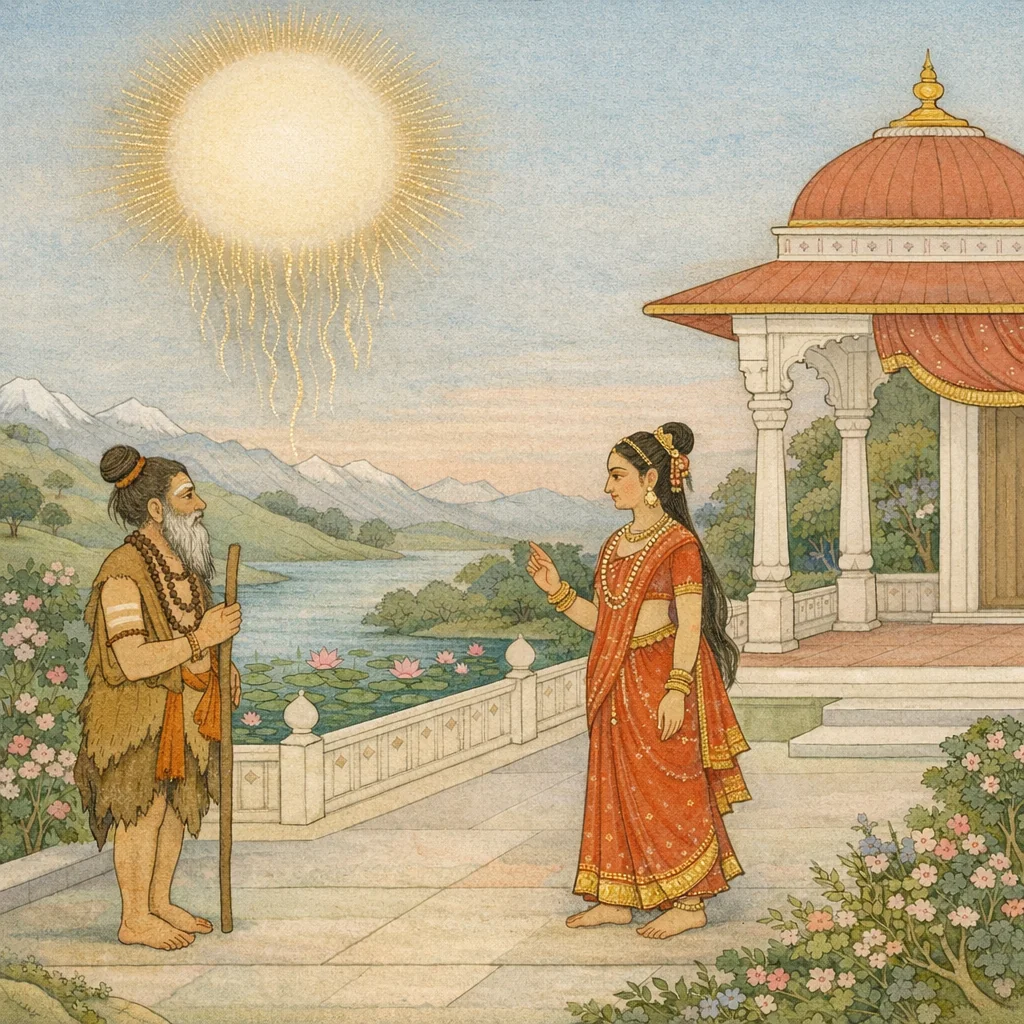
पार्वतीवाक्यं—शिवस्य परब्रह्मत्व-निरूपणम् (Pārvatī’s Discourse: Establishing Śiva as Parabrahman)
Adhyāya 28 unfolds as Pārvatī’s firm clarification when an unusual visitor or disguised figure appears. She declares she now fully understands what is happening and will not be misled by contradictory talk or sophistry. The chapter then offers a compact theological case: Śiva is essentially nirguṇa Brahman, yet appears saguṇa through causal and operative association; therefore notions such as birth, age, and limitation cannot apply to him. Pārvatī identifies Sadāśiva as the perennial ground of all vidyās, making the idea that Śiva “needs” learning incoherent. She affirms the Vedas’ primacy as Śiva’s own “breath,” bestowed at the dawn of creation, and rejects measuring the primordial being by temporal standards. The discourse culminates in a devotional, salvific claim: those who worship Śaṅkara as lord of śakti receive enduring empowerment—often expressed as a triad of śaktis—showing that devotion grants participation in divine potency, not mere intellectual assent.
Shlokas
Verse 1
पार्वत्युवाच । एतावद्धि मया ज्ञातं कश्चिदन्योयमागतः । इदानीं सकलं ज्ञातमवध्यस्त्वम्विशेषतः
Pārvatī said: “Only this much was known to me—that someone else had come here. But now all is clear: you, in particular, are invincible and cannot be slain.”
Verse 2
त्वयोक्तं विदितं देव तदलीकं न चान्यथा । यदि त्वयोदितं स्याद्वै विरुद्धं नोच्यते त्वया
“O Deva, what you have spoken is known to be true—never false, never otherwise. Indeed, if anything were contradictory, it would not be uttered by you at all.”
Verse 3
कदाचिद्दृश्यते तादृक् वेषधारी महेश्वरः । स्वलीलया परब्रह्म स्वरागोपात्तविग्रहः
At times, Mahādeva is indeed seen bearing such a guise. That Supreme Brahman, by His own divine līlā, assumes a manifest form according to His own free will and delight.
Verse 4
ब्रह्मचारिस्वरूपेण प्रतारयितुमुद्यतः । आगतश्छलसंयुक्तं वचोवादीः कुयुक्तितः
Assuming the guise of a brahmacārin (celibate ascetic), he came intent on deceiving her; with guile in his heart, he spoke words contrived through perverse reasoning.
Verse 5
शंकरस्य स्वरूपं तु जानामि सुविशेषतः । शिवतत्त्वमतो वच्मि सुविचार्य्य यथार्हतः
I know the true nature of Śaṅkara with particular clarity. Therefore, after due reflection and as is fitting, I shall now speak of the principle of Śiva.
Verse 6
वस्तुतो निर्गुणो ब्रह्म सगुणः कारणेन सः । कुतो जातिर्भवेत्तस्य निर्गुणस्य गुणात्मनः
In truth, Brahman—the Supreme Reality—is beyond the guṇas; yet, for the sake of being the causal ground, He is spoken of as possessing attributes. How, then, could there be any “birth” for That Reality—guṇa-transcending, yet appearing as the very basis of all qualities?
Verse 7
स सर्वासां हि विद्यानामधिष्ठानं सदाशिवः । किं तस्य विद्यया कार्य्यं पूर्णस्य परमात्मनः
Indeed, Sadāśiva is the very ground and support of all branches of knowledge. What need has that perfect Supreme Self for knowledge as a means, when He is already complete in Himself?
Verse 8
वेदा उच्छ्वासरूपेण पुरा दत्ताश्च विष्णवे । शंभुना तेन कल्पादौ तत्समः कोऽस्ति सुप्रभुः
In ancient times, the Vedas—manifest as Śambhu’s very breath—were bestowed upon Viṣṇu. Therefore, at the beginning of the aeon (kalpa), who could be equal to that supremely radiant Lord Śambhu?
Verse 9
सर्वेषामादिभूतस्य वयोमानं कुतस्ततः । प्रकृतिस्तु ततो जाता किं शक्तेस्तस्य कारणम्
From where, then, could there be any measure of age for Him who is the primal source of all? And if Prakṛti is said to arise from Him, what, indeed, can be the cause of His Śakti?
Verse 10
ये भजंति च तं प्रीत्या शक्तीशं शंकरं सदा । तस्मै शक्तित्रयं शंभुः स ददाति सदाव्ययम्
Those who always worship Śaṅkara—Śambhu, the Lord of Śakti—with loving devotion: to them Śambhu grants the threefold divine power, imperishable and everlasting.
Verse 11
तस्यैव भजनाज्जीवो मृत्युं जयति निर्भयः । तस्मान्मृत्युंजयन्नाम प्रसिद्धम्भुवनत्रये
By worshipping Him alone, the individual soul overcomes death and becomes fearless. Therefore, He is renowned in the three worlds by the name “Mṛtyuñjaya,” the Conqueror of Death.
Verse 12
तस्यैव पक्षपातेन विष्णुर्विष्णुत्वमाप्नुयात् । ब्रह्मत्वं च यथा ब्रह्मा देवा देवत्वमेव च
By His grace alone, Viṣṇu attains his state of Viṣṇu-hood; likewise Brahmā attains Brahmā-hood, and the gods attain their very godhood.
Verse 13
दर्शनार्थं शिवस्यादौ यथा गच्छति देवराट् । भूतादयस्तत्परस्य द्वारपालाश्शिवस्य तु
Just as the king of the gods goes first to obtain the darśana of Śiva, so too the Bhūtas and other attendants—ever intent upon Him—serve as Śiva’s gatekeepers.
Verse 14
दण्डैश्च मुकुटं विद्धं मृष्टं भवति सर्वतः । किं तस्य बहुपक्षेण स्वयमेव महाप्रभुः
When the crown is struck and pierced by rods, it becomes polished on every side. What need is there for many arguments? The Great Lord Himself is the final authority.
Verse 15
कल्याणरूपिणस्तस्य सेवयेह न किं भवेत् । किं न्यूनं तस्य देवस्य मामिच्छति सदाशिवः
By serving Him whose very nature is auspiciousness, what good could fail to arise here? What could be lacking in that Divine Lord, that Sadāśiva should desire me?
Verse 16
सप्तजन्मदरिद्रः स्यात्सेवेन्नो यदि शंकरम् । तस्यैतत्सेवनाल्लोको लक्ष्मीः स्यादनपायिनी
If a man does not serve and worship Śaṅkara, he remains poor even through seven births. But by that very service, Lakṣmī—prosperity—becomes unfailing and never departs from his life.
Verse 17
यदग्रे सिद्धयोष्टौ च नित्यं नृत्यंति तोषितुम् । अवाङ्मुखास्सदा तत्र तद्धितं दुर्ल्लभं कुतः
In whose presence even the eight Siddhis—the perfections—dance ceaselessly to please Him, ever with faces lowered in reverence: how could the highest good bestowed by Him be hard to attain?
Verse 18
यद्यस्य मंगालानीह सेवते शंकरस्य न । यथापि मंगलन्तस्य स्मरणादेव जायते
Even if a person here does not formally observe the auspicious practices connected with Śaṅkara, still auspiciousness arises for him merely by remembering that Auspicious Lord.
Verse 19
यस्य पूजाप्रभावेण कामास्सिद्ध्यन्ति सर्वशः । कुतो विकारस्तस्यास्ति निर्विकारस्य सर्वदा
By the sheer potency of worship of Him, all cherished aims are fulfilled in every way; how then could any change or defect ever belong to the One who is eternally changeless?
Verse 20
शिवेति मंगलन्नाम मुखे यस्य निरन्तरम् । तस्यैव दर्शनादन्ये पवित्रास्संति सर्वदा
He upon whose lips the auspicious Name “Śiva” abides without ceasing—by merely beholding such a devotee, others too are purified at all times.
Verse 21
यद्यपूतम्भवेद्भस्म चितायाश्च त्वयोदितम् । नित्यमस्यांगगं देवैश्शिरोभिर्द्धार्यते कथम्
If, as you have said, the ash from a funeral pyre (citā) is impure, then how is it that the gods continually bear this sacred ash upon their bodies—especially upon their heads?
Verse 22
यो देवो जगतां कर्ता भर्ता हर्ता गुणान्वितः । निर्गुणश्शिवसंज्ञश्च स विज्ञेयः कथम्भवेत्
How is that Deity to be truly known—He who creates, sustains, and withdraws the worlds while being associated with the guṇas, and yet is also nirguṇa, known as Śiva, the Supremely Auspicious?
Verse 23
अगुणं ब्रह्मणो रूपं शिवस्य परमात्मनः । तत्कथं हि विजानन्ति त्वादृशास्तद्बहिर्मुखाः
Śiva, the Supreme Self, is of the nature of Brahman beyond all qualities—nirguṇa. How then can those like you, turned outward and away from That, truly know Him?
Verse 24
दुराचाराश्च पापाश्च देवेभ्यस्ते विनिर्गताः । तत्त्वं ते नैव जानन्ति शिवस्यागुणरूपिणः
Those of wicked conduct and sinful nature, though sprung forth from the gods, do not at all know the true reality of Śiva, whose essence is nirguṇa—beyond the guṇas.
Verse 25
शिवनिन्दां करोतीह तत्त्वमज्ञाय यः पुमान् । आजन्मसंचितं पुण्यं भस्मीभवति तस्य तत्
Here, whoever, not understanding the true reality of Śiva, engages in criticizing Him—his merit accumulated from birth is reduced to ashes.
Verse 26
त्वया निंदा कृता यात्र हरस्यामित तेजसः । त्वत्पूजा च कृता यन्मे तस्मात्पापम्भजाम्यहम्
Because you have spoken in blame there of Hara, whose splendour is immeasurable, and because you have also offered worship to me, therefore I take that sin upon myself.
Verse 27
शिवविद्वेषिणं दृष्ट्वा सचेलं स्नानमाचरेत् । शिवविद्वेषिणं दृष्ट्वा प्रायश्चितं समाचरेत्
On seeing a hater of Śiva, one should perform a purifying bath while still clothed; and on seeing a hater of Śiva, one should also duly undertake an act of expiation (prāyaścitta).
Verse 28
रे रे दुष्ट त्वया चोक्तमहं जानामि शंकरम् । निश्चयेन न विज्ञातश्शिव एव सनातनः
“Hey, you wicked one! You say, ‘I know Śaṅkara.’ Yet in truth you have certainly not known the Eternal Śiva—He alone is the Sanātana, the beginningless and ever-abiding Lord.”
Verse 29
यथा तथा भवेद्रुद्रो यथा वा बहुरूपवान् । ममाभीष्टतमो नित्यं निर्विकारी सतां प्रियः
However Rudra may be—this way or that, or even in countless forms—He is ever my most cherished. He is changeless (nirvikārī) and eternally dear to the virtuous and the wise.
Verse 30
विष्णुर्ब्रह्मापि न समस्तस्य क्वापि महात्मनः । कुतोऽन्ये निर्जराद्याश्च कालाधीनास्सदैवतम्
Even Viṣṇu and Brahmā are not, in any way, the all-inclusive Supreme Great Self. How much less, then, are the other gods—beginning with the so-called ‘deathless’ devas—who, along with their divinities, remain ever subject to Time (Kāla).
Verse 31
इति बुध्या समालोक्य स्वया सत्या सुतत्त्वतः । शिवार्थं वनमागत्य करोमि विपुलं तपः
Having thus reflected with her own true discernment, and having understood the reality as it is, she came to the forest for the sake of attaining Śiva and undertook abundant austerity.
Verse 32
स एव परमेशानस्सर्वेशो भक्तवत्सलः । संप्राप्तुम्मेऽभिलाषो हि दीनानुग्रहकारकम्
He alone is Parameśāna, the Supreme Lord, the Lord of all, tenderly devoted to His devotees. Truly, my longing is to attain Him—the One who bestows grace upon the humble and the afflicted.
Verse 33
ब्रह्मोवाच । इत्युक्त्वा गिरिजा सा हि गिरीश्वरसुता मुने । विरराम शिवं दध्यो निर्विकारेण चेतसा
Brahmā said: Having spoken thus, that Girijā—the daughter of the Lord of the mountain—O sage, fell silent and, with an unmodified and steady mind, contemplated Śiva.
Verse 34
तदाकर्ण्य वचो देव्या ब्रह्मचारी स वै द्विजः । पुनर्वचनमाख्यातुं यावदेव प्रचक्रमे
Hearing the words of the Goddess, that brahmacārī—indeed a twice-born one—at once began again to declare his reply.
Verse 35
उवाच गिरिजा तावत्स्वसखीं विजयां द्रुतम् । शिव सक्तमनोवृत्तिश्शिवनिंदापराङ्मुखी
Then Girijā quickly spoke to her own friend Vijayā—her mind wholly absorbed in Śiva, and turned away from any disparagement of Śiva.
Verse 36
गिरिजोवाच । वारणीयः प्रयत्नेन सख्ययं हि द्विजाधमः । पुनर्वक्तुमनाश्चैव शिवनिंदां करिष्यति
Giri-jā (Pārvatī) said: “This vile brahmin should be restrained with effort, for he is bent on quarrel. And again, with the intention to speak further, he will commit slander of Śiva.”
Verse 37
न केवलम्भवेत्पापं निन्दां कर्तुश्शिवस्य हि । यो वै शृणोति तन्निन्दां पापभाक् स भवेदिह
Sin does not belong only to the one who abuses Lord Śiva; whoever even listens to that blasphemy becomes a sharer of that sin here, in this very life.
Verse 38
शिवनिन्दाकरो वध्यस्सर्वथा शिवकिंकरैः । ब्राह्मणश्चेत्स वै त्याज्यो गन्तव्यं तत्स्थलाद्द्रुतम्
One who reviles Śiva is fit to be punished in every way by Śiva’s attendants. Even if such a person is a brāhmaṇa, he must be abandoned, and one should quickly depart from that place.
Verse 39
अयं दुष्टः पुनर्निन्दां करिष्यति शिवस्य हि । ब्राह्मणत्वादवध्यश्चैत्त्याज्योऽदृश्यश्च सर्वथा
“This wicked man will again revile Lord Śiva. Yet, because he is a brāhmaṇa, he is not to be slain; therefore he must be abandoned and kept out of sight—kept away in every way.”
Verse 40
हित्वैतत्स्थलमद्येव यास्यामोऽन्यत्र मा चिरम् । यथा संभाषणं न स्यादनेनाऽविदुषा पुनः
“Leaving this place this very day, let us go elsewhere without delay, so that we may not have to speak again with this ignorant one.”
Verse 41
ब्रह्मोवाच । इत्युक्त्वा चोमया यावत्पादमुत्क्षिप्यते मुने । असौ तावच्छिवस्साक्षादालंबे प्रियया स्वयम्
Brahmā said: “O sage, as soon as Umā had spoken thus and was about to lift her foot, at that very moment Lord Śiva Himself—manifest in person—of His own accord became the support of His beloved.”
Verse 42
कृत्वा स्वरूपं सुभगं शिवाध्यानं यथा तथा । दर्शयित्वा शिवायै तामुवाचावाङ्मुखीं शिवः
Assuming a most auspicious and beautiful form, fit for meditation upon Śiva, Lord Śiva revealed that form to Śivā (Pārvatī). Then, as she stood with her face lowered in modest reverence, Śiva spoke to her.
Verse 43
शिव उवाच । कुत्र यास्यसि मां हित्वा न त्वं त्याज्या मया पुनः । प्रसन्नोऽस्मि वरं ब्रूहि नादेयम्विद्यते तव
Śiva said: “Where will you go, leaving Me? Never again shall you be abandoned by Me. I am pleased—speak your boon; for you there is nothing I will not grant.”
Verse 44
अद्यप्रभृति ते दासस्तपोभिः क्रीत एव ते । क्रीतोऽस्मि तवसौन्दर्यात्क्षणमेकं युगाय ते
“From this day onward, I am your servant—as though bought for you by my own austerities. Enchanted by your beauty, I am as if purchased by you; to me, a single moment with you becomes like an entire yuga.”
Verse 45
त्यज्यतां च त्वया लज्जा मम पत्नी सनातनी । गिरिजे त्वं हि सद्बुध्या विचारय महेश्वरि
O Girijā, abandon this shyness. You are My eternal consort. With your noble discernment, reflect well upon this, O Maheśvarī.
Verse 46
मया परीक्षितासि त्वं बहुधा दृढमानसे । तत्क्षमस्वापराधम्मे लोकलीलानुसारिणः
O steadfast-minded one, I have tested you in many ways. Therefore, please forgive my offence, for I acted in accordance with the Lord’s worldly play (līlā).
Verse 47
न त्वादृशीम्प्रणयिनीं पश्यामि च त्रिलोकके । सर्वथाहं तवाधीनस्स्वकामः पूर्य्यतां शिवे
I do not see, in all the three worlds, a beloved like you. In every way I am under your sway; therefore, O auspicious one (Śive), let my own desire be fulfilled.
Verse 48
एहि प्रिये मत्सकाशं पत्नी त्वं मे वरस्तव । त्वया साकं द्रुतं यास्ये स्वगृहम्पर्वत्तोत्तमम्
“Come, beloved, near to Me. You are My wife, and your boon has been granted. Together with you I shall quickly go to Our own splendid home—the most excellent of mountains.”
Verse 49
ब्रह्मोवाच । इत्युक्ते देवदेवेन पार्वती मुदमाप सा । तपोजातं तु यत्कष्टं तज्जहौ च पुरातनम्
Brahmā said: When the Lord of lords had spoken thus, Pārvatī was filled with joy. And the former hardship that had arisen from her austerities, she then cast off.
Verse 50
सर्वः श्रमो विनष्टोभूत्स त्यास्तु मुनिसत्तम । फले जाते श्रमः पूर्वो जन्तोर्नाशमवाप्नुयात्
O best of sages, it is indeed so: when the fruit is attained, all prior toil is as though erased. For a being, once the result has arisen, the earlier hardship passes away and is no longer felt.
Frequently Asked Questions
A disguised/oddly appearing figure is perceived (implied as a veṣadhārī Maheśvara), prompting Pārvatī to declare she recognizes Śiva’s identity and cannot be deceived by contradictory or sophistical speech.
The episode functions as a test of discernment (viveka): the supreme can assume forms through līlā, but doctrinally remains beyond birth, age, and limitation; true recognition is grounded in tattva-jñāna rather than surface appearance.
Śiva is presented as Parabrahman/Sadāśiva (nirguṇa) who can appear saguṇa and even in a brahmacārin-like guise; he is also framed as lord of śakti who grants a durable triad of śaktis to devoted worshippers.