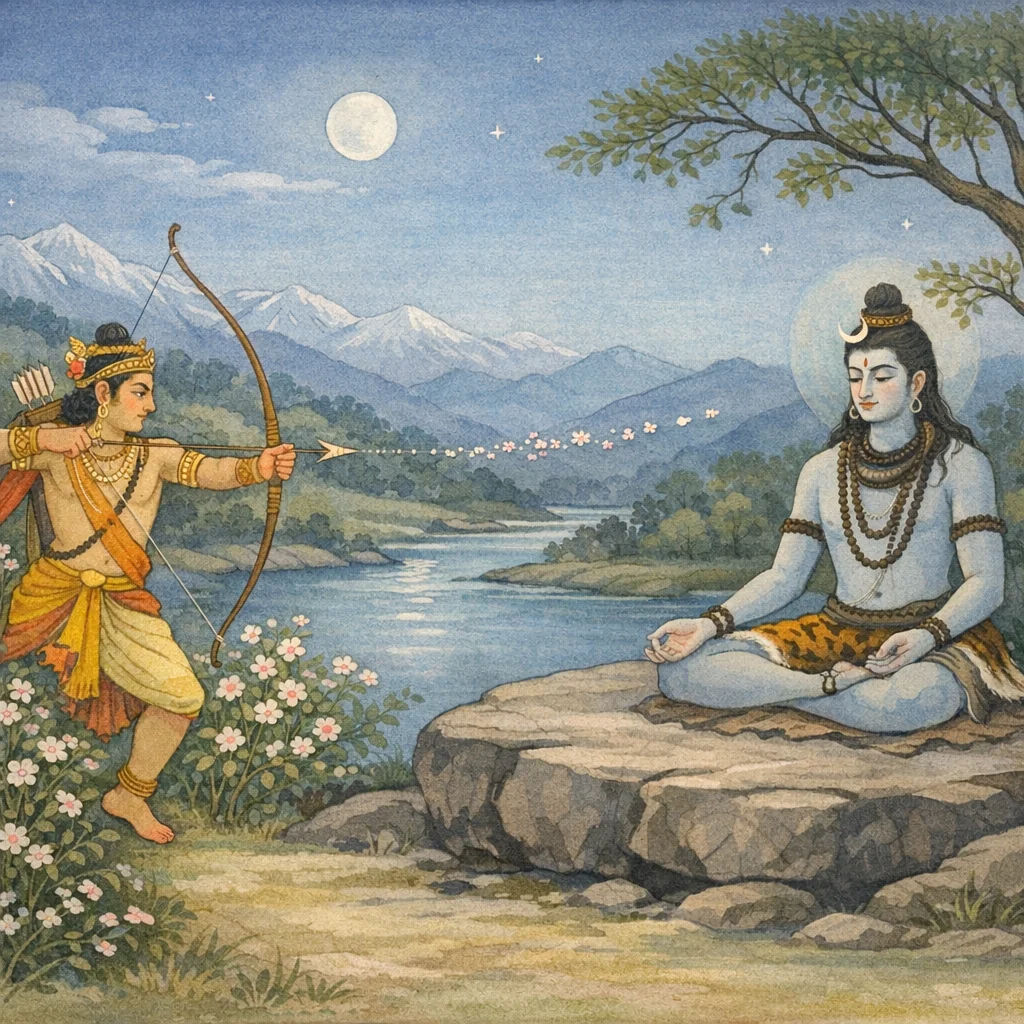
कामप्रहारः — The Subduing of Kāma (Desire) / Kāma’s Assault and Its Futility
Adhyāya 19 unfolds as a dialogue: Nārada asks Brahmā what happened next. Brahmā recounts a pivotal moment during Śiva’s supreme tapas, when Śiva senses a disturbance in his mental composure and investigates its cause, reflecting that attraction toward another’s wife is dharma-virodha and a transgression of śruti-sīmā. This inner moral scrutiny becomes outward: Śiva surveys the directions and sees Kāma to his left, bow drawn, proud and deluded, ready to shoot. Kāma releases the so‑called unfailing amogha-astra at Śaṅkara, but on contact with the Supreme Self it turns mogha—powerless—and its force subsides as Śiva’s wrath arises. The chapter teaches that desire may intrude but cannot bind the Parameśvara, and that even the slightest mental agitation is examined through dharma and yogic self-knowledge before being resolved by divine sovereignty.
Shlokas
Verse 1
नारद उवाच । ब्रह्मन्विधे महाभाग किं जातं तदनंतरम् । कथय त्वं प्रसादेन तां कथां पापनाशिनीम्
Nārada said: “O Brahmā, O Vidhātā, greatly fortunate one—what happened after that? Out of your grace, please narrate to me that sin-destroying account.”
Verse 2
ब्रह्मोवाच । श्रूयतां सा कथा तात यज्जातं तदनंतरम् । तव स्नेहात्प्रवक्ष्यामि शिवलीलां मुदावहाम्
Brahmā said: “Dear child, listen to that account of what happened immediately thereafter. Out of affection for you, I shall recount the joy-bestowing divine play (līlā) of Lord Śiva.”
Verse 3
धैर्यस्य व्यसनं दृष्ट्वा महायोगी महेश्वरः । विचिंतितं मनस्येवं विस्मितोऽतिततः परम्
Seeing that steadfast composure (dhairya) itself had fallen into distress, Mahāyogī Maheśvara turned inward in reflection; in his heart he pondered thus, and was astonished beyond measure.
Verse 4
शिव उवाच । किमु विघ्नाः समुत्पन्नाः कुर्वतस्तप उत्तमम् । केन मे विकृतं चित्तं कृतमत्र कुकर्मिणा
Śiva said: “Why have obstacles (vighna) arisen while I am performing this supreme austerity (tapas)? By whom—by what evil-doer here—has my mind been disturbed and made restless?”
Verse 5
कुवर्णनं मया प्रीत्या परस्त्र्युपरि वै कृतम् । जातो धर्मविरोधोऽत्र श्रुतिसीमा विलंघिता
Out of fond attachment, I have indeed spoken improperly about another man’s wife. By this, a conflict with dharma has arisen here, and the boundary set by the śruti has been transgressed.
Verse 6
ब्रह्मोवाच । विचिंत्येत्थं महायोगी परमेशस्सतां गतिः । दिशो विलोकयामास परितश्शंकितस्तदा
Brahmā said: Having thus reflected, the Great Yogi—Parameśvara, the supreme refuge and goal of the righteous—then looked in all directions, on every side, with a sense of anxious concern.
Verse 7
वामभागे स्थितं कामं ददर्शाकृष्टबाणकम् । स्वशरं क्षेप्तुकामं हि गर्वितं मूढचेतसम्
Then he saw Kāma standing on the left side, his arrow already drawn—eager to release his own shaft, puffed up with pride and deluded in mind.
Verse 8
तं दृष्ट्वा तादृशं कामं गिरीशस्य परात्मनः । संजातः क्रोधसंमर्दस्तत्क्षणादपि नारद
Seeing Kāma in such a state before Girīśa—Lord Śiva, the Supreme Self—at that very moment, O Nārada, a crushing surge of anger was born in him.
Verse 9
कामः स्थितोऽन्तरिक्षे स धृत्वा तत्सशरं धनुः । चिक्षेपास्त्रं दुर्निवारममोघं शंकरे मुने
O sage, Kāma—stationed in the sky—took up his bow with its arrow and hurled his weapon, hard to ward off and unfailing, toward Śaṅkara, Lord Śiva.
Verse 10
बभूवामोघमस्त्रं तु मोघं तत्परमात्मनि । समशाम्यत्ततस्तस्मिन्संकुद्धे परमेश्वरे
That unfailing divine weapon became futile before the Supreme Self. Then it subsided and was pacified, for the Supreme Lord there was inflamed with wrath.
Verse 11
मोघीभूते शिवे स्वेस्त्रे भयमापाशु मन्मथः । चकंपे च पुरः स्थित्वा दृष्ट्वा मृत्युंजयं प्रभुम्
When his own weapon against Śiva proved utterly futile, Manmatha (Kāma) was at once seized by fear; and standing before Him, he trembled on beholding the Lord Mṛtyuñjaya—the Conqueror of Death.
Verse 12
सस्मार त्रिदशान्सर्वान्शक्रादीन्भयविह्वलः । स स्मरो मुनिशार्दूल स्वप्रयासे निरर्थके
Overwhelmed by fear, Smara (Kāma) remembered all the gods—the Devas beginning with Śakra (Indra). O tiger among sages, his own effort had become futile.
Verse 13
कामेन सुस्मृता देवाश्शक्राद्यास्ते मुनीश्वर । आययुः सकलास्ते हि शंभुं नत्वा च तुष्टुवुः
O best of sages, when they were duly invoked by Kāma, all the gods—beginning with Śakra (Indra)—came together. Bowing to Śambhu, they then praised Him with hymns.
Verse 14
स्तुतिं कुर्वत्सु देवेषु कुद्धस्याति हरस्य हि । तृतीयात्तस्य नेत्राद्वै निस्ससार ततो महान्
As the gods were offering hymns of praise, Hari (Viṣṇu) became exceedingly enraged. Then, from his third eye, there burst forth a mighty being.
Verse 15
ललाट मध्यगात्तस्मात्सवह्निर्द्रुतसम्भवः । जज्वालोर्द्ध्वशिखो दीप्तः प्रलयाग्निसमप्रभः
From the middle of his forehead, a fire sprang forth at once. With flames rising upward, it blazed and shone like the fire of pralaya, revealing the awe-inspiring power of Śiva’s divine will.
Verse 16
उत्पत्य गगने तूर्णं निष्पत्य धरणी तले । भ्रामंभ्रामं स्वपरितः पपात मेदनीं परि
It sprang swiftly up into the sky and then plunged down upon the earth’s surface. Whirling again and again around itself, it fell, circling over the ground.
Verse 17
भस्मसात्कृतवान्साधो मदनं तावदेव हि । यावच्च मरुतां वाचः क्षम्यतां क्षम्यतामिति
O holy one, you indeed reduced Kāma (Madana) to ashes—yet only for as long as the Maruts’ words were heard: “Forgive, forgive!”
Verse 18
हते तस्मिन्स्मरे वीरे देव दुःखमुपागताः । रुरुदुर्विह्वलाश्चातिक्रोशतः किमभूदिति
When that heroic Kāma (Smara) was slain, the gods were overcome with sorrow. Bewildered, they wept and cried aloud again and again, “What has happened—how could this be?”
Verse 19
श्वेतांगा विकृतात्मा च गिरिराजसुता तदा । जगाम मंदिरं स्वं च समादाय सखीजनम्
Then the daughter of the Mountain-King—her body pale and her mind inwardly disturbed—returned to her own palace, taking with her the circle of her maiden-companions.
Verse 20
क्षणमात्रं रतिस्तत्र विसंज्ञा साभवत्तदा । भर्तृमृत्युजदुःखेन पतिता सा मृता इव
For a moment, Rati there fell unconscious. Struck by the grief born of her husband’s death, she collapsed, appearing as though dead.
Verse 21
जातायां चैव संज्ञायां रतिरत्यंतविह्वला । विललाप तदा तत्रोच्चरंती विविधं वचः
When consciousness returned, Rati—utterly overwhelmed—lamented there, crying out many kinds of words.
Verse 22
रतिरुवाच । किं करोमि क्व गच्छामि किं कृतं दैवतैरिह । मत्स्वामिनं समाहूय नाशयामासुरुद्धतम्
Rati said: “What shall I do? Where shall I go? What have the gods done here? Having summoned my husband, they have destroyed him—though he was proud and formidable.”
Verse 23
हा हा नाथ स्मर स्वामिन्प्राणप्रिय सुखप्रद । इदं तु किमभूदत्र हा हा प्रिय प्रियेति च
“Alas, alas—O Lord, Smara, my master and husband, beloved of my very life, bestower of joy—what has happened here? ‘Alas, alas, my beloved!’” she cried again and again.
Verse 24
ब्रह्मोवाच । इत्थं विलपती सा तु वदंती बहुधा वचः । हस्तौ पादौ तदास्फाल्य केशानत्रोटयत्तदा
Brahmā said: Thus she lamented, uttering many kinds of words. In that anguish she struck her hands and feet in distress, and then began to tear at her hair.
Verse 25
तद्विलापं तदा श्रुत्वा तत्र सर्वे वनेचराः । अभवन्दुःखितास्सर्वे स्थावरा अपि नारद
Hearing that lamentation at that moment, all the dwellers of the forest there became sorrowful; indeed, even the immovable beings—trees and plants—were distressed, O Nārada.
Verse 26
एतस्मिन्नंतरे तत्र देवाश्शक्रादयोऽखिलाः । रतिमूचुस्समाश्वास्य संस्मरंतो महेश्वरम्
Meanwhile, at that very time and place, all the gods—beginning with Śakra (Indra)—comforted Rati and spoke to her, as they remembered Maheśvara, Lord Śiva.
Verse 27
देवा ऊचुः । किंचिद्भस्म गृहीत्वा तु रक्ष यत्नाद्भयं त्यज । जीवयिष्यति स स्वामी लप्स्यसे त्वं पुनः प्रियम्
The Devas said: “Take a little of the sacred ash, bhasma, and preserve it with care; cast away fear. That Lord will restore him to life, and you shall attain your beloved again.”
Verse 28
सुखदाता न कोप्यस्ति दुःखदाता न कश्चन । सर्वोऽपि स्वकृतं भुंक्ते देवाञ्शोचसि वै वृथा
No one is truly the giver of happiness, and no one is the giver of sorrow. Every being partakes only of the fruit of its own deeds; therefore, O dear one, you grieve for the gods in vain.
Verse 29
ब्रह्मोवाच । इत्याश्वास्य रतिं देवास्सर्वे शिवमुपागताः । सुप्रसाद्य शिवं भक्त्या वचनं चेदमब्रुवन्
Brahmā said: Thus having consoled Rati, all the gods approached Lord Śiva. Having pleased Śiva through devotion, they spoke these words.
Verse 30
देवा ऊचुः । भगवञ्छ्रूयतोमेतद्वचनं नश्शुभं प्रभो । कृपां कृत्वा महेशान शरणागतवत्सल
The Devas said: “O Blessed Lord, please hear this auspicious appeal of ours, O Master. O Maheśāna—tender to those who take refuge—show compassion and protect us.”
Verse 31
सुविचारय सुप्रीत्या कृति कामस्य शंकर । कामेनैतत्कृतं यत्र न स्वार्थं तन्महेश्वर
O Śaṅkara, with calm discernment and kindly understanding, consider this deed of Kāma. Though done by Kāma, it was not for his own selfish gain, O Maheśvara.
Verse 32
दुष्टेन पीडितैर्देवैस्तारकेणाऽखिलैर्विभो । कर्म तत्कारितं नाथ नान्यथा विद्धि शंकर
O all-pervading Lord! All the gods, tormented by the wicked Tāraka, have caused this action to be undertaken. O Master—know it to be so and not otherwise, O Śaṅkara.
Verse 33
रतिरेकाकिनी देव विलापं दुःखिता सती । करोति गिरिश त्वं च तामाश्वासय सर्वदा
O Deva, Satī—left all alone and overwhelmed with sorrow—laments in grief. O Girīśa, you should always console and reassure her.
Verse 34
संहारं कर्तुकामोऽसि क्रोधेनानेन शंकर । दैवतैस्सह सर्वेषां हतवांस्तं यदि स्मरम्
O Śaṅkara, in this very anger you seem intent on destruction. If you were to remember Smara (Kāma), you would have been the slayer of him—and of all the gods along with him.
Verse 35
दुःखं तस्या रतेर्दृष्ट्वा नष्टप्रायाश्च देवताः । तस्मात्त्वया च कर्त्तव्यं रत्याशोकापनोदनम्
Seeing the grief of Rati, the gods were almost undone. Therefore, you too must act so that Rati’s sorrow is removed.
Verse 36
ब्रह्मोवाच । इत्याकर्ण्य वचस्तेषां प्रसन्नो भगवाञ्छिवः । देवानां सकलानां च वचनं चेदमब्रवीत्
Brahmā said: Having thus heard their words, the Blessed Lord Śiva became gracious; and to all the gods He spoke these words in reply.
Verse 37
शिव उवाच । देवाश्च ऋषयस्सर्वे मद्वचश्शृणुतादरात् । मत्कोपेन च यज्जातं तत्तथा नान्यथा भवत्
Śiva said: “O gods and all sages, listen attentively to My words. Whatever has arisen from My wrath comes to be exactly so—and not otherwise.”
Verse 38
अनंगस्तावदेव स्यात्कामो रतिपतिः प्रभुः । यावच्चावतरेत्कृष्णो धरण्यां रुक्मिणीपतिः
Thus Kāma—the bodiless one (Ananga), lord of Rati—would remain powerful, until Kṛṣṇa, the husband of Rukmiṇī, should descend upon the earth.
Verse 39
द्वारकायां यदा स्थित्वा पुत्रानुत्पादयिष्यति । तदा कृष्णस्तु रुक्मिण्यां काममुत्पादयिष्यति
When he comes to dwell in Dvārakā and begets sons, then Kṛṣṇa indeed will awaken in Rukmiṇī the longing for progeny.
Verse 40
प्रद्युम्ननाम तस्यैव भविष्यति न संशयः । जातमात्रं तु तं पुत्रं शंबरस्संहरिष्यति
His very name will be Pradyumna—of this there is no doubt. Yet, as soon as that son is born, Śambara will seize him away and make him disappear.
Verse 41
हृत्वा प्रास्य समुद्रं तं शंबरो दानवोत्तमः । मृतं ज्ञात्वा वृथा मूढो नगरं स्वं गमिष्यति
Having seized him and cast him into the ocean, Śambara—the foremost of the Dānavas—will, thinking him dead, return in vain and deluded to his own city.
Verse 42
तावच्च नगरं तस्य रते स्थेयं यथासुखम् । तत्रैव स्वपतेः प्राप्तिः प्रद्युम्नस्य भविष्यति
Until then, remain in that city and dwell in joy as you please. There itself the coming and attainment of your own husband—Pradyumna—will surely take place.
Verse 43
तत्र कामो मिलित्वा तं हत्वा शम्बरमाहवे । भविष्यति सुखी देवाः प्रद्युम्नाख्यस्स्वकामिनीम्
There, Kāma, the god of love, joining with him, will slay Śambara in battle. Then the gods will rejoice, and Pradyumna by name will obtain his own beloved.
Verse 44
तदीयं चैव यद्द्रव्यं नीत्वा स नगरं पुनः । गमिष्यति तया सार्द्धं देवास्सत्यं वचो मम
Taking with him all the belongings that are hers, he will return again to the city; and together with her he will depart. O Devas, my word is true.
Verse 45
ब्रह्मोवाच । इति श्रुत्वा वचश्शंभोर्देवा ऊचुः प्रणम्य तम् । किंचिदुच्छ्वसिताश्चित्ते करौ बद्ध्वा नतांगकाः
Brahmā said: Having thus heard Śambhu’s words, the gods spoke after bowing to Him. Their hearts somewhat relieved, they stood with joined palms, their bodies bent in reverence.
Verse 46
देवा ऊचुः । देवदेव महादेव करुणासागर प्रभो । शीघ्रं जीवय कामं त्वं रक्ष प्राणान् रतेर्हर
The gods said: “O God of gods, O Mahādeva, O Lord—o ocean of compassion! Quickly restore Kāma to life, and protect the life-breaths of Rati, O destroyer of her beloved.”
Verse 47
ब्रह्मोवाच । इत्याकर्ण्यामरवचः प्रसन्नः परमेश्वरः । पुनर्बभाषे करुणासागरस्सकलेश्वरः
Brahmā said: Having thus heard the words of the gods, the Supreme Lord (Parameśvara) became pleased. Then that ocean of compassion—Śiva, the Lord of all—spoke again.
Verse 48
शिव उवाच । हे देवास्सुप्रसन्नोऽस्मि जीवयिष्यामि चांतरे । कामः स मद्गणो भूत्वा विहरिष्यति नित्यशः
Śiva said: “O Devas, I am exceedingly pleased. I shall restore him to life in due course; and that Kāma, becoming a member of My gaṇas, will ever sport and serve in My presence.”
Verse 49
नाख्येयमिदमाख्यानं कस्यचित्पुरतस्सुराः । गच्छत स्वस्थलं दुखं नाशयिष्यामि सर्वतः
O Devas, this sacred account is not to be spoken before just anyone. Go now to your own safe abode; I shall utterly remove this suffering from every side.
Verse 50
ब्रह्मोवाच । इत्युक्त्वांतर्दधे रुद्रो देवानां स्तुवतां तदा । सर्वे देवास्सुप्रस्सन्ना बभूवुर्गतविस्मयाः
Brahmā said: Having spoken thus, Rudra vanished from sight while the gods were offering hymns of praise. Thereupon all the devas became deeply serene and satisfied, their astonishment having subsided.
Verse 51
ततस्तां च समाश्वास्य रुद्रस्य वचने स्थिताः । उक्त्वा वचस्तदीयं च स्वं स्वं धाम ययुर्मुने
Then, having consoled her, they remained established in Rudra’s command. After speaking those words of his as well, O sage, they departed—each to his own abode.
Verse 52
कामपत्नी समादिष्टं नगरं सा गता तदा । प्रतीक्षमाणा तं कालं रुद्रादिष्टं मुनीश्वर
O best of sages, then Kāma’s wife went to the city that had been indicated to her. There she waited for the appointed time, as ordained by Rudra.
Frequently Asked Questions
Kāma attempts to disturb Śiva’s supreme tapas by shooting an “unfailing” arrow/weapon, but the attack becomes ineffective before the Paramātman, and Śiva’s awareness identifies and confronts the source of the disturbance.
It encodes a Śaiva claim: desire’s force operates only where identification and instability exist; in the Supreme Yogin (parameśvara), the same impulse loses binding power, demonstrating transcendence over guṇa-driven compulsion.
Śiva is portrayed as Mahāyogin (perfect in tapas), Parameśvara/Paramātman (metaphysically unsurpassable), and as the ethical-reflective agent who evaluates mental movement through dharma before responding with sovereign power.