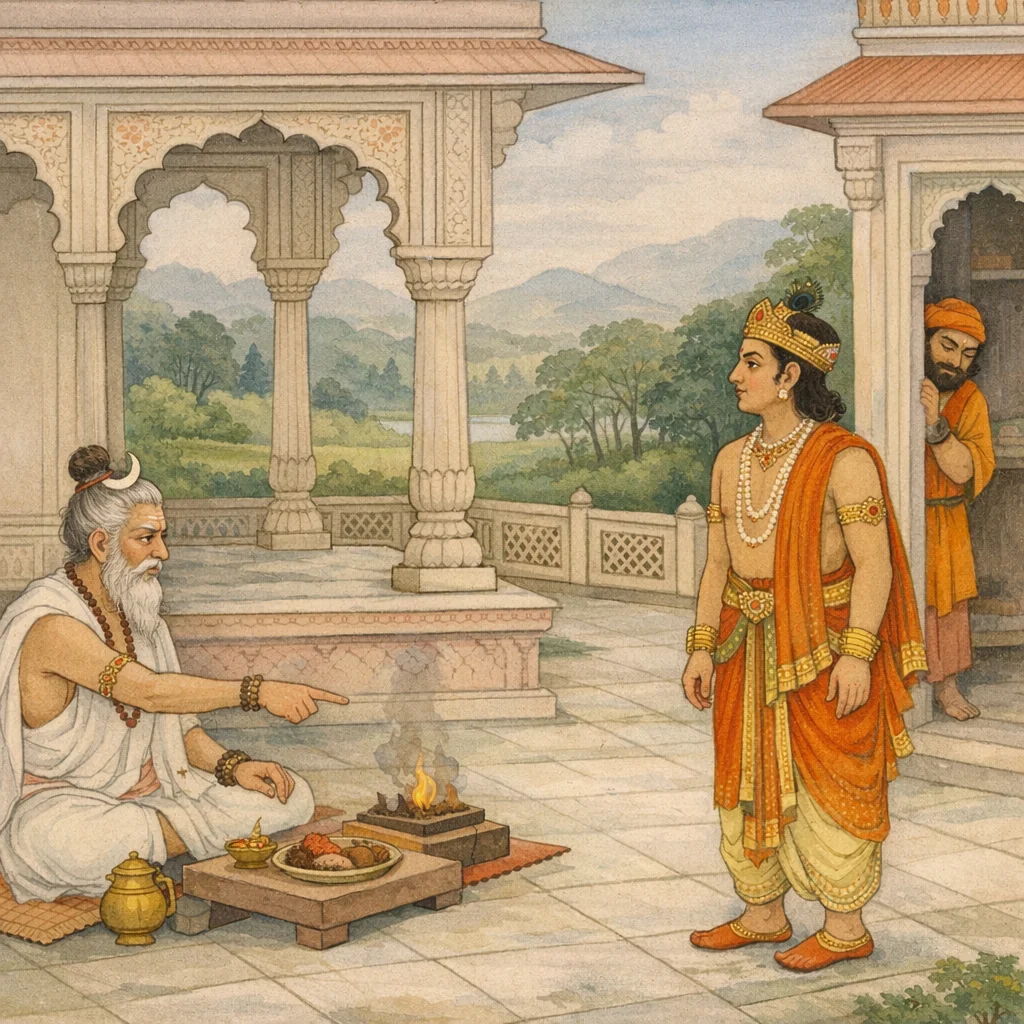
मित्रसह-राज्ञो रक्षत्व-शापकथा — The Curse that Turns King Mitrasaha into a Rakshasa (Vasiṣṭha’s Śāpa Narrative)
In this adhyāya, Sūta narrates the tale of King Mitrasaha of the Ikṣvāku line, famed for dharma and skill in archery. After the king slays the night-roaming demon Kamaṭha in the forest, the demon’s wicked younger brother enters the royal household in disguise. Mistakenly trusted and made overseer of the kitchens, the impostor engineers ritual defilement by mixing human flesh into the food to be offered to the king’s guru, Vasiṣṭha, during a śrāddha rite (pituḥ kṣayāha). When Vasiṣṭha discovers the pollution, he condemns it and utters a curse that the king will become a rākṣasa. The chapter teaches the fragility of ritual purity, the peril of misplaced trust, and the heavy karmic burden rulers bear for deeds done “under their authority,” even when deception is involved. In a Śaiva ethical key, true sovereignty requires vigilant guardianship of correct rites and protection of sādhus, for violations rebound as a fall in being until set right through penance and reorientation to Śiva.
Shlokas
Verse 1
सूत उवाच । श्रीमतीक्ष्वाकुवंशे हि राजा परमधार्मिकः । आसीन्मित्रसहो नाम श्रेष्ठस्सर्वधनुष्मताम्
Sūta said: In the illustrious Ikṣvāku lineage there was a king, supremely righteous, named Mitrasaha—foremost among all archers.
Verse 2
तस्य राज्ञः सुधर्मिष्ठा मदयन्ती प्रिया शुभा । दमयन्ती नलस्येव बभूव विदिता सती
That king had a blessed and beloved queen named Madayantī, most steadfast in righteousness. She was renowned as a chaste and noble lady—like Damayantī, the wife of Nala.
Verse 3
स एकदा हि मृगयास्नेही मित्रसहो नृपः । महद्बलेन संयुक्तो जगाम गहनं वनम्
Once, that king—fond of the hunt and accompanied by his friends—set out with a great force and entered a dense forest.
Verse 4
विहरंस्तत्र स नृपः कमठाह्वं निशाचरम् । निजघान महादुष्टं साधुपीडाकरं खलम्
While roaming there, that king struck down the night-roaming demon named Kamaṭha—an exceedingly wicked villain who oppressed the sādhus and harassed the righteous.
Verse 5
अथ तस्यानुजः पापी जयेयं छद्मनैव तम् । मत्वा जगाम नृपतेरन्तिक च्छद्मकारकः
Then his sinful younger brother, thinking, “I shall defeat him only by deceit,” went near the king—himself a contriver of disguise and treachery.
Verse 6
तं विनम्राकृतिं दृष्ट्वा भृत्यतां कर्तुमागतम् । चक्रे महानसाध्यक्षमज्ञानात्स महीपतिः
Seeing him of humble demeanor, who had come seeking to serve as a menial attendant, the king—out of ignorance—appointed him as the superintendent of the royal kitchen.
Verse 7
अथ तस्मिन्वने राजा कियत्कालं विहृत्य सः । निवृत्तो मृगयां हित्वा स्वपुरीमाययौ मुदा
Then, having sported for some time in that forest, the king desisted; abandoning the hunt, he returned with joy to his own city.
Verse 8
पितुः क्षयाहे सम्प्राप्ते निमंत्र्य स्वगुरुं नृपः । वसिष्ठं गृहमानिन्ये भोजयामास भक्तितः
When the annual funeral observance for his father arrived, the king invited his own revered guru Vasiṣṭha, brought him to his home with honor, and fed him with devotion.
Verse 9
रक्षसा सूदरूपेण संमिश्रितनरामिषम् । शाकामिषं पुरः क्षिप्तं दृष्ट्वा गुरुरथाब्रवीत्
Seeing the vegetable dish placed before him—yet mixed with human flesh by a rākṣasa disguised as a cook—the Guru then spoke.
Verse 10
गुरुरुवाच । धिक् त्वां नरामिषं राजंस्त्वयैतच्छद्मकारिणा । खलेनोपहृतं मह्यं ततो रक्षो भविष्यसि
The Guru said: “Shame upon you, O king—one who lives on human flesh! By your deceit, what was due to me has been taken away by a wicked one. Therefore you shall become a rākṣasa, a demonic being.”
Verse 11
रक्षःकृतं च विज्ञाय तदैवं स गुरुस्तदा । पुनर्विमृश्य तं शापं चकार द्वादशाब्दिकम्
Realizing that the deed had been done by a rākṣasa, the guru at once reflected again and then pronounced a curse lasting twelve years.
Verse 12
स राजानुचितं शापं विज्ञाय क्रोधमूर्छितः । जलांजलिं समादाय गुरुं शप्तुं समुद्यतः
Realizing that such a curse was unworthy of a king, he grew faint, overcome by anger. Cupping his palms, he took up a handful of water and rose, intent on cursing his own guru.
Verse 13
तदा च तत्प्रिया साध्वी मदयन्ती सुधर्मिणी । पतित्वा पादयोस्तस्य शापं तं हि न्यवारयत्
Then his beloved—virtuous Madayantī, steadfast in righteous dharma—fell at his feet and restrained that curse, preventing it from taking effect.
Verse 14
ततो निवृत्तशापस्तु तस्या वचनगौरवात् । तत्याज पादयोरंभः पादौ कल्मषतां गतौ
Then, because of the weight and sanctity of her words, the curse was withdrawn. The water at his feet departed, and those feet became touched by impurity.
Verse 15
ततःप्रभृति राजाभूत्स लोकेस्मिन्मुनीश्वराः । कल्मषांघ्रिरिति ख्यातः प्रभावात्तज्जलस्य हि
From that time onward, O best of sages, that king became renowned in this world as “Kalmaṣāṅghri (Sin-footed),” solely due to the potency of that sacred water.
Verse 16
राजा मित्रसहः शापाद्गुरो ऋषिवरस्य हि । बभूव राक्षसो घोरो हिंसको वनगोचरः
By the curse of his venerable guru—an excellent sage—King Mitrasaha became a dreadful rākṣasa, a violent killer who roamed the forest.
Verse 17
स बिभ्रद्राक्षसं रूपं कालान्तकयमोपमम् । चखाद विविधाञ्जंतून्मानुषादीन्वनेचरः
Assuming a rākṣasa-like form, resembling Yama—the slayer at the end of time—this forest-dweller devoured various creatures, including human beings and others.
Verse 18
स कदाचिद्वने क्वापि रममाणौ किशोरकौ । अपश्यदन्तकाकारो नवोढौ मुनिदम्पती
Once, somewhere in a forest, that fearsome one—having the appearance of Death—saw a newly married sage-couple, still youthful, sporting together in delight.
Verse 19
राक्षसः स नराहारः किशोरं मुनिनन्दनम् । जग्धुं जग्राह शापार्त्तो व्याघ्रो मृगशिशुं यथा
That man-eating rākṣasa, tormented by the curse, seized the youthful son of the sage in order to devour him—just as a tiger snatches up a fawn.
Verse 20
कुक्षौ गृहीतं भर्तारं दृष्ट्वा भीता च तत्प्रिया । सा चक्रे प्रार्थनं तस्मै वदंती करुणं वचः
Seeing her husband seized and held fast within (his) belly, his beloved became afraid; and, speaking words filled with compassion, she made a heartfelt supplication to him.
Verse 21
प्रार्थ्यमानोऽपि बहुशः पुरुषादः स निर्घृणः । चखाद शिर उत्कृत्य विप्रसूनोर्दुराशयः
Although he was repeatedly begged, that merciless man-eater—evil-minded—cut off the head of the Brahmin’s son and devoured it.
Verse 22
अथ साध्वी च सा दीना विलप्य भृशदुःखिता । आहृत्य भर्तुरस्थीनि चितां चक्रे किलोल्बणाम्
Then that virtuous lady, desolate and wailing in deep grief, gathered her husband’s bones and, it is said, prepared a great and formidable funeral pyre.
Verse 23
भर्तारमनुगच्छन्ती संविशंती हुताशनम् । राजानं राक्षसाकारं सा शशाप द्विजाङ्गना
Following her husband and entering the sacrificial fire, the brahmin lady cursed the king—who had taken on a demonic disposition and appearance.
Verse 24
अद्यप्रभृति नारीषु यदा त्वं संगतो भवेः । तदा मृतिस्तवेत्युक्त्वा विवेश ज्वलनं सती
“From this day onward, if ever you unite with another woman, then death shall be yours.” Having spoken thus, Satī entered the blazing fire.
Verse 25
सोपि राजा गुरोश्शापमनुभूय कृतावधिम् । पुनः स्वरूपमास्थाय स्वगृहं मुदितो ययौ
That king too, having endured the guru’s curse for its appointed term, regained his own true form and, rejoicing, returned to his home.
Verse 26
ज्ञात्वा विप्रसतीशापं मदयन्ती रतिप्रियम् । पतिं निवारयामास वैधव्यादतिबिभ्यती
Knowing the curse uttered by the chaste wife of a brahmin, Madayantī—beloved of Ratipriya—restrained her husband, trembling greatly at the fear of widowhood.
Verse 27
अनपत्यो विनिर्विण्णो राज्यभोगेषु पार्थिवः । विसृज्य सकलां लक्ष्मीं वनमेव जगाम ह
Childless and thoroughly disenchanted with the pleasures of kingship, the earthly ruler renounced all prosperity and went indeed to the forest.
Verse 28
स्वपृष्ठतः समायान्तीं ब्रह्महत्यां सुदुःखदाम् । ददर्श विकटाकारां तर्जयन्ती मुहुर्मुहुः
He saw, from behind him, Brahmahatyā—the grievous, sorrow-bringing sin—coming closer: a frightful, monstrous form repeatedly threatening him again and again.
Verse 29
तस्या निर्भद्रमन्विच्छन् राजा निर्विण्णमानसः । चकार नानोपायान्स जपव्रतमखादिकान्
Seeking her well-being and freedom from misfortune, the king—his mind weighed down with sorrow—undertook many means: mantra-japa, sacred vows, and sacrificial rites and the like.
Verse 30
नानोपायैर्यदा राज्ञस्तीर्थस्नानादिभिर्द्विजाः । न निवृत्ता ब्रह्महत्या मिथिलां स ययौ तदा
When, despite many remedies—such as bathing at sacred fords and other expiatory rites—O brāhmaṇas, the sin of brahmahatyā did not subside for the king, then he set out for Mithilā.
Verse 31
बाह्योद्यानगतस्तस्याश्चितया परयार्दितः । ददर्श मुनिमायान्तं गौतमं पार्थिवश्च सः
Tormented by the fierce intensity of her funeral pyre, the king went into the outer garden. There he saw the sage Gautama approaching.
Verse 33
अभिसृत्य स राजेन्द्रो गौतमं विमलाशयम् । तद्दर्शनाप्तकिंचित्कः प्रणनाम मुहुर्मुहुः । अथ तत्पृष्टकुशलो दीर्घमुष्णं च निश्वसन् । तत्कृपादृष्टिसंप्राप्तसुख प्रोवाच तं नृपः
Approaching Gautama, pure in mind, the king found some relief merely by beholding him and bowed again and again. Then, when the sage asked of his welfare, the ruler, breathing out long and burning sighs, spoke—comforted by the compassionate glance of that holy seer.
Verse 34
राजोवाच । मुने मां बाधते ह्येषा ब्रह्महत्या दुरत्यया । अलक्षिता परैस्तात तर्जयंती पदेपदे
The King said: “O sage, this grievous sin of brahmin-slaying afflicts me and is hard to overcome. Though unseen by others, revered sir, it threatens and torments me at every step.”
Verse 35
यन्मया शापदग्धेन विप्रपुत्रश्च भक्षितः । तत्पापस्य न शान्तिर्हि प्रायश्चित्तसहस्रकैः
“For I, scorched by a curse, have even consumed the son of a brāhmaṇa; and for that sin there is truly no pacification, not even through thousands of acts of expiation.”
Verse 36
नानोपायाः कृता मे हि तच्छान्त्यै भ्रमता मुने । न निवृत्ता ब्रह्महत्या मम पापात्मनः किमु
O sage, while wandering I have indeed tried many remedies to pacify it; yet the sin of brahmahatyā has not departed from me—what can be done for one whose very self has become tainted by sin?
Verse 37
अद्य मे जन्मसाफल्यं संप्राप्तमिव लक्षये । यतस्त्वद्दर्शनादेव ममानन्दभरोऽभवत्
Today I feel as though the purpose of my birth has been fulfilled, for by the very sight of you an overwhelming fullness of bliss has arisen within me.
Verse 38
अद्य मे तवपादाब्ज शरणस्य कृतैनसः । शांतिं कुरु महाभाग येनाहं सुखमाप्नुयाम्
Today I have taken refuge in Your lotus-feet, though I am one who has committed faults. O noble Lord, grant me peace, by which I may attain true happiness.
Verse 39
सूत उवाच । इति राज्ञा समादिष्टो गौतमः करुणार्द्रधीः । समादिदेश घोराणामघानां साधु निष्कृतिम्
Sūta said: Thus commanded by the king, Gautama—whose mind was softened with compassion—then prescribed the proper expiation for those dreadful sins.
Verse 40
गौतम उवाच । साधु राजेन्द्र धन्योसि महाघेभ्यो भयन्त्यज । शिवे शास्तरि भक्तानां क्व भयं शरणैषिणाम्
Gautama said: “Well done, O king of kings—you are truly blessed. Cast off fear of even the gravest sins. For devotees who take refuge in Śiva, the divine Lord and Teacher, where can fear remain for those who seek shelter?”
Verse 41
शृणु राजन्महाभाग क्षेत्रमन्यत्प्रतिष्ठितम् । महापातकसंहारि गोकर्णाख्यं शिवालयम्
Listen, O King, greatly blessed: there is another renowned sacred region—Gokarṇa by name—an abode of Śiva, famed as the destroyer of even the gravest sins.
Verse 42
तत्र स्थितिर्न पापानां महद्भ्यो महतामपि । महाबलाभिधानेन शिवः संनिहितः स्वयम्
In that sacred place, sinners find no footing—nor can even the mightiest among the great remain there in pride. For by the very name “Mahābala,” Lord Śiva Himself abides there, personally present.
Verse 43
सर्वेषां शिवलिंगानां सार्वभौमो महाबलः । चतुर्युगे चतुर्वर्णस्सर्वपापापहारकः
Among all Śiva-liṅgas, this one is the sovereign and supremely powerful. In all the four yugas, and for the people of all four varṇas, it removes every sin.
Verse 44
पश्चिमाम्बुधितीरस्थं गोकर्णं तीर्थमुत्तमम् । तत्रास्ति शिवलिंगं तन्महापातकनाशकम्
On the western shore of the ocean lies Gokarṇa, an excellent sacred ford. There is a Śiva-liṅga there, and it destroys even the greatest sins.
Verse 46
तथा त्वमपि राजेन्द्र गोकर्ण गिरिशालयम् । गत्वा सम्पूज्य तल्लिंगं कृतकृत्यत्वमाप्नुयाः
Therefore you too, O best of kings, should go to Gokarṇa, the abode of Girīśa (Lord Śiva). Having duly worshipped that Liṅga there, you will attain the state of having fulfilled life’s true purpose.
Verse 47
तत्र सर्वेषु तीर्थेषु स्नात्वाभ्यर्च्य महाबलम् । सर्वपापविनिर्मुक्तः शिवलोकन्त्वमाप्नुयाः
There, having bathed in all those sacred tīrthas and worshipped the Great and Mighty Lord Śiva, you shall be freed from every sin and attain the world of Śiva.
Verse 48
सूत उवाच । इत्यादिष्टः स मुनिना गौतमेन महात्मना । महाहृष्टमना राजा गोकर्णं प्रत्यपद्यत
Sūta said: Thus instructed by the great-souled sage Gautama, the king—his mind filled with great joy—set out and proceeded to Gokarṇa.
Verse 49
तत्र तीर्थेषु सुस्नात्वा समभ्यर्च्य महाबलम् । निर्धूताशेषपापौघोऽलभच्छंभोः परम्पदम्
There, having bathed well in the sacred tīrthas and duly worshipped the Great and Mighty Lord, he cast off the entire flood of sins and attained Śambhu’s supreme abode—liberation bestowed by Śiva’s grace.
Verse 50
य इमां शृणुयान्नित्यं महाबलकथां प्रियाम् । त्रिसप्तकुलजैस्सार्द्धं शिवलोके व्रजत्यसौ
Whoever listens daily to this beloved account of Mahābala—the great power of Lord Śiva—such a person, together with those born in twenty-one generations of their lineage, attains Śivaloka.
Verse 51
इति वश्च समाख्यातं माहात्म्यं परमाद्भुतम् । महाबलस्य गिरिशलिंगस्य निखिलाघहृत्
Thus have I narrated to you the supremely wondrous glory of Mahābala’s Girīśa-Liṅga, which utterly removes all sins.
Frequently Asked Questions
The central event is Vasiṣṭha’s curse: after a disguised rākṣasa causes human flesh to be served to the guru during a rite, the king Mitrasaha is held accountable and is cursed to become a rākṣasa—an argument for institutional responsibility and the inviolability of guru-centered ritual purity.
Food (āhāra) functions as a purity-symbol and a carrier of moral intention; the kitchen becomes the hidden site where dharma is protected or sabotaged. The curse operates as a ‘speech-act’ that externalizes inner disorder into ontological change, illustrating how ritual violation can precipitate a fall in being (bhāva-pariṇāma).
No explicit Śiva/Gaurī form is foregrounded in the sampled verses; the chapter instead advances Śaiva ethical theology indirectly—by showing how dharma, guru-sanctity, and purity norms (ultimately upheld by Rudra’s cosmic order) govern the fate of even exemplary kings.