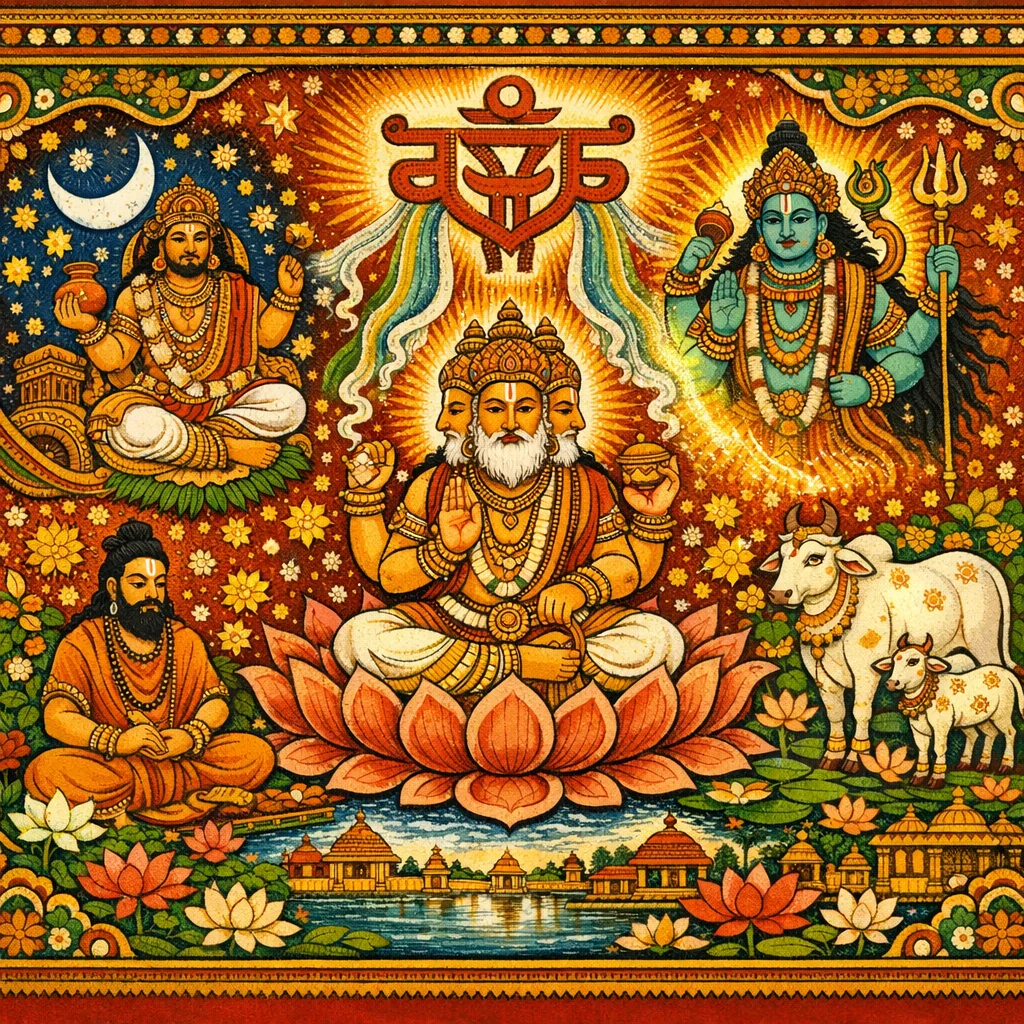
Adhyaya 171: The Pushkara Manifestation, Brahma’s Austerity, and the Genealogical Unfolding of Creation
पौष्करप्रादुर्भाव-वर्णनम् तथा सृष्टिवंशानुक्रमः
Speaker: Lord Matsya
Matsya recounts how Brahmā, standing upon the lotus, performs fierce tapas. Nārāyaṇa appears in a Śambhu-form with Kapila, addresses Brahmā, and imparts the remembrance of Satya and Ṛta as the supreme state. Brahmā then proceeds with creation: the worlds are formed; Śambhu’s three sons are created and attain liberation; and Brahmā, no longer content in solitude, manifests an auspicious wife from half his body. From this power he utters the tri-pada Gāyatrī, from which the four Vedas arise. The chapter then lists Prajāpatis and sages, Dakṣa’s daughters and Kaśyapa’s marriages, the gifting of the Nakṣatras to Soma, and many progeny-lines (devas, asuras, nāgas, yakṣas, and others). It culminates in the Pushkara manifestation (Pauṣkaraka) and proclaims the fruits of reverent listening and recitation: worldly success and spiritual ascent through Hari-bhakti.
Key Concepts
Shlokas in Adhyaya 171
Verse 1
*मत्स्य उवाच स्थित्वा च तस्मिन्कमले ब्रह्मा ब्रह्मविदां वरः ऊर्ध्वबाहुर्महातेजास् तपो घोरं समाश्रितः //
Lord Matsya said: Standing upon that lotus, Brahmā—the foremost among the knowers of Brahman—radiant with great splendor, raised his arms aloft and undertook a fierce austerity.
Verse 2
प्रज्वलन्निव तेजोभिर् भाभिः स्वाभिस्तमोनुदः बभासे सर्वधर्मस्थः सहस्रांशुरिवांशुभिः //
Abiding in every form of dharma, he shone—like the thousand-rayed sun—with his own blazing energies and radiances that drive away darkness.
Verse 3
अथान्यद्रूपमास्थाय शंभुर्नारायणो ऽव्ययः आजगाम महातेजा योगाचार्यो महायशाः //
Then, assuming another form, the imperishable Nārāyaṇa—Śambhu himself—arrived: of great radiance, the preceptor of yoga, and of great renown.
Verse 4
सांख्याचार्यो हि मतिमान् कपिलो ब्राह्मणो वरः उभावपि महात्मानौ स्तुवन्तौ क्षेत्रतत्परौ //
Indeed, the wise Kapila—foremost among brāhmaṇas and the teacher of Sāṃkhya—(was there); and both (he and his companion) were great-souled, devoted to that sacred kṣetra, continually offering it praise.
Verse 5
तौ प्राप्तावूचतुस्तत्र ब्रह्माणममितौजसम् परावरविशेषज्ञौ पूजितौ च महर्षिभिः //
Having arrived there, those two addressed Brahmā, whose splendour is immeasurable—those two who knew the distinctions between the higher and the lower (realities), and who were also honoured by the great seers.
Verse 6
ब्रह्मात्मदृढबन्धश्च विशालो जगदास्थितः ग्रामणीः सर्वभूतानां ब्रह्मा त्रैलोक्यपूजितः //
Brahmā is firmly bound to the Supreme Self; vast in being, he stands as the support of the world. He is the leader of all creatures, and Brahmā is worshipped throughout the three worlds.
Verse 7
तयोस्तद्वचनं श्रुत्वा ब्रह्माभ्याहृतयोगवित् त्रीनिमान् कृतवांल्लोकान् यथेयं ब्रह्मणः श्रुतिः //
Having heard the words of those two, Brahmā—knower of the yoga imparted (to him) and established in sacred utterance—created these three worlds, in accordance with this revelation (śruti) belonging to Brahmā.
Verse 8
पुत्रं च शंभवे चैकं समुत्पादितवानृषिः तस्याग्रे वाग्यतस्तस्थौ ब्रह्मा तामसमव्ययम् //
The sage brought forth a single son for Śambhu (Śiva). Before him, Brahmā stood silent—restraining speech—abiding in his imperishable tāmasa (dark, inert) mode.
Verse 9
सोत्पन्नमात्रो ब्रह्माणम् उक्तवान्मानसः सुतः किं कुर्मस्तव साहाय्यं ब्रवीतु भगवानृषिः //
As soon as he was born, the mind-born son addressed Brahmā: “What shall we do as assistance to you? Let the venerable sage declare (your command).”
Verse 10
*ब्रह्मोवाच य एष कपिलो ब्रह्म नारायणमयस्तथा वदते भवतस्तत्त्वं तत्कुरुष्व महामते //
Brahmā said: “This Kapila—who is Brahman itself, pervaded by Nārāyaṇa—declares the true principle concerning you. Therefore, O great-minded one, act in accordance with that truth.”
Verse 11
ब्रह्मणस्तु तदर्थं तु तदा भूयः समुत्थितः शुश्रूषुरस्मि युवयोः किं करोमि कृताञ्जलिः //
Then Brahmā, rising again for that very purpose, with folded hands said: “I am ready to serve you both—what shall I do?”
Verse 12
*श्रीभगवानुवाच यत्सत्यमक्षरं ब्रह्म ह्य् अष्टादशविधं तु तत् यत्सत्यं यदृतं तत्तु परं पदमनुस्मर //
The Blessed Lord said: “That which is Truth is the Imperishable Brahman; indeed, it is spoken of as eighteenfold. That which is Truth, that which is Ṛta (cosmic order)—remember that as the supreme state.”
Verse 13
एतद्वचो निशम्यैव ययौ स दिशमुत्तराम् गत्वा च तत्र ब्रह्मत्वम् अगमज्ज्ञानतेजसा //
Hearing these words, he at once set out toward the northern direction; and having gone there, he attained the state of Brahman through the radiant power of spiritual knowledge.
Verse 14
ततो ब्रह्मा भुवं नाम द्वितीयमसृजत्प्रभुः संकल्पयित्वा मनसा तमेव च महामनाः //
Then the Lord Brahmā, the great-souled one, having formed the resolve in his mind, created the second realm called Bhuva (Bhuvarloka) as well.
Verse 15
ततः सो ऽथाब्रवीद्वाक्यं किं करोमि पितामह पितामहसमाज्ञातो ब्रह्माणं समुपस्थितः //
Then he spoke these words: “Grandfather (Pitāmaha), what shall I do?”—and, having been summoned by Pitāmaha’s command, he presented himself before Brahmā.
Verse 16
ब्रह्माभ्यासं तु कृतवान् भुवश्च पृथिवीं गतः प्राप्तश्च परमं स्थानं स तयोः पार्श्वमागतः //
Having indeed practiced sustained contemplation on Brahman, he moved from the Bhuvar-loka to the earth; and having attained the supreme station, he came to the side of those two.
Verse 17
तस्मिन्नपि गते पुत्रे तृतीयमसृजत्प्रभुः मोक्षप्रवृत्तिकुशलं भूर्भुवं नामतो विभुम् //
When that son too had passed away, the Lord created a third—an illustrious one named Bhūrbhuva, skilled in setting beings upon the path of liberation.
Verse 18
गोपतित्वं समासाद्य तयोरेवागमद्गतिम् एवं पुत्रास्त्रयो ऽप्येत उक्ताः शंभोर्महात्मनः //
Having attained the office of ‘Lord of the Cows’ (Gopati), he reached the very same destiny as those two. Thus have these three sons of the great-souled Śambhu been described.
Verse 19
तान्गृहीत्वा सुतांस्तस्य प्रयातः स्वार्जितां गतिम् नारायणश्च भगवान् कपिलश्च यतीश्वरः //
Having taken up those sons of his, the Blessed Lord Nārāyaṇa—Kapila, the lord among ascetics—departed to the supreme state that he had attained by his own spiritual power.
Verse 20
यं कालं तौ गतौ मुक्तौ ब्रह्मा तं कालमेव हि ततो घोरतमं भूयः संश्रितः परमं व्रतम् //
The very time in which those two attained release and departed—Brahmā indeed entered that very Time; thereafter, adopting an even more formidable discipline, he again undertook the supreme vow.
Verse 21
न रेमे ऽथ ततो ब्रह्मा प्रभुरेकस्तपश्चरन् शरीरार्धात्ततो भार्यां समुत्पादितवाञ्छुभाम् //
Then Brahmā, the sovereign Lord, did not delight in solitude; practicing austerity alone, he thereafter brought forth from one half of his own body an auspicious wife.
Verse 22
तपसा तेजसा चैव वर्चसा नियमेन च सदृशीमात्मनो देवीं समर्थां लोकसर्जने //
By austerity (tapas), spiritual radiance (tejas), splendor/vital potency (varcas), and disciplined observance (niyama), he fashioned a Goddess akin to his own nature—fully capable of bringing worlds into being.
Verse 23
तया समाहितस्तत्र रेमे ब्रह्मा तपश्चरन् ततो जगाद त्रिपदां गायत्रीं वेदपूजिताम् //
Absorbed in that (power/meditation) there, Brahmā delighted in deep austerity; then he uttered the three-footed Gāyatrī, revered and worshipped by the Vedas.
Verse 24
सृजन्प्रजानां पतयः सागरांश्चासृजद्विभुः अपरांश्चैव चतुरो वेदान्गायत्रिसंभवान् //
While bringing forth creation, the all-powerful Lord produced the lords of creatures and also the oceans; and further, He manifested the four Vedas, born of the Gāyatrī.
Verse 25
आत्मनः सदृशान्पुत्रान् असृजद्वै पितामहः विश्वे प्रजानां पतयो येभ्यो लोका विनिःसृताः //
Indeed, the Grandfather (Brahmā) created sons resembling himself—universal lords of creatures (Prajāpatis)—from whom the worlds and their populations came forth.
Verse 26
विश्वेशं प्रथमं तावन् महातापसमात्मजम् सर्वमन्त्रहितं पुण्यं नाम्ना धर्मं स सृष्टवान् //
First of all, he created Viśveśa—his own son, a great ascetic—holy and auspicious, endowed with the essence of all sacred mantras, and named him Dharma.
Verse 27
दक्षं मरीचिमत्रिं च पुलस्त्यं पुलहं क्रतुम् वसिष्ठं गौतमं चैव भृगुमङ्गिरसं मनुम् //
Dakṣa, Marīci, Atri, Pulastya, Pulaha, Kratu, Vasiṣṭha, Gautama, Bhṛgu, Aṅgiras, and Manu—these (sages/forefathers) are being named (in order).
Verse 28
अथैवाद्भुतमित्येते ज्ञेयाः पैतामहर्षयः त्रयोदशगुणं धर्मम् आलभन्त महर्षयः //
These, indeed, are to be known as the ‘Paitāmaha’ sages—those of the line of the Grandfather (Brahmā); and those great seers undertook (embraced) a dharma endowed with thirteen qualities.
Verse 29
अदितिर्दितिर्दनुः काला अनायुः सिंहिका मुनिः ताम्रा क्रोधाथ सुरता विनता कद्रुरेव च //
Aditi, Diti, Danu, Kālā, Anāyu, Siṃhikā, Muni, Tāmrā, Krodhā, Suratā, Vinatā, and also Kadru—these (are the renowned mothers in the progeny-lines).
Verse 30
दक्षस्यापत्यमेता वै कन्या द्वादश पार्थिव मरीचेः कश्यपः पुत्रस् तपसा निर्मितः किल //
O king, these twelve maidens are indeed the offspring of Dakṣa. And Kaśyapa—son of Marīci—is said to have been brought forth through ascetic power (tapas).
Verse 31
तस्मै कन्या द्वादशान्या दक्षस्ताः प्रददौ तदा नक्षत्राणि च सोमाय तदा वै दत्तवानृषिः //
Then Dakṣa gave him those twelve maidens as wives; and at that very time the sage also bestowed the Nakṣatras (lunar mansions) upon Soma (the Moon).
Verse 32
रोहिण्यादीनि सर्वाणि पुण्यानि रविनन्दन लक्ष्मीर्मरुत्वती साध्या विश्वेशा च मता शुभा //
O son of the Sun, all (the asterisms) beginning with Rohiṇī are auspicious. (Among the auspicious designations) Lakṣmī, Marutvatī, Sādhyā, and Viśveśā are also regarded as fortunate.
Verse 33
देवी सरस्वती चैव ब्रह्मणा निर्मिताः पुरा एताः पञ्च वरिष्ठा वै सुरश्रेष्ठाय पार्थिव //
The goddess Sarasvatī, indeed, was formerly created by Brahmā. These five are truly the foremost (divine powers), O king, for the best of the gods.
Verse 34
दत्ता भद्राय धर्माय ब्रह्मणा दृष्टकर्मणा या तु रूपवती पत्नी ब्रह्मणः कामरूपिणी //
She was given by Brahmā—who beholds the fruits of actions—to the auspicious Dharma; and she, the beautiful, desire-assuming consort of Brahmā, (became associated with him/this arrangement).
Verse 35
सुरभिः सा हिता भूत्वा ब्रह्माणं समुपस्थिता ततस्तामगमद्ब्रह्मा मैथुनं लोकपूजितः //
Then Surabhī, having become favorable and beneficial, approached Brahmā in attendance; thereafter Brahmā—revered by the worlds—united with her in sexual union.
Verse 36
लोकसर्जनहेतुज्ञो गवामर्थाय सत्तमः जज्ञिरे च सुतास्तस्यां विपुला धूमसंनिभाः //
Knowing the causes behind the creation of the worlds, that best of beings—acting for the welfare of the cows—begot sons in her; many were born, vast in number and resembling smoke in hue.
Verse 37
नक्तसंध्याभ्रसंकाशाः प्रादहंस्तिग्मतेजसः ते रुदन्तो द्रवन्तश्च गर्हयन्तः पितामहम् //
Resembling clouds at the darkening twilight, blazing with sharp radiance, they set things ablaze; and, weeping and fleeing, they reviled Pitāmaha (Brahmā).
Verse 38
रोदनाद्रवणाच्चैव रुद्रा इति ततः स्मृताः निरृतिश्चैव शंभुर्वै तृतीयश्चापराजितः //
From (their) causing lamentation and also bringing about melting (or dissolution), they are therefore remembered as “Rudras.” And among them, one is called Nirṛti, and indeed another is Śambhu; the third is Aparājita (the Unconquered).
Verse 39
मृगव्याधः कपर्दी च दहनो ऽथेश्वरश्च वै अहिर्बुध्न्यश्च भगवान् कपाली चापि पिङ्गलः //
He is the Hunter (who subdues the wild), the Wearer of matted locks, the Burning Fire; indeed, the Lord; the blessed Ahirbudhnya as well—also the Skull-bearer, and the Tawny-hued One.
Verse 40
सेनानीश्च महातेजा रुद्रास्त्वेकादश स्मृताः तस्यामेव सुरभ्यां च गावो यज्ञेश्वराश्च वै //
The mighty and radiant Senānī is remembered among the eleven Rudras; and from that very Surabhī arise the sacred cows, revered indeed as the presiding powers of sacrifice.
Verse 41
प्रकृष्टाश्च तथा मायाः सुरभ्याः पशवो ऽक्षराः अजाश्चैव तु हंसाश्च तथैवामृतमुत्तमम् //
Likewise, there are the excellent (higher) māyās; the fragrant and beneficent cattle; the imperishable (akṣara) beings; goats as well as hamsas (sacred swans); and in the same way, the supreme nectar of immortality.
Verse 42
ओषध्यः प्रवरायाश्च सुरस्यास्ताः समुत्थिताः धर्माल्लक्ष्मीस्तथा कामं साध्या साध्यान्व्यजायत //
From Pravarā and from Surasā arose the medicinal herbs. From Dharma was born Lakṣmī; and likewise Kāma; and from the Sādhyā was born the class of gods known as the Sādhyas.
Verse 43
भवं च प्रभवं चैव हीशं चासुरहं तथा अरुणं चारुणिं चैव विश्वावसुबलध्रुवौ //
“(They are) Bhava and Prabhava; Hīśa and also Asuraha; Aruṇa and Aruṇi as well; and Viśvāvasu, Bala, and Dhruva.”
Verse 44
हविष्यं च वितानं च विधानशमितावपि वत्सरं चैव भूतिं च सर्वासुरनिषूदनम् //
One should also offer haviṣya (oblatory food), and the vitāna (ritual canopy/expanded rite); even the pacification brought about by proper procedure (vidhāna) is included. (Such worship yields) a full year (of merit), prosperity, and the power that destroys all demonic forces.
Verse 45
सुपर्वाणं बृहत्कान्तिः साध्या लोकनमस्कृताः वासवानुगता देवी जनयामास वै सुरान् //
The goddess—attended by Vāsava (Indra)—gave birth to the gods: Suparvāṇa, Bṛhatkānti, the Sādhyas, and the Lokanamaskṛtas.
Verse 46
वरं वै प्रथमं देवं द्वितीयं ध्रुवमव्ययम् विश्वावसुं तृतीयं च चतुर्थं सोममीश्वरम् //
First, one should place (or worship) the deity Vara; second, Dhruva, the imperishable; third, Viśvāvasu; and fourth, Soma, the sovereign Lord.
Verse 47
ततो ऽनुरूपमायं च यमस्तस्मादनन्तरम् सप्तमं च तथा वायुम् अष्टमं निरृतिं वसुम् //
Thereafter comes Anurūpamāya; immediately after him is Yama. The seventh in order is likewise Vāyu, and the eighth is Nirṛti—(counted among) the Vasus.
Verse 48
धर्मस्यापत्यम् एतद्वै सुदेव्यां समजायत विश्वे देवाश्च विश्वायां धर्माज्जाता इति श्रुतिः //
Indeed, this offspring of Dharma was born of Sudevī; and from Viśvā, the Viśve Devas were born of Dharma—so says the sacred tradition.
Verse 49
दक्षश्चैव महाबाहुः पुष्करस्वन एव च चाक्षुषस्तु मनुश्चैव तथा मधुमहोरगौ //
Dakṣa, and also Mahābāhu; likewise Puṣkarasvana; and Cākṣuṣa Manu as well—together with Madhu and the great serpent (Mahoraga)—are (here) enumerated.
Verse 50
विश्रान्तकवपुर्बालो विष्कम्भश्च महायशाः गरुडश्चातिसत्त्वौजा भास्करप्रतिमद्युतिः //
He is of a well-composed, restful-bodied form; ever youthful; the mighty Support (Viṣkambha); of great renown—Garuḍa, whose vigor is exceedingly powerful, and whose radiance is like the Sun.
Verse 51
विश्वान्देवान्देवमाता विश्वेशाजनयत् सुतान् मरुत्वती मरुत्वतो देवानजनयत्सुतान् //
Devamātā (the Mother of the gods) bore the sons known as the Viśvedevas; and Marutvatī gave birth to the divine Maruts as her sons.
Verse 52
अग्निं चक्षुं रविर्ज्योतिः सावित्रं मित्रमेव च अमरं शरवृष्टिं च सुकर्षं च महाभुजम् //
He is Fire; the Eye; the Sun; the Radiance; the Savitṛ-power; and Mitra as well. He is the Deathless One—like a rain of arrows in battle—mighty in draw (and attraction), and great-armed.
Verse 53
विराजं चैव वाचं च विश्वावसुमतिं तथा अश्वमित्रं चित्ररश्मिं तथा निषधनं नृप //
“And (there were) Virāja and Vāca; likewise Viśvāvasumatī; and also Aśvamitra, Citraraśmi, and Niṣadhana, O king.”
Verse 54
हूयन्तं वाडवं चैव चारित्रं मन्दपन्नगम् बृहन्तं वै बृहद्रूपं तथा वै पूतनानुगम् //
He is invoked as Hūyanta and also as Vāḍava; as Cāritra and as Mandapannaga; as Bṛhant indeed, as Bṛhadrūpa, and likewise as Pūtanānuga.
Verse 55
मरुत्वती पुरा जज्ञ एतान्वै मरुतां गणान् अदितिः कश्यपाज्जज्ञ आदित्यान्द्वादशैव हि //
Formerly, Marutvatī gave birth to these hosts of the Maruts; and Aditi, by Kaśyapa, indeed gave birth to the twelve Ādityas.
Verse 56
इन्द्रो विष्णुर्भगस्त्वष्टा वरुणो ह्यर्यमा रविः पूषा मित्रश्च धनदो धाता पर्जन्य एव च //
Indra, Viṣṇu, Bhaga, Tvaṣṭṛ, Varuṇa, Aryaman, Ravi (the Sun), Pūṣan, Mitra, Dhanada (Kubera), Dhātṛ, and Parjanya as well—(these deities are to be remembered and revered).
Verse 57
इत्येते द्वादशादित्या वरिष्ठास्त्रिदिवौकसः आदित्यस्य सरस्वत्यां जज्ञाते द्वौ सुतौ वरौ //
Thus are these twelve Ādityas—pre-eminent among the dwellers of the three heavens. And to Āditya, in Sarasvatī, two excellent sons were born.
Verse 58
तपःश्रेष्ठौ गुणश्रेष्ठौ त्रिदिवस्यापि संमतौ दनुस्तु दानवाञ्जज्ञे दितिर्दैत्यान्व्यजायत //
Two were renowned as foremost in austerity and foremost in virtue, celebrated even among the gods of heaven. From Danu were born the Dānavas, and from Diti were born the Daityas.
Verse 59
काला तु वै कालकेयान् असुरान्सुरसा तु वै अनायुषायास्तनया व्याधयः सुमहाबलाः //
Kālā, indeed, gave birth to the Kālakeya Asuras; and Surasā, indeed, bore (the beings of) short life—mighty Diseases, her sons.
Verse 60
सिंहिका ग्रहमाता वै गन्धर्वजननी मुनिः ताम्रा त्वप्सरसां माता पुण्यानां भारतोद्भव //
O sage, Siṃhikā is indeed said to be the mother of the Grahas, and the begetter of the Gandharvas. Tām्रā, O Bhāratodbhava, is the mother of the Apsarases and of the Puṇyas.
Verse 61
क्रोधायाः सर्वभूतानि पिशाचाश्चैव पार्थिव जज्ञे यक्षगणांश्चैव राक्षसांश्च विशांपते //
From Krodhā (Wrath) were born all manner of beings—indeed the Piśācas; and, O king, there also arose the hosts of Yakṣas and the Rākṣasas, O lord of the people.
Verse 62
चतुष्पदानि सत्त्वानि तथा गावस्तु सौरभाः सुपर्णान्पक्षिणश्चैव विनता च व्यजायत //
Then were born the four-footed creatures; likewise the fragrant, milk-giving cows; and the winged Suparṇas (noble birds). Vinatā too gave birth (to her offspring).
Verse 63
महीधरान्सर्वनागान् देवी कद्रूर्व्यजायत एवं वृद्धिं समगमन् विश्वे लोकाः परंतप //
The goddess Kadrū gave birth to all the Nāgas—those mighty, earth-bearing serpents; and thus, O scorcher of foes, all the worlds attained growth and increase.
Verse 64
तदा वै पौष्करो राजन् प्रादुर्भावो महात्मनः प्रादुर्भावः पौष्करस्ते मया द्वैपायनेरितः //
Then indeed, O King, there occurred the sacred manifestation of that great-souled one at Puṣkara. This account of the Puṣkara manifestation has been related to you by me, as prompted by Dvaipāyana (Vyāsa).
Verse 65
पुराणः पुरुषश्चैव मया विष्णुर्हरिः प्रभुः कथितस्ते ऽनुपूर्वेण संस्तुतः परमर्षिभिः //
I have thus described to you, in due sequence, Vishnu—Hari, the Supreme Lord—who is both the Purāṇa (the ancient sacred tradition) and the Puruṣa (the Supreme Person), and who is praised by the highest sages.
Verse 66
यश्चेदमग्र्यं शृणुयात् पुराणं सदा नरः पर्वसु गौरवेण अवाप्य लोकान्स हि वीतरागः परत्र च स्वर्गफलानि भुङ्क्ते //
Whoever regularly listens to this excellent Purāṇa with reverence, especially on sacred festival-days, attains the higher worlds; becoming free from attachment, he also enjoys in the hereafter the fruits of heaven.
Verse 67
चक्षुषा मनसा वाचा कर्मणा च चतुर्विधम् प्रसादयति यः कृष्णं तं कृष्णो ऽनुप्रसीदति //
Whoever pleases Kṛṣṇa in four ways—through the eyes, the mind, speech, and action—upon that person Kṛṣṇa, in turn, bestows His gracious favor.
Verse 68
राजा च लभते राज्यम् अधनश्चोत्तमं धनम् क्षीणायुर्लभते चायुः पुत्रकामः सुतं तथा //
A king attains sovereignty; the poor obtain excellent wealth; one whose lifespan is diminished gains longevity; and one who longs for a son likewise obtains a son.
Verse 69
यज्ञा वेदास्तथा कामास् तपांसि विविधानि च प्राप्नोति विविधं पुण्यं विष्णुभक्तो धनानि च //
A devotee of Vishnu attains sacrifices and Vedic merits, the fulfillment of lawful desires, and many kinds of austerities; he also gains diverse religious merit and material wealth.
Verse 70
यद्यत्कामयते किंचित् तत्तल्लोकेश्वराद् भवेत् सर्वं विहाय य इमं पठेत्पौष्करकं हरेः //
Whatever a person may desire—even the smallest thing—comes to be granted by the Lord of the worlds, if one, renouncing everything else, recites this Pauṣkaraka hymn of Hari.
Verse 71
प्रादुर्भावं नृपश्रेष्ठ न तस्य ह्यशुभं भवेत् एष पौष्करको नाम प्रादुर्भावो महात्मनः कीर्तितस्ते महाभाग व्यासश्रुतिनिदर्शनात् //
O best of kings, for one who witnesses this divine manifestation, no inauspiciousness can arise. This is the manifestation known as the Pauṣkaraka—belonging to Pushkara—of that great-souled Lord, declared to you, O fortunate one, in accordance with the testimony of Vyāsa’s sacred tradition.
Frequently Asked Questions
The chapter anchors creation in Brahmā’s tapas and in the remembrance of Satya and Ṛta as the supreme state. It teaches that disciplined austerity, right knowledge (jñāna-tejas), and sacred speech (Gāyatrī/Vāc) are the means by which worlds, Vedas, and lineages unfold; and that devotion to Hari—especially through reverent listening and recitation of the Pauṣkaraka hymn—yields both spiritual ascent and worldly boons.
This adhyāya is primarily Sṛṣṭi and Genealogy: creation of lokas, origin of Gāyatrī and the four Vedas, lists of Prajāpatis and Paitāmaha sages, Dakṣa’s daughters and Kaśyapa’s progeny-lines, and the emergence of groups like Ādityas, Maruts, Daityas/Dānavas, Nāgas, Yakṣas, and Rākṣasas. It also includes Dharma framing (Satya–Ṛta; Dharma as a named creation) and Tīrtha-māhātmya (Pushkara/Pauṣkaraka prādurbhāva). Vāstu/architecture is not a central focus in this chapter.
After creating an auspicious consort from half his body and stabilizing his creative power through tapas, Brahmā utters the tri-pada Gāyatrī; from that Gāyatrī, the four Vedas are said to manifest (gāyatrī-sambhavāḥ). The narrative presents Vedic revelation as emerging from sacred speech empowered by austerity.
Surabhī approaches Brahmā and from their union many fierce, smoke-hued sons are born who burn and cry; due to ‘rodan’ (weeping) and ‘dravana’ (melting/dissolving), they are remembered as Rudras, counted as eleven. From the same Surabhī-line arise sacred cows, revered as presiding powers connected to yajña.
Matsya states that reverent listening—especially on sacred festival days—leads to higher worlds and enjoyment of heavenly fruits. The text further promises practical boons: kings gain sovereignty, the poor gain wealth, the short-lived gain longevity, and those desiring offspring gain a son; devotees also gain sacrificial/Vedic merit and prosperity through focused recitation of Hari’s Pauṣkaraka hymn.