Adhyaya 23: Origin of Soma (Moon), Rājasūya Sovereignty, and the Abduction of Tārā
सोमोत्पत्तिः ताराहरणं च
Speaker: Ṛṣis, Sūta
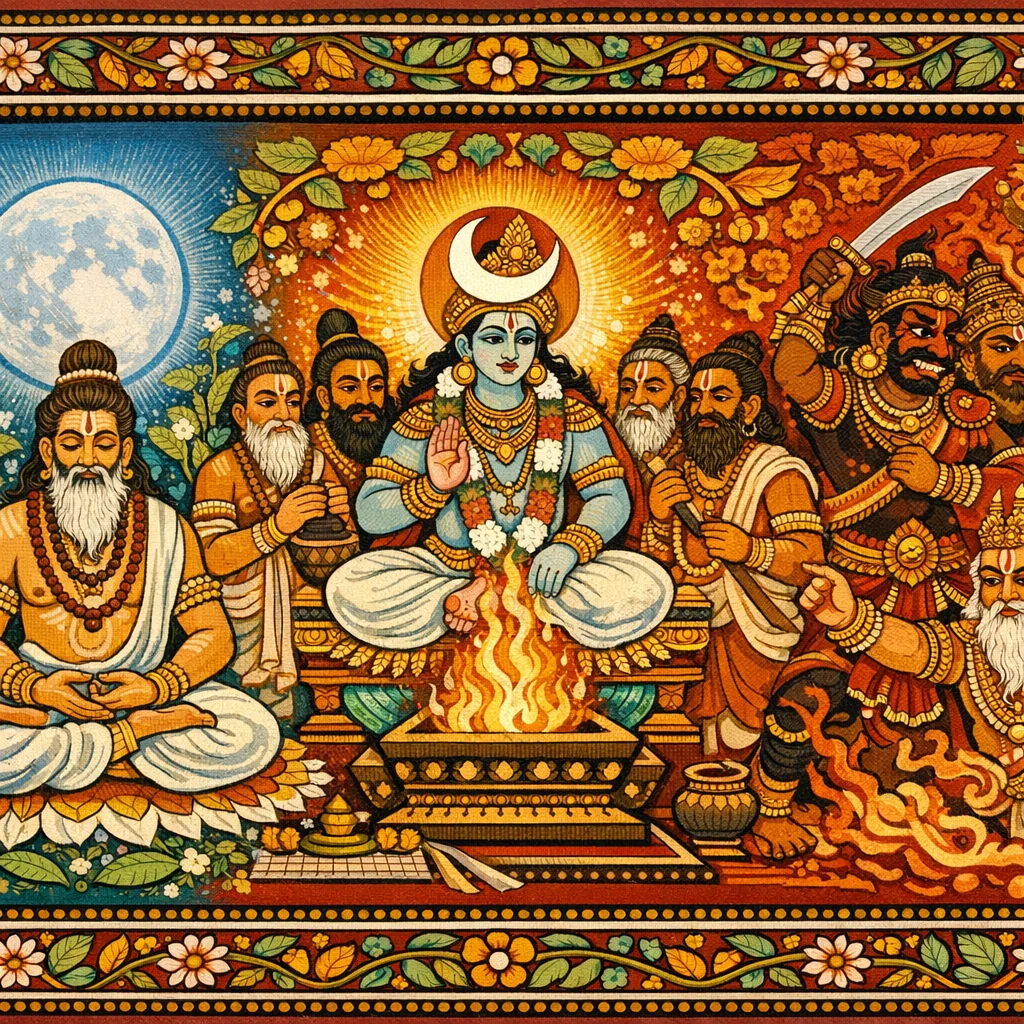
The ṛṣis ask about Soma’s standing as lord of the Pitṛs and the royal line descending from him. Sūta recounts: in the earliest phase of creation Atri performs unsurpassed tapas; under the presiding presence of Umāpati (Śiva) with Umā, Soma manifests. His moonlight brings forth divine herbs, establishing him as lord of the oṣadhis and the waxing and waning of the Moon. Dakṣa gives Soma his 27 daughters—the nakṣatra maidens—as wives. Soma then undertakes intense Viṣṇu-dhyāna, gains boons, and performs a Rājasūya with great ṛṣis and deities as officiants and witnesses, attaining exalted sovereignty. After the avabhṛtha, celestial ladies and motifs of desire arise; Soma’s passion culminates in abducting Tārā, Bṛhaspati’s wife. Bṛhaspati cannot compel Soma; Śiva prepares for war, armies clash, and dreadful astras are unleashed. Brahmā intervenes, condemns the cause—taking another’s wife—curses Soma as a harmful omen among people, and commands Tārā’s return. Soma complies; Bṛhaspati returns home with Tārā and Rudra.
Key Concepts
Shlokas in Adhyaya 23
Verse 1
*ऋषय ऊचुः सोमः पितॄणामधिपः कथं शास्त्रविशारद तद्वंश्या ये च राजानो बभूवुः कीर्तिवर्धनाः //
The sages said: “O you who are learned in the scriptures, how did Soma become the lord of the Pitṛs (ancestral beings)? And which kings were born in his lineage—those who increased fame and renown?”
Verse 2
*सूत उवाच आदिष्टो ब्रह्मणा पूर्वम् अत्रिः सर्गविधौ पुरा अनुत्तमं नाम तपः सृष्ट्यर्थं तप्तवान्प्रभुः //
Sūta said: Formerly, in the ancient procedure of creation, Atri—having been instructed by Brahmā—performed an unsurpassed austerity called “Anuttama,” for the sake of bringing forth creation.
Verse 3
यदानन्दकरं ब्रह्म जगत्क्लेशविनाशनम् ब्रह्मविष्ण्वर्करुद्राणाम् अभ्यन्तरमतीन्द्रियम् //
That Brahman is the giver of bliss and the destroyer of the world’s afflictions; it is the inner, transcendent Reality within Brahmā, Viṣṇu, the Sun, and Rudra—beyond the reach of the senses.
Verse 4
शान्तिकृच् छान्तमनसस् तदन्तर्नयने स्थितम् माहात्म्यात्तपसा विप्राः परमानन्दकारकम् //
O brāhmaṇas, through the greatness of austerity (tapas), that which brings peace—abiding in the inner vision of the tranquil-minded—becomes the cause of supreme bliss.
Verse 5
यस्मादुमापतिः सार्धम् उमया तमधिष्ठितः तं दृष्ट्वा चाष्टमांशेन तस्मात्सोमो ऽभवच्छिशुः //
Because Umāpati (Śiva), together with Umā, had entered into him and presided there, upon beholding that divine presence Soma came forth from him as a child, endowed with an eighth part of that power.
Verse 6
अधः सुस्राव नेत्राभ्यां धाम तच्चाम्बुसम्भवम् दीपयन्विश्वमखिलं ज्योत्स्नया सचराचरम् //
Then, from below, a divine radiance flowed forth from the two eyes—born of the waters—and with its moonlike glow it illuminated the entire universe, all that moves and all that does not.
Verse 7
तद्दिशो जगृहुर्धाम स्त्रीरूपेण सुतेच्छया गर्भो भूत्वोदरे तासाम् आस्थितो ऽब्दशतत्रयम् //
Then, from those regions, a divine being assumed a woman’s form out of the desire for offspring; becoming an embryo, it remained established in their womb for three hundred years.
Verse 8
आशास्तं मुमुचुर्गर्भम् अशक्ता धारणे ततः समादायाथ तं गर्भम् एकीकृत्य चतुर्मुखः //
Unable to sustain the embryo, they released that consecrated foetus; thereafter Caturmukha (four-faced Brahmā), taking up that embryo, unified it into a single whole.
Verse 9
युवानमकरोद्ब्रह्मा सर्वायुधधरं नरम् स्यन्दने ऽथ सहस्राश्वे वेदशक्तिमये प्रभुः //
Brahmā made the man youthful and endowed him with every weapon. Then the Lord placed him upon a chariot drawn by a thousand horses—an embodiment of the power of the Vedas.
Verse 10
आरोप्य लोकमनयद् आत्मीयं स पितामह तत्र ब्रह्मर्षिभिः प्रोक्तम् अस्मत्स्वामी भवत्वयम् //
Having installed him, that Grandfather (Pitāmaha) led him to his own realm; there the great seers (brahmarṣis) declared, “May he be our lord and master.”
Verse 11
ऋषिभिर्देवगन्धर्वैर् ओषधीभिस्तथैव च तुष्टुवुः सोमदेवत्यैर् ब्रह्माद्या मन्त्रसंग्रहैः //
Sages, the divine Gandharvas, and even the medicinal plants likewise praised him; and Brahmā and the other gods, together with those associated with Soma, extolled him through compilations of sacred mantras.
Verse 12
स्तूयमानस्य तस्याभूद् अधिको धामसम्भवः तेजोवितानादभवद् भुवि दिव्यौषधीगणः //
As he was being praised, an even greater manifestation of his radiant glory arose; and from that canopy of splendor there came into being upon the earth a host of divine medicinal herbs.
Verse 13
तद्दीप्तिरधिका तस्माद् रात्रौ भवति सर्वदा तेनौषधीशः सोमो ऽभूद् द्विजेशश्चापि गद्यते //
Therefore his radiance is always greater at night; for that reason Soma (the Moon) became the lord of medicinal herbs, and is also praised as the chief among the twice-born (dvija).
Verse 14
वेदधामरसं चापि यदिदं चन्द्रमण्डलम् क्षीयते वर्धते चैव शुक्ले कृष्णे च सर्वदा //
This lunar orb, which is also said to be the essence of the Veda and the abode of sacred radiance, continually wanes and waxes—ever in the bright fortnight and the dark fortnight.
Verse 15
विंशतिं च तथा सप्त दक्षः प्राचेतसो ददौ रूपलावण्यसंयुक्तास् तस्मै कन्याः सुवर्चसः //
Dakṣa, the son of Pracetas, gave him twenty-seven daughters—radiant maidens endowed with beauty and grace.
Verse 16
ततः पद्मसहस्राणां सहस्राणि दशैव तु तपश्चचार शीतांशुर् विष्णुध्यानैकतत्परः //
Thereafter, Śītāṃśu performed austerities for ten thousand thousands of lotus-counted years, wholly devoted to nothing but meditation upon Viṣṇu.
Verse 17
ततस्तुष्टस्तु भगवांस् तस्मै नारायणो हरिः वरं वृणीष्व प्रोवाच परमात्मा जनार्दनः //
Then, pleased, the Blessed Lord—Nārāyaṇa, Hari, the Supreme Self, Janārdana—said to him: “Choose a boon.”
Verse 18
ततो वव्रे वरान्सोमः शक्रलोकं जयाम्यहम् प्रत्यक्षमेव भोक्तारो भवन्तु मम मन्दिरे //
Then Soma chose his boons: “May I conquer the world of Śakra (Indra); and may the enjoyers (the gods) become directly present as recipients in my temple.”
Verse 19
राजसूये सुरगणा ब्रह्माद्याः सन्तु मे द्विजाः रक्षःपालः शिवो ऽस्माकम् आस्तां शूलधरो हरः //
In the Rājasūya rite, let the hosts of gods—beginning with Brahmā—be my sanctifying witnesses, O twice-born ones. And for our protection, let Śiva—Hara, the wielder of the trident—stand as the guardian against destructive forces.
Verse 20
तथेत्युक्तः स आजह्रे राजसूयं तु विष्णुना होतात्रिर् भृगुरध्वर्युर् उद्गाताभूच्चतुर्मुखः //
Thus instructed, he arranged the Rājasūya, the royal consecration-sacrifice, for Viṣṇu: Atri served as the Hotṛ priest, Bhṛgu as the Adhvaryu, and the Four-faced One (Brahmā) became the Udgātṛ.
Verse 21
ब्रह्मत्वमगमत्तस्य उपद्रष्टा हरिः स्वयम् सदस्याः सनकाद्यास्तु राजसूयविधौ स्मृताः //
Through that rite he attained Brahmatva, the state of Brahmāhood, and Hari Himself stood as the overseeing witness. In the procedure of the Rājasūya, Sanaka and the other sages are remembered as the officiating members of the assembly.
Verse 22
चमसाध्वर्यवस्तत्र विश्वे देवा दशैव तु त्रैलोक्यं दक्षिणा तेन ऋत्विग्भ्यः प्रतिपादितम् //
There, the Camasa and Adhvaryu priests were duly honoured, and the Viśvedevas—ten in number—were invoked; and by that rite the dakṣiṇā, symbolically equated with the three worlds, was properly presented to the officiating ṛtvij priests.
Verse 23
ततः समाप्ते ऽवभृथे तद्रूपालोकनेच्छवः कामबाणाभितप्ताङ्ग्यो नव देव्यः सिषेविरे //
Then, when the concluding avabhṛtha bath was completed, the nine divine ladies—eager to behold his form, their bodies inflamed by the arrows of Kāma—approached and attended upon him.
Verse 24
लक्ष्मीर्नारायणं त्यक्त्वा सिनीवाली च कर्दमम् द्युतिर्विभावसुं तद्वत् तुष्टिर्धातारमव्ययम् //
Lakṣmī, leaving Nārāyaṇa, went to Kardama; and Sinīvālī likewise went to Kardama. Dyuti went to Vibhāvasu; similarly, Tuṣṭi went to Dhātṛ, the imperishable deity.
Verse 25
प्रभा प्रभाकरं त्यक्त्वा हविष्मन्तं कुहूः स्वयम् कीर्तिर्जयन्तं भर्तारं वसुर्मारीचकश्यपम् //
Prabhā, having left Prabhākara, took Haviṣmant as her husband; and Kuhū chose him of her own accord. Kīrti had Jayanta for her spouse; and Vasu had Mārīca-Kaśyapa.
Verse 26
धृतिस् त्यक्त्वा पीतं नन्दिं सोममेवाभजंस्तदा स्वकीया इव सोमो ऽपि कामयामास तास्तदा //
Casting off restraint, they then turned to Soma alone, having drunk the exhilarating sacred draught; and Soma too, as though they were his own, desired those women at that time.
Verse 27
एवं कृतापचारस्य तासां भर्तृगणस्तदा न शशाकापचाराय शापैः शस्त्रादिभिः पुनः //
Thus, when such an offence had been committed, the company of their husbands at that time was no longer able to retaliate for the wrong—whether by curses or by weapons and the like.
Verse 28
तथाप्यराजत विधुर् दशधा भावयन्दिशः सोमः प्राप्याथ दुष्प्राप्यम् ऐश्वर्यमृषिसंस्कृतम् सप्तलोकैकनाथत्वम् अवाप तपसा तदा //
Even so, the Moon (Vidhu) shone forth, illuminating the directions tenfold; and Soma then attained that hard-to-attain sovereignty—sanctified by the sages—and by austerity won the status of sole lord over the seven worlds.
Verse 29
कदाचिदुद्यानगतामपश्यद् अनेकपुष्पाभरणैश्च शोभिताम् बृहन्नितम्बस्तनभारखेदात् पुष्पस्य भङ्गे ऽप्यतिदुर्बलाङ्गीम् //
Once, he saw her in the garden—adorned and radiant with many floral ornaments—yet so delicate of limb that, wearied by the heavy burden of her broad hips and full breasts, she seemed frail even at the mere breaking of a flower.
Verse 30
भार्यां च तां देवगुरोर् अनङ्ग बाणाभिरामायतचारुनेत्राम् तारां स ताराधिपतिः स्मरार्तः केशेषु जग्राह विविक्तभूमौ //
And her—Tārā, the wife of the preceptor of the gods, whose long and lovely eyes were enchanting like the arrows of Ananga (Kāma)—the lord of the stars, Soma/Chandra, tormented by desire, seized by the hair in a secluded place.
Verse 31
सापि स्मरार्ता सह तेन रेमे तद्रूपकान्त्या हृतमानसेन चिरं विहृत्याथ जगाम तारां विधुर्गृहीत्वा स्वगृहं ततो ऽपि //
She too, tormented by love, delighted with him, her mind captivated by his beauty and radiance. After sporting together for a long time, Vidhū/Chandra (the Moon), taking Tārā with him, went again to his own abode.
Verse 32
न तृप्तिरासीच्च गृहे ऽपि तस्य तारानुरक्तस्य सुखागमेषु बृहस्पतिस् तद्विरहाग्निदग्धस् तद्ध्याननिष्ठैकमना बभूव //
Even in his own home he found no satisfaction in pleasures and comforts, for he was deeply attached to Tārā. Bṛhaspati, burned by the fire of separation from her, became wholly single-minded, steadfast only in meditation upon her.
Verse 33
शशाक शापं न च दातुम् अस्मै न मन्त्रशस्त्राग्निविषैरशेषैः तस्यापकर्तुं विविधैरुपायैर् नैवाभिचारैरपि वागधीशः //
Vāgadhīśa was not able to cast a curse upon him, nor could he harm him by any means—whether by mantras, weapons, fire, every kind of poison, diverse stratagems, or even acts of sorcery (abhicāra).
Verse 34
स याचयामास ततस्तु दैन्यात् सोमं स्वभार्यार्थमनङ्गतप्तः स याच्यमानो ऽपि ददौ न तारां बृहस्पतेस्तत्सुखपाशबद्धः //
Then, tormented by Kāma and reduced to helplessness, he begged Soma to recover his own wife. Yet Soma, though repeatedly entreated, did not return Tārā, for he was bound by the snare of the pleasure he took in her, despite Bṛhaspati’s rightful claim.
Verse 35
महेश्वरेणाथ चतुर्मुखेण साध्यैर् मरुद्भिः सह लोकपालैः ददौ यदा तां न कथंचिद् इन्दुस् तदा शिवः क्रोधपरो बभूव //
But when the Moon, though urged by Maheśvara and the four-faced Brahmā—together with the Sādhyas, the Maruts, and the guardians of the worlds—still did not grant her in any way, then Śiva became wholly intent on wrath.
Verse 36
यो वामदेवः प्रथितः पृथिव्याम् अनेकरुद्रार्चितपादपद्मः ततः सशिष्यो गिरिशः पिनाकी बृहस्पतिस्नेहवशानुबद्धः //
That Vāmadeva, renowned upon the earth—whose lotus-feet are worshipped by many Rudras—then appeared together with his disciple: Girīśa, bearer of the Pināka bow, bound by the power of affection for Bṛhaspati.
Verse 37
धनुर्गृहीत्वाजगवं पुरारिर् जगाम भूतेश्वरसिद्धजुष्टः युद्धाय सोमेन विशेषदीप्ततृतीयनेत्रानलभीमवक्त्रः //
Taking up the bow Ajagava, the Foe of the Triple City set forth—attended by the Lord of the Bhūtas and honored by the Siddhas—for battle; and his terrible face blazed with the fire of his third eye, kindled all the more intensely through Soma.
Verse 38
सहैव जग्मुश्च गणेशकाद्या विंशच्चतुःषष्टिगणास्त्रयुक्ताः यक्षेश्वरः कोटिशतैर् अनेकैर् युतो ऽन्वगात् स्यन्दनसंस्थितानाम् //
Along with them went Gaṇeśa and the other gaṇas—twenty-four and sixty-four in number—equipped with weapons. The Lord of the Yakṣas, attended by many hundreds of crores (vast multitudes), followed behind those who were stationed upon chariots.
Verse 39
वेतालयक्षोरगकिंनराणां पद्मेन चैकेन तथार्बुदेन लक्षैस् त्रिभिर् द्वादशभी रथानां सोमो ऽप्यगात्तत्र विवृद्धमन्युः //
With one padma and one arbuda of Vetālas, Yakṣas, Nāgas, and Kiṃnaras—and with three lakṣas and twelve ratha-units besides—Soma too went there, his wrath greatly inflamed.
Verse 40
नक्षत्रदैत्यासुरसैन्ययुक्तः शनैश्चराङ्गारकवृद्धतेजाः जग्मुर्भयं सप्त तथैव लोकाश् चचाल भूर् द्वीपसमुद्रगर्भा //
Joined with the hosts of the Nakṣatras, Daityas, and Asuras, Śanaiścara (Saturn) and Aṅgāraka (Mars) blazed with intensified radiance. Fear seized the seven worlds, and the earth—bearing within it islands and oceans—began to quake and heave.
Verse 41
स सोममेवाभ्यगमत्पिनाकी गृहीतदीप्तास्त्रविशालवह्निः अथाभवद् भीषणभीमसेनसैन्यद्वयस्यापि महाहवो ऽसौ //
Then Pinākī (Śiva), having taken up blazing weapons of vast, fire-like brilliance, advanced straight toward Soma (the Moon). Thereupon a dreadful, great battle arose—terrifying to behold—for the armies on both sides.
Verse 42
अशेषसत्त्वक्षयकृत्प्रवृद्धस् तीक्ष्णायुधास्त्रज्वलनैकरूपः शस्त्रैरथान्योन्यमशेषसैन्यं द्वयोर्जगाम क्षयमुग्रतीक्ष्णैः //
The battle swelled into a force that brought about the destruction of countless living beings; it appeared as a single blaze of sharp weapons and flaming missiles. Then, striking one another with fierce and keen arms, the entire armies on both sides went to annihilation.
Verse 43
पतन्ति शस्त्राणि तथोज्ज्वलानि स्वर्भूमिपातालमथो दहन्ति रुद्रः कोपाद्ब्रह्मशीर्षं मुमोच सोमो ऽपि सोमास्त्रममोघवीर्यम् //
Then blazing weapons rained down, scorching heaven, earth, and the netherworld. In wrath, Rudra released the Brahmaśīrṣa weapon, and Soma too let fly the Soma-astra, whose force never fails.
Verse 44
तयोर्निपातेन समुद्रभूम्योर् अथान्तरिक्षस्य च भीतिरासीत् तदस्त्रयुग्मं जगतां क्षयाय प्रवृद्धमालोक्य पितामहो ऽपि //
From the impact of those two, the ocean and the earth—and even the mid-region of the sky—were seized with terror. Seeing that pair of missiles swelling in power, as if to bring about the destruction of the worlds, even Pitāmaha (Brahmā) took notice and intervened.
Verse 45
अन्तः प्रविश्याथ कथं कथंचिन् निवारयामास सुरैः सहैव अकारणं किं क्षयकृज्जनानां सोम त्वयापीत्थम् अकारि कार्यम् //
Then, entering within, he somehow managed—together with the gods—to restrain him. For what reason, without cause, should one become the destroyer of people? O Soma, you were made to drink, and thus the necessary act was carried out.
Verse 46
यस्मात्परस्त्रीहरणाय सोम त्वया कृतं युद्धमतीव भीमम् पापग्रहस्त्वं भविता जनेषु शान्तो ऽप्यलं नूनमथो सितान्ते भार्यामिमामर्पय वाक्पतेस्त्वं न चावमानो ऽस्ति परस्वहारे //
Since, O Soma, for the sake of abducting another man’s wife you have waged a most dreadful war, you will become among people a baleful influence—an evil omen. Even if you are pacified, it is surely not enough. Therefore, before the final end comes, return this wife to Vākpati (Bṛhaspati); for in taking what belongs to another there is no true honor.
Verse 47
*सूत उवाच तथेति चोवाच हिमांशुमाली युद्धाद् अपाक्रामदतः प्रशान्तः बृहस्पतिः स्वामपगृह्य तारां हृष्टो जगाम स्वगृहं सरुद्रः //
Sūta said: “So be it,” replied Soma, the Moon-crested one; and, becoming calm, he withdrew from the battle. Then Bṛhaspati, taking back his own wife Tārā, joyfully returned to his home—together with Rudra (Śiva).
Frequently Asked Questions
The chapter teaches that spiritual power and sovereignty must be grounded in dharma: Soma gains radiance and lordship through tapas and Vedic ritual (Rājasūya), but when desire leads him to abduct another man’s wife (Tārā), the act becomes a cosmic disorder. Brahmā’s intervention condemns parastrī-haraṇa, marks Soma as a pāpa-graha (inauspicious influence), and restores social-ritual order by returning Tārā to Bṛhaspati.
This adhyāya is primarily Creation theology (Atri’s tapas and Soma’s manifestation), Dharma (ethical breach and restoration), Ritual science (Rājasūya and avabhṛtha), and Genealogy setup (the ṛṣis’ question about Soma’s lineage, pointing toward Somavaṃśa kings). It does not teach Vāstu measurements directly, but it supports temple/ritual SEO intent through yajña-structure themes (ṛtviks, dakṣiṇā, sanctifying witnesses).
As Soma is praised, his radiance intensifies and from the “canopy of splendor” (tejo-vitāna) divine medicinal herbs arise on earth. Because his brilliance is especially greater at night, he is called oṣadhīśa (lord of herbs) and associated with nourishment, healing, and sacred vitality.
Soma’s Viṣṇu-centered austerity culminates in performing a Rājasūya consecration with major cosmic authorities as witnesses and officiants (Atri as Hotṛ, Bhṛgu as Adhvaryu, Brahmā as Udgātṛ; sages like Sanaka as members). The narrative presents kingship/aiśvarya as achieved and legitimized through Vedic rite, not merely force.
Brahmā declares that because Soma waged a dreadful war for the sake of abducting another’s wife, he will become among people a baleful influence—an evil omen (pāpa-graha). The label is a moral-theological consequence: celestial power is stained when used for adharma.