Adhyaya 82
अध्याय ८२ — केशवप्रयाणे निमित्तदर्शनम् (Omens and Reception During Keśava’s Departure)
Upa-parva: Kṛṣṇa-yātrā (Keśava’s journey as diplomatic mobilization episode)
Vaiśaṃpāyana reports that as Devakīputra Kṛṣṇa sets out, he is accompanied by armed mahārathas and a substantial logistical train: infantry, cavalry, provisions, and numerous attendants. Janamejaya inquires how the Dāśārha departed and what omens (nimitta) attended the journey. In response, the narration catalogs extraordinary signs: thunder and lightning without clouds, heavy rain in inappropriate conditions, rivers flowing contrary to expectation, disorientation of directions amid dust and darkness, fires flaring and the earth trembling, and a pervasive, bodiless sound across regions. A destructive southwesterly wind agitates Hāstinapura, breaking trees, while along Kṛṣṇa’s immediate path the atmosphere becomes favorable: gentle winds, rightward auspiciousness (pradakṣiṇa), flower-rain and lotuses, and a smooth, unobstructed road. The chapter then shifts to social reception: Brahmanas honor Keśava with madhuparka and flowers; women strew fragrant forest blossoms; communities assemble to see Viṣvaksena. Reaching Vṛkasthala at sunset, Kṛṣṇa performs ritual cleanliness, orders the chariot unharnessed, and stays the night for Yudhiṣṭhira’s purpose. Local eminent Brahmanas offer worship and propose well-appointed residences; Kṛṣṇa reciprocates with hospitality, feeds them, dines with them, and rests comfortably. Thematically, the chapter contrasts macro-level disorder with localized auspiciousness tied to dharmic mission and proper social rites.
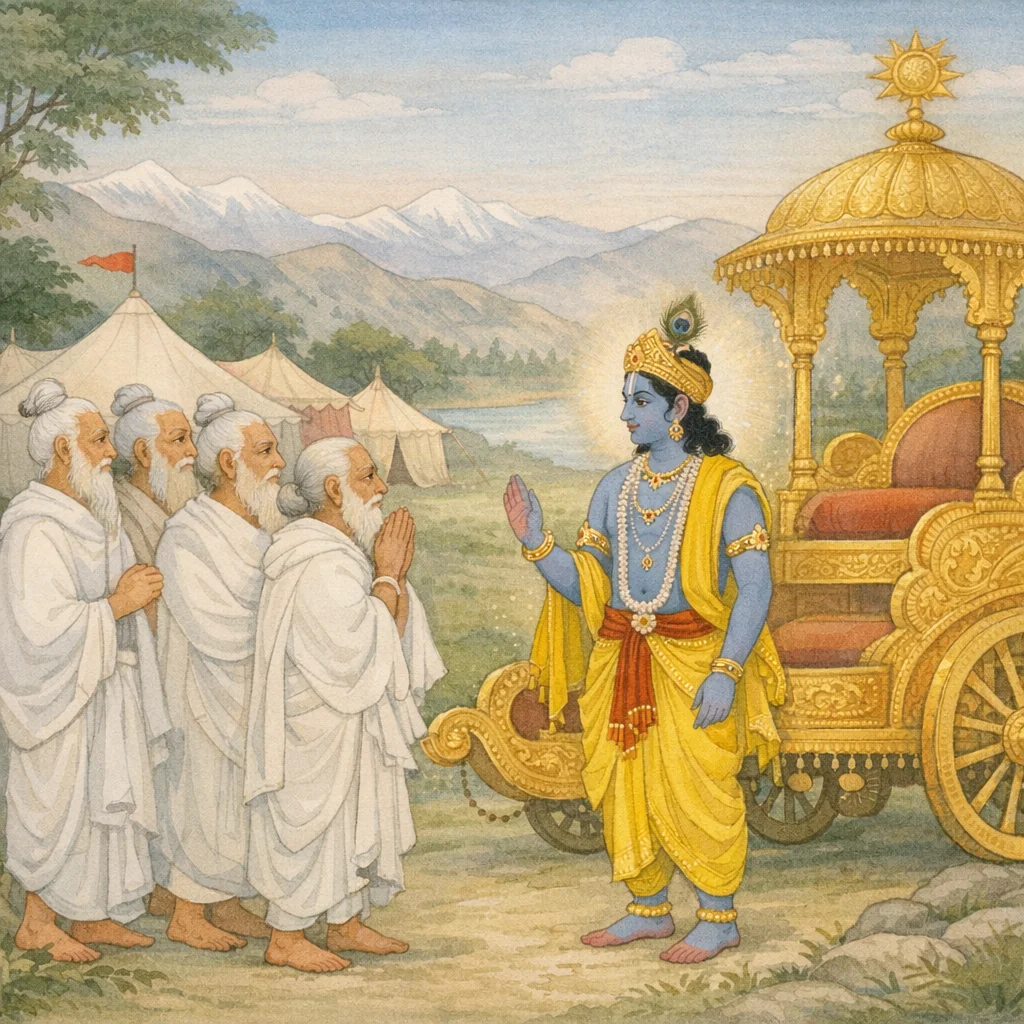
Chapter Arc: पाण्डव-शिविर में शान्ति-दूत बनकर श्रीकृष्ण के हस्तिनापुर-प्रस्थान की घड़ी आती है; युधिष्ठिर उन्हें विनयपूर्वक स्मरण कराते हैं कि अब समस्त कुल का मंगल आपके वचन और नीति पर टिका है। → युधिष्ठिर कृष्ण से आग्रह करते हैं कि सुयोधन को शान्ति के लिए वही वचन कहें जो शत्रु-विनाशक भी हों और धर्म-संरक्षक भी; साथ ही कुन्ती की दीर्घ तपस्विनी पीड़ा और धृतराष्ट्र-पुत्रों के लिए संदेश का भार भी कृष्ण पर रखा जाता है। → कृष्ण का दिव्य रथ—कालाग्नि-सा दीप्त, आकाशगामी-सा वेगवान, सूर्य-चन्द्र-प्रकाश-सम चक्रों से अलंकृत—प्रस्थान के क्षण को महाकाव्य-गौरव देता है; यह दृश्य बताता है कि अब नीति-युद्ध का निर्णायक चरण आरम्भ हो चुका है। → कृष्ण रथ से उतरकर ऋषियों का अभिवादन करते हैं, यथावृत्त पूजन-सम्मान करते हुए शान्ति-यात्रा को धर्मसम्मत बनाते हैं; पाण्डवों की ओर से धृतराष्ट्र, कौरवों और विशेषतः दुर्योधन के लिए संदेश निश्चित हो जाता है। → कृष्ण का हस्तिनापुर की सभा में प्रवेश निकट है—जहाँ भीष्म, द्रोण, विदुर आदि उपस्थित होंगे—और वहीं यह तय होगा कि शान्ति टिकेगी या युद्ध अनिवार्य बनेगा।
Shlokas
Verse 1
ऑपन--माजण बक। अकाल तग्यशीतितमो< ध्याय: श्रीकृष्णका हस्तिनापुरको प्रस्थान, युधिष्ठिरका माता कुन्ती एवं कौरवोंके लिये संदेश तथा श्रीकृष्णको मार्ममें दिव्य महर्षियोंका दर्शन अजुन उवाच कुरूणामद्य सर्वेषां भवान् सुहृदनुत्तम: । सम्बन्धी दयितो नित्यमुभयो: पक्षयोरपि,अर्जुन बोले--श्रीकृष्ण![ आजकल आप ही समस्त कौरवोंके सर्वोत्तम सुहृद् तथा दोनों पक्षोंके नित्य प्रिय सम्बन्धी हैं
Arjuna said: “O Kṛṣṇa, at this time you are the unsurpassed well-wisher of all the Kurus. You are a beloved kinsman, ever dear to both sides as well.”
Verse 2
पाण्डवैर्धार्तराष्ट्राणां प्रतिपाद्यमनामयम् । समर्थ: प्रशमं चैव कर्तुमहसि केशव,केशव! पाण्डवोंसहित धृतराष्ट्रपुत्रोंका मंगल सम्पादन करना आपका कर्तव्य है। आप उभयपक्षमें संधि करानेकी शक्ति भी रखते हैं
Arjuna said: “O Keśava, it is for you to secure the welfare and safety that must be established for both the Pāṇḍavas and the sons of Dhṛtarāṣṭra. You are capable of bringing about pacification and reconciliation between the two sides; therefore you ought to accomplish peace.”
Verse 3
त्वमित: पुण्डरीकाक्ष सुयोधनममर्षणम् । शान्त्यर्थ भ्रातरं ब्रूया यत् तद् वाच्यममित्रहन्,शत्रुओंका नाश करनेवाले कमलनयन श्रीकृष्ण! आप यहाँसे जाकर हमारे अमर्षशील भ्राता दुर्योधनसे ऐसी बातें करें, जो शान्तिस्थापनमें सहायक हों
Arjuna said: “O lotus-eyed Kṛṣṇa, destroyer of foes, go from here and speak to our brother Duryodhana—so hard to bear and quick to anger—whatever words ought to be spoken for the sake of peace, words that may help establish reconciliation.”
Verse 4
त्वया धर्मार्थियुक्तं चेदुक्ते शिवमनामयम् | हित॑ नादास्यते बालो दिष्टस्य वशमेष्यति
Arjuna said: “Even if you speak words aligned with dharma and aimed at true welfare—auspicious words, free from harm—a childish person will not accept that good counsel. He will instead fall under the sway of destiny.”
Verse 5
यदि वह मूर्ख आपकी कही हुई धर्म और अर्थसे युक्त, संतापनाशक, कल्याणकारी एवं हितकर बातें नहीं मानेगा तो अवश्य ही उसे कालके गालमें जाना पड़ेगा ।। श्रीभगवानुवाच धर्म्यमस्मद्धितं चैव कुरूणां यदनामयम् । एष यास्यामि राजानं धृतराष्ट्रमभीप्सया,श्रीभगवान् बोले--अर्जुन! जो धर्मसंगत, हमलोगोंके लिये हितकर तथा कौरवोंके लिये भी मंगलकारक हो, वही कार्य करनेके लिये मैं राजा धुृतराष्ट्रके समीप यात्रा करूँगा
The Blessed Lord said: “Arjuna, I will go to King Dhṛtarāṣṭra with the intent of bringing about that course of action which is righteous, beneficial to us, and also conducive to the welfare and well-being of the Kurus—free from harm and affliction.”
Verse 6
वैशम्पायन उवाच ततो व्यपेततमसि सूर्य विमलवदगते । मैत्रे मुहूर्ते सम्प्राप्ते मृद्रर्चिेषि दिवाकरे
Vaiśampāyana said: Then, when the darkness had withdrawn and the sun had risen with a clear, spotless radiance, and when the auspicious Maitra muhūrta had arrived—while the day-maker shone with gentle rays—the narrative proceeds into the actions undertaken at that propitious time.
Verse 7
कौमुदे मासि रेवत्यां शरदन्ते हिमागमे । स्फीतसस्यसुखे काले कल्प: सत्त्ववतां वर:
Vaiśampāyana said: In the month of Kaumuda, under the asterism Revatī—at the close of autumn, when the cold season was setting in—there came a time of abundant crops and general ease, a season most excellent for the virtuous and steadfast.
Verse 8
वैशम्पायनजी कहते हैं--जनमेजय! तदनन्तर जब रात्रिका अन्धकार दूर हुआ और निर्मल आकाशमें सूर्यदेवके उदित होनेपर उनकी कोमल किरणें सब ओर फैल गयीं। कार्तिक मासके रेवती नक्षत्रमें 'मैत्र” नामक मुहूर्त उपस्थित होनेपर सत्त्वगुणी पुरुषोंमें श्रेष्ठ एवं समर्थ श्रीकृष्णने यात्रा आरम्भ की। उन दिनों शरद्ू-ऋतुका अन्त और हेमन्तका आरम्भ हो रहा था। सब ओर खूब उपजी हुई खेती लहलहा रही थी ।। मड़ल्या: पुण्यनिर्घोषा वाच: शृण्वंश्व सूनूृता: । ब्राह्मणानां प्रतीतानामृषीणामिव वासव:
Vaiśampāyana said: “O Janamejaya, thereafter, when the darkness of night had passed and, in the clear sky, the Sun rose and spread his gentle rays in every direction—when, in the month of Kārttika under the Revatī constellation, the auspicious muhūrta called ‘Maitra’ arrived—Śrī Kṛṣṇa, the foremost among sāttvika and capable men, set out on his journey. It was the close of autumn and the beginning of hemanta; everywhere the well-grown crops waved in abundance. As he went, he heard auspicious, holy-sounding, truthful words—like Indra listening to the trusted Brāhmaṇas and Ṛṣis.”
Verse 9
कृत्वा पौर्वाल्निकं कृत्यं स््नात: शुचिरलंकृत: । उपतस्थे विवस्वन्तं पावकं च जनार्दन:
Having completed the prescribed morning duties, and after bathing—clean and properly adorned—Janārdana (Kṛṣṇa) offered reverent worship to Vivasvān (the Sun) and to Pāvaka (Fire).
Verse 10
ऋषभं पृष्ठ आलभ्य ब्राह्मणानभिवाद्य च | अनमनिं प्रदक्षिणं कृत्वा पश्यन् कल्याणमग्रत:
Touching the bull upon its back and offering respectful salutations to the brāhmaṇas, he then circumambulated (in reverence), keeping his mind composed, and proceeded while looking ahead toward what was auspicious.
Verse 11
तत् प्रतिज्ञाय वचन पाण्डवस्य जनार्दनः । शिनेर्नप्तारमासीनम भ्य भाषत सात्यकिम्
Having thus pledged himself to the Pāṇḍava’s request, Janārdana (Kṛṣṇa) then addressed Sātyaki—the grandson of Śini—who was seated there.
Verse 12
भगवान् जनार्दनने सबसे पहले प्रातः:काल ऋषियोंके मुखसे मंगलपाठ सुननेवाले देवराज इन्द्रकी भाँति विश्वस्त ब्राह्मणोंके मुखसे परम मधुर मंगलकारक पुण्याहवाचन सुनते हुए स्नान किया। फिर उन्होंने पवित्र तथा वस्त्राभूषणोंसे अलंकृत हो स्वन्ध्यावन्दन, सूर्योपस्थान एवं अग्निहोत्र आदि पूर्वह्ञिकृत्य सम्पन्न किये। इसके बाद बैलकी पीठ छूकर ब्राह्मगोंको नमस्कार किया और अग्निकी परिक्रमा करके अपने सामने प्रस्तुत की हुई कल्याणकारक वस्तुओंका दर्शन किया। तदनन्तर पाण्डुनन्दन युधिष्ठटिरकी बातोंपर विचार करके जनार्दनने अपने पास बैठे हुए शिनिपौत्र सात्यकिसे इस प्रकार कहा-- ॥| ८-- ११ || रथ आरोप्यतां शड्खश्षक्रं च गदया सह । उपासंगाश्ष शक््त्यश्ष सर्वप्रहरणानि च
Vaiśampāyana said: In the early morning, Janārdana—like Indra, who first listens to auspicious recitations from the mouths of sages—bathed while hearing the supremely sweet, auspicious, and sanctifying puṇyāha-blessings recited by trusted brāhmaṇas. Then, purified and adorned with clean garments and ornaments, he completed the forenoon rites—his sandhyā worship, salutations to the Sun, and the agnihotra and related observances. After that, touching the back of a bull as a sign of auspiciousness, he bowed to the brāhmaṇas, circumambulated the sacred fire, and beheld the auspicious articles placed before him. Thereupon, reflecting on the words of Yudhiṣṭhira, son of Pāṇḍu, Janārdana addressed Sātyaki, the son of Śini, who was seated near him: “Let the conch, the discus, and the mace be placed upon the chariot, along with the quivers, the spears, and all weapons.”
Verse 13
'युयुधान! मेरे रथपर शंख, चक्र, गदा, तूणीर, शक्ति तथा अन्य सब प्रकारके अस्त्र- शस्त्र लाकर रख दो ।। दुर्योधनश्व दुष्टात्मा कर्णश्न सहसौबल: । न च शत्रुरवज्ञेयो दुर्बलोडपि बलीयसा,“कोई अत्यन्त बलवान क्यों न हो; उसे अपने दुर्बल शत्रुकी भी अवहेलना नहीं करनी चाहिये; (उससे सतर्क रहना चाहिये।) फिर दुर्योधन, कर्ण और शकुनि तो दुष्टात्मा ही हैं। उनसे तो सावधान रहनेकी अत्यन्त आवश्यकता है
Vaiśampāyana said: “Yuyudhāna, bring and place upon my chariot the conch, discus, mace, quivers, spear, and every other kind of weapon and missile. For Duryodhana is wicked at heart, and so too are Karṇa and Śakuni. And even if one is stronger, one should never treat an enemy with contempt, even when that enemy seems weak—one must remain vigilant.”
Verse 14
ततस्तन्मतमाज्ञाय केशवस्य पुर:सरा: । प्रसस्नु्योजयिष्यन्तो रथं चक्रगदा भूत:,तब चक्र और गदा धारण करनेवाले भगवान् श्रीकृष्णके अभिप्रायको जानकर उनके आगे चलनेवाले सेवक रथ जोतनेके लिये दौड़ पड़े
Then, understanding the intention of Keśava—Śrī Kṛṣṇa, bearer of discus and mace—his attendants who went before him hurried forward, running to yoke and ready the chariot.
Verse 15
त॑ दीप्तमिव कालाग्निमाकाशगमिवाशुगम् । सूर्यचन्द्रप्रकाशा भ्यां चक्राभ्यां समलंकृतम्,वह रथ प्रलयकालीन अग्निके समान दीप्तिमान्ू, विमानके सदृश शीघ्रगामी तथा सूर्य और चन्द्रमाके समान तेजस्वी दो गोलाकार चक्रोंसे सुशोभित था
Vaiśampāyana said: That chariot blazed like the fire of Time at the world’s end; it sped as swiftly as something moving through the sky. It was adorned with two radiant wheels shining like the sun and the moon.
Verse 16
अर्धचन्द्रैश्न चन्द्रेश्न मत्स्यै: समृगपक्षिभि: । पुष्पैश्न विविधैश्षित्रं मणिरत्नैश्व सर्वशः,अर्धचन्द्र, चन्द्र, मत्स्य, मृग, पक्षी, नाना प्रकारके पुष्प तथा सभी तरहके मणि-रत्नोंसे चित्रित एवं जटित होनेके कारण उसकी विचित्र शोभा हो रही थी
Vaiśaṃpāyana said: It was adorned everywhere with crescent-moons and full moons, with fish, deer, and birds, and with many kinds of flowers; and being inlaid and embellished on all sides with gems and precious stones, it displayed a striking, intricate splendor.
Verse 17
तरुणादित्यसंकाशं बृहन्तं चारुदर्शनम् | मणिहेमविचित्राड्गं सुध्वजं सुपताकिनम्,वह तरुण सूर्यके समान प्रकाशमान, विशाल तथा देखनेमें मनोहर था। उसके सभी भागोंमें मणि एवं सुवर्ण जड़े हुए थे। उस रथकी ध्वजा बहुत ही सुन्दर थी और उसपर उत्तम पताका फहरा रही थी
Vaiśaṃpāyana said: “It shone like the young sun—vast in size and delightful to behold. Its limbs were richly adorned with inlaid gems and gold; its banner was splendid, and a fine pennant fluttered upon it.”
Verse 18
सूपस्करमनाधुष्यं वैयाप्रपरिवारणम् । यशोष्नं प्रत्यमित्राणां यदूनां नन्दिवर्धनम्,उसमें सब प्रकारकी आवश्यक सामग्री सुन्दर ढंगसे रखी गयी थी। उसपर व्याप्रचर्मका आवरण (पर्दा) शोभा पाता था। वह रथ शत्रुओंके लिये दुर्धर्ष तथा उनके सुयशका नाश करनेवाला था। साथ ही उससे यदुवंशियोंके आनन्दकी वृद्धि होती थी
Vaiśampāyana said: The chariot was excellently equipped, furnished with all necessary implements, and was not to be assailed. It was covered with a protective hide-curtain. For hostile foes it was formidable, and it diminished the enemies’ pride and fame; yet for the Yādavas it became a cause for increased joy and confidence.
Verse 19
वाजिभि: शैब्यसुग्रीवमेघपुष्पबनलाहकै: । स्नातै: सम्पादयामासु: सम्पन्नै: सर्वसम्पदा,श्रीकृष्णके सेवकोंने शैब्य, सुग्रीव, मेघपुष्प तथा बलाहक नामवाले चारों घोड़ोंको नहला-धुलाकर सब प्रकारके बहुमूल्य आभूषणोंद्वारा सुसज्जित करके उस रथमें जोत दिया
Vaiśampāyana said: With the horses named Śaibya, Sugrīva, Meghapuṣpa, and Balāhaka—bathed, made ready, and richly furnished with every kind of gear and ornament—Kṛṣṇa’s attendants completed the preparations and yoked them to the chariot.
Verse 20
महिमानं तु कृष्णस्य भूय एवाभिवर्धयन् । सुघोष: पतगेन्द्रेण ध्वजेन युयुजे रथ:,इस प्रकार वह रथ श्रीकृष्णकी महत्ताकों और अधिक बढ़ाता हुआ गरुड़चिह्वित ध्वजसे संयुक्त हो बड़ी शोभा पा रहा था। चलते समय उसके पहियोंसे गम्भीर ध्वनि होती थी
Enhancing still further the majesty of Kṛṣṇa, that chariot—named Sughoṣa—shone with a banner bearing the emblem of Garuḍa, the lord of birds. As it moved, its wheels resounded with a deep, grave rumble.
Verse 21
त॑ं मेरुशिखरप्रख्यं मेघदुन्दुभिनि:स्वनम् । आरुरोह रथं शौरिविमानमिव कामगम्,मेरुपर्वतके शिखरोंकी भाँति सुनहरी प्रभासे सुशोभित तथा मेघ और दुन्दुभियोंके समान गम्भीर नाद करनेवाले उस रथपर, जो इच्छानुसार चलनेवाले विमानके समान प्रतीत होता था, भगवान् श्रीकृष्ण आरूढ़ हुए
Vaiśaṃpāyana said: Kṛṣṇa mounted that chariot—resplendent like the peak of Mount Meru, and sounding deep like thunderclouds and kettledrums—appearing like a wish-moving celestial car.
Verse 22
ततः सात्यकिमारोप्य प्रययौ पुरुषोत्तम: । पृथिवीं चान्तरिक्षं च रथघोषेण नादयन्,तदनन्तर सात्यकिको भी उसी रथपर बैठाकर पुरुषोत्तम श्रीकृष्णने रथकी गम्भीर ध्वनिसे पृथ्वी और आकाशको गुँजाते हुए वहाँसे प्रस्थान किया
Then the Supreme Person, Śrī Kṛṣṇa, having seated Sātyaki upon the chariot, set out from that place. With the deep roar of the chariot he made both the earth and the sky resound.
Verse 23
व्यपोढा भ्रस्तत: काल: क्षणेन समपद्यत | शिवश्चानुववीौ वायु: प्रशान््तरमभवद् रज:,तत्पश्चात् उस समय क्षणभरमें ही आकाशमें घिरे हुए बादल छिलन्न-भिन्न हो अदृश्य हो गये। शीतल, सुखद एवं अनुकूल वायु चलने लगी तथा धूलका उड़ना बंद हो गया
Vaiśampāyana said: In a single moment the troubled weather cleared away; the sky’s massed clouds were scattered and vanished. A cool, pleasant, favorable breeze began to blow, and the dust in the air settled down.
Verse 24
प्रदक्षिणानुलोमाश्व मड़्गल्या मृगपक्षिण: । प्रयाणे वासुदेवस्य बभूवुरनुयायिन:,वसुदेवनन्दन श्रीकृष्णकी उस यात्राके समय मंगलसूचक मृग और पक्षी उनके दाहिने तथा अनुकूल दिशामें जाते हुए उनका अनुसरण करने लगे
Vaiśampāyana said: As Vāsudeva set out on his journey, auspicious animals and birds followed after him, moving to his right and in a favorable direction—an omen that his undertaking was upheld by good fortune and aligned with dharma.
Verse 25
मड्गल्यार्थप्रदै:ः शब्दैरन्ववर्तन्त सर्वश: । सारसा: शतपत्राश्न हंसाश्न मधुसूदनम्,सारस, शतपत्र तथा हंस पक्षी सब ओरसे मंगलसूचक शब्द करते हुए मधुसूदन श्रीकृष्णके पीछे-पीछे जाने लगे
Vaiśaṃpāyana said: With auspicious, blessing-bearing calls, sarasa-cranes, śatapatra-birds, and swans followed Madhusūdana (Śrī Kṛṣṇa) from every side. The scene frames Kṛṣṇa’s onward journey as one attended by omens of well-being, suggesting the moral weight and dharmic significance of his mission amid the gathering crisis.
Verse 26
मन्त्राहुतिमहाहोमैर्हूयमानश्व॒ पावक: । प्रदक्षिणमुखो भूत्वा विधूम: समपद्यत,मन्त्रपाठपूर्वक दी जानेवाली आहुतियोंसे युक्त बड़े-बड़े होमयज्ञोंद्वारा हविष्य पाकर अन्निदेव प्रदक्षिण-क्रमसे उठनेवाली लपटोंके साथ प्रज्वलित हो धूमरहित हो गये
Vaiśampāyana said: As the great sacrificial fires received oblations offered with mantra-recitation in large homa rites, Agni (the Fire-god) blazed forth with flames rising in a rightward (auspicious) course, and became clear and smokeless—an omen of ritual purity and the efficacy of the rite.
Verse 27
वसिष्ठो वामदेवश्व भूरिद्युम्नो गय: क्रथ: । शुक्रनारदवाल्मीका मरुत्त: कुशिको भृगुः,वसिष्ठ, वामदेव, भूरिद्युम्न, गय, क्रथ, शुक्र, नारद, वाल्मीकि, मरुत्त, कुशिक तथा भृगु आदि देवर्षियों तथा ब्रह्मर्षियोंनेएक साथ आकर यदुकुलको सुख देनेवाले इन्द्रके छोटे भाई श्रीकृष्णकी दक्षिणावर्त परिक्रमा की
Vaiśampāyana said: Vasiṣṭha and Vāmadeva, Bhūridyumna, Gaya, Kratha, Śukra, Nārada, Vālmīki, Marutta, Kuśika, and Bhṛgu—these divine seers and brahmarṣis assembled together and, honoring Śrī Kṛṣṇa, the younger brother of Indra and the giver of joy to the Yadu lineage, circumambulated him in the auspicious rightward (clockwise) manner.
Verse 28
देवब्रह्मर्षयश्चैव कृष्णं यदुसुखावहम् । प्रदक्षिणमवर्तन्त सहिता वासवानुजम्,वसिष्ठ, वामदेव, भूरिद्युम्न, गय, क्रथ, शुक्र, नारद, वाल्मीकि, मरुत्त, कुशिक तथा भृगु आदि देवर्षियों तथा ब्रह्मर्षियोंनेएक साथ आकर यदुकुलको सुख देनेवाले इन्द्रके छोटे भाई श्रीकृष्णकी दक्षिणावर्त परिक्रमा की
Vaiśampāyana said: The divine seers and the Brahma-seers, gathered together, circumambulated Kṛṣṇa—bringer of joy to the Yadu line—keeping him to their right in reverence. Thus they honored Vāsava’s younger brother, acknowledging his sanctity and the dharmic authority that surrounds him.
Verse 29
एवमेतैर्महा भागैर्महर्षिगणसाधुभि: । पूजित: प्रययौ कृष्ण: कुरूणां सदनं प्रति,इस प्रकार इन महाभाग महर्षियों तथा साधु-महात्माओंसे सम्मानित हो श्रीकृष्णने कुरुकुलकी राजधानी हस्तिनापुरकी ओर प्रस्थान किया
Thus honored by those great-souled sages and saintly seers, Kṛṣṇa set out toward the abode of the Kurus—toward their royal seat at Hastināpura—bearing a mission of grave dharmic weight: to seek a righteous settlement before war.
Verse 30
त॑ प्रयान्तमनुप्रायात् कुन्तीपुत्रो युधिष्ठिर: । भीमसेनार्जुनौ चोभौ माद्रीपुत्रो च पाण्डवौ,क्षत्रियशिरोमणे! श्रीकृष्णके जाते समय उन्हें पहुँचानेके लिये कुन्तीपुत्र युधिष्ठिर उनके पीछे-पीछे चले। साथ ही भीमसेन, अर्जुन, माद्रीके दोनों पुत्र पाण्डुकुमार नकुल-सहदेव, पराक्रमी चेकितान, चेदिराज धुृष्टकेतु, ट्रपद, काशिराज, महारथी शिखण्डी, धृष्टट्युम्न, पुत्रों और केकयोंसहित राजा विराट--ये सभी क्षत्रिय अभीष्ट कार्यकी सिद्धि एवं शिष्टाचारका पालन करनेके लिये उनके पीछे गये
Vaiśaṃpāyana said: As Kṛṣṇa set out, Kuntī’s son Yudhiṣṭhira followed behind to see him off; and with him went Bhīmasena and Arjuna, and the two Pāṇḍava sons of Mādrī as well. Thus the foremost of kṣatriyas accompanied him in proper order, upholding royal courtesy and their shared resolve to accomplish the intended purpose.
Verse 31
चेकितानश्न विक्रान्तो धृष्टकेतुश्च चेदिप: । द्रपद: काशिराजश्न शिखण्डी च महारथ:,क्षत्रियशिरोमणे! श्रीकृष्णके जाते समय उन्हें पहुँचानेके लिये कुन्तीपुत्र युधिष्ठिर उनके पीछे-पीछे चले। साथ ही भीमसेन, अर्जुन, माद्रीके दोनों पुत्र पाण्डुकुमार नकुल-सहदेव, पराक्रमी चेकितान, चेदिराज धुृष्टकेतु, ट्रपद, काशिराज, महारथी शिखण्डी, धृष्टट्युम्न, पुत्रों और केकयोंसहित राजा विराट--ये सभी क्षत्रिय अभीष्ट कार्यकी सिद्धि एवं शिष्टाचारका पालन करनेके लिये उनके पीछे गये
Vaiśaṃpāyana said: The valiant Cekitāna, and Dhṛṣṭaketu, the king of Cedi; Drupada, and the king of Kāśi; and Śikhaṇḍī, the great chariot-warrior—these eminent kṣatriyas followed behind, accompanying the foremost leaders in accordance with proper royal conduct and with the aim of accomplishing the intended mission.
Verse 32
धृष्टद्युम्न: सपुत्रश्न विराट: केकयै: सह । संसाधनार्थ प्रययु: क्षत्रिया: क्षत्रियर्षभ,क्षत्रियशिरोमणे! श्रीकृष्णके जाते समय उन्हें पहुँचानेके लिये कुन्तीपुत्र युधिष्ठिर उनके पीछे-पीछे चले। साथ ही भीमसेन, अर्जुन, माद्रीके दोनों पुत्र पाण्डुकुमार नकुल-सहदेव, पराक्रमी चेकितान, चेदिराज धुृष्टकेतु, ट्रपद, काशिराज, महारथी शिखण्डी, धृष्टट्युम्न, पुत्रों और केकयोंसहित राजा विराट--ये सभी क्षत्रिय अभीष्ट कार्यकी सिद्धि एवं शिष्टाचारका पालन करनेके लिये उनके पीछे गये
Vaiśaṃpāyana said: Dhṛṣṭadyumna, together with his sons, and King Virāṭa along with the Kekayas, set out to make the necessary arrangements. O best of kṣatriyas, these nobles followed in proper order, so that the intended task might be accomplished and the courtesies and obligations of dharma upheld after Śrī Kṛṣṇa’s departure.
Verse 33
ततोअनुव्रज्य गोविन्द धर्मराजो युधिष्ठिर: । राज्ञां सकाशे द्युतिमानुवाचेदं वचस्तदा,इस प्रकार गोविन्दके पीछे कुछ दूर जाकर तेजस्वी धर्मराज युधिष्ठिरने राजाओंके समीप उनसे कुछ कहनेका विचार किया
Then Dharmarāja Yudhiṣṭhira, after following Govinda for a short distance, turned to the assembled kings and, radiant in bearing, spoke these words.
Verse 34
यो वै न कामान्न भयान्न लोभान्नार्थकारणात् | अन्यायमनुवर्तेत स्थिरबुद्धिरलोलुप:,जो कभी कामनासे, भयसे, लोभसे अथवा अन्य किसी प्रयोजनके कारण भी अन्यायका अनुसरण नहीं कर सकते, जिनकी बुद्धि स्थिर है, जो लोभ-रहित, धर्मज्ञ, धैर्यवान, विद्वान् तथा सम्पूर्ण भूतोंके भीतर विराजमान हैं, वे भगवान् केशव देवताओंके भी देवता, सनातन परमेश्वर तथा समस्त प्राणियोंके ईश्वर हैं
Vaiśaṃpāyana said: One who, whether from desire, fear, greed, or for any ulterior advantage, never follows the path of injustice—steady in understanding and free from covetousness—embodies the ideal of unwavering dharma, refusing to compromise righteousness under pressure or temptation.
Verse 35
धर्मज्ञो धृतिमान् प्राज्ञ: सर्वभूतेषु केशव: । ईश्वर: सर्वभूतानां देवदेवः सनातन:,जो कभी कामनासे, भयसे, लोभसे अथवा अन्य किसी प्रयोजनके कारण भी अन्यायका अनुसरण नहीं कर सकते, जिनकी बुद्धि स्थिर है, जो लोभ-रहित, धर्मज्ञ, धैर्यवान, विद्वान् तथा सम्पूर्ण भूतोंके भीतर विराजमान हैं, वे भगवान् केशव देवताओंके भी देवता, सनातन परमेश्वर तथा समस्त प्राणियोंके ईश्वर हैं
Vaiśampāyana said: Keshava—knower of dharma, steadfast in resolve, and wise—abides within all beings. He is the eternal Lord, the ruler of all creatures, and the God of gods. (Thus he cannot be led into unrighteousness by desire, fear, greed, or any ulterior motive.)
Verse 36
त॑ सर्वगुणसम्पन्नं श्रीवत्सकृतलक्षणम् । सम्परिष्वज्य कौन्तेय: संदेष्टमुपचक्रमे,उन्हीं सर्वगुणसम्पन्न श्रीवत्सचिह्लसे विभूषित भगवान् श्रीकृष्णको हृदयसे लगाकर कुन्तीकुमार युधिष्ठिरने निम्नांकित संदेश देना आरम्भ किया
Vaiśampāyana said: Embracing that Lord Kṛṣṇa—endowed with every excellence and marked by the Śrīvatsa sign—the son of Kuntī, Yudhiṣṭhira, began to deliver the message.
Verse 37
युधिष्ठिर उवाच या सा बाल्यात् प्रभृत्यस्मान् पर्यवर्थयताबला । उपवासतप:शीला सदा स्वस्त्ययने रता,युधिष्ठिर बोले--शत्रुओंका संहार करनेवाले जनार्दन! अबला होकर भी जिसने बाल्यकालसे ही हमें पाल-पोसकर बड़ा किया है, उपवास और तपस्यामें संलग्न रहना जिसका स्वभाव बन गया है, जो सदा कल्याणसाधनमें ही लगी रहती है, देवताओं और अतिथियोंकी पूजामें तथा गुरुजनोंकी सेवा-शुश्रूषामें जिसका अटूट अनुराग है, जो पुत्रवत्सला एवं पुत्रोंको प्यार करनेवाली है, जिसके प्रति हम पाँचों भाइयोंका अत्यन्त प्रेम है, जिसने दुर्योधनके भयसे हमारी रक्षा की है, जैसे नौका मनुष्यको समुद्रमें डूबनेसे बचाती है, उसी प्रकार जिसने मृत्युके महान् संकटसे हमारा उद्धार किया है और माधव! जिसने हमलोगोंके कारण सदा दुःख ही भोगे हैं, उस दुःख न भोगनेके योग्य हमारी माता कुन्तीसे मिलकर आप उसका कुशल-समाचार अवश्य पूछें
Yudhiṣṭhira said: “O Janārdana, destroyer of foes! Our mother Kuntī—though without worldly power—has nurtured and raised us from childhood; fasting and austerity are her very nature, and she is ever devoted to deeds that bring welfare and auspiciousness. When you meet our mother Kuntī, be sure to ask after her well-being with reverence.”
Verse 38
देवतातिथिपूजासु गुरुशुश्रूषणे रता । वत्सला प्रियपुत्रा च प्रियास्माकं जनार्दन,युधिष्ठिर बोले--शत्रुओंका संहार करनेवाले जनार्दन! अबला होकर भी जिसने बाल्यकालसे ही हमें पाल-पोसकर बड़ा किया है, उपवास और तपस्यामें संलग्न रहना जिसका स्वभाव बन गया है, जो सदा कल्याणसाधनमें ही लगी रहती है, देवताओं और अतिथियोंकी पूजामें तथा गुरुजनोंकी सेवा-शुश्रूषामें जिसका अटूट अनुराग है, जो पुत्रवत्सला एवं पुत्रोंको प्यार करनेवाली है, जिसके प्रति हम पाँचों भाइयोंका अत्यन्त प्रेम है, जिसने दुर्योधनके भयसे हमारी रक्षा की है, जैसे नौका मनुष्यको समुद्रमें डूबनेसे बचाती है, उसी प्रकार जिसने मृत्युके महान् संकटसे हमारा उद्धार किया है और माधव! जिसने हमलोगोंके कारण सदा दुःख ही भोगे हैं, उस दुःख न भोगनेके योग्य हमारी माता कुन्तीसे मिलकर आप उसका कुशल-समाचार अवश्य पूछें
Yudhiṣṭhira said: “O Janārdana, she is ever devoted to the worship of the gods and the honoring of guests, and steadfast in service and reverence to elders and teachers. She is tender-hearted, deeply affectionate toward her sons, and dearly loved by us. Therefore, when you meet our mother Kuntī—who has borne hardship for our sake—be sure to ask after her welfare.”
Verse 39
सुयोधनभयाद् या नोअत्रायतामित्रकर्शन । महतो मृत्युसम्बाधादुद्दप्रे नौरिवार्णवात्,युधिष्ठिर बोले--शत्रुओंका संहार करनेवाले जनार्दन! अबला होकर भी जिसने बाल्यकालसे ही हमें पाल-पोसकर बड़ा किया है, उपवास और तपस्यामें संलग्न रहना जिसका स्वभाव बन गया है, जो सदा कल्याणसाधनमें ही लगी रहती है, देवताओं और अतिथियोंकी पूजामें तथा गुरुजनोंकी सेवा-शुश्रूषामें जिसका अटूट अनुराग है, जो पुत्रवत्सला एवं पुत्रोंको प्यार करनेवाली है, जिसके प्रति हम पाँचों भाइयोंका अत्यन्त प्रेम है, जिसने दुर्योधनके भयसे हमारी रक्षा की है, जैसे नौका मनुष्यको समुद्रमें डूबनेसे बचाती है, उसी प्रकार जिसने मृत्युके महान् संकटसे हमारा उद्धार किया है और माधव! जिसने हमलोगोंके कारण सदा दुःख ही भोगे हैं, उस दुःख न भोगनेके योग्य हमारी माता कुन्तीसे मिलकर आप उसका कुशल-समाचार अवश्य पूछें
Yudhiṣṭhira said: “O subduer of foes, it was she who protected us here out of fear of Suyodhana; and just as a boat rescues one from drowning in the ocean, so did she deliver us from the crushing peril of a great death. Therefore, when you meet our mother Kuntī—who, for our sake, has long endured suffering though she deserves none—be sure to ask after her welfare.”
Verse 40
अस्मत्कृते च सततं यया दुःखानि माधव । अनुभूतान्यदु:खार्हा तां सम पृच्छेरनामयम्,युधिष्ठिर बोले--शत्रुओंका संहार करनेवाले जनार्दन! अबला होकर भी जिसने बाल्यकालसे ही हमें पाल-पोसकर बड़ा किया है, उपवास और तपस्यामें संलग्न रहना जिसका स्वभाव बन गया है, जो सदा कल्याणसाधनमें ही लगी रहती है, देवताओं और अतिथियोंकी पूजामें तथा गुरुजनोंकी सेवा-शुश्रूषामें जिसका अटूट अनुराग है, जो पुत्रवत्सला एवं पुत्रोंको प्यार करनेवाली है, जिसके प्रति हम पाँचों भाइयोंका अत्यन्त प्रेम है, जिसने दुर्योधनके भयसे हमारी रक्षा की है, जैसे नौका मनुष्यको समुद्रमें डूबनेसे बचाती है, उसी प्रकार जिसने मृत्युके महान् संकटसे हमारा उद्धार किया है और माधव! जिसने हमलोगोंके कारण सदा दुःख ही भोगे हैं, उस दुःख न भोगनेके योग्य हमारी माता कुन्तीसे मिलकर आप उसका कुशल-समाचार अवश्य पूछें
Yudhiṣṭhira said: “O Mādhava, she who—though not fit to suffer—has continually endured sorrows for our sake: when you meet her, do ask after her well-being and freedom from illness.”
Verse 41
भृशमाश्चासयेश्रैनां पुत्रशोकपरिप्लुताम् । अभिवाद्य स्वजेथास्त्वं पाण्डवान् परिकीर्तयन्
Yudhiṣṭhira said: “Comfort her deeply—she is overwhelmed by grief for her sons. After offering your respectful salutations, you should also speak of the Pāṇḍavas by name, acknowledging them as her own.”
Verse 42
आप हम पाण्डवोंका समाचार बताते हुए हमारी माँसे मिलियेगा और प्रणाम करके पुत्रशोकसे पीड़ित हुई उस देवीको बहुत-बहुत आश्वासन दीजियेगा ।। ऊढात् प्रभृति दुःखानि श्वशुराणामरिंदम । निकारानतदर्हा च पश्यन्ती दुःखमश्लुते,शत्रुदमन! उसने विवाह करनेसे लेकर ही अपने श्वशुरके घरमें आकर नाना प्रकारके दुःख और कष्ट ही देखे तथा अनुभव किये हैं और इस समय भी वह वहाँ कष्ट ही भोगती है
Yudhiṣṭhira said: “After conveying news of us Pāṇḍavas, go and meet our mother. Bow to that noble lady, who is afflicted by grief for her sons, and console her again and again. From the time she was married, O subduer of foes, she has had to witness in her father-in-law’s house only many kinds of sorrows and humiliations—though she did not deserve them—and even now she continues to endure suffering there.”
Verse 43
अपि जातु स काल: स्यात् कृष्ण दुःखविपर्यय: । यदहं मातरं क्लिष्टां सुखं दद्यामरिंदम,शत्रुनाशक श्रीकृष्ण! क्या कभी वह समय भी आयेगा, जब हमारे सब दु:ख दूर हो जायूँगे और हमलोग दु:खमें पड़ी हुई अपनी माताको सुख दे सकेंगे?
Yudhiṣṭhira said: “O Kṛṣṇa, will that time ever come when our suffering is reversed—when I may be able to give comfort and happiness to my afflicted mother? O subduer of foes, when will the tide of grief turn?”
Verse 44
प्रत्रजन्तोडनुधावन्तीं कृपणां पुत्रगृद्धिनीम् । रुदतीमपहायैनामगच्छाम वयं वनम्,जब हम वनको जा रहे थे, उस समय पुत्रस्नेहसे व्याकुल हो वह कातरभावसे रोती हुई हमारे पीछे-पीछे दौड़ी आ रही थी, परंतु हमलोग उसे वहीं छोड़कर वनमें चले गये
When we were setting out for the forest, she—wretched with grief and consumed by longing for her sons—came running after us, weeping helplessly. Yet we left her there and went on into the woods, bearing the hard consequence of our own duty-bound departure.
Verse 45
न नूनं प्रियते दुःखै: सा चेज्जीवति केशव । तथा पुत्रादिभिर्गाढमार्ता ह्यानर्तसत्कृत,आनर्तदेशके सम्मानित वीर केशव! यह निश्चित नहीं है कि मनुष्य दुःखोंसे घबराकर मर ही जाता हो। इसलिये कदाचित् वह जीवित हो, तो भी पुत्रोंकी चिन्तासे अत्यन्त पीड़ित ही होगी
Yudhiṣṭhira said: “Surely it is not certain, Keśava, that a person must die merely from being overwhelmed by sorrow. Therefore, if she is still alive, then even so—honoured in the land of Ānarta—she must be suffering intensely, tormented by anxiety for her sons and the rest.”
Verse 46
अभिवाद्याथ सा कृष्ण त्वया मद्गचनाद् विभो । धृतराष्ट्रश्न कौरव्यो राजानश्न वयोडधिका:
Yudhiṣṭhira said: “O Kṛṣṇa, O mighty one—after she had respectfully saluted you, she departed at my going. And Dhṛtarāṣṭra, the Kaurava king, along with the other elder kings, (also took their leave/acted accordingly).”
Verse 47
भीष्म द्रोणं कृपं चैव महाराजं च बाह्विकम् | द्रौ्णिंच सोमदत्तं च सर्वाश्ष भरतान् प्रति
Yudhiṣṭhira said: “(I shall address) Bhīṣma, Droṇa, and Kṛpa; and also the king Bāhlīka; and Aśvatthāmā (son of Droṇa), and Somadatta—indeed all the Bharatas.” In this moment, Yudhiṣṭhira’s speech frames the coming appeal not as mere political bargaining but as a dharmic address to revered elders and kinsmen whose authority and conscience are central to restraining violence.
Verse 48
विदुरं च महाप्राज्ञं कुरूणां मन्त्रधारिणम् । अगाथबुद्धि मर्मज्ञं स््वजेथा मधुसूदन
Yudhiṣṭhira said: “And Vidura too—of great wisdom, the trusted bearer of counsel among the Kurus—whose insight is unfathomable and who knows the inner secrets of affairs—please bring him over to our side, O Madhusūdana.”
Verse 49
प्रभो! मधुसूदन श्रीकृष्ण! आप माताको प्रणाम करके मेरे कथनानुसार धुृतराष्ट्र, दुर्योधन, अन्यान्य वयोवृद्ध नरेश, भीष्म, द्रोण, कृप, महाराज बाह्लीक, द्रोणपुत्र अश्वत्थामा, सोमदत्त, समस्त भरतवंशी क्षत्रिय-वृन्द तथा कौरवोंके मन्त्रकी रक्षा करनेवाले, मर्मवेत्ता, अगाधबुद्धि एवं महाज्ञानी विदुरके पास जाकर इन सबको हृदयसे लगाइयेगा-- ।। ४६-- ४८ || इत्युक्त्वा केशवं तत्र राजमध्ये युधिष्ठिर: । अनुज्ञातो निववृते कृष्णं कृत्वा प्रदक्षिणम्
“O lord—Madhusūdana, Śrī Kṛṣṇa! After bowing to your mother, go as I have said to Dhṛtarāṣṭra, Duryodhana, the other aged kings, Bhīṣma, Droṇa, Kṛpa, King Bāhlīka, Aśvatthāmā the son of Droṇa, Somadatta, the whole host of Bharata kṣatriyas and the Kauravas; and also to Vidura—guardian of the Kauravas’ counsel, knower of the vital secrets, of unfathomable intellect, a great sage—and embrace them all from the heart.” Having spoken thus, Yudhiṣṭhira, amid the assembled kings, took leave and withdrew—after respectfully circumambulating Kṛṣṇa.
Verse 50
राजाओंके बीचमें भगवान् श्रीकृष्णसे ऐसा कहकर राजा युधिष्ठिर उनकी परिक्रमा करके आज्ञा ले लौट पड़े ।। व्रजन्नेव तु बीभत्सु: सखायं पुरुषर्षभम् । अब्रवीत् परवीरघ्नं दाशार्हईमपराजितम्,परंतु अर्जुनने पीछे-पीछे जाते हुए ही शत्रुवीरोंका संहार करनेवाले अपराजित नरश्रेष्ठ अपने सखा दशार्हकुलनन्दन श्रीकृष्णसे कहा--
In the midst of the kings, Yudhiṣṭhira spoke thus to Bhagavān Śrī Kṛṣṇa; then, having respectfully circumambulated him and taken leave, he returned. But Arjuna (Bībhatsu), walking on behind, addressed his friend Kṛṣṇa—the bull among men, unconquered, slayer of hostile heroes—saying:
Verse 51
यदस्माकं विभो वृत्तं पुरा वै मन्त्रनिश्चये । अर्धराज्यस्य गोविन्द विदितं सर्वराजसु,“गोविन्द! पहले जब हमलोगोंमें गुप्त मन्त्रणा हुई थी, उस समय एक निश्चित सिद्धान्तपर पहुँचकर हमने आधा राज्य लेकर ही संधि करनेका निर्णय किया था; इस बातको सभी राजा जानते हैं
“O mighty one, Govinda! Formerly, when we held our secret counsel and fixed our resolve, we decided to make peace by accepting only half the kingdom; all the kings know this.”
Verse 52
तच्चेद् दद्यादसंगेन सत्कृत्यानवमन्य च । प्रियं मे स्पान्महाबाहो मुच्येरन् महतो भयात्,“महाबाहो! यदि दुर्योधन लोभ छोड़कर अनादर न करके सत्कारपूर्वक हमें आधा राज्य लौटा दे तो मेरा प्रिय कार्य सम्पन्न हो जाय तथा समस्त कौरव महान् भयसे छुटकारा पा जाये
“O mighty-armed one! If Duryodhana would abandon greed, show us honour without contempt, and restore to us half the kingdom, then what I hold dear would be fulfilled, and all the Kauravas would be freed from a great fear.”
Verse 53
अतश्रेदवन्यथा कर्ता धार्तराष्ट्रोडनुपायवित् । अन्तं नूनं करिष्यामि क्षत्रियाणां जनार्दन,“जनार्दन! यदि समुचित उपायको न जाननेवाला धूृतराष्ट्रपुत्र दुर्योधन इसके विपरीत आचरण करेगा तो मैं निश्चय ही उसके पक्षमें आये हुए समस्त क्षत्रियोंका संहार कर डालूँगा'
“O Janārdana! If Duryodhana, the son of Dhṛtarāṣṭra—unskilled in proper means—acts contrary to this, then I shall surely bring destruction upon all the kṣatriyas who rally to his side.”
Verse 54
वैशम्पायन उवाच एवमुक्ते पाण्डवेन समहृष्यद् वृकोदर: । मुहुर्मुहु: क्रोधवशात् प्रावेपत च पाण्डव:,वैशम्पायनजी कहते हैं--जनमेजय! पाण्डुनन्दन अर्जुनके ऐसा कहनेपर पाण्डव भीमसेनको बड़ा हर्ष हुआ। वे क्रोधवश बारंबार काँपने लगे
Vaiśampāyana said: When the Pāṇḍava (Arjuna) had spoken thus, Vṛkodara (Bhīma) was filled with joy. Yet, driven by anger, that Pāṇḍava repeatedly trembled.
Verse 55
वेपमानश्न कौन्तेय: प्राक्रोशन्महतो रवान् | धनंजयवच: श्र॒ुत्वा हर्षोत्सिक्तमना भृूशम्,काँपते-काँपते ही कुन्तीकुमार भीमसेन बड़े जोर-जोरसे सिंहनाद करने लगे। अर्जुनकी पूर्वोक्त बातें सुनकर उनका हृदय अत्यन्त हर्ष और उत्साहसे भर गया था
Vaiśampāyana said: Trembling, Bhīmasena—the son of Kuntī—began to roar aloud with a mighty cry. Hearing Dhanañjaya (Arjuna)’s words, his heart swelled with intense joy and ardour.
Verse 56
तस्य त॑ निनदं श्रुत्वा सम्प्रावेपन्त धन्विन: । वाहनानि च सर्वाणि शकृन्मूत्रे प्रसुखुवु:,उनका वह सिंहनाद सुनकर समस्त धनुर्धर भयके मारे थरथर काँपने लगे। उनके सभी वाहनोंने मल-मूत्र कर दिये
Vaiśampāyana said: Hearing that mighty roar, the bowmen began to tremble violently in fear; and all their mounts, overwhelmed by terror, voided excrement and urine.
Verse 57
इत्युक्त्वा केशवं तत्र तथा चोक््त्वा विनिश्चयम् । अनुज्ञातो निववृते परिष्वज्य जनार्दनम्,इस प्रकार श्रीकृष्णसे वार्तालाप करके उन्हें अपना निश्चय बता गले मिलकर अर्जुन श्रीकृष्णसे आज्ञा ले लौट आये
Vaiśampāyana said: Having thus spoken to Keśava there, and having clearly stated his firm resolve, he received permission; then, embracing Janārdana, he turned back and departed.
Verse 58
तेषु राजसु सर्वेषु निवृत्तेषु जनार्दन: । तूर्णमभ्यगमद्धृष्ट: शैब्यसुग्रीववाहन:,उन सब राजाओंके लौट जानेपर शैब्य और सुग्रीव आदिसे युक्त रथपर चलनेवाले जनार्दन श्रीकृष्ण बड़े हर्षके साथ तीव्र गतिसे आगे बढ़े
When all those kings had withdrawn and departed, Janārdana (Śrī Kṛṣṇa), riding in the chariot drawn by Śaibya and Sugrīva, advanced swiftly with confident joy.
Verse 59
ते हया वासुदेवस्य दारुकेण प्रचोदिता: । पन्थानमाचेमुरिव ग्रसमाना इवाम्बरम्,दारुकके हाँकनेपर भगवान् वासुदेवके वे अश्व इतने वेगसे चलने लगे, मानो समस्त मार्गको पी रहे हों और आकाशको ग्रस लेना चाहते हों
Vaiśampāyana said: Urged on by Dāruka, Vāsudeva’s horses surged forward with such speed that it seemed as though they were drinking up the entire road and were about to swallow the sky itself. The image underscores Kṛṣṇa’s purposeful haste and the controlled power of his charioteer as events move toward an unavoidable confrontation.
Verse 60
अथापश्यन्महाबाहुर््बषीन ध्वनि केशव: । ब्राह्मयया श्रिया दीप्यमानान् स्थितानुभयत: पथि,तदनन्तर महाबाह श्रीकृष्णने मार्गमें कुछ महर्षियोंको उपस्थित देखा, जो रास्तेके दोनों ओर खड़े थे और ब्रह्मतेजसे प्रकाशित हो रहे थे
Vaiśampāyana said: Then Keśava, the mighty-armed one, saw sages standing on both sides of the road, radiant with brahmanical splendor. Their presence on the path signals a moral and spiritual witness to the unfolding political mission, reminding the travelers that power and policy are to be measured against dharma and the authority of ascetic insight.
Verse 61
सो<वतीर्य रथात् तूर्णमभिवाद्य जनार्दन: । यथावृत्तानृषीन् सर्वानभ्यभाषत पूजयन्,तब भगवान् श्रीकृष्ण तुरंत ही रथसे उतर पड़े और पूर्वोक्तरूपसे खड़े हुए उन समस्त महर्षियोंको प्रणाम करके उनका समादर करते हुए बोले--
Then Janārdana (Śrī Kṛṣṇa) quickly descended from his chariot. Bowing to all the sages who were standing as before, he addressed them with words of reverence, honoring them in accordance with what had occurred—modeling humility and due respect toward spiritual authority even amid political and martial tensions.
Verse 62
कच्चिल्लोकेषु कुशलं कच्चिद् धर्म: स्वनुछ्ित: । ब्राह्मणानां त्रयो वर्णा: कच्चित् तिष्ठन्ति शासने,(पितृदेवातिथि भ्यश्ल॒ कच्चित् पूजा स्वनिषछिता ।) “महात्माओ! सम्पूर्ण लोकोंमें कुशल तो है न? क्या धर्मका अच्छी तरह अनुष्ठान हो रहा है? क्षत्रिय आदि तीनों वर्ण ब्राह्मणोंकी आज्ञाके अधीन रहते हैं न? क्या पितरों, देवताओं और अतिथियोंकी पूजा भलीभाँति सम्पन्न हो रही है?”
Vaiśampāyana said: “Is all well among the peoples? Is dharma being properly observed? Do the three social orders—beginning with the kṣatriyas—remain under the guidance and discipline of the brāhmaṇas? And are the rites of honor and worship duly performed for the ancestors, the gods, and for guests?”
Verse 63
तेभ्य: प्रयुज्य तां पूजां प्रोवाच मधुसूदन: । भगवन्त: क्व संसिद्धा: का वीथी भवतामिह,तत्पश्चात् उन महर्षियोंकी पूजा करके भगवान् मधुसूदनने फिर उनसे पूछा --'महात्माओ! आपने कहाँ सिद्धि प्राप्त की है? आपलोगोंका यहाँ कौन-सा मार्ग है? अथवा आपलोगोंका क्या कार्य है? भगवन्! मैं आपलोगोंकी क्या सेवा करूँ? किस प्रयोजनसे आपलोग इस भूतलपर पधारे हैं?
After offering them due reverence, Madhusūdana (Kṛṣṇa) addressed the venerable sages: “Revered ones, where have you attained your spiritual perfection? What path brings you here? What purpose brings you to this place? How may I serve you, and for what reason have you come upon this earth?” In this courteous inquiry, Kṛṣṇa models dharmic conduct: honoring the holy first, then asking with humility about their aim, their way, and the service one may render to them.
Verse 64
कि वा कार्य भगवतामहं कि करवाणि व: । केनार्थेनोपसम्प्राप्ता भगवन्तो महीतलम्,तत्पश्चात् उन महर्षियोंकी पूजा करके भगवान् मधुसूदनने फिर उनसे पूछा --'महात्माओ! आपने कहाँ सिद्धि प्राप्त की है? आपलोगोंका यहाँ कौन-सा मार्ग है? अथवा आपलोगोंका क्या कार्य है? भगवन्! मैं आपलोगोंकी क्या सेवा करूँ? किस प्रयोजनसे आपलोग इस भूतलपर पधारे हैं?
After duly honoring those great seers, Madhusūdana (Kṛṣṇa) addressed them again: “Revered ones, what is your purpose? What service may I render to you? For what reason have you come down to this earth?”
Verse 65
(एवमुक्ता: केशवेन मुनय: संशितव्रता: । नारदप्रमुखा: सर्वे प्रत्यनन्दन्त केशवम् ।। श्रीकृष्णके ऐसा कहनेपर कठोर व्रत धारण करनेवाले नारद आदि सब महर्षि उनका अभिनन्दन करने लगे। अध:शिरा: सर्पमाली महर्षि: स हि देवल: । अर्वावसु: सुजानुश्च मैत्रेय: शुनको बली ।। बको दाल्भ्य: स्थूलशिरा: कृष्णद्वैपायनस्तथा । आयोदधौम्यो धौम्यश्ष॒ अणीमाण्डव्यकौशिकौ ।। दामोष्णीषस्त्रिषवण: पर्णादो घटजानुक: । मौज्जायनो वायुभक्ष: पाराशर्योडथ शालिक: ।। शीलवानशनिर्धाता शून्यपालो5कृतव्रण: । श्वेतकेतु: कहोलश्न रामश्नैव महातपा: ।। ) (नारदजीके अतिरिक्त जो महर्षि वहाँ उपस्थित थे, उनके नाम इस प्रकार हैं--) अधःशिरा, सर्पमाली, महर्षि देवल, अर्वावसु, सुजानु, मैत्रेय, शुनक, बली, दल्भपुत्र बक, स्थूलशिरा, पराशरनन्दन श्रीकृष्णद्वैपायन, आयोदधौम्य, धौम्य, अणीमाण्डव्य, कौशिक, दामोष्णीष त्रिषवण, पर्णाद, घटजानुक, मौंजायन, वायुभक्ष, पाराशर्य, शालिक, शीलवान्, अशनि, धाता, शून्यपाल, अकृतद्रण, श्वेतकेतु, कहोल एवं महातपस्वी परशुराम। तमब्रवीज्जामदग्न्य उपेत्य मधुसूदनम् । परिष्वज्य च गोविन्दं सुरासुरपते: सखा
Vaiśampāyana said: When Keśava had spoken thus, the sages of firm and disciplined vows—Nārada at their head—rejoiced and praised him. Present there were Adhaḥśirā, Sarpamālī, the great seer Devala, Arvāvasu, Sujānu, Maitreya, Śunaka, Balī, Baka the son of Dālbha, Sthūlaśiras, and Kṛṣṇa Dvaipāyana (Vyāsa), as well as Āyodadhauṁya, Dhauṁya, Aṇīmāṇḍavya, Kauśika, Dāmoṣṇīṣa, Triṣavaṇa, Parṇāda, Ghaṭajānuka, Maujjāyana, Vāyubhakṣa, Pārāśarya, Śālika, Śīlavān, Aśani, Dhātā, Śūnyapāla, Akṛtavraṇa, Śvetaketu, Kahola, and the great ascetic Rāma (Paraśurāma). Then Jāmadagnya (Paraśurāma), friend of the lord of gods and demons, approached Madhusūdana; embracing Govinda, he addressed him.
Verse 66
उस समय देवराज तथा दैत्यराजके भी सखा जमदग्निनन्दन परशुरामने मधुसूदन श्रीकृष्णके पास जाकर उन्हें हृदयसे लगाया और इस प्रकार कहा-- ॥। देवर्षय: पुण्यकृतो ब्राह्मणाश्व बहुश्रुता: । राजर्षयश्न दाशाह मानयन्तस्तपस्विन: । देवासुरस्य द्रष्टार: पुराणस्य महामते
At that time Jāmadagnya (Paraśurāma), friend of both the king of the gods and the king of the daityas, went up to Madhusūdana, Śrī Kṛṣṇa; embracing him from the heart, he said: “Devarṣis of meritorious deeds, brāhmaṇas of wide learning, and royal seers—ascetics held in honor—revere you. O great-minded one, you are a witness to gods and asuras, a knower of the ancient Purāṇic lore.”
Verse 67
समेत पार्थिव क्षत्रं दिदृक्षन्तश्व सर्वतः । सभासदकश्न राजानस्त्वां च सत्यं जनार्दनम्
Vaiśampāyana said: “From every direction the assembled body of kings and warriors came, eager to behold—along with the members of the royal assembly—not only the gathered sovereigns but also you, Janārdana, the unfailing one in truth.”
Verse 68
एतन्महत् प्रेक्षणीयं द्रष्ट गच्छाम केशव । धर्मार्थसहिता वाच: श्रोतुमिच्छाम माधव
“This is a great and momentous sight, worthy to be witnessed. Come, Keśava—let us go and see it. And, Mādhava, we wish to hear words that are grounded in dharma and in true purpose.”
Verse 69
त्वयोच्यमाना: कुरुषु राजमध्ये परंतप । “महामते केशव! जिन्होंने पुरातन देवासुरसंग्रामको भी अपनी आँखोंसे देखा है, वे पुण्यात्मा देवर्षिगण, अनेक शास्त्रोंके विद्वान् ब्रह्मर्षिणण तथा आपका सम्मान करनेवाले तपस्वी राजर्षिगण सम्पूर्ण दिशाओंसे एकत्र हुए भूमण्डलके क्षत्रियनरेशोंको, सभामें बैठे हुए भूपालों-को तथा सत्यस्वरूप आप भगवान् जनार्दनको देखना चाहते हैं। इस परम दर्शनीय वस्तुका दर्शन करनेके लिये ही हम हस्तिनापुरमें चल रहे हैं। शत्रुओंको संताप देनेवाले माधव! वहाँ कौरवों तथा अन्य राजाओंकी मण्डलीमें आपके द्वारा कही जानेवाली धर्म और अर्थसे युक्त बातोंको हम सुनना चाहते हैं | ६६--६८ ह ।। भीष्मद्रोणादयश्वैव विदुरश्ष महामति:
Vaiśampāyana said: “O scorcher of foes, in the midst of the Kuru kings these words were spoken to you: ‘O wise Keśava! Holy divine seers—who have even seen with their own eyes the ancient war between gods and demons—together with Brahma-seers learned in many śāstras, and ascetic royal seers who honor you, have gathered from every direction. They wish to behold the kṣatriya rulers of the earth assembled here, the kings seated in the hall, and you yourself, Lord Janārdana, whose very nature is truth. It is precisely to gain sight of this supremely worthy vision that we are going to Hastināpura. O Mādhava, tormentor of enemies! There, amid the circle of the Kauravas and other kings, we wish to hear from you words that are grounded in dharma and in artha.’”
Verse 70
तव वाक्यानि दिव्यानि तथा तेषां च माधव
Vaiśampāyana said: “O Mādhava, your words are divine—and so too are theirs.”
Verse 71
श्रोतुमिच्छाम गोविन्द सत्यानि च हितानि च । “गोविन्द! माधव! उस सभामें आपके तथा भीष्म आदिके मुखसे जो दिव्य, सत्य एवं हितकर वचन प्रकट होंगे, उन सबको हमलोग सुनना चाहते हैं |। ७० है ।। आपृष्टोडसि महाबाहो पुनर्द्रक्ष्यामहे वयम्,“महाबाहो! अब हमलोग आपसे पूछकर विदा ले रहे हैं, पुन: आपका दर्शन करेंगे। वीर! आपकी यात्रा निर्विष्न हो। जब सभामें पधारकर आप दिव्य आसनपर बैठे होंगे, उसी समय बल और तेजसे सम्पन्न आपके श्रीअंगोंका हम पुनः दर्शन करेंगे”
We wish to hear, O Govinda, words that are true and also beneficial. “Govinda! Mādhava! In that assembly, whatever divine, truthful, and wholesome words are spoken from your mouth and from the lips of Bhīṣma and the rest—we desire to hear them all. O mighty-armed one, having asked your leave, we now depart; we shall behold you again. O hero, may your journey be without hindrance. When you enter the assembly and are seated upon the splendid throne, then shall we once more behold you—your person composed, endowed with strength and radiance.”
Verse 72
याहाविष्नेन वै वीर द्रक्ष्यामस्त्वां सभागतम् । आसीनमासने दिव्ये बलतेज:समाहितम्,“महाबाहो! अब हमलोग आपसे पूछकर विदा ले रहे हैं, पुन: आपका दर्शन करेंगे। वीर! आपकी यात्रा निर्विष्न हो। जब सभामें पधारकर आप दिव्य आसनपर बैठे होंगे, उसी समय बल और तेजसे सम्पन्न आपके श्रीअंगोंका हम पुनः दर्शन करेंगे”
Vaiśaṃpāyana said: “O hero, we now take our leave after seeking your permission. We shall see you again—may your journey be free from hindrance. When you arrive in the royal assembly and are seated upon the splendid throne, we shall once more behold you, your person composed and endowed with strength and radiance.”
Verse 82
इस प्रकार श्रीमह्याभारत उद्योगपर्वके अन्तर्गत भगवद्यानपर्वमें द्रौपदी-कृष्णसंवादविषयक बयासीवाँ अध्याय पूरा हुआ
Thus ends the eighty-second chapter of the Udyoga Parva of the sacred Mahābhārata, within the section known as the Bhagavad-yāna Parvan, dealing with the dialogue between Draupadī and Kṛṣṇa. This closing formula marks the completion of that episode and signals a transition in the narrative toward the next movement of the embassy and the preparations for war, framed by questions of dharma, counsel, and righteous action.
Verse 83
इति श्रीमहाभारते उद्योगपर्वणि भगवद्यानपर्वणि श्रीकृष्णप्रस्थाने त्रय्शीतितमो<5ध्याय:
Thus, in the Śrī Mahābhārata, within the Udyoga Parva, in the section concerning the Lord’s peace-mission, in the episode of Śrī Kṛṣṇa’s departure, ends the eighty-third chapter. This closing colophon frames Kṛṣṇa’s journey as a dharmic intervention—an attempt to avert war through righteous counsel—while marking the narrative transition to the next phase of deliberation and consequence.
Verse 696
त्वं च यादवशार्दूल सभायां वै समेष्यथ । 'यदुकुलसिंह! वहाँ कौरवसभामें भीष्म, द्रोण आदि प्रमुख व्यक्ति, परम बुद्धिमान् विदुर तथा आप पधारेंगे
Vaiśampāyana said: “And you too, O tiger among the Yādavas, will indeed come to the royal assembly.” The line anticipates Kṛṣṇa’s presence in the Kaurava court, where the fate of peace and war will be weighed before elders and counselors—an ethical moment in which wise speech and righteous counsel are tested against pride and power.
Frequently Asked Questions
The implicit tension is how a polity should act when signs indicate systemic disorder: whether to prioritize immediate conciliation or to proceed with a duty-bound mission that aims to restore lawful order through legitimate diplomacy.
The chapter suggests that social and cosmic disorder can coexist with localized auspiciousness around a disciplined, dharmically oriented mission; it also emphasizes that correct ritual conduct and hospitality stabilize communal life amid uncertainty.
No explicit phalaśruti is stated here; the chapter functions as contextual meta-signaling—using nimittas and reception rites to orient the listener to the gravity of the diplomatic phase within the epic’s moral causality.