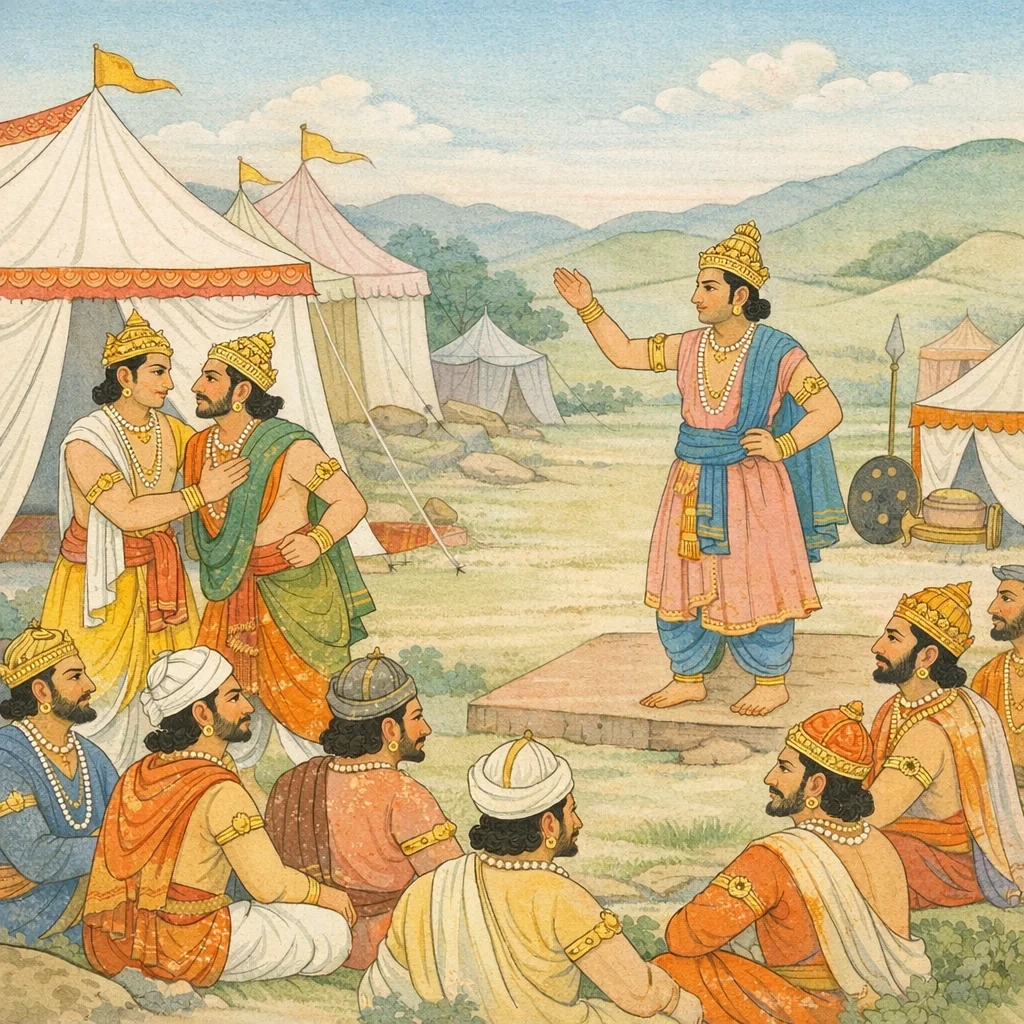
Adhyaya 200
Chapter Arc: धृतराष्ट्र संजय से पूछते हैं—जिस द्रोणाचार्य ने विधिपूर्वक वेदाध्ययन किया, जिनका तेज देवासुरों को भी दुर्लभ था, उनके सामने ऐसा ‘अमानुष’ कर्म कैसे घटा? (वेद-विद्या और रण-कौशल का स्मरण कराकर अध्याय का आरम्भ द्रोण-वध की नैतिक गूँज से होता है)। → सभा-सा वातावरण बनता है—आरोप, प्रत्यारोप और कटु वचन। ‘गुरुघाती’, ‘नीच’, ‘पापकर्मणा’ जैसे शब्दों से द्रोण-वध के उपाय पर तीखी निन्दा उठती है। साथ ही पुराने घाव भी उभरते हैं—भूरिश्रवा का छिन्नभुज होकर गिरना, भीष्म-वध का प्रसंग, और ‘क्षात्रधर्म’ पर धिक्कार। सहदेव सात्यकि को शान्त करने का प्रयास करते हैं, पर वाणी का विष थमता नहीं। → धृष्टद्युम्न (पाञ्चालराज का पुत्र) हँसकर तीखे व्यंग्य के साथ उत्तर देता है—जो स्वयं नख-शिख तक पाप में डूबा हो, वह दूसरों को कटु वचन क्यों सुनाए? वह विरोधियों को उनके ही कर्मों (भीष्म-प्रसंग, भूरिश्रवा-प्रसंग, छल-नीति) की याद दिलाकर नैतिक ऊँचाई का दावा तोड़ता है और द्रोण-वध को ‘युद्ध-धर्म’ की कठोर अनिवार्यता के रूप में ठहराने की चेष्टा करता। → विवाद का निष्कर्ष किसी एक ‘निर्मल’ सत्य पर नहीं, बल्कि युद्धकालीन धर्म-संकट की स्वीकृति पर टिकता है—क्षमा की प्रशंसा होते हुए भी पापात्मा उसे दुर्बलता समझता है; इसलिए कभी-कभी कठोरता ही रक्षा बनती है। सहदेव का शमन-प्रयास और धृष्टद्युम्न की प्रत्युत्तर-वाणी मिलकर यह संकेत देते हैं कि पाण्डव-पक्ष अब आत्म-रक्षा और प्रतिशोध के बीच संतुलन खोज रहा है। → द्रोण-वध के बाद की यह वाक्य-युद्ध-लहर अगले रक्त-प्रवाह का संकेत देती है—कौरव-पक्ष की प्रतिहिंसा और रणभूमि में नई उग्र प्रतिज्ञाएँ आसन्न हैं।
Shlokas
Verse 1
इस प्रकार श्रीमहाभारत द्रोणपर्वके अन्तर्गत नारायणास्त्रमोक्षपर्वमें धृष्टटुम्नवाक्यविषयक एक सौ सत्तानबेवाँ अध्याय पूरा हुआ ॥/ १९७ ॥। अपना छा | अत्-४-णकात अष्टनवर्त्याधेकशततमोब् ध्याय: सात्यकि और धृष्टद्युम्नका परस्पर क्रोधपूर्वक वाग्बाणोंसे लड़ना तथा भीमसेन, सहदेव और श्रीकृष्ण एवं युधिष्ठिरके प्रयत्नसे उनका निवारण धृतराष्ट उवाच साड्जा वेदा यथान्यायं येनाधीता महात्मना । यस्मिन् साक्षाद् थनुर्वेदो ह्वीनिषेवे प्रतिष्ठित:
Dhṛtarāṣṭra said: “That great-souled one has studied the Vedas in their complete form, together with their auxiliary disciplines, and in the proper traditional manner. In him, the science of archery stands firmly established as if it were directly embodied and ever ready for use.”
Verse 2
यस्य प्रसादात् कुर्वन्ति कर्माणि पुरुषर्षभा: । अमानुषाणि संग्रामे देवेरसुकराणि च
Dhṛtarāṣṭra said: “By whose favor do those bull-like men accomplish deeds in battle that seem beyond human capacity—feats that even the gods and demons would find hard to perform?”
Verse 3
तस्समिन्नाक्रुश्यति द्रोणे समक्ष पापकर्मणा । नीचात्मना नृशंसेन क्षुद्रेण गुरुघातिना
Dhṛtarāṣṭra said: “When Droṇa was being reviled to his face, he was abused by a man of sinful deeds—base-souled, cruel, petty, and a slayer of his own teacher. The scene exposes not only the brutality of war but the deeper moral collapse in which reverence for the guru and basic decency are cast aside.”
Verse 4
नामर्ष तत्र कुर्वन्ति धिक क्षात्रं धिगमर्षिताम् । धृतराष्ट्र बोले--संजय! जिन महात्माने विधिपूर्वक अंगोंसहित सम्पूर्ण वेदोंका अध्ययन किया था, जिन लज्जाशील सत्पुरुषमें साक्षात् धथनुर्वेद प्रतिष्ठित था, जिनके कृपाप्रसादसे कितने ही पुरुषरत्न योद्धा संग्रामभूमिमें ऐसे-ऐसे अलौकिक पराक्रम कर दिखाते थे, जो देवताओं के लिये भी दुष्कर थे; उन्हीं द्रोणाचार्यकी वह पापी, नीच, नृशंस, क्षुद्र और गुरुधाती धृष्टद्युम्मन सबके सामने निन््दा कर रहा था और लोग क्रोध नहीं प्रकट करते थे। धिक्कार है ऐसे क्षत्रियोंको! और धिक्कार है उनके अमर्षशील स्वभावको!! ।। १ -+3३३ || पार्था: सर्वे च राजान: पृथिव्यां ये धनुर्धरा:
Dhṛtarāṣṭra said: “They show no righteous indignation there. Shame on such kṣatriyahood, and shame on the temper of those who cannot be stirred to anger when honor and duty are violated.”
Verse 5
संजय उवाच श्र॒त्वा द्रुपदपुत्रस्य ता वाच: क्रुरकर्मण:,सबाष्पमतिनि:श्वस्य धिग् धिगित्येव चाब्रवीत् । संजयने कहा--प्रजानाथ! क्रूरकर्मा ट्रुपदपुत्रकी वे बातें सुनकर वहाँ बैठे हुए सभी नरेश मौन रह गये। केवल अर्जुन टेढ़ी नजरोंसे उसकी ओर देखकर आँसू बहाते हुए दीर्घ निःश्वास ले इतना ही बोले कि--'धिक्कार है! धिक्कार है!!”
Sañjaya said: Hearing those words of Drupada’s son—whose deeds were cruel—Arjuna, his mind overwhelmed and his eyes filled with tears, heaved a long, heavy sigh and uttered only this: “Shame! Shame!”
Verse 6
तूष्णीं बभूवू राजान: सर्व एव विशाम्पते | अर्जुनस्तु कटाक्षेण जिद्दां विप्रेक्ष्य पार्षतम्
Sañjaya said: All the kings fell silent, O lord of the people. Arjuna, however, with a mere sidelong glance, looked toward the son of Pṛṣata (Dhṛṣṭadyumna), as if to signal resolve and readiness amid the tense moral weight of the battlefield.
Verse 7
युधिष्ठिरश्न भीमश्न यमौ कृष्णस्तथापरे
Sañjaya said: Yudhiṣṭhira and Bhīma, the twin brothers, and Kṛṣṇa as well—along with the others—were there, in the same state of mind.
Verse 8
आसन सुव्रीडिता राजन् सात्यकिस्त्वब्रवीदिदम् । राजन! उस समय युधिष्ठिर, भीमसेन, नकुल, सहदेव, भगवान् श्रीकृष्ण तथा अन्य लोग भी अत्यन्त लज्जित हो चुप ही बैठे रहे, परंतु सात्यकि इस प्रकार बोल उठे-- ।। ७६ || नेहास्ति पुरुष: कश्चिद् य इमं पापपूरुषम्
Sañjaya said: O King, all sat there overwhelmed with shame and silence—Yudhiṣṭhira, Bhīmasena, Nakula, Sahadeva, and even Lord Śrī Kṛṣṇa, along with the others. But Sātyaki, unable to endure the moral humiliation of the moment, rose to speak: “Here there is no man who would accept this sinful person…”
Verse 9
एते त्वां पाण्डवा: सर्वे कुत्सयन्ति विकुत्सया
Sañjaya said: “All these Pāṇḍavas are reviling you with contempt, seeking to disgrace you.”
Verse 10
एतत् कृत्वा महत् पाप॑ निन्दित: सर्वसाधुभि:,गुरुमाक्रोशत: क्षुद्र न चाधर्मेण पात्यसे । “यह महान् पाप करके तू समस्त श्रेष्ठ पुरुषोंकी दृष्टिमें निन्दाका पात्र बन गया है। साधु पुरुषोंकी इस सुन्दर सभामें पहुँचकर ऐसी बातें करते हुए तुझे लज्जा कैसे नहीं आती है? तेरी जीभके सैकड़ों टुकड़े क्यों नहीं हो जाते और तेरा मस्तक क्यों नहीं फट जाता? ओ नीच! गुरुकी निन््दा करते हुए तेरा इस पापसे पतन क्यों नहीं हो जाता?
Sañjaya said: “Having committed this great sin, you have become an object of condemnation in the eyes of all the virtuous. O petty man, as you revile your teacher, why do you not fall through unrighteousness? By entering this noble assembly and speaking such words, how do you not feel shame? Why does your tongue not split into hundreds of pieces, and why does your head not burst?”
Verse 11
न लज्जसे कथं वक्तुं समितिं प्राप्प शोभनाम् । कथं च शतधा जिद्ला न ते मूर्धा च दीर्यते
Sañjaya said: “How are you not ashamed to speak so, after having come to that illustrious assembly? And how, though shattered a hundredfold, does your head not split apart?”
Verse 12
वाच्यस्त्वमसि पार्थश्न सर्वेैश्ञान्धकवृष्णिभि:
Sañjaya said: “O slayer of Pārtha, you are to be addressed and called upon by all the Andhakas and the Vṛṣṇis.”
Verse 13
अकार्य तादृशं कृत्वा पुनरेव गुरु क्षिपन्
Sañjaya said: “Having committed such an improper deed, he again hurled it at the teacher.”
Verse 14
वध्यस्त्वं न त्वयार्थो5स्ति मुहूर्तमपि जीवता । “वैसा पापकर्म करके तू पुनः गुरुपर आक्षेप कर रहा है; अतः तू वध करनेके ही योग्य है। एक मुहूर्त भी तेरे जीवित रहनेका कोई प्रयोजन नहीं है ।। १३ $ ।। कस्त्वेतद् व्यवसेदार्यस्त्वदन्य: पुरुषाधम
Sañjaya said: “You are fit to be slain; there is no purpose served by your remaining alive even for a single muhūrta. Having committed such sinful deeds, you are again casting blame upon your teacher—therefore you deserve death.”
Verse 15
सप्तावरे तथा पूर्वे बान्धवास्ते निमज्जिता:
Sañjaya said: “In the same way, those earlier kinsmen of yours—seven in number—have sunk down (been overwhelmed and lost).”
Verse 16
उक्तवांश्वापि यत् पार्थे भीष्म प्रति नरर्षभम्
Sañjaya said: Even what he had spoken to Pārtha—addressing the bull among men—was directed toward Bhīṣma. The narration highlights how words spoken in the midst of war are often aimed not merely at one listener, but at shaping the resolve and moral stance of the foremost elders and leaders who embody the battlefield’s ethical weight.
Verse 17
तथान्तो विहितस्तेन स्वयमेव महात्मना | तूने जो कुन्तीकुमार अर्जुनपर नरश्रेष्ठ भीष्मके वधका दोष लगाया है, वह भी व्यर्थ ही है; क्योंकि महात्मा भीष्मने स्वयं ही उसी प्रकार अपनी मृत्युका विधान किया था ।। १६ ६ || तस्यापि तव सोदर्यो निहन्ता पापकृत्तम:
Sañjaya said: “Thus, that end was ordained by him—by the great-souled Bhīṣma himself. And as for you, even your own brother is the slayer, the most sinful of doers.”
Verse 18
स चापि सृष्ट: पित्रा ते भीष्मस्यान्तकर: किल
Sañjaya said: “And he too was, it is said, brought forth by your father—destined to become the slayer of Bhīṣma.”
Verse 19
शिखण्डी रक्षितस्तेन स च मृत्युर्महात्मन: । 'यह प्रसिद्ध है कि उसे भी तेरे पिताने भीष्मका अन्त करनेके लिये उत्पन्न किया था; उन्होंने महात्मा भीष्मकी मूर्तिमान् मृत्युके रूपमें ही शिखण्डीको सुरक्षित रखा था ।। १८६ || पज्चालाश्वलिता धर्मात् क्षुद्रा मित्रगुरुद्रुह:
Sañjaya said: “Śikhaṇḍī was protected by him, and he was, as it were, the embodied death of the great-souled one (Bhīṣma).”
Verse 20
त्वां प्राप्प सहसोदर्य धिक्कृतं सर्वसाधुभि: । “तू और तेरा भाई दोनों समस्त साधु पुरुषोंके धिककारके पात्र हैं। तुम दोनोंको पाकर सारे पांचाल धर्मभ्रष्ट, नीच, मित्रद्रोही तथा गुरुद्रोही बन गये हैं ।। पुनश्चेदवीदृशी वाचं मत्समीपे वदिष्यसि
Sañjaya said: “O sister with your brother, having obtained you, you have become an object of condemnation to all the righteous. You and your brother are fit to be rebuked by every good person. Because of associating with you two, the entire Pañcāla side has become fallen from dharma—base, treacherous to friends, and betrayers of their teacher. And if you speak such words again in my presence…”
Verse 21
शिरस्ते पोथयिष्यामि गदया वज्कल्पया । “यदि तू पुनः मेरे समीप ऐसी बात बोलेगा तो मैं अपनी इस वज्तुल्य गदासे तेरा सिर कुचल दूँगा ।। त्वां च ब्रह्म॒हणं दृष्टवा जन: सूर्यमवेक्षते
Sanjaya said: "I will crush your head with this mace, hard as a thunderbolt. If you speak such words again in my presence, I will smash your head with this thunderbolt-like club." And seeing you—one stained with the sin of brahmin-slaying—people turn their gaze away, as though looking toward the sun, unable to face you directly. The passage underscores how violent threats and the taint of grievous wrongdoing corrode moral standing even amid the brutal necessities of war.
Verse 22
पाञज्चालक सुदुर्वत्त ममैव गुरुमग्रत:
Sañjaya said: “That wicked Pāñcālaka has brought my own revered teacher right before me.” The line conveys a moral shock: in the chaos of war, reverence for one’s guru is violated, and the act is condemned as a grave ethical transgression.
Verse 23
तिष्ठ तिष्ठ सहस्वैंकं गदापातमिमं मम
Sañjaya said: “Stand your ground—stand! Endure this single blow of my mace.” The line captures the warrior’s demand for steadfastness in the midst of battle, where courage and endurance are tested even as violence escalates.
Verse 24
सात्वतेनैवमाक्षिप्त: पार्षत: परुषाक्षरम्
Sañjaya said: Thus provoked by the Sātvata, the son of Pārṣata replied with harsh words—showing how, under the pressures of war, even great warriors are driven from restraint into cutting speech.
Verse 25
संरब्धं सात्यकिं प्राह संक्रुद्ध: प्रहसन्निव । सात्वतवंशी सात्यकिके इस प्रकार कठोर वचन कहकर आक्षेप करनेपर धृष्टद्युम्न अत्यन्त कुपित हो उठे। फिर वे भी क्रोधमें भरे हुए सात्यकिसे हँसते हुए-से बोले ।। धृष्टह्युम्न उवाच श्रूयते श्रूयते चेति क्षम्यते चेति माधव
Dhṛṣṭadyumna said: “Yes, yes—one hears it, one hears it; and ‘it is to be forgiven’—so you keep saying, O Mādhava.” In the heat of battle and wounded pride, he answers with biting irony, rejecting repeated appeals to patience and forgiveness.
Verse 26
क्षमा प्रशस्यते लोके न तु पापो$हति क्षमाम्
Forgiveness is praised in the world; yet a sinner does not truly value forgiveness—he neither upholds it nor responds to it.
Verse 27
स त्वं क्षुद्रसममाचारो नीचात्मा पापनिश्चय:
But you are one whose conduct is petty and base—low-minded, and resolved upon sin.
Verse 28
यः स भूरिश्रवाश्छिन्नभुज: प्रायगतस्त्वया
Dhṛṣṭadyumna said: “That Bhūriśravas—his arm severed—has been brought to the point of death by you.”
Verse 29
गाहमानो मया द्रोणो दिव्येनास्त्रेण संयुगे
Dṛṣṭadyumna said: “In the thick of battle, Droṇa was being pressed hard by me with a divine weapon.”
Verse 30
अयुध्यमानं यस्त्वाजी तथा प्रायगतं मुनिम्
Dhṛṣṭadyumna said: “Whoever, in battle, strikes one who is not fighting, and likewise a sage who has withdrawn from life and is on the verge of death—such an act violates the warrior’s code and stains the cause with unrighteousness.”
Verse 31
छिन्नबाहुं परैर्हन्यात् सात्यके स कथं वदेत् । सात्यके! जो युद्धस्थलमें मुनिवृत्तिका आश्रय ले आमरण उपवासका निश्चय लेकर बैठ गया हो, जो अपने साथ युद्ध न कर रहा हो तथा जिसकी बाँह भी शत्रुओंद्वारा काट डाली गयी हो, ऐसे पुरुषको जो मार सकता है, वह दूसरेकी निन्दा कैसे कर सकता है? ।। निहत्य त्वां पदा भूमौ स विकर्षति वीर्यवान्
Dhṛṣṭadyumna said: “How could that man speak, O Sātyaki, who would strike down one whose arm has been cut off by enemies? O Sātyaki—if someone, on the battlefield, has taken up the life of an ascetic, resolved to fast until death, sits apart without fighting alongside his comrades, and even has his arm severed by foes—how can a man who is capable of killing such a person presume to censure another? Having slain you, that mighty warrior would drag you along the ground with his foot.”
Verse 32
त्वया पुनरनार्येण पूर्व पार्थेन निर्जित:
Dhrishtadyumna said: “But you—acting in an unworthy, ignoble manner—were earlier defeated by Pārtha (Arjuna).”
Verse 33
यत्र यत्र तु पाण्डूनां द्रोणो द्रावयते चमूम्
Dhṛṣṭadyumna said: “Wherever Droṇa drives the Pāṇḍavas’ army into flight, there—at each such point—lies the urgent task before us.”
Verse 34
किरन् शरसहस्राणि तत्र तत्र प्रयाम्पहम् । द्रोणाचार्य जहाँ-जहाँ पाण्डव-सेनाको खदेड़ते थे, वहीं-वहीं मैं जा पहुँचता और सहस्रों बाणोंकी वर्षा करके उनके छक्के छुड़ा देता था ।। ३३ $ ।। स त्वमेवंविध॑ कृत्वा कर्म चाण्डालवत् स्वयम्
Dhṛṣṭadyumna said: “Scattering thousands of arrows, I would rush to whatever point of the field was threatened. Wherever Droṇa drove back the Pāṇḍava host, there I would arrive, and by pouring down volleys of arrows I would break his momentum and blunt his force. Yet you, though acting in such a manner, have yourself performed a deed as base as that of an outcaste.”
Verse 35
कर्ता त्वं कर्मणो हास्य नाहं वृष्णिकुलाधम
Dhṛṣṭadyumna said: “You are the doer of this deed—certainly not I, O lowest of the Vṛṣṇi line.”
Verse 36
जोषमास्स्व न मां भूयो वक्तुमर्हस्थत: परम्
Dhṛṣṭadyumna said: “Be silent; from this point onward you should not speak to me again.”
Verse 37
अथ वक्ष्यसि मां मौख्याद् भूय: परुषमीदृशम्
Dhṛṣṭadyumna said: “Will you, out of sheer foolishness, again speak to me such harsh words?”
Verse 38
गमयिष्यामि बाणैस्त्वां युधि वैवस्वतक्षयम् । यदि मूर्खतावश तू पुनः मुझसे ऐसी कठोर बातें कहेगा, तो युद्धमें बाणोंद्वारा मैं अभी तुझे यमलोक भेज दूँगा ।। न चैवं मूर्ख धर्मेण केवलेनैव शक््यते
Dhṛṣṭadyumna declared: “If, driven by foolishness, you again speak such harsh words to me, then in battle I will send you this very day to the realm of Yama (Vaivasvata) with my arrows. And mere obstinate, foolish ‘dharma’—a hollow moral posture—cannot accomplish what is needed in this situation.”
Verse 39
तेषामपि हाधर्मेण चेष्टितं शृूणु यादृशम् । ओ मूर्ख! केवल धर्मसे ही युद्ध नहीं जीता जा सकता। उन कौरवोंकी भी जो अधर्मपूर्ण चेष्टाएँ हुई हैं, उन्हें सुन ले ।। ३८ ई ।। वज्चित: पाण्डव: पूर्वमधर्मेण युधिछिर:
Dhṛṣṭadyumna said: “Hear also what manner of unrighteous conduct they have practiced. O fool—war cannot be won by dharma alone. Listen as well to the Kauravas’ deeds, the actions they undertook steeped in adharma.”
Verse 40
प्रत्राजिता वनं सर्वे पाण्डवा: सह कृष्णया
Dhṛṣṭadyumna said: “All the Pāṇḍavas, together with Kṛṣṇā (Draupadī), were driven out and forced into the forest.”
Verse 41
सर्वस्वमपकृष्टं च तथाधर्मेण बालिश । ओ मूर्ख! समस्त पाण्डवोंको जो द्रौपदीके साथ वनमें भेज दिया गया और उनका सर्वस्व छीन लिया गया, वह भी अधर्मका ही कार्य था || ४० $ ।। अधर्मेणापकृष्टश्च मद्रराज: परेरित:
Dhṛṣṭadyumna said: “Fool—yes, you deluded man! To drive the Pāṇḍavas into the forest along with Draupadī and to strip them of all they possessed—this too was adharma. And the king of Madra as well was wrongfully drawn away, being instigated by others.”
Verse 42
इतोडप्यधर्मेण हतो भीष्म: परपुरंजय:
Dhṛṣṭadyumna said: “Even so, Bhīṣma—conqueror of enemy strongholds—was slain through an unrighteous stratagem.”
Verse 43
भूरिश्रवा हधर्मेण त्वया धर्मविदा हतः । इस पक्षसे भी अधर्मके द्वारा ही शत्रुनगरीपर विजय पानेवाले भीष्म मारे गये हैं और तू बड़ा धर्मज्ञ बनता है पर तूने भी अधर्मसे ही भूरिश्रवाका वध किया है ।। एवं परैराचरितं पाण्डवेयैश्व संयुगे
Dhṛṣṭadyumna said: “Bhūriśravā has been slain by you—one who claims to know dharma—yet by an unrighteous means. And in this war, the Pāṇḍavas too have acted in the very manner practiced by others (their foes).”
Verse 44
रक्षमाणैर्जयं वीरैर्धर्मज्ैरपि सात्वत । सात्वत! इस प्रकार धर्मके जाननेवाले वीर पाण्डवों तथा शत्रुओंने भी युद्धके मैदानमें अपनी विजयको सुरक्षित रखनेके लिये समय-समयपर अधर्मपूर्ण बर्ताव किया है || ४३ ३ || दुर्ज्ञेयः स परो धर्मस्तथाधर्मश्न दुर्विद:
Dhrishtadyumna said: “O Sātvata! Even heroic men who know dharma, intent on safeguarding victory, have at times acted in ways that are not fully righteous. Thus, on the battlefield, the valiant Pāṇḍavas—and their enemies as well—have, from time to time, resorted to conduct tainted by adharma in order to secure their triumph. Indeed, the highest dharma is hard to discern, and so too is adharma difficult to judge.”
Verse 45
संजय उवाच एवमादीनि वाक्यानि क्रूराणि परुषाणि च
Sañjaya said: Thus were spoken words of this kind—cruel and harsh—revealing how, amid the fury of war, speech itself becomes a weapon that wounds and degrades, departing from restraint and righteous conduct.
Verse 46
श्रुत्वा किमाहु: पाज्चाल्यं तन््ममाचक्ष्य संजय । संजय! भूमण्डलके जो-जो धनुर्धर नरेश वहाँ उपस्थित थे, उन सबने तथा कुन्तीके पुत्रोंने धृष्टद्यम्मकी बात सुनकर उससे क्या कहा? यह मुझे बताओ,श्रावितः सात्यकि: श्रीमानाकम्पित इवा भवत् । तच्छुत्वा क्रोधताम्राक्ष: सात्यकिस्त्वाददे गदाम्
Dhṛtarāṣṭra said: “Sañjaya, tell me—after hearing the words of the Pāñcāla prince (Dhṛṣṭadyumna), what did the assembled bow-bearing kings there, and the sons of Kuntī, say in reply?” Having been informed, the illustrious Sātyaki became as if shaken; and on hearing it, Sātyaki—his eyes reddened with anger—took up his mace, signaling a surge of righteous fury and readiness to act amid the moral pressures of war.
Verse 47
विनिः:श्वस्य यथा सर्प: प्रणिधाय रथे धनु: । ततो$भिपत्य पाज्चाल्यं संरम्भेणेदमब्रवीत्
Sañjaya said: Breathing hard like a serpent, he set his bow upon the chariot. Then, rushing at the Pāñcāla warrior, he spoke these words in a surge of wrath—signaling how anger and pride can drive speech and action amid the moral chaos of war.
Verse 48
नत्वां वक्ष्यामि परुषं हनिष्ये त्वां वधक्षमम् । संजय कहते हैं--राजन्! इस प्रकार कितने ही क्रूर एवं कठोर वचन धृष्टद्युम्नने श्रीमान् सात्यकिको सुनाये। उन्हें सुनकर वे क्रोधसे काँपने लगे। उनकी आँखें लाल हो गयीं तथा उन्होंने सर्पषके समान लंबी साँस खींचकर धनुषको तो रथपर रख दिया और हाथमें गदा उठा ली। फिर वे धृष्टद्युम्नके पास पहुँचकर बड़े रोषके साथ इस प्रकार बोले--“अब मैं तुझसे कठोर वचन नहीं कहूँगा। तू वधके ही योग्य है, अतः तुझे मार ही डालूँगा || ४५-- ४७३ || तमापतन्तं सहसा महाबलममर्षणम्,अवलप्लुत्य रथात् तूर्ण बाहुभ्यां समवारयत् | महाबली, अमर्षशील एवं अत्यन्त क्रोधमें भरे हुए यमराज-तुल्य सात्यकि जब सहसा कालस्वरूप धृष्टद्युम्नकी ओर बढ़े, तब भगवान् श्रीकृष्णकी आज्ञासे महाबली भीमसेनने तुरंत ही रथसे कूदकर उन्हें दोनों हाथोंसे रोक लिया
Sanjaya said: “I will not address you with harsh words; I will kill you—you are fit only to be slain.” As Sātyaki, mighty and intolerant of insult, surged forward in a sudden rush—like Death itself in his wrath—Bhīmasena, acting on Kṛṣṇa’s command, leapt down quickly from the chariot and restrained him with both arms.
Verse 49
पाज्चाल्यायाभिसंक्रुद्धमन्तकायान्तकोपमम् । चोदितो वासुदेवेन भीमसेनो महाबल:
Sañjaya said: Urged on by Vāsudeva (Kṛṣṇa), the mighty Bhīmasena—enraged against Pāñcālī’s foe—advanced like Death itself, as though he were the slayer of Death.
Verse 50
द्रवमाणं तथा क्रुद्धं सात्यकिं पाण्डवो बली
Sañjaya said: The mighty Pāṇḍava, seeing Sātyaki rushing forward, aflame with wrath, turned his attention to him amid the battle.
Verse 51
स्थित्वा विष्टभ्य चरणौ भीमेन शिनिपुज्भव:
Sañjaya said: Standing firm and bracing his feet, the descendant of Śini steadied himself before Bhīma, poised for the next violent exchange.
Verse 52
अवरुह्य रथात् तूर्ण प्रियमाणं बलीयसा
Sañjaya said: Quickly dismounting from the chariot, he was being overpowered by one stronger than himself.
Verse 53
अस्माकं पुरुषव्याप्र मित्रमन्यन्न विद्यते,कृष्णस्य च तथास्मत्तो मित्रमन्यन्न विद्यते । “माननीय पुरुषसिंह! अन्धक और वृष्णिवंशके यादवों तथा पांचालोंसे बढ़कर दूसरा कोई हमलोगोंका मित्र नहीं है। इसी प्रकार अन्धक और वृष्णिवंशके लोगोंका तथा विशेषत: श्रीकृष्णका हमलोगोंसे बढ़कर दूसरा कोई मित्र नहीं है
Sañjaya said: “For us, O lion among men, there is no greater friend than the Yādavas of the Andhaka and Vṛṣṇi lines, and the Pāñcālas; and likewise, for Kṛṣṇa there is no greater friend than us.”
Verse 54
परमन्धकवृष्णिभ्य: पज्चालेभ्यश्व मारिष । तथैवान्धकवृष्णीनां तथैव च विशेषत:
Sañjaya said: “O revered one, there was fierce hostility toward the foremost among the Andhakas and Vṛṣṇis, and toward the Pāñcālas as well; and likewise, on the side of the Andhakas and Vṛṣṇis too there was the same hostility—indeed, with particular intensity.”
Verse 55
पंचालानां च वार्ष्णेय समुद्रान्तां विचिन्चताम्
Sañjaya said: “O descendant of the Vṛṣṇis, they searched through the lands of the Pañcālas, ranging as far as the ocean’s edge.”
Verse 56
स भवानीदृशं मित्र मन््यते च यथा भवान्
Sañjaya said: “He regards you, my friend, as being just such a person—exactly as you are.”
Verse 57
स एवं सर्वधर्मज्ञ मित्रधर्ममनुस्मरन्,वयं क्षमयितारश्न किमन्यत्र शमाद् भवेत् । “सब धर्मोंके ज्ञाता शिनिप्रवर! इस प्रकार मित्रधर्मका विचार करके आप धूृष्टद्युम्नकी ओरसे अपने क्रोधको रोकें और शान्त हो जाय, आप धृष्टद्युम्नके और धृष्टद्युम्न आपके अपराधको क्षमा कर लें। हमलोग केवल क्षमा-प्रार्थना करनेवाले हैं; शान्तिसे बढ़कर श्रेष्ठ वस्तु और क्या हो सकती है?”
Sañjaya said: “O knower of all dharma, remembering the duty owed to a friend, restrain your anger on account of Dṛṣṭadyumna and become calm. Let there be mutual forgiveness—may you forgive Dṛṣṭadyumna’s offence, and may Dṛṣṭadyumna also forgive yours. We stand here only as petitioners for pardon; for what could be better than peace?”
Verse 58
नियच्छ मन्युं पाञ्चाल्यात् प्रशाम्य शिनिपुड्भव । पार्षतस्य क्षम त्वं वै क्षमतां पार्षतश्न ते
Sañjaya said: “O descendant of Śini, restrain your wrath against the son of Pāñcāla and calm yourself. Do forgive the son of Pārṣata; and may the son of Pārṣata also forgive you.”
Verse 59
प्रशाम्यमाने शैनेये सहदेवेन मारिष
Sañjaya said: “O venerable one, as Śaineya’s fury was being calmed by Sahadeva…”
Verse 60
मुछ्च मुछ्च शिने: पौत्र॑ भीम युद्धमदान्वितम्,युद्धश्रद्धांच कौन्तेय जीवितं चास्य संयुगे | 'भीमसेन! शिनिके इस पौत्रको अपने युद्ध-कौशलपर बड़ा घमंड है। तुम इसे छोड़ दो, छोड़ दो। जैसे हवा पर्वतसे आकर टकराती है, उसी प्रकार यह मुझसे आकर भिड़े तो सही। कुन्तीनन्दन! मैं अभी तीखे बाणोंसे इसका क्रोध उतार देता हूँ। साथ ही इसका युद्धका हौसला और जीवन भी समाप्त किये देता हूँ
Sañjaya said: “Bhīma, release—release this grandson of Śini, who is intoxicated with the pride of battle-skill. O son of Kuntī, I shall strip him, here in the clash of arms, of his confidence in war and even of his life.”
Verse 61
आसादयतु मामेष धराधरमिवानिल: । यावदस्य शितैर्बाणै: संरम्भं विनयाम्यहम्,युद्धश्रद्धांच कौन्तेय जीवितं चास्य संयुगे | 'भीमसेन! शिनिके इस पौत्रको अपने युद्ध-कौशलपर बड़ा घमंड है। तुम इसे छोड़ दो, छोड़ दो। जैसे हवा पर्वतसे आकर टकराती है, उसी प्रकार यह मुझसे आकर भिड़े तो सही। कुन्तीनन्दन! मैं अभी तीखे बाणोंसे इसका क्रोध उतार देता हूँ। साथ ही इसका युद्धका हौसला और जीवन भी समाप्त किये देता हूँ
Sañjaya said: “Let this one come and assail me, like the wind striking a mountain. Before long, with my sharp arrows I shall quell his fury; and, O son of Kuntī, I shall also bring to an end his confidence in battle—and his very life—upon the field.”
Verse 62
कि नु शक््यं मया कर्तु कार्य यदिदमुद्यतम्
Sañjaya said: “What, indeed, can I do—what duty or task is within my power—regarding this enterprise that has now been set in motion?”
Verse 63
अथवा फाल्गुन: सर्वान् वारयिष्यति संयुगे,सबाष्पमतिनि:श्वस्य धिग् धिगित्येव चाब्रवीत् । संजयने कहा--प्रजानाथ! क्रूरकर्मा ट्रुपदपुत्रकी वे बातें सुनकर वहाँ बैठे हुए सभी नरेश मौन रह गये। केवल अर्जुन टेढ़ी नजरोंसे उसकी ओर देखकर आँसू बहाते हुए दीर्घ निःश्वास ले इतना ही बोले कि--'धिक्कार है! धिक्कार है!!”
Sañjaya said: “Or else Phālguna (Arjuna) will restrain them all in the battle.” Then, with tears in his eyes and breathing a long, heavy sigh, he uttered only this: “Shame! Shame!”
Verse 64
अहमप्यस्य मूर्धानं पातयिष्यामि सायकै: । मन्यते छिन्नबाहुं मां भूरिश्रवसमाहवे
Sañjaya said: “I too shall strike down his head with my arrows. In the midst of battle, Bhūriśravas thinks of me as one whose arms have been cut off.”
Verse 65
उत्सृजैनमहं चैनमेष वा मां हनिष्यति | “अथवा केवल अर्जुन युद्धके मैदानमें इन समस्त कौरवोंको रोकेंगे, तबतक मैं भी अपने बाणोंद्वारा इस सात्यकिका मस्तक काट गिराऊँगा। यह मुझे भी रणभूमिमें कटी हुई बाँहवाला भूरिश्रवा समझता है। तुम छोड़ दो इसे। या तो मैं इसे मार डालूँगा या यह मुझे” ।। शृण्वन् पाज्चालवाक्यानि सात्यकि: सर्पवच्छवसन्
Sanjaya said: “Release him. Either I will kill him, or he will kill me. Or else, while Arjuna alone holds back all these Kauravas on the battlefield, I too will cut down Sātyaki’s head with my arrows. He takes me to be another Bhūriśravas—one whose arm has been severed on the field. Let him go. Either I will slay him, or he will slay me.” Hearing these words spoken by the Pāñcālas, Sātyaki, hissing like a serpent, …
Verse 66
तौ वृषाविव नर्दन्तौ बलिनौ बाहुशालिनौ,अपनी भुजाओंसे सुशोभित होनेवाले वे दोनों वीर दो साँड्ोंक समान गरज रहे थे। माननीय नरेश! उस समय भगवान् श्रीकृष्ण और धर्मराज युधिष्ठिरने शीघ्रतापूर्वक महान् प्रयत्न करके उन दोनों वीरोंको रोका
Sañjaya said: Like two bulls bellowing, those two mighty, strong-armed heroes—splendid with the power of their own arms—roared at each other. O revered king, at that moment Bhagavān Śrī Kṛṣṇa and Dharma-rāja Yudhiṣṭhira, acting swiftly and with great effort, restrained those two warriors, preventing their fury from spilling into immediate violence.
Verse 67
त्वरया वासुदेवश्च धर्मराजश्न मारिष | यत्नेन महता वीरी वारयामासतुस्तत:,अपनी भुजाओंसे सुशोभित होनेवाले वे दोनों वीर दो साँड्ोंक समान गरज रहे थे। माननीय नरेश! उस समय भगवान् श्रीकृष्ण और धर्मराज युधिष्ठिरने शीघ्रतापूर्वक महान् प्रयत्न करके उन दोनों वीरोंको रोका
Verse 68
निवार्य परमेष्वासौ कोपसंरक्तलोचनौ । युयुत्सुनपरान् संख्ये प्रतीयु: क्षत्रियर्षभा:,क्रोधसे लाल आँखें किये उन दोनों महान् धनुर्धरोंको रोककर वे क्षत्रियशिरोमणि वीर समरभूमिमें युद्धकी इच्छासे आते हुए शत्रुओंका सामना करनेके लिये चल दिये
Sañjaya said: Having restrained those two supreme archers, their eyes reddened with anger, the bull-like heroes among kṣatriyas advanced on the battlefield to confront the other foes who were coming forward eager to fight. The verse underscores disciplined restraint amid rage, and the kṣatriya duty to meet aggression without surrendering to uncontrolled wrath.
Verse 86
भाषमाणमकल्याणं शीघ्र हन्यान्नराधमम् । “क्या यहाँ कोई ऐसा पुरुष नहीं है, जो इस प्रकार अभद्रतापूर्ण वचन बोलनेवाले इस पापी नराधमको शीघ्र ही मार डाले
Sañjaya said: “Let someone swiftly strike down that vile wretch who utters such inauspicious, disgraceful words.”
Verse 113
गुरुमाक्रोशत: क्षुद्र न चाधर्मेण पात्यसे । “यह महान् पाप करके तू समस्त श्रेष्ठ पुरुषोंकी दृष्टिमें निन्दाका पात्र बन गया है। साधु पुरुषोंकी इस सुन्दर सभामें पहुँचकर ऐसी बातें करते हुए तुझे लज्जा कैसे नहीं आती है? तेरी जीभके सैकड़ों टुकड़े क्यों नहीं हो जाते और तेरा मस्तक क्यों नहीं फट जाता? ओ नीच! गुरुकी निन््दा करते हुए तेरा इस पापसे पतन क्यों नहीं हो जाता?
Sañjaya said: “Wretch! You revile your own guru, yet you do not fall at once through that very adharma. By committing this grave sin you have become an object of blame in the eyes of all noble men. Having entered this fair assembly of the virtuous, how do you feel no shame while speaking such words? Why does your tongue not split into a hundred pieces, and why does your head not burst? O base one—while censuring the guru, why are you not ruined by this sin?”
Verse 123
यत् कर्म कलुषं कृत्वा शलाघसे जनसंसदि । 'तू पापकर्म करके जनसमाजमें जो इस तरह अपनी बड़ाई कर रहा है, इसके कारण तू कुन्तीके सभी पुत्रों तथा अन्धक और वृष्णिवंशके याददवोंद्वारा निन्दाके योग्य हो गया है
Sañjaya said: Having committed a tainted deed, you now boast of it in the assembly of people; by this very cause you have become worthy of censure by all the sons of Kuntī, and by the Andhakas and the Vṛṣṇis (the Yādavas).
Verse 143
निगृहा केशेषु वर्ध॑ गुरोर्धर्मात्मन: सतः । 'पुरुषाधम! तेरे सिवा दूसरा कौन श्रेष्ठ पुरुष धर्मात्मा सज्जन गुरुके केश पकड़कर उनके वधका विचार भी मनमें लायेगा
Sañjaya said: “Having seized by the hair an aged, righteous, and virtuous teacher—O lowest of men!—who besides you would ever be so depraved as to even conceive in his heart the thought of killing such a noble, dharma-abiding guru?”
Verse 156
यशसा च परित्यक्तास्त्वां प्राप्प कुलपांसनम् | “तुझ-जैसे कुलांगारको पाकर तेरे सात पीढ़ी पहलेके और सात पीढ़ी आगे होनेवाले बन्धु-बान्धव नरकमें डूब गये तथा सदाके लिये सुयशसे वंचित हो गये
Sañjaya said: Having obtained you—O disgrace of your lineage—your kinsmen have been abandoned by good repute itself. Through association with one so ruinous to the family, they fall from lasting honor and are driven toward a fate of suffering, as if dragged down to hell along with the generations connected to you.
Verse 173
नान्य: पाज्चाल्यपुत्रेभ्यो विद्यते भुवि पापकृत् *वास्तवमें भीष्मका वध करनेवाला भी तेरा महान् पापाचारी भाई ही है। इस पृथ्वीपर पांचालराजके पुत्रोंके सिवा दूसरा कोई ऐसा पाप करनेवाला नहीं है
Sañjaya said: On this earth there is no other sinner—no other doer of so heinous a deed—apart from the sons of Pāñcālī. The words cast the killing as a grave moral transgression and fix the blame upon that group alone.
Verse 198
इति श्रीमहाभारते द्रोणपर्वणि नारायणास्त्रमोक्षपर्वणि धृष्टद्युम्नसात्यकि- क्रोधेडष्टनवत्यधिकशततमो<5ध्याय:
Thus, in the Śrī Mahābhārata, within the Droṇa Parva, in the section concerning the discharge of the Nārāyaṇa weapon, concludes the one-hundred-and-ninety-eighth chapter, dealing with the wrath of Dhṛṣṭadyumna and Sātyaki. This colophon marks the close of a narrative unit in which anger’s escalation in war is set against the awe and peril of divine weaponry, implicitly reminding the listener that ungoverned rage and overwhelming force bear grave ethical weight even on the battlefield.
Verse 216
ब्रह्महत्या हि ते पापं प्रायश्षित्तार्थमात्मन: । तुझे ब्रह्महत्याका पाप लगा है। तुझ ब्रह्महत्यारेको देखकर लोग अपने प्रायश्ित्तके लिये सूर्यदेवका दर्शन करते हैं
Sañjaya said: “Indeed, the sin of brahma-slaying (brahmahatyā) has come upon you. Seeing you marked by that brahmahatyā, people seek the sight of the Sun-god as an act of expiation for themselves.”
Verse 223
गुरो्गुरुं च भूयो5पि क्षिपन्नैव हि लज्जसे । दुराचारी पांचाल! तू मेरे आगे मेरे ही गुरु तथा मेरे गुरुके भी गुरुपर बारंबार आक्षेप कर रहा है, तो भी तुझे लज्जा नहीं आती
Sañjaya said: “You keep hurling insults again and again at my teacher and even at my teacher’s teacher, right before me—yet you feel no shame. O Pañcāla of wicked conduct! In this moment your words reveal not courage but moral collapse: contempt for one’s elders and preceptors, spoken openly, is a grave breach of propriety even amid war.”
Verse 236
तव चापि सहिष्येड5हं गदापाताननेकश: । खड़ा रह, खड़ा रह', मेरी गदाकी यह एक ही चोट सह ले, फिर मैं तेरी गदाकी भी अनेक चोटें सहन करूँगा”
Sañjaya said: “I too will endure your many blows of the mace. ‘Stand firm, stand firm—bear just this single strike of my mace; then I will bear many strikes from your mace as well.’”
Verse 283
वार्यमाणेन हि हतस्तत: पापतरं नु किम् | भूरिश्रवाकी बाँह काट डाली गयी थी। वे आमरण उपवासका नियम लेकर चुपचाप बैठे हुए थे। उस दशामें सबके मना करनेपर भी जो तूने उनका वध किया, इससे बढ़कर महान् पापकर्म और क्या हो सकता है?
Dhṛṣṭadyumna said: “He was slain even while others were trying to restrain the deed. What act could be more sinful than that?” In context, he condemns the killing of Bhūriśravas—already disarmed and observing a vow of fasting unto death—as a grievous violation of righteous conduct in war.
Verse 296
विसृष्टशस्त्रो निहतः कि तत्र क्रूर दुष्कृतम् । ओ क्रूर! मैंने तो पहलेसे ही युद्धके मैदानमें दिव्यास्त्रद्वारा द्रोणाचार्यको मथ डाला था। फिर वे हथियार डालकर मारे गये, तो उसमें मैंने कौन-सा पाप कर डाला
Dhṛṣṭadyumna said: “If a man who has cast away his weapons is slain, what cruelty or wrongdoing is there in that? O cruel one, I had already crushed Droṇācārya on the battlefield by means of divine missiles. If afterward he was killed when he had laid down his arms, what sin did I truly commit?”
Verse 313
कि तदा न निहंस्येनं भूत्वा पुरुषसत्तम: । जिस समय पराक्रमी भूरिश्रवा तुझे लातसे मारकर धरतीपर घसीट रहे थे, तू बड़ा श्रेष्ठ पुरुष था, तो उसी समय उन्हें क्यों नहीं मार डाला?
Dhṛṣṭadyumna said: “If you were truly the best of men, why did you not strike him down at that very moment? When the mighty Bhūriśravas was kicking you and dragging you along the ground, why did you not kill him then?”
Verse 323
यदा तदा हतः शूर: सौमदत्ति: प्रतापवान् | जब अर्जुनने पहले ही प्रतापी शूरवीर सोमदत्तकुमार भूरिश्रवाको परास्त कर दिया, उस समय तूने उनका वध किया। तू कितना नीच है?
Dhṛṣṭadyumna said: “At that very moment, the valiant hero Saumadatti was slain. When Arjuna had already overpowered the mighty warrior Bhūriśravas, you killed him—how base and dishonourable that is.”
Verse 343
वक्तुम्हसि वक्तव्य: कस्मात् त्वं परुषाण्यथ । जब तू स्वयं ही चाण्डालके समान ऐसा पाप-कर्म करके निन्दाका पात्र बन गया है, तब दूसरेको कटु वचन सुनानेका कैसे अधिकारी हो सकता है?
Dhṛṣṭadyumna said: “How can you presume to speak harshly to others? For when you yourself, by committing a sinful deed, have become like a caṇḍāla and thus a fit object of reproach, by what right can you hurl bitter words at anyone else?”
Verse 353
पापानां च त्वमावास: कर्मणां मा पुनर्वद । वृष्णिकूलकलंक! तू ही ऐसे-ऐसे पाप करनेवाला और पाप-कर्मोंका भण्डार है, मैं नहीं। अत: फिर ऐसी बातें मुँहले न निकालना
Dhṛṣṭadyumna said: “You are an abode of sins, a storehouse of sinful deeds—do not speak to me again in that manner. O blot upon the Vṛṣṇi lineage, it is you who commits such wrongs and hoards such evil actions, not I; therefore let such words not fall from your mouth again.”
Verse 366
अधरोत्तरमेतद्धि यन्मां त्वं वक्तुमहसि । चुपचाप बैठा रह; अब फिर ऐसी बातें तुझे नहीं कहनी चाहिये। तू मुझसे जो कुछ कहना चाहता है, वह तेरी बड़ी भारी नीचता है
Dhrishtadyumna said: “This is utterly improper—beneath all bounds—that you presume to say such a thing to me. Sit silently; you ought not speak like this again. Whatever you are trying to say to me reveals a grave baseness in you.”
Verse 396
द्रौपदी च परिक्लिष्टा तथाधर्मेण सात्यके । सात्यके! सबसे पहले पाण्डुपुत्र युधिष्ठिरको अधर्मपूर्वक छला गया। फिर अधर्मसे ही द्रौपदीको अपमानित किया गया
Dhṛṣṭadyumna said: “Draupadī too was grievously afflicted, O Sātyaki. Sātyaki! First of all, Yudhiṣṭhira, the son of Pāṇḍu, was deceitfully cheated in a manner contrary to dharma; then, again through adharma, Draupadī was subjected to humiliation.”
Verse 413
अधर्मेण तथा बाल: सौभद्रो विनिपातित: । शत्रुओंने अधर्मसे ही छलकर मद्रराज शल्यको अपने पक्षमें खींच लिया और सुभद्राके बालक पुत्र अभिमन्युको भी अधर्मसे ही मार डाला था
Dhrishtadyumna said: “And in the same unrighteous manner, the young son of Subhadrā—still a mere boy—was struck down.”
Verse 443
युध्यस्व कौरवै: सार्ध मा गा पितृनिवेशनम् । उत्तम धर्मका स्वरूप जानना अत्यन्त कठिन है। अधर्म क्या है? इसे समझना भी सरल नहीं है। अब तू कौरवोंके साथ पूर्ववत् युद्ध कर। मुझसे विवाद करके पितृलोकमें जानेकी तैयारी न कर
Dhṛṣṭadyumna said: “Fight on, together with the Kauravas; do not go to the dwelling of the Fathers. The true nature of the highest dharma is exceedingly hard to know; and what adharma is, that too is not easy to grasp. Therefore, return to battle with the Kauravas as before—do not, by disputing with me, make ready to depart for the world of the ancestors.”
Verse 493
अवलप्लुत्य रथात् तूर्ण बाहुभ्यां समवारयत् | महाबली, अमर्षशील एवं अत्यन्त क्रोधमें भरे हुए यमराज-तुल्य सात्यकि जब सहसा कालस्वरूप धृष्टद्युम्नकी ओर बढ़े, तब भगवान् श्रीकृष्णकी आज्ञासे महाबली भीमसेनने तुरंत ही रथसे कूदकर उन्हें दोनों हाथोंसे रोक लिया
Sañjaya said: Leaping swiftly down from his chariot, he restrained him with both arms. When the mighty Sātyaki—unable to brook insult, blazing with extreme wrath, and like Yama himself—suddenly surged toward Dhṛṣṭadyumna, who appeared as Time (Kāla) incarnate, then at Lord Śrī Kṛṣṇa’s command the powerful Bhīmasena at once sprang from his chariot and held Sātyaki back with both hands.
Verse 506
प्रस्पन्दमानमादाय जगाम बलिन॑ बलात् | क्रोधपूर्वक आगे बढ़ते और झपटते हुए बलवान् सात्यकिको महाबली पाए्डुपुत्र भीमने थामकर साथ-साथ चलना आरम्भ किया
Sañjaya said: Seizing him as he struggled and surged forward, the mighty Bhīma—son of Pāṇḍu—forcibly restrained the powerful Sātyaki and began to move along with him, checking his wrath-driven rush.
Verse 513
निगृहीतः पदे षष्ठे बलेन बलिनां वर: | फिर भीमने खड़े होकर अपने दोनों पैर जमा दिये और बलवानोंमें श्रेष्ठ शिनिप्रवर सात्यकिको छठे कदमपर बलपूर्वक काबूमें कर लिया
Sañjaya said: The foremost among the mighty was forcibly checked at the sixth step—Bhīma, planting both feet firmly, overpowered and restrained the eminent Śini-descendant Sātyaki.
Verse 523
उवाच श्लक्ष्णया वाचा सहदेवो विशाम्पते । प्रजानाथ! इतनेहीमें सहदेव भी तुरंत ही रथसे उतर पड़े और महाबली भीमसेनके द्वारा पकड़े गये सात्यकिसे मधुर वाणीमें इस प्रकार बोले---
Sañjaya said: O lord of the people, Sahadeva spoke in a gentle voice. At that very moment, Sahadeva quickly descended from his chariot and, addressing Sātyaki—who had been seized by the mighty Bhīmasena—spoke to him with sweet, conciliatory words as follows—
Verse 543
कृष्णस्य च तथास्मत्तो मित्रमन्यन्न विद्यते । “माननीय पुरुषसिंह! अन्धक और वृष्णिवंशके यादवों तथा पांचालोंसे बढ़कर दूसरा कोई हमलोगोंका मित्र नहीं है। इसी प्रकार अन्धक और वृष्णिवंशके लोगोंका तथा विशेषत: श्रीकृष्णका हमलोगोंसे बढ़कर दूसरा कोई मित्र नहीं है
Sañjaya said: “For Kṛṣṇa, and likewise for us, no other friend exists beyond this. O venerable lion among men! For us there is no ally greater than the Yādavas of the Andhaka and Vṛṣṇi lineages and the Pāñcālas; and in the same way, for the Andhakas and Vṛṣṇis—especially for Śrī Kṛṣṇa—there is no friend greater than us.”
Verse 556
नान्यदस्ति परं मित्र यथा पाण्डववृष्णय: । वार्ष्णेय! पांचाल लोग भी यदि समुद्रतककी सारी पृथ्वी खोज डालें, तो भी उन्हें दूसरा कोई वैसा मित्र नहीं मिलेगा, जैसे उनके लिये पाण्डव और वृष्णिवंशके लोग हैं
Sañjaya said: “There is no friendship higher than that of the Pāṇḍavas and the Vṛṣṇis. O Vārṣṇeya, even if the people of Pāñcāla were to search the whole earth to the ocean’s edge, they would still not find another friend like the Pāṇḍavas and the men of the Vṛṣṇi line—such allies as these are for them.”
Verse 563
भवन्तश्न यथास्माकं भवतां च तथा वयम् | “आप भी हमारे ऐसे ही मित्र हैं, जैसा कि आप स्वयं भी मानते हैं। आपलोग जैसे हमारे मित्र हैं, वैसे ही हम भी आपके हैं
Sañjaya said: “You are indeed our friends, just as we are yours. As you regard us with friendship, so do we regard you in the same way.”
Verse 583
वयं क्षमयितारश्न किमन्यत्र शमाद् भवेत् । “सब धर्मोंके ज्ञाता शिनिप्रवर! इस प्रकार मित्रधर्मका विचार करके आप धूृष्टद्युम्नकी ओरसे अपने क्रोधको रोकें और शान्त हो जाय, आप धृष्टद्युम्नके और धृष्टद्युम्न आपके अपराधको क्षमा कर लें। हमलोग केवल क्षमा-प्रार्थना करनेवाले हैं; शान्तिसे बढ़कर श्रेष्ठ वस्तु और क्या हो सकती है?”
Sañjaya said: “We are only those who seek forgiveness; what could be better than peace? O best of the Śinis, knowing all dharmas, reflect on the duty of friendship in this way—restrain your anger on account of Dṛṣṭadyumna, become calm, and let each forgive the other’s offense.”
Verse 626
सुमहत् पाण्डुपुत्राणामायान्त्येते हि कौरवा: । 'परंतु मैं इस समय क्या कर सकता हूँ। पाण्डवोंका यह दूसरा ही महान् कार्य उपस्थित हो गया। ये कौरव बढ़े चले आ रहे हैं
Sañjaya said: “A mighty undertaking of the sons of Pāṇḍu is at hand; for behold, the Kauravas are advancing toward them.”
Verse 656
भीमबाद्न्तरे सक्तो विस्फुरत्यनिशं बली । भीमसेनकी भुजाओंमें फँसे हुए बलवान् सात्यकि धृष्टद्युम्नकी बातें सुनकर फुफकारते हुए सर्पके समान लंबी साँस खींचते हुए निरन्तर छूटनेकी चेष्टा कर रहे थे
Sañjaya said: Caught fast in the crushing grip of Bhīmasena’s arms, the mighty Sātyaki kept struggling without pause. Hearing Dhṛṣṭadyumna’s words, he hissed like a serpent, drawing long, hard breaths, and ceaselessly strove to break free—an image of a warrior’s resolve under restraint amid the moral pressure of battle.
Verse 936
कर्मणा तेन पापेन श्वपाकं ब्राह्मणा इव । 'धृष्टद्युम्न! जैसे ब्राह्मण चाण्डालकी निन्दा करते हैं, उसी प्रकार ये समस्त पाण्डव उस पाप कर्मके कारण अत्यन्त घृणा प्रकट करते हुए तेरी निन्दा कर रहे हैं
Sañjaya said: “Because of that sinful deed, they revile you with intense disgust—just as Brahmins would denounce a śvapāka (outcaste).”
Verse 2536
सदानार्यो5शुभः साधु पुरुष क्षेप्तुमिच्छति । धृष्टद्युम्नने कहा--माधव! मैं तेरी यह बात सुनता हूँ, सुनता हूँ और इसके लिये तुझे क्षमा भी करता हूँ। दुष्ट और अनार्य पुरुष सदा साधु जनोंपर ऐसे ही आक्षेप करनेकी इच्छा रखते हैं
Dhrishtadyumna said: “Mādhava, I hear your words—again and again—and for this I even forgive you. A wicked and uncultured man is ever eager to cast aspersions upon a virtuous person.”
Verse 2636
क्षमावन्तं हि पापात्मा जितो5यमिति मन्यते । यद्यपि लोकमें क्षमाभावकी प्रशंसा की जाती है, तथापि पापात्मा मनुष्य कभी क्षमाके योग्य नहीं है; क्योंकि क्षमा कर देनेपर वह पापात्मा क्षमाशील पुरुषको ऐसा समझ लेता है कि “यह मुझसे हार गया”
Dhṛṣṭadyumna said: “A sinful-minded man, when met with forbearance, imagines, ‘This person has been defeated by me.’ Though the world praises forgiveness as a virtue, a wicked person is not truly fit to be forgiven, for once pardoned he takes the patient man to be one who has yielded in weakness.”
Verse 2736
आकेशाग्रान्नखाग्राच्च वक्तव्यो वक्तुमिच्छसि । तू स्वयं ही दुराचारी, नीच और पापपूर्ण विचार रखनेवाला है। नखसे शिखातक पापमें डूबा होनेके कारण निन्दाके योग्य है, तथापि दूसरोंकी निन््दा करना चाहता है
Dhṛṣṭadyumna said: “From the tip of your hair to the tip of your nails you deserve censure—yet you wish to sit in judgment of others. You yourself are of corrupt conduct, base in nature, and filled with sinful intentions. Drowned in wrongdoing from nail to crown, you are fit for reproach; and still you desire to reproach others.”
Verse 5936
पाञ्चालराजस्य सुतः प्रहसन्निदमब्रवीत् । माननीय नरेश! जब सहदेव सात्यकिको इस प्रकार शान्त कर रहे थे, उस समय पांचालराजके पुत्रने हँसकर इस प्रकार कहा--
Sañjaya said: “The son of the king of Pāñcāla, smiling, spoke these words. While Sahadeva and Sātyaki were trying to calm the situation, the Pāñcāla prince responded with a smile.”