Adhyaya 10
Kṛṣṇa-vīrya-kathana (Dhṛtarāṣṭra’s appraisal of Vāsudeva’s deeds)
Upa-parva: Droṇa-parva — Dhṛtarāṣṭra–Saṃjaya Saṃvāda on Kṛṣṇa’s Vīrya (Episode Cluster)
Dhṛtarāṣṭra addresses Saṃjaya by recounting and enumerating Vāsudeva Kṛṣṇa’s celebrated exploits, beginning with childhood demonstrations of strength and extending to victories over formidable adversaries and the acquisition of divine implements (e.g., Pāñcajanya and the discus), as well as notable political acts such as marriage by svayaṃvara and the management of rival kings. He recalls Kṛṣṇa’s successes against major opponents (including figures remembered as tyrannical or militarily dominant) and frames these as evidence that no comparable human agent exists. The discourse then pivots to the strategic implication: the Vr̥ṣṇi heroes and Baladeva’s proximity to Kṛṣṇa amplify Pāṇḍava security, and if Kṛṣṇa were to take up arms directly, opposition would be untenable. Dhṛtarāṣṭra concludes with a theological-philosophical register: Kṛṣṇa and Arjuna are portrayed as a paired manifestation (Nara-Nārāyaṇa motif), and the fall of great warriors is interpreted through kāla (time), inevitability of death, and the limits of asceticism, learning, and weaponry. The chapter ends in a sober recognition of irreversible decline and a request for an accurate report of the war’s course.
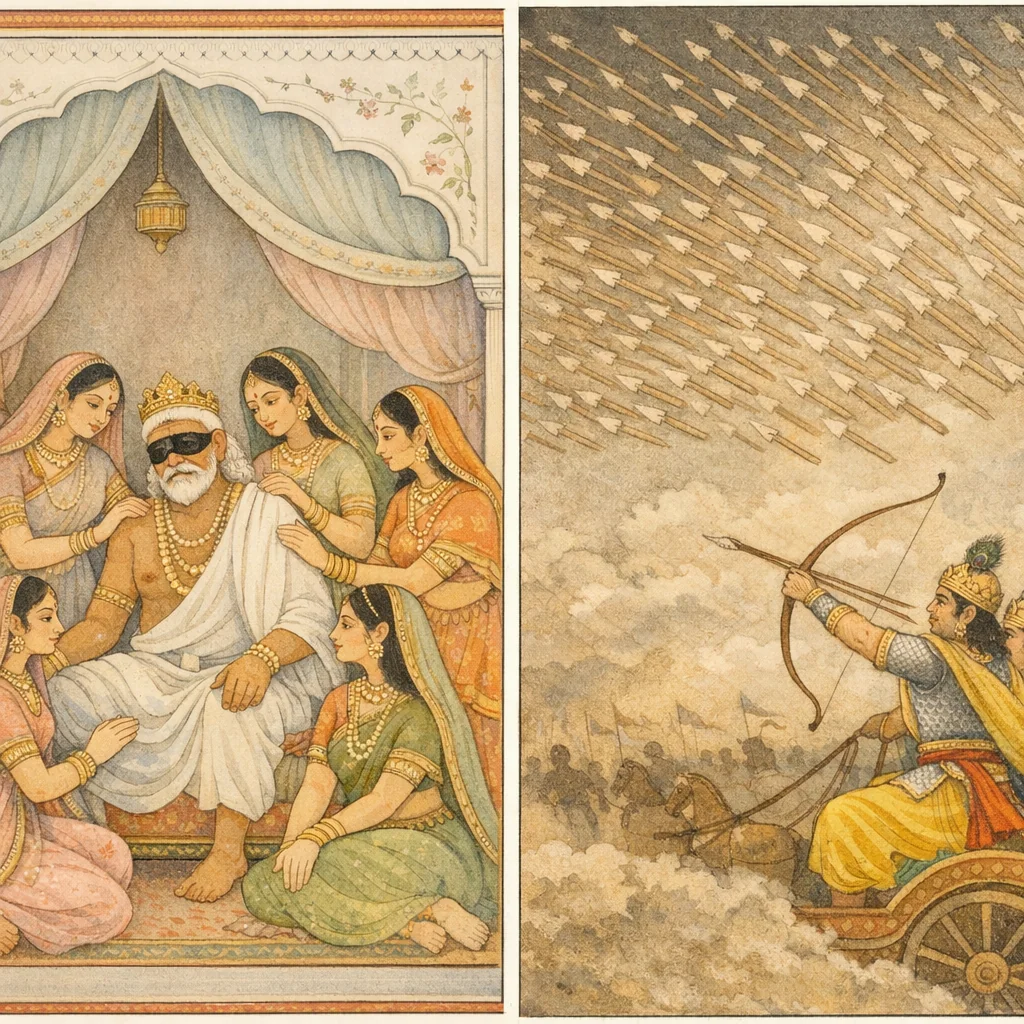
Chapter Arc: वैशम्पायन कहते हैं—धृतराष्ट्र, युद्ध का वृत्तान्त सुनकर हृदय-शोक से अत्यन्त पीड़ित हो उठे; प्रश्न करते-करते उनकी चेतना डगमगा जाती है और राजसभा में ही वे मूर्छित होकर गिर पड़ते हैं। → दासियाँ शीतल जल छिड़ककर और सुगन्धित पंखों से उन्हें होश में लाने का यत्न करती हैं; भरत-कुल की स्त्रियाँ चारों ओर घेर लेती हैं। होश लौटते ही धृतराष्ट्र संजय से फिर रण-स्थिति पूछते हैं—विशेषतः अर्जुन के गाण्डीव-प्रभाव, धृष्टद्युम्न की नीति-धारिता, और घटोत्कच जैसे भय-कारक योद्धा के विषय में। → संजय के वर्णन में अर्जुन ‘कपिवरध्वज’ के साथ आकाश को बाणों से भर देते हैं—गाण्डीवधारी का नाम सुनते ही अग्रभाग के सैनिक विदीर्ण-से हो जाते हैं; उसी के साथ कृष्ण का ‘लोकगुरु, सनातन लोकनाथ नारायण’ रूप स्मरण में उभरता है, मानो दिव्य संरक्षण स्वयं पाण्डव-पक्ष के रथ पर बैठा हो। → अध्याय का स्वर युद्ध-गणना से अधिक ‘मानसिक युद्ध’ का है—धृतराष्ट्र का शोक, भय और जिज्ञासा; संजय का आश्वस्त-सा संकेत कि जहाँ कृष्ण-नारायण और अर्जुन का पराक्रम है वहाँ पाण्डवों की जय-आकांक्षा प्रबल है। → धृतराष्ट्र की व्याकुलता अगले प्रश्न की ओर धकेलती है—यदि अर्जुन ऐसा है, तो कौरव-सेना उसे कैसे रोकेगी, और द्रोणाचार्य के रहते युद्ध का पलड़ा किस ओर झुकेगा?
Shlokas
Verse 1
दशमो< ध्याय: राजा धृतराष्ट्रका शोकसे व्याकुल होना और संजयसे युद्धविषयक प्रश्न वैशम्पायन उवाच एतत् पृष्टवा सूतपुत्र हृच्छोकेनार्दितो भृशम् | जये निराश: पुत्राणां धृतराष्ट्रोडपतत् क्षितौ,वैशम्पायनजी कहते हैं--जनमेजय! सूतपुत्र संजयसे इस प्रकार प्रश्न करते-करते हार्दिक शोकसे अत्यन्त पीड़ित हो अपने पुत्रोंकी विजयकी आशा टूट जानेके कारण राजा धृतराष्ट्र अचेत-से होकर पृथ्वीपर गिर पड़े
Vaiśampāyana said: O Janamejaya, as King Dhṛtarāṣṭra thus questioned Sañjaya, the son of a sūta, he was sorely stricken by grief within his heart; and, having lost hope of his sons’ victory, the king fell upon the earth as though bereft of consciousness.
Verse 2
तं विसंज्ञं निपतितं सिषिचु: परिचारिका: । जलेनात्यर्थशीतेन वीजन्त्य: पुण्यगन्धिना,उस समय अचेत पड़े हुए राजा धृतराष्ट्रको उनकी दासियाँ पंखा झलने लगीं और उनके ऊपर परम सुगन्धित एवं अत्यन्त शीतल जल छिड़कने लगीं
Vaiśampāyana said: Seeing King Dhṛtarāṣṭra fallen down and unconscious, the attendant women sprinkled him with exceedingly cool water and fanned him with a fragrant, auspicious-scented fan, striving to restore his senses.
Verse 3
पतितं चैनमालोक्य समन्ताद् भरतस्त्रिय: । परिवव्रुर्महाराजमस्पृशंश्वैव पाणिभि:,महाराजको गिरा देख धृतराष्ट्रकी बहुत-सी स्त्रियाँ उन्हें चारों ओरसे घेरकर बैठ गयीं और उन्हें हाथोंसे सहलाने लगीं
Seeing him fallen, the women of the Bharata house gathered around on all sides. They surrounded the king and gently touched and stroked him with their hands.
Verse 4
उत्थाप्य चैनं शनकै राजानं पृथिवीतलात् | आसन प्रापयामासुर्बाष्पकण्ठ्यो वरानना:,फिर उन सुमुखी स्त्रियोंने राजाको धीरे-धीरे धरतीसे उठाकर सिंहासनपर बिठाया। उस समय उनके नेत्रोंसे आँसू झर रहे थे और कण्ठ गदगद हो रहे थे
Vaiśampāyana said: Gently lifting the king up from the ground, those noble-faced women helped him and seated him upon a throne. Their eyes were streaming with tears, and their voices were choked with grief.
Verse 5
आसन प्राप्य राजा तु मूर्च्डयाभिपरिप्लुत: । निश्चेष्टोी>तिष्ठत तदा वीज्यमान: समन्तत:,सिंहासनपर पहुँचकर भी राजा धृतराष्ट्र मू्च्छसे पीड़ित हो निश्चेष्ट हो गये। उस समय सब ओरसे उनके ऊपर व्यजन डुलाया जा रहा था
Having reached his seat, King Dhṛtarāṣṭra—overwhelmed and engulfed by a swoon—remained motionless. At that time, attendants fanned him from all sides as he lay stricken by the shock of what he had heard.
Verse 6
स लब्ध्वा शनकै: संज्ञां वेपमानो महीपति: । पुनर्गावल्गर्णिं सूतं पर्यपृच्छद् यथातथम्,फिर धीरे-धीरे होशमें आनेपर काँपते हुए राजा धृतराष्ट्रने पुन: सूतजातीय संजयसे युद्धका यथावत् समाचार पूछा
Vaiśampāyana said: When the king gradually regained consciousness, trembling, he once again questioned the charioteer Sañjaya, son of Gāvalgaṇa, asking for the true and complete report of the battle as it had occurred.
Verse 7
धृतराष्ट्र रवाच यः स उद्यन्निवादित्यो ज्योतिषा प्रणुदंस्तम: । अजातशत्रुमायान्तं कस्तं द्रोणादवारयत्,धृतराष्ट्र बोले--जो उगते हुए सूर्यकी भाँति अपनी प्रभासे अन्धकार दूर कर देते हैं, उन अजातशत्रु युधिष्ठिरको द्रोणके समीप आनेसे किसने रोका था?
Dhṛtarāṣṭra said: “He who, like the rising sun, drives away darkness by his radiance—when Ajātaśatru (Yudhiṣṭhira) was advancing toward Droṇa, who was it that held him back from reaching Droṇa?”
Verse 8
प्रभिन्नमिव मातडुं यथा क्रुद्धं तरस्विनम् । प्रसन्नवदनं दृष्टवा प्रतिद्विरदगामिनम्
Vaiśampāyana said: Seeing him advance like a rut-maddened elephant—furious and full of irresistible force—yet with a serene, composed face, moving straight against the enemy’s elephants, they beheld a striking union of calm self-mastery and terrifying martial power.
Verse 9
वासितासंगमे यद्वदजय्यं प्रति यूथपै: । निजघान रणे वीरान् वीर: पुरुषसत्तम:
Vaiśampāyana said: Just as, in a close and tumultuous clash, a seemingly unconquerable foe is struck down by the leaders of a herd acting together, so too that foremost of men—the heroic warrior—slew many heroes in the battle.
Verse 10
यो होको हि महावीरयों निर्दहेद् घोरचक्षुषा । कृत्स्नं दुर्योधनबलं धृतिमान् सत्यसंगर:,इति श्रीमहाभारते द्रोणपर्वणि द्रोणाभिषेकपर्वणि धृतराष्ट्रवाक्ये दशमो<5ध्याय: ।। १० || इस प्रकार श्रीमहाभारत द्रोणपर्वके अन्तर्गत द्रोणाभिषेकपर्वमें धृतराष्ट्रवक्यविषयक दसवाँ अध्याय पूरा हुआ
Vaiśampāyana said: “Truly, such a great hero—steadfast and true in battle—could, with a terrible gaze, burn up the entire host of Duryodhana.” The line proclaims the awe inspired by a warrior’s resolve and the moral weight of war: power and determination may overwhelm armies, yet admiration for such destructive might also intimates the tragic cost borne by both righteous and unrighteous conflict.
Verse 11
चक्षुर्हणं जये सक्तमिष्वासधरमच्युतम् । दान्तं बहुमतं लोके के शूरा: पर्यवारयन्
Vaiśampāyana said: “Who were the heroes that surrounded Acyuta—an archer intent on victory, disciplined and self-controlled, esteemed by the world—as though to check him?”
Verse 12
जो मदकी धारा बहानेवाले, हथिनीके साथ समागमके समय आये हुए विपक्षी हाथीपर आक्रमण करनेवाले तथा गजयूथपतियोंके लिये अजेय मतवाले गजराजके समान वेगशाली और पराक्रमी हैं, कौरवोंके प्रति जिनका क्रोध बढ़ा हुआ है, जिन पुरुषप्रवर वीरने रणक्षेत्रमें बहुत-से वीरोंका संहार किया है, जो महापराक्रमी, धैर्यवान् एवं सत्यप्रतिज्ञ हैं और अपनी भयंकर दृष्टिसे अकेले ही दुर्योधनकी सम्पूर्ण सेनाको भस्म कर सकते हैं, जो क्रोधभरी दृष्टिसे ही शत्रुका संहार करनेमें समर्थ हैं, विजयके लिये प्रयत्नशील, अपनी मर्यादासे कभी च्युत न होनेवाले, जितेन्द्रिय तथा लोकमें विशेष सम्मानित हैं, उन प्रसन्नवदन धनुर्धर युधिष्ठिरको द्रोणाचार्यके सामने आते देख मेरे पक्षके किन शूरवीरोंने रोका था? ।। ८-- ११ || के दुष्प्रधर्ष राजानमिष्वासधरमच्युतम् । समासेदुर्नरव्याप्र॑ कौन्तेयं तत्र मामका:,जो धर्मसे कभी विचलित नहीं होते हैं, उन महाधनुर्धर दुर्धर्ष वीर पुरुषसिंह कुन्तीकुमार राजा युधिष्ठिरपर मेरे किन योद्धाओंने आक्रमण किया था?
Vaiśampāyana said: “Which of my warriors there advanced against that unassailable king—Kuntī’s son Yudhiṣṭhira—the tiger among men, a steadfast bearer of the bow, unwavering from dharma? In that moment, who among the Kauravas dared to confront him?”
Verse 13
तरसैवाभिपलद्याथ यो वै द्रोणमुपाद्रवत् । य: करोति महत् कर्म शत्रूणां वै महाबल:,जिन्होंने वेगसे ही पहुँचकर द्रोणाचार्यपर आक्रमण किया था, जो शत्रुके समक्ष महान् पराक्रम प्रकट करते हैं, जो महाबली, महाकाय और महान् उत्साही हैं तथा जिनमें दस हजार हाथियोंके समान बल है, उन भीमसेनको आते देख किन वीरोंने रोका था?
Vaiśampāyana said: “Who were the heroes that checked Bhīmasena—he who, rushing forward with sheer speed, had charged at Droṇācārya; he who performs mighty deeds in the very face of enemies, being of great strength?”
Verse 14
महाकायो महोत्साहो नागायुतसमो बले । त॑ भीमसेनमायान्तं के शूरा: पर्यवारयन्,जिन्होंने वेगसे ही पहुँचकर द्रोणाचार्यपर आक्रमण किया था, जो शत्रुके समक्ष महान् पराक्रम प्रकट करते हैं, जो महाबली, महाकाय और महान् उत्साही हैं तथा जिनमें दस हजार हाथियोंके समान बल है, उन भीमसेनको आते देख किन वीरोंने रोका था?
Vaiśaṃpāyana said: “Mighty of frame and great in ardour, possessing strength equal to ten thousand elephants—when Bhīmasena came rushing forward, who were the heroes that stood around him and checked his advance?”
Verse 15
यदा55याज्जलदप्रख्यो रथ: परमवीर्यवान् । पर्जन्य इव बीभत्सुस्तुमुलामशनीं सृूजन्,सम्प्लावयन् दिश: सर्वा मानवैरास्तरन् महीम् । जो मेघके समान श्यामवर्णवाले परम पराक्रमी महारथी अर्जुन विद्युत॒की उत्पत्ति करते हुए बादलोंके समान भयंकर वच्ञास्त्रका प्रयोग करते हैं, जो जलकी वर्षा करनेवाले इन्द्रके समान बाणसमूहोंकी वृष्टि करते हैं तथा जो अपने धनुषकी टंकार और रथके पहियेकी घरघराहटसे सम्पूर्ण दिशाओंको शब्दायमान कर देते हैं, वे स्वयं भयंकर मेघस्वरूप जान पड़ते हैं। धनुष ही उनके समीप विद्युत्प्रभाके समान प्रकाशित होता है। रथियोंकी सेना उनकी फैली हुई घटाएँ जान पड़ती हैं। रथके पहियोंकी घरघराहट मेघ-गर्जनाके समान प्रतीत होती है। उनके बाणोंकी सनसनाहट वर्षके शब्दकी भाँति अत्यन्त मनोहर लगती है। क्रोधरूपी वायु उन्हें आगे बढ़नेकी प्रेरणा देती है। वे मनोरथकी भाँति शीघ्रगामी और विपक्षियोंके मर्मस्थलोंको विदीर्ण कर डालनेवाले हैं। बाण धारण करके वे बड़े भयानक प्रतीत होते और रक्तरूपी जलसे सम्पूर्ण दिशाओंको आप्लावित करते हुए मनुष्योंकी लाशोंसे धरतीको पाट देते हैं
Vaiśampāyana said: When that supremely powerful chariot—like a rain-cloud—advanced, and Bībhatsu (Arjuna), like Parjanya the rain-giver, unleashed a tumultuous thunderbolt of weaponry, he seemed to flood all the directions and carpet the earth with fallen men. The verse casts Arjuna’s onrush as a force of nature: awe-inspiring, overwhelming, and morally weighty in its consequences on the battlefield.
Verse 16
विसृजज्छरजालानि वर्षाणि मघवानिव । अवस्फूर्जन् दिश: सर्वास्तलनेमिस्वनेन च
Vaiśampāyana said: He released showers of interlaced arrows, like Maghavān (Indra) pouring down rain; and with the thunderous roar of his chariot-wheels he made all the directions resound. The verse heightens the battlefield image of overwhelming force—power displayed as a storm—signaling how martial prowess, when unleashed without restraint, can dominate the world around it and intensify the moral pressure of war upon all who witness it.
Verse 17
चापविद्युत्प्रभो घोरो रथगुल्मबलाहक: । स नेमिघोषस्तनित: शरशब्दातिबन्धुर:
Vaiśampāyana said: Terrible to behold, it shone like lightning from a bow; it rose like a cloud-mass formed of chariots and squadrons. Its roar was the thunder of wheels, and it was thickly interwoven with the harsh sound of arrows—an image of war’s overwhelming force, where martial skill and massed power eclipse gentler duties and press all beings toward peril and moral trial.
Verse 18
रोषानिलसमुद्धूतो मनोभिप्रायशीघ्रग: । मर्मातिगो बाणधरस्तुमुल: शोणितोदकै:
Vaishampayana said: Driven onward as if by a gale of wrath, swift as the mind’s own intent, the arrow-bearing force surged forward—piercing vital points, tumultuous, and leaving a stream of blood in its wake. The verse evokes the moral horror of battle: anger becomes a wind that accelerates violence, and skill turns into lethal precision against the body’s most vulnerable places.
Verse 19
भीमनिः:स्वनितो रौद्रो दुर्योधनपुरोगमान्,जिस समय भयंकर गर्जना करनेवाले रौद्ररूपधारी बुद्धिमान् अर्जुनने युद्धमें गाण्डीव धारण करके सानपर चढ़ाकर तेज किये हुए गृध्रपंखयुक्त बाणोंद्वारा दुर्योधन आदि मेरे पुत्रों और सैनिकोंको घायल करना आरम्भ किया, उस समय तुमलोगोंके मनकी कैसी अवस्था हुई थी?
Vaiśampāyana said: When the wise Arjuna—terrible in form and roaring with a fearsome cry—took up the Gāṇḍīva in battle and began to strike Duryodhana and those marching at his head, wounding my sons and their soldiers with arrows fitted with vulture-feathers and sharpened on the whetstone, what was the state of your minds then? The question probes not only the battlefield’s violence but also the inner moral shock and fear that arise when righteous prowess turns decisively against one’s own side.
Verse 20
युद्धे3भ्यषिज्चद् विजयो गार्ध्रपत्रे: शिलाशितै: । गाण्डीवं धारयन् धीमान् कीदृशं वो मनस्तदा,जिस समय भयंकर गर्जना करनेवाले रौद्ररूपधारी बुद्धिमान् अर्जुनने युद्धमें गाण्डीव धारण करके सानपर चढ़ाकर तेज किये हुए गृध्रपंखयुक्त बाणोंद्वारा दुर्योधन आदि मेरे पुत्रों और सैनिकोंको घायल करना आरम्भ किया, उस समय तुमलोगोंके मनकी कैसी अवस्था हुई थी?
Vaiśampāyana said: “When the wise Arjuna, holding the Gāṇḍīva in battle, began to strike down and wound Duryodhana and the rest of my sons and their troops with vulture-feathered arrows sharpened on stone, what was the state of your minds at that time?”
Verse 21
इषुसम्बाधमाकाशं कुर्वन् कपिवरध्वज: । यदा55यात् कथमासीत् तु तदा पार्थ समीक्षताम्,वानरके चिह्नसे युक्त श्रेष्ठ ध्वजावाले अर्जुन जब आकाशको अपने बाणोंसे ठसाठस भरते हुए तुमलोगोंपर चढ़ आये थे, उस समय उन्हें देखकर तुम्हारे मनकी कैसी दशा हुई थी?
Vaiśampāyana said: “O Pārtha (Arjuna), when the warrior bearing the banner marked with the foremost of monkeys (Hanumān) advanced, making the sky densely packed with arrows, what was the state of your mind then, as you beheld him?”
Verse 22
कच्चिद् गाण्डीवशब्देन न प्रणश्यति वै बलम् । यद्व: सभैरवं कुर्वन्नर्जुनो भूशमन्वयात्,जिस समय अर्जुनने अत्यन्त भयंकर सिंहनाद करते हुए तुमलोगोंका पीछा किया था, उस समय गाण्डीवकी टंकार सुनकर हमारी सेना भाग तो नहीं गयी थी?
Vaiśampāyana said: “Tell me—did our army not collapse in panic at the very sound of the Gāṇḍīva? When Arjuna, raising a terrifying lion-roar, pursued you relentlessly across the battlefield, did the twang of his bow not send our forces fleeing?”
Verse 23
कच्चिन्नापानुदत् प्राणानिषुभिवों धनंजय: । वातो वेगादिवाविध्यन्मेघान् शरगणैर्नपान्,उस अवसरपर पार्थने अपने बाणोंद्वारा तुम्हारे सैनिकोंके प्राण तो नहीं ले लिये थे? जैसे वायु वेगपूर्वक चलकर मेघोंकी घटाको छिजत्न-भिन्न कर देती है, उसी प्रकार अर्जुनने वेगसे चलाये हुए बाण-समूहोंद्वारा विपक्षी नरेशोंको घायल कर दिया होगा
Vaiśampāyana said: “Did Dhanañjaya (Arjuna), with his arrows, not drive away the very life-breaths of those kings? Just as a swift wind pierces and scatters masses of clouds, so too did Pārtha, by volleys of fast-flying shafts, strike and wound the opposing rulers.”
Verse 24
को हि गाण्डीवधन्वानं रणे सोढुं नरो$हति । यमुपश्रुत्य सेनाग्रे जन: सर्वो विदीर्यते,सेनाके प्रमुख भागमें जिनका नाम सुनकर ही सारे सैनिक विदीर्ण हो जाते (भाग निकलते) हैं, उन्हीं गाण्डीवधारी अर्जुनका वेग रणक्षेत्रमें कौन मनुष्य सह सकता है?
Vaiśampāyana said: “For who among men could endure in battle the onrush of Arjuna, the wielder of the Gāṇḍīva? Hearing even his name at the very front of the army, all the troops are thrown into disarray and scatter.”
Verse 25
यत्सेना: समकम्पन्त यद्वीरानस्पृशद् भयम् । के तत्र नाजहुढद्रोंणं के क्षुद्रा: प्राद्रवन्ू भयात्,जहाँ सारी सेनाएँ काँप उठीं, समस्त वीरोंके मनमें भय समा गया, वहाँ किन वीरोंने ट्रोणाचार्यका साथ नहीं छोड़ा और कौन-कौनसे अधम सैनिक भयके मारे मैदान छोड़कर भाग गये?
Where the whole host trembled and fear seized the hearts of all the heroes—who were the warriors that did not forsake Droṇācārya, and who were the base soldiers that fled the field in terror?
Verse 26
के वा तत्र तनूंस्त्यक्त्वा प्रतीपं मृत्युमाव्रजन् । अमानुषाणां जेतारं युद्धेष्वपि धनंजयम्,मानवेतर प्राणियों (देवताओं और दैत्यों)-पर भी विजय पानेवाले वीर अर्जुनको युद्धमें अपने प्रतिकूल पाकर किन वीरोंने वहाँ अपने शरीरोंको निछावर करके मृत्युको स्वीकार किया?
Vaiśampāyana said: “Who indeed, on that battlefield, cast off their bodies and went to death against their will—having encountered in war Dhanañjaya (Arjuna), the conqueror even of non-human foes (gods and asuras)?”
Verse 27
न च वेगं सिताश्व॒स्य विसहिष्यन्ति मामका: । गाण्डीवस्य च निर्घोष॑ं प्रावड्जलदनि:स्वनम्,मेरे सैनिक श्वेतवाहन अर्जुनके वेग और वर्षाकालके मेघकी गम्भीर गर्जनाकी भाँति गाण्डीव धनुषकी टंकारध्वनिको नहीं सह सकेंगे
Vaiśampāyana said: My warriors will not be able to endure the onrush of Arjuna, the rider of the white horses, nor the thunderous twang of the Gāṇḍīva bow—deep and rolling like the roar of monsoon clouds.
Verse 28
विष्वक्सेनो यस्य यन्ता यस्य योद्धा धनंजय: । अशक्य: स रथो जेतुं मन्ये देवासुरैरपि,जिसके सारथि भगवान् श्रीकृष्ण और योद्धा वीर धनंजय हैं, उस रथको जीतना मैं देवताओं तथा असुरोंके लिये भी असम्भव मानता हूँ
Vaiśampāyana said: “That chariot whose charioteer is Viṣvaksena (Śrī Kṛṣṇa) and whose warrior is Dhanañjaya (Arjuna)—I deem it impossible to conquer, even for the gods and the asuras.”
Verse 29
सुकुमारो युवा शूरो दर्शनीयश्व पाण्डव: । मेधावी निपुणो धीमान् युधि सत्यपराक्रम:,सुकुमार, तरुण, शूरवीर, दर्शनीय (सुन्दर), मेधावी, युद्धकुशल, बुद्धिमानू और सत्यपराक्रमी पाण्डुपुत्र नकुल जब युद्धमें जोर-जोरसे गर्जना करके समस्त सैनिकोंको पीड़ित करते हुए द्रोणाचार्यपर चढ़ आये, उस समय किन वीरोंने उन्हें रोका था?
Vaiśampāyana said: The Pāṇḍava (Nakula) was tender in form yet youthful and heroic, handsome to behold, intelligent, skilled, and wise—one whose prowess in battle was true to his word and character.
Verse 30
आयावं विपुल कुर्वन् व्यथयन् सर्वसैनिकान् | यदा<<याजन्नकुलो द्रोणं के शूरा: पर्यवारयन्,सुकुमार, तरुण, शूरवीर, दर्शनीय (सुन्दर), मेधावी, युद्धकुशल, बुद्धिमानू और सत्यपराक्रमी पाण्डुपुत्र नकुल जब युद्धमें जोर-जोरसे गर्जना करके समस्त सैनिकोंको पीड़ित करते हुए द्रोणाचार्यपर चढ़ आये, उस समय किन वीरोंने उन्हें रोका था?
Vaiśampāyana said: “When Nakula—raising a mighty roar and distressing the entire host—charged straight at Droṇācārya in the thick of battle, which valiant warriors surrounded him and held him back?”
Verse 31
आशीविष इव क्रुद्ध: सहदेवो यदाभ्ययात् कदनं करिष्यउछत्रूणां तेजसा दुर्जयो युधि,विषधर सर्पके समान क्रोधमें भरे हुए तथा तेजसे दुर्जय सहदेव जब युद्धमें शत्रुओंका संहार करते हुए द्रोणाचार्यके सामने आये, उस समय श्रेष्ठ व्रतधारी अमोघ बाणोंवाले लज्जाशील और अपराजित वीर सहदेवको आते देख किन शूरवीरोंने उन्हें रोका था?
Vaiśampāyana said: When Sahadeva, wrathful like a venomous serpent and hard to overcome in battle by reason of his blazing energy, advanced with the intent to slaughter the enemy, he came before Droṇācārya while cutting down foes. Seeing Sahadeva—an unconquered hero, modest in bearing, steadfast in noble vows, and armed with unfailing arrows—approaching, which valiant warriors stepped forward to restrain him?
Verse 32
आर्यव्रतममोधेषुं हीमनन्तमपराजितम् । सहदेवं तमायान्तं के शूरा: पर्यवारयन्,विषधर सर्पके समान क्रोधमें भरे हुए तथा तेजसे दुर्जय सहदेव जब युद्धमें शत्रुओंका संहार करते हुए द्रोणाचार्यके सामने आये, उस समय श्रेष्ठ व्रतधारी अमोघ बाणोंवाले लज्जाशील और अपराजित वीर सहदेवको आते देख किन शूरवीरोंने उन्हें रोका था?
Vaiśampāyana said: “Which warriors surrounded and checked Sahadeva as he advanced—Sahadeva, a follower of noble vows, whose arrows never failed, modest in bearing, and unconquered?”
Verse 33
यस्तु सौवीरराजस्य प्रमथ्य महतीं चमूम् । आदत्त महिषीं भोजां काम्यां सर्वाड्रशो भनाम्,जिन्होंने सौवीरराजकी विशाल सेनाको मथकर उनकी सर्वांगसुन्दरी कमनीय कन्या भोजाको अपनी रानी बनानेके लिये हर लिया था, उन पुरुषशिरोमणि सात्यकिमें सत्य, धैर्य, शौर्य और विशुद्ध ब्रह्मचर्य आदि सारे सदगुण सदा विद्यमान रहते हैं
Vaiśampāyana said: He who, after crushing the great army of the king of Sauvīra, carried off the lovely princess Bhojā—beautiful in every limb—to make her his queen: in that crest-jewel of men, Sātyaki, truthfulness, steadfast courage, heroic valor, and pure brahmacarya and other noble virtues ever abide.
Verse 34
सत्यं धृतिश्व शौर्य च ब्रह्म॒चर्य च केवलम् । सर्वाणि युयुधाने5स्मिन् नित्यानि पुरुषर्षभे,जिन्होंने सौवीरराजकी विशाल सेनाको मथकर उनकी सर्वांगसुन्दरी कमनीय कन्या भोजाको अपनी रानी बनानेके लिये हर लिया था, उन पुरुषशिरोमणि सात्यकिमें सत्य, धैर्य, शौर्य और विशुद्ध ब्रह्मचर्य आदि सारे सदगुण सदा विद्यमान रहते हैं
Vaiśampāyana said: In this bull among men, Yuyudhāna (Sātyaki), truthfulness, steadfast courage, heroism, and pure continence are ever-present—indeed, all these virtues abide in him constantly.
Verse 35
बलिनं सत्यकर्माणमदीनमपराजितम् । वासुदेवसमं युद्धे वासुदेवादनन्तरम्,वे सात्यकि बलवान, सत्यपराक्रमी, उदार, अपराजित, युद्धमें वसुदेवनन्दन श्रीकृष्णके समान शक्तिशाली, अवस्थामें उनसे कुछ छोटे, अर्जुनसे ही शिक्षा पाकर बाणविद्यामें श्रेष्ठ तथा अस्त्रोंके संचालनमें कुन्तीकुमार अर्जुनके तुल्य यशस्वी हैं। उन वीरवर सात्यकिको किसने द्रोणाचार्यके पास आनेसे रोका?
Vaiśampāyana said: “Sātyaki is mighty, steadfast in truthful conduct, unbowed, and unconquered. In battle he is like Vāsudeva (Kṛṣṇa) himself—second only to Vāsudeva. Who, then, could have prevented that foremost hero Sātyaki from advancing toward Droṇācārya?”
Verse 36
धनंजयोपदेशेन श्रेष्ठमिष्वस्त्रकर्मणि । पार्थेन सममस्त्रेषु कस्तं द्रोणादवारयत्,वे सात्यकि बलवान, सत्यपराक्रमी, उदार, अपराजित, युद्धमें वसुदेवनन्दन श्रीकृष्णके समान शक्तिशाली, अवस्थामें उनसे कुछ छोटे, अर्जुनसे ही शिक्षा पाकर बाणविद्यामें श्रेष्ठ तथा अस्त्रोंके संचालनमें कुन्तीकुमार अर्जुनके तुल्य यशस्वी हैं। उन वीरवर सात्यकिको किसने द्रोणाचार्यके पास आनेसे रोका?
Vaiśampāyana said: “Trained by Dhanañjaya (Arjuna), foremost in the practice of bow-and-weapon craft, and equal to Pārtha in the use of missiles—who could have held him back from approaching Droṇa?”
Verse 37
वृष्णीनां प्रवरं वीरं शूरं सर्वधनुष्मताम् । रामेण सममस्त्रेषु यशसा विक्रमेण च,वृष्णिवंशके श्रेष्ठ शूरवीर सात्यकि सम्पूर्ण धनुर्धरोंमें उत्तम हैं। वे अस्त्र-विद्या, यश तथा पराक्रममें परशुरामजीके समान हैं
Vaiśampāyana said: “Among the Vṛṣṇis, Sātyaki was the foremost hero—valiant and preeminent among all archers. In mastery of weapons, in fame, and in prowess, he was the equal of Rāma (Paraśurāma).”
Verse 38
सत्यं धृतिर्मति: शौर्य बाह्दां चास्त्रमनुत्तमम् सात्वते तानि सर्वाणि त्रैलोक्यमिव केशवे,जैसे भगवान् श्रीकृष्णमें तीनों लोक स्थित हैं, उसी प्रकार सात्वतवंशी सात्यकिमें सत्य, धैर्य, बुद्धि, शौर्य तथा परम उत्तम ब्रह्मास्त्र विद्यमान हैं
Vaiśampāyana said: “Truthfulness, steadfastness, intelligence, valor, and an unsurpassed weapon of the arm—all these were present in Sātyaki of the Sātvata line, just as the three worlds abide in Keśava (Kṛṣṇa).”
Verse 39
तमेवंगुणसम्पन्नं दुर्वारमपि दैवतै: । समासाद्य महेष्वासं के शूरा: पर्यवारयन्,इस प्रकार सर्वसदगुणसम्पन्न महाधनुर्धर सात्यकिको रोकना देवताओंके लिये भी अत्यन्त कठिन है। उनके पास पहुँचकर किन शूरवीरोंने उन्हें आगे बढ़नेसे रोका?
Vaiśampāyana said: “Who were the heroes that, having closed in upon that great archer—Sātyaki—so richly endowed with virtues and so hard to check that even the gods would find him difficult to restrain, managed to block his advance?”
Verse 40
पज्चालेषूत्तमं वीरमुत्तमाभिजनप्रियम् । नित्यमुत्तमकर्माणमुत्तमौजसमाहवे,पांचालोंमें उत्तम, श्रेष्ठ कुल एवं ख्यातिके प्रेमी, सदा सत्कर्म करनेवाले, संग्राममें उत्तम आत्मबलका परिचय देनेवाले, अर्जुनके हितसाधनमें तत्पर, मेरा अनर्थ करनेके लिये उद्यत रहनेवाले, यमराज, कुबेर, सूर्य, इन्द्र और वरुणके समान तेजस्वी, विख्यात महारथी तथा भयंकर युद्धमें अपने प्राणोंको निछावर करके द्रोणाचार्यसे भिड़नेके लिये सदा तैयार रहनेवाले वीर धृष्टद्युम्नको किन शूरवीरोंने रोका?
Vaiśampāyana said: “Who were the heroic warriors that checked the valiant Dhṛṣṭadyumna—foremost among the Pāñcālas, dear to men of noble lineage, ever devoted to righteous deeds, displaying unsurpassed inner strength in battle; intent on Arjuna’s welfare, yet resolute in bringing about my ruin; radiant like Yama, Kubera, Sūrya, Indra, and Varuṇa; famed as a great chariot-warrior; and always ready, even at the cost of his own life, to clash with Droṇācārya in that dreadful war?”
Verse 41
युक्त धनंजयहिते समानर्थार्थमुत्थितम् । यमवैश्रवणादित्यमहेन्द्रवरुणोपमम्,पांचालोंमें उत्तम, श्रेष्ठ कुल एवं ख्यातिके प्रेमी, सदा सत्कर्म करनेवाले, संग्राममें उत्तम आत्मबलका परिचय देनेवाले, अर्जुनके हितसाधनमें तत्पर, मेरा अनर्थ करनेके लिये उद्यत रहनेवाले, यमराज, कुबेर, सूर्य, इन्द्र और वरुणके समान तेजस्वी, विख्यात महारथी तथा भयंकर युद्धमें अपने प्राणोंको निछावर करके द्रोणाचार्यसे भिड़नेके लिये सदा तैयार रहनेवाले वीर धृष्टद्युम्नको किन शूरवीरोंने रोका?
Vaiśampāyana said: “Who were the heroic warriors that checked the valiant Dhṛṣṭadyumna—ever intent on Arjuna’s welfare, risen with a single-minded purpose, radiant like Yama, Kubera, the Sun, Indra, and Varuṇa; foremost among the Pāñcālas, a lover of noble lineage and fame, constant in righteous deeds, displaying supreme inner strength in battle; ever ready to stake his life in that dreadful war and confront Droṇācārya—who held him back?”
Verse 42
महारथं समाख्यात॑ द्रोणायोद्यतमाहवे । त्यजन्तं तुमुले प्राणान् के शूराः समवारयन्,पांचालोंमें उत्तम, श्रेष्ठ कुल एवं ख्यातिके प्रेमी, सदा सत्कर्म करनेवाले, संग्राममें उत्तम आत्मबलका परिचय देनेवाले, अर्जुनके हितसाधनमें तत्पर, मेरा अनर्थ करनेके लिये उद्यत रहनेवाले, यमराज, कुबेर, सूर्य, इन्द्र और वरुणके समान तेजस्वी, विख्यात महारथी तथा भयंकर युद्धमें अपने प्राणोंको निछावर करके द्रोणाचार्यसे भिड़नेके लिये सदा तैयार रहनेवाले वीर धृष्टद्युम्नको किन शूरवीरोंने रोका?
Vaiśampāyana said: “Who were the heroes that held back that famed great chariot-warrior—Dhṛṣṭadyumna—when, in the tumult of battle, he was ready to stake his very life and rush against Droṇa in combat?”
Verse 43
एको<पसृत्य चेदिभ्य: पाण्डवान् यः समाश्रित: । धृष्टकेतुं समायान्तं द्रोणं कस्तं न््यवारयत्,जिसने अकेले ही चेदिदेशसे आकर पाण्डव-पक्षका आश्रय लिया है, उस धृष्टकेतुको द्रोणके पास आनेसे किसने रोका?
Vaiśampāyana said: “Who was it that held back Dhṛṣṭaketu—he who, coming alone from the land of the Cedis and taking refuge with the Pāṇḍavas—from advancing toward Droṇa?”
Verse 44
यो<वधीत् केतुमान् वीरो राजपुत्रं दुरासदम् | अपरान्तगिरिद्वारे द्रोणात् कस्तं न््यवारयत्,जिस वीरने अपरान्त पर्वतके द्वारदेशमें स्थित दुर्जय राजकुमारका वध किया, उस केतुमान्को द्रोणाचार्यके पास आनेसे किसने रोका?
Vaiśampāyana said: “Which hero slew Ketumān—the hard-to-overcome prince—at the gateway of the Aparānta mountains, and who then prevented him from reaching Droṇācārya?”
Verse 45
स्त्रीपुंसयोर्नरव्याप्रो यः स वेद गुणागुणान् | शिखण्डिनं याज्ञसेनिमम्लानमनसं युधि,जो पुरुषसिंह स्त्री और पुरुष दोनों शरीरोंके गुण-अवगुणको अपने अनुभवद्वारा जानता है, युद्धस्थलमें जिसका मन कभी म्लान (उत्साहशून्य) नहीं होता, जो समरांगणमें महात्मा भीष्मकी मृत्युमें हेतु बन चुका है, उस द्रुपदपुत्र शिखण्डीको द्रोणाचार्यके सम्मुख आनेसे किन वीरोंने रोका था?
Vaiśampāyana said: “That warrior who, through lived experience, understands the strengths and flaws of both female and male embodiment—Śikhaṇḍin, the son of Drupada (Yājñaseni), whose resolve in battle never droops—who were the heroes that prevented him from coming before Droṇācārya?”
Verse 46
देवव्रतस्य समरे हेतुं मृत्योर्महात्मन: । द्रोणायाभिमुखं यान्तं के शूरा: पर्यवारयन्,जो पुरुषसिंह स्त्री और पुरुष दोनों शरीरोंके गुण-अवगुणको अपने अनुभवद्वारा जानता है, युद्धस्थलमें जिसका मन कभी म्लान (उत्साहशून्य) नहीं होता, जो समरांगणमें महात्मा भीष्मकी मृत्युमें हेतु बन चुका है, उस द्रुपदपुत्र शिखण्डीको द्रोणाचार्यके सम्मुख आनेसे किन वीरोंने रोका था?
Vaiśampāyana said: “Which valiant warriors stood in the way of Śikhaṇḍin as he advanced straight toward Droṇācārya—Śikhaṇḍin who had already become the instrumental cause of the great-souled Devavrata (Bhīṣma)’s death on the battlefield?”
Verse 47
यस्मिन्नभ्यधिका वीरे गुणा: सर्वे धनंजयात् । यस्मिन्नस्त्राणि सत्यं च ब्रह्मचर्य च सर्वदा,जिस वीरमें अर्जुनसे भी अधिक मात्रामें समस्त गुण मौजूद हैं, जिसमें अस्त्र, सत्य तथा ब्रह्मचर्य सदा प्रतिष्ठित हैं, जो पराक्रममें भगवान् श्रीकृष्ण, बलमें अर्जुन, तेजमें सूर्य और बुद्धिमें बृहस्पतिके समान है, वह महामना अभिमन्यु जब मुँह फैलाये हुए कालके समान द्रोणाचार्यके सम्मुख जा रहा था, उस समय किन शूरवीरोंने उसे रोका था?
Vaiśampāyana said: “In that heroic warrior, all virtues were present in a measure even greater than in Dhanañjaya (Arjuna); in him, weapons-skill, truthfulness, and lifelong brahmacarya were ever firmly established. That high-souled Abhimanyu—like Death itself with gaping mouth—was advancing toward Droṇācārya. At that moment, which valiant warriors held him back?”
Verse 48
वासुदेवसमं वीर्ये धनंजयसमं बले । तेजसा55दित्यसदृशं बृहस्पतिसमं मतौ,जिस वीरमें अर्जुनसे भी अधिक मात्रामें समस्त गुण मौजूद हैं, जिसमें अस्त्र, सत्य तथा ब्रह्मचर्य सदा प्रतिष्ठित हैं, जो पराक्रममें भगवान् श्रीकृष्ण, बलमें अर्जुन, तेजमें सूर्य और बुद्धिमें बृहस्पतिके समान है, वह महामना अभिमन्यु जब मुँह फैलाये हुए कालके समान द्रोणाचार्यके सम्मुख जा रहा था, उस समय किन शूरवीरोंने उसे रोका था?
Vaiśampāyana said: “He whose prowess was like Vāsudeva’s, whose strength matched Dhanañjaya’s, whose radiance resembled the Sun, and whose counsel was like Bṛhaspati’s—such was the high-souled Abhimanyu. As he advanced toward Droṇācārya, gaping like Death itself, which warriors stood in his way and restrained him?”
Verse 49
अभिमन्युं महात्मानं व्यात्ताननमिवान्तकम् | द्रोणायाभिमुखं यान्तं के शूरा: समवारयन्,जिस वीरमें अर्जुनसे भी अधिक मात्रामें समस्त गुण मौजूद हैं, जिसमें अस्त्र, सत्य तथा ब्रह्मचर्य सदा प्रतिष्ठित हैं, जो पराक्रममें भगवान् श्रीकृष्ण, बलमें अर्जुन, तेजमें सूर्य और बुद्धिमें बृहस्पतिके समान है, वह महामना अभिमन्यु जब मुँह फैलाये हुए कालके समान द्रोणाचार्यके सम्मुख जा रहा था, उस समय किन शूरवीरोंने उसे रोका था?
Vaiśampāyana said: “As the great-souled Abhimanyu advanced straight toward Droṇa, his mouth agape like Death itself, which warriors stepped forward to check and restrain him?”
Verse 50
तरुणस्तरुणप्रज्ञ: सौभद्र: परवीरहा । यदाभ्यधावद् वै द्रोणं तदा5डसीद् वो मन: कथम्,तरुण अवस्था और तरुण बुद्धिवाले शत्रुवीरोंके हन्ता सुभद्राकुमारने जब द्रोणाचार्यपर धावा किया था, उस समय तुमलोगोंका मन कैसा हो रहा था?
Vaiśampāyana said: “When the youthful Abhimanyu—young in years yet keen in understanding, a slayer of enemy heroes—charged straight at Droṇa, what was the state of your minds then?”
Verse 51
द्रौपदेया नरव्याप्रा: समुद्रमिव सिन्धव: । यद् द्रोणमाद्रवन् संख्ये के शूरास्तान् न््यवारयन्,पुरुषसिंह द्रौपदीकुमार समुद्रकी ओर जानेवाली नदियोंकी भाँति जब द्रोणाचार्यपर धावा कर रहे थे, उस समय युद्धमें किन शूरवीरोंने उनको रोका था?
Vaiśampāyana said: “Like rivers rushing toward the ocean, the sons of Draupadī—intent on manly combat—charged at Droṇa in the thick of battle. Then who were the heroes that checked and held them back on the battlefield?”
Verse 52
एते द्वादश वर्षाणि क्रीडामुत्सूज्य बालका: । अस्त्रार्थमवसन् भीष्मे बि शभ्रतो व्रतमुत्तमम्,इन द्रौपदीकुमारोंने बारह वर्षोतक खेल-कूद छोड़कर अस्त्रोंकी शिक्षा पानेके लिये उत्तम ब्रह्मचर्य व्रतका पालन करते हुए भीष्मके समीप निवास किया था
Vaiśampāyana said: “For twelve years those boys, giving up childish play, lived near Bhīṣma in order to master the science of weapons, observing an excellent vow of brahmacarya (disciplined celibate studentship). The narrative underscores that true martial power is grounded in restraint, training, and ethical self-control rather than mere aggression.”
Verse 53
क्षत्रंजय: क्षत्रदेव: क्षत्रवर्मा च मानद: । धृष्टद्युम्नात्मजा वीरा: के तान् द्रोणादवारयन्,क्षत्रंजय, क्षत्रदेव तथा दूसरोंको मान देनेवाले क्षत्रवर्मा--ये धृष्टद्युम्नके तीन वीर पुत्र हैं। उन्हें द्रोणके पास आनेसे किन वीरोंने रोका था?
Vaiśampāyana said: “Kṣatraṃjaya, Kṣatradeva, and Kṣatravarmā—renowned as one who honors others—these are the three heroic sons of Dhṛṣṭadyumna. Which warriors held them back, preventing them from reaching Droṇa?”
Verse 54
शताद् विशिष्ट यं युद्धे सममन्यन्त वृष्णय: । चेकितान महेष्वासं कस्तं द्रोणादवारयत्,जिन्हें युद्धके मैदानमें वृष्णिवंशियोंने सौ वीरोंसे भी अधिक माना है, उन महाधनुर्धर चेकितानको द्रोणके पास आनेसे किसने रोका?
Vaiśampāyana said: “Chekitāna, the great bowman whom the Vṛṣṇis in the battlefield esteemed as superior even to a hundred warriors—who was it that held him back from reaching Droṇa?”
Verse 55
वार्थक्षेमि: कलिड्रानां यः कन्यामाहरद् युधि । अनाधृष्टिरदीनात्मा कस्तं द्रोणादवारयत्,वृद्धक्षेमके पुत्र उदारचित्त अनाधुष्टिने युद्धस्थलमें कलिंगराजकी कन््याका अपहरण किया था। उन्हें द्रोणके पास आनेसे किसने रोका?
Vaiśampāyana said: “Who was it that kept him back from Droṇa?—that Vārthakṣemi, son of Vṛddhakṣema, who in battle carried off the daughter of the king of Kaliṅga; a man unassailable and unbroken in spirit.”
Verse 56
भ्रातर: पञज्च कैकेया धार्मिका: सत्यविक्रमा: । इन्द्रगोपकसंकाशा रक्तवर्मायुधध्वजा:,केकय देशके सत्यपराक्रमी, धर्मात्मा पाँच वीर राजकुमार लाल रंगके कवच, आयुध और ध्वज धारण करनेवाले हैं तथा उनके शरीरकी कान्ति भी इन्द्रगोपके समान लाल रंगकी ही है; वे पाण्डवोंकी मौसीके बेटे हैं। वे जब पाण्डवोंकी विजयके लिये द्रोणाचार्यको मारनेके लिये उनपर चढ़ आये, उस समय किन वीरोंने उन्हें रोका था?
Vaiśampāyana said: “There were five brothers of the Kekaya land—righteous in conduct and true in valor. Their splendor was like the crimson indragopa insect, and they bore red armor, weapons, and banners. These heroic princes, sons of the Pāṇḍavas’ maternal aunt, charged forward to slay Droṇācārya for the sake of the Pāṇḍavas’ victory. At that moment, which warriors held them back?”
Verse 57
मातृष्वसु: सुता वीरा: पाण्डवानां जयार्थिन: । तान् द्रोणं हन्तुमायातान् के वीरा: पर्यवारयन्,केकय देशके सत्यपराक्रमी, धर्मात्मा पाँच वीर राजकुमार लाल रंगके कवच, आयुध और ध्वज धारण करनेवाले हैं तथा उनके शरीरकी कान्ति भी इन्द्रगोपके समान लाल रंगकी ही है; वे पाण्डवोंकी मौसीके बेटे हैं। वे जब पाण्डवोंकी विजयके लिये द्रोणाचार्यको मारनेके लिये उनपर चढ़ आये, उस समय किन वीरोंने उन्हें रोका था?
Vaiśampāyana said: “The heroic sons of the Pāṇḍavas’ maternal aunt, intent on securing victory for the Pāṇḍavas, advanced to slay Droṇa. Which warriors stood in their way and checked them?”
Verse 58
यं योधयन्तो राजानो नाजयन् वारणावते । षण्मासानपि संरब्धा जिघांसन्तो युधाम्पतिम्,वारणावत नगरमें सब राजालोग मार डालनेकी इच्छासे क्रोधमें भरकर छ: महीनोंतक युद्ध करते रहनेपर भी योद्धाओंमें श्रेष्ठ जिस वीरको परास्त न कर सके, धनुर्धरोंमें उत्तम, शौर्यसम्पन्न, सत्यप्रतिज्ञ, महाबली, उस पुरुषसिंह युयुत्सुको द्रोणाचार्यके पास आनेसे किसने रोका?
Vaiśampāyana said: In Vāraṇāvata, many kings—burning with anger and intent on killing the lord of battle—fought for six months, yet they could not defeat that hero. Who, then, could have prevented that lion among men, Yuyutsu—supreme among archers, mighty in valor, firm in truth—from coming to Droṇācārya?
Verse 59
धनुष्मतां वरं शूरं सत्यसंध॑ महाबलम् | द्रोणात् कस्तं नरव्याप्र॑ युयुत्सुं पर्यवारयत्,वारणावत नगरमें सब राजालोग मार डालनेकी इच्छासे क्रोधमें भरकर छ: महीनोंतक युद्ध करते रहनेपर भी योद्धाओंमें श्रेष्ठ जिस वीरको परास्त न कर सके, धनुर्धरोंमें उत्तम, शौर्यसम्पन्न, सत्यप्रतिज्ञ, महाबली, उस पुरुषसिंह युयुत्सुको द्रोणाचार्यके पास आनेसे किसने रोका?
Vaiśampāyana said: Who was it that held back Yuyutsu—best among archers, a heroic man of great strength, steadfast in truth, a tiger among men—from going to Droṇa? Even after long fighting driven by wrath and the desire to kill, other kings could not subdue that foremost warrior; so who prevented him from reaching Droṇa?
Verse 60
य: पुत्रं काशिराजस्य वाराणस्यां महारथम् | समरे स्त्रीषु गृध्यन्तं भल्लेनापाहरद् रथात्,जिसने काशीपुरीमें काशिराजके महारथी पुत्रको, जो स्त्रियोंके प्रति आसक्त था, समरभूमिमें भल्ल नामक बाणद्दवारा रथसे मार गिराया; जो कुन्तीकुमारोंकी गुप्त मन्त्रणाको सुरक्षित रखनेवाला तथा दुर्योधनका अनर्थ करनेके लिये उद्यत रहनेवाला है तथा जिसकी उत्पत्ति द्रोणाचार्यके वधके लिये हुई है; वह महाधनुर्धर धृष्टद्युम्न जब रणक्षेत्रमें योद्धाओंको अपने बाणोंकी अग्निसे चलाता और सब ओरसे सारी सेनाको विदीर्ण करता हुआ द्रोणाचार्यके सम्मुख आ रहा था, उस समय किन शूरवीरोंने उसे रोका था?
Vaiśampāyana said: “He who struck down from his chariot, with a bhalla-arrow, the mighty chariot-warrior—son of the King of Kāśī—at Vārāṇasī, even as that man fought in the midst of battle with a mind greedy for women: that great bowman Dhṛṣṭadyumna, guardian of the Pāṇḍavas’ secret counsel, ever intent on bringing ruin upon Duryodhana, and born for the slaying of Droṇa—when he advanced toward Droṇācārya, driving the warriors with the fire of his arrows and rending the entire host on every side, which heroes then checked him?”
Verse 61
धृष्टय्युम्नं महेष्वासं पार्थानां मन्त्रधारिणम् । युक्त दुर्योधनानर्थे सृष्ट द्रोणवधाय च,जिसने काशीपुरीमें काशिराजके महारथी पुत्रको, जो स्त्रियोंके प्रति आसक्त था, समरभूमिमें भल्ल नामक बाणद्दवारा रथसे मार गिराया; जो कुन्तीकुमारोंकी गुप्त मन्त्रणाको सुरक्षित रखनेवाला तथा दुर्योधनका अनर्थ करनेके लिये उद्यत रहनेवाला है तथा जिसकी उत्पत्ति द्रोणाचार्यके वधके लिये हुई है; वह महाधनुर्धर धृष्टद्युम्न जब रणक्षेत्रमें योद्धाओंको अपने बाणोंकी अग्निसे चलाता और सब ओरसे सारी सेनाको विदीर्ण करता हुआ द्रोणाचार्यके सम्मुख आ रहा था, उस समय किन शूरवीरोंने उसे रोका था?
Vaiśampāyana said: “Dhṛṣṭadyumna—the great archer, the trusted keeper of the Pāṇḍavas’ secret counsel, intent on bringing ruin to Duryodhana, and born for the very purpose of slaying Droṇa—was advancing toward Droṇācārya, scorching warriors with the fire of his arrows and rending the army on every side. At that moment, which heroes stood forth to check him?”
Verse 62
निर्दहन्तं रणे योधान् दारयन्तं च सर्वतः । द्रोणाभिमुखमायान्तं के शूरा: पर्यवारयन्,जिसने काशीपुरीमें काशिराजके महारथी पुत्रको, जो स्त्रियोंके प्रति आसक्त था, समरभूमिमें भल्ल नामक बाणद्दवारा रथसे मार गिराया; जो कुन्तीकुमारोंकी गुप्त मन्त्रणाको सुरक्षित रखनेवाला तथा दुर्योधनका अनर्थ करनेके लिये उद्यत रहनेवाला है तथा जिसकी उत्पत्ति द्रोणाचार्यके वधके लिये हुई है; वह महाधनुर्धर धृष्टद्युम्न जब रणक्षेत्रमें योद्धाओंको अपने बाणोंकी अग्निसे चलाता और सब ओरसे सारी सेनाको विदीर्ण करता हुआ द्रोणाचार्यके सम्मुख आ रहा था, उस समय किन शूरवीरोंने उसे रोका था?
Vaiśampāyana said: “As Dhṛṣṭadyumna advanced straight toward Droṇa—burning the warriors in battle as though with fire and rending the host on every side—what heroes stood around him and checked his onrush?”
Verse 63
उत्सज् इव संवृद्ध द्रुपदस्यास्त्रवित्तमम् | शैखण्डिनं शस्त्रगुप्तं के च द्रोणादवारयन्,जो ट्रपटकी गोदमें पला हुआ था और शश्त्रोंद्वारा सुरक्षित था, अस्त्रवेत्ताओंमें श्रेष्ठ उस शिखण्डीपुत्रको द्रोणाचार्यके पास आनेसे किन वीरोंने रोका?
Vaiśampāyana said: “Who were the warriors that held back from Droṇācārya the well-protected Śikhaṇḍin—reared as it were in Drupada’s lap, guarded by weapons, and foremost among those skilled in the science of arms?”
Verse 64
य इमां पृथिवीं कृत्स्नां चर्मवत् समवेष्टयत् । महता रथघोषेण मुख्यारिघ्नो महारथ:,जैसे चमड़ेको अंगोमें लपेट लिया जाता है, उसी प्रकार जिन्होंने अपने रथके महान् घोषद्वारा इस सारी पृथ्वीको व्याप्त कर लिया था, जो प्रधान-प्रधान शत्रुओंका वध करनेवाले और महारथी वीर थे, जिन्होंने प्रजाका पुत्रकी भाँति पालन करते हुए सुन्दर अन्न, पान तथा प्रचुर दक्षिणासे युक्त एवं विघ्नरहित दस अश्वमेध-यज्ञोंका अनुष्ठान किया और कितने ही सर्वमेध-यज्ञ सम्पन्न किये, वे राजा उशीनरके वीर पुत्र सर्वत्र विख्यात हैं, गंगाजीके स्रोतमें जितने सिकताकण बहते हैं, उतनी ही अर्थात् असंख्य गौएँ उशीनरकुमारने अपने यज्ञमें ब्राह्मणोंको दी थीं
Vaiśampāyana said: “He who, as though wrapping the whole earth like a hide, encompassed this entire world by the mighty roar of his chariot—a great chariot-warrior, a slayer of foremost foes—is remembered here as a paradigm of royal power joined to public renown. The image underscores how fame and force can ‘cover’ the earth, and invites reflection on the ethical use of such might: true kingship is measured not only by conquest but by the protection and ordering of the realm.”
Verse 65
दशाश्वमेधानाजलद्ले स्वन्नपानाप्तदक्षिणान् । निरर्गलान् सर्वमेधान् पुत्रवत् पालयन् प्रजा:,जैसे चमड़ेको अंगोमें लपेट लिया जाता है, उसी प्रकार जिन्होंने अपने रथके महान् घोषद्वारा इस सारी पृथ्वीको व्याप्त कर लिया था, जो प्रधान-प्रधान शत्रुओंका वध करनेवाले और महारथी वीर थे, जिन्होंने प्रजाका पुत्रकी भाँति पालन करते हुए सुन्दर अन्न, पान तथा प्रचुर दक्षिणासे युक्त एवं विघ्नरहित दस अश्वमेध-यज्ञोंका अनुष्ठान किया और कितने ही सर्वमेध-यज्ञ सम्पन्न किये, वे राजा उशीनरके वीर पुत्र सर्वत्र विख्यात हैं, गंगाजीके स्रोतमें जितने सिकताकण बहते हैं, उतनी ही अर्थात् असंख्य गौएँ उशीनरकुमारने अपने यज्ञमें ब्राह्मणोंको दी थीं
Vaiśampāyana said: He performed ten Aśvamedha sacrifices—unobstructed and flawless—rich in fine food and drink and accompanied by abundant priestly fees, while protecting his subjects as a father protects his children. He also completed many Sarvamedha sacrifices. The passage highlights the ideal of kingship grounded in dharma: prosperity and ritual generosity are presented as the fruit of righteous governance and care for the people.
Verse 66
गड़ास्रोतसि यावत्य: सिकता अप्यशेषत: । तावतीर्गा ददौ वीर उशीनरसुतो<5ध्वरे,जैसे चमड़ेको अंगोमें लपेट लिया जाता है, उसी प्रकार जिन्होंने अपने रथके महान् घोषद्वारा इस सारी पृथ्वीको व्याप्त कर लिया था, जो प्रधान-प्रधान शत्रुओंका वध करनेवाले और महारथी वीर थे, जिन्होंने प्रजाका पुत्रकी भाँति पालन करते हुए सुन्दर अन्न, पान तथा प्रचुर दक्षिणासे युक्त एवं विघ्नरहित दस अश्वमेध-यज्ञोंका अनुष्ठान किया और कितने ही सर्वमेध-यज्ञ सम्पन्न किये, वे राजा उशीनरके वीर पुत्र सर्वत्र विख्यात हैं, गंगाजीके स्रोतमें जितने सिकताकण बहते हैं, उतनी ही अर्थात् असंख्य गौएँ उशीनरकुमारने अपने यज्ञमें ब्राह्मणोंको दी थीं
Vaiśampāyana said: “As many grains of sand as flow in the river’s current—countless beyond measure—so many cows did the heroic son of Uśīnara bestow upon the priests in his sacrificial rite. By this image the tradition highlights the king’s fame: his generosity was not occasional but vast, deliberate, and dharmic, expressed through giving that sustains the learned and upholds the sacrificial order.”
Verse 67
न पूर्वे नापरे चक्रुरिदं केचन मानवा: । इतीदं चुक्रुशु्देवा: कृते कर्मणि दुष्करे,राजा जब उस दुष्कर यज्ञका अनुष्ठान पूर्ण कर चुके, तब सम्पूर्ण देवताओंने यह पुकार-पुकारकर कहा कि “ऐसा यज्ञ पहलेके और बादके भी मनुष्योंने कभी नहीं किया था'
Vaiśampāyana said: “Neither in former times nor in later ages did any men accomplish such a deed.” Thus the gods cried out again and again when that arduous rite had been completed—proclaiming the king’s extraordinary resolve and the unmatched difficulty of the sacrifice he had fulfilled.
Verse 68
पश्यामस्त्रिषु लोकेषु न त॑ संस्थास्नुचारिषु । जातं चापि जनिष्यन्तं द्वितीयं चापि साम्प्रतम्,स्थावर-जंगमरूप तीनों लोकोंमें एकमात्र उशीनरपौत्र शैब्यको छोड़कर दूसरे किसी ऐसे राजाको न तो हम इस समय उत्पन्न हुआ देखते हैं और न भविष्यमें किसीके उत्पन्न होनेका लक्षण ही देख पाते हैं, जो इस महान् भारको वहन करनेवाला हो। इस मर्त्यलोकके निवासी मनुष्य उनकी गतिको नहीं पा सकेंगे
Vaiśampāyana said: “Across the three worlds, among all beings that move and stand, we do not see—neither among those already born, nor among those yet to be born, nor even at present—a second person equal to him, capable of bearing this immense burden. The men who dwell in the mortal world will not be able to fathom his course.”
Verse 69
अन्यमौशीनराच्छैब्याद् धुरो वोढारमित्युत । गति यस्य न यास्यन्ति मानुषा लोकवासिन:,स्थावर-जंगमरूप तीनों लोकोंमें एकमात्र उशीनरपौत्र शैब्यको छोड़कर दूसरे किसी ऐसे राजाको न तो हम इस समय उत्पन्न हुआ देखते हैं और न भविष्यमें किसीके उत्पन्न होनेका लक्षण ही देख पाते हैं, जो इस महान् भारको वहन करनेवाला हो। इस मर्त्यलोकके निवासी मनुष्य उनकी गतिको नहीं पा सकेंगे
Vaiśampāyana said: “Except for Śaibya, the grandson of Uśīnara, we do not at present see—nor do we discern any sign that there will arise in the future—any other king capable of bearing this immense burden. The men who dwell in this mortal world will not be able to comprehend the full measure of his course (his stature and destiny).”
Verse 70
तस्य नप्तारमायान्तं शैब्यं क: समवारयत् | द्रोणायाभिमुखं यत्तं व्यात्ताननमिवान्तकम्,उन्हीं उशीनरका पौत्र शैब्य सावधान हो जब द्रोणाचार्यके सम्मुख आ रहा था, उस समय मुँह फैलाये हुए कालके समान उस वीरको किसने रोका?
Vaiśampāyana said: As Śaibya—the grandson of Uśīnara—came rushing straight toward Droṇa, intent on confronting him, gaping like Death itself, who was it that checked that warrior?
Verse 71
विराटस्य रथानीकं मत्स्यस्यामित्रधातिन: । प्रेप्सन्तं समरे द्रोणं के वीरा: पर्यवारयन्,शत्रुधाती मत्स्ययाज विराटकी रथसेनाको, जो द्रोणाचार्यको नष्ट करनेकी इच्छासे खोजती हुई आ रही थी, किन वीरोंने रोका था?
Vaiśampāyana said: “As Droṇa was being sought out in the thick of battle by the chariot-host of Virāṭa of the Matsyas—an enemy-slayer intent on bringing him down—which heroes stood around and checked that advance?”
Verse 72
सद्यो वृकोदराज्जातो महाबलपराक्रम: । मायावी राक्षसो वीरो यस्मान्मम महद् भयम्,जो भीमसेनसे तत्काल प्रकट हुआ तथा जिससे मुझे महान् भय बना रहता है, वह महान् बल और पराक्रमसे सम्पन्न मायावी राक्षस वीर घटोत्कच कुन्तीकुमारोंकी विजय चाहता है और मेरे पुत्रोंके लिये कंटक बना हुआ है, उस महाकाय घटोत्कचको द्रोणाचार्यके पास आनेसे किसने रोका?
Vaiśampāyana said: “Born at once from Vṛkodara, endowed with immense strength and heroic prowess, that sorcerous Rākṣasa warrior—because of whom I am seized by great fear—(Ghaṭotkaca), who seeks the victory of Kuntī’s sons and stands as a thorn to my sons: who prevented that colossal Ghaṭotkaca from coming to Droṇācārya?”
Verse 73
पार्थानां जयकामं तं॑ पुत्राणां मम कण्टकम् । घटोत्कचं महात्मानं कस्तं द्रोणादवारयत्,जो भीमसेनसे तत्काल प्रकट हुआ तथा जिससे मुझे महान् भय बना रहता है, वह महान् बल और पराक्रमसे सम्पन्न मायावी राक्षस वीर घटोत्कच कुन्तीकुमारोंकी विजय चाहता है और मेरे पुत्रोंके लिये कंटक बना हुआ है, उस महाकाय घटोत्कचको द्रोणाचार्यके पास आनेसे किसने रोका?
Vaiśampāyana said: “Who held back that great-souled Ghaṭotkaca from reaching Droṇa? He longs for the Pāṇḍavas’ victory, and to my sons he is a thorn—an ever-present source of fear.”
Verse 74
एते चान्ये च बहवो येषामर्थाय संजय । त्यक्तार: संयुगे प्राणान् कि तेषामजितं युधि,संजय! ये तथा और भी बहुत-से वीर जिनके लिये युद्धमें प्राण त्याग करनेको तैयार हैं, उनके लिये कौन-सी ऐसी वस्तु होगी, जो जीती न जा सके
Vaiśaṃpāyana said: “And there are many other warriors as well, O Sañjaya, who for his sake are ready to cast away their very lives in battle. For such men, what could possibly remain unconquerable in war, O Sañjaya?”
Verse 75
येषां च पुरुषव्याप्र: शार्ड्र्धन्चा व्यपाश्रय: । हितार्थी चापि पार्थानां कथं तेषां पराजय:,शार्ज््धनुष धारण करनेवाले पुरुषसिंह भगवान् श्रीकृष्ण जिनके आश्रय तथा हित चाहनेवाले हैं, उन कुन्तीकुमारोंकी पराजय कैसे हो सकती है?
Vaiśampāyana said: “How could defeat ever befall those Pārthas—the sons of Kuntī—for whom the tiger among men, Śrī Kṛṣṇa, bearer of the Śārṅga bow, is both refuge and well-wisher? When such a protector stands as their support and seeks their good, their downfall is inconceivable.”
Verse 76
लोकानां गुरुरत्यर्थ लोकनाथ: सनातन: । नारायणो रणे नाथो दिव्यो दिव्यात्मक: प्रभु:,भगवान् श्रीकृष्ण सम्पूर्ण जगत्के परम गुरु हैं, समस्त लोकोंके सनातन स्वामी हैं, संग्रामभूमिमें सबकी रक्षा करनेवाले दिव्य स्वरूप, सामर्थ्यशाली, दिव्य नारायण हैं
Vaiśampāyana said: “Śrī Kṛṣṇa—Bhagavān Nārāyaṇa—is truly the supreme teacher of all beings, the eternal Lord of all worlds. On the battlefield he stands as the protector and refuge of all, a divine, divinely constituted, sovereign power.”
Verse 77
यस्य दिव्यानि कर्माणि प्रवदन्ति मनीषिण: । तान्यहं कीर्तयिष्यामि भक्त्या स्थैर्यार्थमात्मन:,मनीषी पुरुष जिनके दिव्य कर्मोंका वर्णन करते हैं, मैं उन्हीं भगवान् श्रीकृष्णकी लीलाओंका अपने मनकी स्थिरताके लिये भक्तिपूर्वक वर्णन करूँगा
Vaiśaṃpāyana said: “Of Him whose divine deeds the wise continually proclaim, those very deeds I shall recount with devotion, so that my own mind may become steady.”
Verse 183
सम्प्लावयन् दिश: सर्वा मानवैरास्तरन् महीम् । जो मेघके समान श्यामवर्णवाले परम पराक्रमी महारथी अर्जुन विद्युत॒की उत्पत्ति करते हुए बादलोंके समान भयंकर वच्ञास्त्रका प्रयोग करते हैं, जो जलकी वर्षा करनेवाले इन्द्रके समान बाणसमूहोंकी वृष्टि करते हैं तथा जो अपने धनुषकी टंकार और रथके पहियेकी घरघराहटसे सम्पूर्ण दिशाओंको शब्दायमान कर देते हैं, वे स्वयं भयंकर मेघस्वरूप जान पड़ते हैं। धनुष ही उनके समीप विद्युत्प्रभाके समान प्रकाशित होता है। रथियोंकी सेना उनकी फैली हुई घटाएँ जान पड़ती हैं। रथके पहियोंकी घरघराहट मेघ-गर्जनाके समान प्रतीत होती है। उनके बाणोंकी सनसनाहट वर्षके शब्दकी भाँति अत्यन्त मनोहर लगती है। क्रोधरूपी वायु उन्हें आगे बढ़नेकी प्रेरणा देती है। वे मनोरथकी भाँति शीघ्रगामी और विपक्षियोंके मर्मस्थलोंको विदीर्ण कर डालनेवाले हैं। बाण धारण करके वे बड़े भयानक प्रतीत होते और रक्तरूपी जलसे सम्पूर्ण दिशाओंको आप्लावित करते हुए मनुष्योंकी लाशोंसे धरतीको पाट देते हैं
Vaiśaṃpāyana said: Arjuna—the dark-hued, supremely valiant great charioteer—seemed like a dreadful storm-cloud. As lightning flashes from within clouds, his bow blazed near him; and like Indra who pours down rain, he poured down volleys of arrows. With the twang of his bow and the rumbling of his chariot-wheels he made all directions resound. The massed ranks of warriors looked like his spreading cloud-banks; the wheel’s roar was like thunder; the hiss of arrows was like the sound of rain. Driven onward by the wind of wrath, swift as a thought, he pierced the vital points of his foes. Bearing arrows, he appeared terrifying—flooding the quarters with blood as with water, and carpeting the earth with the bodies of men.
Frequently Asked Questions
The ethical pressure point is Dhṛtarāṣṭra’s confrontation with strategic reality: acknowledging that outcomes are shaped by alliance and exceptional capability (Kṛṣṇa with Arjuna) while simultaneously interpreting catastrophic losses through kāla, which complicates simple moral accounting of merit, effort, and desert.
The chapter teaches that prowess, learning, ritual discipline, and arms do not grant immunity from mortality; prudent judgment requires seeing the limits of human control, recognizing the decisive role of wise counsel and alliances, and accepting that events may unfold contrary to intention under the pressure of time and circumstance.
No formal phalaśruti is stated; the meta-commentary operates indirectly through Dhṛtarāṣṭra’s reflective framing—linking narrative memory of Kṛṣṇa’s deeds to a broader interpretive claim about inevitability (kāla) and the epistemic limits of assessing outcomes solely by effort or virtue.