Adhyaya 9
भाण्डीरवट-क्रीडा: प्रलम्बासुरवधः, मानुष्यलीला, एक-कारण-तत्त्वम्
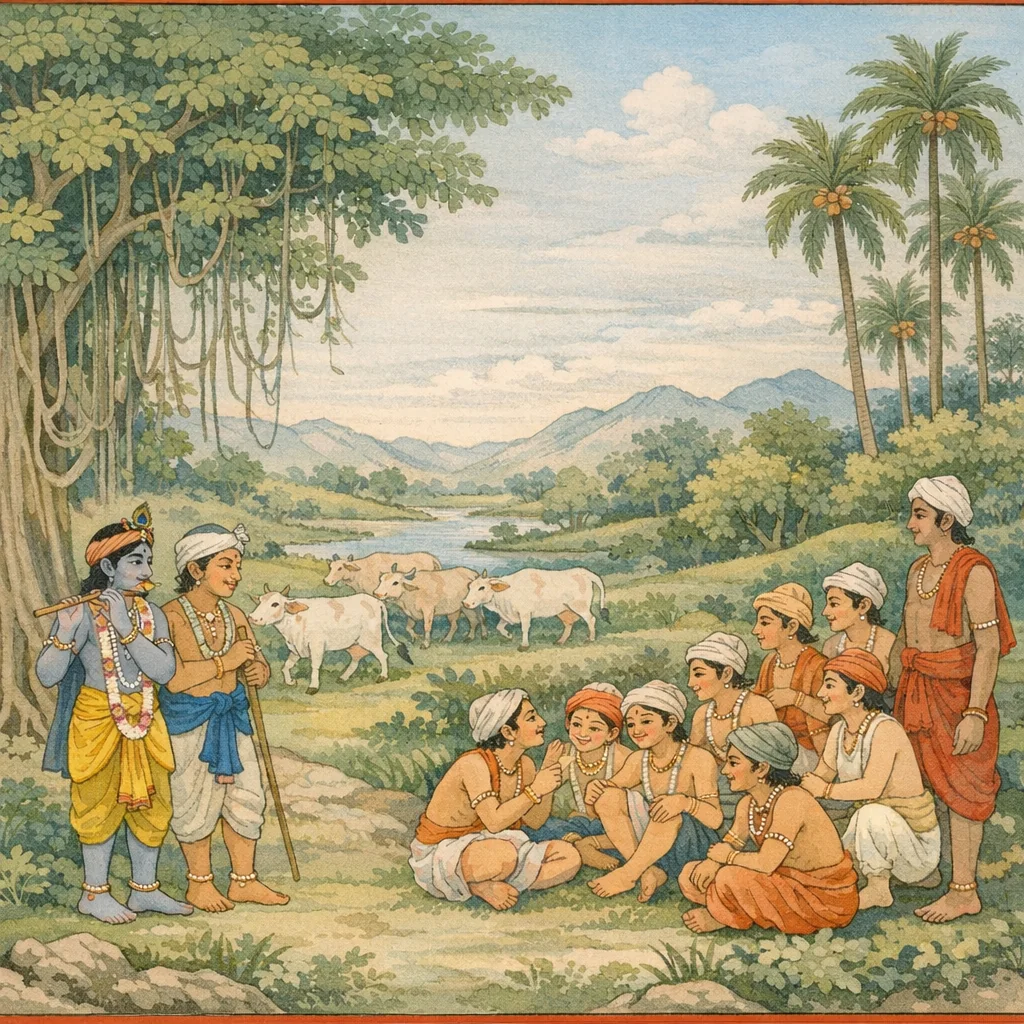
Parāśara tells Maitreya that after Dhenuka’s fall, Tālavana becomes fit for Vraja’s delight. Kṛṣṇa and Balarāma go to the Bhāṇḍīra banyan, sporting in cowherd games and performing human-like tasks, garlanded and carrying yoke-ropes—revealing manuşya-līlā. The asura Pralamba slips in disguised as a cowherd; finding Kṛṣṇa unassailable, he targets Balarāma and abducts him. In the crisis, doctrine shines forth: remembrance of the Supreme as the single cause, the cosmic form, time, dissolution and re-creation, and their shared descent to lighten Earth’s burden. Kṛṣṇa reminds Balarāma of their unity as the world’s cause, while maintaining functional distinction for the world’s purpose. Awakened to divine strength, Balarāma slays Pralamba with a deadly blow. The cowherds rejoice and return with Kṛṣṇa to Gokula.
Shlokas
Verse 1
तस्मिन् रासभदैतेये सानुगे विनिपातिते सेव्यं गोगोपगोपीनां रम्यं तालवनं बभौ
When that ass-like Daitya had been struck down together with his followers, the lovely forest of Tālavana became a place safe and fit to be freely enjoyed by the cowherds, their cattle, and the gopīs.
Verse 2
ततस् तौ जातहर्षौ तु वसुदेवसुताव् उभौ हत्वा धेनुकदैतेयं भाण्डीरवटम् आगतौ
Then the two sons of Vasudeva, their hearts lifted with joy, slew the Daitya Dhenuka and came to Bhāṇḍīra-vata, the sacred banyan.
Verse 3
क्ष्वेलमानौ प्रगायन्तौ विचिन्वन्तौ च पादपान् चारयन्तौ च गा दूरे व्याहरन्तौ च नामभिः
Sportively calling out and singing aloud, they wandered about examining the trees, drove the cows far out to pasture, and summoned them back by their familiar names.
Verse 4
निर्योगपाशस्कन्धौ तौ वनमालाविभूषितौ शुशुभाते महात्मानौ बालशृङ्गाव् इवर्षभौ
Bearing the yoke-ropes upon their shoulders and adorned with garlands of forest flowers, those two great-souled ones shone resplendently like two young bulls with newly budding horns.
Verse 5
सुवर्णाञ्जनचूर्णाभ्यां तौ तदा रुषिताम्बरौ महेन्द्रायुधसंयुक्तौ श्वेतकृष्णाव् इवाम्बुदौ
Then, their garments stained with golden powder and black collyrium, those two appeared in wrath—like a pair of clouds, one white and one dark, both yoked with Indra’s bow of lightning.
Verse 6
चेरतुर् लोकसिद्धाभिः क्रीडाभिर् इतरेतरम् समस्तलोकनाथानां नाथभूतौ भुवं गतौ
They sported with one another through pastimes celebrated across the worlds; and, having become protectors even to the lords of all realms, those two moved upon the earth.
Verse 7
मनुष्यधर्माभिरतौ मानयन्तौ मनुष्यताम् तज्जातिगुणयुक्ताभिः क्रीडाभिश् चेरतुर् वनम्
Delighting in the duties proper to human life and honoring the very condition of humanity, the two wandered through the forest, engaging in pastimes befitting that human kind’s qualities and customs.
Verse 8
ततश् चान्दोलिकाभिश् च नियुद्धैश् च महाबलौ व्यायामं चक्रतुस् तत्र क्षेपणीयैस् तथाश्मभिः
Then those two mighty ones exercised there—now with swinging bouts, now with close hand-to-hand combat, and also by hurling missiles and casting stones.
Verse 9
तल्लिप्सुर् असुरस् तत्र ह्य् उभयो रममाणयोः आजगाम प्रलम्बाख्यो गोपवेषतिरोहितः
Longing to seize Him, the asura named Pralamba came there—while both sides delighted in their play—hiding himself in the guise of a cowherd boy.
Verse 10
सो ऽवगाहत निःशङ्कस् तेषां मध्यम् अमानुषः मानुषं वपुर् आस्थाय प्रलम्बो दानवोत्तमः
Then that inhuman being—Pralamba, foremost among the Dānavas—without suspicion or fear, slipped into their midst, assuming a human form.
Verse 11
तयोश् छिद्रान्तरप्रेप्सुर् अविषह्यम् अमन्यत कृष्णं ततो रौहिणेयं हन्तुं चक्रे मनोरथम्
Seeking a vulnerable opening against the two, he deemed Kṛṣṇa utterly unassailable; therefore he set his mind on killing Rauhiṇeya (Balarāma) instead.
Verse 12
हरिणाक्रीडनं नाम बालक्रीडनकं ततः प्रकुर्वन्तो हि ते सर्वे द्वौ द्वौ युगपद् उत्पतन्
Then they all began a children’s game called “hariṇa-krīḍā,” the ‘deer-play’: pairing off two by two, they leapt up together at the same moment, delighting in their sport.
Verse 13
श्रीदाम्ना सह गोविन्दः प्रलम्बेन तथा बलः गोपालैर् अपरैश् चान्ये गोपालाः सह पुप्लुवुः
Govinda, accompanied by Śrīdāman, and Bala (Balarāma) along with Pralamba—together with the other cowherd boys as well—leapt about in play as one joyous band.
Verse 14
श्रीदामानं ततः कृष्णः प्रलम्बं रोहिणीसुतः जितवान् कृष्णपक्षीयैर् गोपैर् अन्ये पराजिताः
Then Śrī Kṛṣṇa overcame Śrīdāman, and Balarāma, Rohiṇī’s son, overcame Pralamba; the other cowherds on Kṛṣṇa’s side defeated the rest. Thus, even in the boys’ pastoral sport, the Lord’s party prevailed.
Verse 15
ते वाहयन्तस् त्व् अन्योन्यं भाण्डीरस्कन्धम् एत्य वै पुनर् निववृतुः सर्वे ये ये तत्र पराजिताः
Bearing one another in turn, they reached the lofty trunk of Bhāṇḍīra; and all who had been defeated there withdrew again.
Verse 16
संकर्षणं तु स्कन्धेन शीघ्रम् उत्क्षिप्य दानवः न तस्थौ प्रजगामैव सचन्द्र इव वारिदः
But the dānava, swiftly heaving Saṃkarṣaṇa onto his shoulder, did not remain there; he moved away at once, like a cloud bearing the moon across the sky.
Verse 17
असहन् रौहिणेयस्य स भारं दानवोत्तमः ववृधे सुमहाकायः प्रावृषीव बलाहकः
Unable to endure the weight of Rauhiṇeya (Balarāma), that foremost of dānavas swelled into a vast form, like a monsoon cloud rising in the rainy season.
Verse 18
संकर्षणस् तु तं दृष्ट्वा दग्धशैलोपमाकृतिम् स्रग्दामलम्बाभरणं मुकुटाटोपिमस्तकम्
But Saṅkarṣaṇa, seeing him—his body like a mountain scorched by fire, adorned with garlands and hanging ornaments, his head crowned with a towering diadem—beheld that awe-inspiring form with solemn gaze.
Verse 20
कृष्ण कृष्ण ह्रियाम्य् एष पर्वतोदग्रमूर्तिना केनापि पश्य दैत्येन गोपालछद्मरूपिणा
“Kṛṣṇa! Kṛṣṇa! I am being carried away—look!—by some demon who has assumed the guise of a cowherd, towering with a form as vast and steep as a mountain-peak.”
Verse 21
यद् अत्र साम्प्रतं कार्यं मया मधुनिषूदन तत् कथ्यतां प्रयात्य् एष दुरात्मातित्वरान्वितः
O Madhusūdana, tell me what must be done by me right now, for this wicked-souled one is departing, driven on by excessive haste.
Verse 22
तम् आह रामं गोविन्दः स्मितभिन्नौष्ठसंपुटः महात्मा रौहिणेयस्य बलवीर्यप्रमाणवित्
Then Govinda spoke to Rāma—His lips gently parting with a smile. That great-souled Lord, fully knowing the measure of Rauhiṇeya’s strength and valor, addressed him with assured understanding.
Verse 23
किम् अयं मानुषो भावो व्यक्तम् एवावलम्ब्यते सर्वात्मन् सर्वगुह्यानां गुह्यगुह्यात्मना त्वया
How can this be merely a human condition—how could You be dependent only upon what is manifest? O Soul of all, You who are the most hidden of all mysteries, You abide as the innermost secret within the secret itself.
Verse 24
स्मराशेषजगन्नाथ कारणं कारणाग्रजम् आत्मानम् एकं तद्वच् च जगत्य् एकार्णवे च यत्
Remember the Lord of all worlds—the Cause, the One who is prior to every cause—the single Self. For when, at dissolution, the universe becomes a single ocean, that same Reality remains as that One alone.
Verse 25
किं न वेत्सि यथाहं च त्वं चैकं कारणं भुवः भारावतारणार्थाय मर्त्यलोकम् उपागतौ
Do you not know that you and I are the one supreme cause of the world? We have descended to the realm of mortals to lift the burden of the Earth.
Verse 26
नभः शिरस् ते ऽम्बुमयी च मूर्तिः पादौ क्षितिर् वक्त्रम् अनन्त वह्निः सोमो मनस् ते श्वसितं समीरो दिशश् चतस्रो ऽव्यय बाहवस् ते
The sky is Your head, and Your form is of water; the earth is Your feet, and Your mouth is the boundless fire. The moon is Your mind, the wind Your very breath; and the four directions are Your imperishable arms, O Undecaying One.
Verse 27
सहस्रवक्त्रो हि भवान् महात्मा सहस्रहस्ताङ्घ्रिशरीरभेदः सहस्रपद्मोद्भवयोनिर् आद्यः सहस्रशस् त्वां मुनयो गृणन्ति
O great-souled Lord, You are the Thousand-Faced One—of countless forms, with innumerable hands and feet. You are the primal source from whom a thousand lotus-born worlds arise; thus the sages sing Your praise in a thousand ways.
Verse 28
दिव्यं हि रूपं तव वेत्ति नान्यो देवैर् अशेषैर् अवताररूपम् तवार्च्यते वेत्सि न किं यद् अन्ते त्वय्य् एव विश्वं लयम् अभ्युपैति
Truly none other comprehends Your divine form—the form that becomes the very pattern of all descents, even for the assembled gods. You are worshipped; yet who can fully know that, in the end, the whole universe dissolves into You alone and finds its final repose in You?
Verse 29
त्वया धृतेयं धरणी बिभर्ति चराचरं विश्वम् अनन्तमूर्ते कृतादिभेदैर् अज कालरूपो निमेषपूर्वो जगद् एतद् अत्सि
O Vishnu of endless forms—because You uphold her, the Earth can bear the entire universe, the moving and the unmoving. Unborn, You assume the form of Time and, through the divisions beginning with the Kṛta age, You measure out the moments; in the end, You consume this whole world.
Verse 30
अत्तं यथा वाडववह्निनाम्बु हिमस्वरूपं परिगृह्य कास्तम् हिमाचले भानुमतो ऽंशुसङ्गाज् जलत्वम् अभ्येति पुनस् तद् एव
Just as water swallowed by the submarine fire takes on the hardened form of ice and abides in the Himalayan heights, yet, when touched by the sun’s rays, becomes water again exactly as before—so too what has assumed another condition returns, by the proper cause, to its own true state.
Verse 31
एवं त्वया संहरणे ऽत्तम् एतज् जगत् समस्तं पुनर् अप्य् अवश्यम् तथैव सर्गाय समुद्यतस्य जगत्त्वम् अभ्येत्य् अनुकल्पम् ईश
Thus, at the time of dissolution, this entire universe is drawn back and absorbed by You; and then, inevitably, when You rise again for creation, it returns to the state of “worldhood,” manifesting once more in due order, O Lord.
Verse 32
भवान् अहं च विश्वात्मन्न् एकम् एव हि कारणम् जगतो ऽस्य जगत्य् अर्थे भेदेनावां व्यवस्थितौ
O Soul of the universe, You and I are in truth one and the same cause of this world; yet, for the world’s unfolding and governance, we stand as if distinct—set in difference only to serve the order of creation.
Verse 33
तत् स्मर्यताम् अमेयात्मंस् त्वयात्मा जहि दानवम् मानुष्यम् एवावलम्ब्य बन्धूनां क्रियतां हितम्
Remember, O one of immeasurable Self: by your own Self, strike down the Daitya. Taking refuge in a human form alone, accomplish what is beneficial for your kinsmen.
Verse 34
इति संस्मारितो विप्र कृष्णेन सुमहात्मना विहस्य पीडयाम् आस प्रलम्बं बलवान् बलः
Thus reminded by Śrī Kṛṣṇa, that great-souled Lord, O Brahmin, Bala (Balarāma), mighty in strength, laughed aloud and began to crush and torment Pralamba.
Verse 35
मुष्टिना चाहनन् मूर्ध्नि कोपसंरक्तलोचनः तेन चास्य प्रहारेण बहिर् याते विलोचने
With his fist he struck him upon the head, his eyes reddened with rage; and by that blow, the other’s eyes were driven out and forced outward.
Verse 36
स निष्कासितमस्तिष्को मुखाच् छोणितम् उद्वमन् निपपात महीपृष्ठे दैत्यवर्यो ममार च
His skull shattered and his brain forced out, vomiting blood from his mouth, that foremost of the Daityas collapsed upon the earth’s surface—and there he died.
Verse 37
प्रलम्बं निहतं दृष्ट्वा बलेनाद्भुतकर्मणा प्रहृष्टास् तुष्टुवुर् गोपाः साधु साध्व् इति चाब्रुवन्
Seeing Pralamba struck down by Balarāma—whose deeds are wondrous beyond measure—the cowherds overflowed with joy. They praised him aloud, repeatedly exclaiming, “Well done! Well done!”
Verse 38
संस्तूयमानो गोपैस् तु रामो दैत्ये निपातिते प्रलम्बे सह कृष्णेन पुनर् गोकुलम् आययौ
Praised by the cowherds, Balarāma—after the demon Pralamba had been struck down—returned once more to Gokula together with Kṛṣṇa.
Frequently Asked Questions
The narrative states he considers Kṛṣṇa ‘avishahya’ (unassailable) and therefore seeks to kill Rauhiṇeya (Balarāma) by deception and abduction.
It expresses a non-dual causal principle (eka-kāraṇa) manifesting differentiated functions in līlā and governance—unity in tattva, distinction in vyavahāra for loka-saṃgraha.