Adhyaya 13
Nāndīmukha-śrāddha (Prosperity Rites), Preta-kriyā, Aśauca, Ekoddiṣṭa, and Sapiṇḍīkaraṇa Framework
Parāśara teaches Maitreya the dharma of gṛhastha life: at a son’s birth the father bathes with garments on (sacaila-snāna), performs jātakarma, and offers the auspicious Nāndīmukha-śrāddha. He explains honoring dvijas in proper order and offering piṇḍas of curds, rice, and badara while facing east or north, thus pleasing the Nāndīmukha Pitṛs—commended for all occasions of increase such as weddings, house-entry, naming, tonsure, sīmanta, and a child’s first sight. The teaching then turns to rites for the departed: bathing and adorning the body, cremation, post-cremation bathing, south-facing water-libations (tilodaka), restrained conduct, daily piṇḍa for the preta, brāhmaṇa-feeding on prescribed days, and special tilodaka on the 1st/3rd/7th/9th days. On the fourth day, collecting ashes and bones marks a shift in restrictions among sapiṇḍas. Parāśara sets aśauca periods by varṇa, describes ekoddiṣṭa (a single arghya/pavitraka, without deities) to be observed for a year, and introduces sapiṇḍīkaraṇa: merging the preta vessel into three pitṛ vessels to admit the departed into ancestorhood. He concludes with rules of who may perform (sons first, then wider kin including maternal relations, even women/community, and the king’s duty when lineages end) and classifies rites as pūrva, madhyama, and uttara.
Shlokas
Verse 1
सचैलस्य पितुः स्नानं जाते पुत्रे विधीयते जातकर्म तथा कुर्याच् श्राद्धम् अभ्युदये च यत्
When a son is born, the father is enjoined to bathe while still clothed; and he should duly perform the jātakarma, as well as the śrāddha prescribed for occasions of prosperity and auspicious increase.
Verse 2
युग्मान् देवांश् च पित्र्यांश् च सम्यक् सव्यक्रमाद् द्विजान् पूजयेद् भोजयेच् चैव तन्मना नान्यमानसः
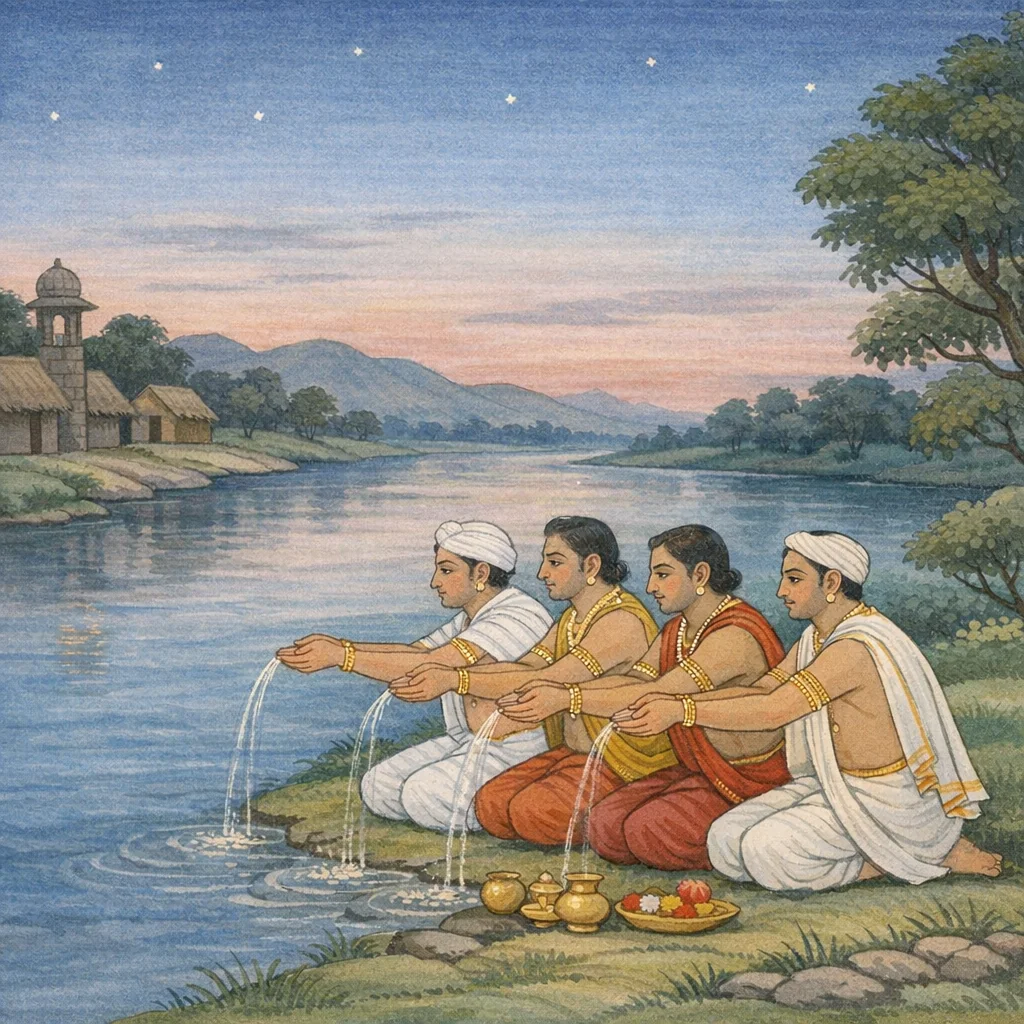
He should, in proper order, honor and feed the twice-born, seating them in pairs as representatives of the gods and the ancestral spirits, with a mind wholly intent on the sacred act and not turned elsewhere.
Verse 3
दध्यक्षतैः सबदरैः प्राङ्मुखोदङ्मुखो ऽपि वा देवतीर्थेन वै पिण्डान् दद्यात् कायेन वा नृप
O King, facing east or north, one should offer the piṇḍas—sanctified with curds, grains of rice, and jujube fruits—by the ‘deva-tīrtha’ method; or, as needed, present them directly by hand.
Verse 4
नान्दीमुखः पितृगणस् तेन श्राद्धेन पार्थिव प्रीयते तत् तु कर्तव्यं पुरुषैः सर्ववृद्धिषु
O king, by that śrāddha the host of Pitṛs known as the Nāndīmukhas is gratified; therefore it should indeed be performed on every occasion of increase and prosperity.
Verse 5
कन्यापुत्रविवाहेषु प्रवेशे नववेश्मनः नामकर्मणि बालानां चूडाकर्मादिके तथा
At the weddings of daughters and sons; at the entering of a newly built home; at the naming-rite of children; and likewise at the tonsure and other sacraments—on all these auspicious occasions, śrāddha and the prescribed observances should be duly performed.
Verse 6
सीमन्तोन्नयने चैव पुत्रादिमुखदर्शने नान्दीमुखं पितृगणं पूजयेत् प्रयतो गृही
At the rite of parting the hair and at the first auspicious sight of a son and such family milestones, the disciplined householder should reverently worship the ancestral hosts known as the Nāndīmukha Pitṛs.
Verse 7
पितृपूजाक्रमः प्रोक्तो वृद्धाव् एष समासतः श्रूयताम् अवनीपाल प्रेतकर्मक्रियाविधिः
O king, the sequence of honoring the Fathers has been stated in brief—this is the venerable tradition. Now listen to the ordained procedure for the rites performed for the departed.
Verse 8
प्रेतदेहं शुभैः स्नानैः स्नापितं स्रग्विभूषितम् दग्ध्वा ग्रामाद् बहिः स्नात्वा सचैलाः सलिलाशये
Having bathed the departed body with auspicious washings and adorned it with garlands, and then having cremated it, they should go outside the village and bathe in a reservoir of water, still wearing their garments.
Verse 9
यत्र तत्र स्थितायैतद् अमुकायेति वादिनः दक्षिणाभिमुखा दद्युर् बान्धवाः सलिलाञ्जलिम्
Wherever they may be standing, his kinsmen should face south and offer a cupped libation of water, uttering, “This is for so-and-so.”
Verse 10
प्रविष्टाश् च समं गोभिर् ग्रामं नक्षत्रदर्शने कटधर्मांस् ततः कुर्युर् भूमौ प्रस्तरशायिनः
When the stars become visible, entering the village together with the cattle, they should perform the prescribed evening observances; then, lying on the earth upon a simple bed of stone, they should pass the night in disciplined restraint.
Verse 11
दातव्यो ऽनुदिनं पिण्डः प्रेताय भुवि पार्थिव दिवा च भक्तं भोक्तव्यम् अमांसं मनुजर्षभ
O king of the earth, a piṇḍa-offering should be given each day to the departed who abides as a preta; and by day, O best of men, one should eat food free from flesh, observing restraint.
Verse 12
दिनानि तानि चेच्छातः कर्तव्यं विप्रभोजनम् प्रेतस् तृप्तिं तथा याति बन्धुवर्गेण भुञ्जता
On those appointed days, one should deliberately arrange the feeding of Brāhmaṇas; for the preta too attains satisfaction when the kinsmen partake in the proper śrāddha manner.
Verse 13
प्रथमे ऽह्नि तृतीये च सप्तमे नवमे तथा वस्त्रत्यागं बहिःस्नानं कृत्वा दद्यात् तिलोदकम्
On the first day, and likewise on the third, the seventh, and the ninth, having set aside one’s garments and bathed outside, one should offer water mixed with sesame (tilodaka).
Verse 14
चतुर्थे ऽह्नि च कर्तव्यं भस्मास्थिचयनं नृप तदूर्ध्वम् अङ्गस्पर्शश् च सपिण्डानाम् अपीष्यते
O king, on the fourth day the gathering of ashes and bones should be performed; after that, even bodily contact with one’s sapinda kin is again permitted.
Verse 15
योग्याः सर्वक्रियाणां तु समानसलिलास् तथा अनुलेपनपुष्पादिभोगाद् अन्यत्र पार्थिव
They are fit for the performance of all rites, O king, and their water is regarded as equivalent; yet in enjoyments such as unguents and perfumes, flowers, and the like, a distinction remains.
Verse 16
शय्यासनोपभोगश् च सपिण्डानाम् अपीष्यते भस्मास्थिचयनाद् ऊर्ध्वं संयोगो न तु योषिताम्
For those who are sapiṇḍas, even the use of bed and seat is deemed restricted; but after the ashes and bones have been gathered, the condition of association comes to an end—yet, by rule, it is not so in the case of women.
Verse 17
बाले देशान्तरस्थे च पतिते च मुनौ मृते सद्यः शौचं तथेच्छातो जलाग्न्युद्बन्धनादिषु
In the case of a child, one who is in a foreign land, or one who has fallen from the community—and likewise when a muni has died—purification is to be undertaken at once. So too, for those who of their own will resort to acts such as entering water, fire, hanging, and the like, immediate cleansing is enjoined.
Verse 18
मृतबन्धोर् दशाहानि कुलस्यान्नं न भुज्यते दानं प्रतिग्रहो यज्ञः स्वाध्यायश् च निवर्तते
When a kinsman has died, for ten days the family does not partake of its customary food; and giving and receiving, sacrifice (yajña), and even the recitation of sacred study (svādhyāya) are set aside.
Verse 19
विप्रस्यैतद् द्वादशाहं राजन्यस्याप्य् अशौचकम् अर्धमासं तु वैश्यस्य मासं शूद्रस्य शुद्धये
For a Brāhmaṇa, O king, this aśauca lasts twelve days; for a Kṣatriya too aśauca is prescribed. For a Vaiśya it is half a month, and for a Śūdra a full month—so that each may return to purity according to the station ordained.
Verse 20
अयुजो भोजयेत् कामं द्विजान् आद्ये ततो दिने दद्याद् दर्भेषु पिण्डं च प्रेतायोच्छिष्टसंनिधौ
On the very first day, as one is able and with devotional intent, one should feed the twice-born (Brahmins). Then, on the following day, one should place a piṇḍa upon sacred darbha grass for the preta, keeping it near the remnants of the offering (ucchiṣṭa), so that the rite may reach the departed.
Verse 21
वार्यायुधप्रतोदास् तु दण्डश् च द्विजभोजनात् स्प्रष्टव्यो ऽनन्तरं वर्णैः शुध्येरंस् ते ततः क्रमात्
Water-vessels, weapons, goads, and the staff—once used in connection with a brāhmaṇa’s meal—should thereafter be touched in proper sequence by the succeeding social orders; by that successive contact they are regarded as purified.
Verse 22
ततः स्ववर्णधर्मा ये विप्रादीनाम् उदाहृताः तान् कुर्वीत पुमाञ् जीवेन् निजधर्मार्जनैस् तथा
Therefore, whatever duties have been declared for one’s own social order—beginning with those of the brāhmaṇas—let a person perform them with faithful resolve; and let him sustain his life as well by livelihoods that arise from his own dharma.
Verse 23
मृते ऽहनि च कर्तव्यम् एकोद्दिष्टम् अतः परम् आह्वानादिक्रियादैवनियोगरहितं हि तत्
On the very day a person has died, the rite known as Ekoddiṣṭa should be performed, and thereafter as well. For it is observed without the customary invocations and other formal acts, and without assigning offerings to the deities—being directed solely to the departed spirit.
Verse 24
एको ऽर्घ्यस् तत्र दातव्यस् तथैवैकं पवित्रकम् प्रेताय पिण्डो दातव्यो भुक्तवत्सु द्विजातिषु
There, a single arghya (water-offering) should be presented, and likewise a single pavitraka (ring of sacred kuśa-grass). And when the twice-born have completed their meal, a piṇḍa (funerary rice-ball) is to be offered for the preta—so that the rite proceeds in due order, according to dharma.
Verse 25
प्रश्नश् च तत्राभिरतिर् यजमानद्विजन्मनाम् अक्षय्यम् अमुकस्येति वक्तव्यं विरतौ तथा
There, the question should be asked, and the officiating twice-born priests should remain attentive to the sacrificer. And at the proper conclusion it should be declared: “May this be imperishable for such-and-such a one,”—thus is it to be pronounced when the rite is brought to its close.
Verse 26
एकोद्दिष्टमयो धर्म इत्थम् आवत्सरात् स्मृतः सपिण्डीकरणं तस्मिन् काले राजेन्द्र तच् छृणु
Thus is the rite called Ekoḍḍiṣṭa-dharma remembered as to be performed for a full year. Now, O best of kings, listen to the Sapīṇḍīkaraṇa to be done at that time.
Verse 28
पात्रं प्रेतस्य तत्रैकं पैत्रं पात्रत्रयं तथा सेचयेत् पितृपात्रेषु प्रेतपात्रं नृप त्रिषु
There, one vessel is to be set for the preta, and likewise three vessels for the Pitṛs. O King, the offering in the preta-vessel should be poured into the three vessels of the Pitṛs.
Verse 29
ततः पितृत्वम् आपन्ने तस्मिन् प्रेते महीपते श्राद्धधर्मैर् अशेषैस् तु तत्पूर्वान् अर्चयेत् पितॄन्
Thereafter, O lord of the earth, when that preta has entered the state of ancestorhood, one should, by fulfilling all the duties of Śrāddha, duly honor the Pitṛs—beginning with those who preceded him.
Verse 30
पुत्रः पौत्रः प्रपौत्रो वा बन्धुर् वा भ्रातृसंततिः सपिण्डसंततिर् वापि क्रियार्हो नृप जायते
O King, whether it be a son, a grandson, or a great-grandson—whether a kinsman, the line of a brother, or even the wider sapiṇḍa line—among these one is born who is fit to perform the prescribed rites.
Verse 31
तेषाम् अभावे सर्वेषां समानोदकसंततिः मातृपक्षस्य पिण्डेन संबद्धा ये जलेन वा
If all those are absent, then one should proceed according to the samānodaka line—those connected by the same water-libation. Likewise, relatives on the mother’s side, linked either by the piṇḍa offering or by the water oblation, are to be included.
Verse 32
कुलद्वये ऽपि चोच्छिन्ने स्त्रीभिः कार्याः क्रिया नृप संघातान्तर्गतैर् वापि कार्याः प्रेतस्य याः क्रियाः उत्सन्नबन्धुरिक्थानां कारयेद् अवनीपतिः
O King, even if both family lines are cut off, the rites for the departed must still be performed—by women, or by members of the community. Let not the due observances for the dead fall into neglect; and for those whose kin have perished and whose wealth stands without an heir, the ruler, lord of the land, should cause those rites to be duly carried out.
Verse 33
पूर्वाः क्रिया मध्यमाश् च तथा चैवोत्तराः क्रियाः त्रिःप्रकाराः क्रिया ह्य् एतास् तासां भेदं शृणुष्व मे
Ritual duties (kriyā) are of three kinds: those that come first, those that stand in the middle, and those that conclude. Hear from me, then, the distinctions among these three.
Verse 34
आदाहवार्यायुधादिस्पर्शाद्यन्तास् तु याः क्रियाः ताः पूर्वा मध्यमा मासि मास्य् एकोद्दिष्टसंज्ञिताः
Those ritual acts that run from the initial consecratory touches—by fire, water, and the prescribed implements—up to their concluding observances are called the earlier rites. When performed in the early or middle part of a month, they are known in that month as “Ekoddiṣṭa”, the offering directed to one specified departed spirit.
Verse 35
प्रेते पितृत्वम् आपन्ने सपिण्डीकरणाद् अनु क्रियन्ते याः क्रियाः पित्र्याः प्रोच्यन्ते ता नृपोत्तराः
O best of kings, when the departed, after the rite of sapiṇḍīkaraṇa, attains the status of an Ancestor (Pitṛ), the observances then performed in due sequence are declared to be pitṛ-kriyā, the proper ancestral rites—these are the later, concluding rites.
Verse 36
पितृमातृसपिण्डैस् तु समानसलिलैस् तथा तत्संघातगतैश् चैव राज्ञा वा धनहारिणा
But the claim (to the wealth) should be pursued through the paternal and maternal sapinda-kindred, through those who share the same libation-waters (the same ancestral line), and likewise through those belonging to that collective body; or else it should be recovered through the king—or from the thief who has carried off the wealth.
Verse 37
पूर्वाः क्रियास् तु कर्तव्याः पुत्राद्यैर् एव चोत्तराः दौहित्रैर् वा नरश्रेष्ठ कार्यास् तत्तनयैस् तथा
The earlier rites are to be performed only by sons and the like; but the later rites, O best of men, may be duly carried out by a daughter’s son, or likewise by his sons as well.
Verse 38
मृताहनि च कर्तव्याः स्त्रीणाम् अप्य् उत्तराः क्रियाः प्रतिसंवत्सरं राजन्न् एकोद्दिष्टविधानतः
On the very day of death itself, the subsequent funerary rites are to be performed—even for women; and, O king, they should also be observed every year thereafter, in accordance with the prescribed one-offering (ekoddiṣṭa) procedure.
Verse 39
तस्माद् उत्तरसंज्ञा याः क्रियास् ताः शृणु पार्थिव यदा यदा च कर्तव्या विधिना येन चानघ
Therefore, O king, listen to those rites that are known as the ‘subsequent’ (uttara) observances—when, on what occasions, and by what proper procedure they are to be performed, O sinless one.
Frequently Asked Questions
It is an auspicious (abhyudaya) śrāddha meant to gratify the Nāndīmukha Pitṛs, prescribed at life-increase thresholds such as birth (jātakarma context), weddings, entering a new house, naming, tonsure, and similar prosperity occasions.
Sapiṇḍīkaraṇa ritually merges the newly-departed (preta) into the established ancestral collective (Pitṛs), symbolized by transferring the offering from one preta-vessel into three pitṛ-vessels—marking the transition from solitary preta-status to ancestorhood.