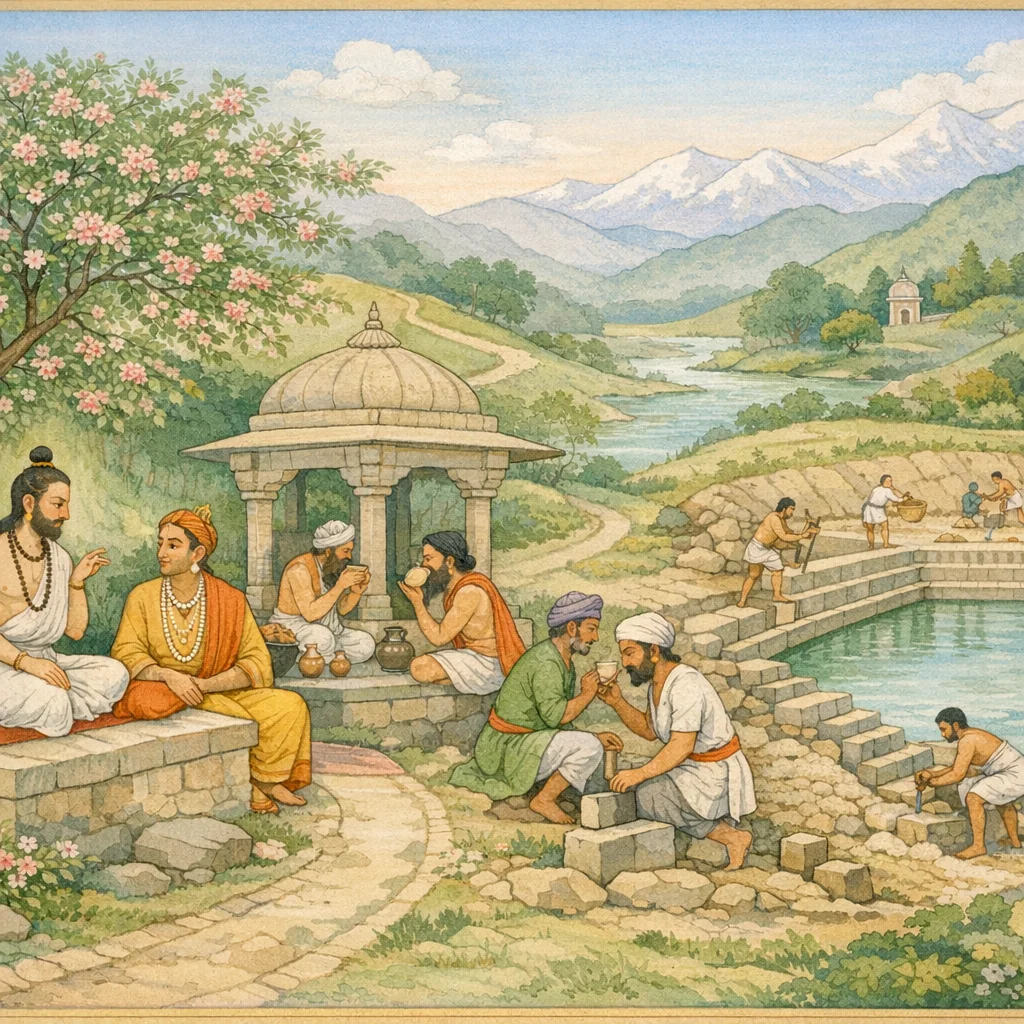
पानीयदान-प्रपादान-वापीकूपतडाग-निर्माण-प्रशंसा (Praise of Water-Gift and the Construction of Wells and Tanks)
Adhyāya 12 is presented as Sanatkumāra’s instruction, declaring pānīya-dāna—the gifting and provision of drinking water—to be the highest gift, since water universally sustains life and satisfies all beings. The teaching moves from private charity to public welfare: establishing prapās (water stations) and building lasting reservoirs—vāpīs (stepwells/waterworks), kūpas (wells), and taḍāgas (tanks/ponds). The case is both ethical and salvific: such works generate enduring puṇya, bring honor in the three worlds, and even lessen past wrongdoing; a well with properly available water is said to remove a portion of sin. The verses stress inclusivity—humans, ascetics, brāhmaṇas, and cattle all benefit—so water infrastructure is upheld as exemplary lokasaṅgraha in harmony with Śaiva dharma. In a subtler sense, water is treated as a sacramental medium of nourishment, purification, and karmic repair, making civic compassion a valid spiritual discipline within the ritual-ethical vision of the Umāsaṃhitā.
Shlokas
Verse 1
सनत्कुमार उवाच । पानीयदानं परमं दानानामुत्तमं सदा । सर्वेषां जीवपुंजानां तर्पणं जीवनं स्मृतम्
Sanatkumāra said: The gift of drinking water is supreme—ever the highest among gifts. For all multitudes of living beings, the act of satisfying them with water is remembered as life itself.
Verse 2
प्रपादानमतः कुर्यात्सुस्नेहादनिवारितम् । जलाश्रयविनिर्माणं महानन्दकरं भवेत्
Therefore, one should, with affectionate devotion and without obstruction or reluctance, build a foot-resting platform at a water-spot; the making of a water-shelter—a reservoir or watering-place—becomes a cause of great joy and merit.
Verse 3
इह लोके परे वापि सत्यं सत्यं न संशयः । तस्माद्वापीश्च कूपांश्च तडागान्कारयेन्नरः
In this world and in the world beyond, it is true—true indeed—without any doubt. Therefore, one should have wells, stepwells (vāpī), and ponds constructed.
Verse 4
अर्द्धं पापस्य हरति पुरुषस्य विकर्मणः । कूपः प्रवृत्तपानीयः सुप्रवृत्तस्य नित्यशः
For a man who has fallen into wrongful action, a well established to provide flowing drinking-water removes half of his sin; and for one who is steadily righteous, it becomes a source of merit at all times.
Verse 5
सर्वं तारयते वंशं यस्य खाते जलाशये । गावः पिबंति विप्राश्च साधवश्च नरास्सदा
He delivers his entire lineage for whom a water-reservoir has been dug; for there cows drink, and Brahmins (vipra), and the virtuous—indeed people always.
Verse 6
निदाघकाले पानीयं यस्य तिष्ठत्यवारितम् । सुदुर्गं विषमं कृच्छ्रं न कदाचिदवाप्यते
For one who, in the heat of summer, keeps drinking-water available for others without obstruction, the hard-to-cross, uneven, and grievous path of suffering is never attained at any time.
Verse 7
तडागानां च वक्ष्यामि कृतानां ये गुणाः स्मृता । त्रिषु लोकेषु सर्वत्र पूजितो यस्तडागवान्
Now I shall describe the virtues remembered of ponds that have been constructed. He who has a pond (made for dharma) is honored everywhere throughout the three worlds.
Verse 8
अथवा मित्रसदने मैत्रं मित्रार्तिवर्जितम् । कीर्तिसंजननं श्रेष्ठं तडागानां निवेशनम्
Or else, let him establish amity in a friend’s abode—friendship free from causing distress to friends. Yet best of all is the founding of ponds, for it gives rise to enduring kīrti, noble fame.
Verse 9
धर्मस्यार्थस्य कामस्य फलमाहुर्मनीषिणः । तडागं सुकृते येन तस्य पुण्यमनन्तकम्
The wise declare that the making of a pond (tadāga) is a fruit-bearing act for dharma, artha, and kāma. Whoever creates such a pond as a meritorious deed gains inexhaustible spiritual merit.
Verse 10
चतुर्विधानां भूतानां तडागः परमाश्रयः । तडागादीनि सर्वाणि दिशन्ति श्रियमुत्तमाम्
For the fourfold classes of living beings, a pond is a supreme refuge. Ponds and other such water-works bestow the highest prosperity and auspicious well-being.
Verse 11
देवा मनुष्या गन्धर्वाः पितरो नागराक्षसाः । स्थावराणि च भूतानि संश्रयंति जलाशयम्
Devas, human beings, Gandharvas, Pitṛs, Nāgas, and Rākṣasas—and even immobile beings—take refuge in a reservoir of water.
Verse 12
इति श्रीशिवमहापुराणे पंचम्यामुमासंहितायां तपोमाहात्म्यवर्णनं नाम द्वादशोऽध्यायः
Thus ends the Twelfth Chapter, called “The Description of the Greatness of Tapas (austerity),” in the Fifth Book of the Śrī Śiva Mahāpurāṇa, within the Umā-saṃhitā.
Verse 13
शरत्काले तु सलिलं तडागे यस्य तिष्ठति । गोसहस्रफलं तस्य भवेन्नैवात्र संशयः
If, in the autumn season, water remains in a person’s pond (one who maintains a reservoir for beings), that person surely gains merit equal to the gift of a thousand cows—of this there is no doubt.
Verse 14
हेमन्ते शिशिरे चैव सलिलं यस्य तिष्ठति । स वै बहुसुवर्णस्य यज्ञस्य लभते फलम्
If, during the Hemanta and Śiśira seasons, water remains stored with someone (for charitable giving), that person indeed attains merit equal to a sacrifice performed with abundant gold.
Verse 15
वसंते च तथा ग्रीष्मे सलिलं यस्य तिष्ठति । अतिरात्राश्वमेधानां फलमाहुर्मनीषिणः
The wise declare that one whose reservoir retains water even in spring and in summer attains merit equal to performing the Atirātra and the Aśvamedha sacrifices.
Verse 16
मुने व्यासाथ वृक्षाणां रोपणे च गुणाञ्छृणु । प्रोक्तं जलाशयफलं जीवप्रीणनमुत्तमम्
O sage Vyāsa, now hear also the virtues of planting trees. It is declared that the fruit of creating water-reservoirs is the highest, for it supremely nourishes living beings.
Verse 17
अतीतानागतान्सर्वान्पितृवंशांस्तु तारयेत् । कांतारे वृक्षरोपी यस्तस्माद्वृक्षांस्तु रोपयेत्
One who plants trees in a wilderness delivers the entire line of ancestors—both those who have passed away and those yet to come. Therefore, one should indeed plant trees.
Verse 18
तत्र पुत्रा भवंत्येते पादपा नात्र संशयः । परं लोकं गतस्सोऽपि लोकानाप्नोति चाक्षयान्
There, those trees indeed become his sons—of this there is no doubt. Even after he departs to the higher world, he attains imperishable realms.
Verse 19
पुष्पैस्सुरगणान्सर्वान्फलैश्चापि तथा पितॄन् । छायया चातिथीन्सर्वान्पूजयंति महीरुहाः
With their flowers, the great trees honor all the hosts of the gods; with their fruits, they likewise honor the Pitṛs, the ancestral spirits; and with their shade, they honor all guests—thus do the great trees continually perform worship through selfless giving.
Verse 20
किन्नरोरगरक्षांसि देवगंधर्वमानवाः । तथैवर्षिगणाश्चैव संश्रयंति महीरुहान्
Kinnaras, serpentine beings, and the Rākṣasas; likewise the Devas, Gandharvas, and human beings—and so too the hosts of Ṛṣis—take refuge in the great trees.
Verse 21
पुष्पिताः फलवंतश्च तर्पयंतीह मानवान् । इह लोके परे चैव पुत्रास्ते धर्मतः स्मृताः
Those good deeds and virtuous acts that blossom and bear fruit, bringing satisfaction to people here, are—by the law of Dharma—remembered as one’s “sons,” both in this world and in the next.
Verse 22
तडागकृद्वृक्षरोपी चेष्टयज्ञश्च यो द्विजः । एते स्वर्गान्न हीयंते ये चान्ये सत्यवादिनः
That twice-born man who digs a pond, plants trees, and performs the yajña with earnest devotion—such people do not fall away from heaven; nor do others who are devoted to truthfulness.
Verse 23
सत्यमेव परं ब्रह्म सत्यमेव परं तपः । सत्यमेव परो यज्ञस्सत्यमेव परं श्रुतम्
Truth alone is the Supreme Brahman; truth alone is the highest austerity. Truth alone is the highest sacrifice, and truth alone is the supreme sacred teaching heard in the scriptures.
Verse 24
सत्यं सुप्तेषु जागर्ति सत्यं च परमं पदम् । सत्येनैव धृता पृथ्वी सत्ये सर्वं प्रतिष्ठितम्
Truth remains awake even when beings are asleep; Truth itself is the supreme state. By Truth alone the earth is sustained, and in Truth everything stands firmly established.
Verse 25
ततो यज्ञश्च पुण्यं च देवर्षिपितृपूजने । आपो विद्या च ते सर्वे सर्वं सत्ये प्रतिष्ठितम्
From Truth arise sacrifice and merit, expressed through the worship of the gods, sages, and ancestors. Waters and sacred knowledge too—all of these, and indeed everything—are established upon Truth.
Verse 26
सत्यं यज्ञस्तपो दानं मंत्रा देवी सरस्वती । ब्रह्मचर्य्यं तथा सत्यमोंकारस्सत्यमेव च
Truth is yajña (sacrifice); truth is tapas (austerity); truth is dāna (charitable giving). Truth is the mantra, and Truth is Goddess Sarasvatī. Truth is also brahmacarya (chaste discipline); and the sacred Oṃkāra too is verily Truth alone.
Verse 27
सत्येन वायुरभ्येति सत्येन तपते रविः । सत्येनाग्निर्निर्दहति स्वर्गस्सत्येन तिष्ठति
By truth the wind moves; by truth the Sun burns with heat. By truth fire blazes and consumes; and heaven itself stands established by truth.
Verse 28
पालनं सर्ववेदानां सर्वतीर्थावगाहनम् । सत्येन वहते लोके सर्वमाप्नोत्यसंशयम्
Truthfulness upholds the essence of all the Vedas and equals bathing in every sacred tīrtha. By truth the world’s order is sustained; through truth a person attains everything—without doubt.
Verse 29
अश्वमेधसहस्रं च सत्यं च तुलया धृतम् । लक्षाणि क्रतवश्चैव सत्यमेव विशिष्यते
A thousand Aśvamedha sacrifices and Truth were placed together on a balance; even when compared against hundreds of thousands of rituals, it is Truth alone that outweighs and excels them all.
Verse 30
सत्येन देवाः पितरो मानवोरगराक्षसाः । प्रीयंते सत्यतस्सर्वे लोकाश्च सचराचराः
Through truthfulness, the gods, the ancestors, human beings, serpents, and even the rākṣasas are pleased. Indeed, by truth alone all the worlds—moving and unmoving—are satisfied and upheld.
Verse 31
सत्यमाहुः परं धर्मं सत्यमाहुः परं पदम् । सत्यमाहुः परं ब्रह्म तस्मात्सत्यं सदा वदेत्
They declare truth to be the highest dharma; they declare truth to be the supreme state. They declare truth to be the supreme Brahman—therefore one should always speak the truth.
Verse 32
मुनयस्सत्यनिरतास्तपस्तप्त्वा सुदुश्चरम् । सत्यधर्मरतास्सिद्धास्ततस्स्वर्गं च ते गताः
Those sages, devoted to truth, performed extremely arduous austerities. Established in the dharma of truth and perfected by that discipline, they then attained heaven.
Verse 33
अप्सरोगणसंविष्टैर्विमानैःपरिमातृभिः । वक्तव्यं च सदा सत्यं न सत्याद्विद्यते परम्
Surrounded by aerial chariots filled with hosts of apsarās and attended by revered motherly divinities, one should always speak the truth; for beyond truth there is no higher principle.
Verse 34
अगाधे विपुले सिद्धे सत्यतीर्थे शुचिह्रदे । स्नातव्यं मनसा युक्तं स्थानं तत्परमं स्मृतम्
In that fathomless and expansive holy place—perfected, a true ford of truth, with a pure and luminous lake—one should bathe with the mind gathered in concentration. That place is remembered as the supreme abode.
Verse 35
आत्मार्थे वा परार्थे वा पुत्रार्थे वापि मानवाः । अनृतं ये न भाषंते ते नरास्स्वर्गगामिनः
Whether for one’s own sake, for another’s sake, or even for the sake of one’s son—those people who do not speak untruth are indeed destined for heaven.
Verse 36
वेदा यज्ञास्तथा मंत्रास्संति विप्रेषु नित्यशः । नोभांत्यपि ह्यसत्येषु तस्मात्सत्यं समाचरेत्
The Vedas, the sacrifices, and the mantras ever abide with the brāhmaṇas; yet they do not shine forth in those who are untruthful. Therefore, one should steadfastly practice truthfulness.
Verse 37
व्यास उवाच । तपसो मे फलं ब्रूहि पुनरेव विशेषतः । सर्वेषां चैव वर्णानां ब्राह्मणानां तपोधन
Vyāsa said: “Tell me once again—especially and in detail—the fruit of tapas (austerity): the results for all the varṇas, and in particular for the brāhmaṇas, O treasure of ascetic power.”
Verse 38
सनत्कुमार उवाच । प्रवक्ष्यामि तपोऽध्यायं सर्व कामार्थसाधकम् । सुदुश्चरं द्विजातीनां तन्मे निगदतः शृणु
Sanatkumāra said: “I shall expound the chapter on tapas—the discipline of austerity that fulfills every rightful desire and every human aim. Though it is exceedingly hard to practice for the twice-born, listen as I proclaim it.”
Verse 39
तपो हि परमं प्रोक्तं तपसा विद्यते फलम् । तपोरता हि ये नित्यं मोदंते सह दैवतैः
Tapas is declared to be the highest; through tapas its true fruit is attained. Those who are ever devoted to austerity rejoice in divine felicity, in the company of the gods.
Verse 40
तपसा प्राप्यते स्वर्गस्तपसा प्राप्यते यशः । तपसा प्राप्यते कामस्तपस्सर्वार्थसाधनम्
By tapas one attains heaven; by tapas one attains renown. By tapas one attains desired enjoyments; indeed tapas is the means that accomplishes every aim.
Verse 41
तपसा मोक्षमाप्नोति तपसा विंदते महत् । ज्ञानविज्ञानसंपत्तिः सौभाग्यं रूपमेव च
Through tapas (austerity and disciplined spiritual practice) one attains liberation; through tapas one gains what is truly great. By tapas arise the riches of spiritual knowledge and realized insight, as well as auspicious fortune and even excellence of form.
Verse 42
नानाविधानि वस्तूनि तपसा लभते नरः । तपसा लभते सर्वं मनसा यद्यदिच्छति
By tapas, a person obtains many kinds of attainments; through tapas one gains everything that the mind truly seeks. From the Shaiva standpoint, such tapas becomes fruitful when aligned with devotion to Pati (Śiva) and disciplined inner intention, leading the seeker from worldly attainments toward liberation.
Verse 43
नातप्ततपसो यांति ब्रह्मलोकं कदाचन । नातप्ततपसां प्राप्यश्शंकरः परमेश्वरः
Those who have not undertaken tapas (austerity) never reach Brahmaloka. For those who have not practiced tapas, Śaṅkara—the Supreme Lord—is likewise unattainable.
Verse 44
यत्कार्यं किंचिदास्थाय पुरुषस्तपते तपः । तत्सर्वं समवाप्नोति परत्रेह च मानवः
Whatever aim a person takes up and, for that purpose, performs tapas, he attains it all—both here in this world and also in the hereafter.
Verse 45
सुरापः पारदारी च ब्रह्महा गुरुतल्पगः । तपसा तरते सर्वं सर्वतश्च विमुंचति
Even one who drinks intoxicants, violates another’s spouse, slays a brāhmaṇa, or violates the guru’s bed—by the power of tapas crosses beyond all sin and is released from bondage on every side.
Verse 46
अपि सर्वेश्वरः स्थाणुर्विष्णु श्चैव सनातनः । ब्रह्मा हुताशनः शक्रो ये चान्ये तपसान्विताः
Even Sthāṇu, the Lord of all, and Viṣṇu the Eternal; Brahmā, Agni, Indra, and all other beings endowed with tapas—each is encompassed by this truth and stands subordinate to the Supreme Lord.
Verse 47
अष्टाशीतिसहस्राणि मुनीनामूर्द्ध्वरेतसाम् । तपसा दिवि मोदंते समेता दैवतैस्सह
Eighty-eight thousand sages, whose vital energies are sublimated upward through brahmacarya, rejoice in heaven by the power of their tapas, gathered in the company of the gods.
Verse 48
तपसा लभ्यते राज्यं स च शक्रस्सुरेश्वरः । तपसाऽपालयत्सर्वमहन्यहनि वृत्रहा
Through tapas sovereignty is attained; thus Śakra (Indra) became the lord of the gods. And that slayer of Vṛtra protected all things day after day by the power of tapas.
Verse 49
सूर्य्याचन्द्रमसौ देवौ सर्वलोकहिते रतौ । तपसैव प्रकाशंते नक्षत्राणि ग्रहास्तथा
The Sun and the Moon—these divine powers—are devoted to the welfare of all worlds. By tapas alone they shine forth; and so too do the stars and the planets.
Verse 50
न चास्ति तत्सुखं लोके यद्विना तपसा किल । तपसैव सुखं सर्वमिति वेदविदो विदुः
In this world there is no true happiness that exists without tapas. Indeed, the knowers of the Veda declare that through tapas alone all happiness is attained.
Verse 51
ज्ञानं विज्ञानमारोग्यं रूपवत्त्वं तथैव च । सौभाग्यं चैव तपसा प्राप्यते सर्वदा सुखम्
Through tapas—disciplined austerity and worship—one attains knowledge and realized wisdom, freedom from disease, beauty and excellence of form, and also good fortune; and by such tapas one ever obtains happiness.
Verse 52
तपसा सृज्यते विश्वं ब्रह्मा विश्वं विनाश्रमम् । पाति विष्णुर्हरोऽप्यत्ति धत्ते शेषोऽखिलां महीम्
By tapas—austerity and concentrated spiritual power—Brahmā brings forth this universe, this ordered world-system. Viṣṇu protects it; Hara (Śiva) withdraws and dissolves it in due time; and Śeṣa upholds the entire earth.
Verse 53
विश्वामित्रो गाधिसुतस्तपसैव महामुने । क्षत्रियोऽथाभवद्विप्रः प्रसिद्धं त्रिभवेत्विदम्
O great sage, Viśvāmitra, the son of Gādhi, by austerity (tapas) alone became a brāhmaṇa though born a kṣatriya—this is renowned in all the three worlds.
Verse 54
इत्युक्तं ते महाप्राज्ञ तपोमाहात्म्यमुत्तमम् । शृण्वध्ययनमाहात्म्यं तपसोऽधिकमुत्तमम्
Thus, O great wise one, I have declared to you the supreme greatness of austerity (tapas). Now hear the greatness of sacred study (adhyayana), which is even more excellent and surpasses austerity.
Frequently Asked Questions
The chapter argues that providing water surpasses other gifts because it directly sustains all embodied life; therefore, building and maintaining accessible water sources becomes a paradigmatic dharmic act with lasting merit in this world and beyond.
Beyond civic utility, water functions as a purificatory and life-bearing sacrament: creating stable water access symbolizes sustaining prāṇa in the world, converting compassion into karmic transformation (puṇya) and partial pāpa-reduction through continuous benefit to others.
No distinct iconographic form (mūrti/avatāra) is foregrounded in the sampled verses; the emphasis is ethical-ritual instruction within a Śaiva framework, where dharmic public welfare is treated as a spiritually efficacious offering consonant with Śiva–Umā’s dharma.