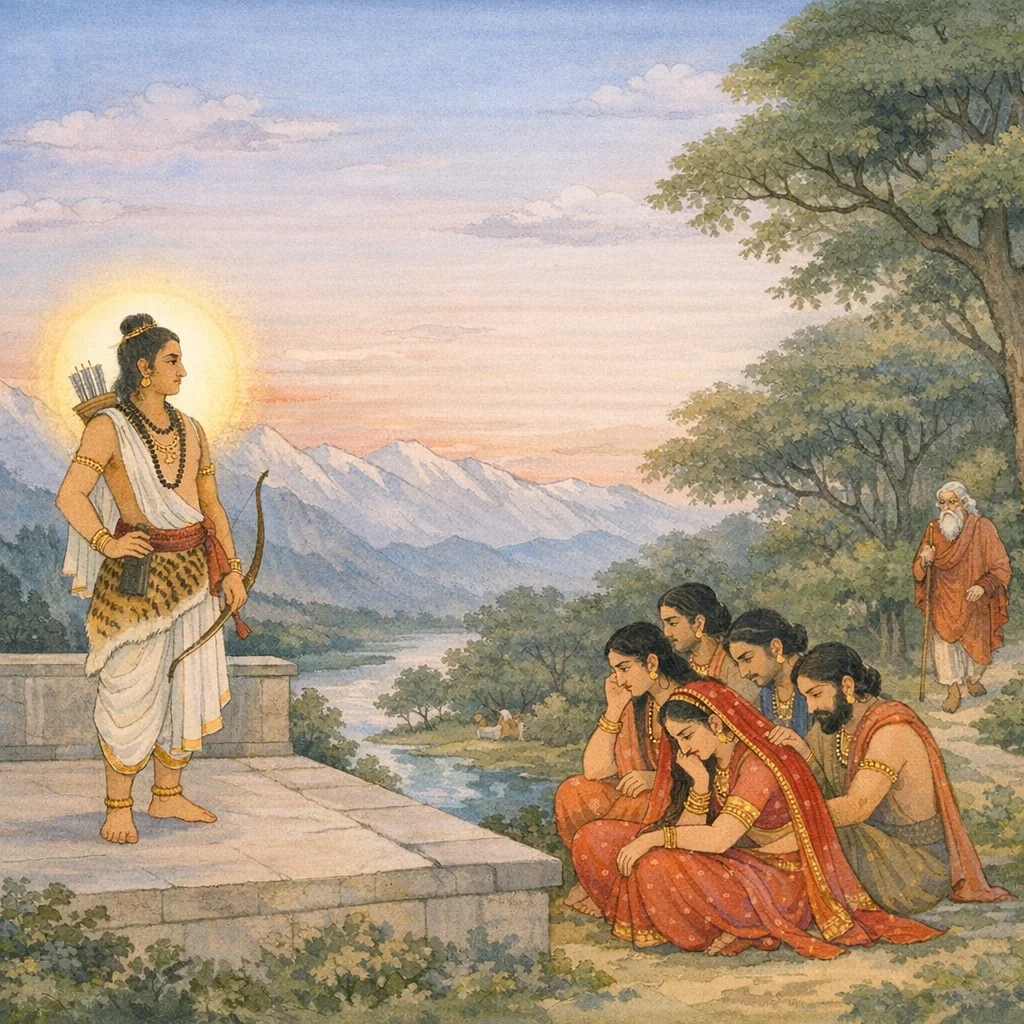
Arjuna’s Mantra-Empowerment and the Pāṇḍavas’ Separation (Śiva-rūpa through Mantra)
Framed as Nandīśvara’s report, this adhyāya turns to Arjuna’s visible transformation: he shines with extraordinary tejas, born of a mantra that manifests in Śiva-form (śivarūpa). The Pāṇḍavas take it as a sure omen of victory, affirming that true power arises from mantra aligned with Śiva. Counsel follows: the mission is declared Arjuna’s alone, and Vyāsa’s instruction serves as śāstric and ācārya authorization. Though reluctant in heart, they send him forth; Draupadī, grieving yet composed, offers an auspicious blessing that explicitly links Arjuna’s path to Śaṅkara’s favor. The chapter dwells on separation (viyoga) and its doubled sorrow even for the steadfast, revealing the human cost of dharma-driven duties. It closes with Vyāsa’s compassionate arrival among the mourning Pāṇḍavas, preparing further guidance within a Shaiva pedagogy where mantra, resolve, and grace govern outcomes.
Shlokas
Verse 1
नन्दीश्वर उवाच । अर्जुनोपि तदा तत्र दीप्यमानो व्यदृश्यत । मन्त्रेण शिवरूपेण तेजश्चातुलमावहत्
Nandīśvara said: Then Arjuna too was seen there, blazing with radiance; by the power of the mantra he had assumed Śiva’s form and bore an extraordinary splendor.
Verse 2
ते सर्वे चार्जुनन्दृष्ट्वा पाण्डवा निश्चयं गताः । जयोऽस्माकं धुवञ्जातन्तेजश्च विपुलं यतः
Seeing Arjuna, all the Pāṇḍavas became firm in resolve: “Victory for us is now certain, for from him a vast radiance and strength have arisen.”
Verse 3
इदङ्कार्य्यन्त्वया साध्यन्नान्येन च कदाचन । व्यासस्य वचनाद्भाति सफलं कुरु जीवितम्
“This task must be accomplished by you—and by no one else, at any time. By Vyāsa’s word it becomes evident; therefore, make your life fruitful.”
Verse 4
इति प्रोच्यार्जुनन्ते वै विरहौत्सुक्यकातराः । अनिच्छन्तोपि तत्रैव प्रेषयामासुरादरात्
Having spoken thus to Arjuna, those distressed by the yearning born of separation—though unwilling—respectfully sent him onward from there.
Verse 5
द्रौपदी दुःखसंयुक्ता नेत्राश्रूणि निरुध्य च । प्रेषयन्ती शुभं वाक्यन्तदोवाच पतिव्रता
Draupadī, overwhelmed with sorrow, checked the tears in her eyes; and that devoted wife then spoke, sending forth auspicious words.
Verse 6
द्रौपद्युवाच । व्यासोपदिष्टं यद्राजंस्त्वया कार्यं प्रयत्नतः । शुभप्रदोऽस्तु ते पन्थाश्शंकरश्शंकरोस्तु वै
Draupadī said: “O King, strive with full effort to do exactly what Vyāsa has instructed. May that path be auspicious and grant you welfare; indeed, may Śaṅkara—ever the giver of good—be your beneficent protector.”
Verse 7
ते सर्वे चावसंस्तत्र विसृज्यार्जुनमादरात् । अत्यन्तदुःखमापन्ना मिलित्वा पञ्च एव च
After respectfully sending Arjuna away, all of them remained there. Then the five, gathering together, were overcome by intense sorrow.
Verse 8
स्थितास्तत्र वदन्ति स्म श्रूयतामृषिसत्तम । दुःखेपि प्रियसंगो वै न दुःखाय प्रजायते
Remaining there, they spoke: “Listen, O best of sages. Even amid sorrow, communion with the beloved is never born as sorrow; it does not become a cause of suffering.”
Verse 9
वियोगे द्विगुणन्तस्य दुःखम्भवति नित्यशः । तत्र धैर्य्यधरस्यापि कथन्धैर्य्यम्भवेदिह
In separation, that person’s pain is doubled at every moment. In such a state, how could steadiness of heart arise here—even in one otherwise firm in patience?
Verse 10
नन्दीश्वर उवाच । कुर्वतस्त्वेव तदा दुःखम्पाण्डवेषु मुनीश्वरः । कृपासिंधुश्च स व्यास ऋषिवर्य्यस्समागत
Nandīśvara said: “At that time, when suffering had arisen among the Pāṇḍavas, the great sage Vyāsa—the foremost of seers and an ocean of compassion—came there.”
Verse 11
तन्तदा पाण्डवास्ते वै नत्वा सम्पूज्य चादरात् । दत्त्वासनं हि दुःखाढ्याः करौ बद्ध्वा वचोऽब्रुवन्
Then those Pāṇḍavas—laden with sorrow—bowed down, worshipped him with reverence, offered him a seat, and with folded hands spoke these words.
Verse 12
पाण्डवा ऊचुः । श्रूयतामृषभश्रेष्ठ दुःखदग्धा वयम्प्रभो । दर्शनन्तेऽद्य सम्प्राप्य ह्यानन्दं प्राप्नुमो मुने
The Pāṇḍavas said: “O best of sages, O Lord, please hear us. Scorched by sorrow, today we have attained your blessed darśana; and by this darśana, O muni, we are filled with joy.”
Verse 13
कियत्कालं वसात्रैव दुःखनाशाय नः प्रभो । दर्शनात्तव विप्रर्षेस्सर्वं दुःखं विलीयते
O Lord, how long will you dwell here solely to destroy our suffering? O foremost sage among the brāhmaṇas—by merely beholding you, all sorrow is dissolved.
Verse 14
नन्दीश्वर उवाच । इत्युक्तस्स ऋषिश्रेष्ठो न्यवसत्तत्सुखाय वै । कथाभिर्विविधाभिश्च तद्दुःखं नोदयंस्तदा
Nandīśvara said: “Thus addressed, that best of sages indeed stayed there for his host’s happiness; and then, by recounting various sacred narratives, he did not allow that sorrow to arise again.”
Verse 15
वार्तायां क्रियमाणायान्तेन व्यासेन सन्मुने । सुप्रणम्य विनीतात्मा धर्मराजोऽब्रवीदिदम्
O noble sage, as that Vyāsa, the virtuous muni, continued the discourse, Dharma-rāja (Yama), having bowed deeply with a humble heart, spoke these words.
Verse 16
धर्मराज उवाच । शृणु त्वं हि ऋषिश्रेष्ठ दुःखशान्तिर्मता मम । पृच्छामि त्वां महाप्राज्ञ कथनीयन्त्वया प्रभो
Dharmarāja said: “Listen, O best of sages. In my understanding, the true pacification of sorrow lies herein. I ask you, O greatly wise one—O Lord—please tell me what ought to be spoken.”
Verse 17
ईदृशं चैव दुःखं च पुरा प्राप्तश्च कश्चन । वयमेव परं दुःखं प्राप्ता वै नैव कश्चन
Has anyone in former times ever met with suffering like this? No one at all—only we have truly fallen into the utmost sorrow.
Verse 18
व्यास उवाच । राज्ञस्तु नलनाम्नो वै निषधाधिपतेः पुरा । भवद्दुःखाधिकं दुःखं जातन्तस्य महात्मनः
Vyāsa said: Formerly, for that great-souled King Nala, the lord of Niṣadha, there arose a sorrow even greater than the sorrow you now endure.
Verse 19
हरिश्चन्द्रस्य नृपतेर्जातं दुःखम्महत्तरम् । अकथ्यन्तद्विशेषेण परशोकावहन्तथा
For King Hariścandra, an exceedingly great sorrow arose—so intense that it is, in its particulars, beyond telling—bringing profound grief to others as well.
Verse 20
दुःखम्तथैव विज्ञेयं रामस्याप्यथ पाण्डव । यच्छ्रुत्वा स्त्रीनराणां च भवेन्मोहो महत्तरः
O Pāṇḍava, know that even Rāma too encountered such sorrow; and on hearing it, an even greater delusion arises in the minds of both women and men.
Verse 21
तस्माद्वर्णयितुन्नैव शक्यते हि मया पुनः । शरीरं दुःखराशिं च मत्वा त्याज्यन्त्वयाधुना
Therefore, I am truly unable to describe it further. Knowing the body to be a mere heap of suffering, you should renounce it now through detachment and take refuge in Śiva, the Lord who grants liberation.
Verse 22
येनेदञ्च धृतन्तेन व्याप्तमेव न संशयः । प्रथमम्मातृगर्भे वै जन्म दुःखस्य कारणम्
By That Supreme Lord through whom this entire world is sustained, it is indeed pervaded—there is no doubt. First of all, birth in the mother’s womb itself becomes the cause of suffering.
Verse 23
कौमारेऽपि महादुःखं बाललीलानुसारि यत् । ततोपि यौवने कामान्भुन्जानो दुःखरूपिणः
Even in childhood there is great sorrow, trailing behind childish play; and more than that, in youth one “enjoys” sense-pleasures that are, in truth, forms of suffering.
Verse 24
गतागतैर्दिनानां हि कार्यभारैरनेकशः । आयुश्च क्षीयते नित्यं न जानाति ह तत्पुनः
As days come and go, burdened again and again by countless worldly tasks, one’s lifespan steadily diminishes—yet the person does not truly realize this, again and again.
Verse 25
अन्ते च मरणं चैव महादुःखमतः परम् । नानानरकपीडाश्च भुज्यंतेज्ञैर्नरैस्सदा
And in the end there is death—an anguish greater than all. Thereafter, ignorant men continually undergo the torments of many hells.
Verse 26
तस्मादिदमसत्यं च त्वन्तु सत्यं समाचर । येनैव तुष्यते शम्भुस्तथा कार्यं नरेण च
Therefore, this is false; you, however, should practice what is true. A person must act only in that way by which Śambhu (Lord Śiva) is pleased.
Verse 27
नन्दीश्वर उवाच । एवं विविधवार्ताभिः कालनिर्यापणन्तदा । चक्रुस्ते भ्रातरः सर्वे मनोरथपथैः पुनः
Nandīśvara said: “Thus, at that time, they whiled away the hours with many kinds of talk; and all those brothers once more set themselves upon the paths of their own wishes and designs.”
Verse 28
अर्जुनोपि स्वयं गच्छन्दुर्गाद्रिषु दृढव्रतः । यक्षं लब्ध्वा च तेनैव दस्यून्निघ्नन्ननेकशः
Arjuna too, steadfast in his vow, went alone into the harsh fastnesses of the mountains. There he obtained a Yakṣa (a divine being), and by that very power he struck down many bandits again and again.
Verse 29
मनसा हर्षसंयुक्तो जगामाचलमुत्तमम् । तत्र गत्वा च गंगायास्समीपं सुन्दरं स्थलम्
With his mind suffused with joy, he went to that most excellent mountain. Having arrived there, he came to a beautiful spot near the river Gaṅgā.
Verse 30
अशोककाननं यत्र तिष्ठति स्वर्ग उत्तमः । तत्र तस्थौ स्वयं स्नात्वा नत्वा च गुरुमुत्तमम्
Where the Aśoka grove stands—like an excellent heaven—there he remained. Having bathed there himself, he bowed to the supreme Guru and stayed on.
Verse 31
यथोपदिष्टं वेषादि तथा चैवाकरोत्स्वयम् । इन्द्रियाण्यपकृष्यादौ मनसा संस्थितोऽभवत्
Just as he had been instructed, he himself arranged the prescribed attire and the rest. Then, withdrawing the senses from the very outset, he became firmly established in the mind—steady in inner recollection of Śiva.
Verse 32
पुनश्च पार्थिवं कृत्वा सुन्दरं समसूत्रकम् । तदग्रे प्रणिदध्यौ स तेजोराशिमनुत्तमम्
Then again, having fashioned a beautiful earthen emblem, well-proportioned and evenly formed, he fixed his awareness before it and meditated upon the unsurpassed mass of divine radiance—the supreme Light of Lord Śiva.
Verse 33
त्रिकालं चैव सुस्नातः पूजनं विविधं तदा । चकारोपासनन्तत्र हरस्य च पुनः पुनः
Having bathed well at the three sacred times of day, he then performed diverse forms of worship; and there, again and again, he carried out devoted adoration of Hara (Lord Śiva).
Verse 34
तस्यैव शिरसस्तेजो निस्सृतन्तच्चरास्तदा । दृष्ट्वा भयं समापन्नाः प्रविष्टश्च कदा ह्ययम्
From that very head, a blazing radiance burst forth. Seeing it, those beings were seized with fear and wondered, “When indeed did this one enter here?”
Verse 35
पुनस्ते च विचार्यैवं कथनीयं बिडौजसे । इत्युक्त्वा तु गतास्ते वै शक्रस्यान्तिकमञ्जसा
Reflecting again in this way, they concluded, “This must be reported to Biḍaujas (Indra).” Having said so, those messengers quickly went to the presence of Śakra (Indra).
Verse 36
चरा ऊचुः । देवो वाऽथ ऋषिश्चैव सूर्यो वाथ विभावसुः । तपश्चरति देवेश न जानीमो वने च तम्
The spies said: “O Lord of gods, we do not know who that one is in the forest, performing austerities—whether he is a god, or a sage, or the Sun, or even Fire, Agni.”
Verse 37
तस्यैव तेजसा दग्धा आगतास्तव सन्निधौ । निवेदितञ्चरित्रं तत्क्रियतामुचितन्तु यत्
Scorched by his very radiance, we have come into your presence. Our account has been submitted—now, please do what is proper and fitting.
Verse 38
इति श्रीशिवमहापुराणे तृतीयायां शतरुद्रसंहितायां किरातावतारवर्णनप्रसंगेऽर्जुनतपोवर्णनं नामाष्टत्रिंशोऽध्यायः
Thus, in the sacred Śiva Mahāpurāṇa, in the Third Book—the Śatarudra Saṃhitā—within the narrative of the Kirāta incarnation, the thirty-eighth chapter, entitled “The Description of Arjuna’s Penance,” comes to its close.
Verse 39
स वृद्धब्राह्मणो भूत्वा ब्रह्मचारी शचीपतिः । जगाम तत्र विप्रेन्द्र परीक्षार्थं हि तस्य वै
O best of Brahmins, Śacī’s lord (Indra) assumed the form of an aged brāhmaṇa and a brahmacārin, and went there indeed—solely to test him.
Verse 40
तमागतन्तदा दृष्ट्वाकार्षीत्पूजाश्च पाण्डवः । स्थितोग्रे च स्तुतिं कृत्वा क्वायातोसि वदाधुना
Seeing him arrive just then, the Pāṇḍava performed due worship. Standing before him, he offered praise and then asked, “From where have you come? Tell me now.”
Verse 41
इत्युक्तस्तेन देवेशो धैर्य्यार्थन्तस्य प्रीतितः । परीक्षागर्वितं वाक्यं पाण्डवन्तं ततोऽब्रवीत्
Thus addressed by him, the Lord of the Devas, pleased and wishing to test his steadfastness, then spoke to that son of Pāṇḍu words laden with a probing challenge.
Verse 42
ब्राह्मण उवाच । नवे वयसि वै तात किन्तपस्यसि साम्प्रतम् । मुक्त्यर्थं वा जयार्थं किं सर्वथैतत्तपस्तव
The Brāhmaṇa said: “O dear child, you are still in the fresh bloom of youth—why do you perform austerities now? Is this penance for liberation (mokṣa), or for victory and worldly attainment? In truth, for what purpose is this austerity of yours?”
Verse 43
नन्दीश्वर उवाच । इति पृष्टस्तदा तेन सर्वं संवेदितम्पुनः । तच्छ्रुत्वा स पुनर्वाक्यमुवाच ब्राह्मणस्तदा
Nandīśvara said: Thus, when he was questioned by him, everything was explained again in full. Having heard that, the brāhmaṇa then spoke once more.
Verse 44
ब्राह्मण उवाच । युक्तं न क्रियते वीर सुखं प्राप्तुं च यत्तपः । क्षात्रधर्मेण क्रियते मुक्त्यर्थं कुरुसत्तम
The Brāhmaṇa said: “O hero, austerity undertaken merely to obtain worldly pleasure is not proper. But when that same discipline is performed in accordance with the Kṣatriya’s dharma, for the sake of liberation, O best of the Kurus, it becomes rightful.”
Verse 46
इन्द्रस्तु सुखदाता वै मुक्तिदाता भवेन्न हि । तस्मात्त्वं सर्वथा श्रेष्ठ कर्तुमर्हसि सत्तपः । नन्दीश्वर उवाच । इदन्तद्वचनं श्रुत्वा क्रोधं चक्रेऽर्जुनस्तदा । प्रत्युवाच विनीतात्मा तदनादृत्य सुव्रतः
“Indra is indeed a giver of worldly pleasures, but he is not a giver of liberation. Therefore you are superior in every way; O noble ascetic, you should undertake the true austerity (that leads to Śiva).” Nandīśvara said: Hearing these words, Arjuna became angry at that moment; yet, disciplined and self-controlled, he replied, disregarding that statement.
Verse 47
अर्जुन उवाच । राज्यार्थं न च मुक्त्यर्थ किमर्थं भाषसे त्विदम् । व्यासस्य वचनेनैव क्रियते तप ईदृशम्
Arjuna said: “This austerity is not undertaken for the sake of a kingdom, nor for liberation—so why do you speak of it in that way? Such tapas is performed solely in obedience to Vyāsa’s command.”
Verse 48
इतो गच्छ ब्रह्मचारिन्मा पातयितुमिच्छसि । प्रयोजनं किमत्रास्ति तव वै ब्रह्मचारिणः
“Go away from here, O brahmacārin; do not wish to make me fall from my vow. What purpose could there be for you here, O celibate student?”
Verse 49
नन्दीश्वर उवाच । इत्युक्तः स प्रसन्नोभूत्सुन्दरं रूपमद्भुतम् । स्वोपस्करणसंयुक्तं दर्शयामास वै निजम्
Nandīśvara said: Thus addressed, he was pleased and revealed his own wondrous, beautiful form—adorned with his proper divine accoutrements.
Verse 50
शक्ररूपन्तदा दृष्ट्वा लज्जितश्चार्जुनस्तदा । स इन्द्रस्तं समाश्वास्य पुनरेव वचोब्रवीत्
Seeing that very form of Śakra (Indra), Arjuna felt ashamed. Then Indra reassured him and once again spoke these words.
Verse 51
इंद्र उवाच । वरं वृणीष्व हे तात धनंजय महामते । यदिच्छसि मनोभीष्टन्नादेयं विद्यते तव
Indra said: “O dear one—Dhanañjaya, wise and noble—choose a boon. Whatever you desire, even what your heart most longs for, is not beyond being granted to you.”
Verse 52
तच्छ्रुत्वा शक्रवचनम्प्रत्युवाचार्जुनस्तदा । विजयन्देहि मे तात शत्रुक्लिष्टस्य सर्वथा
Hearing Śakra (Indra)’s words, Arjuna replied at once: “O revered father, grant me victory completely, for I am sorely afflicted by the enemies in every way.”
Verse 53
शक्र उवाच । बलिष्ठाश्शत्रवस्ते च दुर्योधनपुरःसराः । द्रोणो भीमश्च कर्णश्च सर्वे ते दुर्जया धुवम्
Śakra (Indra) said: “Your enemies are exceedingly mighty, led by Duryodhana. Droṇa, Bhīma, and Karṇa—indeed all of them—are certainly difficult to conquer.”
Verse 54
अश्वत्थामा द्रोणपुत्रो रौद्रोंशो दुर्जयोऽति सः । मया साध्या भवेयुस्ते सर्वथा स्वहितं शृणु
“He is Aśvatthāmā, the son of Droṇa—invincible, a portion (aṃśa) of Rudra-like power. By me, your aims shall be accomplished in every way; listen to what is truly for your own welfare.”
Verse 55
एतद्वीर जपं कर्तुं न शक्तः कश्चनाधुना । वर्तते हि शिवोवर्यस्तस्माच्छम्भोर्जयोऽ धुना
O hero, in this age no one is capable of performing this heroic japa in its full power. For the most excellent Śiva Himself is present as the supreme refuge; therefore, victory belongs to Śambhu even now.
Verse 56
शंकरः सर्वलोकेशश्चराचरपतिः स्वराट् । सर्वं कर्तुं समर्थोस्ति भुक्तिमुक्तिफलप्रदः
Śaṅkara is the Lord of all worlds, the sovereign Master of all that moves and does not move. He is able to accomplish everything and bestows the fruits of both bhukti (worldly enjoyment) and mukti (liberation).
Verse 57
अहं मन्ये च ब्रह्माद्या विष्णुः सर्ववरप्रदः । अन्ये जिगीषवो ये च ते सर्वे शिवपूजकाः
I deem that even Brahmā and the other gods—and Viṣṇu, bestower of every boon—together with all who strive for victory, are in truth all worshippers of Śiva.
Verse 58
अद्यप्रभृति तन्मन्त्रं हित्वा भक्त्या शिवं भज । पार्थिवेन विधानेन ध्यानेनैव शिवस्य च
From this day onward, abandon that (other) mantra and worship Śiva with devotion—performing the prescribed rite of the earthen (Pārthiva) liṅga, and also by meditating upon Śiva alone.
Verse 59
उपचारैरनेकैश्च सर्वभावेन भारत । सिद्धिः स्यादचला तेद्य नात्र कार्या विचारणा
O Bhārata, by worshipping with many sacred offerings and with your whole being, unwavering spiritual attainment becomes yours even today; here there is no need for doubt or further deliberation.
Verse 60
नन्दीश्वर उवाच । इत्युक्त्वा च चरान्सर्वान्समाहूयाब्रवीदिदम् । सावधानेन वै स्थेयमेतत्संरक्षणे सदा
Nandīśvara said: “Having spoken thus, he summoned all the scouts and said: ‘You must always remain vigilant in guarding and protecting this.’”
Verse 61
प्रबोध्य स्वचरानिन्द्रोऽर्जुनसंरक्षणादिकम् । वात्सल्यपूर्णहृदयः पुनरूचे कपिध्वजम्
Having roused his own attendants and arranged matters such as the protection of Arjuna, Indra—his heart filled with affectionate concern—again addressed Arjuna, the one whose banner bears the monkey emblem.
Verse 62
इन्द्र उवाच । राज्यं त्वया प्रमादाद्वै न कर्तव्यं कदाचन । श्रेयसे भद्र विद्येयं भवेत्तव परन्तप
Indra said: “In matters of kingship, never at any time should you, through heedlessness, act carelessly. For your true welfare, O noble one—subduer of foes—know this and hold it firmly.”
Verse 63
धैर्यं धार्य साधकेन सर्वथा रक्षकः शिवः । संपत्तीश्च फलन्तुल्यं दास्यते नात्र संशयः
The spiritual aspirant should always uphold steadfast courage, for Śiva is the unfailing Protector in every way. He will surely bestow prosperity and fruits commensurate with one’s practice—of this there is no doubt.
Verse 64
नन्दीश्वर उवाच । इति दत्त्वा वरन्तस्य भारतस्य सुरेश्वरः । स्मरञ्छिवपदाम्भोजञ्जगाम भवनं स्वकम्
Nandīśvara said: “Thus, having granted that boon to Bharata, the Lord of the gods departed to His own abode, keeping in remembrance the lotus-feet of Lord Śiva.”
Verse 65
अर्जुनोपि महावीरस्सुप्रणम्य सुरेश्वरम् । तपस्तेपे संयतात्मा शिवमुद्दिश्य तद्विधम्
Arjuna too, that great hero, bowed with deep reverence to the Lord of the gods, and with a disciplined mind performed austerities in the prescribed manner, directing his worship toward Lord Śiva.
Frequently Asked Questions
Arjuna is seen blazing with tejas produced by a mantra that manifests as Śiva-form (śivarūpeṇa), and the Pāṇḍavas treat this as a theologically grounded assurance of success—victory is read as the downstream effect of Śiva-aligned mantra power and Vyāsa-authorized duty.
Śivarūpa indicates that mantra is not merely verbal but a transformative mode that configures the practitioner’s presence into a Śiva-coded potency; tejas functions as the outward sign of inner alignment—an epistemic marker that power and protection arise when agency is yoked to Śiva through mantra.
Rather than a named iconographic form (e.g., a particular mūrti), the chapter highlights Śiva as mantra-mediated presence—Śaṅkara as the auspicious lord who grants a ‘śubha panthā’ (fortunate path) and whose ‘rūpa’ is assumed through mantra-empowerment.