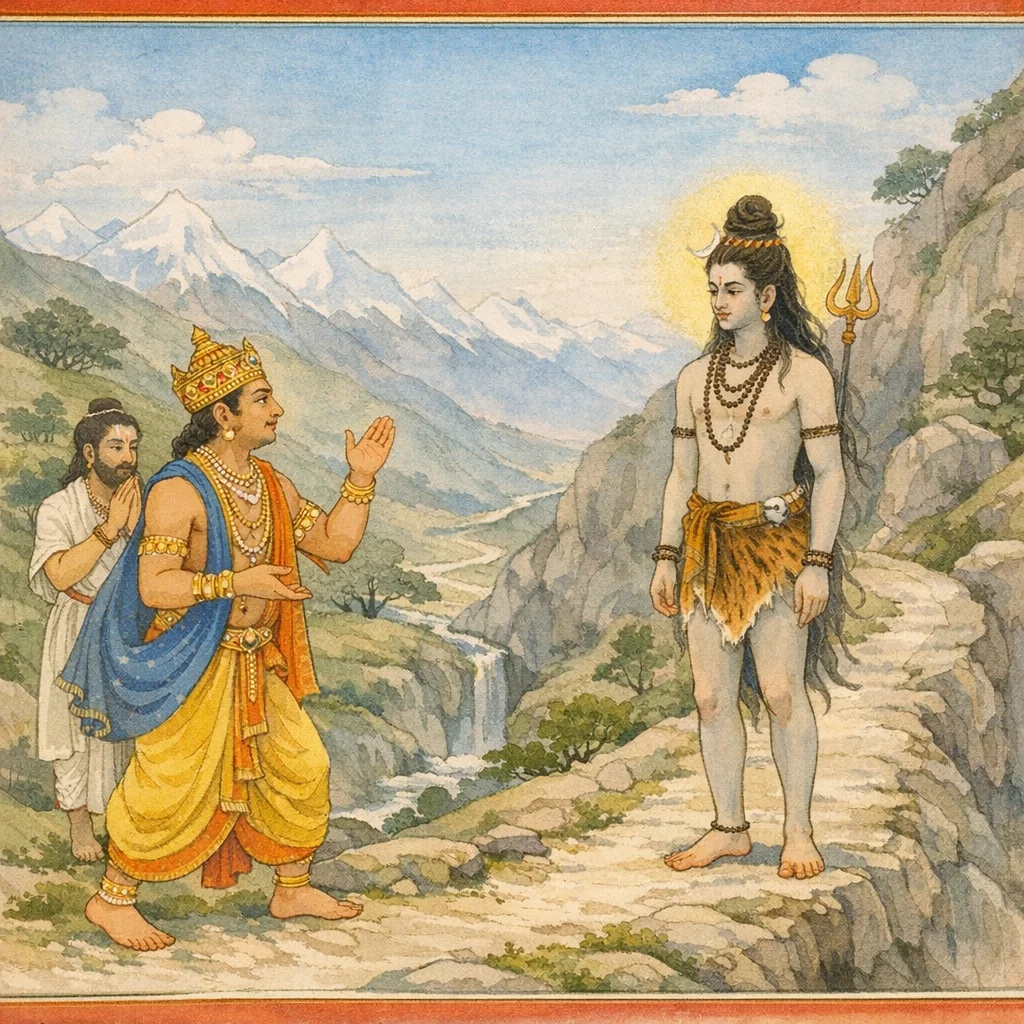
कैलासमार्गे शङ्करस्य परीक्षा — Śiva Tests the Approachers on the Kailāsa Path
Adhyāya 13 unfolds as a nested narration: Vyāsa asks for a detailed account of Śiva’s deed and spotless fame, and Sūta reports Sanatkumāra’s reply. The focus then turns to Jīva and Indra (Śakra/Puraṃdara), who, impelled by intense devotion, journey toward Kailāsa to seek Śiva’s darśana. Knowing their approach, Śiva resolves to test (parīkṣā) their understanding and inner disposition. Midway on the path he blocks the route in a striking digambara form—matted hair bound up, austere yet radiant, fearsome and extraordinary. Indra, puffed up by the pride of office (svādhikāra) and failing to recognize Śiva, questions him: who he is, where he came from, and whether Śambhu is at home or has gone elsewhere. Through this encounter the chapter highlights recognition versus misrecognition, the danger of institutional arrogance, and the proper spiritual etiquette of approaching the Divine: humility and discernment, not entitlement.
Shlokas
Verse 1
व्यास उवाच । भो ब्रह्मन्भगवन्पूर्वं श्रुतं मे ब्रह्मपुत्रक । जलंधरं महादैत्यमवधीच्छंकरः प्रभुः
Vyāsa said: “O revered Brahman, O blessed one—O son of Brahmā—earlier I heard that Lord Śaṅkara, the sovereign Master, slew the great Daitya Jalandhara.”
Verse 2
तत्त्वं वद महाप्राज्ञ चरितं शशिमौलिनः । विस्तारपूर्वकं शृण्वन्कस्तृप्येत्तद्यशोऽमलम्
O greatly wise one, speak the true purport and the sacred deeds of the Moon-crested Lord, Śiva. Who, hearing them in full detail, could ever be satisfied—so spotless is His glory?
Verse 3
सूत उवाच । इत्येवं व्याससंपृष्टो ब्रह्मपुत्रो महामुनिः । उवाचार्थवदव्यग्रं वाक्यं वाक्यविशारदः
Sūta said: Thus questioned by Vyāsa, that great sage—the son of Brahmā—skilled in speech, spoke meaningful words, composed and undistracted.
Verse 4
सनत्कुमार उवाच । एकदा जीवशक्रौ च भक्त्या परमया मुने । दर्शनं कर्तुमीशस्य कैलासं जग्मतुर्भृशम्
Sanatkumāra said: O sage, once Jīva and Śakra, filled with supreme devotion, set out earnestly for Kailāsa to obtain the direct darśana of the Lord Īśa.
Verse 5
अथ गुर्विन्द्रयोर्ज्ञात्वागमनं शंकरः प्रभुः । परीक्षितुं तयोर्ज्ञानं स्वदर्शनरतात्मनोः
Then Lord Śaṅkara, learning of the approach of the Guru and Indra, resolved to test their understanding—those two whose minds were intent on attaining His own divine vision.
Verse 6
महातेजस्विनं शांतं जटासंबद्धमस्तकम् । महाबाहुं महोरस्कं गौरं नयनभीषणम्
He beheld one of immense radiance yet perfectly tranquil, whose head was bound with matted jaṭā locks; mighty-armed and broad-chested, fair in hue, and awe-inspiring to the eyes.
Verse 7
अथ तौ गुरुशक्रौ च कुर्वंतौ गमनं मुदा । आलोक्य पुरुषं भीमं मार्गमध्येऽद्भुताकृतिम्
Then those two—Bṛhaspati, the preceptor, and Śakra (Indra)—went on their way in joy. On the path they beheld a fearsome person of wondrous, extraordinary form standing before them.
Verse 9
अथो पुरंदरोऽपृच्छत्स्वाधिकारेण दुर्मदः । पुरुषं तं स्वमार्गांतस्थितमज्ञाय शंकरम्
Then Purandara (Indra), intoxicated with pride in his own authority, questioned that Person standing at the end of his path, not recognizing Him to be Śaṅkara, Lord Śiva.
Verse 10
पुरन्दर उवाच । कस्त्वं भोः कुत आयातः किं नाम वद तत्त्वतः । स्वस्थानेसंस्थितश्शंभु किं वान्यत्र गतः प्रभुः
Purandara (Indra) said: “Sir, who are you? From where have you come? Tell me your name truthfully. Is Śambhu, the Lord, established in His own abode, or has that Supreme Master gone elsewhere?”
Verse 11
सनत्कुमार उवाच । शक्रेणेत्थं स पृष्टस्तु किंचिन्नोवाच तापसः । शक्रः पुनरपृच्छद्वै नोवाच स दिगंबरः
Sanatkumāra said: Thus questioned by Śakra (Indra), that ascetic said nothing at all. Śakra asked again, but the sky-clad renunciant (digambara) still did not speak.
Verse 12
पुनः पुरंदरोऽपृच्छ्ल्लोकानामधिपेश्वरः । तूष्णीमास महायोगी लीलारूपधरः प्रभुः
Again Indra, lord of the worlds, questioned him; but the Supreme Lord—the great Yogi who assumes forms in divine play—remained silent.
Verse 13
इति श्रीशिवमहापुराणे द्वितीयायां रुद्रसंहितायां पंचमे युद्धखण्डे जलंधरवधोपाख्याने शक्रजीवनं नाम त्रयोदशोऽ ध्यायः
Thus, in the Śrī Śiva Mahāpurāṇa, in the second section called the Rudra Saṃhitā, within the fifth division, the Yuddha-khaṇḍa, in the episode concerning the slaying of Jalandhara, ends the thirteenth chapter titled “Śakrajīvana” (the restoring of Indra).
Verse 14
अथ चुक्रोध देवेशस्त्रैलोक्यैश्वर्यगर्वितः । उवाच वचनं चैव तं निर्भर्त्स्य जटाधरम्
Then the lord of the gods, puffed up with pride in his sovereignty over the three worlds, flared up in anger; and, rebuking that matted-haired ascetic, he spoke these words.
Verse 15
इन्द्र उवाच । रे मया पृच्छ्यमानोऽपि नोत्तरं दत्तवानसि । अतस्त्वां हन्मि वज्रेण कस्ते त्रातास्ति दुर्मते
Indra said: “Hey! Though questioned by me, you have given no reply. Therefore I will strike you with the thunderbolt—who is there to protect you, O evil-minded one?”
Verse 16
सनत्कुमार उवाच । इत्युदीर्य ततो वज्री संनिरीक्ष्य क्रुधा हि तम् । हंतुं दिगंबरं वज्रमुद्यतं स चकार ह
Sanatkumāra said: Having spoken thus, Vajrī glared at him in anger and raised his thunderbolt, intent on slaying the sky-clad Digambara.
Verse 17
पुरंदरं वज्रहस्तं दृष्ट्वा देवस्सदाशिवः । चकार स्तंभनं तस्य वज्रपातस्य शंकरः
Seeing Purandara (Indra) with the vajra in his hand, the Lord Sadāśiva—Śaṅkara—checked that very fall of the vajra and rendered its force powerless.
Verse 18
ततो रुद्रः क्रुधाविष्टः करालाक्षो भयंकरः । द्रुतमेव प्रजज्वाल तेजसा प्रदहन्निव
Then Rudra, seized by wrath—terrible-eyed and awe-inspiring—blazed forth at once, as though scorching all things with His fiery splendour.
Verse 19
बाहुप्रतिष्टंभभुवामन्युनांतश्शचीपतिः । समदह्यत भोगीव मंत्ररुद्धपराक्रमः
Then Śacī’s lord (Indra), whose strength and valour had been restrained by the power of mantra, was scorched by the wrath of those once checked by his arms—like a serpent burning within itself.
Verse 20
दृष्ट्वा बृहस्पतिस्तूर्णं प्रज्वलंतं स्वतेजसा । पुरुषं तं धिया ज्ञात्वा प्रणनाम हरं प्रभुम्
Seeing that Divine Person blaze forth at once with His own innate splendour, Bṛhaspati recognized Him through discerning insight and bowed down in reverence to Hara, the Supreme Lord.
Verse 21
कृतांजलिपुटो भूत्वा ततो गुरुरुदारधीः । नत्वा च दंडवद्भूमौ प्रभुं स्तोतुं प्रचक्रमे
Then the noble-minded Guru, joining his hands in a reverent añjali, bowed to the Lord by prostrating upon the earth like a staff, and began to offer Him praise.
Verse 22
गुरुरुवाच । नमो देवाधिदेवाय महादेवाय चात्मने । महेश्वराय प्रभवे त्र्यम्बकाय कपर्दिने
The Guru said: “Salutations to the God of gods—to Mahādeva, the very Self within; to Maheśvara, the sovereign Lord; to Prabhava, the primal source; to Tryambaka, the Three‑eyed One; and to Kapardin, the matted‑haired Lord.”
Verse 23
दीननाथाय विभवे नमोंऽधकनिषूदिने । त्रिपुरघ्नाय शर्वाय ब्रह्मणे परमेष्ठिने
Salutations to the Lord of the afflicted, the all‑powerful One; salutations to the slayer of Andhaka. Salutations to the destroyer of Tripura, to Śarva, to the Supreme Brahman—the Highest Lord who presides over all.
Verse 24
विरूपाक्षाय रुद्राय बहुरूपाय शंभवे । विरूपायातिरूपाय रूपातीताय ते नमः
Salutations to You—Rudra, the Virūpākṣa, Lord of wondrous and transcendent sight; Śambhu of manifold forms; You who are beyond ordinary form, beyond even all supernal forms, and who ultimately transcend form altogether.
Verse 25
यज्ञविध्वंसकर्त्रे च यज्ञानां फलदायिने । नमस्ते मखरूपाय परकर्मप्रवर्तिने
Salutations to You—who can bring sacrificial rites to an end, yet who alone bestows the true fruits of all sacrifices; obeisance to You, who are the very form of Makha (the sacrifice), and who set beings in motion toward the actions ordained by their karma.
Verse 26
कालांतकाय कालाय कालभोगिधराय च । नमस्ते परमेशाय सर्वत्र व्यापिने नमः
Salutations to You—the Slayer of Death, Time itself, and the Bearer of the serpent of Time. Salutations to You, O Parameśvara, the all-pervading Lord, present everywhere.
Verse 27
नमो ब्रह्मशिरोहंत्रे ब्रह्मचंद्र स्तुताय च । ब्रह्मण्याय नमस्तेऽस्तु नमस्ते परमात्मने
Salutations to You, slayer of Brahmā’s head; salutations to You, praised by Brahmā and by the Moon. Salutations to You, protector and benefactor of the devoted; salutations to You, the Supreme Self (Paramātman).
Verse 28
त्वमग्निरनिलो व्योम त्वमेवापो वसुंधरा । त्वं सूर्यश्चन्द्रमा भानि ज्योतिश्चक्रं त्वमेव हि
You are fire, wind, and the vast expanse of space; You alone are the waters and the earth. You are the sun and the moon, the shining lights—indeed, the entire wheel of luminous bodies is none other than You.
Verse 29
त्वमेव विष्णुस्त्वं ब्रह्मा तत्स्तुतस्त्वं परेश्वरः । मुनयः सनकाद्यास्त्वं नारदस्त्वं तपोधनः
You alone are Viṣṇu; You are Brahmā. You are the Supreme Lord (Pareśvara) who is praised even by them. You are the sages—Sanaka and the rest—and You are Nārada, the ascetic rich in tapas.
Verse 30
त्वमेव सर्व लोकेशस्त्वमेव जगदात्मकः । सर्वान्वयस्सर्वभिन्नस्त्वमेव प्रकृतेः परः
You alone are the Lord of all worlds; You alone are the very Self of the universe. You pervade all as their inner connection, yet You remain distinct from all; You alone transcend Prakṛti (material nature).
Verse 31
त्वं वै सृजसि लोकांश्च रजसा विधिनामभाक् । सत्त्वेन हरिरूपस्त्वं सकलं यासि वै जगत्
Truly, through rajas You create the worlds, taking up the office of Brahmā. Through sattva You assume the form of Hari (Viṣṇu) and pervade the entire universe.
Verse 32
त्वमेवासि महादेव तमसा हररूपधृक् । लीलया भुवनं सर्वं निखिलं पांचभौतिकम्
You alone are Mahādeva. By the power of tamas You assume the form of Hara; and by Your līlā, Your divine play, You pervade and sustain this entire universe, wholly constituted of the five elements.
Verse 33
त्वद्ध्यानबलतस्सूर्यस्तपते विश्वभावन । अमृतं च्यवते लोके शशी वाति समरिणः
O Nourisher of the universe, by the power of meditation upon You the sun gives heat; the moon causes amṛta to flow in the world; and the wind blows—everything moves and functions through Your indwelling sovereignty.
Verse 34
त्वद्ध्यानबलतो मेघाश्चांबु वर्षंति शंकर । त्वद्ध्यानबलतश्शक्रस्त्रिलोकीं पाति पुत्रवत्
O Śaṅkara, by the power of meditation upon You, the clouds pour down rainwater; by the power of meditation upon You, Śakra (Indra) protects the three worlds as though they were his own children.
Verse 35
त्वद्ध्यानबलतो मेघाः सर्वे देवा मुनीश्वराः । स्वाधिकारं च कुर्वंति चकिता भवतो भयात्
By the power of meditation upon You, the clouds, all the gods, and the lordly sages perform their appointed functions—yet they do so in awe, trembling in fear of You.
Verse 36
त्वत्पादकमलस्यैव सेवनाद्भुवि मानवाः । नाद्रियन्ते सुरान्रुद लोकैश्वर्यं च भुंजते
O Rudra, by serving Your lotus-feet alone, people on earth no longer depend on the gods; they come to enjoy sovereignty and prosperity in the worlds.
Verse 37
त्वत्पादकमलस्यैव सेवनादगमन्पराम् । गतिं योगधना नामप्यगम्यां सर्वदुर्लभाम्
By serving Your lotus-feet alone, they attained the supreme state—an incomparable goal called “the wealth of Yoga,” a destination inaccessible to the undevout and exceedingly rare for all.
Verse 38
सनत्कुमार उवाच । बृहस्पतिरिति स्तुत्वा शंकरं लोकशंकरम् । पादयो पातयामास तस्येशस्य पुरंदरम्
Sanatkumāra said: Having praised Śaṅkara—the benefactor of the worlds—(Indra) invoked Bṛhaspati; then Purandara (Indra) caused himself to fall at the feet of that Lord, the supreme Īśa.
Verse 39
पातयित्वा च देवेशमिंद्रं नत शिरोधरम् । बृहस्पतिरुवाचेदं प्रश्रयावनतश्शिवम्
Having caused Indra, the lord of the gods, to fall—his head bowed in submission—Bṛhaspati then spoke these words to Śiva, with reverence and humility.
Verse 40
बृहस्पतिरुवाच । दीननाथ महादेव प्रणतं तव पादयोः । समुद्धर च शांतं स्वं क्रोधं नयनजं कुरु
Bṛhaspati said: “O Mahādeva, refuge of the helpless! I bow at Your feet. Please lift up and protect Your devotee; and pacify Your own anger—born of the eyes—making it serene.”
Verse 41
तुष्टो भव महादेव पाहीद्र शरणागतम् । अग्निरेव शमं यातु भालनेत्रसमुद्भवः
“Be gracious, O Mahādeva. Protect Indra who has come seeking refuge. May this fire—born from Your brow-eye—be pacified and subside.”
Verse 42
सनत्कुमार उवाच । इत्याकर्ण्य गुरोर्वाक्यं देवदेवो महेश्वरः । उवाच करुणासिन्धुर्मेघनिर्ह्रादया गिरा
Sanatkumāra said: Thus hearing the words of his guru, Mahādeva—the God of gods, Maheśvara—an ocean of compassion, spoke in a voice that resounded like the rumbling of clouds.
Verse 43
महेश्वर उवाच । क्रोधं च निस्सृते नेत्राद्धारयामि बृहस्पतेः । कथं हि कञ्चुकीं सर्पस्संधत्ते नोज्झितां पुनः
Mahādeva said: “O Bṛhaspati, even when wrath has issued forth from My eye, I restrain it and bear it. How, indeed, can a serpent take up again the sloughed skin—once it has been cast off?”
Verse 44
सनत्कुमार उवाचु । इति श्रुत्वा वचस्तस्य शंकरस्य बृहस्पतिः । उवाच क्लिष्टरूपश्च भयव्याकुलमानसः
Sanatkumāra said: Hearing those words of Śaṅkara, Bṛhaspati—his appearance strained and his mind shaken with fear—spoke.
Verse 45
बृहस्पतिरुवाच । हे देव भगवन्भक्ता अनुकंप्याः सदैव हि । भक्तवत्सलनामेति त्वं सत्यं कुरु शंकर
Bṛhaspati said: “O Deva, O Blessed Lord—your devotees are ever worthy of compassion indeed. Therefore, O Śaṅkara, make your name ‘Bhakta-vatsala’ (Tender to devotees) true in deed.”
Verse 46
क्षेप्तुमन्यत्र देवेश स्वतेजोऽत्युग्रमर्हसि । उद्धर्तस्सर्वभक्तानां समुद्धर पुरंदरम्
O Lord of the gods, direct your exceedingly fierce divine power elsewhere. You are the rescuer of all devotees—therefore, lift up and save Purandara (Indra).
Verse 47
सनत्कुमार उवाच । इत्युक्तो गुरुणा रुद्रो भक्तवत्सलनामभाक् । प्रत्युवाच प्रसन्नात्मा सुरेज्यं प्रणतार्त्तिहा
Sanatkumāra said: Thus addressed by his Guru, Rudra—renowned as the tender guardian of devotees—replied with a serene heart. He, the One worshipped even by the gods, the remover of the distress of those who bow down, spoke in response.
Verse 48
शिव उवाच । प्रीतः स्तुत्यानया तात ददामि वरमुत्तमम् । इन्द्रस्य जीवदानेन जीवेति त्वं प्रथां व्रज
Śiva said: “Dear child, pleased by this hymn of praise, I grant you an excellent boon. Since you have bestowed life upon Indra, go forth and become renowned by the name ‘Jīva’ (the Life-giver).”
Verse 49
समुद्भूतोऽनलो योऽयं भालनेत्रात्सुरेशहा । एनं त्यक्ष्याम्यहं दूरं यथेन्द्रं नैव पीडयेत्
“This fire that has arisen from the Eye on Shiva’s forehead is a slayer of the lords of the gods. I shall cast it far away, so that it may not afflict Indra.”
Verse 50
सनत्कुमार उवाच् । इत्युक्त्वा तं करे धृत्वा स्वतेजोऽनलमद्भुतम् । भालनेत्रात्समुद्भूतं प्राक्षिपल्लवणांभसि
Sanatkumāra said: Having spoken thus, he took in his hand that wondrous fire—his own radiant tejas—born from the eye upon the forehead, and cast it into the salty waters of the sea.
Verse 51
ततश्चांतर्दधे रुद्रो महालीलाकरः प्रभुः । गुरुशक्रौ भयान्मुक्तौ जग्मतुः सुखमुत्तमम्
Thereupon Lord Rudra—the sovereign who performs great divine līlā—vanished from sight. Freed from fear, both Guru (Bṛhaspati) and Śakra (Indra) departed, attaining the highest peace and well-being.
Verse 52
यदर्थं गमनोद्युक्तौ दर्शनं प्राप्य तस्य वै । कृतार्थौ गुरुशक्रौ हि स्वस्थानं जग्मतुर्मुदा
Having obtained the very sight (darśana) of Him for whose sake they had set out, Guru (Bṛhaspati) and Śakra (Indra) felt their purpose fulfilled and, rejoicing, returned to their own abode.
Frequently Asked Questions
Jīva and Indra journey to Kailāsa for Śiva’s darśana; Śiva appears as a formidable digambara figure blocking the path, initiating a test as Indra questions him without recognizing him.
The ‘blocked path’ symbolizes epistemic obstruction: pride and entitlement prevent recognition of Śiva; the test converts external authority into inner humility and discernment.
Śiva’s liminal, boundary-guarding manifestation as a digambara ascetic with jaṭā (matted locks), simultaneously serene and terrifying—an instructive form that conceals and reveals.