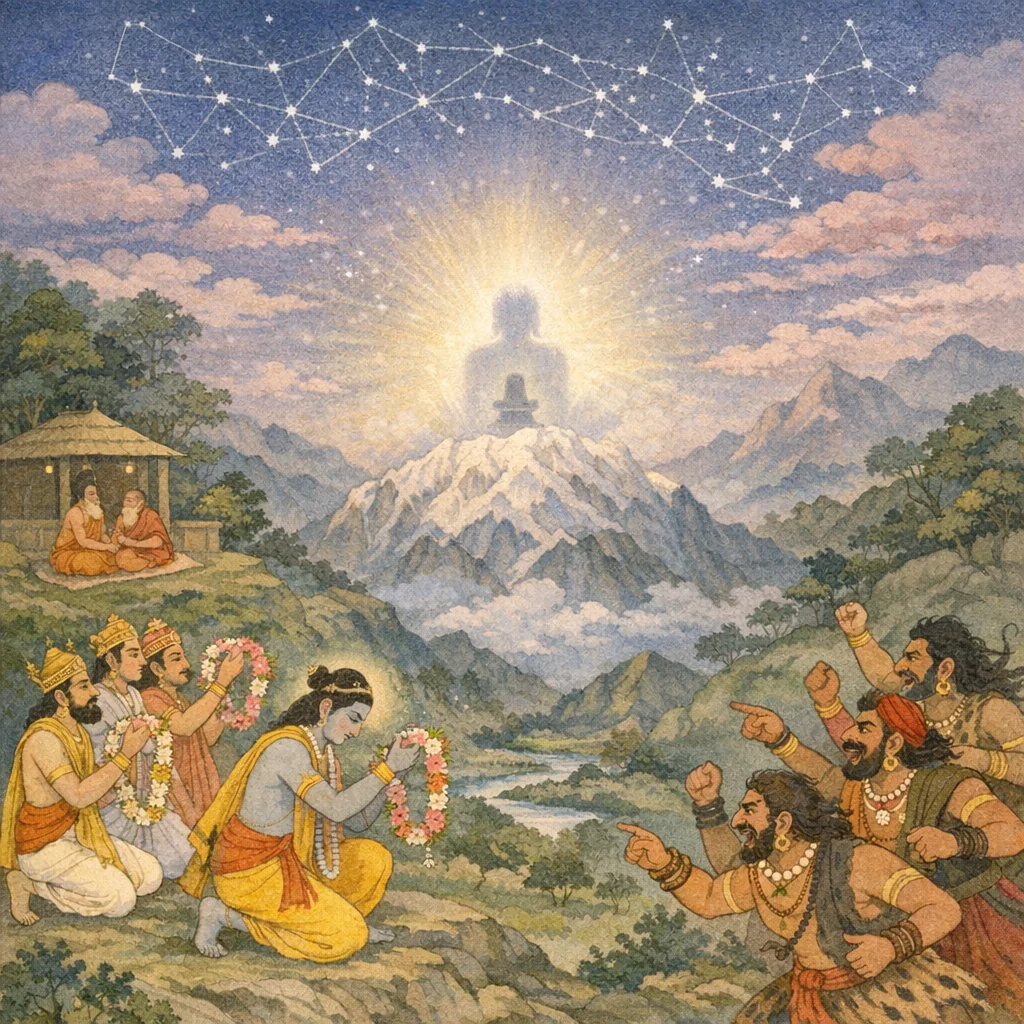
देवस्तुतिः—शिवस्य परब्रह्मत्वं, मायाशक्तिः, कर्मफलप्रदातृत्वं च (Devas’ Hymn: Śiva as Parabrahman, Māyā-Śakti, and Giver of Karmic Fruits)
Adhyāya 41 is a theologically dense stuti and inquiry offered by Viṣṇu and other devas to Mahādeva. They affirm Śiva as Īśvara/Śaṃbhu and as Parabrahman beyond mind (manas) and speech (vāc), while also reflecting on his free use of “parā māyā” that bewilders embodied beings. The chapter proclaims both his transcendence and his immanence: through his own śivaśakti he creates and sustains the universe, like a spider spinning its web. It further presents Śiva as the establisher of worldly and Vedic boundaries (setu), the originator of ritual order (kratu), and the constant dispenser of all karmic fruits. It contrasts pure, faith-filled (śraddhā) Vedic knowers with envious, deluded critics who harm others through harsh speech, and ends with a plea for Śiva’s grace and corrective intervention against such destructive tendencies. Overall, it maps a Purāṇic theology of sovereignty—Śiva’s freedom to veil and reveal, joined to compassionate governance of moral and ritual order.
Shlokas
Verse 1
विष्ण्वादय ऊचुः । देवदेव महादेव लौकिकाचारकृत्प्रभो । ब्रह्म त्वामीश्वरं शंभुं जानीमः कृपया तव
Viṣṇu and the other gods said: “O God of gods, O Mahādeva—O Lord who establishes the right conduct of the worlds—by Your grace we recognize You, O Śambhu, as the Supreme Lord, as Brahman itself.”
Verse 2
किं मोहयसि नस्तात मायया परया तव । दुर्ज्ञेयया सदा पुंसां मोहिन्या परमेश्वर
O dear one—O Supreme Lord—why do You bewilder us with Your transcendent Māyā, ever hard for embodied beings to comprehend, and deluding to all people?
Verse 3
प्रकृतः पुरुषस्यापि जगतो योनिबीजयोः । परब्रह्म परस्त्वं च मनोवाचामगोचरः
You are the very Prakṛti and also the Puruṣa; for the universe, you are both the womb and the seed. You are the Supreme Brahman, the highest Reality, beyond the reach of mind and speech.
Verse 4
त्वमेव विश्वं सृजसि पास्यत्सि निजतंत्रतः । स्वरूपां शिवशक्तिं हि क्रीडन्नूर्णपटो यथा
You alone create this universe and You alone sustain it, entirely by Your own sovereign power. Indeed, You sport with Your own essential Śiva-Śakti—just as a spider playfully brings forth its web from itself.
Verse 5
त्वमेव क्रतुमीशान ससर्जिथ दयापरः । दक्षेण सूत्रेण विभो सदा त्रय्यभिपत्तये
O Īśāna, Lord of sacrifice—out of compassion You alone brought forth the sacred rite of yajña. O all-pervading One, using Dakṣa as the guiding “thread” (instrument), You established it ever for the rightful attainment and flourishing of the Three Vedas.
Verse 6
त्वयैव लोकेवसितास्सेतवो यान् धृतव्रताः । शुद्धान् श्रद्दधते विप्रा वेदमार्गविचक्षणाः
By you alone are the world’s boundaries and sacred ordinances established; and the steadfast, pure-minded brāhmaṇas—skilled in discerning the Vedic path—place their faithful trust in those pure disciplines.
Verse 7
कर्तुस्त्वं मंगलानां हि स्वपरं तु मुखे विभो । अमंगलानां च हितं मिश्रं वाथ विपर्ययम्
O Lord, you are indeed the accomplisher of auspicious outcomes; you hold the power to turn what is one’s own and what is opposed—both—toward the right end. Even in inauspicious situations, you can bring about what is beneficial, whether mixed with hardship or by reversing the apparent course of events.
Verse 8
सर्वकर्मफलानां हि सदा दाता त्वमेव हि । सर्वे हि प्रोक्ता हि यशस्तत्पतिस्त्वं श्रुतिश्रुतः
You alone are ever the giver of the fruits of all actions. Truly, all proclaim You as the Lord of glory; You are the One praised and heard of in the Śrutis (the Vedas).
Verse 9
पृथग्धियः कर्मदृशोऽरुंतुदाश्च दुराशयाः । वितुदंति परान्मूढा दुरुक्तैर्मत्सरान्विताः
Those of divided understanding, who judge only by outward acts, harsh of tongue and driven by base hopes—such deluded people, filled with envy, wound others with cruel words.
Verse 10
तेषां दैववधानां भो भूयात्त्वच्च वधो विभो । भगवन्परमेशान कृपां कुरु परप्रभो
O mighty Lord, let the slaying of those enemies destined by divine decree be accomplished—yet more than that, O all-pervading One, let my own death also come to pass. O blessed Parameśāna, Supreme Lord, show compassion, O highest Master.
Verse 11
नमो रुद्राय शांताय ब्रह्मणे परमात्मने । कपर्दिने महेशाय ज्योत्स्नाय महते नमः
Salutations to Rudra, the Peaceful One; salutations to Brahman, the Supreme Self. Salutations to Kapardin, to Maheśa the Great Lord; salutations to the Great One who shines forth as luminous radiance.
Verse 12
त्वं हि विश्वसृजां स्रष्टा धाता त्वं प्रपितामहः । त्रिगुणात्मा निर्गुणश्च प्रकृतेः पुरुषात्परः
Indeed, You are the creator of the creators of the universe; You are the sustainer, You are the primal grandsire. You are manifest as the very essence of the three guṇas, and yet You are beyond all guṇas—transcending both Prakṛti and Puruṣa.
Verse 13
नमस्ते नीलकंठाय वेधसे परमात्मने । विश्वाय विश्वबीजाय जगदानंदहेतवे
Salutations to You, O Nīlakaṇṭha—Creator and Supreme Self; You who are the universe, the seed of the universe, and the very cause of the bliss of all the worlds.
Verse 14
ओंकारस्त्वं वषट्कारस्सर्वारंभप्रवर्तकः । हंतकास्स्वधाकारो हव्यकव्यान्नभुक् सदा
You are the sacred syllable Oṃ; You are the vaṣaṭ-call that empowers offerings, the initiator of every sacred undertaking. You are the haṃtā-call and the svadhā-invocation; eternally You are the one who receives and partakes of the oblations offered to the gods and the ancestral offerings as well.
Verse 15
कृतः कथं यज्ञभंगस्त्वया धर्मपरायण । ब्रह्मण्यस्त्वं महादेव कथं यज्ञहनो विभो
“O Mahādeva, devoted to dharma—how was the sacrifice disrupted by you? You are ever gracious to the Brāhmaṇas and protective of sacred order; O all-pervading Lord, how then could you be a destroyer of the yajña?”
Verse 16
ब्राह्मणानां गवां चैव धर्मस्य प्रतिपालकः । शरण्योसि सदानंत्यः सर्वेषां प्राणिनां प्रभो
O Lord, You are the protector of brāhmaṇas, of cows, and of dharma itself. You are ever the refuge—endless and eternal—O Master of all living beings.
Verse 17
नमस्ते भगवन् रुद्र भास्करामिततेजसे । नमो भवाय देवाय रसायांबुमयाय ते
Salutations to You, O Blessed Lord Rudra, whose splendour is immeasurable like the Sun. Salutations to You, O Deva Bhava, whose form is of the essence of rasa (the vital sap) and of water.
Verse 18
शर्वाय क्षितिरूपाय सदा सुरभिणे नमः । रुद्रायाग्निस्वरूपाय महातेजस्विने नमः
Salutations to Śarva, whose form is the Earth—ever fragrant and life-sustaining. Salutations to Rudra, whose form is Fire—of immense splendour and blazing spiritual radiance.
Verse 19
ईशाय वायवे तुभ्यं संस्पर्शाय नमोनमः । पशूनांपतये तुभ्यं यजमानाय वेधसे
Salutations again and again to You—the Lord, the Vāyu (life-breath), the very Principle of sacred touch and contact. Salutations to You, the Lord of beings (Paśupati), to You the divine Sacrificer who receives worship, and to You the all-wise Ordainer (Vedhas) who fashions and directs all.
Verse 20
भीमाय व्योमरूपाय शब्दमात्राय ते नमः । महादेवाय सोमाय प्रवृत्ताय नमोस्तु ते
Salutations to You—the Terrible One, whose form is the vast sky, who is the very essence of sound. Salutations to You, Mahādeva, the Moon-like Lord, the One who sets the cosmos into active manifestation.
Verse 21
उग्राय सूर्यरूपाय नमस्ते कर्मयोगिने । नमस्ते कालकालाय नमस्ते रुद्र मन्यवे
Salutations to You, the fierce One whose form is the Sun; salutations to You, Lord of karma‑yoga. Salutations to You, the Death of Death, Overlord of Time; salutations to You, O Rudra, embodiment of sacred wrath.
Verse 22
नमश्शिवाय भीमाय शंकराय शिवाय ते । उग्रोसि सर्व भूतानां नियंता यच्छिवोसि नः
Salutations to You—Śiva, the Terrible Bhīma, and Śaṅkara, bestower of auspiciousness. You are fierce, the regulator of all beings; yet You are our very Śiva—ever gracious and benevolent to us.
Verse 23
मयस्कराय विश्वाय ब्रह्मणे ह्यार्तिनाशिने । अम्बिकापतये तुभ्यमुमायाः पतये नमः
Salutations to You—the bestower of auspiciousness, the all-pervading Lord of the universe, the Supreme Reality who destroys affliction. O Lord of Ambikā, O Husband of Umā—unto You I bow.
Verse 24
शर्वाय सर्वरूपाय पुरुषाय परात्मने । सदसद्व्यक्तिहीनाय महतः कारणाय ते
Salutations to You—Śarva—who are of all forms, the Supreme Person, the highest Self; who transcend being and non-being and are beyond all manifestation; who are the very cause of even Mahat (the cosmic intellect).
Verse 25
जाताय बहुधा लोके प्रभूताय नमोनमः । नीलाय नीलरुद्राय कद्रुद्राय प्रचेतसे
Repeated salutations to You—who manifest in many ways throughout the world, who are abundantly present everywhere. Salutations to the Blue One, to Nīlarudra (the blue-hued Rudra), and to that Rudra who is ever-awake, the all-knowing Pracetas.
Verse 26
मीढुष्टमाय देवाय शिपिविष्टाय ते नमः । महीयसे नमस्तुभ्यं हंत्रे देवारिणां सदा
Salutations to You, the divine Lord—most bountiful and gracious, the all-pervading One. O ever-great and ever-worshipful, I bow to You always, the constant slayer of the enemies of the gods.
Verse 27
ताराय च सुताराय तरुणाय सुतेजसे । हरिकेशाय देवाय महेशाय नमोनमः
Salutations again and again to Mahādeva—who is the guiding Star (Tārā) and the most excellent Star (Sutārā); who is ever youthful (Taruṇa) and of radiant splendour (Sutejas); who is Harikeśa, the Deva with tawny-golden hair, Maheśa, the Great Lord.
Verse 28
देवानां शंभवे तुभ्यं विभवे परमात्मने । परमाय नमस्तुभ्यं कालकंठाय ते नमः
Salutations to You, Śambhu—the auspicious Lord of the gods; to You, the all-pervading Majesty, the Supreme Self. Salutations to You, the Highest Reality; salutations to You, O Kālakaṇṭha, the Blue-throated One.
Verse 29
हिरण्याय परेशाय हिरण्यवपुषे नमः । भीमाय भीमरूपाय भीमकर्मरताय च
Salutations to Him who shines with golden splendour, the Supreme Lord; salutations to Him whose very body is radiant like gold. Salutations to Bhīma, the awe-inspiring One, of formidable form, ever intent upon mighty deeds.
Verse 30
भस्मदिग्धशरीराय रुद्राक्षाभरणाय च । नमो ह्रस्वाय दीर्घाय वामनाय नमोस्तु ते
Salutations to You whose body is anointed with sacred ash and adorned with Rudrākṣa beads. Salutations to You who are both the Small and the Vast—Vāmana in form and yet all-expansive; to You, indeed, salutations.
Verse 31
दूरेवधाय ते देवा ग्रेवधाय नमोनमः । धन्विने शूलिने तुभ्यं गदिने हलिने नमः
O Deva, salutations again and again to You—the slayer from afar and the slayer at close range. Salutations to You who bear the bow and the trident; salutations to You who wield the mace and the plough.
Verse 32
नानायुधधरायैव दैत्यदानवनाशिने । सद्याय सद्यरूपाय सद्योजाताय वै नमः
Salutations to Sadyojāta—He who bears many weapons, the destroyer of the Daityas and Dānavas; salutations to the Ever-Imminent One, whose very form is immediate and ever-present.
Verse 33
वामाय वामरूपाय वामनेत्राय ते नमः । अघोराय परेशाय विकटाय नमोनमः
Salutations to You, O Vāma—of gracious form and gentle eye. Salutations again and again to You, O Aghora—Supreme Lord beyond all; and to You, the Vast and Formidable One, my repeated homage.
Verse 34
तत्पुरुषाय नाथाय पुराणपुरुषाय च । पुरुषार्थप्रदानाय व्रतिने परमेष्ठिने
Salutations to Tatpuruṣa—the Lord and Protector, the Primeval Person. Salutations to Him who bestows the four aims of human life, who is steadfast in sacred observances (vrata), and who is the Highest Ruler.
Verse 35
ईशानाय नमस्तुभ्यमीश्वराय नमो नमः । ब्रह्मणे ब्रह्मरूपाय नमस्साक्षात्परात्मने
Salutations to You, Īśāna; salutations again and again to You, the Lord (Īśvara). Salutations to You who are Brahman, whose very form is Brahman—salutations to You, the Supreme Self (Paramātman) manifest before us.
Verse 36
उग्रोसि सर्वदुष्टानां नियंतासि शिवोसि नः । कालकूटाशिने तुभ्यं देवाद्यवन कारिणे
You are fierce toward all the wicked and the supreme restrainer of the unrighteous. You are our auspicious Lord Śiva. Salutations to You—the consumer of the Kālakūṭa poison—who safeguards the Devas and all beings from harm.
Verse 37
वीराय वीरभद्राय रक्षद्वीराय शूलिने । महादेवाय महते पशूनां पतये नमः
Salutations to the Heroic Lord—to Vīrabhadra; to the valiant Protector; to the Trident-bearer; to the Great God, the supreme and mighty Mahādeva—the Pati, Lord of all paśus, the bound souls.
Verse 38
वीरात्मने सुविद्याय श्रीकंठाय पिनाकिने । नमोनंताय सूक्ष्माय नमस्ते मृत्युमन्यवे
Salutations to You whose very Self is heroic power; to You who are perfect wisdom; to Śrīkaṇṭha, the auspicious-throated Lord; to the bearer of the Pināka bow. Salutations to the Infinite, to the Subtle One; salutations to You, O conqueror of Death’s wrath.
Verse 39
पराय परमेशाय परात्परतराय ते । परात्पराय विभवे नमस्ते विश्वमूर्तये
Salutations to You—the Supreme Lord—who are beyond the beyond, higher than the highest transcendence; to You, the all-pervading Lord of majesty, whose very form is the universe.
Verse 40
नमो विष्णुकलत्राय विष्णुक्षेत्राय भानवे । भैरवाय शरण्याय त्र्यंबकाय विहारिणे
Salutations to Him who is the consort of Viṣṇu’s Śakti, who is Viṣṇukṣetra, the sacred field of Viṣṇu, who shines as the radiant Sun. Salutations to Bhairava, the giver of refuge; to Tryambaka, the Three‑eyed Lord; and to the ever-sporting Lord who freely roams as the supreme Protector.
Verse 41
इति श्रीशिव महापुराणे द्वितीयायां रुद्रसंहितायां द्वितीये सतीखंडे देवस्तुतिवर्णनं नामैकचत्वारिंशोऽध्यायः
Thus, in the Śrī Śiva Mahāpurāṇa—within the second section, the Rudra Saṃhitā; and within its second division, the Satī Khaṇḍa—concludes the forty-first chapter, entitled “Devastuti-varṇana,” the account of the gods’ hymn of praise.
Verse 42
भवता हि जगत्सर्वं व्याप्तं स्वेनैव तेजसा । परब्रह्म निर्विकारी चिदानंदःप्रकाशवान्
Truly, by You this entire universe is pervaded through Your own splendour. You are the Supreme Brahman—unchanging—self-luminous as Consciousness and Bliss.
Verse 43
ब्रह्मविष्ण्विंद्रचन्द्रादिप्रमुखास्सकलास्सुराः । मुनयश्चापरे त्वत्तस्संप्रसूता महेश्वर
O Maheśvara, all the gods—headed by Brahmā, Viṣṇu, Indra, and Candra—have arisen from You; and the other sages as well have indeed been born forth from You.
Verse 44
यतो बिभर्षि सकलं विभज्य तनुमष्टधा । अष्टमूर्तिरितीशश्च त्वमाद्यः करुणामयः
Because you sustain the entire universe by dividing your own being into an eightfold manifestation, you are called the Lord of the Eight Forms (Aṣṭamūrti). O Īśa, you are the primordial One, overflowing with compassion.
Verse 45
त्वद्भयाद्वाति वातोयं दहत्यग्निर्भयात्तव । सूर्यस्तपति ते भीत्या मृत्युर्धावति सर्वतः
Out of fear of You, this wind blows; out of fear of You, fire burns. Out of fear of You, the sun gives heat; and Death, in fear of You, runs about everywhere (carrying out its task).
Verse 46
दयासिन्धो महेशान प्रसीद परमेश्वर । रक्ष रक्ष सदैवास्मान् यस्मान्नष्टान् विचेतसः
O ocean of compassion, O Maheśāna, be gracious, O Supreme Lord. Protect—protect us always, for we have become bewildered and lost, our discernment overwhelmed.
Verse 47
रक्षिताः सततं नाथ त्वयैव करुणानिधे । नानापद्भ्यो वयं शंभो तथैवाद्य प्रपाहि नः
O Lord, ocean of compassion—truly it is You alone who have protected us at all times. O Śambhu (Śiva), from many kinds of dangers protect us even today, just as before.
Verse 48
यज्ञस्योद्धरणं नाथ कुरु शीघ्रं प्रसादकृत् । असमाप्तस्य दुर्गेश दक्षस्य च प्रजापतेः
O Lord, master of the fortress of the worlds, quickly show Your grace and rescue this sacrifice—this rite of Prajāpati Dakṣa, which has been left unfinished.
Verse 49
भगोक्षिणी प्रपद्येत यजमानश्च जीवतु । पूष्णो दंताश्च रोहंतु भृगोः श्मश्रूणि पूर्ववत्
“May Bhaga’s blinded eye be restored; may the sacrificer live. May Pūṣan’s teeth grow back, and may Bhṛgu’s moustache return as before.”
Verse 50
भवतानुग्रहीतानां देवादीनांश्च सर्वशः । आरोग्यं भग्नगात्राणां शंकर त्वायुधाश्मभिः
O Śaṅkara, by the stone-like force of your divine weapons, grant complete well-being to the gods and to all others favored by your grace, and restore health to those whose limbs have been broken.
Verse 51
पूर्णभागोस्तु ते नाथावशिष्टेऽध्वरकर्मणि । रुद्रभागेन यज्ञस्ते कल्पितो नान्यथा क्वचित्
O Lord, may Your full share be duly assigned in the remaining rites of this sacrifice. For this yajña can be properly completed only by the portion belonging to Rudra—never otherwise, at any time.
Verse 52
इत्युक्त्वा सप्रजेशश्च रमेशश्च कृतांजलिः । दंडवत्पतितो भूमौ क्षमापयितुमुद्यतः
Having spoken thus, Prajāpati (Dakṣa) and Rameśa, with palms joined in reverence, fell upon the earth like a staff, eager to seek forgiveness.
Frequently Asked Questions
The chapter primarily presents a deva-stuti and theological inquiry rather than a single dramatic event: Viṣṇu and other devas address Śiva, questioning his māyā and affirming his supreme status and governance of cosmic/ritual order.
It encodes Śiva’s sovereign freedom to veil (āvaraṇa) and reveal (anugraha) reality: māyā is not an independent rival but Śiva’s own power, through which embodied cognition becomes limited until grace and right understanding arise.
Śiva is highlighted as creator and sustainer via śivaśakti, establisher of dharma and ritual ‘setus,’ and the constant dispenser of karmic results—while remaining transcendent (parabrahman) beyond mind and speech.