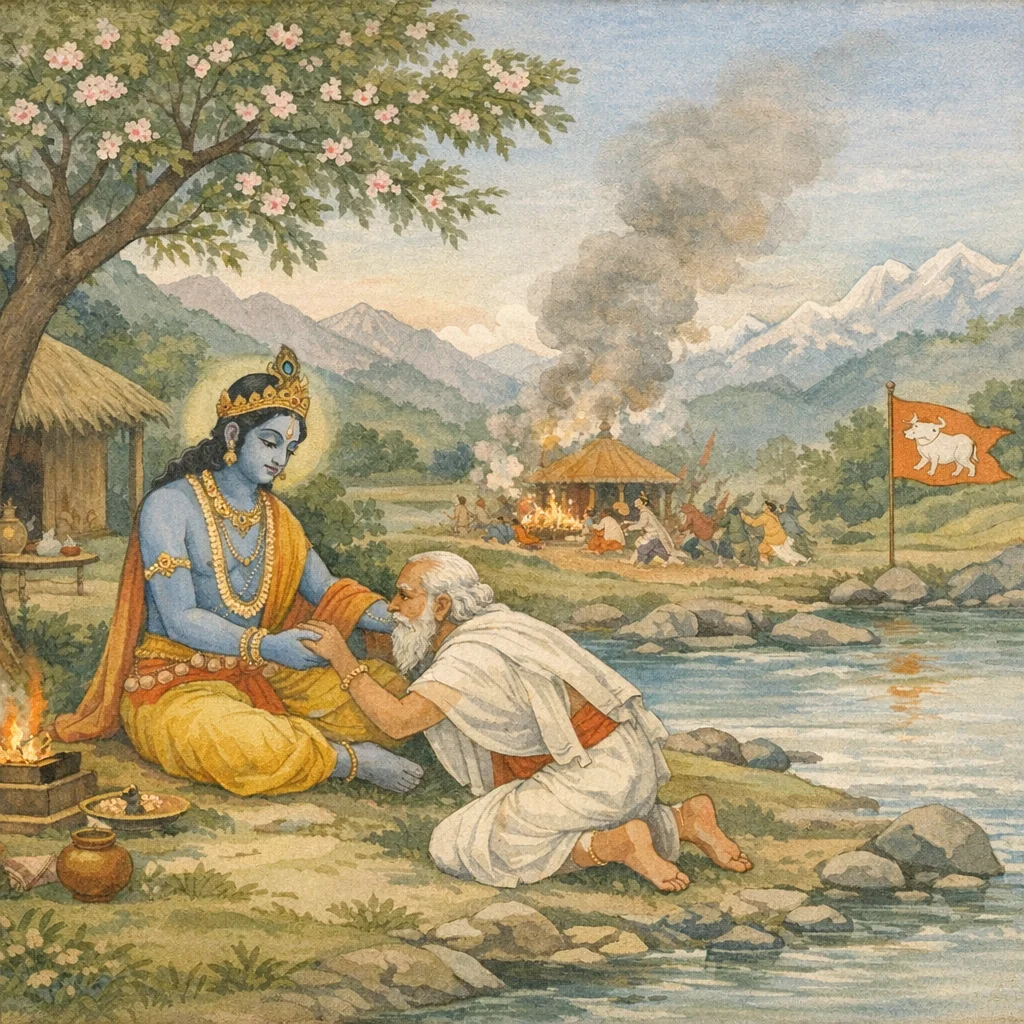
दक्षस्य विष्णुं प्रति शरणागतिḥ — Dakṣa’s Appeal to Viṣṇu and the Teaching on Disrespect to Śiva
Adhyāya 35 begins with Dakṣa addressing Viṣṇu as the protector of sacrifice, pleading that his yajña not be shattered and seeking protection for himself and the righteous. Brahmā describes Dakṣa’s fear-born surrender as he falls at Viṣṇu’s feet. Viṣṇu raises him and, remembering Śiva, replies as one who knows Śiva-tattva. Hari then gives a corrective teaching: Dakṣa’s root fault is avajñā—disrespect toward Śaṅkara, the supreme inner Self and lord of all. The chapter sets forth a causal doctrine: disrespect to Īśvara makes undertakings fruitless and brings repeated calamity. A normative maxim follows: where the unworthy are honored and the worthy are not, three results arise—poverty, death, and fear. Thus the yajña crisis is reframed not as a mere ritual mishap but as a metaphysical and ethical inversion, requiring renewed honor to Vṛṣadhvaja (Śiva), since great danger has arisen from dishonoring him.
Shlokas
Verse 1
दक्ष उवाच । देवदेव हरे विष्णो दीनबंधो कृपानिधे । मम रक्षा विधातव्या भवता साध्वरस्य च
Dakṣa said: “O God of gods—O Hari, O Viṣṇu—friend of the distressed, ocean of compassion! You must grant protection to me, and also to this righteous (devoted) person.”
Verse 2
रक्षकस्त्वं मखस्यैव मखकर्मा मखात्मकः । कृपा विधेया यज्ञस्य भंगो भवतु न प्रभो
You alone are the protector of this sacrifice; you are its very action and its inner essence. O Lord, show compassion—let this yajña not be ruined.
Verse 3
ब्रह्मोवाच । इत्थं बहुविधां दक्षः कृत्वा विज्ञप्तिमादरात् । पपात पादयोस्तस्य भयव्याकुलमानसः
Brahmā said: Thus, after making many kinds of earnest entreaties with reverence, Dakṣa—his mind shaken by fear—fell down at his feet.
Verse 4
उत्थाप्य तं ततो विष्णुर्दक्षं विक्लिन्नमानसम् । श्रुत्वा च तस्य तद्वाक्यं कुमतेरस्मरच्छिवम्
Then Lord Viṣṇu raised up Dakṣa, whose mind had become shaken and despondent. Hearing those words spoken from Dakṣa’s misguided understanding, Viṣṇu recollected Lord Śiva.
Verse 5
स्मृत्वा शिवं महेशानं स्वप्रभुं परमेश्वरम् । अवदच्छिवतत्त्वज्ञो दक्षं सबोधयन्हरिः
Remembering Śiva—the Great Lord (Maheśāna), his own Master and the Supreme Īśvara—Hari (Viṣṇu), the knower of Śiva’s true principle, spoke to Dakṣa, instructing and awakening his understanding.
Verse 6
हरिरुवाच । शृणु दक्ष प्रवक्ष्यामि तत्त्वतः शृणु मे वचः । सर्वथा ते हितकरं महामंत्रसुखप्रदम्
Hari (Viṣṇu) said: “Listen, Dakṣa. I shall tell you the truth—hear my words. They are beneficial to you in every way, and they bestow the joy that comes from the great mantra.”
Verse 7
अवज्ञा हि कृता दक्ष त्वया तत्त्वमजानता । सकलाधीश्वरस्यैव शंकरस्य परात्मनः
O Dakṣa, not knowing the true principle (tattva), you have indeed committed contempt—toward Śaṅkara, the Supreme Self, the very Lord of all beings.
Verse 8
ईश्वरावज्ञया सर्वं कार्यं भवति सर्वथा । विफलं केवलं नैव विपत्तिश्च पदेपदे
By disregarding Īśvara, every undertaking becomes futile in every way; it yields no true fruit, and misfortune arises at every step.
Verse 9
अपूज्या यत्र पूज्यंते पूजनीयो न पूज्यते । त्रीणि तत्र भविष्यंति दारिद्र्यं मरणं भयम्
Where those unworthy of reverence are honoured, and the truly worshipful are not worshipped, three outcomes certainly arise there: poverty, death, and fear.
Verse 10
तस्मात्सर्वप्रयत्नेन माननीयो वृषध्वजः । अमानितान्महेशाच्च महद्भयमुपस्थितम्
Therefore, with every possible effort, Vṛṣadhvaja—the Lord whose banner bears the Bull—Mahādeva, must be duly honoured. For when Maheśa is dishonoured, a great fear (calamity) inevitably comes upon the offender.
Verse 11
अद्यापि न वयं सर्वे प्रभवः प्रभवामहे । भवतो दुर्नयेनैव मया सत्यमुदीर्य्यते
Even now, none among us can truly claim independent mastery or lordship. Because of your misguided conduct, I am compelled to speak this truth plainly.
Verse 12
ब्रह्मोवाच । विष्णोस्तद्वचनं श्रुत्वा दक्षश्चिंतापरोऽभवत् । विवर्णवदनो भूत्वा तूष्णीमासीद्भुवि स्थितः
Brahmā said: Hearing those words of Viṣṇu, Dakṣa became consumed by anxious thought. His face lost its color, and standing there upon the earth, he remained silent.
Verse 13
एतस्मिन्नंतरे वीरभद्रः सैन्यसमन्वितः । अगच्छदध्वरं रुद्रप्रेरितो गणनायकः
Meanwhile, Vīrabhadra—the commander of the Gaṇas—set out for the sacrificial rite, accompanied by his forces, impelled by Rudra’s command.
Verse 14
पृष्ठे केचित्समायाता गगने केचिदागताः । दिशश्च विदिशः सर्वे समावृत्य तथापरे
Some arrived from behind, and some came through the sky; others, covering all the directions and intermediate quarters, surrounded the place on every side.
Verse 15
शर्वाज्ञया गणाः शूरा निर्भया रुद्रविक्रमाः । असंख्याः सिंहनादान्वै कुर्वंतो वीरसत्तमाः
By Śarva’s command, the heroic gaṇas—fearless and mighty with Rudra’s own prowess—advanced in countless numbers, roaring lion-cries like the best of warriors.
Verse 16
तेन नादेन महता नादितं भुवनत्रयम् । रजसा चावृतं व्योम तमसा चावृता दिशः
By that mighty sound (nāda), the three worlds resounded. The sky was veiled by rajas (restless activity), and the directions were shrouded in tamas (darkness and inertia).
Verse 17
सप्तद्वीपान्विता पृथ्वी चचालाति भयाकुला । सशैलकानना तत्र चुक्षुभुस्सकलाब्धयः
Then the Earth—together with her seven continents—trembled in utter terror; and there, along with mountains and forests, all the oceans surged and churned in agitation.
Verse 18
एवंभूतं च तत्सैन्यं लोकक्षयकरं महत् । दृष्ट्वा च विस्मितास्सर्वे बभूवुरमरादयः
Seeing that vast army—so formidable that it could bring about the destruction of the worlds—all the gods and other celestial beings were filled with astonishment.
Verse 19
सैन्योद्योगमथालोक्य दक्षश्चासृङ्मुखाकुलः । दंडवत्पतितो विष्णुं सकलत्रोऽभ्यभाषत
Seeing the preparations of the army, Dakṣa was thrown into distress, his mouth agitated and smeared with blood. Falling full-length in daṇḍavat obeisance, together with his wife, he addressed Lord Viṣṇu.
Verse 20
दक्ष उवाच । भवद्बलेनैव मया यज्ञः प्रारंभितो महान् । सत्कर्मसिद्धये विष्णो प्रमाणं त्वं महाप्रभो
Dakṣa said: “Only by Your power have I begun this great sacrifice. O Viṣṇu, O great Lord, for the successful completion of this righteous rite, You are the authoritative sanction and the sure support.”
Verse 21
विष्णो त्वं कर्मणां साक्षी यज्ञानां प्रतिपालकः । धर्मस्य वेदगर्भस्य ब्रह्मणस्त्वं महाप्रभो
O Viṣṇu, You are the witness of all actions and the protector of sacrifices. You are the mighty Lord who upholds Dharma—Dharma rooted in the Vedas—and You are also the great sustainer of Brahmā.
Verse 22
तस्माद्रक्षा विधातव्या यज्ञस्यास्य मम प्रभो । त्वदन्यः यस्समर्थोस्ति यतस्त्वं सकलप्रभुः
Therefore, O my Lord, protection must be arranged for this sacrifice of mine. For apart from You, who else is capable? Since You are the sovereign Lord of all.
Verse 23
ब्रह्मोवाच । दक्षस्य वचनं श्रुत्वा विष्णुर्दीनतरं तदा । अवोचद्बोधयंस्तं वै शिवतत्त्वपराङ्मुखम्
Brahmā said: Hearing Dakṣa’s words, Viṣṇu then became even more sorrowful, and spoke—seeking to instruct that Dakṣa, who had turned away from the true principle (tattva) of Śiva.
Verse 24
विष्णुरुवाच । मया रक्षा विधातव्या तव यज्ञस्य दक्ष वै । ख्यातो मम पणः सत्यो धर्मस्य परिपालनम्
Viṣṇu said: “O Dakṣa, I must indeed provide protection for your sacrifice. For my well-known and truthful vow is this: the safeguarding of dharma.”
Verse 25
तत्सत्यं तु त्वयोक्तं हि किं तत्तस्य व्यतिक्रमः । शृणु त्वं वच्म्यहं दक्ष क्रूरबुद्धिं त्यजाऽधुना
What you have spoken is indeed true—why, then, should it be transgressed? Listen, O Dakṣa, as I speak: abandon this cruel-mindedness now.
Verse 26
नैमिषे निमिषक्षेत्रे यज्जातं वृत्तमद्भुतम् । तत्किं न स्मर्यते दक्ष विस्मृतं किं कुबुद्धिना
In Naimiṣa, within the sacred Nimisha-kṣetra, whatever wondrous event took place—why is it not remembered, O Dakṣa? Has it been forgotten through misguided understanding?
Verse 27
रुद्रकोपाच्च को ह्यत्र समर्थो रक्षणे तव । न यस्याभिमतं दक्ष यस्त्वां रक्षति दुर्मतिः
When Rudra’s wrath is aroused, who here is truly capable of protecting you? O Dakṣa—since you have acted against His will—what ill-judging protector could possibly save you?
Verse 28
किं कर्म किमकर्मेति तत्र पश्यसि दुर्मते । समर्थं केवलं कर्म न भविष्यति सर्वदा
“What is action and what is non-action—thus you behold it wrongly, O misguided one. Mere action by itself will not always be capable of bringing the highest good.”
Verse 29
स्वकर्मविद्धि तद्येन समर्थत्वेन जायते । न त्वन्यः कर्मणो दाता शं भवेदीश्वरं विना
Know that one’s own karma is that by which capability and fitness arise; yet no one else is truly the giver of the fruits of action—apart from Śaṃbhū, the Lord.
Verse 30
ईश्वरस्य च यो भक्त्या शांतस्तद्गतमानसः । कर्मणो हि फलं तस्य प्रयच्छति तदा शिवः
But one who, through devotion to the Lord, becomes tranquil and whose mind rests in Him—Shiva then bestows upon that person the true fruit of his actions.
Verse 31
केवलं ज्ञानमाश्रित्य निरीश्वरपरा नराः । निरयं ते च गच्छंति कल्पकोटिशतानि च
Relying only on dry, isolated knowledge, those devoted to the doctrine of “no Lord” indeed go to hell, and remain there for hundreds of crores of kalpas.
Verse 32
पुनः कर्ममयैः पाशैर्वद्धा जन्मनि जन्मनि । निरयेषु प्रपच्यंते केवलं कर्मरूपिणः
Bound again and again—birth after birth—by the nooses made of karma, those who live only as doers of action (identifying themselves with karma alone) are cooked in the hell-realms.
Verse 33
अयं रुद्रगणाधीशो वीरभद्रोऽरि मर्दनः । रुद्रकोपाग्निसंभूतः समायातोध्वरांगणे
“This is Vīrabhadra, the lord of Rudra’s gaṇas, the crusher of enemies. Born from the blazing fire of Rudra’s wrath, he has now arrived at the courtyard of the sacrifice.”
Verse 34
अयमस्मद्विनाशार्थमागतोस्ति न संशयः । अशक्यमस्य नास्त्येव किमप्यस्तु तु वस्तुतः
There is no doubt—he has come here to bring about our destruction. For him nothing is impossible; indeed, in truth there is nothing he cannot accomplish.
Verse 35
इति श्रीशिवमहापुराणे द्वितीयायां रुद्रसंहितायां द्वितीये सतीखंडे सत्युपाख्याने विष्णुवाक्यवर्णनं नाम पंचत्रिंशोऽध्यायः
Thus, in the Śrī Śiva Mahāpurāṇa, in the second division called the Rudra Saṃhitā, within its second section, the Satī Khaṇḍa—under the narrative of Satī—ends the thirty-fifth chapter, entitled “The Description of Viṣṇu’s Words.”
Verse 36
श्रीमहादेवशपथं समुल्लंघ्य भ्रमान्मया । यतः स्थितं ततः प्राप्यं मया दुःखं त्वया सह
Deluded as I was, I transgressed the sacred oath made in the name of Śrī Mahādeva. From wherever you had remained, having reached that very state, I too have come upon sorrow—together with you.
Verse 37
शक्तिर्मम तु नास्त्येव दक्षाद्यैतन्निवारणे । शपथोल्लंघनादेव शिवद्रोही यतोस्म्यहम्
Truly I have no power to prevent this act of Dakṣa and the others; for, by violating my vow, I have become an offender against Śiva.
Verse 38
कालत्रयेपि न यतो महेशद्रोहिणां सुखम् । ततोऽवश्यं मया प्राप्तं दुःखमद्य त्वया सह
Since, in all the three times (past, present, and future), there is no happiness for those who betray Mahesha, therefore I have inevitably met with suffering today—along with you.
Verse 39
सुदर्शनाभिधं चक्रमेतस्मिन्न लगिष्यति । शैवचक्रमिदं यस्मादशैवलयकारणम्
The discus known as Sudarśana will not be effective against this. For this is the Śaiva discus—by its very nature it becomes the cause of the destruction of all that is non-Śaiva (opposed to Śiva).
Verse 40
विनापि वीरभद्रेण नामैतच्चक्रमैश्वरम् । हत्वा गमिष्यत्यधुना सत्वरं हरसन्निधौ
“Even without Vīrabhadra, this divine, sovereign discus will now swiftly go into Hara’s presence—after slaying the offender.”
Verse 41
शैवं शपथमुल्लंघ्य स्थितं मां चक्रमीदृशम् । असंहत्यैव सहसा कृपयैव स्थिरं परम्
Having transgressed the Śaiva vow, I have come to be in such a condition—like a wheel, unstable and turning. Yet, without being shattered, suddenly—by sheer grace alone—I have been made firm again in the supreme state.
Verse 42
अतः परमिदं चक्रमपि न स्थास्यति ध्रुवम् । गमिष्यत्यधुना शीघ्रं ज्वालामालासमाकुलम्
Therefore, even this (cosmic) cycle will no longer remain fixed or stable. Now it will swiftly rush onward, engulfed and confused by a garland of flames.
Verse 43
वीरभद्रः पूजितोपि शीघ्रमस्माभिरादरात् । महाक्रोधसमाक्रांतो नास्मान्संरक्षयिष्यति
“Even if we promptly worship Vīrabhadra with reverence, once seized by overwhelming wrath he will not protect us.”
Verse 44
अकांडप्रलयोऽस्माकमागतोद्य हि हा हहा । हा हा बत तवेदानीं नाशोस्माकमुपस्थितः
"Alas, alas! An untimely dissolution has come upon us today. Alas—indeed, your ruin is now at hand, and our destruction has arrived."
Verse 45
शरण्योऽस्माकमधुना नास्त्येव हि जगत्त्रये । शंकरद्रोहिणो लोके कश्शरण्यो भविष्यति
Now, for us, there is truly no refuge anywhere in the three worlds. In this world, for those who have betrayed Śaṅkara, who indeed will become a protector and shelter?
Verse 46
तनुनाशेपि संप्राप्यास्तैश्चापि यमयातनाः । तानैव शक्यते सोढुं बहुदुःखप्रदायिनीः
Even after the body’s destruction, one still encounters the punishments of Yama; and those torments—bestowing many kinds of suffering—can indeed be endured only by them (such sinful beings).
Verse 47
शिवद्रोहिणमालोक्य दष्टदंतो यमः स्वयम् । तप्ततैलकटाहेषु पातयत्येव नान्यथा
Seeing a betrayer of Śiva, Yama himself—gnashing his teeth in fury—casts that offender into cauldrons of boiling oil; it is so and not otherwise.
Verse 48
गन्तुमेवाहमुद्युक्तं सर्वथा शपथोत्तरम् । तथापि न गतश्शीघ्रं दुष्टसंसर्गपापतः
“I was indeed fully resolved to depart, having given my oath without reserve. Yet I did not set out quickly, because of the sin that arises from association with the wicked.”
Verse 49
यदद्य क्रियतेस्माभिः पलायनमितस्तदा । शार्वो ना कर्षकश्शस्त्रैरस्मानाकर्षयिष्यति
If today we try to flee from here, then Śarva (Lord Śiva) will surely drag us back—like a farmer pulling with his implements.
Verse 50
स्वर्गे वा भुवि पाताले यत्र कुत्रापि वा यतः । श्रीवीरभद्रशस्त्राणां गमनं न हि दुर्ल भम्
Whether in heaven, on earth, or in the netherworld—wherever one may be—there is truly no difficulty for the weapons of the glorious Vīrabhadra to reach and strike.
Verse 51
यावतश्च गणास्संति श्रीरुद्रस्य त्रिशूलिनः । तावतामपि सर्वेषां शक्तिरेतादृशी धुवम्
As many Gaṇas as there are of the glorious Rudra, the Trident-bearer—so many indeed, in every case, is this very power certainly present in them all.
Verse 52
श्रीकालभैरवः काश्यां नखाग्रेणैव लीलया । पुरा शिरश्च चिच्छेद पंचमं ब्रह्मणो ध्रुवम्
In Kāśī, Śrī Kālabhairava, merely with the tip of his nail and as a divine līlā, long ago severed Brahmā’s steadfast fifth head.
Verse 53
एतदुक्त्वा स्थितो विष्णुरतित्रस्तमुखाम्बुजः । वीरभद्रोपि संप्राप तदैवाऽध्वरमंडपम्
Having spoken thus, Viṣṇu stood there, his lotus-like face struck with great fear. At that very moment, Vīrabhadra too arrived at the sacrificial pavilion.
Verse 54
एवं ब्रुवति गोविन्द आगतं सैन्यसागरम् । वीरभद्रेण सहितं ददृशुश्च सुरादया
As Govinda spoke thus, the gods and the others beheld an ocean-like host of troops arriving, accompanied by Vīrabhadra.
Frequently Asked Questions
It situates the Dakṣa-yajña crisis: Dakṣa seeks Viṣṇu’s protection for the sacrifice, and Viṣṇu interprets the impending disruption as rooted in Dakṣa’s disrespect toward Śiva.
Hari frames the issue as tattva-jñāna: without recognizing Śiva as the supreme lord, ritual becomes spiritually void and karmically dangerous; reverence is the metaphysical condition for efficacy.
Śiva is invoked as Maheśāna/Parameśvara/Śaṅkara and Vṛṣadhvaja, stressing his supreme sovereignty and the necessity of honoring him as the rightful recipient of worship.