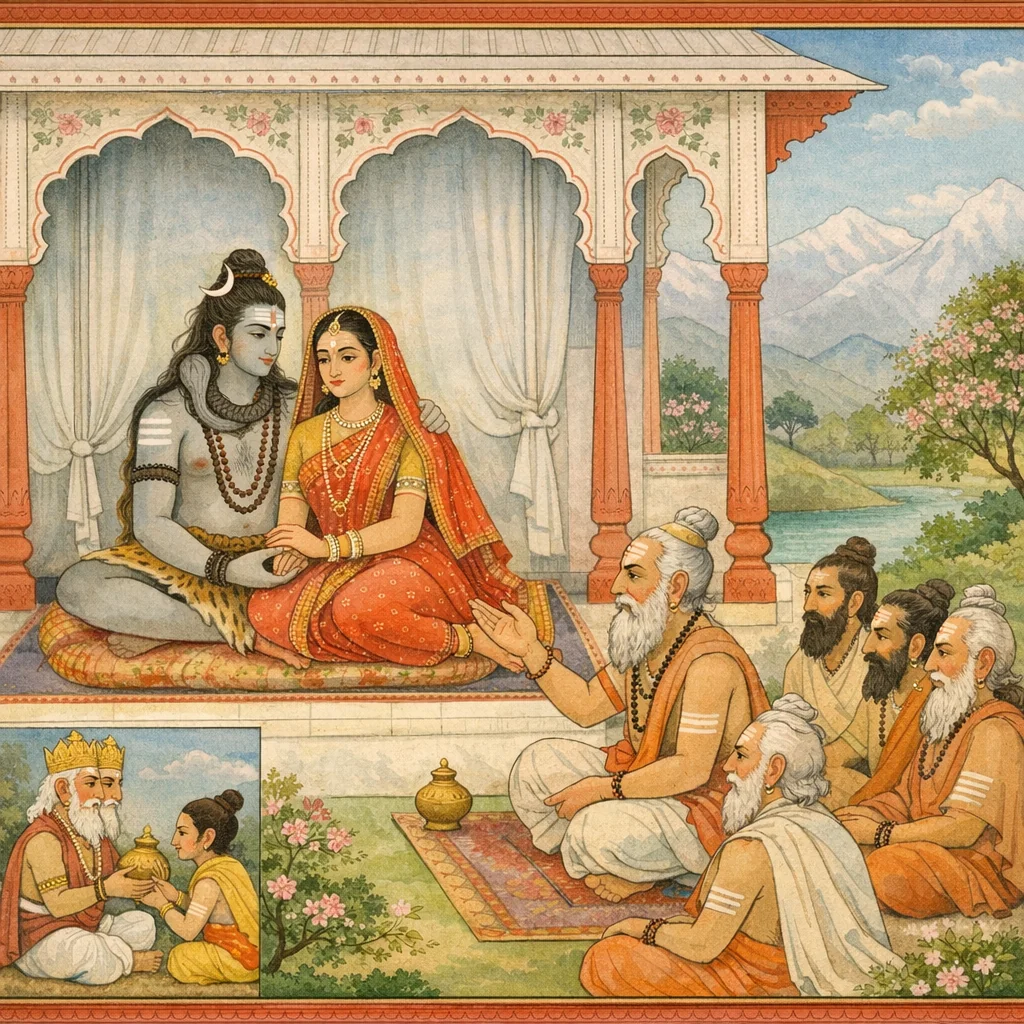
वैवाहिकानुष्ठानसमापनं दानप्रशंसा च / Completion of Wedding Rites and Praise of Gifts (Dāna)
This chapter continues the post-wedding rites of Śiva and Pārvatī. Brahmā tells Nārada that, by Śiva’s command and amid assemblies of sages, the remaining ceremonies are completed: head-anointing (śiro’bhiṣeka), auspicious viewing (darśana), heart-strengthening rites (hṛdayālambhana), and benedictory recitations (svastipāṭha), all within a grand festival (mahotsava). Guided by the twice-born priests, Śiva applies sindūra to Śivā’s head; Pārvatī shines with wondrous radiance and is hailed as Girijā. The couple is seated together on a single seat, signifying conjugal unity and public auspiciousness, and they joyfully perform the concluding consumption rite (saṃsrava-prāśana). When the wedding yajña is duly finished, Śiva grants Brahmā a full vessel (pūrṇapātra) for the welfare of the worlds, then bestows godāna and other great auspicious gifts upon the ācārya and the Brahmins—gold, jewels, and varied valuables. The narrative ends with universal rejoicing among gods and beings, resounding with victory cries (jayadhvani) as the cosmos affirms the rite.
Shlokas
Verse 1
ब्रह्मोवाच । ततश्चाहं मुनिगणैश्शेषकृत्यं शिवाज्ञया । अकार्षं नारद प्रीत्या शिवाशिवविवाहतः
Brahmā said: Thereafter, by Śiva’s command, I—together with the hosts of sages—performed the remaining rites. O Nārada, I did so with joy, on account of the auspicious wedding of Śivā (Pārvatī) and Śiva.
Verse 2
तयोश्शिरोऽभिषेकश्च बभूवादरतस्ततः । ध्रुवस्यदर्शनं विप्राः कारयामासुरादरात
Then, with reverent care, the abhiṣeka—the consecratory bathing upon their heads—was performed. Thereafter, O brāhmaṇas, with great devotion they arranged the auspicious darśana of Dhruva.
Verse 3
हृदयालम्भनं कर्म बभूव तदनन्तरम् । स्वस्तिपाठश्च विप्रेन्द्र महोत्सवपुरस्सरः
Immediately after that, a heart-gladdening rite was performed. Then, O best of brāhmaṇas, the auspicious svasti-pāṭha benedictory recitations were made as a prelude to the great festival.
Verse 4
शिवाशिरसि सिन्दूरं ददौ शम्भुर्द्विजाज्ञया । तदानीं गिरिजाभिख्याद्भुतावर्ण्या बभूव ह
At the brāhmaṇa’s command, Śambhu placed sacred vermilion (sindūra) upon Śivā’s head. At that very moment, Girijā became wondrously radiant, her beauty beyond all description.
Verse 5
ततो विप्राज्ञया तौ द्वावेकासनसमास्थितौ । लेभाते परमां शोभां भक्तचित्त मुदावहाम्
Then, at the brāhmaṇa’s command, the two sat together upon a single seat (āsana). They attained a supreme radiance that brought gladness to the hearts of devotees.
Verse 6
ततः स्वस्थानमागत्य संस्रवप्राशनं मुदा । चक्रतुस्तौ निदेशान्मेऽद्भुतलीलाकरौ मुने
Then the two returned to their proper place; performers of wondrous divine līlā, they joyfully drank the consecrated remnant in accordance with my instruction, O sage.
Verse 7
इत्थं निवृत्ते विधिवद्याज्ञे वैवाहिके शिवः । ब्रह्मणे पूर्णपात्रं मे ददौ लोककृते प्रभुः
When the wedding sacrifice had thus been duly completed according to rule, Lord Śiva—the sovereign who acts for the welfare of the worlds—gave to Brahmā, on my behalf, a vessel filled to completeness as an offering-gift.
Verse 8
गोदानं विधिवच्छम्भुराचार्याय ददौ ततः । महादानानि च प्रीत्या यानि मङ्गलदानि वै
Then Śambhu, in due accordance with rite, bestowed the gift of a cow upon the ācārya; and with glad devotion he also offered the great gifts—those auspicious donations that bring sacred well-being.
Verse 9
ततश्शतसुवर्णं च विप्रेभ्यस्स ददौ पृथक् । बहुभ्यो रत्नकोटीश्च नानाद्रव्याण्यनेकशः
Thereafter, he distributed hundreds of gold pieces separately to the Brāhmaṇas; and to many others he gave koṭis of precious gems, along with many kinds of gifts in great abundance. In Shaiva understanding, such generous dāna, when offered in devotion and in reverence to dharma, becomes a purifying aid, preparing the mind for steadfast bhakti to Lord Śiva.
Verse 10
तदानीममरास्सर्वे परे जीवाश्चराचराः । मुमुदुश्चेतसातीव जयध्वनिः
At that very time, all the devas, and likewise all other beings—moving and unmoving—became greatly delighted in their hearts, and a resounding cry of victory arose.
Verse 11
मङ्गलध्वनिगानश्च बभूव बहु सर्वतः । वाद्यध्वनिरभूद्रम्यो सर्वानन्दप्रवर्द्धनः
Auspicious songs and jubilant cries arose everywhere in great abundance; and the delightful resonance of musical instruments increased the joy of all.
Verse 12
हरिर्मयाथ देवाश्च मुनयश्चापरेऽखिलाः । गिरिमामन्त्र्य सुप्रीत्या स्वस्थानम्प्रययुर्द्रुतम्
Then Hari (Viṣṇu), I, and all the other gods and sages—having affectionately taken leave of the Mountain (Himālaya)—quickly departed to our respective abodes.
Verse 13
तदानीं शैलनगरे स्त्रियश्च मुदिता वरम् । शिवाशिवौ समानीय ययुः कुह वरालयम्
Then, in the mountain-city, the women—greatly delighted—brought Śiva and Śivā together and went to the splendid bridal abode.
Verse 14
लौकिकाचारमाजह्रुस्ताः स्त्रियस्तत्र चादृताः । महोत्साहो बभूवाथ सर्वतः प्रमुदावहः
There, those women adopted proper worldly decorum and were duly honored. Then a great uplifted zeal (utsāha) arose everywhere, bringing joy on all sides.
Verse 15
अथ तास्तौ समानीय दम्पती जनशंकरौ । वासालयम्महादिव्यं भवाचारं व्यधुर्मुदा
Then the two—Śiva and Pārvatī, the blessed divine couple who bestow auspiciousness upon all beings—were brought there. Rejoicing, they arranged a supremely splendid dwelling and established the proper sacred conduct befitting Bhava, Lord Śiva.
Verse 16
अथो समीपमागत्य शैलेन्द्रनगरस्त्रियः । निर्वृत्य मङ्गलं कर्म प्रापयन्दम्पती गृहम्
Then the women of Śailendra-city came near; having duly completed the auspicious rites, they escorted the divine couple and brought them to their home.
Verse 17
कृत्वा जयध्वनिं चक्रुर्ग्रन्थिनिर्मोचनादिकम् । सस्मितास्सकटाक्षाश्च पुलकाञ्चितविग्रहाः
Raising cries of victory, they performed the customary auspicious acts, such as untying the ceremonial knots and the like. Smiling, exchanging sidelong glances, and with their bodies thrilled in rapture, they rejoiced—signs of heartfelt devotion and sacred joy.
Verse 18
वासगेहं सम्प्रविश्य मुमुहुः कामिनीवराः । प्रसंशन्त्यस्स्वभाग्यानि पश्यन्तः परमेश्वरम्
Entering the dwelling, those excellent women were overwhelmed with rapture; beholding Parameśvara, Lord Śiva, they praised their own good fortune.
Verse 19
महासुरूपवेषश्च सर्व लावण्यसंयुतम् । नवीनयौवनस्थञ्च कामिनीचित्तमोहनम्
He appeared in a supremely beautiful form and attire, endowed with every kind of charm—standing in the freshness of new youth, captivating the minds of women.
Verse 20
ईषद्धास्यप्रसन्नास्यं सकटाक्षं सुसुन्दरम् । सुसूक्ष्मवासो बिभ्राणं नानारत्न विभूषितम्
He appeared of surpassing beauty—his face serene with a faint smile, his eyes casting graceful sidelong glances; he wore garments of the finest delicacy and was adorned with ornaments set with many kinds of jewels.
Verse 21
तदानीन्दिव्यनार्यश्च षोडशारं समाययुः । तौ दम्पती च संद्रष्टुं महादरपुरस्सरम्
Then, at that very moment, the celestial women gathered in the sixteenfold circle and, with eager hearts, went forth to behold the divine couple—Śiva and Pārvatī—leading the grand procession.
Verse 22
सरस्वती च लक्ष्मीश्च सावित्री जाह्नवी तथा । अदितिश्च शची चैव लोपामुद्राप्यरुन्धती
There were Sarasvatī and Lakṣmī, Sāvitrī and Jāhnavī; Aditi and Śacī as well—along with Lopāmudrā and Arundhatī too.
Verse 23
अहल्या तुलसी स्वाहा रोहिणी च वसुन्धरा । शतरूपा च संज्ञा च रतिरेतास्सुरस्त्रियः
“Ahalyā, Tulasī, Svāhā, Rohiṇī, and Vasundharā; Śatarūpā, Saṃjñā, and Rati—these are the women among the devas who are being enumerated here.”
Verse 24
देवकन्या नागकन्या मुनिकन्या मनोहराः । तत्र या याः स्थितास्तासां सङ्ख्यां कर्तुं च कः क्षमः
There were charming maidens—daughters of the Devas, daughters of the Nāgas, and daughters of sages. Of all those who stood assembled there, who could possibly be capable of counting their number?
Verse 25
ताभी रत्नासने दत्ते तत्रोवास शिवो मुदा । तमूचुः क्रमतो देव्यस्सुहास मधुरं वचः
When they had seated Him upon a jeweled throne, Śiva remained there joyfully. Then, in due order, the goddesses—smiling—addressed Him with sweet words.
Verse 26
सरस्वत्युवाच । प्राप्ता सती महादेवाधुना प्राणाधिका मुदा । दृष्ट्वा प्रियास्यञ्चन्द्राभं सन्तापन्त्यज कामुक
Sarasvatī said: “Satī has now come to Mahādeva, dearer to Him than life itself, bringing great joy. Seeing the moonlike face of his beloved, O passionate one, cast off your anguish.”
Verse 27
कालं गमय कालेश सतीसंश्लेषपूर्वकम् । विश्लेषस्ते न भविता सर्वकालं ममाश्रिता
O Kāleśa, Lord of Time, pass the time in union with Satī. For you there shall never be separation; at all times I shall depend on you and take refuge in you.
Verse 28
लक्ष्मीरुवाच । लज्जां विहाय देवेश सतीं कृत्वा स्ववक्षसि । तिष्ठ ताम्प्रति का लज्जा प्राणा यान्ति यया विना
Lakṣmī said: “O Lord of the gods, cast aside shyness; take Satī upon your own chest and remain with her. What place is there for modesty toward her? Without her, even the life-breath departs.”
Verse 29
सावित्र्युवाच । भोजयित्वा सती शम्भो शीघ्रं त्वं भुंक्ष्व मा खिद । तदाचम्य सकर्पूरन्तांबूलं देहि सादरम्
Sāvitrī said: “O Śambhu, after feeding Satī, quickly take your meal—do not be distressed. Then, after performing ācamana, please accept with reverence the tāmbūla prepared with camphor.”
Verse 30
जाह्नव्युवाच । स्वर्णकांतिकरां धृत्वा केशान्मार्जय योषितः । कामिन्यास्स्वामिसौभाग्यसुखं नातः परं भवेत्
Jāhnavī said: “Holding a golden-hued hand (as with a golden comb), a woman should groom and cleanse her hair. For a beloved wife, there is no happiness higher than the good fortune of her husband’s favor and well-being.”
Verse 31
अदितिरुवाच । भोजनान्ते शिवः शम्भुं मुखं शुद्ध्यर्थमादरात् । जलं देहि महाप्रीत्या दम्पतिप्रेम दुर्लभम्
Aditi said: “After the meal, Śivā (as the devoted wife) asks Śambhu with reverent care for water to cleanse his mouth. ‘Please give the water with great affection—such loving harmony between husband and wife is rare indeed.’”
Verse 32
शच्युवाच । कृत्वा विलापं यद्धेतोः शिवां कृत्वा च वक्षसि । यो बभ्रामानिशं मोहात् का लज्जा ते प्रियाम्प्रति
Śacī said: “For whose sake did you lament—having clasped Śivā to your chest—yet then, deluded, you wandered all night long? What sense of shame or restraint do you still have toward your beloved?”
Verse 33
लोपामुद्रोवाच । व्यवहारोऽस्ति च स्त्रीणां भुक्त्वा वासगृहे शिव । दत्त्वा शिवायै ताम्बूलं शयनं कर्तुमर्हसि
Lopāmudrā said: “O Śiva, there is a customary observance for women: after eating in the home, you should offer tāmbūla (betel) to Śivā (Pārvatī), and then it is fitting for you to retire to rest.”
Verse 34
अरुन्धत्युवाच । मया दत्तां सतीमेनां तुभ्यन्दातुमनीप्सिताम् । विविधं बोधयित्वेमां सुरतिं कर्तुमर्हसि
Arundhatī said: “I have given you this virtuous lady, though she was not inclined to be given away. After instructing her in various ways, you should duly unite with her in conjugal intimacy.”
Verse 35
अहल्योवाच । वृद्धावस्थाम्परित्यज्य ह्यतीव तरुणो भव । येन मेनानुमन्येत त्वां सुतार्पितमानसा
Ahalyā said: “Casting off old age, become exceedingly youthful, so that Menā—her heart fully offered to her daughter—may consent to you.”
Verse 36
तुलस्युवाच । सती त्वया परित्यक्ता कामो दग्धः पुरा कृतः । कथन्तदा वसिष्ठश्च प्रभो प्रस्थापितोऽधुना
Tulasi said: “O Lord, Sati was once forsaken by you, and Kāma, the god of desire, was long ago burned by you. How then, O Master, has Vasiṣṭha been sent forth now?”
Verse 37
स्वाहोवाच । स्थिरो भव महादेव स्त्रीणां वचसि साम्प्रतम् । विवाहे व्यवहारोऽस्ति पुरन्ध्रीणां प्रगल्भता
Svāhā said: “Be steadfast, O Mahādeva, before women’s words at this time. In matters of marriage there is much worldly dealing, and women may be bold in speech and in conduct.”
Verse 38
रोहिण्युवाच । कामम्पूरय पार्वत्याः कामशास्त्रविशारद । कुरु पारं स्वयं कामी कामिनीकामसागरम्
Rohiṇī said: “O master of the science of love, fulfill Pārvatī’s desire. You yourself—aflame with passion—carry this ocean of a maiden’s longing across to the far shore.”
Verse 39
वसुन्धरोवाच । जानासि भावं भावज्ञ कामार्तानां च योषिताम् । न च स्वं स्वामिनं शम्भो ईश्वरं पाति सन्ततम्
Vasundharā said: “O knower of inner states, you understand the minds of women distressed by desire. Yet, O Śambhu, the fickle mind does not constantly guard—nor remain faithful to—its own Lord, the Supreme Īśvara.”
Verse 40
शतरूपोवाच । भोगं दिव्यं विना भुक्त्वा न हि तुष्येत्क्षुधातुरः । येन तुष्टिर्भवेच्छंभो तत्कर्तुमुचितं स्त्रियाः
Śatarūpā said: “One tormented by hunger is not satisfied by eating without a divine enjoyment. Therefore, O Śambhu, that by which You may be pleased—this is what a woman should properly do.”
Verse 41
संज्ञोवाच । तूर्णं प्रस्थापय प्रीत्या पार्वत्या सह शङ्करम् । रत्नप्रदीपन्ताम्बूलं तल्पं निर्माय निर्जने
Saṃjñā said: “Quickly and with loving devotion, escort Śaṅkara together with Pārvatī. In a secluded place, prepare a couch, arrange jewel-like lamps, and keep betel ready.”
Verse 42
ब्रह्मोवाच । स्त्रीणान्तद्वचनं श्रुत्वा ता उवाच शिवः स्वयम् । निर्विकारश्च भगवान्योगीन्द्राणां गुरोर्गुरुः
Brahmā said: Hearing the words of those women, Śiva Himself spoke to them—He, the blessed Lord who is changeless, the supreme Guru even of the gurus of the greatest yogins.
Verse 43
शंकर उवाच । देव्यो न ब्रूत वचनमेवंभूतं ममान्तिकम् । जगतां मातरः साध्व्यः पुत्रे चपलता कथम्
Śaṅkara said: “O goddesses, do not speak such words to me. You are the virtuous mothers of the worlds—how could there be fickleness toward your own son?”
Verse 44
ब्रह्मोवाच । शङ्करस्य वचः श्रुत्वा लज्जितास्सुरयोषितः । बभूवुः सम्भ्रमात्तूष्णीं चित्रपुत्तलिका यथा
Brahmā said: Hearing Śaṅkara’s words, the wives of the gods were ashamed; and, in sudden bewilderment, they fell silent—like painted dolls.
Verse 45
भुक्त्वा मिष्टान्नमाचम्य महेशो हृष्टमानसः । सकर्पूरं च तांबूलं बुभुजे भार्य या सह
After eating the sweet food and performing ācamana, Maheśa—his mind delighted—enjoyed the tāmbūla (betel) mixed with camphor together with his wife (Pārvatī).
Verse 50
इति श्रीशिवमहापुराणे द्वितीयायां रुद्रसंहितायां तृतीय पार्वतीखण्डे परिहासवर्णनंनाम पञ्चाशत्तमोऽध्यायः
Thus ends the fiftieth chapter, called “The Description of Playful Banter,” in the Pārvatī-khaṇḍa (the third section) of the Rudra-saṃhitā (the second division) of the revered Śiva Mahāpurāṇa.
Frequently Asked Questions
The chapter depicts the completion of Śiva–Pārvatī’s wedding proceedings, including anointing rites, auspicious recitations, shared seating, and the formal closing of the vaivāhika yajña followed by gifts.
Ritual closure and dāna are presented as cosmic-stabilizing acts: the union of Śiva–Śivā is publicly sealed through maṅgala-kriyā, while gifts redistribute auspicious power and merit for loka-kalyāṇa (welfare of worlds).
Śiva appears as Śambhu, the ritual patron and giver of boons; Pārvatī is explicitly marked as Girijā and described as wondrously radiant after the sindūra rite, emphasizing her auspicious śakti in the marital context.